
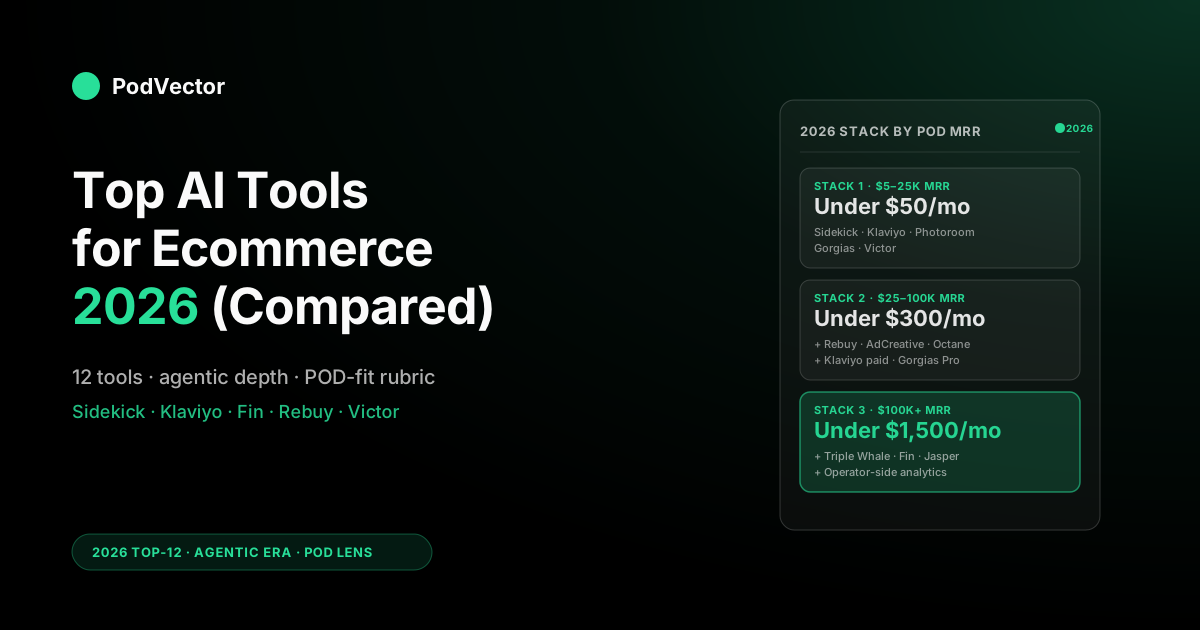
Quick Answer: The 12 top AI tools for ecommerce in 2026, ranked across use cases: 1. Shopify Sidekick + Magic (free with Shopify, agentic admin), 2.
Klaviyo AI (predictive + send-time, free to 250 contacts), 3. Fin by Intercom (support resolution, $0.99/resolution), 4.
Gorgias AI (Shopify-native support, from $10/mo), 5. Rebuy (cart and post-purchase, from $99/mo), 6.
AdCreative.ai (ad generation, from $29/mo), 7. Octane AI (quizzes and conversion, from $50/mo), 8.
Bloomreach Loomi (enterprise CDP + search), 9. Triple Whale (DTC analytics, from $129/mo), 10.
Jasper (content at scale, from $39/mo), 11. Photoroom (AI product photos, free to $13/mo), 12.
Victor by PodVector AI (POD-native AI employee, free during beta).
The 2026 cut isn't last year's roundup recycled. Two shifts re-ordered everything: agentic AI moved from demo to production (Shopify Sidekick, Fin, and Klaviyo Agent now take actions, not just suggest), and the AI search era forced the on-site discovery layer to get smarter or get bypassed. This guide ranks 12 tools on a 2026-specific rubric and gives stack picks for stores from $5K to $250K+ MRR — including the operator-side layer most ecommerce roundups skip entirely.
What Changed in 2026 for AI in Ecommerce
Two structural shifts in 2026 actually redrew the top-tools list, not the usual incremental vendor reshuffling. First, agentic AI moved from demo into production.
Shopify Sidekick can now create discounts, edit products, draft campaigns, and answer admin questions — actions, not just suggestions. Fin by Intercom resolves support tickets end to end, including issuing refunds and updating accounts when wired into backend systems.
Klaviyo's flow agent autonomously builds and edits flows. The line between "AI tool" and "AI coworker" got noticeably thinner this year.
Second, AI search and answer engines started cannibalizing top-of-funnel traffic for ecommerce. Google's AI Overviews, ChatGPT shopping, Perplexity, and Claude all now answer product-discovery queries directly — which means on-site search and discovery has to do more work for the visits that do convert through. Tools like Bloomreach, Constructor, and Shopify Search & Discovery quietly shipped semantic-search upgrades to compete; tools that didn't are losing relevance fast.
What did not change: enterprise platforms (Bloomreach, Adobe, Salesforce) still need a $200K+ MRR base to pay back their license cost. Their AI got better but the math at small scale is unchanged. They're excellent tools for the wrong customer profile if you're under $1M annual revenue.
For a print-on-demand seller fulfilling through Printify, Printful, or Gelato, the implication is concrete: the 2026 top-12 weights agentic capability higher (because labor scarcity makes "AI that takes actions" more valuable than "AI that suggests"), and weights the operator-side layer higher (because variable supplier cost makes generic ecommerce analytics misread profit). The full POD lens is later in this guide.
How These 12 Tools Were Scored
Each tool earned points on five 2026-specific axes:
- What shipped this year (0–10) — did the platform ship a meaningful agentic or AI capability in 2026, or is it coasting on 2024 marketing?
- Floor price (0–10) — does the tool have a usable free or sub-$30 entry, or does the AI live behind a $99+ paywall?
- Time-to-payback (0–10) — for a store doing $10–50K/month, how fast does the tool earn its monthly cost back? Sub-30 days scores 10; 90+ days scores 4 or below.
- Setup without a developer (0–10) — is it a one-click Shopify install, or does it need API plumbing and a CDP migration?
- POD compatibility (0–10) — does the data model handle variable per-unit Printify/Printful costs, $20–35 AOV apparel, and zero on-hand inventory?
The composite score is the average. A score of 8.5+ earns a place in almost any POD stack. Below 7.0, the tool is better postponed until revenue justifies the floor — typically past $50–100K/month.
Comparison Table: 12 Top AI Tools for Ecommerce 2026
"Free or low tier" reflects what you can use without a credit card or with a sub-$30 entry. "POD fit" reflects how well the tool serves a Shopify + Printify/Printful store at $10–60K MRR.
| Rank | Tool | Primary job | Floor price | Free or low tier? | 2026 score | POD fit (/10) |
|---|---|---|---|---|---|---|
| 1 | Shopify Sidekick + Magic | Agentic admin + content | Free with Shopify | Yes (full) | 9.4 | 9 |
| 2 | Klaviyo AI | Lifecycle (email/SMS) | $0 → $20/mo | Yes (250 contacts) | 9.3 | 9 |
| 3 | Fin by Intercom | Support resolution agent | $0.99/resolution | Pay-per-use | 8.8 | 7 |
| 4 | Gorgias AI | Shopify-native support | $10/mo | Yes (50 tickets) | 8.6 | 8 |
| 5 | Rebuy | Cart and post-purchase | $99/mo | No (14-day trial) | 8.4 | 8 |
| 6 | AdCreative.ai | Ad creative generation | $29/mo | Yes (7-day trial) | 8.2 | 7 |
| 7 | Octane AI | Quizzes and conversion | $50/mo | Yes (14-day trial) | 8.0 | 8 |
| 8 | Bloomreach Loomi | CDP + search + email AI | Custom ($3K+/mo) | No | 7.6 | 3 |
| 9 | Triple Whale | DTC analytics + AI Moby | $129/mo | Yes (15-day trial) | 7.4 | 5 |
| 10 | Jasper | Content at scale | $39/mo | Yes (7-day trial) | 7.3 | 7 |
| 11 | Photoroom | AI product photography | Free → $13/mo | Yes (full) | 8.1 | 9 |
| 12 | Victor by PodVector AI | POD-native AI employee | Free (beta) | Yes (full) | 8.7 | 10 |
The first four tools have either a free tier, a sub-$30 floor, or a pay-per-use model. They cover agentic admin, lifecycle, and support — roughly 60% of what a POD store needs from "AI for ecommerce" in 2026 — for under $100/month combined.
Tools 5–11 fill in cart, ads, content, photos, and analytics. Tool 12 (Victor) is the operator-side layer that none of the other tools touch.
The full ranking and rationale follow. For the broader category map, the tools cluster index aggregates every comparison published on the topic.
The 12 Tools, Ranked by Category
Agentic Admin and Content (Rank 1)
1. Shopify Sidekick + Magic — Best agentic admin AI for any Shopify store. Sidekick is the headline 2026 release: an in-admin AI that takes actions — creates discount codes, segments customers, drafts campaigns, edits product copy, answers store-data questions.
Combined with Shopify Magic (image fills, product copy, email subject lines, theme assistance, Search & Discovery semantic search), the Shopify-native AI surface is now the broadest free AI offering in ecommerce. Floor: $0 (included in any Shopify plan).
The 2026 score (9.4) reflects what shipped, not what was promised. POD fit is high because Sidekick reads Shopify order data natively, including line-item cost when you populate it from Printify/Printful.
Lifecycle and Email (Rank 2)
2. Klaviyo AI — Best lifecycle AI for stores under $5M. Klaviyo's 2026 ship list earned the high slot: Klaviyo Agent (autonomously builds and edits flows), predictive AI (LTV, churn, next-purchase) now in lower tiers, multi-product email blocks that rearrange per recipient, and SMS AI for subject and body generation.
Floor: free to 250 contacts, then $20/month. The platform is overwhelmingly the right pick for any DTC or POD store under $1M annual revenue. POD fit is excellent — predictive LTV is gross-revenue based, but with the right margin layer (covered in our complete AI-for-POD guide), Klaviyo is the strongest single-tool ROI in the 2026 stack.
Customer Support (Ranks 3–4)
3. Fin by Intercom — Best agentic support resolution AI. Fin is the cleanest example of the agentic shift in 2026.
It doesn't just suggest replies — it resolves tickets end to end, draws on help center content, historical conversations, and live system data, and (when wired into your backend) issues refunds and updates accounts autonomously. Pricing is $0.99 per resolution, which is essentially "pay only when it works." Floor scales with volume rather than seats. POD fit is good but not perfect — refund automation needs your supplier-cost view to flag genuinely costly refunds, which Fin doesn't see.
4. Gorgias AI — Best Shopify-native support AI. Gorgias is the incumbent Shopify-helpdesk and its 2026 AI Agent now resolves a meaningful share of tickets autonomously, with deep Shopify integration that Fin's general approach can't quite match.
Auto-tagging, auto-responses, and AI-suggested replies are now in the $10/month entry tier. POD fit is strong — Gorgias reads Shopify orders, fulfillments, and tracking links natively, which is most of what POD support tickets need. For stores already using Gorgias, the AI tier is an upgrade rather than a tool swap.
Cart, Upsell, Conversion (Ranks 5, 7)
5. Rebuy — Best cart and post-purchase AI. Rebuy's smart cart, post-purchase one-click upsells, and email/SMS rec blocks are the highest-EV personalization surface for POD stores doing $10K+/month in revenue.
The 2026 release added an AI agent for offer testing and a margin-aware upsell mode (still beta) — a meaningful nod to the "revenue-vs-margin" critique. Floor: $99/month. Time-to-payback is fast for stores doing 400+ orders/month; below that, postpone.
7. Octane AI — Best AI quiz tool for product discovery. Octane's quiz-and-recommendation flow is the strongest tool for stores where visitors don't know exactly what they want — POD stores with 200+ designs across 8 product types are the canonical fit.
The 2026 AI release added auto-generated quiz logic from product catalog data, which removes most of the setup work. Floor: $50/month. POD fit is high because quiz-led discovery does some of the work that on-site search does in non-POD stores.
Ads, Content, and Photos (Ranks 6, 10, 11)
6. AdCreative.ai — Best AI ad creative tool. AdCreative.ai now generates Meta and TikTok ad creative from a product image and a few prompts, scores against historical performance, and pushes directly to ad accounts.
The 2026 release added video generation (limited length, but workable for short-form) and TikTok Spark ad templates. Floor: $29/month. POD fit is good — ad creative is one place where POD's design-heavy nature pairs naturally with generative AI.
10. Jasper — Best AI content at scale. Jasper holds its slot as the most capable long-form content generator with brand-voice and SEO controls. 2026's release added agentic workflows (multi-step content plans that run autonomously) and direct CMS publishing for Shopify and WordPress.
Floor: $39/month. POD fit is fine for content marketing and product description batches, but the floor is too high if you only need product descriptions — Shopify Magic does that for free.
11. Photoroom — Best AI product photography tool. Photoroom's batch-edit, scene generation, and one-tap background-swap workflows are now the cleanest AI-photo pipeline for ecommerce, and the 2026 mobile app + API combo lets POD sellers process hundreds of mockup variants in minutes.
Floor: free for individual creators; $12.99/month for Photoroom Pro. POD fit is unusually high — design-heavy stores with frequent SKU additions get the most leverage out of batch photo AI. For deeper POD-specific design tooling, see our AI design tools for print-on-demand comparison.
Search, Discovery, CDP (Rank 8)
8. Bloomreach Loomi — Best enterprise AI CDP and discovery. Bloomreach combines AI-driven search, content personalization, and email orchestration; Loomi's 2026 ship list (autonomous campaign building, semantic search upgrades, AI-generated content blocks) is genuinely strong.
The catch: floor pricing starts at $3K+/month and scales with traffic. POD fit drops to a 3 — not because the AI is bad, but because variable-supplier-cost POD economics rarely justify the license. Excellent tool for the wrong customer profile under $1M annual revenue.
Analytics (Ranks 9, 12)
9. Triple Whale — Best DTC ad-attribution analytics with AI Moby. Triple Whale's Moby AI agent answers attribution and cohort questions in plain English, reads ad-platform data alongside Shopify, and now (2026) auto-generates daily summaries and anomaly alerts.
Floor: $129/month. POD fit is partial — Triple Whale's strength is ad attribution, which works for any DTC, but its margin model assumes warehoused inventory and doesn't natively handle Printify/Printful per-unit costs.
Pair it with the operator-side layer for accurate POD margin reporting. The full AI analytics topic hub covers the broader analytics-for-ecommerce category in detail.
12. Victor by PodVector AI — Best POD-native AI employee. Victor is the only AI agent in this list purpose-built for print-on-demand sellers.
Victor sees your orders, supplier costs and ad spend all together, so he can answer real questions like, "which Printify provider is most profitable for my hoodie line this month?" or "which design has the lowest margin despite the highest revenue?" Every answer comes with actions you can approve — like pausing an ad, shifting design priority, or flagging a supplier cost change.
Floor: free during beta. POD fit is 10 by definition — every other tool in this list optimizes the visitor side; Victor is the only one optimizing the operator side. Read the agentic-AI walkthrough for what that looks like in practice.
Three Stacks by Store Stage
The 12-tool list isn't a shopping list. Stores at different stages need different subsets. Here are three concrete stacks, each chosen for actual payback at the listed revenue floor.
Stack 1: $5–25K MRR — Under $50/month
- Shopify Sidekick + Magic (free with Shopify) — agentic admin + on-site search
- Klaviyo (free to 250 contacts) — lifecycle
- Photoroom (free → $12.99/mo) — product photos
- Gorgias AI ($10/mo, 50 tickets) — support if volume warrants
- Victor (free beta) — operator-side analytics
Total: $0–35/month. Covers 70% of what most stores need from AI in 2026. The free tiers and sub-$30 floors are the entire stack — no enterprise tools belong at this stage. The full small-store comparison covers the alternatives that didn't make this top-12.
Stack 2: $25–100K MRR — Under $300/month
- Everything in Stack 1, with Klaviyo paid (~$45/mo at typical list size)
- Rebuy ($99/mo) — cart and post-purchase
- AdCreative.ai ($29/mo) — ad creative
- Octane AI ($50/mo) — quizzes if catalog is design-heavy
- Gorgias Pro ($60/mo) — support at higher ticket volume
Total: $250–300/month. The cart layer and ad-creative tools start paying back at this revenue floor. Triple Whale at $129/mo is justifiable here only if you're spending $20K+/month on ads; below that, Shopify's native attribution is fine.
Stack 3: $100K+ MRR — Under $1,500/month
- Everything in Stack 2, with Klaviyo at higher tier (~$200/mo)
- Triple Whale ($129–500/mo) — attribution and Moby AI
- Jasper ($39/mo) — agentic content workflows
- Fin or Gorgias Premium (~$300/mo or per-resolution) — agentic support
- Photoroom Pro / API (~$30/mo) — batch product photos
Total: $800–1,500/month. This is roughly the threshold where Bloomreach Loomi starts to be worth a conversation, though for most POD stores Bloomreach still doesn't pay back until $250K+/month. The Victor operator-layer is non-negotiable at this scale — without it, you'll mistake revenue lift for margin lift consistently.
Where the Top-12 List Bends for Print-on-Demand
Most ecommerce AI roundups (including the three top SERP results: Fin's 2026 list, AI Prompts X's tested-and-ranked list, and GPTPrompts' 60-tool mega-roundup) assume warehoused inventory, three-figure AOV, and a single supplier. Print-on-demand inverts all three: zero on-hand inventory, $20–35 AOV on apparel, and per-unit costs that vary by Printify or Printful provider, blank, and print method. The 2026 top-12 bends in three concrete ways:
Margin per order is thin, so any AI tool with a $99+ floor needs a 3–5% conversion or AOV lift to pay for itself. That rules out enterprise tools whose AI was tuned for $80–200 AOV stores — at $25 AOV, even a 4% lift is a dollar per order, and Bloomreach's monthly floor would need 1,000+ orders just to break even on the license alone.
Variable supplier cost breaks generic ecommerce analytics. Triple Whale, Klaviyo predictive LTV, and most BI tools report gross-revenue contribution; POD profit is a function of per-line-item Printify or Printful base cost, which changes by provider and blank. A retention campaign that costs $4 per customer is profitable on margin terms but looks unprofitable in revenue-only attribution. The fix is reading margin separately — the visitor-side tools won't do it for you. The full POD analytics picture is in our analytics-for-POD guide.
Agentic AI matters more for POD operators than for warehoused-DTC operators. POD operators are typically small teams or solos juggling supplier mix, ad spend, design pipeline, and customer support simultaneously. The leverage from "AI that takes actions" — agentic admin, agentic support resolution, agentic ad creative — is higher for a 1-2 person POD shop than for a 30-person DTC team. The 2026 weighting of agentic capability in the rubric reflects that.
The practical implication: a POD store should build the stack from free + sub-$30 tier first (Shopify Sidekick, Klaviyo, Photoroom, Victor), add cart and ads ($99–150/mo combined) once AOV justifies it, and skip the enterprise tier entirely until store revenue passes the threshold where the floor pays back. The full POD-tilted comparison goes deeper on the rubric.
Five Mistakes Sellers Make Picking AI Tools in 2026
1. Buying for "AI capability" instead of "agentic depth." Most tools in 2024 marketed AI features (suggestion, classification, summarization).
In 2026, the real differentiator is whether the tool takes actions. A platform that suggests a refund but makes you click is not the same as one that issues the refund and updates the customer record. Score for action-taking, not for AI logo presence.
2. Treating "best in 2026" as "best for me." Forrester and Gartner leadership rates capability, not fit. A platform can be a category leader and still be the wrong tool for your revenue stage. Pick on rubric, not on logo. Bloomreach is a great tool for the wrong customer profile under $1M revenue.
3. Ignoring the AI-search-traffic shift. Google AI Overviews, ChatGPT shopping, Perplexity, and Claude now answer product-discovery queries directly.
That changes the math on top-of-funnel content tools (Jasper, Photoroom for product hero shots, AdCreative.ai). The visits that arrive on your store in 2026 are warmer and fewer than they were in 2024 — and the on-site experience needs to do more conversion work per visit, not less.
4. Confusing revenue lift with margin lift. Visitor-side AI tools all report revenue attribution.
For POD, the revenue number masks the margin truth — variable supplier cost means a 6% revenue lift can be a 2% margin lift if the lift came from heavier blanks or premium print methods. Track margin separately. Our POD-specific tool roundup goes deeper on this.
5. Skipping the operator-side layer. Every tool in the top-12 except Victor optimizes the visitor experience.
POD profit is a function of operator decisions — supplier mix, design ranking, ad spend allocation. Visitor-side AI without operator-side AI is half the system.
The other half is reading what's working across your stack against actual margin, not just revenue. The Victor operator-layer is the gap most 2026 ecommerce stacks have.
FAQs
What is the best AI tool for ecommerce in 2026?
For most stores under $1M annual revenue, Shopify Sidekick + Magic and Klaviyo AI are the strongest single picks — both are free or near-free, both shipped agentic capabilities in 2026, and both pay back almost immediately. For enterprise stores doing $5M+, Bloomreach Loomi or Salesforce's AI agents become viable on the search-and-discovery axis. For POD specifically, pair Shopify and Klaviyo with Victor for the operator-side layer.
Which AI tools should a small ecommerce store use first in 2026?
Start with the free or sub-$30 tier: Shopify Sidekick + Magic ($0), Klaviyo (free to 250 contacts), Photoroom (free), and Victor (free beta). That covers agentic admin, lifecycle, product photos, and POD operator analytics for under $30/month combined.
Add Gorgias AI ($10/mo) once support volume warrants. Skip Rebuy, Octane, and AdCreative.ai until revenue passes ~$15K/month. The full small-store comparison covers the alternatives.
How is "best in 2026" different from "best in 2024 or 2025"?
Two things changed: agentic AI moved from demo to production (Sidekick, Fin, Klaviyo Agent now take actions), and AI search engines started cannibalizing top-of-funnel ecommerce traffic. The 2026 rubric weights "what shipped this year" and "agentic depth" higher than the prior years' rubric. Tools that coasted on 2023–2024 AI marketing without shipping action-taking capabilities lost relative ranking.
What's the best AI tool for Shopify in 2026?
Shopify Sidekick + Magic, by a wide margin, because it's native, free, and now agentic. Outside the platform's native AI, Klaviyo (lifecycle), Gorgias (support), Rebuy (cart), and Octane (quizzes) are the strongest Shopify-native AI add-ons. The Shopify-specific best-of comparison goes deeper on the trade-offs.
Which AI tool works best with Printify or Printful?
Visitor-side: Shopify Sidekick, Klaviyo, and Rebuy all work cleanly with Shopify + Printify or Printful out of the box because they read Shopify order data directly. Store owner-side: Victor by PodVector AI is the only AI agent that pulls in your real Printify and Printful supplier costs, so he always knows your true cost per item — every other tool treats that cost as zero or a fixed warehouse-style number, which hides how much margin really swings for POD. The POD-specific AI tools roundup covers the Printify/Printful integration depth in detail.
Are agentic AI tools actually production-ready in 2026?
For some categories, yes. Shopify Sidekick (agentic admin), Fin (agentic support), Klaviyo Agent (agentic flow building), and Gorgias AI Agent (autonomous ticket resolution) are all in production at thousands of stores.
For other categories — fully agentic ad management, fully agentic merchandising — the tools are closer to advanced suggestion than full action-taking. The agentic depth varies; score the specific tool, not the category.
How does Victor by PodVector AI fit into a 2026 ecommerce AI stack?
Victor is the operator-side layer that the rest of the stack doesn't cover. Visitor-side tools (Shopify Sidekick, Klaviyo, Rebuy, Triple Whale) optimize what visitors see and do; Victor reads what your store is actually doing to margin.
Victor sees your orders, supplier costs and ad spend all together, so he can answer questions a generic ecommerce AI can't — which Printify provider is most profitable this month, which design ranks high on revenue but low on margin, which campaign actually made you money. He answers your questions and takes action — with your approval. The agentic-AI walkthrough covers what that looks like for POD sellers.
The Operator-Side Layer the Top-12 Doesn't Cover
Eleven of the twelve top AI tools for ecommerce in 2026 focus on your shoppers. None of them see your Printify or Printful supplier cost, your true margin per design, or which campaign dollars actually paid off. That's where Victor fits in — a POD-focused AI employee who sees your orders, supplier costs and ad spend together, then tells you which products, segments, and campaigns actually made you money in 2026. The rest of the stack works for your customers; Victor works for you.
Try Victor free