
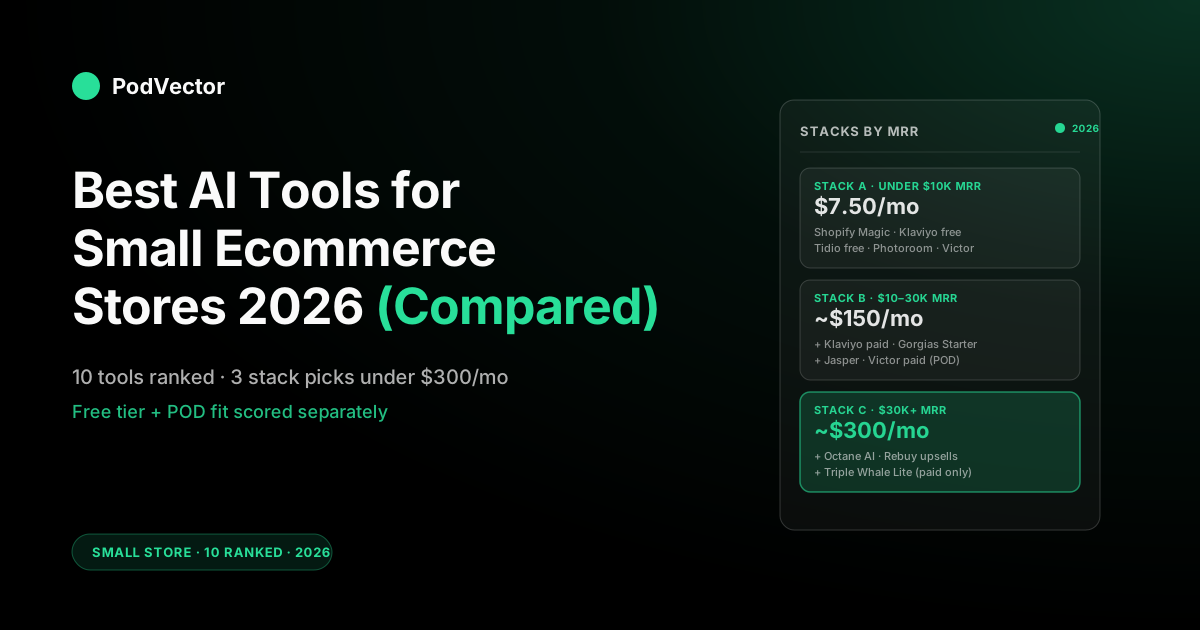
Quick Answer: The 10 best AI tools for small ecommerce stores in 2026, ranked for stores doing under ~$30K/month: 1. Shopify Magic (free with Shopify), 2. Klaviyo AI (free to 250 contacts), 3. Tidio AI (free chat tier; Lyro AI add-on from $39/mo), 4. Photoroom (from $7.50/mo), 5. Gorgias (from $10/mo + per-resolution AI), 6. Victor by PodVector AI (POD-native AI employee, free tier), 7. Jasper AI (from $39/mo for content at scale), 8. Octane AI (from $50/mo for quizzes), 9. Rebuy (from $99/mo for cart upsells), 10. Triple Whale Lite (DTC attribution). The cheapest viable stack — Shopify Magic, Klaviyo free, Tidio free, and Photoroom — runs about $7.50/month and covers 80% of what a small store needs.
"Small" matters because the economics flip below ~$30K/month: enterprise contracts that pay back at $200K MRR are net-negative at $8K MRR. This guide ranks each tool on a small-store scoring rubric (free tier, time-to-payback, no-developer setup, POD-fit) and then gives three concrete stacks — under $50/month, under $150/month, and under $300/month — that will pay for themselves inside 60 days.
What Changes at Small Store Scale
Most AI-tool roundups are written for the median Shopify store, which is closer to $80K/month than $8K/month. The gap matters because three things that don't move on enterprise spreadsheets will sink a small store: the floor price, the time-to-first-value, and the integration complexity.
A $400/month tool that lifts revenue 4% pays for itself at $200K MRR. At $8K MRR, that same lift is $320 — the tool loses money before it does anything. Small stores need tools where the cost scales with the outcome, not with the company that bought them.
So the rubric below downranks anything with a $99+ floor unless it earns the floor inside 60 days, anything that needs a developer to install, and anything where the AI features are gated to higher tiers. Tools with genuine free or sub-$30 entry points get bumped up. The full ranking changes again for print-on-demand stores; that section is at the end.
How These 10 Tools Were Scored
Each tool earned points on four small-store-specific axes:
- Free or low-floor tier (0–10) — does it have a meaningful free tier, or sub-$30/month entry, or does the AI part live behind a paywall that only opens at $99+?
- Time-to-payback (0–10) — for a store doing $5–25K/month, how fast does the tool earn its monthly cost back? Sub-30 days scores 10; 90+ days scores 4 or below.
- Setup without a developer (0–10) — is the install a one-click Shopify app, or does it need technical setup with special codes and connections only a developer can handle?
- POD compatibility (0–10) — for stores fulfilling through Printify, Printful, or Gelato, does the tool's data model handle variable per-unit costs and zero-inventory? Most "ecommerce AI" tools assume warehoused stock.
The composite score is the average of those four. A score of 8.5+ means the tool earns a place in a small-store stack at almost any revenue level. Below 7.0, the tool is better postponed until the store crosses $30K/month and the rubric flips.
Comparison Table: 10 Best AI Tools for Small Ecommerce Stores
The "Free tier" column is what you can actually use without paying — not a 14-day trial that needs a credit card. The "POD fit" column reflects how well the tool works for a store fulfilling through Printify or Printful at $5–30K/month.
| Rank | Tool | Job | Floor price | Free tier? | Small-store score | POD fit (/10) |
|---|---|---|---|---|---|---|
| 1 | Shopify Magic | Generation (built-in) | Free with Shopify | Yes (full) | 9.5 | 9 |
| 2 | Klaviyo AI | Activation (email/SMS) | $0 → $20/mo | Yes (250 contacts) | 9.3 | 9 |
| 3 | Tidio AI | Service (live chat) | $0 → $29/mo | Yes (50 chats) | 8.8 | 7 |
| 4 | Photoroom | Generation (imagery) | $7.50/mo | Yes (limited exports) | 8.7 | 9 |
| 5 | Gorgias Starter | Service (helpdesk) | $10/mo + AI add-on | No (paid only) | 8.4 | 8 |
| 6 | Victor by PodVector AI | Operator (POD-native) | Free tier; paid plans | Yes | 8.2 | 10 |
| 7 | Jasper AI | Generation (content) | $39/mo | No (7-day trial) | 7.1 | 6 |
| 8 | Octane AI | Activation (quizzes) | $50/mo | No (paid only) | 6.9 | 7 |
| 9 | Rebuy | Activation (upsells) | $99/mo | No (14-day trial) | 6.5 | 7 |
| 10 | Triple Whale Lite | Analysis (DTC) | $129/mo | No | 5.8 | 5 |
The first six tools all have either a true free tier or a sub-$30 floor. They're stackable for under $50/month combined and cover roughly 80% of what a small ecommerce store actually needs from AI in 2026. Tools 7–10 only earn slots once revenue justifies the floor — usually past $15–25K/month.
The 10 Tools, Ranked
1. Shopify Magic — The Free AI Suite You Already Own
Best for: any small Shopify store, no exceptions.
Pricing: free with any Shopify plan ($29/month and up).
Small-store score: 9.5 / 10 · POD fit: 9 / 10
Shopify Magic is the floor of a small-store AI stack and the ceiling of "free." It generates product descriptions, titles, alt text, email subject lines, FAQ answers, and Inbox replies — all using the same operator-grade language model under the hood that the paid tools rebrand. For small stores, that means the first 80% of AI content work is already done and bundled into the platform fee.
The catch is that Magic doesn't reach into anything outside Shopify's own surfaces. It won't write your blog posts, run your paid ad copy, or analyze why GPAM dropped last week — those need other tools or a separate analyst. But for the on-site copy that actually sells, it earns the rank-one slot at zero marginal cost.
POD note: Magic handles Printify and Printful product imports cleanly. The auto-generated descriptions are generic, so plan to spend 30 seconds editing for niche language, but the time saved on a 200-SKU catalog is real.
2. Klaviyo AI — The Email Channel That Pays Back Fastest
Best for: any store with a list above 100 subscribers.
Pricing: free to 250 contacts and 500 monthly emails; $20/month at 500 contacts; scales with list size.
Small-store score: 9.3 / 10 · POD fit: 9 / 10
Email is still the highest-ROI channel for ecommerce, and Klaviyo's AI features (subject line generation, send-time optimization, predictive analytics for customer lifetime value, and AI-suggested flows) are the closest thing to "money-printing button" the small-store category gets. The free tier covers a real store, not a demo store, and the $20/month entry point keeps the math sane until the list crosses 1,000 contacts.
The reason Klaviyo lands at #2 instead of #1: it requires a list to work. A store with 30 subscribers can install it, but the AI features need data to optimize against.
Stores under three months old should still install it — the data lock-in compounds — but the payback only kicks in once the list crosses 200 subscribers. Pair with Shopify Magic for product copy that funnels into Klaviyo flows.
The one alternative worth a look at this tier is Omnisend, which bundles email and SMS with AI segmentation at a flatter price as your list grows — if your store leans hard on SMS, Omnisend's combined send pricing often comes out cheaper than Klaviyo's. For most small stores, Klaviyo's free tier and deeper Shopify integration still win, but the gap narrows once you're sending real SMS volume.
POD note: Klaviyo handles Printify and Printful order data fine. The one wrinkle: lifetime-value predictions are less reliable for POD because repeat-purchase rates are lower than warehoused-DTC. Don't over-trust the LTV scores until you've fed it 12+ months of orders.
3. Tidio AI — The Free Chat Tier That Actually Works
Best for: small stores fielding under 100 chats per month.
Pricing: free tier with 50 conversations; paid AI starts at $29/month.
Small-store score: 8.8 / 10 · POD fit: 7 / 10
Tidio's Lyro AI handles the boring 70% of customer support questions — order status, shipping windows, return policies, sizing — without a human in the loop. The free tier (50 chats/month) is enough for a sub-$10K-MRR store; the $29 plan covers most stores up to $30K/month. For comparison, Gorgias starts at $10/month for the helpdesk but adds $0.90 per AI resolution on top, so high-volume stores tip toward Tidio's flat fee while low-volume stores tip the other way.
The setup is genuinely one-click for Shopify, and the AI training pulls from your help center plus product catalog automatically. Where Tidio loses points: the AI is conservative — it'll escalate to a human more often than Gorgias's resolution AI does, which means slightly more inbox work for the operator. For a small store, that's actually fine; the cost of an over-eager bot mishandling a refund is higher than the cost of one extra human reply.
POD note: Tidio doesn't pull supplier-side fulfillment data. If a customer asks "where's my order?" and the answer depends on whether Printify routed it through Florida or Czechia, Tidio will guess and probably get it wrong. For POD-specific shipping questions, see our deep-dive on AI chatbots for ecommerce from a POD lens.
4. Photoroom — The $7.50 Imagery Tool Punching Above Weight
Best for: any store running its own product photography or generating mockups.
Pricing: free tier with watermark; $7.50/month for full export.
Small-store score: 8.7 / 10 · POD fit: 9 / 10
Photoroom is the cheapest tool on this list per dollar of perceivable lift. Background removal, AI-generated lifestyle backgrounds, batch product photo cleanup, and one-click ad-format resizing — all under $10/month. For a Printify or Printful store running 50+ SKUs, the time savings alone pay for the tool inside the first hour of use.
The reason it lands at #4 instead of #1 in the imagery category: results need a human eye on them. AI-generated lifestyle backgrounds occasionally produce uncanny-valley shadows, weird hand placements, or impossible product orientations. Plan to keep the human-in-the-loop step short but real. Compared to Canva's AI features (also good, also $14.99/month), Photoroom wins on raw output quality for product imagery specifically; Canva wins on broader marketing-asset versatility.
POD note: Photoroom handles transparent-background mockups from Printify's mockup generator cleanly. The AI lifestyle backgrounds work especially well for apparel — it'll place a tee on a model in a coffee shop more convincingly than for, say, a coffee mug.
5. Gorgias Starter Plan — Helpdesk With Per-Resolution AI Pricing
Best for: small stores already feeling support-ticket overwhelm.
Pricing: $10/month base plus roughly $0.90 per AI-resolved ticket.
Small-store score: 8.4 / 10 · POD fit: 8 / 10
Gorgias rebuilt its pricing in 2024 to compete on the small-store end with a $10 floor, and it's been quietly the best deal in helpdesk software ever since. The AI-resolution add-on charges per ticket the bot actually closes, which means the cost scales with the value — a structurally better deal than flat-rate competitors at small volumes.
The tradeoff vs. Tidio: Gorgias is a full helpdesk (ticketing, macros, multichannel — email, chat, Instagram, Facebook), which is more than most small stores need. If you're getting 30 tickets/month, Tidio AI is enough.
If you're getting 200+ and they're spread across email and chat, Gorgias's unified inbox saves more operator hours than the AI does. Either way, both tools clear the small-store bar.
POD note: Gorgias has a Printful integration but not a clean Printify one — it can pull order status but not real-time supplier-routing data. For deeper POD-specific helpdesk options, our best AI chatbot for ecommerce comparison covers what works.
6. Victor by PodVector AI — POD-Native AI Employee
Best for: Printify or Printful stores doing $5K+/month who want an AI employee that knows their real margins.
Pricing: free tier; paid plans scale with store volume.
Small-store score: 8.2 / 10 · POD fit: 10 / 10
Victor is the only AI tool on this list built specifically for the POD economics that the rest of the category papers over. It connects to your Printify or Printful supplier costs, your Shopify orders, and your ad spend at once — so you can ask in plain English "which SKU should I push and which should I pause this week?" and Victor reasons over itemized payment-processing fees, supplier costs, and ad-attributed revenue to tell you what to do, not just hand you a dashboard to interpret yourself.
The three-agent architecture is what separates Victor from a generic chat-with-your-data tool — each agent has scoped access to the right data sources, so the question lands at the right layer and Victor comes back with the operator move, not a chart. The roadmap heads toward Victor executing those moves directly (auto-pause underperforming SKUs, auto-adjust ad budgets) once the safety guardrails are battle-tested.
Why it lands at #6 instead of higher: it's narrower than the top five. If you're not on Printify or Printful, the supplier-data angle doesn't apply, and you'd be better served by Triple Whale or a generic analytics stack. For POD operators specifically, Victor's POD-fit is the highest on this list. Connect a store free to see your real per-SKU margins in a few minutes.
7. Jasper AI — Long-Form Content at Scale
Best for: stores running content marketing, blogs, or landing-page testing programs.
Pricing: $39/month for the Creator plan.
Small-store score: 7.1 / 10 · POD fit: 6 / 10
Jasper has lost ground to ChatGPT Plus ($20/month) for the basic "write me a blog post" use case, but its Brand Voice and templates still earn the price for stores actively running an SEO or content program. If you're not publishing regularly, Jasper is overkill — Shopify Magic and ChatGPT cover the small-volume use cases at a third of the cost.
The reason it's on the list at all: small stores running content marketing as a growth lever (rather than just a maintenance task) get genuine compounding returns from Jasper's templates and brand-voice training, especially when paired with a structured editorial calendar. For stores not actively investing in content, this rank should be a 5/10 and the tool should be skipped.
8. Octane AI — Quizzes for Product Discovery
Best for: stores with 50+ SKUs where customers don't know which product to buy.
Pricing: $50/month for the starter plan.
Small-store score: 6.9 / 10 · POD fit: 7 / 10
Quizzes are unreasonably effective for catalog discovery — a well-designed Octane quiz routinely converts at 4–8% versus a 1.5–2.5% baseline on a category page. The catch for small stores is that quizzes need traffic to pay back, and the $50/month floor means the math only works once you're seeing 3,000+ monthly visitors landing on quiz-eligible pages.
For POD stores with niche-tied catalogs (e.g., "find your perfect zodiac mug"), quizzes are especially well-suited because the variant axes (sign, color, size) map cleanly to quiz logic. For broad apparel catalogs without obvious decision axes, the quiz format is forced and the conversion lift won't show up.
9. Rebuy — Cart Personalization and Post-Purchase Upsells
Best for: stores past $15K/month with proven repeat-purchase patterns.
Pricing: $99/month.
Small-store score: 6.5 / 10 · POD fit: 7 / 10
Rebuy's AI cart upsells and post-purchase offers add 5–15% AOV when implemented well, but the $99/month floor means the math doesn't work below ~$15K/month. The tool is excellent; the price is wrong for stores that aren't already at scale. Postpone Rebuy until you've crossed the threshold and have the order volume for the upsell flows to actually compound.
10. Triple Whale Lite — DTC Analytics Beyond Shopify Reports
Best for: small DTC stores running paid ads on multiple channels.
Pricing: $129/month for the Lite plan.
Small-store score: 5.8 / 10 · POD fit: 5 / 10
Triple Whale's attribution dashboard answers questions Shopify's native reports don't: which Meta campaign drove the second purchase, which creative actually pushed CAC down, what's the true blended ROAS across Meta and Google. For stores spending $5K+/month on paid, the answer is worth $129. For stores spending $500/month or running mostly organic traffic, the dashboard is over-instrumented for the decisions you're making.
POD-specific note: Triple Whale's data model assumes consistent per-unit COGS, which doesn't reflect how Printify and Printful pricing actually works (variable supplier costs, blueprint-dependent margins). It's accurate enough for paid attribution but unreliable for POD-specific profitability questions — which is the gap Victor fills. For more on this, see our best AI tools for ecommerce data analysis deep-dive.
Three Stacks: Under $50, $150, and $300 per Month
Picking individual tools matters less than picking a stack that compounds. Three concrete recommendations, each ordered by where they earn their slot:
Stack A — The Under-$50 Stack ($0–10K/month in revenue)
- Shopify Magic — free, included.
- Klaviyo AI — free under 250 contacts.
- Tidio AI — free under 50 chats.
- Photoroom — $7.50/month.
- Victor by PodVector AI (free tier) if you're on Printify or Printful.
Total: $7.50/month. Covers content generation, email/SMS activation, customer support, product imagery, and (for POD stores) operator-level analytics. Most stores under $10K/month don't need anything beyond this stack — adding more tools at this stage usually means worse focus, not better outcomes.
Stack B — The Under-$150 Stack ($10–30K/month in revenue)
- Everything in Stack A, plus:
- Klaviyo at the $20–45/month tier (depending on list size).
- Gorgias Starter — $10/month + ~$30/month in AI resolutions = ~$40/month effective.
- Jasper — $39/month, only if you're actively publishing content.
- Victor by PodVector AI paid tier if you're a POD store at this revenue level.
Total: ~$120–150/month. The transition stack — your store has enough revenue, list size, and ticket volume that the free tiers of Stack A start hitting their ceilings. Add tools deliberately, one at a time, and measure 30-day revenue lift before adding the next.
Stack C — The Under-$300 Stack ($30K+/month in revenue)
- Everything in Stack B, plus:
- Octane AI — $50/month if you have 50+ SKUs.
- Rebuy — $99/month for cart and post-purchase upsells.
- Triple Whale Lite — $129/month if you're spending $5K+/month on paid ads.
Total: ~$300/month. At this revenue level, the rubric is no longer "small store." You're approaching mid-market and the small-store-specific scoring above starts to matter less than enterprise-level scoring. For the broader comparison at this scale, see our best AI tools for ecommerce (compared) guide.
Where the Best-of List Changes for Print-on-Demand Stores
Three specific things flip when the store fulfills through Printify, Printful, or Gelato instead of holding inventory:
- Per-unit costs vary by SKU. A POD blueprint's supplier cost depends on the print provider, the variant, and sometimes the season. Tools assuming flat COGS (Triple Whale, most generic analytics) get the margin math wrong.
- Itemized fees aren't visible. Shopify's payment-processing fee, Printify's processing markup, currency-conversion costs, and chargeback reserves all eat into per-order GPAM in ways that aren't visible in the standard Shopify reports. Tools that don't model these (most of them) systematically overstate profitability.
- No inventory means no inventory questions. Half the AI ecommerce category solves "what should I reorder, and when?" That entire question category is irrelevant for POD. Don't pay for tools whose biggest lever doesn't apply.
The practical implication: for POD stores, the small-store stack should lean heavier on Victor (POD-native analytics), Photoroom (imagery for variant-rich catalogs), and Klaviyo (email/SMS, where the math still works the same), and lean lighter on tools like Triple Whale that assume warehoused-inventory economics. For more on the POD lens, our complete guide to AI tools for POD sellers goes deeper, and the AI analytics topic hub indexes every related deep-dive.
Five Mistakes Small Stores Make Picking AI Tools
- Buying the demo. Most demos are run on a $1M-revenue test store. The 30% lift the rep showed you was on a base of $300K/month, not $8K/month. Ask for case studies at your revenue tier or skip.
- Stacking too many tools too fast. Three tools you actually use beat seven you partially use. Add tools one at a time and measure for 30 days before adding the next — see the tools cluster for category-by-category breakdowns.
- Skipping the free tier. Shopify Magic, Klaviyo's free tier, Tidio's free tier, and Photoroom's near-free tier collectively cover 80% of small-store needs at under $10/month. Most stores under $20K/month should max these out before considering anything paid beyond Shopify itself.
- Picking enterprise tools at small-store scale. The $400/month tool that lifts revenue 4% costs more than the lift at $10K/month MRR. Don't fall for the floor pricing on tools built for $200K MRR stores — the math doesn't bend in your favor just because the dashboard looks impressive.
- Treating "AI" as the goal instead of the lever. The goal is revenue, retention, or operator hours saved. AI is one of several ways to get there. If the same outcome is cheaper or faster without AI (a well-written email template, a Notion macro, a $30 Shopify app), pick that.
FAQs
What's the cheapest AI tool stack a small ecommerce store can run?
Under $10/month. Shopify Magic (free with Shopify), Klaviyo's free tier (up to 250 contacts), Tidio AI's free tier (50 chats/month), and Photoroom at $7.50/month covers content generation, email/SMS, chat support, and product imagery.
For Printify or Printful stores, add Victor by PodVector AI's free tier for POD-specific analytics. That stack is enough for stores doing under $10K/month — adding paid tools above this stage usually delivers worse outcomes through worse focus.
Are AI tools worth it for stores doing under $5K/month?
Free ones, yes. Paid ones, mostly no.
Below $5K/month, the highest-leverage activity is product-market fit and traffic — not AI tooling. The free tiers of Shopify Magic, Klaviyo, and Tidio remove time-suck without adding cost. Beyond that, deferring paid AI tools until you've crossed $10K/month MRR will produce better store-level results than installing seven tools at month one.
Which AI tool has the fastest payback for a small Shopify store?
Klaviyo, almost always. The combination of a free tier under 250 contacts, AI-driven send-time optimization, and predictive analytics on lifetime value means the tool starts contributing measurably within the first send.
For stores already running email campaigns manually, switching to Klaviyo typically lifts email-attributed revenue 30–60% within 90 days. Shopify Magic is faster to implement (zero install) but the lift is harder to attribute discretely.
What's different about AI tools for print-on-demand vs. regular ecommerce?
POD economics break the assumption most ecommerce AI tools make about flat per-unit costs. Printify and Printful supplier costs vary by SKU, by print provider, and sometimes by region — so margin tools assuming consistent COGS systematically overstate profitability. Tools that model itemized payment-processing fees, supplier markups, and per-order GPAM (like Victor by PodVector AI) are more accurate for POD stores than generic DTC analytics like Triple Whale.
Should small stores use ChatGPT Plus instead of paid AI tools?
For some categories, yes. ChatGPT Plus at $20/month replaces a lot of what Jasper does for content, and replaces some of what AI ad-copy tools do.
It doesn't replace Klaviyo (which integrates with your store data), Shopify Magic (which lives inside the admin), or Photoroom (which handles imagery natively). The right framing: ChatGPT Plus is a generalist tool; the others on this list are specialists. Most small stores benefit from one generalist plus 2–3 specialists, not the generalist alone.
How many AI tools should a small ecommerce store run?
Three to five. Below three, you're leaving free leverage on the table; above five, you start losing operator focus.
The under-$50 stack above hits exactly that range — Shopify Magic, Klaviyo, Tidio, Photoroom, plus one POD-specific analytics tool if you're on Printify or Printful. Add tool #6 only when one of the existing tools genuinely caps out (e.g., chat volume exceeds Tidio's free tier and Gorgias becomes worth the upgrade).
What AI tool should I add first?
Klaviyo's free tier, before anything else. Email is still the highest-ROI ecommerce channel and the data lock-in compounds — every order Klaviyo sees makes its predictions better.
Install on day one even if your list has 30 subscribers. Shopify Magic is already on; Tidio adds in five minutes when chat volume warrants it; Photoroom comes in once you have product photos to clean up. But Klaviyo is the one that earns the most over time and rewards installing early most heavily.
Do I need a developer to install these tools?
No, with one caveat. Shopify Magic, Klaviyo, Tidio, Photoroom, Gorgias, Octane AI, and Rebuy are all one-click installs from the Shopify App Store.
Victor by PodVector AI connects via OAuth to your store data — also no developer. Jasper and Triple Whale require a few minutes of API-credential setup but no actual development work. The only caveat: if you want custom integrations between tools (e.g., Klaviyo segments triggering Octane quizzes), some no-code work in Shopify Flow is involved, but this is rarely needed at small-store scale.
The POD-native AI tool the small-store list was missing
Most of the tools above were built for warehoused DTC. Victor by PodVector AI was built for the print-on-demand economics that flip every margin assumption — variable supplier costs, itemized payment fees, and the GPAM that actually pays your bills. Free tier connects in minutes.
Try Victor free