
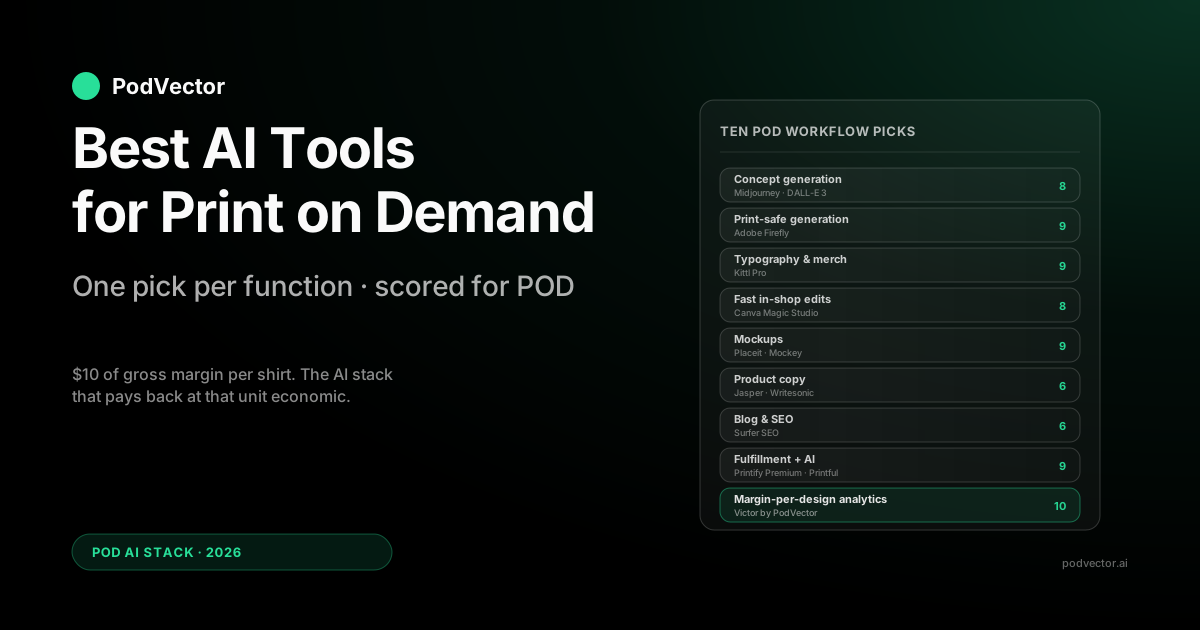
Quick Answer: The best AI tools for print on demand in 2026 are Midjourney and Adobe Firefly for design generation, Nano Banana 2 (free, inside Google Gemini) for text-heavy designs, Kittl for typography-led merch art, Canva Magic Studio for fast in-store edits, Placeit and Mockey for mockups, Jasper and Surfer SEO for copy, Printify and Printful for AI-augmented fulfillment, and Victor by PodVector AI — the AI employee that tracks margin per design and acts on it with your approval.
The 2026 roundups for this query are dominated by design and image generators. That's the part of the workflow with the splashiest demos — but not the part where most POD operators lose money.
The layer that decides payback on a Printify-supplied $24 shirt is knowing which of your 200 designs actually clears supplier cost, ad spend, and platform fees — and having something act on that answer.
Why a "Best AI Tools" List Needs a POD Filter in 2026
Search "best AI tools for print on demand 2026" and the first three results are almost identical: 8–15 tools across four buckets — design, mockups, copywriting, fulfillment — each one rated on output quality and ease of use. Podbase's 2026 best-AI-tools-for-print-on-demand roundup covers thirteen tools in roughly that pattern. dodropshipping's eight-tool listicle is the same shape. mydesigns' "complete toolkit" goes deeper on design-tool comparison but stays within the same four buckets.
What's changed since early 2026 sits at the edges of those buckets: Google's free Nano Banana 2 generator made $0 design generation genuinely print-viable, and AI on-model photography turned the mockup bucket into brand photography. What hasn't changed: none of the roundups filter recommendations against print-on-demand unit economics.
That's the gap this guide fills.
The math: a Printify-supplied tee retails at $24, costs $11 from the supplier, eats roughly $3 in Shopify fees, shipping refunds, and reserve, and clears about $10 of gross margin before any marketing dollar touches the unit. A $39/month design tool needs about four extra units a month to pay for itself.
A $99/month copywriting tool needs ten. A $300/month "all-in-one POD AI suite" needs thirty extra incremental units to clear its own bill — incremental, meaning units you would not have sold without the tool, which is a much higher bar than units you sold while it was installed.
The roundups that rank Midjourney first don't do this math. They benchmark output quality against a 60–80% gross margin DTC profile, which is what most software reviewers come from. For a POD operator working a 30–40% margin profile, "the AI tool with the best output" and "the AI tool with the highest payback" are not the same answer.
For the broader category map, the complete guide to AI tools for POD sellers is the pillar piece. The closely-related AI tools for print on demand comparison and the design-specific AI design tools for POD comparison drill into adjacent slices of the same question. The tools cluster hub indexes every comparison in this series, and the AI analytics topic hub is where the margin-aware analytics question lives across clusters.
The Scorecard: One Pick Per Workflow Function
Scoring is on POD-operator criteria, not generic feature lists: payback against a $10/unit gross margin, time-to-first-output for a working-hour POD operator (no design degree assumed), commercial-license clarity (because POD on Etsy and Amazon Merch demands it), and integration with the fulfillment stack you already pay for. Output quality is held to a "good enough to print and sell" floor, not a "wins the design contest" ceiling.
| Workflow function | Top pick for POD | Starting all-in cost | POD payback | Commercial license |
|---|---|---|---|---|
| Concept & image generation | Midjourney | $10/mo | 8 | Pro plan and above |
| Print-safe generation | Adobe Firefly | $5/mo (add-on) | 9 | Yes, indemnified |
| Typography & merch art | Kittl Pro | $15/mo | 9 | Yes |
| Free text-led generation | Nano Banana 2 (Gemini) | Free | 9 | Standard Google terms |
| Fast in-store edits | Canva Magic Studio | $15/mo | 8 | Pro plan |
| Mockups | Placeit | $14.95/mo | 9 | Yes |
| Bulk free mockups | Mockey | Free → $14/mo | 7 | Free tier limited |
| Product copy | Jasper | $39/mo | 6 | N/A (text) |
| Blog & SEO content | Surfer SEO | $89/mo | 6 | N/A |
| Fulfillment + AI | Printify Premium | $29/mo | 9 | Yes |
| Margin-per-design analytics | Victor by PodVector AI | Free trial | 10 | N/A |
The "POD payback" column is where this guide diverges from every other 2026 roundup. It is not a feature score.
It is the inverse-payback multiple — how many incremental shirts you'd need to sell to clear the tool's monthly bill, normalized to a 0–10 scale and weighted by how directly the tool drives those sales versus serving as overhead. Tools that produce sellable artwork score higher than tools that produce content one funnel layer removed; tools that read your supplier cost score highest of all because they tell you which of your existing designs is already paying for the rest of the stack.
Design and Image Generation: Midjourney, Firefly, Kittl, Canva
Every roundup leads here, and rightly — the design output is the input to every other step. The core picks cover the four POD design jobs that actually exist: concept generation, print-safe production art, typography-led merch, and fast in-shop edits. Two 2026 additions — Nano Banana 2 and ChatGPT image generation — round out the free and iteration ends of the range.
Midjourney — the concept generator
Midjourney's V7 model is still the most distinctive visual aesthetic in the consumer AI design pool, and that distinctiveness is exactly what a saturated POD niche needs. The Basic plan at $10/month gives roughly 200 generations, which is enough to develop two to three new design concepts a week. The Pro plan at $60/month is where commercial use clears unambiguously — Basic-plan output has a "license but no privacy" caveat that creates problems if a customer's design ends up in another seller's gallery feed.
For POD, Midjourney is best used as a concept tool, not a print-final tool. The output is 1024px or 2048px, JPG with compression artifacts, and not vectorized — which means it gets re-traced, upscaled, or reworked in Kittl or Photoshop before it's ready for a 4500×5400px transfer file.
Operators who skip the rework step end up with banding on the first wash, and that's a quiet refund driver that doesn't show up in any AI tool's analytics. Worth knowing before you load up on Midjourney concepts.
Adobe Firefly — the indemnified pick
Firefly's 2026 differentiator is the thing nobody else can credibly offer: commercial indemnification. Adobe trains exclusively on Adobe Stock plus public-domain content, and they back the output with a legal indemnity for paid plans.
For POD operators selling on Amazon Merch — which has a no-AI-art-generated-from-copyrighted-data policy that gets enforced by takedowns, not warnings — Firefly is the safe pick. It's also the cheapest serious option at $5/month for the standalone plan, or bundled into Creative Cloud at no extra cost if you already pay for Photoshop.
Output quality is a notch behind Midjourney for stylized work but ahead for product-ready vector and clean fills, which is what most apparel art actually needs. The integration with Photoshop's Generative Fill is the daily-driver feature for fixing transparent-background bleed on existing designs.
Kittl — the typography-led merch tool
Kittl was built for merch and POD specifically, which shows in the workflow. The AI features — image generator, background remover, vector tracer, AI assistant — sit on top of a design canvas pre-loaded with thousands of merch-style typography templates, badges, and ornaments. For text-led tee designs (the highest-margin POD category by far, because the artwork costs nothing and the conversion rate on a punchy slogan tee can run 3x a generic graphic), Kittl Pro at $15/month is the most efficient single tool in the category.
The vectorizer is the underrated feature: drop a Midjourney render into Kittl, click Vectorize, and you get a clean SVG you can scale to 6000px without artifacts. That single workflow — Midjourney concept → Kittl vector trace → Printify upload — is what most successful 2026 POD operators are running.
Canva Magic Studio — the fast in-shop edit
Canva's Magic Studio at $15/month (Canva Pro) is not the best-output design tool in any category, but it's the fastest tool to get a finished product mockup with copy ready for a Shopify product page. The AI features include text-to-image generation (powered by Firefly under the hood, so commercial-safe), Magic Edit for swapping elements, Magic Eraser for cleanup, and Brand Kit for keeping a 200-design store visually coherent.
For POD operators running a hybrid workflow — concept in Midjourney, refine in Kittl, finalize banner-and-listing assets in Canva — Magic Studio is the third tool. For operators starting from scratch with no design background, Canva is the only tool. The choice is downstream of what your workflow already looks like.
Nano Banana 2 — the free text-rendering pick (new for 2026)
Nano Banana 2 launched inside Google Gemini in February 2026 and immediately became the best free image generator for POD. The reason is text rendering: earlier free generators garbled letters, which disqualified them for slogan tees. Nano Banana 2 renders clean typography straight from the prompt, and any Google account gets it at no cost.
For text-led designs — the highest-margin POD category — that makes it a real budget alternative to a paid generator. Two caveats: output still needs an upscale or vector-trace pass before it's transfer-file ready, and Google's standard terms carry no commercial indemnity the way Firefly's do. Nano Banana concept → Kittl vector trace → Printify upload is the new $15/month workflow.
ChatGPT image generation — the iteration pick
ChatGPT's built-in image generation (the DALL-E successor, included in the $20/month Plus plan) earns a slot for one reason: conversational iteration. You refine a design by talking — "make the mascot angrier, move the text under the graphic" — instead of re-rolling prompts from scratch.
Resolution is the weak point. Like Nano Banana, the output needs an upscaler (Magnific AI is the category leader) or Kittl's vectorizer before it can hold a 4500×5400px transfer file. Use it to converge on a concept fast, not to produce the final print file.
Mockups: Placeit, Mockey, Mockuuups Studio
Mockups are where 60–70% of POD listing photos come from in 2026 — generating apparel mockups in studio is no longer the price-of-entry it was in 2018. The AI features in this category are mostly automatic background swap, face swap on model images, and bulk variant generation across multiple products from one design upload.
Placeit — the breadth pick
Placeit has the largest catalog (50,000+ mockups) and the cleanest commercial license. At $14.95/month for unlimited downloads, the per-mockup cost is functionally zero past the first day of use. The AI features include automatic design upload across 100+ mockups in one click, model-image variation, and 2026's text-to-mockup workflow that generates a brand-relevant background from a prompt.
For POD specifically, Placeit's apparel and tote-bag library is the largest in the category, and the licensing is unambiguous — you can use the mockups in paid ads and on third-party marketplaces (Etsy, Amazon Merch) without per-image fees.
Mockey — the free starting point
Mockey's free tier covers 25+ product categories with watermark-free downloads (rare in the free-mockup category), and the paid plan at $14/month removes the resolution cap and adds bulk processing. For POD operators under 50 SKUs, the free tier is sustainable indefinitely. Output is a notch behind Placeit on photographic realism but identical on flat-lay and mug-style mockups, which is most of the volume anyway.
Mockuuups Studio — the pure-AI pick
Mockuuups Studio's differentiator is the AI background generator: drop a flat product photo, prompt the scene ("rustic kitchen counter, morning light"), and get a mockup that doesn't look like a stock template. At $19/month for the AI tier, it's positioned slightly above Placeit and Mockey, and the depth of the AI scene generation is the reason. For a POD store leaning hard on lifestyle imagery — coffee mugs, home decor, candle accessories — Mockuuups is the picky-photographer's pick.
AI on-model photography — the new 2026 subcategory
The mockup bucket grew a new layer in 2026: tools like WearView that put your finished shirt or hoodie on realistic AI-generated models. You pick the model's ethnicity, body type, and age range, describe the setting, and get on-model photos in seconds instead of booking a shoot.
For apparel stores selling to a specific audience, listings that show the actual customer profile wearing the product convert better than flat-lays. Treat it as a layer on top of Placeit or Mockey for your hero listings, not a replacement for the bulk library.
Product Copy and Blog: Jasper, Surfer SEO, Writesonic
The text layer is where most POD operators waste the most AI tooling budget. Product descriptions for a tee that costs $11 to produce do not need a $99/month dedicated copywriter — the marginal CVR lift from "AI-written" versus "thirty-minute human copy" is roughly zero in the data we've seen. Where the text AI tools earn their bill is blog content for organic search traffic, where the per-article time savings compound across hundreds of pages.
Ad and email copy tooling is a separate buy with its own payback math — the AI marketing tools for Shopify comparison covers that slice of the stack.
Jasper — the brand-voice pick
Jasper at $39/month (Creator plan) is the most polished brand-voice trainer in the category — feed it five sample descriptions, and the next 200 it generates carry the same voice. For POD operators running a niche store ("vintage motorcycle apparel," "queer wedding stationery") where voice consistency is part of the moat, Jasper is the right pick. For a store running a generic tee catalog, Shopify Magic (free, in-platform) does the same job at a fraction of the cost.
Surfer SEO — the content-team-of-one pick
Surfer SEO at $89/month (Essential) is the highest-leverage tool in this whole list for one specific operator profile: a POD store that has decided to invest in organic blog traffic as a marketing channel and is publishing 4+ articles a month. Surfer's content editor scores draft articles against a real-time keyword and competitor analysis, and the integration with its AI generator (Surfer AI, $19 per article extra) gets a draft to "publishable with editing" in about 30 minutes per piece.
For a POD store under $20K MRR, the payback math on Surfer is shaky — organic content takes 6–9 months to compound, and most stores at that stage need cash-flow today, not pipeline in the back half of the year. For a store past $20K MRR with a content function in place, it's the highest-payback pick in the SEO category.
Writesonic — the budget alternative
Writesonic at $16/month (Pro) covers most of what Jasper does at a third of the price, with a noticeably weaker brand-voice trainer. For an operator who needs product descriptions and basic blog drafts but isn't trying to win an SEO content war, Writesonic clears payback faster than either Jasper or Surfer. The Shopify integration writes directly into product pages, which removes the copy-paste tax that's bigger than it sounds across 200 SKUs.
Fulfillment with AI Layered In: Printify, Printful, Gelato
The fulfillment platforms have all added AI features in 2025–2026, and for the most part, those features are the right kind of AI — embedded in the workflow you already pay for, free or near-free as part of the plan, and pointed at the actual bottleneck (uploading 80 design variants to 8 products is tedious). None of the fulfillment AI features earn a standalone score because they're not standalone tools; they're plan upgrades.
Printify Premium — the AI-included pick
Printify's AI Image Generator is bundled into the Premium plan ($29/month) and produces print-ready 4500×5400px output directly into the design upload flow. The quality is behind Midjourney's, but the integration is the value — the design lives one click away from a published listing on Shopify, Etsy, and Amazon Merch.
For a brand-new POD operator who hasn't yet built a design workflow, Printify Premium is the right starting point because the AI features cover the first 50 designs with no separate tool to learn. The deeper Printify breakdown is in the Printify vs Printful comparison.
Printful — the workflow automation pick
Printful's 2026 AI layer is more workflow-focused than design-focused: AI design generator (basic), AI mockup generator, automated design-rule checking (catches misalignment, low-DPI uploads, off-color profiles before they reach print), and a "design transfer" tool that adapts one design across the full product catalog with auto-cropping. For operators who already have their design tooling sorted and want the fulfillment side to stop being a click-tax, Printful's AI features are the closer fit.
Gelato — the international pick
Gelato's AI features are a notch behind both Printify and Printful, but the platform's distinctive value (local production in 32 countries, which collapses international shipping times and emissions) is what most non-US POD operators are paying for. The AI design helper is fine; the geography is the moat.
Margin-Per-Design Analytics: Victor by PodVector AI
This is the category that none of the 2026 SERP roundups include, and it's the one that decides whether the rest of the stack pays back.
By the time a typical POD operator is using Midjourney for concepts, Kittl for typography, Placeit for mockups, Jasper for copy, and Printify for fulfillment, they're paying somewhere between $80 and $200 per month in AI tooling and selling 200+ designs across 4–6 base products on Shopify, Etsy, and Amazon Merch. Most operators at this stage cannot answer the question "which design made me money last month?" without a 90-minute spreadsheet exercise — supplier cost from Printify, ad spend from Meta, fees from each marketplace, refunds and chargebacks from accounting. The information lives in five different dashboards, and even the operators running it manually do it once a quarter, not weekly, because it takes too long.
That's the gap Victor fills — and he's an employee, not another dashboard. Victor reads your Shopify orders, your Meta and Google Ads spend, and your itemized Printify and Printful supplier costs live, then answers plain-language questions against the merged picture: "Which design made me money last month?" "Show me SKUs where supplier cost ate more than 50% of revenue." "What's the operating profit on my top 10 designs after Meta spend?"
Then he acts on the answer. Victor proposes the move with its expected impact — reprice a product to a target margin, create a discount, reorganize collections, raise the free-shipping threshold — and executes it on Shopify once you approve. On the ad side, he reads Meta and Google and proposes the reallocation; you make the change on the platform.
The architecture and the employee roadmap are covered in the complete guide to AI agents for ecommerce analytics and the agentic AI for ecommerce piece.
The reason this earns the highest POD payback score in the table: it's the only tool on the list that tells you which of the designs you're already producing — with the design tools you've already paid for — is generating the cash that pays for the rest of the stack, and then moves the store accordingly. The other tools generate output; Victor acts on which output is profitable. The deeper positioning is in the complete guide to AI analytics for print-on-demand.
Three Stacks by Store Stage
The "best" AI tool depends on what stage your store is in. Three configurations cover roughly 80% of POD operators in 2026.
Stage 1 — pre-revenue or under $2K MRR
Total monthly tooling: under $50/month.
- Design: Canva Pro ($15/mo) — single tool, lowest learning curve, covers concept and final.
- Free design generation: Nano Banana 2 (free inside Google Gemini) — clean text rendering for slogan tees at $0.
- Mockups: Mockey free tier — bulk-process new designs at zero cost.
- Copy: Shopify Magic (free, in-platform).
- Fulfillment: Printify Free — no plan fee, AI Image Generator included on the design upload flow at lower cap.
- Analytics: Victor free trial — start tracking margin-per-design from unit one.
The trap at this stage is paying for tools whose payback assumes a store that doesn't exist yet. Stay under $50/month total until you've cleared $2K MRR, then upgrade the slot that's costing you the most time, not the slot that has the most prestigious tool.
Stage 2 — $2K to $20K MRR
Total monthly tooling: $80–150/month.
- Design: Midjourney Basic ($10/mo) + Kittl Pro ($15/mo) — concept-to-vector workflow.
- Mockups: Placeit ($14.95/mo) — unlimited, large catalog, clear license.
- Copy: Writesonic ($16/mo) or Shopify Magic.
- Fulfillment: Printify Premium ($29/mo) — better routing, lower base costs, AI bundled in.
- Analytics: Victor — full plan, weekly margin-per-design review baked into operating cadence.
This is the stack where the per-tool payback math gets clearest. Each tool is replaceable individually with a plug-compatible alternative, and the total stays well under 1% of revenue at the upper bound.
Stage 3 — $20K MRR and up
Total monthly tooling: $200–400/month plus ad creative tooling.
- Design: Midjourney Pro ($60/mo) + Kittl Pro ($15/mo) + Adobe Firefly bundle ($5–25/mo).
- Mockups: Placeit + Mockuuups Studio for lifestyle.
- Copy: Jasper Creator ($39/mo) + Surfer SEO ($89/mo) for blog traffic.
- Fulfillment: Printify Premium + Printful Pro for SKU diversification.
- Analytics: Victor — operating cadence is daily margin checks, weekly cohort reviews, monthly design pruning.
The flag at this stage: total tooling is approaching 1.5–2% of revenue, which is fine if it's earning back, and the only tool in the stack that tells you whether it's earning back is the analytics layer. Operators at this stage who skip the analytics tool tend to discover, six months later, that two of the design tools were redundant and one of the mockup tools was unused — Victor is the audit layer that catches that.
What to Skip in 2026
Four tool categories dominate POD AI listicles and don't earn payback for most stores:
Standalone "AI POD platforms" promising end-to-end automation. Several startups in 2025–2026 raised on the pitch that one tool would handle design, listing, ad creative, and fulfillment. The reality in 2026 is that none of them are best-in-class at any individual function, and the bundled price ($199–499/month) is higher than the sum of the four best-in-class single-purpose tools that replace them — the AI platform for ecommerce comparison runs that math tool by tool. The exception is Printify Premium — but that's a fulfillment platform with AI included, not the other way around.
AI personalization engines before you have the traffic to train them. Recommendation and quiz-flow AI needs thousands of sessions a month to learn anything; below that, it's a $50–200/month bet on noise. The AI personalization software comparison runs the payback math, and the guide to AI for personalization in ecommerce and the personalized ecommerce guide cover when the strategy earns a slot at all.
AI ad creative generators below $50K MRR. Tools like AdCreative.ai, Pencil, and Smartly.io are built to optimize ad creative variation at volume — which only matters when you're running the volume. Below $5K/month in ad spend, the lift from rotating 30 AI-generated variations versus 5 manually-produced ones is statistically indistinguishable from noise. Wait until you're spending the money before you optimize the variation.
AI niche-research and "winning product" tools. The category that promises to surface profitable POD niches via AI — Sale Samurai, Niche Pursuits' AI tools, several others — works at the listing-research level (which keywords have demand, what's the competition density) but fails at the unit-economic level (whether the niche actually clears margin once Printify supplier costs are factored in). Most of the "winning niches" they surface are zero-margin races to the bottom that look great in keyword search volume and disappoint in profit.
FAQs
What's the single best AI tool for print on demand in 2026?
There isn't one. The "best" answer is a stack of two to four tools — typically a design generator (Midjourney, or Nano Banana 2 for free), a mockup tool (Placeit), a fulfillment platform with AI included (Printify Premium), and Victor, the AI employee that tracks margin per design and acts on it. The roundups that pick one tool are answering a different question than the one POD operators are actually asking.
Is AI-generated art legal to sell on print-on-demand platforms?
It's legal in the US under current copyright doctrine — AI-generated work is generally not copyrightable, but selling it as a product on a tee or a mug is permitted. The platform-policy layer is more nuanced: Amazon Merch on Demand has aggressively de-listed AI-generated art that uses copyrighted prompts ("Disney style," "Marvel character"), and Etsy requires AI-generated work to be disclosed in listings. Adobe Firefly is the safest input because it's trained on licensed Adobe Stock data and carries an indemnification, but the platform-policy compliance is on the seller regardless of the input tool.
Can I run a POD store on free AI tools only?
Yes, and many operators do at the pre-revenue stage. The 2026 free stack is Nano Banana 2 (free in Google Gemini) + Canva free + Mockey free + Shopify Magic + Printify free + Victor's free trial — and Nano Banana's clean text rendering closed the biggest gap the free stack had in 2025. The trade-off is friction at scale: once you cross 50 active designs, the time tax of free-tier limits exceeds the cost of the paid upgrade, and most operators move off the free stack between month 3 and month 6.
Which AI tool helps most with the actual profit problem?
The analytics layer, which is exactly the slot every other 2026 roundup leaves out. Design tools, mockup tools, and copy tools all generate output.
None of them tell you whether the output is making money once supplier cost, ad spend, fees, and refunds are netted. Victor by PodVector AI is the only category-purpose-built AI tool for that question in 2026, and the case for it is the strongest in the whole stack because it makes the rest of the stack accountable — and then, with your approval, acts on what it finds.
How does the agentic angle change things?
Most "AI POD tools" in 2026 are AI features on traditional SaaS — generate this image, write this description, optimize this ad. The employee capability is an AI that doesn't just generate the artifact but decides which artifact to generate, evaluates the result, and adjusts the next attempt.
Victor answers profit questions and then executes the Shopify-side moves those answers imply — reprice a product, create a discount, reorganize collections, adjust the free-shipping threshold — each one waiting on your approval. For the ad side, he reads Meta and Google spend and proposes the reallocation; you execute it on the platform. The deeper agentic-ecommerce piece is in the agentic AI for ecommerce guide.
Do I need design skills to use AI print-on-demand tools?
No. Canva and Kittl assume zero design background, and Nano Banana 2 turns a text prompt into finished typography for free. The skill that still matters isn't drawing — it's judgment about which designs to produce and which to kill, and that's a margin question, not an art question.
How do I choose between Midjourney and Adobe Firefly?
If you're selling on Amazon Merch or running paid ads on Meta (which has tightened its AI-content provenance rules in 2025), Firefly's commercial indemnity matters and the answer is Firefly. If you're selling exclusively on your own Shopify store and your aesthetic moat is distinctive style, Midjourney's output ceiling is higher. Many operators run both — Firefly for stock-safe production art, Midjourney for the hero designs that drive the brand voice.
Pick the design tools you want. Let Victor make them pay back.
Midjourney, Nano Banana, Kittl, Placeit, Printify — the full 2026 POD AI stack generates a lot of output. None of those tools will tell you which of your 200 designs is actually clearing supplier cost, ad spend, and platform fees. Victor reads your Shopify orders, Meta and Google Ads spend, and itemized Printify/Printful costs, tells you which designs make money, and acts on it — repricing, discounts, collections — with your approval.
Try Victor free