
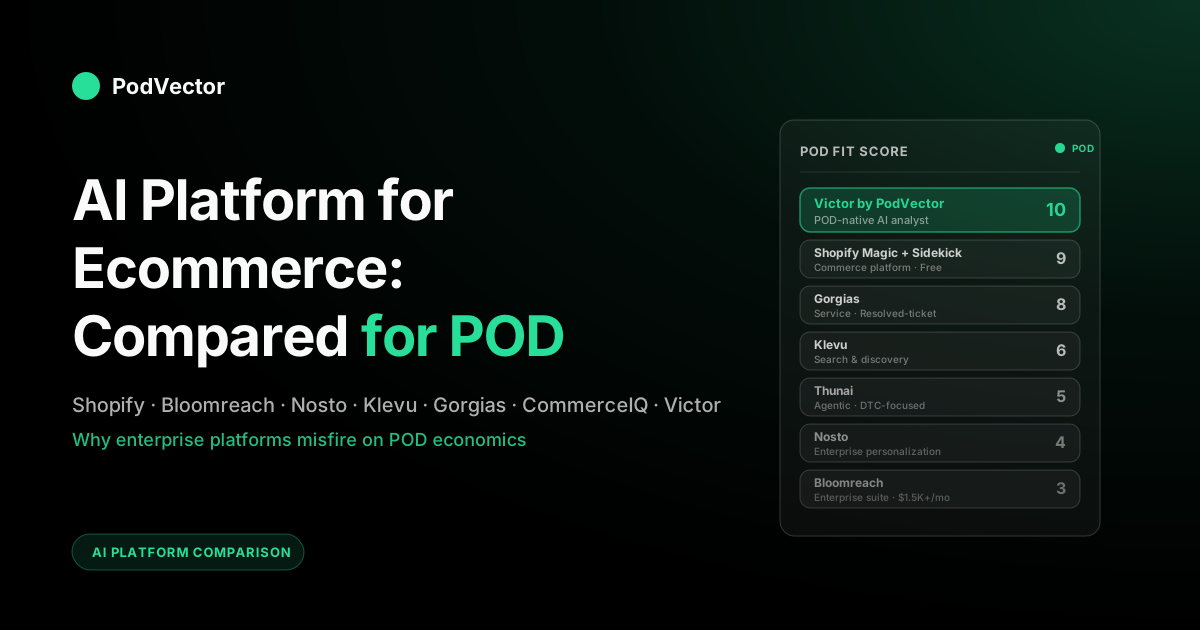
Quick Answer: For a print-on-demand operator, "AI platform for ecommerce" is a category to buy carefully. Enterprise platforms like Bloomreach, CommerceIQ, and Nosto are built for inventory-owning brands with large annual revenues — their pricing and feature surface assume a SKU model POD doesn't have.
The right stack for most POD stores is thin and purpose-matched: Shopify Magic + Sidekick as the storefront layer, Gorgias as the service platform, Klaviyo for lifecycle activation, and a POD-aware AI employee on top — that's where Victor by PodVector AI fits. Below: eight platforms compared on POD fit, plus the four questions to ask before any "all-in-one ecommerce AI platform" pitch lands in your inbox.
If you're scoping an AI analytics platform for ecommerce as a POD seller, the SERP will push you toward enterprise suites that don't model variable supplier cost or design royalties. Here's what each platform actually does, who it fits, and where the cost-of-goods math breaks for print-on-demand specifically.
What Counts as an "AI Platform for Ecommerce" in 2026
Every roundup currently ranking on Google uses the phrase "AI platform for ecommerce" to mean three different things: (1) commerce platforms with AI features built in (Shopify Magic + Sidekick, BigCommerce AI), (2) specialized AI suites that sit on top of your storefront (Bloomreach, Nosto, Klevu, CommerceIQ), and (3) operator-facing AI agents that answer questions about your business and take approved action (Thunai, Victor by PodVector AI). All three call themselves "platforms." Most aren't substitutable.
For 2026, the line between "platform" and "tool" has moved, and the dividing line everyone now markets on is agentic: does the AI just generate output (copy, images, recommendations), or does it take action across your systems — with your approval? CommerceIQ pitches "agentic retail"; Gorgias, Bloomreach (Loomi), and Thunai all lead with agents that execute, not just suggest. The roundups have caught up too — the consensus take is that the highest-value tools resolve issues and take action across systems rather than merely generating content. That's the right instinct; the question for POD is whether the actions the agent can take map to POD's actual levers (supplier mix, base-price spikes, ad-creative margin) or to an inventory-owner's (restock, warehouse routing, shelf compliance).
The unified-platform thesis — one AI suite that handles search, personalization, content, and analysis — is real for enterprise retail, but it doesn't translate cleanly to POD.
POD stores have a fundamentally different SKU economics model than the inventory-owning brands these platforms were designed around. A platform that assumes a single COGS per SKU, fixed warehouse capacity, and brand-owned product photography is solving problems POD doesn't have, while ignoring problems POD does have (variable supplier cost, royalty splits, design IP risk).
The category is real. The question is which platform — if any — earns its monthly fee against the thin margins and lower AOVs typical of a POD store.
Platform vs. Tool: Why the Distinction Matters for POD
An AI tool does one job — generate copy, draft an email, score an ad creative. An AI platform tries to be your operating system: it owns the data layer, the rules engine, the user interface, and the integrations. Platforms compound when they're a fit; they bleed money when they're not.
Three reasons POD operators should be more cautious about platforms than tools:
- Platforms charge for surface area you may not use. Bloomreach, Nosto, and CommerceIQ price as if every customer needs personalization, search, content, merchandising, and media optimization. POD stores typically need two of those, badly. The other features are dead weight on the invoice.
- Platforms assume a static cost-of-goods model. Most ecommerce AI platforms ingest your Shopify product catalog and treat each SKU's "cost" as a single number. POD's cost varies per fulfillment partner, per blank, per print method, and per region. The platform's "find your most profitable products" feature is wrong from day one — and every recommendation downstream inherits the error.
- Platforms lock you in faster than tools do. A point tool can be swapped in an afternoon. A platform that's already running your search, personalization, and analytics has months of configuration baked in. The switching cost compounds while the wrong-fit pain compounds.
The honest framing: most POD stores under $500K/year don't need an AI platform. They need three or four AI tools, integrated through Shopify, plus an AI employee layer that understands POD economics. Platforms become rational at scale, and even then the vendor short list narrows quickly.
If you want to understand POD margin mechanics before evaluating any platform's cost claims, see Printify t-shirt cost and profit breakdown — the numbers there show exactly why a single-COGS data model fails for POD.
How POD Operators Should Evaluate AI Platforms
Most "how to choose an AI ecommerce platform" sections give generic SaaS advice — list your bottlenecks, evaluate integrations, run a POC. True, but the questions that matter for POD are narrower. Four to ask before any platform demo:
- Does it model variable cost-of-goods per supplier? Printify and Printful charge different base prices for what looks like the same SKU. A platform that treats COGS as a flat number per SKU will misprice your "most profitable" rankings the moment your supplier mix shifts. Ask: "Can I model two different COGS for one Shopify variant depending on which supplier fulfills it?" If the answer requires custom development, the platform isn't built for POD. See also how to get contribution margin for the right margin formula to use when benchmarking any platform's output.
- What's the floor pricing relative to your AOV? POD AOVs are typically low relative to inventory-owning DTC. A platform with a high monthly floor needs to deliver a large number of extra orders just to break even on the subscription, before you've covered fulfillment cost. Bloomreach, Nosto, and CommerceIQ all have effective floors well above what most POD stores can justify.
- Does it integrate with your fulfillment APIs, not just Shopify? "Shopify integration" means the platform sees your storefront. POD economics live in Printify, Printful, and similar fulfillment APIs. A platform that doesn't pull production status, supplier-side cost, or fulfillment lead time is missing the data that actually drives POD margin decisions.
- Is it answering questions or just producing content? Generation features (write product copy, draft emails, score ad variants) are commoditizing fast — every platform now has them, and the marginal value is dropping. Analytical features (which SKUs lost margin this week, why is my Printify spend up vs. Printful) are scarce and getting scarcer to build well, because they require live data and POD-aware modeling. Bias your evaluation toward the analytical layer.
If a platform fails any of those four, it doesn't belong on the shortlist regardless of how strong the demo looks. For a deeper look at the checkout and conversion metrics worth monitoring before committing to any platform, see ecommerce checkout conversion rate optimization.
Quick Comparison: 8 AI Platforms for Ecommerce
Scored for fit with a POD store on Shopify, fulfilling through Printify or Printful, in the $30K–$500K/year revenue range. "POD fit" is on 10 — POD-specific, not the platform's general quality. Several enterprise platforms below are best-in-class for inventory-owning DTC and enterprise retail; the low scores reflect mismatch with POD economics, not platform quality.
| Platform | Category | Starting price | Best for | POD fit (/10) |
|---|---|---|---|---|
| Shopify Magic + Sidekick | Commerce platform AI | Free with Shopify | Storefront ops, copy, images | 9 |
| Gorgias | Service platform | From $10/mo + usage | POD support automation | 8 |
| Klevu | Search & discovery | From $59/mo | Mid-size catalogs, AI search | 6 |
| Nosto | Personalization suite | Custom (enterprise floor) | Enterprise DTC personalization | 4 |
| Bloomreach | Discovery + content + comms | Custom (enterprise floor) | Enterprise multi-channel | 3 |
| CommerceIQ | Retail media + ops AI | Enterprise (custom) | CPG brands selling on Amazon | 2 |
| Thunai | Agentic ecommerce AI | From $99/mo | Mid-size DTC, agentic workflows | 5 |
| Victor by PodVector AI | POD-native AI employee | Free tier; paid plans | POD margin, supplier mix, AI Q&A + approved actions | 10 |
The low scores on Bloomreach, Nosto, and CommerceIQ aren't a knock on the platforms — they're a knock on fit. All three are credible enterprise choices for retailers with large revenues and inventory-ownership economics. Drop into a mid-six-figure Printify store and the floor pricing alone makes the math impossible.
The 8 Platforms, Reviewed Through a POD Lens
1. Shopify Magic + Sidekick — The Free Baseline Every POD Store Should Use
Best for: any Shopify store, full stop.
Pricing: free with any Shopify plan; advanced features ride on Plus.
What it does well for POD: Sidekick is Shopify's conversational AI agent — ask it to help configure an abandoned-cart flow or draft product descriptions and it works directly inside the admin. Magic generates product copy, email subject lines, image edits, FAQs, and brand-voice text across the admin.
Shopify has shipped a large and growing suite of AI features, and the bar to use them is "you already pay for Shopify." For most POD stores, this is the highest-ROI AI surface area in the stack — because it's free.
POD-specific gap: Sidekick doesn't know about Printify or Printful product taxonomy. It'll happily generate copy for a Bella+Canvas 3001 and a Gildan 64000 alike without surfacing the margin difference between them.
It also doesn't model supplier-side cost, so when you ask Sidekick "which products are most profitable," it's using whatever single COGS you set on the variant — not the supplier-aware reality. Use Magic for production work; pair it with a POD-aware AI employee for decisions. If you also use the Shopify Admin API for store automation, see Shopify Admin API store modifications and automation for what's possible at the API layer.
2. Gorgias — The Service Platform That Resolves Order-Status at POD Scale
Best for: stores doing 100+ tickets/month where a large share are "where's my order."
Pricing: from $10/month for the basic helpdesk; AI Agent priced per resolved conversation — check the Gorgias pricing page for current rates.
What it does well for POD: Gorgias positions itself as a CX platform, not a tool. The AI Agent ingests your help center and historical tickets, then resolves common conversations end-to-end — order status, shipping windows, refund eligibility, size and fit.
For POD specifically, the high-value feature is order-status resolution: the AI looks up the Printify or Printful tracking number and replies with the carrier event. That category of ticket makes up a large portion of POD support volume at most stores, and it's exactly the work that doesn't need a human.
POD-specific gap: Gorgias doesn't natively pull production-status data from POD APIs. "Your order is in production" is a real status that matters for POD; Gorgias treats it as pre-shipped until the tracking event lands.
You'll need a custom integration or accept that some pre-shipment "where's my order" tickets escalate to humans. Still — the resolved-ticket model is the strongest unit-economics story in this whole list when support volume justifies the platform.
3. Klevu — AI Search and Discovery for Mid-Size Catalogs
Best for: POD stores with 500+ active SKUs and a search-driven traffic profile.
Pricing: from $59/month for the entry plan; scales with traffic.
What it does well for POD: Klevu is a focused AI search platform — semantic product discovery, AI-driven merchandising, conversational catalog discovery, autocomplete, and recommendations. For POD stores with sprawling catalogs (a single shop with hundreds of designs across a dozen product types isn't unusual), search relevance is a real revenue lever.
Klevu's mid-tier pricing makes it accessible to growth-stage stores in a way Bloomreach and Nosto aren't.
POD-specific gap: Klevu indexes your Shopify product data. It doesn't know about supplier mix, royalty obligations, or which designs are trademark-clean. "Boost in search" recommendations will surface your highest-converting designs, which may also be your lowest-margin or most IP-fragile. Use Klevu for discovery; pair it with margin-aware analysis to decide what should actually rank.
4. Nosto — Enterprise Personalization, Wrong AOV for POD
Best for: large DTC apparel brands with inventory ownership and high AOV.
Pricing: custom-quoted; effective floor is well above what most POD stores can justify.
What it does well in general: Nosto unifies personalization, search, content, and CDP data in one platform. The AI engine optimizes product recommendations, on-site content, and category pages in real time.
For inventory-owning DTC at scale, Nosto delivers measurable conversion lift — that's the published case-study reality.
POD-specific gap: three structural mismatches. (1) Nosto's pricing floor is too high for the typical POD store at a low AOV. (2) Personalization recommendations don't account for variable supplier cost, so "show this customer their most likely next purchase" can systematically push low-margin SKUs over high-margin ones. (3) Inventory-aware features like "low stock urgency" don't apply to POD; you're paying for surface area you can't use. Nosto fits only at the very top of the POD revenue curve, if at all.
5. Bloomreach — Discovery, Content, and Comms in One Platform
Best for: enterprise multi-channel retailers with large revenues.
Pricing: custom-quoted at enterprise rates; published estimates suggest annual deals well into six figures.
What it does well in general: Bloomreach combines AI-driven product discovery, personalization, content management, and email/SMS into a unified suite. The Loomi AI agent layer ties it together — natural-language merchandising, AI-generated content, and predictive segmentation.
For retailers running multi-channel campaigns at scale, the unified data model is a real advantage.
POD-specific gap: Bloomreach is a category leader for the wrong category. The pricing floor alone rules out most POD stores.
The platform's value compounds when you have content management, headless commerce, and multi-channel campaigns running together — POD stores typically don't. Even at strong POD revenue levels, the per-feature ROI doesn't beat a focused stack of Shopify Magic + Klaviyo + Gorgias + a POD-aware AI employee.
6. CommerceIQ — Retail Media AI for Brands Selling on Amazon
Best for: CPG brands and category-leading apparel selling on Amazon and other retailers.
Pricing: enterprise, custom-quoted.
What it does well in general: CommerceIQ's AllyAI is a serious agentic platform — Content Agent, Sales Agent, Shelf Agent, and Media Agent, all tied to an algorithmic-retail data backbone. Their customer list signals where the platform earns its fee: at scale, on retailers, in regulated supply chains.
POD-specific gap: CommerceIQ is built for brands that sell on retailers, not through their own Shopify store.
Amazon Merch on Demand is the closest POD analog, and even there CommerceIQ's data model assumes you're managing a brand portfolio with shelf, content, and media spend — not a designer-led POD shop. Skip unless you've grown into a true multi-channel retail operation.
7. Thunai — Agentic Ecommerce AI for Mid-Size DTC
Best for: mid-size DTC brands wanting agentic workflows without enterprise pricing.
Pricing: from $99/month, scaling with usage.
What it does well in general: Thunai positions itself in the "agentic ecommerce AI" tier — workflows that don't just generate output but execute multi-step actions on your behalf. The platform competes on agentic depth at a price point below Nosto/Bloomreach.
For mid-size DTC, that combination is increasingly rare.
POD-specific gap: Thunai is DTC-focused but built around inventory-owning economics.
Agentic workflows that "auto-restock low-inventory SKUs" or "trigger reorder when COGS spikes" don't translate to POD's supplier-API-as-inventory reality. POD-relevant agentic workflows — "flag ad sets when supplier base price increases," "surface which designs to reprice before margin slips" — aren't on the Thunai roadmap as of this writing.
8. Victor by PodVector AI — POD-Native AI Employee
Best for: POD stores on Shopify, advertising on Meta and Google Ads, fulfilling through Printify and/or Printful, that want an AI employee who knows their margin math and can act on it.
Pricing: free tier available; paid plans for advanced features — see the signup page for current plan details.
What it does well for POD: Victor is an AI employee built just for POD stores, not a dashboard or a profit tracker. Connect Shopify, Printify, Printful, Meta Ads, and Google Ads once. Victor looks at your orders, ad spend, and costs together, and suggests clear next steps with reasons why — you approve or reject each one, and Victor makes the approved change in Shopify, Google Ads, or Meta Ads.
Unlike the enterprise suites above, Victor models variable supplier cost and reads order-side itemized COGS from actual completed orders, so margin answers are grounded in real fulfillment data rather than catalog estimates. Ask a plain-English question like "which Printify SKUs lost margin this month?" and Victor surfaces the answer from live data — with supplier-side cost variance already accounted for.
What Victor can execute today (Shopify-side, with your approval): reprice a product to a target margin, bulk reprice products across your store, set up a buy-one-get-one discount, create a free-shipping discount, raise your free-shipping threshold, create a customer-specific discount, organize products into a collection, and revert a price change. Broader Shopify write automation is expanding. Meta Ads, Google Ads, Printify, and Printful are read-only surfaces — Victor reads them and proposes moves; ad-platform writes like pausing campaigns or changing bids are not built and the merchant executes those on the ad platform directly.
Honest limits to know: Victor has no memory between chats — each new chat starts blank. He sends a Weekly Health Report every Monday on his own; the rest of the time, he answers when you ask. Victor can tell you a product's margin even before it sells, because he pulls your supplier costs from Printify, Printful, and Gelato ahead of time. He reads data from Shopify, Meta Ads, Google Ads, Printify, Printful, Gelato, and Klaviyo — he does not read Etsy, Amazon, or TikTok.
That narrowness is the whole point: every feature is calibrated to POD economics on Shopify, not to the median inventory-owning DTC brand. For the margin-and-pricing decisions Victor supports, see also how to get contribution margin.
AI Platforms by Job-to-Be-Done
Platforms are easiest to compare when you sort them by what they actually do for you. Below: the best fit at each job for a typical POD store.
Storefront and content generation
- Primary: Shopify Magic + Sidekick — free, deeply integrated, brand-voice-aware.
- When to add a generation tool: only when content volume justifies it. Most POD stores under $30K/month don't need anything beyond Sidekick and a general-purpose AI writing tool.
Customer service and ticket resolution
- Primary: Gorgias AI Agent — the per-resolution pricing model is the right unit economics for POD at volume.
- Per-resolution alternative: Fin (Intercom's AI agent) competes on a similar pay-per-outcome model; worth evaluating if you're already in the Intercom stack, though it has the same POD-production-status blind spot Gorgias does.
- Lighter alternative: Tidio AI for stores at early scale — see conversational AI platform for ecommerce for the deeper comparison.
Search, discovery, and merchandising
- Primary at mid-size: Klevu for catalogs over 500 SKUs.
- Skip: Bloomreach, Nosto, Constructor, and Dynamic Yield until you're at significant scale — they're strong enterprise search and personalization suites, but the effective floors make the math impossible for a typical POD store below that revenue level.
Email, SMS, and lifecycle activation
- Primary: Klaviyo AI — predictive segments, AI subject lines, send-time optimization. Note: Victor also reads your Klaviyo data and can set up or adjust flows and campaigns there, with your approval — the two tools work well together.
- Skip personalization-suite platforms (Nosto, Bloomreach) for activation specifically — Klaviyo handles the overwhelming majority of POD email/SMS use cases at a fraction of the cost.
Operator analysis, decisions, and approved actions
- Primary for POD: Victor by PodVector AI — POD-native cost-of-goods modeling from live order data, plain-English query layer, and Shopify-side execution under human approval.
- Why not Triple Whale or Polar: both are solid for inventory-owning DTC; both bake in single-COGS-per-SKU assumptions that misprice POD margin every time supplier mix shifts. Neither executes actions on your store. Compared in detail in best AI tools for ecommerce (compared).
- Ad fatigue and frequency: part of the operational picture Victor surfaces. For context on when to act on those signals, see how to avoid ad fatigue and what is ad frequency.
The Enterprise-Platform Trap for POD
Three signals that an "AI platform for ecommerce" pitch is going to misfire on a POD store, every time:
- The case studies are all CPG, fashion, or beauty brands. If the published wins are P&G, Levi's, and Sephora, the platform's data model assumes inventory ownership and brand-portfolio economics. Those are the opposite of POD's supplier-as-inventory, designer-led model. The gap won't close in implementation.
- The pricing floor is north of what your margin can support. Run the math before any demo: at a low POD AOV and thin gross margins, a high monthly floor demands many incremental orders just to break even on the subscription. No platform vendor surfaces that math in the demo. You should run it before signing — see how to get contribution margin for the formula.
- The "agentic" features all assume warehouse-aware logic. Auto-restock, demand forecasting tied to inventory capacity, multi-warehouse routing — these are inventory-owner features. POD's equivalents (flag when a supplier base price spikes, surface which products to reprice before margin erodes, create a targeted discount for a specific customer segment) are what a POD-native AI employee handles. For the Shopify-side actions Victor can execute today, see the platform reviews section above.
The honest fix for most POD stores: don't buy an enterprise platform. Buy a focused stack.
Shopify Magic for storefront, Gorgias for service, Klaviyo for activation, Victor for analysis and approved Shopify actions. Total cost: well under what an enterprise suite charges, at the growth stage.
Every tool in that stack can pay for itself within weeks at a meaningful monthly revenue. The platform suites become rational at significant scale, and even then the short list narrows fast. If Shopify Capital is part of your growth equation, see how to get Shopify Capital and does Shopify Capital check credit for the mechanics.
Recommended Platform Stack by Revenue Band
The right "platform stack" depends on revenue more than any other variable. Below: three concrete configurations.
Starter Stack: $0–$10K/month revenue
Total: ~$30/month or less.
- Shopify Magic + Sidekick — free
- Klaviyo AI — free up to a small contact list
- Tidio AI — entry-level pricing (lighter than Gorgias at this scale)
- Meta Advantage+ campaigns — free (you're paying for the ads, not the AI)
Skip enterprise platforms entirely. At this revenue band, the bottleneck is product-market fit and design throughput, not platform capability. Adding a high-cost suite to a small store is the fastest way to bleed margin to vendors.
Growth Stack: $10K–$100K/month revenue
Total: ~$200–$500/month.
- Shopify Magic + Sidekick — free
- Klaviyo AI — scales with list size
- Gorgias AI — entry plan including AI resolutions
- Klevu — entry plan if catalog has 500+ active SKUs
- Victor by PodVector AI — free tier or paid plan for the AI employee layer
This is where AI starts compounding. Each platform above can pay for itself through reduced support labor (Gorgias), better lifecycle revenue (Klaviyo), better discovery (Klevu), and faster margin decisions with approved Shopify-side execution (Victor). For a deeper take on the AI employee layer specifically, see the complete guide to AI analytics for print-on-demand.
Scale Stack: $100K+/month revenue
Total: ~$1,000–$3,000/month.
- Shopify Magic + Sidekick + Plus AI features — included in Plus
- Klaviyo AI — scales with list size at this tier
- Gorgias AI Pro — scales with ticket volume
- Klevu or equivalent — scales with traffic
- Victor by PodVector AI — paid plan for advanced features
- Optional: AdCreative.ai or Smartly.io for paid ad creative volume
At this scale, a Bloomreach or Nosto pitch might earn its fee — but only if you've genuinely outgrown the focused stack and have specific personalization or merchandising bottlenecks the focused stack can't solve. Audit your platform roster every quarter and cut anything that hasn't shipped a measurable lift in 90 days. Most "all-in-one ecommerce AI platforms" don't pass that audit.
FAQs
What's the difference between an AI platform and an AI tool for ecommerce?
An AI tool does one job — generate copy, draft an email, score an ad creative. An AI platform tries to be your operating system, owning the data, rules, and integrations across multiple jobs.
Platforms compound when they fit; they bleed money when they don't. POD stores under significant scale typically get more from a focused stack of tools than from a single platform.
Is Shopify itself an AI platform for ecommerce?
Increasingly, yes. With Magic + Sidekick and a growing suite of AI features, Shopify is now closer to an "AI commerce platform" than a hosting provider. For POD stores, that matters because the AI surface area is free with the plan you already pay for. Use it as your baseline before adding any third-party platform.
Why do enterprise platforms like Bloomreach and Nosto score low for POD fit?
Three structural mismatches: (1) pricing floors are high relative to POD AOVs and margins; (2) data models assume single COGS per SKU, which mis-prices POD margin every time supplier mix shifts; (3) inventory-aware features (low stock, restock prediction, warehouse routing) don't apply to POD's supplier-API-as-inventory model. Both are excellent for inventory-owning DTC at scale; both are wrong-fit for typical POD stores.
How is Victor different from Triple Whale, Polar, or Thunai?
Triple Whale, Polar, and Thunai are credible analytics or agentic platforms built around inventory-owning DTC assumptions. Victor is built around POD's actual reality — variable supplier cost across Printify and Printful, modeled from live order-side COGS rather than catalog estimates. Beyond analysis, Victor can propose and execute approved Shopify-side actions (repricing, discounts, collections) that those platforms don't offer. The read surface covers Shopify, Meta Ads, Google Ads, Printify, and Printful — Victor acts on what he reads, with your approval, rather than just reporting it.
Do I need a separate AI platform, or are Shopify Magic and Sidekick enough?
For stores at early revenue stages, Shopify Magic + Sidekick + free Klaviyo + a free chat widget are enough. The marginal value of additional platforms at very low revenue is negative once you factor in setup time. Once you reach meaningful monthly revenue, add Gorgias for service and a POD-aware AI employee layer — those two typically have the strongest ROI as second purchases.
Will an AI platform help me rank in ChatGPT Shopping or other AI answer engines?
Most platforms on this list don't directly affect AI search visibility — they optimize the operations of your store, not its discoverability inside AI answers. For AEO specifically, the tool category is different. Most POD stores should focus on operational AI first, AEO second.
How quickly can I see ROI from adding an AI platform to my POD store?
By platform: Shopify Magic + Sidekick show ROI quickly (it's free). Gorgias shows ROI within weeks once ticket volume justifies the platform — the per-resolution model makes the math transparent.
Klevu shows ROI over a longer window as search-driven conversion lift accumulates. Enterprise platforms like Bloomreach and Nosto require the longest payback period, which is why they're typically wrong-fit below significant scale. Victor's AI employee layer shows ROI through faster margin decisions and approved Shopify-side actions, with value compounding as your team learns to ask the right questions.
What's the biggest mistake POD stores make with AI platforms?
Buying surface area. Enterprise AI platforms charge for personalization + search + content + merchandising + media as a bundle, but POD stores typically need two of those, badly.
The others are dead weight on the invoice. Buy narrow, focused tools instead — and add a POD-aware AI employee layer on top to make sure the rest of the stack is paying for itself. For the Shopify-side actions that actually move the needle on POD margin, see Shopify Admin API store modifications and automation.
Skip the enterprise-platform trap — get a POD-aware AI employee
Bloomreach, Nosto, and CommerceIQ weren't built for variable Printify base costs, supplier-API-as-inventory economics, or Shopify-side execution under human approval. Victor by PodVector AI was. Connect your live Shopify, Printify, Printful, Meta Ads, and Google Ads data once, then ask plain-English questions like "which SKUs lost margin this week and why?" — and let Victor propose and execute the approved fix on Shopify. Free tier available for early POD operators.
Try Victor free