
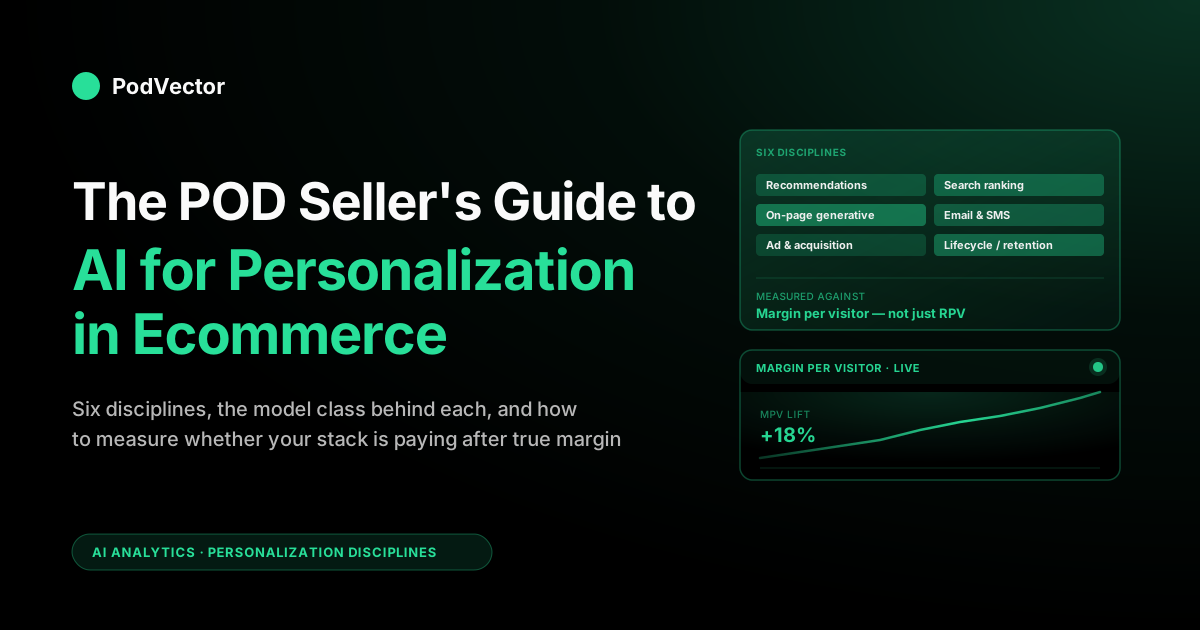
Quick Answer: AI for personalization in ecommerce is the use of machine-learning models — recommendation engines, ranking models, propensity classifiers, and generative LLMs — to adjust what each visitor sees, when they see it, and what they're offered, based on first-party behavior across your store, email, and ad surfaces. It's a category, not a feature: six distinct disciplines (recommendations, search, on-page, email, ads, lifecycle), plus a fast-emerging conversational/agentic layer, each powered by its own model class, deployed on different surfaces, and measured against different KPIs. The stakes are real — McKinsey finds 71% of shoppers now expect personalized interactions and 76% get frustrated without them, and brands running it report 15–25% higher conversion. For POD sellers, the trap is buying a generic "personalization platform" priced for 60% gross margin retail and trying to run it on a 25% margin POD store. This guide walks the personalization stack discipline by discipline, the decision framework for what to personalize first, the build-vs-buy call at each layer, and how to measure whether your personalization is actually paying — not just lifting vanity metrics.
What "AI for personalization in ecommerce" actually means
"Personalization" is the most overloaded word in ecommerce. Vendors use it to mean recommendations. ESPs use it to mean dynamic email content. Ad platforms use it to mean lookalike modeling. The term collapses six structurally different disciplines into one marketing pitch, and that confusion is why most operators end up paying for overlapping tools that don't compound.
A useful working definition for 2026: AI for personalization in ecommerce is the use of machine learning models — recommendation engines, generative LLMs, propensity classifiers, ranking models — to adjust what an individual visitor sees, when they see it, and what they're offered, based on first-party signals collected across the storefront, email, and ad surfaces. The output is per-visitor decisions; the input is behavior, identity, and catalog metadata; the model class varies by discipline.
That definition matters because it forces the next question: which discipline? Generic guides like Netguru's "what actually works" piece, RBM Software's 2026 ROI guide, and platform overviews from Firework and Braze bundle all the disciplines together, which is fine for an executive overview but unhelpful when you're choosing what to spend your next $300/month on. The 2026 versions of those guides all foreground the same new development — autonomous "AI agents" that don't just predict but act on the prediction in real time (Braze ships "BrazeAI Agents," Firework an "AI Shopping Agent"). That shift from passive scoring to agentic action is the real story this year, and it's exactly where the POD measurement gap bites hardest. POD operators need the disaggregation. We've covered the parent topic in our complete guide to AI analytics for print-on-demand and the cluster context in our AI overview cluster hub; this piece zooms into personalization specifically.
The six disciplines inside ecommerce personalization
Each of these is its own product category, model class, and budget line. Confusing one for another is how stacks turn into Frankenstein.
1. Recommendation personalization (product page, cart, post-purchase)
The original and still largest category. Models — typically collaborative filtering, content-based filtering, or hybrid neural rerankers — predict what an individual visitor is most likely to buy next, given session behavior and historical signals. Surfaces: product page "you might also like," cart drawer upsells, post-purchase recommendations. KPI: AOV and attach rate.
2. Search and discovery personalization
The same query produces different ranked results for different visitors. A visitor who's spent five minutes browsing minimalist outdoor designs gets minimalist outdoor results when they search "shirt"; a visitor who's been on bold typographic designs gets typographic results.
Models: learning-to-rank with personalization features. Surfaces: site search, faceted filtering, category landing pages. KPI: search-to-conversion rate.
3. On-page generative personalization
Hero copy, product descriptions, social proof blocks, and CTA wording adjusted per visitor or per segment. The newest discipline, made viable by generative LLMs that can produce variants cheaply. Models: instruction-tuned LLMs with prompt scaffolding around brand voice and visitor context. Surfaces: landing pages, hero, PDP copy. KPI: landing-page conversion rate.
4. Email and SMS personalization
Send-time optimization, dynamic content blocks per segment, subject-line variants, offer logic per recipient. Klaviyo's 2026 benchmark across 183,000+ ecommerce brands shows automated personalized flows generate roughly 41% of total email revenue from just 5.3% of sends — a ratio that has been widening every year.
Models: send-time prediction, propensity-to-open classifiers, dynamic content selection. Surfaces: ESP-driven flows. KPI: email revenue per recipient.
5. Ad and acquisition personalization
Lookalike audience modeling, dynamic product ads, creative selection by segment, bidding adjustments by predicted LTV. Models: propensity scoring, audience clustering, predicted-LTV regression. Surfaces: Meta, Google, TikTok ad accounts. KPI: ROAS-after-COGS, not just ROAS.
6. Lifecycle and retention personalization
Predicting which buyers are about to churn, which are about to repeat-buy, which are worth the retention budget. Models: survival analysis, propensity classifiers, RFM-style segmentation augmented with ML. Surfaces: retention email, push, paid retargeting. KPI: 90-day retained revenue, not first-purchase conversion.
Emerging: conversational and agentic personalization
The newest entrant — and the one every 2026 vendor pitch now leads with — is the conversational shopping assistant: an LLM-driven agent that personalizes through dialogue ("show me something like that but in a vintage palette") rather than through a static "you might also like" rail. Firework's AI Shopping Agent and Braze's autonomous decisioning agents are early examples. This isn't a seventh model class so much as a new surface that consumes the same identity, history, and catalog inputs and renders them as a chat or guided-discovery experience. For POD, the catch is the same as everywhere else in this guide: a chat agent that pushes the higher-AOV bundle is only a win if that bundle's itemized margin is positive — and the conversational vendors, like the recommendation vendors before them, assume a flat margin number that doesn't exist in POD.
Each discipline has its own dominant vendors, its own data requirements, and its own implementation effort. A "personalization platform" pitch that promises all six in one is almost always weaker than three or four point solutions in the disciplines you actually need. The first job is naming which disciplines you're shopping for.
How AI personalization works under the hood
The vendor pitch is "our AI learns your customer." Useful, but it elides the mechanics. The real picture:
The four ingredients every personalization decision needs
- Identity. A stable identifier for the visitor across sessions, devices, and surfaces. Without identity, every visit is a new stranger. Most stacks rely on a Klaviyo profile, a Shopify customer record, or a first-party cookie tied to email opens.
- Behavioral history. What this identity has done — pages viewed, products clicked, emails opened, designs favorited, past orders. The richer and more recent, the better the prediction.
- Catalog metadata. Tags, attributes, embeddings on the products themselves. For inventoried DTC, this is category and SKU. For POD, the relevant metadata is design family, aesthetic, niche, color — none of which Shopify auto-populates.
- A model. Something that takes identity + history + catalog and outputs a decision: "rank these products in this order," "send this email at this time," "show this hero variant." Most off-the-shelf personalization tools ship with a default model and let you tune weights.
The model classes you'll actually encounter
Collaborative filtering. "Buyers similar to you also bought." Cheap, mature, robust at scale. Weakness: cold-start — fails on new visitors and new products.
Content-based filtering. "Products similar to what you've shown interest in." Works on day one but doesn't capture cross-buyer patterns.
Hybrid / two-tower / neural rerankers. What most modern recommendation engines actually run — collaborative + content + session features fed into a deep model. The lift over pure collaborative is real but not always worth the complexity for stores under $5M revenue.
LLMs for generative personalization. Used for on-page copy, email subject variants, product description rewrites. The relevant question isn't "which LLM" but "which prompt scaffolding keeps brand voice intact."
Propensity and survival models. Predict the probability of a binary event (buy, churn, open) within a window. Underused in POD; high-leverage for retention spend allocation.
Where generic personalization stacks misfire on POD
The category was built for inventoried DTC: 200–800 SKUs, predictable repeat purchase, 50–70% gross margins, category-driven traffic. POD breaks four of those assumptions, and that's where generic personalization stacks waste money.
Catalog scale and shape are different
A well-stocked POD store can have 2,000–10,000 design × product combinations. Default Shopify recommendation engines treat each as a unique SKU and fail to surface the underlying signal — that the same buyer who liked a vintage motocross hoodie will also like a vintage motocross tee, mug, and poster.
Personalization that doesn't aggregate at the design-family level is operating on noise. Our guide to AI for personalized ecommerce covers the design-family taxonomy in depth.
Margin per recommendation is variable
Inventoried DTC has fixed COGS. A POD seller's true cost per order changes with product type, supplier (Printify vs. Printful vs. SPOD), print method, and shipping zone.
Personalization that recommends the higher-AOV bundle without checking whether that bundle's itemized margin is positive can push you into unprofitable orders cheerfully. The lift in the dashboard is real; the bank balance is the truth. Generic personalization tools assume a flat margin number — they were built for a buyer that doesn't exist in POD.
Repeat purchase is signal-driven, not calendar-driven
Inventoried brands measure repeat purchase in weeks. POD repeat purchase looks like long gaps with bursts — buyers come back when a new design in the same niche catches them.
Lifecycle personalization tuned to "send winback at day 60" misses the POD buyer entirely. The right cadence is signal-driven: send when there's new inventory in their stated aesthetic, not when the calendar dictates.
Niche-driven traffic doesn't cluster like category traffic
Most personalization vendors trained their default models on broad ecommerce data — running shoes, kitchen appliances, beauty products. POD traffic is "vintage 90s skateboarding for mid-30s nostalgia buyers," which doesn't cluster the way running-shoe shoppers do. Out-of-the-box similarity scoring underperforms; the operator has to actively narrow it with niche tags or accept generic results.
A decision framework for what to personalize first
Most stacks try to personalize everything at once and end up doing nothing well. A more honest sequencing for a POD operator under $5M annual revenue:
The two-axis prioritization
Score each personalization discipline against two axes: expected revenue lift (how big is the dollar impact if this works) and setup difficulty (how much of your time will it take to implement and maintain). The disciplines that win are high-lift × low-difficulty. For POD, that ordering tends to be:
- Product-page recommendations on a tagged catalog. High lift (15–30% AOV gains are common with proper tagging), moderate setup (the tagging is the work, the app is plug-and-play). Start here unless your catalog is already tagged.
- Email aesthetic-segmented flows. High lift on email revenue (often 30–60% above broadcast), low setup once tags exist. Naturally follows after recommendations because the same tag taxonomy serves both.
- Search personalization with aesthetic ranking. Moderate lift (20–40% on search-driven revenue), moderate setup. Worth it once your tags are mature.
- Live margin gating. Not a "lift" in the recommendation sense — a guardrail that prevents lift from being fictional. Should be running before scale, not after.
- On-page generative personalization. Real lift (8–18% landing-page conversion), but quality risk — bad LLM output erodes brand voice. Do after the data foundation is solid.
- Predicted-LTV ad bidding. Significant lift on retention spend efficiency, but high setup cost (warehouse, modeling, ad-platform integration). Phase 2 work for stores under $5M.
The 80/20 of POD personalization
For most POD operators, 80% of the dollar lift comes from the first three: tag-aware recommendations, aesthetic email, aesthetic search. The remaining 20% is real but takes more effort, and chasing it before the foundation is in place is how you end up with five overlapping subscriptions and no clear lift.
Build vs. buy: where each makes sense for POD
Vendors will tell you everything is buy. The honest decomposition for a POD operator:
Buy by default
- Recommendation engine. Rebuy, Searchanise, LimeSpot, Boost — all of them work for POD if configured against your tags. Do not build this. The model is commodity; the integration value is the work.
- Email platform with personalization. Klaviyo or Omnisend. Do not build email infrastructure.
- On-store search with aesthetic ranking. Algolia, Searchanise, Boost. Do not build search.
- Send-time optimization. Bundled with Klaviyo and similar — no separate buy or build needed.
Build (or insist on transparent third-party tooling)
- Real product costs and live profit tracking. No off-the-shelf personalization tool can see your Printify costs, your Shopify orders and your ad spend all in one place. Victor can. He pulls your supplier costs before you even make a sale, then matches them to every order and every ad dollar spent. That way you always know your true profit — not a guess locked inside a personalization vendor's black box.
- Design tags are yours to keep. No tool will decide what your designs mean to shoppers — only you know your own style. You have to tag your designs yourself, then store those tags somewhere you control, like Shopify's product fields, so they can be used across your store.
- True profit on every ad campaign. No personalization tool will show you the real return on a Meta retargeting campaign once you subtract your product costs. Victor can. He pulls your costs, orders and ad spend together, so he can show you the actual profit behind every campaign — not just click numbers.
Hybrid (where Victor and similar tools sit)
Someone has to check if these tools are actually working. That's where Victor comes in. He looks at your live orders, costs and ad spend, and tells you whether the tools you bought are really making you money. You don't have to build your own system to track this, and you don't have to trust a single personalization vendor's own numbers.
Tools that sit on top of your warehouse and answer plain-English questions about live margin and personalization performance are the right shape here. We cover the architectural pattern in our complete guide to AI agents for ecommerce analytics and our guide to AI for ecommerce news.
Measuring whether personalization is actually paying
Most personalization vendor dashboards report "lift over baseline" — usually conversion rate or AOV — and call it done. For a POD operator, that's not enough. The dashboard number can be up while the bank balance moves the wrong way. The measurement framework that actually works:
The four metrics every personalization decision needs
- Revenue per visitor (RPV). The right top-line metric — captures both conversion rate and AOV in one number. If RPV isn't moving, the rest is academic.
- Margin per visitor (MPV). RPV minus itemized supplier cost minus payment fees, divided by visitors. The number that actually pays the bills. RPV up + MPV flat means the personalization shifted SKU mix toward worse-margin items.
- Incremental margin per dollar spent. Most personalization tools cost $200–$2,000/month. The right comparison isn't "lift vs. no tool" but "lift per dollar of subscription cost." A 5% lift on a $5M store from a $2,000/month tool is real; a 12% lift on a $200K store from a $2,000/month tool is not.
- Net 90-day retention impact. Some personalization moves lift first-purchase revenue but hurt repeat behavior (over-aggressive upsells produce buyers who feel manipulated). Tracking the same buyer cohort 90 days out is the discipline that catches this.
Why most personalization "lift" reports overstate
Two common biases: selection bias (the personalized cohort is also more engaged, so they would have converted more anyway) and cannibalization (the upsell that "added" $5 to AOV displaced a different add-on that would have added $7). Proper A/B testing with holdout groups catches both, but most stores don't have the volume to run statistically valid tests on every personalization rule.
The pragmatic alternative: trust the lift you see, but check it against margin per visitor using Victor's profit numbers. If margin per visitor moves with revenue per visitor, the lift is real. If margin per visitor stays flat while revenue per visitor climbs, the personalization is pushing shoppers toward worse-margin products.
Where Victor sits in the personalization stack
Victor isn't a recommendation engine, an email platform, or a search ranker. The market has good options for each. Victor is the analytics layer underneath — the agent that reads your Shopify orders, your Printify or Printful invoices, and your Meta and Google ad spend together, and answers questions like "which aesthetic segment is converting under-margin from Meta retargeting this week" or "did the new product-page recommendation rule lift margin per visitor or just RPV" in plain English.
Most POD operators we talk to have already bought a recommendation app and an email platform. The hole is the live margin truth — the answer to "is this personalization actually paying off after itemized supplier costs and fees, or is it just shifting mix?" Victor reads that data live, not as a weekly export, and answers in seconds.
It's an AI employee that responds and acts on the answer — with your approval — pause the under-margin recommendation rule, increase budget on the over-margin segment, without you babysitting the dashboard. That's what "AI for personalization" should mean for the operator: not a single black-box vendor that does everything, but a measurement-and-action layer on top of the personalization tools you already chose.
Implementation traps that quietly burn budget
The mistakes show up in roughly the same order across most POD personalization rollouts.
Trap 1: Personalizing on SKU history instead of design family
Default segmentation is purchase history. For POD, that's the wrong axis — buyers don't repeat-buy SKUs, they repeat-buy aesthetics. Tag your catalog by design family before you turn personalization on. Skipping the tagging makes every downstream decision noisy.
Trap 2: Stacking three recommendation apps
Three engines fighting for the same product-page real estate produces worse results than one engine configured well. Pick one, set it up against your tags, run it for at least 30 days. The configuration matters more than the engine choice.
Trap 3: Personalizing before margin is itemized
If your COGS is "estimated at 32% of revenue," you can't tell whether your personalization is profitable. The lift number you see is fictional. Itemize COGS — by product type, supplier, shipping zone — before scaling personalization budget. We cover the warehouse pattern in our guide to AI for ecommerce.
Trap 4: Treating "first name in subject line" as personalization
That's a token replacement. Real email personalization is dynamic content blocks per segment, send-time optimization per recipient, and aesthetic-triggered flows. Anything less is leaving 30–50% of email revenue on the table.
Trap 5: Skipping holdout groups
Most stores turn personalization on and immediately attribute every uptick to the new tool. Without a holdout cohort that doesn't get personalization, you can't separate the tool's lift from seasonal lift, traffic-mix shift, or the design that just happened to land that week. A 5–10% holdout is enough to keep your measurement honest at most POD volumes.
Trap 6: Optimizing conversion without checking margin
The single most expensive mistake. A personalization rule that lifts conversion 8% but pushes a worse-margin SKU mix can lose money. Personalization decisions have to be checked against true margin, not just revenue. Live margin gating is the guardrail.
FAQs
How is "AI for personalization in ecommerce" different from "personalized ecommerce"?
"AI for personalization" is the toolkit — the disciplines, the model classes, the platforms. "Personalized ecommerce" is the outcome — what the buyer experiences. This guide is about the toolkit and how to assemble it. Our guide to AI for personalized ecommerce covers the outcome side: the eight personalization plays POD buyers actually feel.
What's the minimum tech stack for AI personalization on a POD store?
Four pieces: a tagged catalog (Shopify metafields or sidecar), one recommendation app that respects tags (Rebuy, Searchanise, LimeSpot), an email platform with segmentation flows (Klaviyo, Omnisend), and a live margin layer that reads orders + supplier invoices + fees together. The fourth is the one most POD stacks are missing.
How much should I budget monthly for AI personalization tools?
For a store doing $50K–$500K monthly revenue, the realistic stack is $200–$800/month: one recommendation app ($30–$200), one email platform with personalization ($50–$400 by list size), and the analytics layer that measures lift against margin. Stacks that exceed $1,000/month at that revenue tier are usually overspent on overlapping tools.
Is collaborative filtering still relevant in 2026, or is it all neural now?
Collaborative filtering is still the workhorse for most off-the-shelf recommendation engines, augmented with content features and session signals. Pure neural rerankers exist and produce real lift at scale, but for a POD store under $5M, the difference between a well-configured collaborative-filtering engine on a tagged catalog and a "deep learning recommendation" on the same catalog is usually measurable in single-digit percentages — not enough to justify the complexity.
How do I know if my personalization is paying for itself?
Look at margin per visitor (MPV), not just revenue per visitor (RPV). If RPV climbs but MPV stays flat, the personalization shifted SKU mix toward worse margins — the lift is fictional. The discipline is to measure both, in the same dashboard, against the same time window. This is the gap most personalization vendor dashboards leave open.
What's the role of generative AI in personalization specifically?
Generative AI shows up in two places: on-page copy variants (hero, PDP, CTA) and email content generation. It's a real productivity unlock for variant production, but it's not a substitute for the underlying personalization engines (recommendations, search, propensity). Treat generative as one of the six disciplines, not as the whole category.
Are conversational AI shopping assistants worth it for a POD store?
Conversational personalization — an LLM agent that guides discovery through chat — is the discipline every 2026 vendor leads with, and it can genuinely lift engagement on a large, hard-to-browse catalog (which most POD stores have). But treat it as a surface, not a strategy: it runs on the same tag taxonomy and identity data as your recommendation engine, so it inherits the same POD failure mode. If the agent steers buyers toward a bundle whose itemized margin is negative, it lifts AOV in the dashboard and loses money in the bank. Add it after your tags and live margin layer are in place, not before — and measure it on margin per visitor, not chat-driven AOV.
Can Victor recommend products?
Victor isn't a recommendation engine — those exist and are good. Victor is the analytics agent that reads your live margin, ad spend, and orders together, and answers questions like "did this week's recommendation rule lift margin per visitor or just RPV" so the recommendation rules upstream are operating on real data, not approximated margin. Victor answers and acts on those answers — gated through your approval.
Personalization that lifts margin, not just metrics.
Most POD personalization rollouts look great in the vendor dashboard and leak money on itemized COGS. Victor is the AI employee that reads your Shopify, Printify, and Meta/Google ad spend together — in real time — and tells you which personalization rules are paying after true margin and which are bleeding it. Built for POD economics, not generic DTC.
Try Victor free