
Quick Answer: The eight AI personalization platforms worth a print-on-demand seller's time in 2026, ranked by POD-fit: 1. Klaviyo (free to 250 contacts, predictive LTV, send-time AI), 2. Shopify Search & Discovery + Magic (free with Shopify, on-site recommendations), 3. LimeSpot (Shopify-native, from ~$18/mo), 4. Rebuy (cart and post-purchase AI, entry plan from ~$25/mo), 5. Nosto (on-site + Huginn agentic AI, from ~$500/mo), 6. Dynamic Yield (enterprise testing-led + Shopping Muse), 7. Bloomreach (enterprise CDP + Loomi AI), 8. Insider (enterprise omnichannel + Sirius AI).
The real story: most enterprise platforms in this category were built for $200K+ MRR DTC brands with warehoused inventory and 3-figure AOVs. POD economics — variable Printify/Printful base costs, $20–35 AOV on apparel, and zero on-hand inventory — break those assumptions.
The 2026 shift is toward agentic, in-session personalization — AI that reacts to hesitation and exit intent in real time rather than serving static widgets. The right pick still depends on store stage, not platform leaderboard. This guide ranks each tool against a POD-specific rubric and ends with three concrete stacks for stores from $5K to $100K+ MRR.
What AI Personalization Software Actually Does
"AI personalization software for ecommerce" is a category that bundles three distinct jobs that often get conflated:
- On-site personalization — what the homepage, search, category pages, and recommendation widgets show each visitor based on behavior, segment, or session signals.
- Lifecycle personalization — what email, SMS, and push subscribers see, when, and with what subject line, image, and product feed.
- Cart and post-purchase personalization — upsells, cross-sells, bundles, and "complete the look" recommendations at the highest-intent moments.
Most platforms try to do all three. A few specialize — Klaviyo owns lifecycle, Rebuy owns cart, LimeSpot owns Shopify-native on-site — and the specialists tend to outperform generalists at small and mid scale. Enterprise platforms (Bloomreach, Dynamic Yield, Insider) are full-stack with a CDP, but the floor pricing makes them mathematically unworkable below ~$1M annual revenue.
For a print-on-demand store fulfilling through Printify, Printful, or Gelato, the personalization stakes are higher than usual. Margin per order is thin (often $4–9 on a $25 t-shirt after supplier costs and payment fees), so even a 5–8% lift in conversion or AOV is the difference between profitable and break-even. But the same thin margin means you can't pay $500–2,000/month for the platform doing the lifting.
The POD Rubric: How These Were Scored
Each platform is scored on five POD-specific axes, not the generic "best AI personalization software" framing the rest of the SERP uses:
- Floor price (0–10) — what does month one cost? Free or sub-$30 floors get 9–10; $99–500 gets 5–7; $1K+ floors get 2–4.
- POD economics fit (0–10) — does the platform's data model handle variable per-SKU supplier costs, zero-inventory, and per-order GPAM? Most "ecommerce personalization" platforms assume warehoused stock and flat COGS.
- Time-to-first-result (0–10) — for a store doing $5–25K/month, how fast does the platform earn its monthly cost back? Sub-30 days scores 10; 90+ days scores 4 or less.
- No-developer setup (0–10) — one-click Shopify install scores 10; CDP integration with custom event mapping scores 4–5.
- Apparel/print-product feature fit (0–10) — does the recommendation engine handle apparel attributes (size, color, design family) and zero-stock SKUs gracefully? Generic ecommerce engines often surface out-of-stock or wrong-size items.
The composite score is the average of those five. A score of 8.0+ means the platform earns a slot in a POD stack at most revenue tiers. Below 6.0, the platform is better postponed until store revenue justifies the floor — usually past $50K/month.
Comparison Table: 8 AI Personalization Platforms
The "POD score" averages the five-axis rubric above. The "Job" column is the personalization layer the platform is best at — picking on this axis matters more than picking on aggregate score, because the right-shaped tool for one job is usually wrong-shaped for the others.
| Rank | Platform | Best at (job) | Floor price | Free tier? | POD score | Best fit |
|---|---|---|---|---|---|---|
| 1 | Klaviyo | Lifecycle (email/SMS) | $0 → $20/mo | Yes (250 contacts) | 9.2 | All POD stages |
| 2 | Shopify Search & Discovery + Magic | On-site (built-in) | Free with Shopify | Yes | 8.6 | $0–25K MRR |
| 3 | LimeSpot | On-site (recommendations) | $18/mo | 14-day trial | 8.1 | $10–50K MRR |
| 4 | Rebuy | Cart and post-purchase | ~$25/mo (Starter) | 14-day trial | 7.4 | $25K+ MRR |
| 5 | Nosto | On-site + Huginn agentic AI | ~$500/mo | No | 5.9 | $80K+ MRR |
| 6 | Dynamic Yield | Testing-led + Shopping Muse | Custom (~$2K+/mo) | No | 4.5 | $300K+ MRR |
| 7 | Bloomreach | Enterprise CDP + omnichannel | Custom (~$3K+/mo) | No | 4.2 | $500K+ MRR |
| 8 | Insider | Omnichannel + Sirius AI | Custom (~$2K+/mo) | No | 4.4 | $300K+ MRR |
The split is sharp: the top four are stackable for a POD store under $25K/month at a combined cost south of $130/month if Klaviyo is on its free tier. The bottom four are enterprise platforms whose floor pricing is structurally incompatible with single-operator POD economics — the floor alone exceeds the gross margin on 60+ apparel orders per month before the platform has done anything.
The 8 Platforms, Ranked for POD
1. Klaviyo — Lifecycle personalization, POD-shaped pricing
Klaviyo is the dominant ecommerce email/SMS platform, and its AI features are the most useful slice of "personalization" for a POD store under $50K/month. Subject Line Assistant predicts open rate before you send.
Predictive Analytics estimates next-purchase date, churn risk, and lifetime value per contact. Segments AI builds segments from natural-language descriptions ("buyers who viewed two designs in the dog-dad collection but haven't ordered"). The free tier covers 250 contacts and 500 sends; paid plans start at $20/month for 500 contacts.
POD fit: excellent. The data model is contact-centric, not inventory-centric — so zero-stock POD SKUs and variable Printify costs don't break it. Predictive LTV is materially useful for low-AOV apparel because it identifies the small minority of repeat-buyer cohorts that drive most POD lifetime margin. Setup is a one-click Shopify install.
Where it's weak: Klaviyo doesn't do on-site personalization (homepage, search, recommendations) or cart upsells. You'll need a second tool for those layers.
2. Shopify Search & Discovery + Shopify Magic — Free, native, underrated
Bundled with Shopify since 2023 and meaningfully upgraded with AI features in 2025–26. Search & Discovery handles synonyms, filters, boosts, and product recommendations. Shopify Magic generates product descriptions, FAQ blocks, and email subject lines. The combination covers a credible 50–70% of what a paid on-site personalization tool delivers, at zero incremental cost.
POD fit: very good. Native to Shopify means it inherits Shopify's understanding of variants, inventory state, and product taxonomy — so out-of-stock POD designs don't surface in recommendations the way they sometimes do with third-party engines that index nightly. Shopify Magic understands apparel attributes (size, color, fit) more reliably than generic LLM-driven copy tools.
Where it's weak: the personalization is rules-and-recency-driven more than truly behavioral. For a $50K+/month POD store with enough traffic to train a real model, a paid on-site engine like LimeSpot or Nosto will beat it. For everyone else, native is enough.
3. LimeSpot — Shopify-native on-site personalization
LimeSpot is the best-known mid-market on-site personalization app on Shopify. It runs product recommendations, "complete the look" bundles, and email content blocks. Pricing starts at $18/month, scaling with order volume. The brand recognition in the Shopify ecosystem is high — it's been a top-200 Shopify App Store entry for years.
POD fit: good. The recommendation engine handles apparel attributes well, and the bundle logic works with virtual SKUs (which most POD designs effectively are — same blank, different art). Setup is one-click; first results typically show within 14 days at $5K+/month traffic levels.
Where it's weak: the recommendation quality is meaningful but not transformative below ~$10K/month — there isn't enough behavioral signal yet. Stores below this scale see better ROI from Klaviyo + Shopify-native than from adding LimeSpot.
4. Rebuy — Cart and post-purchase upsells
Rebuy is the cart-and-checkout specialist. AI-driven smart cart upsells, post-purchase one-click offers, "frequently bought together" widgets, and — newer in 2025–26 — a Monetize layer that turns the post-purchase page into a sponsored-offer placement. A Starter plan now opens around $25/month, though the full smart-cart and AI rules sit on higher tiers that scale with orders (the practical floor for the AI features is closer to $99/month). For DTC brands with $50+ AOVs, Rebuy regularly delivers 8–15% AOV lifts inside 60 days.
POD fit: middling. The mechanic — "you bought the dog-dad t-shirt, want a matching mug?" — works for POD if your catalog spans product types (apparel + drinkware + posters).
But at apparel-only stores with $20–30 AOVs, the $99 floor takes 4–5 months to pay back at typical lift rates. Stores above ~$25K/month with mixed product types see Rebuy pay back inside 30 days.
Where it's weak: apparel-only POD stores under $20K/month should defer Rebuy. Single-product-type catalogs don't have enough cross-sell variety for the engine to add real lift.
5. Nosto — On-site personalization for mid-market
Nosto is a marketer-friendly commerce experience platform — on-site recommendations, segments, and campaigns with a polished UI and a meaningful ML backbone. Its 2025–26 push is Huginn, an agentic AI layer that acts on real-time session signals (hesitation, browse depth, exit intent) rather than serving static recommendation widgets. Pricing is custom but typically starts around $500/month for stores under $1M ARR, scaling well into four-figure monthly spend at scale.
POD fit: reasonable but rarely the right pick. The platform handles apparel-style catalogs cleanly and the segment engine is genuinely useful.
The floor is the problem — at $500/month, the platform has to clear ~$6,000/year of incremental margin to break even. For an apparel POD store with 15% gross margin, that requires ~$40K/year of attributed lift.
Where it's weak: sub-$80K/month POD stores almost always get better ROI from LimeSpot ($18/mo) plus Klaviyo ($0–60/mo) than from Nosto. The performance difference doesn't justify a 10x spend until store revenue is large enough that Nosto's better segmentation actually moves dollars.
6. Dynamic Yield — Testing-led enterprise platform
Dynamic Yield (now part of Mastercard) is one of the original AI personalization platforms — testing-first, with a strong A/B and multivariate framework alongside the personalization engine, plus Shopping Muse, an AI shopping assistant that turns natural-language queries into curated product sets. Used by enterprise retailers and large DTC brands. Custom pricing typically lands at $2,000+/month with annual contracts.
POD fit: poor. Not because the platform is bad — it's excellent at what it does — but because the math is unworkable below ~$300K/month MRR. The platform also assumes warehoused inventory in several feature paths (predictive stockouts, replenishment-driven recommendations), which are noise for POD stores.
Where it's right: the POD store has crossed $300K+/month, has a marketing team running structured experiments, and the founder has time to manage a six-figure annual contract. Vanishingly rare for the cohort reading this article.
7. Bloomreach — Enterprise CDP + omnichannel
Bloomreach combines AI-driven product discovery with content and merchandising personalization across email, SMS, web, and search. The Loomi AI engine coordinates messaging across channels. Used by enterprise ecommerce teams for omnichannel sophistication. Pricing is custom and starts in the $3,000+/month range with annual contracts.
POD fit: structurally wrong-shaped. Bloomreach is built for brands with multiple channels, large catalogs, and complex merchandising rules. POD stores rarely have any of those things — most are single-channel (Shopify), small-catalog (50–500 SKUs), and rule-light (most decisions are "show the design that converts").
Where it's right: never, for a single-operator POD store. By the time the store is large enough to need Bloomreach, it has typically pivoted away from POD into warehoused inventory.
8. Insider — Omnichannel + Sirius AI
Insider is the omnichannel personalization platform that recently launched Sirius AI for prediction and EUREKA for search optimization. Strong adoption among mid-large retailers and DTC brands in EMEA and APAC. Custom pricing in the $2,000+/month range.
POD fit: similar to Bloomreach and Dynamic Yield — the platform is excellent but priced for retailers who measure budget in $20K+/month per channel. POD economics don't bend that way.
Where it's right: the operator has scaled past POD-only into a warehoused-plus-POD hybrid model and the budget bracket has changed.
The 2026 Shift: Agentic, In-Session Personalization
The biggest change in this category since 2024 isn't a new vendor — it's a new mechanic. The roundups that now rank for "AI personalization software for ecommerce" lead with agentic, in-session personalization: AI that watches a live session for friction signals (hesitation on a product page, repeated cart edits, exit-intent on checkout) and intervenes in the moment, instead of pre-computing a static recommendation widget overnight.
The marquee examples on the current SERP are Nosto's Huginn, Dynamic Yield's Shopping Muse, Bloomreach's Loomi, Insider's Sirius AI, and a wave of conversational-commerce apps (Rep AI and similar) that replace the product-grid with a chat-style assistant. The shared promise: react to behavior within the same session, not the next email.
Three things to know before this reframes your buying decision as a POD operator:
- It's mostly an enterprise-tier feature today. The genuinely agentic layers (Huginn, Shopping Muse, Loomi, Sirius) sit on the $500–3K/month platforms — the same floor pricing that already failed the POD rubric above. The mechanic is real; the price tag hasn't moved.
- In-session lift needs in-session traffic. Agentic personalization learns from concurrent sessions. A POD store under ~5K monthly sessions doesn't generate enough live signal for an agent to act on confidently — the model spends its time exploring, not converting.
- The affordable version already exists in your stack. Shopify Search & Discovery's recency signals, Klaviyo's send-time and predictive flows, and a cart app like Rebuy cover the high-intent moments (browse, abandon, post-purchase) without the agentic price floor. For most POD stores, that's 70% of the in-session benefit at 5% of the cost.
Translation for a print-on-demand operator: agentic personalization is worth tracking, not buying — until store revenue clears the ~$80K/month line where Nosto-class platforms start to pay back. Below that, the composable stack below captures the same intent-moment lift on POD-shaped economics.
Three Personalization Stacks by Store Stage
Composite score is a useful sort but it isn't the buying decision. The buying decision is "what stack gives me the best lift per dollar at my current revenue?" Three stacks below, each tuned to a POD revenue band:
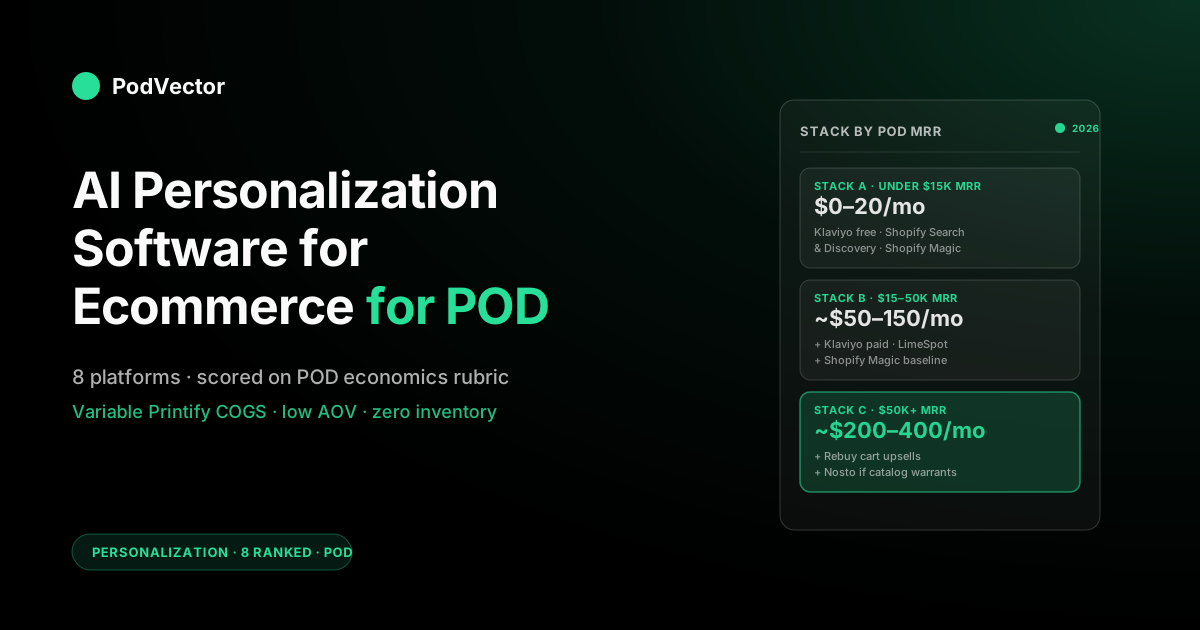
Stack A — POD store under $15K/month: ~$0–20/month
- Klaviyo (free tier) — up to 250 contacts and 500 sends/month at $0. Predictive analytics and Segments AI come on at $20/month past the free tier.
- Shopify Search & Discovery + Shopify Magic — free with Shopify. Covers on-site recommendations, search relevance, and AI-generated product copy.
This stack costs $0–20/month and covers ~70% of what a paid personalization stack delivers at this revenue band. Adding LimeSpot or Rebuy below $15K/month is usually negative ROI — the lift exists but the floor pricing doesn't pay back fast enough at low AOV.
Spend the saved budget on traffic instead. For more on small-store stacking, see best AI tools for small ecommerce stores.
Stack B — POD store $15–50K/month: ~$50–150/month
- Klaviyo paid — $20–60/month depending on contact count. Predictive LTV and AI flows start to materially compound.
- LimeSpot — $18/month and up. On-site recommendations and bundles. Replaces some of what Shopify-native would cap out on at this scale.
- Shopify Magic — still free, still useful for product copy and email subject lines.
At this revenue band, adding LimeSpot to the Shopify-native baseline typically delivers a 4–8% on-site conversion lift inside 60 days — paying back the $18/month inside the first week. Rebuy stays out of this stack unless the catalog is multi-product-type (apparel + drinkware + accessories), in which case it earns its $99 floor at the upper end of this range.
Stack C — POD store $50K+/month: ~$200–400/month
- Klaviyo — $60–250/month at this contact volume. Now running full predictive flows, SMS, and segment automation.
- LimeSpot or Nosto — depends on catalog size. LimeSpot for under 1,000 SKUs; Nosto if catalog and traffic justify the floor.
- Rebuy — $99–199/month. Cart and post-purchase now matter on absolute-dollar basis even at low AOV.
- Shopify Search & Discovery + Magic — still in the stack as the baseline.
This is where personalization software starts compounding meaningfully. At $50K+/month, an 8–10% combined lift from a stacked personalization layer is $4–5K/month in incremental revenue — enough to pay for the stack, the operator's time, and a budget for testing additional layers. Stage 2 (Solution Aware) reading is in our POD Seller's Guide to AI for Ecommerce Personalization if you want the framework rather than the tool list.
Where Personalization Software Misreads POD Stores
Most "ecommerce personalization software" guides were written without a single POD-specific assumption baked in. The roundups currently ranking for this query, like Rep's 8-platform comparison, lead with agentic and conversational features priced for $200K+ MRR brands. Three pitfalls show up in every implementation:
The variable-COGS problem
Printify and Printful base costs vary per SKU, per print provider, and sometimes per region. A "Bella Canvas 3001 t-shirt" has a different supplier cost depending on which provider Printify routes the order to.
Most personalization platforms assume flat COGS per SKU — so margin-aware features ("recommend the highest-margin product") systematically misrank POD products. The recommendation engine doesn't break, but it makes margin-suboptimal picks, and the operator has no visibility into the gap.
The "out-of-stock" assumption
POD products are technically zero-inventory — they're produced on demand. Some personalization engines (especially older ones) treat zero-inventory SKUs as out-of-stock and suppress them from recommendations. Modern Shopify-native tools (Search & Discovery, LimeSpot) handle this correctly; some enterprise engines that ingest nightly inventory feeds get it wrong without configuration. Worth verifying during trial.
The AOV mismatch in payback math
A $99/month tool that lifts conversion 5% pays back differently at $25 AOV vs. $80 AOV. At $25 AOV with 200 orders/month, the lift is $250 — break-even on the floor.
At $80 AOV with 200 orders/month, the same lift is $800 — three months of stack cost recouped in a single month. Most personalization vendor case studies are run on stores closer to $80 AOV; replicate the math at your AOV before committing. For the underlying analytics framework, the POD seller's guide to AI personalization for ecommerce walks through the unit economics.
The Operator-Side Layer Most Stacks Miss
Personalization software answers "what should the customer see?" There's a parallel question the same data set can answer that almost nobody is asking: "which personalization tactics actually moved itemized profit, after Printify supplier costs and Stripe fees, on a per-order basis?" Standard analytics — Shopify Analytics, even Triple Whale — answer this in revenue, not in margin.
The gap matters because POD AOV is low and per-order margin is thin. A 7% conversion lift from a personalization recommendation can be either net-profitable or net-unprofitable depending on which products got recommended and which Printify provider routed the order. The personalization platform doesn't know this — it optimizes for the metric you gave it, usually revenue or conversion rate, not gross profit after material costs (GPAM).
This is the operator-side analytics layer that pairs with personalization software, not replaces it. Victor by PodVector AI is built specifically for this — he connects to your Shopify, Printify and Printful accounts and works out the true profit on every order as it happens, so you can ask "which products recommended by LimeSpot last month actually delivered margin?" rather than just "did revenue go up?" Victor answers right in chat within seconds, not as a long dashboard project. He complements every personalization platform on this list — he doesn't compete with any of them.
For the broader analytics picture, our AI analytics topic hub indexes the full coverage. For tool comparisons across categories, the tools cluster hub is the catalog. And for the next-tier question — which 2025 personalization tools beat the 2026 landscape on specific criteria — see the planned best AI personalization tools for ecommerce 2025 comparison.
FAQs
What's the cheapest AI personalization stack for a POD store?
Under $20/month. Klaviyo's free tier (up to 250 contacts) plus Shopify Search & Discovery and Shopify Magic (both free with Shopify) covers lifecycle personalization, on-site recommendations, search relevance, and AI-generated product copy.
For a POD store under $15K/month, this stack outperforms most paid combinations because the floor pricing on paid tools eats the lift at low AOV and contact counts. Add LimeSpot ($18/month) once the store crosses $15K/month and on-site recommendations start to compound on real traffic.
Is Klaviyo really better than Bloomreach for POD?
For POD stores under ~$200K/month, yes — almost always. Klaviyo's data model fits POD economics (contact-centric, not inventory-centric), the floor is $0–60/month, and the predictive analytics genuinely move email-attributed revenue.
Bloomreach is technically more sophisticated, but the floor is ~$3K/month and the omnichannel orchestration assumes channels POD stores rarely run (in-store, complex catalogs, multi-region merchandising). Klaviyo wins until the store is large enough that Bloomreach's incremental sophistication is paying off in absolute-dollar terms.
Does AI personalization software work with Printify and Printful?
The personalization software itself doesn't care — it integrates with Shopify (or your storefront) and personalizes based on Shopify product data. The Printify or Printful integration sits below it, fulfilling the order after the customer converts.
The compatibility question is really about COGS modeling: most personalization platforms assume flat per-SKU costs, which is wrong for Printify (where supplier costs vary by routing). The recommendations still work; the margin attribution is just systematically off until you layer an operator-side analytics tool on top.
How much lift should I expect from AI personalization for a POD store?
For a store doing $5–25K/month: expect 4–8% combined lift from a stacked Klaviyo + Shopify-native + LimeSpot setup inside 60 days, with most of that coming from Klaviyo's email-attributed revenue. For stores doing $50K+/month: 8–12% combined lift is realistic when LimeSpot or Nosto runs alongside Klaviyo and Rebuy. Below 4% combined lift typically means the catalog is too small (under ~30 SKUs) or traffic is too low (under ~5K monthly sessions) for the recommendation engines to learn meaningfully — fix those first.
Should I use Shopify Magic instead of paying for AI personalization?
For stores under $15K/month: largely yes. Shopify Magic plus Search & Discovery covers product copy generation, FAQ blocks, search relevance, and basic recommendations at zero incremental cost.
The lift versus a $0 baseline is real and immediate. Once the store crosses $15–25K/month, paid tools (Klaviyo paid, LimeSpot) start to materially outperform native — but most POD operators add them too early, paying for capability that won't compound until traffic and contact volume catch up.
What's the difference between AI personalization and AI marketing tools?
Personalization software adapts the on-site or in-message experience per visitor or contact in real time. AI marketing tools span a wider set of jobs — ad copy generation, SEO, content production, attribution.
Some platforms blur the line (Klaviyo does both lifecycle personalization and email marketing). For POD operators specifically, the budget allocation usually goes: traffic acquisition tools (~50%), personalization tools (~30%), analytics tools (~20%) at most revenue tiers. Cross-reference our AI tools for ecommerce comparison for POD for the broader category map.
Is agentic or conversational AI personalization worth it for a POD store?
Not yet for most. The 2026 wave of agentic, in-session tools — Nosto's Huginn, Dynamic Yield's Shopping Muse, Bloomreach's Loomi, conversational apps like Rep AI — reacts to live session friction instead of serving static widgets, which is a genuine step up. But the capable versions sit on $500–3K/month platforms, and in-session AI needs in-session traffic to learn: under ~5K monthly sessions there isn't enough concurrent signal for an agent to act on confidently.
For a POD store under ~$80K/month, the affordable stack (Shopify Search & Discovery + Klaviyo + a cart app) already covers the high-intent moments — browse, abandon, post-purchase — at a fraction of the cost. Track agentic personalization; buy it once revenue clears the enterprise floor.
Do I need a developer to install these platforms?
Not for the top four. Klaviyo, Shopify Search & Discovery, Shopify Magic, LimeSpot, and Rebuy are all one-click Shopify App Store installs — usable inside 15 minutes.
Nosto involves a tag implementation but no real development work. Dynamic Yield, Bloomreach, and Insider involve CDP-style integration with custom event mapping and a multi-week onboarding — and at those budgets, vendor-side support typically handles it. For a single-operator POD store, only the first five are realistically self-installable.
Which AI personalization software has the fastest payback at POD scale?
Klaviyo, then Shopify Magic + Search & Discovery (which costs nothing so payback is instant). For paid tools specifically: Klaviyo's send-time AI and predictive flows typically pay back the first month past the free tier — meaning the $20/month plan recovers itself before month one closes for most stores doing $5K+/month in email-attributable revenue. LimeSpot's $18/month payback is fast at $15K+ MRR but slower below that, where the on-site signal is too sparse for the recommendation engine to learn.
Personalization tells your store what to show. Victor tells you which picks actually paid.
Every platform on this list optimizes the storefront. None of them tell you which recommendations, which segments, and which campaigns delivered itemized margin after Printify and Printful took their share. Victor by PodVector AI connects via OAuth in minutes and computes per-order GPAM live — so you can ask "which LimeSpot recommendations actually moved profit last month?" and get the answer in seconds.
Try Victor free