
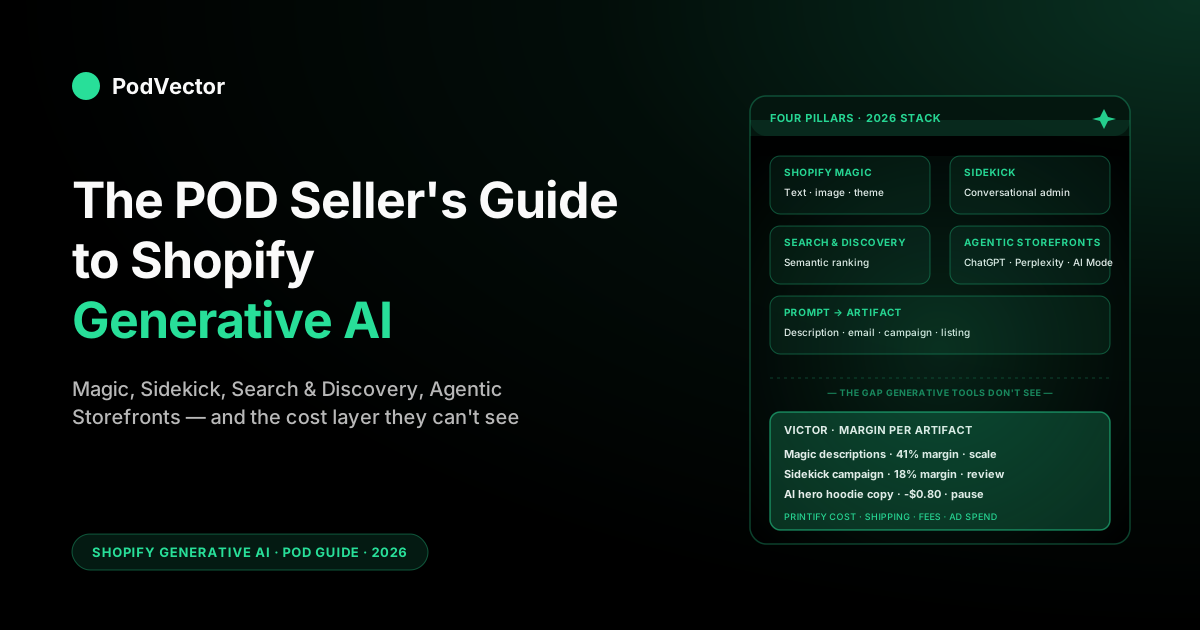
Quick Answer: Shopify generative AI is the bundle of free, built-in features that turn a prompt into store output: Shopify Magic for product descriptions, blog posts, email subject lines, headlines, and image edits; Sidekick for conversational admin tasks; Search & Discovery for semantic ranking; and Agentic Storefronts for syndicating your catalog into ChatGPT, Perplexity, Google AI Mode, Gemini, and Microsoft Copilot Checkout. In 2026 all four are folded into the platform fee — no separate "premium AI" tier.
For a print-on-demand store, that free Magic layer covers about 80% of the content you need. What it does not understand is variant explosion, design-family reuse, niche-audience tone, or the supplier-cost layer that decides whether the generated copy actually sells profitably. This guide walks the surfaces, the prompt patterns that work for a POD catalog, and the agentic gap between "Shopify generated this copy" and "this copy cleared its cost."
What "Shopify generative AI" actually means in 2026
"Generative AI" inside Shopify is not one feature. It is a stack of features that share two properties: they take a prompt (sometimes implicit, sometimes typed) and they emit output that didn't exist before — text, images, code suggestions, theme sections, ranked product lists, conversational answers.
The difference from older Shopify AI features (recommendations, fraud scoring, demand forecasting) is that generative AI creates the artifact instead of scoring something the merchant already has. Shopify's own framing of the category — covered in their guide to generative AI — collapses everything from product descriptions to image generation to conversational assistance under the same umbrella, and that's roughly how the platform ships it.
The reason this matters for a print-on-demand seller is that 2026 is the first year where Shopify's free, built-in generative AI is good enough to replace most of the third-party content tools POD operators were paying for in 2023 and 2024. Shopify Magic generates product descriptions that are competitive with what most copywriters produce on a per-SKU basis, and at zero marginal cost.
Sidekick can write a follow-up email, draft a discount campaign, and propose merchandising rules. Theme editor AI assistance can stand up a section without you opening Liquid. The question for a POD store is no longer "should I use generative AI" — Shopify is generating output for you whether you opt in or not — but "where do I trust the generic generative output, where do I correct it, and where does the generic output silently lose me money."
This guide is built around two arguments. First: the Shopify Magic / Sidekick / Search & Discovery / Agentic Storefronts stack covers about 80% of what a POD store needs from generative AI, and the marginal value of bolting on a third-party content tool has collapsed.
Second: the remaining 20% is exactly where POD economics differs from generic ecommerce — variant explosion, design-family reuse, niche-audience tone, supplier-cost blindness — and that 20% is the part that decides whether your generated content actually makes you money. The free tools don't see that. We'll cover what does.
The seven surfaces where Shopify generates output
Before tuning anything, get clear on where generative AI actually shows up across the Shopify admin. Most store operators have all seven running, often without realizing it.
1. Product descriptions and bullet copy
The most-used surface. Click "Generate" inside any product editor and Shopify Magic produces a description from the product title, vendor, type, and tags.
For POD this is the surface that decides whether a 200-SKU catalog gets uniquely-described or stays on the supplier's default copy. The deeper treatment of this exact surface is in the POD seller's guide to Shopify AI product description and the POD seller's guide to AI product description generator Shopify.
2. Blog posts, page content, and meta descriptions
Shopify Magic generates long-form blog posts, page bodies, and meta descriptions from a brief or a topic. For a POD store running content marketing for design families ("the meaning behind the tiger-dad design") this is the surface that compresses a per-design content cycle from hours to minutes. Treat the output as a draft floor, not a publish-ready ceiling.
3. Email subject lines, body copy, and campaigns
Inside Shopify Email, Magic generates subject lines, preview text, and body copy from a campaign brief. Sidekick goes further: ask "draft a campaign for last weekend's tiger-dad drop" and Sidekick assembles the segment, the copy, the product blocks, and the schedule.
4. Image editing and generation
Magic removes backgrounds from product photos, generates new hero banners, and edits product imagery in place. For POD this matters for mockups: the supplier's default mockup photography is rarely on-brand, and Magic can extend or recolor backgrounds to match a store's aesthetic without sending the mockup to a designer.
5. Theme generation and section building
The themes page now ships with theme-generation prompts that produce a starter theme from a description, and section-level AI can build a hero section or a feature grid from a brief. For a POD store launching a sub-brand or a holiday landing page, this collapses a designer ticket into a 10-minute task.
6. Search and merchandising via Search & Discovery + Sidekick
Search & Discovery uses semantic ranking — a shopper searching "warm sweater for hiking" is matched on conceptual similarity, not just keyword overlap. Sidekick lets you ask "boost the cheetah-dad designs over the next two weeks" and execute the merchandising rule in plain English. Both lean on generative models for ranking and for understanding the operator's intent.
7. Agentic Storefronts: catalog syndication into AI buying surfaces
The newest surface. Shopify's Agentic Storefronts — automatically enabled for eligible merchants and expanded at NRF 2026 to include Google AI Mode and Gemini — syndicate your product catalog into ChatGPT, Perplexity, Microsoft Copilot Checkout, and the Google AI buying surfaces.
A shopper asking ChatGPT for "a funny tiger-themed dad gift" can surface and check out your product without ever visiting your storefront. For POD this is a discovery channel that depends on your generated product titles, descriptions, and tags being clean enough for an LLM to retrieve confidently.
This channel stopped being theoretical in 2026. Per Shopify's Q1 2026 commerce data, referral sessions from AI chatbots grew more than 8x year over year and AI-referred orders grew nearly 13x — and those AI-referred visitors convert at roughly 50% higher rates and carry about 14% higher average order values than organic search.
The detail that matters most for POD: more than half of AI-referred sessions land directly on a product page, versus roughly 20% for organic search. The LLM has already done the shortlisting, and it shortlisted on your product data. That makes the generated title, description, and tags on each design the thing that wins or loses the sale before a shopper ever sees your storefront.
Optimizing for this surface now has its own name — generative engine optimization (GEO) — and Shopify frames it as three pillars: SEO fundamentals (titles, headings, sitemap, robots.txt), brand authority (reviews, press, social proof an LLM can weigh), and data quality (complete fields, clean variant modeling, specific taxonomy like "women's waterproof hiking tee" over "apparel"). For a POD store, the generative content you produce is the data-quality pillar.
For the broader Shopify-AI surface area beyond generative specifically — recommendations, analytics, chatbots, agents — see the POD seller's guide to Shopify AI and the POD seller's guide to Shopify AI product recommendations.
Magic, Sidekick, Search & Discovery, Agentic Storefronts: who does what
The four pillars are easy to confuse because Shopify's marketing collapses them into "AI." Operationally they do different jobs.
Shopify Magic is the content-generation layer. It's free, it runs across product editors, theme editor, blog, email, and image tools, and it writes or edits artifacts. Every "Generate" button in the admin is Magic. Magic is text and image; it doesn't take actions on its own.
Sidekick is the conversational admin agent. It's the chat surface inside the admin where you can ask "what's my best-selling design last week" or "draft a campaign for the cheetah-dad drop" and Sidekick combines retrieval over your store data with generative output and, increasingly, action-taking inside the admin (creating discounts, updating merchandising rules, drafting campaigns).
Sidekick is the surface that's moving fastest in 2026 — every quarterly release expands what it can do without dev work. The dedicated sibling guide is the POD seller's guide to AI assistant for ecommerce.
Search & Discovery is the storefront-side ranker. Free, first-party, installed by default on most stores.
Adds semantic search ranking, synonyms, merchandising rules, and product boosts to your storefront. The generative piece sits in how it understands shopper intent — "warm sweater for hiking" maps to the right tags and descriptions even when the literal words don't appear in your catalog.
Agentic Storefronts is the catalog-syndication channel. Your products surface inside ChatGPT, Perplexity, Microsoft Copilot Checkout, Google AI Mode, and Gemini without bespoke integration work. The generative piece here is upstream and downstream: upstream because the AI surfaces are themselves generative interfaces (the shopper asks an LLM, the LLM retrieves your product), and downstream because the quality of your generated product titles and descriptions decides whether the LLM picks your product over a competitor's.
The pricing summary: Magic, Search & Discovery, and Agentic Storefronts are free across plans. Sidekick is free for most use cases, with some advanced workflows tied to higher Shopify plans.
There is no longer a meaningful tier of "premium AI" inside Shopify itself — the generative AI has been folded into the platform fee. The strategic implication for a POD store is that the budget you used to spend on third-party content tools, in 2026, can be redirected to either ad spend, design freelancers, or a POD-specific analytics layer that fills the cost-side blind spot we'll cover under the cost-side blind spot.
Why generic Shopify generative AI advice misses POD
Most generative-AI-for-Shopify content (including the Shopify-authored guide that ranks for the keyword) treats the platform's catalog as if every store is selling discrete physical goods. Print-on-demand catalogs have a different shape, and that shape breaks four assumptions every generic generative tool makes.
Assumption 1: each SKU is a distinct product. For a POD catalog, "tiger-dad tee in black, M" and "tiger-dad tee in red, L" are not distinct products in any meaningful merchandising sense — they're variants of one design. Magic will generate a unique description for every SKU if you let it, which is wasteful (and sometimes counterproductive: it can produce six slightly-different descriptions of the same design that confuse the semantic search index).
Assumption 2: descriptions should sell features. Generic generative tools default to "premium quality cotton, soft to the touch, unique design" — features any garment has. POD descriptions sell identity: the tiger-dad buyer is buying because the design names something about them. Generic generative output reads as filler against that intent.
Assumption 3: the merchant has supplier-cost flexibility. Generic tools optimize for conversion rate. POD margins are tight enough that a recommendation, an upsell copy, or a discount-banner generation that drives conversions but kills margin is a net loss. The generative tool can't see the cost layer; it ranks output by predicted engagement, not by predicted profit.
Assumption 4: niche audience tone is generic. Magic's default voice is "approachable, professional, slightly enthusiastic" — fine for a generic catalog, wrong for a niche audience. A nurse-themed POD line needs ICU-specific in-jokes; a fishing-dad line needs the right amount of dad-humor lean. Generic generative output flattens those signals, and a flattened version of niche copy reads as a brand that doesn't get the audience.
None of these mismatches make Shopify Magic unusable for POD. They make the difference between using Magic as a draft floor (good idea) and using Magic as a publish-ready ceiling (cost you're paying without realizing it). The next section walks the six applications where the difference matters most.
Six POD-specific generative applications that actually move revenue
Six places where generative AI inside Shopify earns its keep on a POD-shaped catalog, ordered by where we see the largest revenue lift on stores we've audited.
1. Variant-aware product descriptions at the design family level
Generate one description per design, not per SKU. Use Magic to draft the design-level copy from the design's name, audience, and aesthetic, then propagate that description across every variant of the design with light templating for product type ("on a heavyweight tee" / "on a 11oz mug" / "on a structured cap"). This avoids the six-similar-descriptions-per-design problem, keeps the semantic search index clean, and gives the LLMs powering Agentic Storefronts a coherent concept to retrieve.
2. Niche-audience SEO copy and meta descriptions
Magic generates blog posts, page bodies, and meta descriptions, but the default tone is too generic for niche POD audiences. The fix is a saved prompt template that injects the audience archetype ("nurses with 5+ years of ICU experience, dry humor, in-jokes about charting") into every generation. The deeper treatment is in the POD seller's guide to AI SEO for Shopify and the POD seller's guide to AI writing for ecommerce.
3. Email subject lines and campaign drafts via Sidekick
Sidekick, given a brief like "draft a Friday-drop campaign for the cheetah-dad design family targeting the segment that bought from the tiger-dad family in the last 90 days," will assemble the segment, draft the subject lines (typically 5-10 variants), draft the body copy, pick the product blocks, and schedule the send. This is where Sidekick's value compounds — the same task by hand is 30 minutes and multiple admin tabs; with Sidekick it's a 90-second prompt and a review.
4. Customer support reply suggestions inside Shopify Inbox
Magic-powered suggested replies inside Shopify Inbox handle the long tail of "where's my order," "what's the return policy," "what size should I get" without an operator typing. For POD specifically this is high-leverage because the support volume per order tends to be higher than for non-print products (sizing variance across suppliers, shipping windows that are longer than Amazon-conditioned customers expect, fulfillment-time questions). The deeper treatment of POD chatbot use cases is in AI chatbot for ecommerce: what it looks like for POD sellers.
5. Mockup background and hero image generation
Magic's image-editing tools recolor backgrounds, generate hero banners from a prompt, and clean up mockup imagery to match a store's aesthetic. For POD where supplier-default mockups are rarely on-brand, this surface saves a designer ticket per design family. The output is not yet good enough to fully replace a designer for hero campaigns; it is good enough for the per-product mockup background work that nobody was paying a designer for anyway.
6. Theme sections and landing pages for sub-brands or seasonal drops
The theme-editor AI builds a hero section, a feature grid, or a full landing-page section from a brief. For POD with seasonal drops (a Thanksgiving family-pun line, a Mother's Day collection), this collapses the per-drop landing-page build into a 10-minute exercise. The output is rarely brand-perfect but is consistently good enough as a 70% draft.
For the broader picture of AI-driven content creation across the POD workflow, see the POD seller's guide to AI for ecommerce product content creation and the POD seller's guide to AI product content creation for ecommerce.
Prompt patterns that work for a POD catalog
Magic and Sidekick both accept either zero-shot prompts (you click "Generate" with nothing typed) or directed prompts. The default zero-shot output is fine for generic catalogs and mediocre for POD. The directed pattern that consistently produces usable output for POD has four parts.
Part 1: design-level context. One sentence describing the design itself — what it depicts, what audience it targets, what tonal register it hits. Example: "the tiger-dad design is a watercolor portrait of a tiger wearing reading glasses, intended for fathers who self-identify as both nurturing and intimidating, dry-humor register."
Part 2: product-type context. One sentence on the specific product format. Example: "this variant is a heavyweight unisex tee, available in five colors, sized S-3XL, retailing for $26."
Part 3: voice constraint. One sentence on the brand voice and tonal guardrails. Example: "voice is conversational, prefers concrete over abstract, avoids the words 'unique,' 'premium,' and 'soft to the touch.'"
Part 4: output spec. One sentence on what you want back. Example: "produce a 60-word product description with one bullet on fit, one bullet on care, and a 25-word meta description."
Saved as a Magic prompt template, this four-part pattern produces output that's consistently 80-90% publish-ready for a POD catalog, versus the 50-60% publish-readiness of zero-shot. The same pattern works for blog posts, email body copy, and Sidekick-driven campaign drafts — the parts that change are the design-level context (sometimes design-family rather than single-design) and the output spec (length, format, structure).
One pattern specifically not to use: do not ask Magic to "rewrite for SEO." It will produce keyword-stuffed output that reads as obvious AI copy, and Google's helpful-content updates have specifically penalized that pattern. Generate for the human reader; let the keyword fit emerge from the audience-relevant language naturally.
The gap between generative and agentic — what comes next
Shopify Magic is generative — it produces an artifact in response to a prompt. Sidekick is increasingly agentic — it can take actions inside the admin (create discounts, update merchandising rules, send campaigns) on the operator's behalf.
The trajectory is clear: more of what's currently a "generate, review, paste" cycle will collapse into a "describe the goal, the agent executes" cycle. The 2026 NRF announcements around Agentic Storefronts are the same trajectory pointed outward — at the buying surfaces.
For a POD store, this trajectory has three implications.
First, the work that compounds in 2026 is the work that gets cleaner with each agentic upgrade. Tagging your catalog at the design-family level, building merchandising rules around design tags, writing brand-voice guidance into a Sidekick context — all of this gets more powerful as Sidekick gets more capable. Investments in disorganized, untagged catalogs do not compound; investments in clean, structured catalogs do.
Second, the agent boundary in 2026 is "actions inside Shopify." Sidekick can execute admin tasks, but it does not yet plan a quarter, reconcile your Printify or Printful supplier costs against revenue, or decide which design families to promote based on profit. The generative AI is content-shaped; the agentic AI is admin-task-shaped.
Shopify Flow sits alongside Sidekick here as the deterministic-automation layer: rules you define ("when a tiger-dad variant drops below 10 units, tag it for reorder") that fire without a prompt. Flow automates the repeatable; Sidekick handles the described-once task. Neither one weighs margin — both execute the action you or your rule asked for, profit-blind.
The gap is decision-shaped: "given my live data, what should I do next" remains an employee job the platform agent can't do for you yet. The deeper treatment of the agentic landscape is in the complete guide to AI agents for ecommerce analytics and agentic AI for ecommerce: what it looks like for POD sellers.
Third, the strategic risk for POD is over-reliance on generic agentic output. If Sidekick recommends pausing a design family because its conversion rate dipped 4% last week, but that design family carries 60% margin while the next-best alternative carries 22%, Sidekick has just told you to take a profit-negative action. The platform-level agent is generic by design; the POD-specific decisions need a layer that understands your supplier cost, your design economics, and your audience.
The cost-side blind spot: generated content that doesn't make money
This is the part of the Shopify generative AI story that no Shopify-authored content will tell you. Every generative output — the product description, the email campaign, the merchandising rule, the recommended product slot, the Agentic Storefront listing — is ranked by some flavor of predicted engagement: predicted clicks, predicted opens, predicted conversions.
None of them are ranked by predicted profit. That's not Shopify's failure; Shopify doesn't have your supplier-cost layer, your real fulfillment cost per supplier, your true ad spend attribution. The generative engine is doing what generative engines are built to do.
The concrete pattern we see most often on POD stores: a store leans into Magic-generated content across descriptions, blog posts, and email. Engagement metrics look great — open rates up, click-throughs up, sessions up.
Reconcile the lifted revenue against supplier cost, shipping, and ad spend, and the actual margin lift is a fraction of the engagement lift. Sometimes negative.
The store has generated more content, drawn more traffic, converted more visitors — and made less money. The dashboards will not surface this.
Shopify's analytics show revenue; supplier costs live in Printify or Printful; ad spend lives in Meta and Google. They never join in one view.
The other failure mode: an operator asks Sidekick "what should I do this week" and gets a directionally-correct but profit-blind answer. Sidekick will recommend boosting the design family with the highest sell-through, regardless of whether that family has 18% or 41% margin.
Sidekick will recommend a discount cadence based on conversion lift, regardless of whether the discount destroys per-unit margin. None of this is a Sidekick bug — it's the boundary of what Sidekick has visibility into.
What to do about it:
- Tag every generated artifact (description, email, ad copy, recommendation) with a source identifier so you can reconcile its downstream revenue against true cost
- Maintain a live join between your Shopify orders, your Printify or Printful supplier line items, your Shopify Payments fees, and your ad spend, so that any artifact's contribution can be evaluated in margin, not just revenue
- Run a 5-10% holdout for major generative content rollouts (not the per-product description level — too granular — but the campaign and merchandising-rule level) so you have a real counterfactual
- Treat the generative output as a draft floor, not a publish-ready ceiling, especially for niche-audience copy where generic voice reads as brand-mismatch
This is the gap PodVector AI's Victor fills. Victor sees your orders, your Printify or Printful supplier costs, your Shopify Payments fees, and your ad spend, all together. That lets him answer "which generated artifact is actually making money on a per-design, per-campaign, per-channel basis." Today Victor answers when you ask him a question.
The 2026 roadmap turns Victor agentic — it will spot the design family whose generative campaigns are converting at negative margin and pause them, or shift spend to a higher-margin family, with an audit log and a confirmation gate. The Shopify generative stack stays in charge of creating the content; Victor stays in charge of which content clears its cost. The deeper treatment of POD-specific analytics is in the complete guide to AI analytics for print-on-demand.
FAQs
What is Shopify generative AI?
Shopify generative AI is the bundle of features that produce new artifacts (text, images, code, ranked product lists, conversational answers) inside the Shopify platform. The four pillars are Shopify Magic (content generation across descriptions, blogs, emails, images, themes), Sidekick (conversational admin agent), Search & Discovery (semantic search and merchandising), and Agentic Storefronts (catalog syndication into ChatGPT, Perplexity, Google AI Mode, Gemini, and Microsoft Copilot Checkout). All four are free or included in standard Shopify plans in 2026.
Is Shopify Magic free for print-on-demand stores?
Yes. Magic is free across all Shopify plans, with no per-generation fee.
The same applies to Search & Discovery and Agentic Storefronts. Sidekick is free for most use cases, with some advanced workflows tied to higher plans. The strategic implication for POD operators is that the third-party content-tool budget that was common in 2023-2024 has largely been absorbed into the platform.
How is Shopify generative AI different from ChatGPT or Claude?
Shopify Magic and Sidekick run inside the Shopify admin and have direct access to your store data — products, orders, customers, themes, settings — which a standalone LLM doesn't. The trade-off: standalone LLMs (ChatGPT, Claude) are more flexible for arbitrary tasks but require you to copy data in and out.
Shopify's generative tools are narrower in scope but more efficient for in-Shopify tasks. Most POD operators we talk to use both: Shopify Magic for in-admin generation, ChatGPT or Claude for off-platform research, drafting, and analysis.
Will Shopify Magic write good product descriptions for my print-on-demand store?
It will write descriptions that are 50-60% publish-ready out of the box and 80-90% publish-ready when you give it a directed prompt with design context, audience, voice constraints, and output spec. The generic output reads as filler for niche-audience POD; the directed output reads as on-brand for most stores.
Treat it as a draft floor that compresses your description-writing time from hours to minutes per design, not as a fully autonomous copywriter. The dedicated guide is the POD seller's guide to Shopify AI product description.
Can Sidekick run my Shopify store autonomously?
Not in 2026, and not in the near roadmap. Sidekick can execute admin tasks (create discounts, update merchandising rules, send campaigns, draft emails) on your prompt, but it does not yet plan strategically, reconcile supplier costs against revenue, or make profit-aware decisions across your stack. The agentic boundary in 2026 is "actions inside Shopify"; the decision boundary — "given my real margins, what should I do next" — still requires an employee and an AI employee layer that understands the cost side.
What's the difference between Shopify Magic and Shopify Sidekick?
Magic is the content-generation layer (every "Generate" button across the admin). Sidekick is the conversational admin agent (the chat surface where you describe a goal in plain English).
Magic produces artifacts; Sidekick takes actions. They're complementary: Sidekick frequently invokes Magic under the hood when its action requires generating content, but you'll use Magic directly any time you're inside a product editor, theme editor, or email campaign and Sidekick directly when you want a multi-step task done from a single prompt.
How do Agentic Storefronts change SEO for print-on-demand?
Agentic Storefronts syndicate your catalog into LLM buying surfaces (ChatGPT, Perplexity, Google AI Mode, Gemini, Microsoft Copilot Checkout). Optimizing for these surfaces has its own discipline now — generative engine optimization (GEO) — built on three pillars: SEO fundamentals, brand authority (reviews and social proof an LLM can weigh), and data quality. The retrieval signal those LLMs use to pick your product over a competitor's is a function of your product titles, descriptions, tags, and structured data — which means clean, design-family-coherent generative content compounds in this channel in a way it never did with Google's classic search index. With AI-referred orders up nearly 13x year over year in Shopify's Q1 2026 data and converting at roughly 50% higher rates than organic search, POD stores with disciplined, design-family-level descriptions will outperform stores with raw supplier copy on every Agentic Storefront surface in 2026 and beyond.
See which generated content is actually making you money
Shopify Magic and Sidekick generate the content. Magic dashboards show engagement; Shopify Analytics shows revenue. Neither shows margin. Victor sits on top of your live data — Shopify orders, Printify or Printful supplier costs, Shopify Payments fees, ad spend — and tells you which generated descriptions, campaigns, and merchandising rules clear their cost on a per-design basis. Victor answers. Victor acts on those answers with your approval.
Try Victor free