
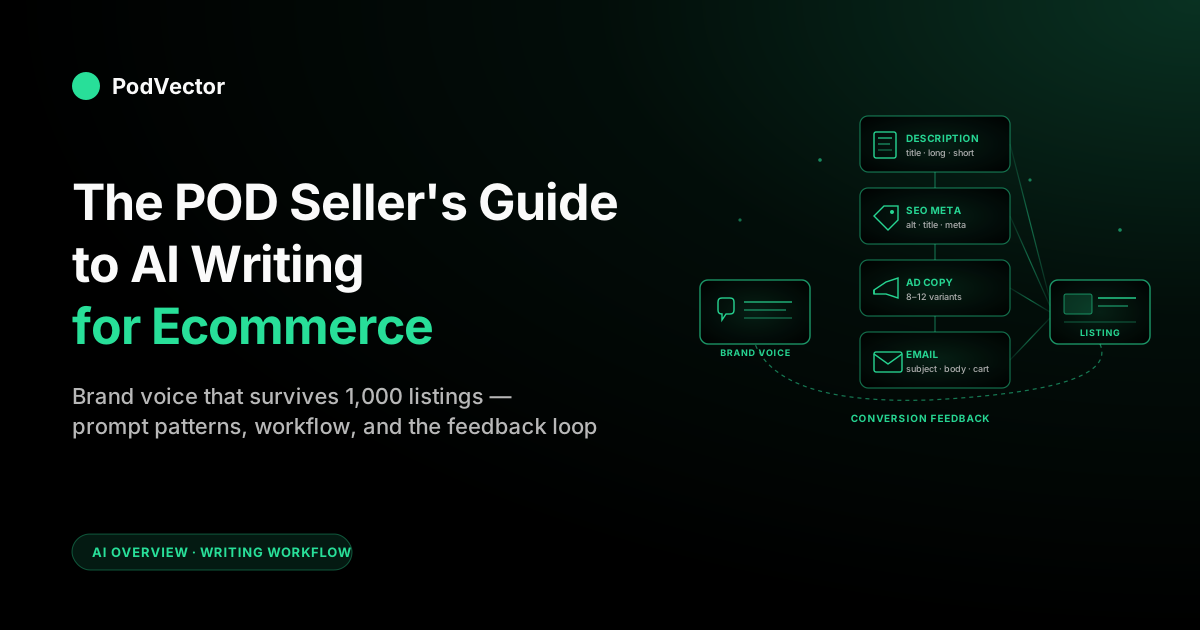
Quick Answer: AI writing for ecommerce in 2026 isn't about pasting a product name into ChatGPT — it's a templated workflow that turns design metadata, audience context, and keyword targets into product copy, ad variants, email flows, and SEO meta in one pass. Generic guides cover the tool list.
For a print-on-demand operator, the real problem is voice consistency at 1,000-listing scale, not draft speed on listing #1. This guide covers which AI writing jobs actually pay off for POD, where the default models quietly fail, the prompt patterns that hold a brand voice across thousands of designs, and how to wire writing output back to the conversion data that says which words actually sell shirts.
What AI writing for ecommerce covers in 2026
Three years ago, "AI writing for ecommerce" meant one thing: feeding a product name into a generator and pasting the output into a description field. That use case still exists and is now the smallest slice of a much wider category. In 2026, the term covers any AI workflow that produces, transforms, or grades the words on a storefront — product titles, long descriptions, alt text, SEO meta, ad copy variants, abandoned-cart emails, blog posts, FAQ entries, social captions, and the structured data that AI search engines now read instead of the page itself.
The reason the definition expanded matters. Per Semrush's 2026 AI report, 96% of ecommerce professionals now use AI somewhere in their workflow, up from 69% in 2024, and 47% specifically use AI to create product content.
The newer pressure is on the search side. AI Overviews now surface on roughly 14% of shopping-intent queries, which means a slice of your buyers read an AI summary of your listing before they ever see the page. Writing for that surface — sometimes called generative engine optimization, or GEO — means structuring copy as clear, attribute-rich blocks an LLM can quote, not just keyword-dense paragraphs a crawler can index.
The early-mover edge of "I use ChatGPT and you don't" is gone. The competitive edge in 2026 is structural — how cleanly your catalog data flows into generation, how consistently the output sounds like one brand, and how quickly you rewrite when conversion data tells you the copy is wrong.
For a POD operator, that structural shift hits hard for one reason: catalog scale. A 50-SKU wholesale brand can rewrite every description twice a year and call it done.
A 500-design POD store can't. The point of an AI writing stack isn't to save fifteen minutes per listing — it's to make catalog throughput stop being the bottleneck on launching designs. Get that framing right and the tool conversation gets simpler.
The tool layers that matter for POD
Most roundups list ten tools and rank them. That misses the structure of the category. AI writing tools split into four layers, each with different ROI and different failure modes for a POD store.
1. General-purpose LLMs (the engines)
ChatGPT, Claude, Gemini. These are the underlying models everything else wraps.
They're cheap (or free) per query and produce excellent output when you write the prompt yourself. For a small store with 50–200 designs, a well-templated ChatGPT prompt with brand-voice examples often beats a $99/month vertical tool. The tradeoff: you build the prompt, you maintain the prompt, and you copy-paste the output into Shopify.
2. Vertical AI writing tools (Jasper, Copy.ai, Anyword, Writesonic, Rytr)
The category that owned 2023. These wrap an LLM with templates for product descriptions, ad copy, blog intros, and email subject lines.
Strong at variety — produce 12 ad copy variants at once, switch between formats fast. Weak at brand-voice consistency unless you do the spec work yourself, which most operators don't.
Per Trakkr's 2026 AI visibility report, Jasper, Copy.ai, and Anyword are the consensus picks across ChatGPT, Claude, Gemini, and Perplexity. Pricing: $20–$100/month per seat.
3. Ecommerce-native writing tools (Shopify Magic, Describely, Hypotenuse AI, Frase)
Built specifically for catalog work. They pull product data directly from Shopify or a feed, produce titles, descriptions, alt text, and meta in bulk, and push back into the catalog without copy-paste.
For POD operators with 200+ designs, this is usually the right tool layer. Shopify Magic is free on most plans and the easiest starting point.
Describely and Hypotenuse AI are stronger at bulk catalog regeneration. The guide to Shopify Magic AI features covers the native option in more detail.
4. Orchestration and agentic writing systems
The newest layer and the one that breaks the per-seat pricing model. Orchestration tools chain text generation with image generation, ad creative, social posts, and email sequences off a single product event.
Agentic systems go further — they read conversion data, identify which listings are underperforming, and rewrite them automatically. Most operators don't need this in 2026, but it's where the category is heading. The guide to AI product content creation covers the orchestration end of this layer.
The choice between layers isn't tool-by-tool — it's where your bottleneck lives. If you write your own prompts and want fine control, layer 1.
If you want template variety for ad creative, layer 2. If catalog throughput is the constraint, layer 3. If you're already past 1,000 designs and the limit is rewrite velocity, layer 4.
Why POD writing breaks generic AI workflows
The same AI writing tools that work cleanly for a 50-SKU wholesale brand quietly degrade on a real POD operation. Three structural reasons.
The catalog is two orders of magnitude larger
A wholesale brand selling 50 SKUs can spend an hour per description and call it craftsmanship. A POD store with 500 active designs across 6 product types and 8 colors has effectively 24,000 listing variants.
Any tool or workflow that requires meaningful human review per listing is broken at this volume. Any workflow that doesn't is producing copy you've never read.
The tension between those two realities is the entire AI writing problem for POD — and it's why "best tool" lists miss the point. The tool that fits is the one whose default workflow assumes you won't review every output.
Niche voice is the product
POD lives or dies on niche specificity. A vintage retro typography design for cat owners doesn't compete with "men's blue T-shirt size M" — it competes with twenty other cat-owner shirts in the same aesthetic.
The shopper buys the voice as much as the design. Generic LLM output sounds generic by default, and "generic" is exactly what loses a niche tee shop.
The writing system has to encode niche-specific voice (dad-joke energy, snarky craftcore, soft-girl pastel) in a way that survives bulk generation. That's a brand-voice problem, not a tool problem.
Margins are tight enough that copy quality moves the P&L
POD margins are typically 25–40% before ad spend. A 1% conversion rate uplift from better copy on a paid-traffic listing is the difference between a winner and a break-even.
Wholesale brands can absorb mediocre copy because their unit economics let them. POD operators can't.
That makes the conversion-feedback loop more important on POD than on any other ecommerce vertical — and it's the loop most operators skip entirely. The guide to AI for ecommerce business walks through the margin math in more detail.
High-leverage writing jobs to automate first
Narrowing the field: these are the writing jobs where AI in 2026 is reliably better than a manual workflow at POD scale. Start here, in roughly this priority order.
Bulk product descriptions
Highest-volume task, biggest unlock. A templated prompt with design metadata, niche keywords, audience context, and 5–10 brand-voice examples produces a usable first draft for hundreds of listings in an afternoon. The output isn't always your final copy — it's the floor that beats "filename plus 'available in 5 colors.'" Catalog tools (Shopify Magic, Describely, Hypotenuse AI) handle this end-to-end; LLM-with-spreadsheet workflows handle it for free if you'll spend the prompt-engineering time.
Product titles optimized for search
POD shoppers find listings through Google Shopping, Etsy search, and increasingly through ChatGPT and Perplexity product queries. The right title format — primary keyword, design descriptor, product type, audience — moves more traffic than any clever copy.
AI is reliably better than manual templating at packing all four into 60–80 characters that read naturally. Run as a batch job on the full catalog quarterly.
Alt text and accessibility metadata
Free SEO and free compliance lift. AI handles alt text well because the constraints are tight: describe the design, mention the product type, stay under 125 characters.
Most POD stores ship listings with empty alt text or alt text that's just the filename. An LLM with vision can generate accurate, keyword-relevant alt for an entire catalog overnight. The accessibility win matters in its own right; the SEO bonus and AI-search-engine indexing are bonuses that compound.
Ad copy variants from product copy
The one-to-many multiplier. Once a product description exists, an LLM can produce 8–12 ad copy variants for Meta, TikTok, and Google Shopping in seconds — different hooks, different angles, different lengths.
The variant volume is what feeds the testing loop, and POD is one of the niches where ad creative testing actually moves numbers. Generic AI tools treat ad copy as a separate prompt; orchestration tools chain it off the product page so you don't double-enter context.
SEO meta titles and descriptions
Boring, repetitive, high-leverage. AI is better than most operators at packing keywords into a 60-character meta title without sounding mechanical, and at writing 155-character meta descriptions that read like a human wrote them. Run as a batch every quarter; the search-traffic compounding is real.
Email subject lines and abandoned-cart copy
Underused. The same brand-voice spec that produces product copy can produce a winback email, an abandoned-cart sequence, a post-purchase thank-you, and a re-engagement flow in a single pass.
POD operators leave money on the table here because email tooling is treated as a separate workflow. It shouldn't be — same brand, same voice, same source data.
Customer-support replies and FAQ copy
The job every tool roundup lists and most POD operators ignore. Sizing questions, "where's my order," print-quality concerns, and return policy come up on the same shirts over and over — and the answers are the same brand voice your listings already use. An LLM grounded in your shipping times, supplier (Printify or Printful) production windows, and return policy drafts replies and a structured FAQ block in one pass, so support copy doesn't drift into a flatter, off-brand tone than the storefront. Keep a human in the loop on anything touching refunds or claims; automate the repeat 80%.
Multi-language listings
Translation used to be the slowest path to a new market. Brand-aware AI translation (not just literal) makes Spanish, German, French, and Japanese listings affordable for POD operators who'd otherwise stay US-only. Pair with a per-market human spot-check on the first 50 listings, then trust the process to keep going.
Where AI writing quietly fails
The expensive failures aren't dramatic. They don't produce obvious gibberish. They produce competent-looking copy that quietly underperforms — and the symptoms hide in conversion rate, not in the listing itself.
Default-LLM voice that sounds like every other store
Default LLM output sounds like default LLM output, and shoppers (and Google) increasingly recognize it. Per Ideqo's 2026 analysis, consumer preference for AI-detected content dropped from 60% in 2023 to 26% in 2026 — the same copy that converted three years ago now actively repels shoppers. The fix isn't a fancier model; it's brand-voice grounding (covered below).
Hallucinated product attributes
The LLM cheerfully invents specs. "Made from 100% organic cotton" when your supplier uses a 50/50 blend. "Ethically sourced" when nobody verified. These claims become legal exposure the moment a customer screenshots them. Constrain the model to only reference attributes that exist in your structured product data, and add a prohibited-claims list to the system prompt. SL Development's guide covers the legal-risk angle in more detail.
Duplicate-content drift across the niche
When you generate descriptions for 50 designs in the same niche, the model converges on the same phrases. Three listings with "perfect for cat lovers" word-for-word is a duplicate-content signal Google notices. Fix by injecting per-listing variation prompts (different angle, different reader voice, different opening) and by running a similarity check on each batch before publishing.
Keyword stuffing dressed as SEO
Tools that optimize for keyword density without optimizing for readability produce listings that hit every target term and convert at half the rate of looser, human-feeling copy. The cost shows up in conversion rate, not search rankings — so it's invisible if you only track traffic.
Tone collisions across the catalog
One batch is generated with a casual prompt, the next with a polished one, the third with a Shopify Magic default. Six months in, your catalog reads like five different brands collaborated on it. The fix is process — one canonical brand-voice spec, used in every generation step, audited quarterly.
Prompt patterns that hold a brand voice
The single biggest predictor of whether AI writing works for a POD store is whether brand voice survives the volume. Get this wrong and your store sounds like a generic tee shop with rotating designs. Get it right and the catalog reads like one writer made every listing.
Four patterns that separate brands that hold voice from brands that don't:
Anchor every batch with examples, not adjectives
"Write in a casual, friendly voice" is too vague to constrain a model. Five example listings written in your voice constrain it tightly. Always include examples. The hand-curated examples are the asset; the adjective list isn't.
Enforce a vocabulary stop-list
Words you never use ("perfect," "amazing," "elevate," "showcase," "boasts," "unleash," "step into," "level up") go in the system prompt as forbidden. The default LLM voice is built on these, so removing them forces the model toward something more specific and less generic-AI.
Inject niche-specific context
The system prompt knows your store sells cat-themed shirts; the per-listing prompt should know whether this design is sarcastic-cat-mom energy or wholesome-grandma-with-cats energy. The metadata doing the niche disambiguation is the second-most-important input after brand voice. Generic AI fails here because it doesn't know to ask.
Ground prompts in real audience data
The highest-leverage upgrade most operators haven't made: feed the prompt your actual top-performing listings and let the model see what's already working. "Here are five listings with above-median conversion this quarter; write in their voice for this new design." That's the data-grounded prompting pattern, and it's only possible if you have per-listing conversion data accessible. Most POD operators don't, which is why most POD AI copy reads generic.
The second source most operators ignore is the shopper's own words. Pull the exact phrases from your product reviews, Q&A, and support tickets — "runs big," "the print held up after 20 washes," "perfect for my cat-mom sister" — and hand them to the model as approved vocabulary. Review-grounded copy sounds like a real buyer because it literally borrows real buyers' language. The guide to AI analytics for print-on-demand covers how Victor keeps your store data organized so this kind of data-grounded prompting works.
A weekly AI writing workflow for POD
Tool choice matters less than process. The data backs this up: industry surveys put roughly 70% of failed AI rollouts on process problems rather than the technology, and only about 7% of companies have AI fully scaled into daily operations. The gap between buying a tool and running it is where most POD stores stall.
Below is the cadence that scales for a POD operator publishing 30–120 designs per month. Adjust the volume; the structure stays the same.
Monday — Inputs and metadata
Every new design from the prior week gets its metadata fields filled: niche, theme, mood, target shopper, key visual elements, target keywords, intended product types. This is the bottleneck most operators skip. Without it, every downstream AI step has to guess. With it, the rest of the week runs cleanly. Plan 30 seconds per design in this step.
Tuesday — Generation pass
Run the batch generation: titles, long descriptions, short descriptions, alt text, three meta descriptions per listing, and 8–12 ad copy variants — all from the structured input plus the brand-voice spec. Output is JSON so the next step can route each field to the right destination.
Concurrent: image AI generates 4–6 mockup variations. The guide to generative AI for ecommerce covers the image side of the same workflow.
Wednesday — Constraint check
Automated quality gates before publish. Hallucinated claims caught (regex against banned-attributes list). Duplicate-content similarity score against existing listings in the same niche. Reading level inside the brand spec. Keyword density not over a set ceiling. Failed listings flagged for review; passing listings continue.
Thursday — Spot-check and publish
One in 20 listings reviewed by a human, weighted toward niches that are new or high-traffic. The human's job here isn't writer — it's AI editor: score each on three axes (brand voice, accuracy, conversion-readiness) and feed the patterns back into the brand-voice spec. That editor role is the consensus 2026 model — AI drafts at volume, a human owns quality assurance and voice — and it's the one most POD stores under-staff.
Listings push to Shopify with a content_version tag. This is the only step that's not automated — and it's why the workflow doesn't degrade over time.
Friday — Track and triage
Pull conversion data on the listings that have been live 30+ days. Bottom-quartile listings get flagged for regeneration with new prompts.
Top-quartile listings get added to the brand-voice example bank. The point of Friday is keeping the system learning, not just running. Skip this and the workflow degenerates into "we generate stuff and never look at it."
Closing the loop: writing → conversion → rewrite
The most overlooked step in any AI writing workflow is feedback. Most operators generate listings, push to Shopify, and never come back. The high-margin operators close the loop: every listing has a conversion signal attached, and every poorly converting listing gets rewritten.
The mechanism is straightforward in principle and structurally hard in practice. You need three things wired together:
- A way to track per-listing conversion data (Shopify analytics handles the basics; an analytics layer that ties listing version to revenue handles the rest).
- A way to ask questions about that data in plain English, so finding underperforming listings doesn't take writing any code each time.
- A way to feed underperforming listings back into the generation step with new prompts — not the same prompt that produced the underperformer.
This is where the conversation about "AI writing" merges with the conversation about "AI analytics." The two used to be separate categories with separate vendors; the agentic shift is collapsing them. Victor — PodVector AI's AI employee for POD sellers — already handles the second piece: ask "which listings published in March had below-median conversion?" and get an answer against your live data joined from Shopify, Printify or Printful, and your ad accounts.
The third piece — automated rewrite — is on the employee roadmap. Victor surfaces the answer and ships the rewrite — with your approval. The complete guide to AI agents for ecommerce analytics walks through that analyst-to-action trajectory.
What an AI writing stack actually costs
Marketing copy for AI writing tools loves the "save 75% of writing time" line. That's true at the unit level and misleading at the stack level. The actual cost of an AI writing workflow at POD scale has five components:
- LLM API or vertical tool subscription: $20–$200/month. ChatGPT Plus and Claude Pro at the cheap end; Jasper, Copy.ai, and Hypotenuse AI in the middle; Describely and orchestration suites at the top.
- Catalog integration: $0–$100/month. Free if you use Shopify Magic. $30–$100/month for Describely, Hypotenuse AI, and similar that push directly into the catalog.
- Brand voice and spec maintenance: 2–4 hours/week of human time. Don't skip — this is the line between "scaled content" and "scaled garbage."
- Spot-check and triage: 1–3 hours/week. The 1-in-20 review and the rewrite triage on bottom-quartile listings.
- Conversion analytics: $0 if you only use Shopify's built-ins, $50–$500/month for a POD-aware analytics tool that ties listing version to revenue. The complete guide to AI tools for POD sellers covers this category.
Ballpark for a working stack on a 500-design POD store: $100–$500/month in tooling, plus 4–7 hours/week of human time. The payoff is publishing throughput that doesn't bottleneck on writing — which is the difference between launching 30 designs a month and launching 120, on roughly the same effort budget.
Mistakes POD operators make with AI writing
The errors that cost more than the tool subscription saved:
- Treating "save time" as the entire ROI. Time savings are nice; the real ROI is publishing throughput, ad creative volume, and conversion compounding. If your only KPI is hours saved, you're under-using the stack.
- Skipping the brand voice spec. Without it, every batch sounds like a different brand. With it, the same model produces consistent output for a year.
- Reviewing every listing. The point of the workflow is that you don't. Spot-check 1 in 20 and trust the pipeline; reviewing every listing collapses the throughput advantage.
- Generating but never measuring. Listings without conversion tracking are invisible to the optimization loop. The whole stack underperforms.
- Buying tools before fixing inputs. Orchestration tools amplify whatever's upstream. If your design metadata is messy, an orchestration tool just produces messy content faster.
- Treating AI writing as a one-time project. The first batch is the easy part. Quarterly voice audits, conversion-driven rewrites, and prompt iteration are where the long-term margin lives.
If any of these are familiar, the fix is structural rather than tactical. Tighten the inputs and the loop, and the tool layer mostly takes care of itself. For broader context on where AI writing fits in the wider stack, the AI overview cluster covers adjacent topics, and the AI analytics topic hub ties writing output back to the measurement layer that makes it pay.
FAQs
Does AI writing actually work for print-on-demand stores?
Yes, but the ROI shape is different from wholesale ecommerce. The win isn't "save time on listing #1" — it's publishing throughput at catalog scale.
A 500-design POD store can't afford manual content creation; an AI writing workflow is the only way to maintain quality across that volume. Operators who treat AI writing as a one-shot description generator see modest gains. Operators who build it into a weekly workflow with feedback loops see compounding ones.
What's the best AI writing tool for ecommerce in 2026?
It depends on your stack and scale. Per the 2026 consensus across major AI platforms, Jasper, Copy.ai, and Anyword lead the vertical-tool category.
Shopify Magic is the easiest starting point for stores under 200 designs and is free on most plans. Describely and Hypotenuse AI win on bulk catalog work above 500 designs.
For the highest leverage, an orchestration approach (chain text, image, ad copy off one product event) beats any single-purpose tool. The best AI for ecommerce comparison covers the broader category.
Will Google penalize AI-written product descriptions?
Not directly. Google's stance since 2023 is that AI content is fine if it serves the reader.
The actual ranking risk comes from generic AI content that's indistinguishable from a hundred other stores — duplicate-content patterns, thin pages, keyword stuffing without value. An AI workflow with brand-voice grounding, per-listing variation, and uniqueness checks ranks fine. A workflow that runs default ChatGPT prompts on a thousand listings does not.
How do I keep my brand voice consistent across thousands of listings?
Three practices: anchor every batch with 5–10 example listings in your voice (not adjective lists), enforce a vocabulary stop-list of words you never use, and audit 30 random listings quarterly to catch drift. Brand voice in 2026 is the moat that survives commoditization of the underlying AI tools, so the time invested compounds.
Should I use ChatGPT or a vertical AI writing tool?
For under 100 designs, a well-templated ChatGPT or Claude prompt with brand-voice examples is hard to beat — cheap, flexible, fully under your control. Above 200 designs, the catalog integration of vertical tools (Shopify Magic, Describely, Hypotenuse AI) usually wins because the bottleneck shifts from prompt quality to operational throughput. The guide to ChatGPT for Shopify covers the LLM-native approach in more detail.
How much time does AI writing actually save on a POD store?
For description writing specifically, 75–88% of writing time per listing — that part of the marketing copy is real. The bigger time saving is at the catalog level: launching 100 new designs in a week with full content goes from "impossible" to "scheduled." Plan on 4–7 hours/week of human time on spec maintenance, spot-checks, and rewrite triage; the rest is tool time.
Can AI write product descriptions that actually convert?
Yes, with two conditions. The prompt has to encode brand voice and niche specificity (not generic LLM defaults), and the workflow has to feed conversion data back into the prompt over time.
Without conversion feedback, AI writing produces copy that's grammatically correct and emotionally generic — competent but unconverting. With feedback, the system learns which language patterns work for your audience and the gap between AI and human-written copy effectively closes.
How do I write product copy that shows up in AI Overviews and ChatGPT results?
This is the generative engine optimization (GEO) question, and it's newer than classic SEO. AI summaries pull from copy that states attributes plainly — material, fit, use case, audience — in short, quotable blocks rather than keyword-stuffed prose.
Structure each listing so the model can lift a clean sentence: lead with what the product is and who it's for, keep claims accurate and specific, and put sizing, material, and care facts in their own lines. The same brand-voice spec still applies; GEO changes the shape of the copy, not the voice.
What about AI writing for blog content and SEO articles?
Different problem, related toolkit. Long-form ecommerce blog content benefits from a different prompt structure than product copy — outline-driven, intent-matched, internally linked. The same brand-voice spec applies. The guide to AI search for ecommerce covers how AI-generated content interacts with the new generation of AI-powered search engines like ChatGPT Search and Perplexity.
The writing stack only pays off if you can measure what worked
Generating 1,000 listings is the easy part. Knowing which 200 actually convert, which 300 are wasting ad spend, and which 500 need a rewrite — that's the loop most POD stores never close. Victor reads your live Shopify, Printify or Printful, and Meta data and answers questions in plain English: "which listings I published in March had below-median conversion?" Victor surfaces the answer and closes the loop — with your approval.
Try Victor free