
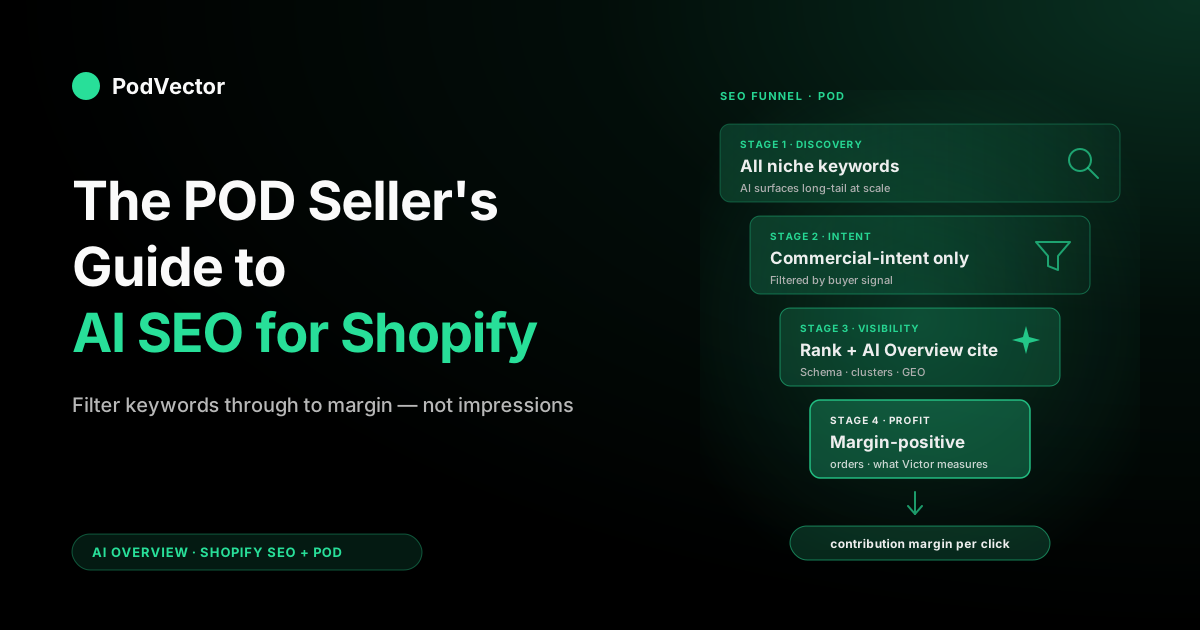
Quick Answer: AI SEO for Shopify is the use of large language models and machine-learning tools to do four jobs at once on a Shopify store: keyword research, content generation at catalog scale, technical and on-page optimization, and visibility inside AI-generated answers (Google AI Overviews, ChatGPT shopping, and other AI answer engines).
Generic guides treat Shopify like a wholesale brand with 50 SKUs. Print-on-demand inverts that — you optimize thousands of design pages that share a base product, where the differentiation lives in the title, the description, the schema, and the design intent.
This guide walks through what actually works, which AI SEO tools are worth their subscription on a POD store, and where the AI Overview shift changes the SEO playbook for POD sellers on Shopify.
What "AI SEO for Shopify" actually means in 2026
"AI SEO for Shopify" is the umbrella for any workflow that uses machine learning or large language models to make a Shopify store more findable — through Google's traditional ten blue links, through Google's AI Overviews, through ChatGPT and other AI-assistant shopping queries, and through the new wave of LLM-driven product discovery. In practice that breaks into four jobs:
- Keyword and intent research at a depth and speed no manual workflow can match.
- Content generation — product descriptions, collection page copy, blog posts, meta titles and descriptions — at catalog scale.
- Technical and on-page optimization — internal linking, schema markup, image alt text, Core Web Vitals tuning — automated where the work is repetitive.
- Generative engine optimization (GEO) — making sure your Shopify product data is structured the way LLMs expect to read it, so your store appears inside AI-generated answers and shopping recommendations.
The shift that matters for 2026 isn't smarter keyword tools. It's that a meaningful share of product discovery now happens through AI-generated answers instead of search-engine result pages.
Authoritas data cited across the SEO industry shows that for ecommerce specifically, only about 16.7% of Google AI Overview citations overlap with traditional organic results — meaning ranking #1 organically does not guarantee you appear in the AI answer. That gap is the new playing field. For broader category context, the AI Overview cluster covers the category-level picture and the wider AI Analytics topic hub walks through the tooling adjacent to SEO.
Why Shopify is a uniquely good — and uniquely tricky — surface for AI SEO
Shopify's strengths for AI SEO are real: a mature app ecosystem, native AI in the admin (Magic, Sidekick), structured product data the platform exposes cleanly, and built-in schema for products, reviews, and offers. Its weaknesses are also real: duplicate URLs from collection-product pairings, pagination that can dilute crawl budget, default theme performance that hurts Core Web Vitals on long product pages, and a product data model that wasn't designed with thousands of design-as-SKU listings in mind.
Most generic Shopify SEO guides write to the strengths. The work for POD sellers is mostly in mitigating the weaknesses while exploiting the strengths.
Why Shopify SEO for POD is a different game
Apply a generic Shopify SEO playbook to a print-on-demand store and you'll either over-invest in tools that don't move your numbers, or miss the one optimization that would have. Four POD-specific realities reshape the playbook.
You're competing with millions of identical-base products
Every Shopify POD seller selling a Bella+Canvas 3001 t-shirt is selling the same Bella+Canvas 3001 t-shirt as every other Shopify POD seller. The product page differentiation lives almost entirely in the title, the description, the design intent, and the niche language.
Generic AI SEO advice ("use the product name in the title") is useless when the product name is shared by 50,000 stores. POD SEO is design-language SEO: titles and descriptions written in the precise vocabulary of the niche your design targets, indexed against the long-tail queries that niche actually searches. AI tools earn their keep when they help you generate that specificity at the scale of a thousand designs.
The catalog is large, fast-changing, and design-led
A wholesale Shopify brand might launch ten new products a quarter. A working POD store launches ten new designs a week — sometimes a day.
Each design needs a title, a description, meta tags, alt text, and ideally schema-rich structured data. Hand-writing that work doesn't scale, and the cost of leaving placeholder copy live is invisible until you check why your long-tail traffic isn't growing.
AI content generation isn't a luxury here; it's the only way the workflow holds together past a few hundred designs. See the POD seller's guide to AI product content creation for the content-pipeline pattern.
The competing pages share their schema
For POD, the structured-data layer matters more than for almost any other Shopify category. When two thousand stores list the same Bella+Canvas tee, what differentiates your offer in Google's product knowledge graph and inside AI shopping answers is the precision of your structured data: MerchantReturnPolicy, OfferShippingDetails, AggregateRating, exact variant attributes (color, size, fit), Brand, and the descriptive text that ties the design to the niche.
Since January 2026, Google has made several Merchant schema fields effectively mandatory for product visibility inside AI shopping surfaces. Shopify exposes most of these natively if you configure them, and AI SEO tools can fill the gaps — but only if you've decided to take the layer seriously.
Margins are tight, so wasted SEO effort hurts more
A wholesale brand with 60% gross margins can absorb an SEO program that takes a year to pay back. A POD seller with 25–35% gross margins on a hoodie cannot.
Every hour spent optimizing for a query that doesn't convert at margin-positive cost-per-click is an hour with negative ROI. AI SEO done well for POD is ruthlessly intent-filtered: prioritize queries with commercial intent in your niche, not vanity volume. The complete guide to break-even analysis for Shopify POD walks through the unit-economics math you need to set those filters.
The 6 AI SEO workflows that move the needle for POD
Of all the things AI can do for SEO on a Shopify store, six workflows deliver the bulk of the value for POD sellers. Everything else is either nice-to-have or a productivity tweak.
1. Niche-language keyword research at scale
Traditional keyword tools start from seed terms and broaden. AI keyword workflows start from your designs — the metadata, the niche, the audience — and surface the long-tail vocabulary the niche actually uses.
A trail-running design might index against twenty distinct sub-niches (ultra runners, Appalachian Trail thru-hikers, dad-strength trail runners, women's trail running gear gifts, etc.), each with its own micro-vocabulary. ChatGPT, another general-purpose LLM, or a dedicated tool like Surfer or Semrush's AI features can take a single design brief and surface the cluster of queries it should target. Done well, this is the single highest-leverage AI SEO work for POD.
2. Product description generation tuned to design intent
Shopify Magic, ChatGPT, and other LLMs can generate a product description in seconds. The hard part isn't generation — it's prompting the model with enough of the design's intent that the output sounds like your brand and indexes against the right queries.
The pattern that works: a prompt template that ingests design metadata (title, niche tags, target audience, design style notes), generates a description using the niche-specific vocabulary you identified in workflow #1, and outputs in your brand voice with the right keyword density. Sample-review one in twenty for quality control. The POD seller's guide to AI writing for ecommerce covers the prompting patterns in depth.
3. Meta titles, descriptions, and structured snippets at catalog scale
Title tags and meta descriptions are the single most under-invested SEO surface on most Shopify POD stores. A thousand designs means a thousand titles and a thousand descriptions, and the default Shopify auto-generation produces near-duplicates that compete with each other in the index.
AI batch workflows can take your design metadata and produce title-tag and meta-description variants tuned to keyword intent and click-through, then push them into Shopify via the Admin API or via apps like SEOWILL, SEOAnt, or Smart SEO. The investment of a single afternoon on a thousand designs typically pays back in months.
4. Internal linking and collection-page copy
Internal links are how Google understands the topical structure of your store. A POD store with a thousand product pages and a handful of collection pages is structurally a flat graph — bad for SEO.
AI tools can analyze your catalog, propose collection groupings (by niche, by occasion, by style), generate the collection-page copy, and suggest which product pages should link to which collections. Alli AI and similar tools automate the link-injection itself. Done once at scale, this is one of the largest one-shot SEO lifts most POD stores can capture.
5. Image alt text and on-page schema
POD product pages live and die by their image SEO. The mockup is the product.
AI vision models can generate descriptive alt text for every product image at near-zero marginal cost (apps like SEOWILL include this), and AI workflows can enrich your product schema with the variant attributes Google now expects (color, size, material, return policy, shipping details). For POD specifically, alt text that includes the design subject and niche language ("trail running ultra-distance long sleeve t-shirt with mountain-range graphic") is meaningful long-tail visibility you don't capture if you let Shopify default to file names.
6. AI Overview and LLM shopping optimization
The fastest-growing surface for ecommerce discovery is AI-generated answers. Optimizing for it is its own workflow — covered in detail in the next section — but it deserves a slot in the use-case list because for POD niches, AI Overview optimization often outperforms traditional ranking optimization. Long-tail queries that LLMs handle ("a t-shirt for my friend who just finished her first marathon, ships before Mother's Day, under $35") are exactly the ones POD niche stores can win on, and exactly the ones where competing on raw blue-link rank is impossible.
Optimizing for AI Overviews and LLM shopping
The defining shift in Shopify SEO for 2026 is the rise of AI-generated shopping answers. A growing share of product research starts in ChatGPT, other AI assistants, or directly inside Google's AI Overview block above the traditional results. For POD sellers on Shopify, this isn't a side workflow — it's increasingly the main one.
Why AI Overview optimization differs from traditional SEO
Traditional SEO optimizes pages for ranking. AI Overview optimization optimizes pages for citation — being the source the LLM quotes or links from in its answer. The criteria overlap but aren't identical. LLMs reward:
- Direct answers to specific questions embedded in product and content pages.
- Structured data that disambiguates the product (precise attributes, returns, shipping, brand).
- Authoritative-sounding context — descriptions that explain who the product is for and why, not just what it is.
- Topical clusters — multiple pages on a theme that establish your store as a credible source on that niche.
- Cited brand mentions across the web, since LLMs use mention frequency as a credibility signal.
What POD sellers should actually do for AI Overview visibility on Shopify
Six concrete moves, in priority order:
- Add MerchantReturnPolicy and OfferShippingDetails to every product offer. Since January 2026, Google treats these fields as effectively mandatory for product visibility inside AI shopping surfaces. Shopify Markets handles much of this if configured; otherwise apps like Smart SEO or JSON-LD for SEO close the gap.
- Write product descriptions as direct answers. Lead with who the product is for, what occasion or use case it serves, and what makes the design specific to that use case. LLMs cite the page that contains the answer in plain text, not the page that buries it under marketing copy.
- Build niche topical clusters around your design themes. A blog post or pillar page per niche, linking to the relevant collection and product pages. The cluster signals topical authority. The POD seller's guide to AI for ecommerce product content creation walks through the pillar-cluster pattern for POD.
- Use precise variant attributes in product schema. Color, size, material, fit, age group, gender. LLM shopping agents filter on these; if your data is missing them, you're invisible to a structured query.
- Cultivate brand mentions in your niche. Reviews, Reddit mentions, niche-blog features, podcast appearances. LLMs use brand-mention density as a trust signal more than traditional search did. This is the slow compound move.
- Monitor AI shopping referrals separately from organic. They look like direct traffic in most analytics tools — set up referrer rules, UTM tagging where possible, and ChatGPT and AI-assistant referral identification. The POD seller's guide to AI for Shopify covers the broader native-AI integration patterns.
The 16.7% problem
The Authoritas data point everyone in SEO is repeating — that only 16.7% of Google AI Overview citations for ecommerce overlap with the top-ranking organic results — has a corollary that matters for POD specifically. AI Overview citations skew heavily toward content-rich pages: blog posts, guides, comparison pages, niche-authority sites.
They under-represent thin product pages with default Shopify copy. Investing in long-form content that actually answers buyer questions — and that links naturally to your relevant product pages — is the closest thing to a high-leverage hack in 2026 SEO. POD niches are particularly fertile here because the content gaps are wide.
The AI SEO tools worth running on a Shopify POD store
The AI SEO tool category is crowded. For Shopify POD sellers specifically, the tools worth a subscription cluster into five buckets. Pick one or two from each bucket; don't stack five.
Native Shopify AI: Magic and Sidekick
Free, included, and capable of more SEO work than most sellers use them for. Magic generates product descriptions, meta descriptions, blog posts, and email copy at speed.
Sidekick can answer questions about your store's traffic and conversion data without you opening a report. For an early-stage POD store, the native layer covers 60–70% of the AI SEO workflow with zero extra spend. Lean on it before paying for anything else.
SEO platforms with deep AI features: Semrush, Surfer, Ahrefs
The legacy SEO platforms have all rebuilt around AI in the last 18 months. Semrush's Copilot, Surfer's content-optimization workflow, and Ahrefs' AI features bring keyword research, competitor analysis, content scoring, and topical-authority mapping into a single workflow.
For a POD store with serious SEO ambition past $100K/year in revenue, one of these three is worth the $100–300/month. Surfer is particularly strong for content optimization; Semrush is the most complete; Ahrefs has the deepest backlink dataset.
Shopify-native SEO apps with AI: SEOWILL, SEOAnt, Smart SEO, Booster SEO
These apps live inside the Shopify admin and automate the repetitive on-page and technical work — alt-text generation, meta-tag generation, schema enrichment, broken-link auditing, image compression, sitemap optimization. Most have AI-powered batch generation now.
For POD stores with hundreds or thousands of products, one of these is essentially mandatory; doing the same work manually costs more in time than the subscription. SEOWILL and SEOAnt are the two most-installed; Smart SEO is the cleanest interface.
LLMs as AI SEO copilots: ChatGPT and the general-purpose models
The single highest-leverage tool in any AI SEO stack. The general-purpose LLMs handle keyword brainstorming, content drafting, prompt-template engineering, schema generation, and competitive analysis.
The skill is in the prompting, not the tool. A well-prompted LLM session can do more SEO work in an hour than a junior SEO consultant in a day.
Cost: $20/month per seat. For POD stores at any size, at least one LLM subscription is the highest-ROI dollar in the stack.
Generative-engine optimization specialists
A new tool category emerging in 2025–2026: tools specifically built to optimize for AI search engines and LLM shopping. Frizerly, Profound, Otterly.AI, and Daydream are early entrants.
They monitor ChatGPT, Google AI Overview, and other AI-answer citations, surface what queries you appear in (and don't), and benchmark you against competitors in those AI surfaces. For POD stores willing to invest early in the GEO category, these tools can shortcut what would otherwise be a year of trial and error. The category will consolidate; pick one with a flexible contract.
Where Victor fits: the operator that acts on SEO, not another dashboard
Every tool above reports on ranking, traffic, or AI visibility. None of them does the work, and none tracks your itemized Printify and Printful supplier costs — so none can move spend or listings toward the queries that actually earn margin.
Victor is an AI employee, not a report. He can change your Shopify prices and discounts, and shift your Google Ads and Meta Ads budgets and keywords toward the searches that convert at positive contribution margin — asking for your approval before each change.
Because he sees your Shopify orders, your Printify and Printful costs, and your ad and organic traffic all together, he can judge every move by real margin, not vanity traffic. See the complete guide to profit tracking for Shopify POD stores for how he tracks it.
For an outside view of the broader AI SEO tool landscape, Shopify's own roundup of best AI SEO tools covers the general-purpose category well — the POD-specific profit-aware layer is where this guide adds beyond that starting point.
A realistic AI SEO stack for a Shopify POD seller
You don't need every tool in every category. A working AI SEO stack for a Shopify POD store in 2026 looks roughly like this:
- Native: Shopify Magic + Sidekick, free, used aggressively for product copy and admin questions.
- One LLM: ChatGPT or a comparable general-purpose model, $20/month, used as a daily SEO copilot for keyword research, drafting, and prompt templates.
- One Shopify SEO app: SEOWILL, SEOAnt, or Smart SEO, $20–60/month, for alt-text, schema, and meta-tag automation across thousands of designs.
- One SEO platform (above $100K/year revenue): Surfer SEO or Semrush, $100–300/month, for keyword and content workflows. Skip until revenue justifies.
- One GEO monitor (optional, recommended): Profound, Otterly, or Frizerly, $50–200/month, for AI Overview and LLM citation tracking.
- Profit-aware analytics: Victor or a comparable POD-native analytics layer, so SEO decisions can be made against contribution margin instead of vanity traffic.
Total stack cost: $40–600/month depending on revenue stage. The single biggest mistake is buying the SEO platform tier before you have the volume to use it. Start with native + one LLM + one Shopify app. Add the rest as the data justifies.
How to measure AI SEO that actually converts
Most AI SEO workflows get measured on the wrong number. Ranking improved. Impressions are up. Click-through went from 2% to 3%. None of those tell you whether the work paid back. For a POD store on Shopify, the measurement that matters is contribution margin per organic visit, segmented by landing page and query.
The vanity-metric trap
An AI SEO program that doubles your impressions in three months sounds successful. Then you look at conversions and find the new traffic is entirely informational — people researching, not buying.
Worse, the orders that did come through were on low-margin SKUs that lost money after fulfillment. The vanity metrics improved; the business didn't. POD margins are too tight to chase impressions for impressions' sake.
The metrics worth watching
- Contribution margin per organic landing page, over a 90-day window, after Printify or Printful supplier cost, Shopify fees, and payment processing.
- Contribution margin per ranking keyword — which actual queries are driving margin-positive orders, not just clicks.
- AI Overview citation rate for your priority queries — what share of buyer-intent queries in your niche cite your store.
- Repeat-purchase rate of customers acquired organically — organic visitors are usually higher LTV than paid; segment to confirm.
- Schema completeness across the catalog — share of products with full MerchantReturnPolicy, OfferShippingDetails, and structured attribute coverage.
The first two metrics require itemized supplier-cost data Shopify doesn't natively reconcile. This is where a POD-aware analytics layer is the difference between SEO that grows the business and SEO that grows the report. The complete guide to Shopify COGS tracking for POD walks through the data plumbing.
Mistakes POD sellers make with AI SEO on Shopify
Auto-publishing AI-generated content without review
AI content generation is fast enough that the temptation to publish unedited at scale is real. Don't. Sample-review one in ten product descriptions, one in five blog posts.
Google's helpful-content systems penalize obvious AI sloppiness, and LLM shopping engines will under-cite a store that reads like spun copy. The tooling lets you generate ten thousand pages a day; quality control is what determines whether those pages help or hurt.
Optimizing for traffic instead of margin
The most common POD SEO failure: ranking for queries that don't convert at margin-positive cost. A "best gift for runners under $30" query at high volume sounds great until you realize the orders it generates are entry-price hoodies that cost $19 to fulfill on a $24 sale. SEO without a contribution-margin lens is exactly the same trap as paid acquisition without true ROAS.
Ignoring schema because Shopify "handles it"
Shopify's default product schema is a starting point, not a finished implementation. Without explicit MerchantReturnPolicy and OfferShippingDetails, your products are invisible to a growing share of AI shopping surfaces.
Without complete variant attributes, you don't show up when an LLM filters on color or size. Take the schema layer seriously; it's the highest-leverage technical work in 2026 ecommerce SEO.
Stacking five SEO apps that do the same thing
Six AI SEO apps, each with overlapping features, each charging a subscription, each with its own dashboard. The point of AI is to reduce the surface area of attention you spend on your business — not expand it. Audit your stack quarterly. If two apps overlap, kill the weaker one.
Treating AI SEO as a one-shot project
SEO is compound. AI SEO is more compound, because the tooling lets you iterate faster.
The mistake is doing one batch of AI SEO work at launch, then leaving the catalog static for six months. POD catalogs change constantly; the SEO maintenance has to keep pace. Build a recurring workflow: batch-generate copy for new designs weekly, audit existing pages monthly, refresh top-traffic pages quarterly.
Skipping the AI Overview workflow because "it's still early"
By the time AI Overview optimization stops being early, the niches will be locked in by the brands that started in 2025–2026. The stores that establish topical authority in their niches now will be the cited sources when LLM shopping is mainstream. Waiting until the data is overwhelming is waiting too long.
Trusting AI keyword research without commercial-intent filtering
An LLM will happily surface a hundred long-tail queries for any niche. Many of them will be informational or low-intent. The work after generation is filtering for queries with buyer intent at margin-viable CPC. Done well, AI SEO is a force multiplier; done badly, it's a faster way to write the wrong thousand pages.
FAQs
What is AI SEO for Shopify in plain English?
It's the use of AI tools — large language models like ChatGPT, machine-learning SEO platforms like Surfer and Semrush, and Shopify-native AI like Magic — to do SEO work that used to require manual effort: keyword research, content generation, on-page optimization, schema markup, and visibility inside AI-generated shopping answers. For POD sellers specifically, it's the only practical way to handle SEO at the scale of a thousand designs.
Does Shopify have built-in AI SEO?
Partially. Shopify Magic generates product descriptions, blog posts, and meta descriptions.
Sidekick can answer questions about your store's traffic and conversion. Shopify's product schema is auto-generated.
None of this is a complete AI SEO program — you still need keyword research tooling, content optimization, and (increasingly) generative-engine optimization for AI Overviews. Treat the native layer as the floor, not the ceiling.
What's the best AI SEO tool for a Shopify POD store?
There isn't one. The high-ROI stack is small: an LLM subscription (ChatGPT or a comparable model, $20/month) plus a Shopify-native SEO app for batch automation (SEOWILL, SEOAnt, or Smart SEO, $20–60/month).
Add a full SEO platform like Surfer or Semrush only once revenue justifies the $100–300/month cost. Add a GEO monitoring tool (Profound, Otterly) if AI Overview visibility is a serious goal.
Can AI SEO really replace a human SEO?
For a POD store, mostly yes — at the level of execution. AI handles keyword research, content drafting, schema generation, and on-page optimization at a quality level that's hard to beat at the price.
What AI can't replace is the strategic judgment: which niches to target, which queries are commercially viable at your margin, which design themes are worth a content push. A POD operator with a clear sense of their niche can run their own SEO with AI tooling. A POD operator without that sense will be more efficient at producing the wrong work.
How do I optimize my Shopify store for Google AI Overviews?
Six things: complete product schema (especially MerchantReturnPolicy and OfferShippingDetails), product descriptions written as direct answers to who-the-product-is-for questions, niche topical clusters via blog content, precise variant attributes, brand mentions across niche communities, and a measurement loop that tracks AI Overview citations for your priority queries. The shift in 2026 is that ranking #1 organically no longer guarantees AI Overview citation — only 16.7% of citations overlap with top organic results for ecommerce.
How does AI SEO for POD differ from AI SEO for a wholesale brand?
Three differences. POD has thousands of designs sharing identical base products, so differentiation lives in the title, description, and design intent — not in the product spec.
Margins are tighter, so SEO has to be ruthlessly intent-filtered toward queries that convert at viable CPC. And the catalog changes faster, so the AI workflow has to be recurring, not one-shot.
Generic Shopify SEO advice tends to assume a small, stable, distinctive catalog. POD has a large, fast-moving, generic-base catalog. The playbook is different.
Is AI SEO worth it for a small POD store under $50K/year?
Yes, but only the cheap end of the stack. Shopify Magic + Sidekick (free), one LLM subscription ($20/month), and one Shopify SEO app ($20–40/month) is a working stack for under $60/month all-in.
That's enough to handle product copy at scale, schema enrichment, alt text, and meta tags across a growing catalog. Add the more expensive tools only when revenue can absorb them.
How do I know which AI SEO work actually paid back?
Measure contribution margin per organic landing page over a 90-day window — revenue minus Printify or Printful supplier cost minus Shopify fees minus payment processing. If your tooling can't compute that (most generic SEO tools can't), pair the SEO work with a POD-aware profit tool that tracks your itemized supplier costs. Otherwise you're measuring SEO success against vanity metrics that don't tell you whether the work made the business money.
Will AI agents do SEO work autonomously on Shopify in the next two years?
Yes, increasingly. The trajectory is clear: today's AI SEO tools answer questions and generate drafts; tomorrow's AI SEO tools will take bounded actions — pushing meta-tag updates to the Shopify Admin API after sample review, refreshing schema as Google's requirements evolve, generating and publishing pillar-cluster content from a brief.
The same shift the rest of ecommerce AI is going through. The vendors building the agentic substrate now are the ones to watch. The complete guide to AI agents for ecommerce analytics covers the broader category trajectory.
What's the single highest-leverage AI SEO move for a Shopify POD store today?
Niche-language product descriptions and meta tags batch-generated for every design in your catalog, using a prompt template that encodes the design's intent and target audience. Done once at scale on a thousand-design catalog, this typically lifts long-tail organic traffic measurably within 60–90 days, and it's the prerequisite to most of the higher-tier AI SEO work.
Hand your Shopify SEO ops to an AI employee
AI SEO tools tell you what's ranking. They don't do anything about it. Victor does — he can change your prices and discounts in Shopify and move your ad budget in Google Ads and Meta Ads toward the searches that earn margin, asking for your approval before each change. He looks at your itemized Printify and Printful costs next to your Shopify orders, so every SEO move is measured on contribution margin, not impressions.
Try Victor free