
Quick Answer: AI product content creation for ecommerce is using AI to generate and refine the words and images on a product page — titles, descriptions, bullets, alt text, mockups, and ad copy. In 2026 it isn't a single tool but an assembly line that turns structured design data into all of those in one pass.
Generic guides treat it as "use ChatGPT to write descriptions." For a print-on-demand store with 300–2,000 active designs, the real problem is producing thousands of consistent, conversion-tuned listings without losing brand voice or leaking margin to per-seat tool stacks.
This guide shows what to automate, what to keep human, and how to wire content output back to the conversion data that tells you which words actually sell shirts.
What AI product content creation covers in 2026
"AI product content creation" used to be shorthand for "paste a product name, get three paragraphs of copy." That tool category still exists and is now the smallest slice of a much larger surface area. In 2026, the term covers any AI workflow that produces, transforms, or grades the words and images that sit on a product page, in an ad, in an email, or in an organic post. The more useful working definition for an operator: any system that turns structured product data into something a shopper, a merchant feed, or an algorithm reads.
The reason the definition expanded matters. Adoption shifted hard.
Per Semrush's 2026 AI report, 47% of online sellers now use AI to create product content, and 96% of ecommerce professionals report using AI somewhere in their workflow, up from 69% in 2024. Clarity Ventures' 2026 platform roundup describes the same shift as a multimodal expansion — written copy, images, video scripts, and voice all flowing through the same brand context. The early-mover edge that ChatGPT provided in 2023 is gone. Today's competitive edge is structural: how cleanly your catalog data flows into generation, how consistently the output matches your brand, and how fast you rewrite when conversion data tells you the copy is wrong.
For a POD store, that structural shift is unusually consequential. Catalog scale punishes generic copy faster than it does on a curated 50-SKU brand site. A thousand listings that sound the same compress your search rankings, dilute your brand, and quietly waste ad spend on pages that don't convert.
The point of an AI content stack is to scale without flattening — and that's a different problem from "save time on descriptions."
There's a name for the thing the stack is fighting: content debt. Evince's 2026 breakdown defines it as the growing backlog of thin, missing, or stale listing copy a catalog accumulates as it scales faster than the team can write. POD is the worst-case generator of content debt: new designs land weekly, each spawns 4–10 variants, and the backlog compounds until the content stack either keeps pace or the catalog quietly rots. The job of everything below is to keep that debt at zero without a copywriting army.
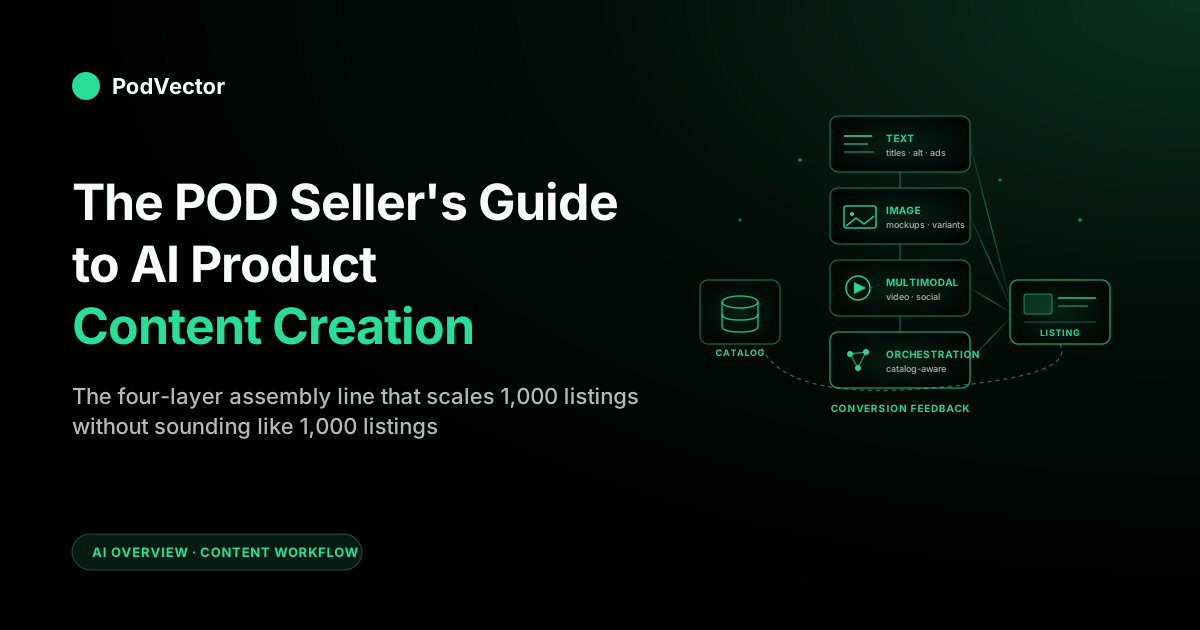
The four-layer AI content stack for POD
Once you stop thinking of AI product content creation as one tool, the working stack falls into four layers. Each one has a different ROI, a different failure mode, and a different reason it's worth (or not worth) paying for.
1. Text generation
The original layer. Tools like Hypotenuse AI, Describely, Copy.ai, Jasper, Writer, and Shopify Magic take structured product data — design title, attributes, design metadata, target keywords — and emit on-brand text.
The strongest of them ground the generation in your existing catalog so output stays consistent with what's already on the site. For POD, this is where the highest-volume work lives: most operators have hundreds of designs that ship with title-cased filenames as descriptions and nothing else. Reading level, length, and structure are the levers; tone is the rail.
2. Image and mockup generation
The fastest-growing layer between 2024 and 2026. Two sub-types matter for POD.
The first is design generation — Midjourney, Ideogram, Adobe Firefly, DALL·E, Imagen — which produces the artwork that becomes the printable file. That's upstream of the listing and gets covered in the best AI art generator for print-on-demand comparison.
The second is mockup and lifestyle generation — placing a design on a model, in a setting, on a varied background — which is what actually ships to the product page. Photoroom, Pebblely, and the new wave of Shopify-native mockup AIs sit here. Mockup AI is structurally cheaper than photographing every variant, and the quality threshold is finally high enough for POD.
3. Multimodal content (video, voiceover, social)
The category that didn't exist in 2023. Short-form video for TikTok and Reels, AI voiceovers for product walkthroughs, social-native carousels generated from the same product data — all are produced inside the content stack now. For POD, the leverage is in turning every new design into a multi-channel asset bundle automatically rather than treating "the listing" and "the ad creative" as separate workflows.
4. Orchestration: catalog-aware content systems
The newest and least understood layer. These tools sit on top of layers 1–3 and bind them to your catalog.
When you create a new product, they generate the title, description, alt text, mockup variations, ad copy, and social asset in a single flow, push the assets into Shopify, and version them. Describely, Ecomtent, and the broader Shopify Magic suite point in this direction. So do the agentic-analytics tools that read content performance and feed insight back to the generation step — the AI assistants guide covers that hand-off in more detail.
Most generic guides cover layers 1 and 2 and skip 3 and 4. For a POD operator, layer 4 is where the leverage lives. Without it, you're paying a per-seat AI subscription per category and stitching them together by hand every time you launch a design.
Why POD breaks generic content workflows
The same tools that work cleanly for a 50-SKU wholesale brand break down on a real POD operation. Three structural reasons.
The catalog is two orders of magnitude bigger
A wholesale brand might have 50 SKUs and rewrite each description twice a year. A working POD store has 300–2,000 active designs, each across 4–10 product types and color variants, and the count compounds every week.
That changes "good copy" from a craft project into a throughput problem. Any tool that requires meaningful human review per listing breaks at that volume. Any tool that doesn't is producing copy you've never read.
The product is the design, and designs are unstructured
A wholesale brand sells "men's blue T-shirt, size M." A POD seller sells "vintage retro typography design celebrating cat owners on a unisex t-shirt." The product attributes that matter — niche, theme, mood, audience — live in the design itself, not in a clean SKU spreadsheet. AI text generators trained on Shopify's average product page don't know what to do with that.
The output reads like a wholesale brand's because the prompt structure was built for one. POD-aware content tools either pull from your design metadata directly or accept structured prompts you can template.
Ad copy and product copy share DNA
POD margins are tight enough that paid traffic typically underwrites a meaningful share of revenue, and ad creative is generated faster and tested harder than on a wholesale store. That means content created for a product page also has to feed ad copy variants, social posts, and email sequences — without manually rewriting the same idea five times.
Generic content tools treat the product page as the destination. POD-appropriate ones treat it as one output of a content event, not the only one.
What AI handles well (automate first)
Narrowing the field: these are the content jobs where AI in 2026 is reliably better than a human at POD scale. Start here.
Bulk product titles and descriptions
Highest-volume task, biggest unlock. A well-templated LLM prompt that reads design metadata, product type, target keywords, and a brand voice spec can produce a usable first-draft title and description for hundreds of designs in an afternoon. The result isn't always your final copy — it's the floor that beats "filename plus 'available in 5 colors.'" Pair with a quality-sample workflow (review every 20th listing) instead of reviewing all of them.
Alt text and accessibility metadata
Free SEO and free compliance lift. AI handles alt text well because the constraints are tight: describe the design, mention the product type, stay under 125 characters.
Most POD stores ship listings with empty alt text or alt text that's just the filename. An LLM with vision can generate accurate, keyword-relevant alt for an entire catalog overnight. The accessibility win matters in its own right; the SEO and AI-search-engine indexing wins are a bonus.
Mockup variation at scale
Where image AI earned its keep. Generating five lifestyle mockups for every new design — different models, different settings, different lighting — used to mean a photoshoot.
In 2026, it means a job that runs while you sleep. Shopify-native mockup tools and standalone mockup AIs both work; the differentiator is whether the tool can hold consistent settings (your "brand world") across hundreds of designs without manual configuration each time.
Ad copy variants from product pages
The one-to-many multiplier. Once a product description exists, an LLM can produce 8–12 ad copy variants for Meta, TikTok, and Google Shopping in seconds.
The variant volume is what feeds the testing loop — and POD is one of the niches where ad creative testing actually moves numbers. Generic AI tools treat ad copy as a separate prompt; orchestration tools chain it off the product page so you don't double-enter context.
Multi-language listings for international markets
Translation used to be the slowest path to a new market. AI translation that's brand-aware (not just literal) makes Spanish, German, French, and Japanese listings affordable for POD operators who'd otherwise stay US-only. Pair with a per-market human spot-check on the first 50 listings, then trust the pipeline.
Filling in and cleaning up product details
The unglamorous job that fixes everything downstream. AI reads a design and fills in the details most POD catalogs leave blank — material, fit, theme, audience, occasion — and cleans up mismatched labels ("tee" vs "t-shirt" vs "T-Shirt") so they all say the same thing.
This matters more than it looks. Clean attributes are what let filters, search, and every later generation step work; a vision model can populate them across a whole catalog in one pass, then your titles and descriptions stop guessing.
Marketplace-ready formatting and syndication
The "create once, adapt many" multiplier. Most POD operators don't sell only on their own Shopify — the same design goes to Etsy, Amazon Merch, and a shopping feed, each with its own title length, bullet rules, and banned-word lists.
AI reformats one source listing into each channel's spec automatically, so a single content event feeds every storefront. Content creation is only half the job; syndicating it cleanly across channels is the other half, and it's where the volume actually shows up.
SEO meta titles and descriptions
Boring, repetitive, and high-leverage. AI is better than most operators at packing keywords into a 60-character meta title without sounding mechanical, and at writing meta descriptions that read like a human wrote them. Run these as a batch job on your full catalog every quarter; the search-traffic compounding is real.
Where AI quietly fails on POD listings
The expensive failures aren't dramatic — they don't produce obvious gibberish. They produce competent-looking copy that quietly underperforms. Five common ones:
Generic descriptions that read like every other store
Default LLM output sounds like default LLM output, and shoppers (and Google) increasingly recognize it. Per Ideqo's 2026 analysis, consumer preference for AI-detected content dropped from 60% in 2023 to 26% in 2026 — the same copy that converted three years ago now actively pushes shoppers away. The fix is brand-voice grounding: feed the model 5–10 examples of your best human-written copy as a style anchor before any batch generation.
Hallucinated product attributes
The LLM cheerfully invents specs that aren't true. "Made from 100% organic cotton" when your supplier uses a 50/50 blend. "Ethically sourced" when nobody verified that. These claims become legal exposure the moment a customer screenshots them. Constrain the model to only reference attributes that exist in your structured product data, and add a prohibited-claims list to the system prompt.
Duplicate or near-duplicate listings
When you generate descriptions for 50 designs in the same niche, the model converges on the same phrases. Three listings with "perfect for cat lovers" word-for-word is a duplicate-content signal Google notices. Fix by injecting per-listing variation prompts (different angle, different reader voice, different opening) and by running a similarity check on the batch before publishing.
Keyword stuffing that sounds machine-built
Tools that optimize for SEO without optimizing for readability produce listings that hit every target keyword and convert at half the rate of looser, human-feeling copy. The cost shows up in conversion rate, not search rankings — so it's invisible if you only watch traffic.
Mockups that don't match brand
AI mockup tools default to generic-bright lifestyle settings. If your brand is darker, more vintage, more streetwear, the default mockups silently undercut the design's appeal. Either lock down a brand-world setting once and reuse it, or accept that mockup AI is producing assets that fit a brand other than yours.
A POD-specific assembly-line workflow
The structural difference between operators who get AI content right and those who don't isn't tool choice — it's whether they treat content creation as an assembly line or as a per-listing craft project. Here's the line that scales.
Step 1 — Structured input
Every new design enters the system with the same metadata fields populated: niche, theme, mood, target shopper, color palette, key visual elements, target keywords. This is the bottleneck most operators skip. Without it, every downstream AI step has to guess. With it, every downstream step gets cheaper and more consistent.
Step 2 — Brand voice spec
One canonical document — 1–2 pages — that defines your voice. Reading level. Sentence length distribution. Words you use. Words you don't. Examples of on-brand and off-brand copy. This goes in the system prompt of every text generation step. Most operators write this once and forget it; revisit quarterly as your brand evolves.
Step 3 — Generation pass
The LLM produces title, long description, short description, alt text, three meta descriptions, and 8–12 ad copy variants in a single pass. Output is structured (JSON) so the next step can route each field to the right destination. Concurrent: image AI generates 4–6 mockup variations.
Step 4 — Constraint check
Automated quality gates before anything publishes. Hallucinated claims caught (regex against a banned-attributes list). Duplicate-content similarity score against existing listings in the same niche. Reading level inside the brand spec. Keyword density not over a set ceiling. Failed listings get flagged for human review; passing listings continue.
Step 5 — Human spot-check
One in 20 listings reviewed by a human, weighted toward niches that are new or high-traffic. The reviewer scores each listing on three axes (brand voice, accuracy, conversion-readiness) and feeds patterns back to the brand voice spec. This is the only step that's not automated, and it's why the workflow doesn't degrade over time.
Step 6 — Publish and track
Listings push to Shopify with a content_version tag. Click-through rate, time-on-page, and conversion rate are tracked per listing version. After 30 days, underperforming listings (bottom quartile on conversion) get flagged for regeneration with new prompts. This is the loop that turns content creation from a one-shot into a learning system.
The leverage of the assembly line is that it scales. Adding 200 new designs in a month becomes a configuration change, not a content project. The constraint becomes design throughput, not content throughput — which is the right constraint for a POD business.
Holding brand voice across thousands of listings
The single biggest predictor of whether AI content works for a POD brand is whether brand voice survives the volume. Get this wrong and your store sounds like a generic tee shop with rotating designs. Get it right and your catalog reads like a brand with a thousand products.
Three practices separate brands that hold voice from brands that don't:
- Anchor every batch with examples, not instructions. "Write in a casual, friendly voice" is too vague to constrain an LLM. Five example listings written in your voice constrain it tightly. Always include examples.
- Enforce a vocabulary stop-list. Words you never use ("perfect," "amazing," "elevate," "showcase," "boasts") go in the system prompt as forbidden. The default LLM voice is built on these, so removing them forces the model toward something more specific.
- Audit the catalog quarterly. Pull 30 random listings every quarter and read them in a row. If they feel like one author wrote them, the system is working. If they read like five tools collided, the spec needs tightening.
The deeper point: brand voice in 2026 is the moat. Generic AI copy is a commodity, and shoppers (and search engines) discount it. Whatever process you build to keep your voice human-feeling at scale is the asset that competitors who don't bother will never reproduce. The POD seller's guide to AI for ecommerce product content creation covers the brand-voice spec format in more depth.
Closing the loop: content → conversion → rewrite
The most overlooked step in any AI content workflow is feedback. Most operators generate listings, push them to Shopify, and never come back. The high-margin operators close the loop: every listing has a conversion signal attached, and every poorly converting listing gets rewritten.
The mechanism is straightforward in principle, structurally hard in practice. You need three things wired together:
- A way to track per-listing conversion data (Shopify analytics handles the basics; an analytics layer that ties listing version to revenue attribution handles the rest).
- A way to ask questions about that data in plain English, so finding underperforming listings doesn't take any coding each time.
- A way to feed underperforming listings back into the generation step with new prompts — not the same prompt that produced the underperformer.
This is where AI content creation stops being a writing problem and becomes an operations one. The two used to be separate categories with separate vendors; the agentic shift is collapsing them. Victor — PodVector AI's AI employee for POD sellers — runs the downstream actions on your behalf.
It watches per-listing conversion against your live Shopify, Printify/Printful, and Meta data, flags the listings dragging your margin, and — with your approval — reallocates ad spend off the losers or pauses them before they burn another week of budget. You don't get a chart to interpret; you get an action proposed and executed once you say go.
The last piece — auto-rewriting the weak copy itself — is on the employee roadmap. Today Victor flags and acts on the spend; tomorrow the rewrite ships too.
For more on what "AI that acts" looks like for a POD operator, the agentic AI for ecommerce guide walks through the spectrum from surfacing insight to taking action. The complete guide to AI analytics for print-on-demand covers the data layer that makes the loop measurable.
The real cost stack of an AI content workflow
Marketing material for AI content tools loves the line "save 75% of writing time." That's true at the unit level and misleading at the stack level. The actual cost of an AI content workflow at POD scale has five components:
- Text generation API or subscription: $20–$200/month depending on tool and volume. Hypotenuse AI, Describely, and Copy.ai sit here.
- Image/mockup generation: $20–$150/month. Photoroom, Pebblely, or per-image API costs (Adobe Firefly, Midjourney).
- Orchestration layer: $30–$300/month if you buy one (Ecomtent, Describely's Pro tier). Free if you build your own with Make/Zapier and an LLM API, but engineering time is the real cost.
- Quality and brand-voice work: 2–6 hours/week of human time on spec maintenance, sample review, and rewrite triage. Don't skip this — it's the line between "scaled content" and "scaled garbage."
- Conversion analytics layer: $0 if you only use Shopify's built-ins, $50–$500/month for a POD-aware analytics tool that ties listing version to revenue. The complete guide to AI tools for POD sellers covers this category in detail.
Ballpark for a working stack on a 500-design POD store: $200–$800/month in tooling, plus 4–8 hours/week of human time. The payoff is publishing throughput that doesn't bottleneck on content — which is the difference between launching 30 designs a month and launching 120.
Mistakes POD operators make with AI content
The top errors that cost more than the tool subscription saved:
- Treating "save time on descriptions" as the entire ROI. Time savings are nice; the real ROI is publishing throughput, ad creative volume, and conversion compounding. If your only KPI is hours saved, you're under-using the stack.
- Skipping the brand voice spec. Without it, every batch sounds like a different brand. With it, the same model produces consistent output for a year.
- Reviewing every listing. The point of the assembly line is that you don't. Spot-check 1 in 20 and trust the process.
- Generating content but never measuring it. Listings without conversion tracking are invisible to the optimization loop. The whole stack underperforms.
- Buying orchestration before having structured inputs. Orchestration tools amplify whatever's upstream. If your design metadata is messy, an orchestration tool just produces messy content faster.
- Treating AI content as a one-time project. The first batch is the easy part. Quarterly voice audits, conversion-driven rewrites, and prompt iteration are where the long-term margin lives.
If any of these are familiar, the fix is usually structural rather than tactical. Tighten the inputs and the loop, and the tool layer mostly takes care of itself. For wider context on where this fits in the broader AI stack, the AI overview cluster covers adjacent topics, and the AI analytics topic hub ties content output back to the measurement layer that makes it pay.
FAQs
Does AI product content creation actually work for print-on-demand?
Yes, but the ROI shape is different from wholesale ecommerce. The win isn't "save time writing one description" — it's publishing throughput at catalog scale.
A 1,000-design POD store can't afford manual content creation; an AI assembly line is the only way to maintain quality across that volume. Operators who treat AI content as a one-shot description generator see modest gains. Operators who build it into an assembly line with feedback loops see compounding ones.
What's the best AI tool for POD product descriptions?
It depends on your stack. Shopify Magic is the easiest starting point if you're already on Shopify Plus.
Describely and Hypotenuse AI are stronger at catalog-aware bulk generation. For the highest leverage, an orchestration layer that combines text and image generation (Ecomtent, or a custom build on top of an LLM API) beats any single-purpose tool. The best AI tools for ecommerce data analysis comparison covers the analytics side of the same workflow.
Will AI-generated content hurt my Google rankings?
Not directly. Google's stance since 2023 is that AI content is fine if it serves the reader.
The actual ranking risk comes from generic AI content that's indistinguishable from a hundred other stores — duplicate-content patterns, thin pages, keyword stuffing without value. An AI workflow with brand voice grounding, per-listing variation, and uniqueness checks ranks fine. A workflow that runs default ChatGPT prompts on a thousand listings does not.
How much time does AI content actually save on a POD store?
For description writing specifically, AI saves 75–88% of writing time per listing — that part of the marketing copy is real. The bigger time saving is at the catalog level: launching 100 new designs in a week with full content goes from "impossible" to "scheduled." Plan on 4–8 hours/week of human time on spec maintenance, spot-checks, and rewrite triage; the rest is tool time.
Should I review every AI-generated listing before publishing?
No. Reviewing every listing defeats the throughput advantage and produces no quality lift over a 1-in-20 spot check, assuming the brand voice spec and constraint checks are tight. Operators who insist on reviewing every listing tend to publish at one-tenth the rate of operators who don't, with no measurable conversion difference. Trust the process; tighten it when patterns emerge.
How do I keep my brand voice consistent across thousands of AI-generated listings?
Three practices: anchor every batch with 5–10 example listings in your voice, enforce a vocabulary stop-list of words you never use, and audit 30 random listings quarterly to catch drift. Brand voice is the moat that survives commoditization of the underlying AI tools, so the time invested compounds.
What's the difference between AI content creation and AI content optimization?
Creation is the first pass — generating new listings, descriptions, mockups. Optimization is the rewrite loop — taking underperforming listings and regenerating them with new prompts based on conversion data. Most operators build creation first and ignore optimization; the higher-margin operators do both. The distinction matters because the optimization loop is where compounding gains live.
Can AI generate the design itself, or just the listing content?
Both, but treat them as separate workflows. Design generation (Midjourney, Ideogram, Firefly) is upstream of listing content and has a different quality bar. Listing content generation operates on the design after it exists. Most POD operators run them as two workflows feeding a shared catalog, not as one tool.
The content stack only pays off if someone acts on it
Generating 1,000 listings is the easy part. Knowing which 200 convert, which 300 waste ad spend, and which 500 need a rewrite — then doing something about it — is the loop most POD stores never close. Victor connects to your live Shopify, Printify or Printful, and Meta data, flags the listings dragging your margin, and reallocates spend or pauses the losers — with your approval — before they burn another week of budget. Hand the busywork to an AI employee and keep the final call.
Try Victor free