
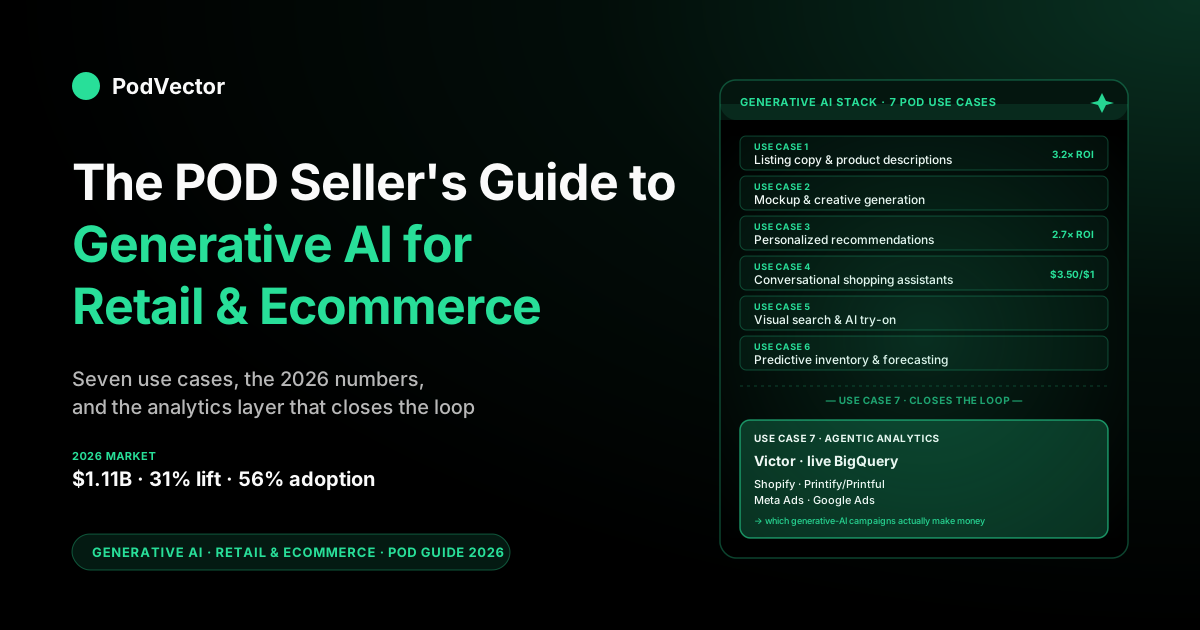
Quick Answer: Generative AI for retail and ecommerce in 2026 is no longer a single product — it's a stack of seven use cases that each have their own ROI envelope, their own incumbent tooling, and their own failure modes. The global generative-AI-in-ecommerce market hit roughly $1.11B in 2026, AI-referred shoppers convert about 31% higher than traditional traffic, and 56% of US shoppers used a gen-AI tool during the 2025 holiday season.
For a print-on-demand operator the seven recipes that move the needle are listing-copy generation, mockup and creative generation, personalized recommendations, conversational shopping assistants, visual search and try-on, predictive inventory and demand forecasting, and the analytics layer that connects all of the above to real per-variant margin. The first six are commoditizing fast. The seventh — agentic analytics that reads live Shopify, Printify or Printful, Meta Ads, and Google Ads data and tells you which generative-AI-driven campaigns are actually profitable — is the layer most POD stores skip and the one that decides whether the rest of the stack is pointing in the right direction.
Why generative AI is no longer optional for retail in 2026
The generative-AI-in-ecommerce market hit roughly $1.11 billion in 2026, up from $962 million the year before, and is projected to grow toward $3.95 billion by 2035. The harder number is on the consumer side: 56% of US shoppers used a generative AI tool during the 2025 holiday season — up from 11% in 2024 — and 61% of Gen Z used AI to help with a purchase in the past year. The shift is no longer "will customers adopt this." It's "your customers already adopted this and your store may or may not be where the AI sends them."
For a print-on-demand operator the strategic question is narrower than the trend pieces make it sound. Most of the generative AI categories in the ecommerce stack — listing copy, mockups, recommendations, chat, search, forecasting — have a working tool today, a default integration with Shopify, and a price point under $50/month.
Adoption isn't the bottleneck. The bottleneck is which use cases are worth installing on a POD-specific operation, in what order, and how to avoid the trap most operators fall into: stacking three overlapping AI marketing apps that each automate 30% of the same workflow while none of them tell you whether the resulting orders are profitable after Printify or Printful cost.
This guide walks the seven generative AI use cases that actually move the needle for a working POD store, the 2026 numbers worth quoting back to yourself when you're deciding budget, the POD-specific gotchas the generic ecommerce content rarely covers, and a 30-day rollout plan. For the cluster overview see the complete guide to AI analytics for print-on-demand; for the broader topic, see the AI Analytics topic hub.
The 2026 numbers POD operators should actually know
Before the use cases, the data points worth keeping in your head when you're triaging which AI tool to install. Most of these come from the 2025 holiday-season cohort that the major retail-AI tracker reports published in early 2026 — see the 52 generative AI ecommerce statistics for 2026 roundup for the full set.
The conversion premium on AI-referred traffic
AI-referred shoppers — the visitors who arrive from ChatGPT, Gemini, Copilot, Perplexity, or another conversational discovery surface — convert about 31% higher than traditional traffic, and revenue per visit from that cohort jumped 254% year over year during the 2025 holiday season. For POD this matters more than for most categories because the AI-referred shopper is usually arriving with a high-intent prompt ("a soft heavyweight tee with an embroidered Year of the Tiger crest") rather than a generic browse, and the conversion gap is partly a selection effect and partly a relevance effect. The implication is that the share of organic traffic you're getting from AI surfaces is now a metric worth tracking separately, not lumped into "referral."
The ROI numbers retailers are reporting
Roughly 69% of retailers report measurable revenue lift directly attributable to AI in the 2026 cohort. The use-case-level numbers reported by ecommerce operators are: AI content drafting at 3.2× ROI, AI personalization engines at 2.7× ROI, AI customer service at about $3.50 returned per dollar invested.
The widely cited macro figure is McKinsey's estimate that generative AI could add $240–390 billion in value to the retail and consumer-goods sector. That's the number the generic vendor guides lead with — useful for context, useless for deciding what to install Monday morning.
These are operator-reported figures from a self-selected group; they're directionally useful, not benchmarks. The honest read is that AI content drafting is the highest-confidence early ROI win for a POD store and the one that deserves the first 30 minutes of your attention.
The agentic-commerce wave
Generative AI and AI agents drove an estimated $262 billion in global retail revenue during the 2025 holiday season, roughly 20% of total sales by some tracker estimates. The number is doing a lot of work — it lumps AI-powered recommendations, conversational chat, and agent-mediated checkout together — but the direction is clear: agentic commerce, where the AI doesn't just recommend the product but can actually transact, is the trajectory that the next two years are pointing toward. For POD operators that means starting to think about which surfaces your catalog is discoverable on by AI agents, not just by humans.
Use case 1 — Listing copy and product descriptions at scale
The single highest-confidence early win for a POD store with generative AI is listing-copy generation. A typical POD drop with 15 designs across five base products is 75 SKUs that each need a title, description, alt text, tags, and SEO metadata.
Done by hand it's a full day of focused writing. Done with generative AI it's two to three hours of editing.
The tool stack
The cheap default is Shopify Magic — the in-product AI generation now free across every Shopify plan. For per-product editing under 50 SKUs in a drop, Magic in the product editor is the fastest path: open the product, click Generate, edit the 20% that needs your voice, ship.
For volume over 50 SKUs the cheaper pattern is to feed the design briefs into ChatGPT or Claude in a single session, get back a structured table, and bulk-import via CSV. The brand-voice work happens once at the prompt level rather than per product. The deeper Shopify Magic treatment is in the POD seller's guide to Shopify Magic AI features.
The POD-specific tweak
POD listings have a different SEO surface than first-party retail. Customers searching "vintage Year of the Tiger embroidered crewneck" want to land on a listing that talks about the design intent and the wearer (gift idea, occasion, fit) rather than a generic product description. The generative AI prompt that works is "write a 90-word listing description for a [base product] featuring this design [paste the design brief], targeting a buyer who [paste the audience description], with two sentences on the design and one sentence on the fit/material; do not mention shipping or returns." Strip out the cliché lines about "perfect for any occasion" before publishing.
The honest measurement
Most POD stores see a 10-25% lift in organic listing traffic after a systematic rewrite of generic descriptions to AI-augmented, design-specific descriptions. The lift compounds with on-listing conversion rate because the description sets a sharper expectation. Track the change at the SKU level, not the store level — generic store-wide A/B tests bury the signal in the noise of seasonal demand.
Use case 2 — Mockup and creative generation
Generative-AI image tools are the second commoditizing layer of the POD stack. The job they do today: design ideation, mockup generation, ad-creative variants, lifestyle imagery for listings.
What the tools actually do well
Midjourney v7, Ideogram, and the Adobe Firefly suite reliably generate design ideation that survives a human pass, ad creative variants for Meta and Google paid social, lifestyle background imagery for product photos, and concept variations of a design across color palettes. The pattern that works for POD is to use the AI tool for the "give me 20 variations" step where human designers are slow, then put a human designer (or yourself) on the curation, refinement, and brand-voice pass. The all-AI design path produces output that looks like all-AI design output and the audience notices.
The mockup-specific shortcut
For mockup generation, both Printify and Printful now have AI mockup generators inside their dashboards, plus dedicated tools (Placeit, ARTSIO) that take your design file and generate lifestyle mockups across 50+ scenes. For a POD store running 10+ designs a month, the mockup tool is the second-most-valuable AI install after listing copy because lifestyle mockups consistently outperform flat product shots in both organic search and paid creative tests. The category is mapped in detail in best AI art generator for print on demand (compared).
The licensing footnote that isn't optional
Every generative-AI image tool has a different stance on commercial-use rights, training-data provenance, and the resulting copyright status of the output. For a POD store this is unusually load-bearing because your output is the product, not the marketing.
As of 2026 the safer defaults for commercial-grade POD work are Adobe Firefly (trained on licensed Adobe Stock and the company indemnifies output for enterprise users) and Ideogram's commercial tier. The riskier defaults — outputs whose commercial-use status is contested — are best treated as ideation only, with the production design redrawn by a human after the AI gave you the concept.
Use case 3 — Personalized product recommendations
AI-driven product recommendations have been part of the ecommerce stack for a decade, but the 2026 generation of generative-AI recommendation engines is materially different from the older collaborative-filtering layer.
What changed in 2025-2026
The newer recommendation tools (Shopify's native AI recommendations, Klaviyo AI, Dynamic Yield's generative tier, Bloomreach's discovery suite) generate the recommendation prose alongside the product selection. The customer doesn't just see four product cards in an "you may also like" rail; they see a conversational "if you liked the Year of the Tiger crewneck, you'll probably want the Year of the Tiger heavyweight hoodie because [reason that's actually grounded in the catalog]." The prose layer is the thing that's been hard to do well at scale and the new generation does it well.
The POD-specific implementation
The POD-specific tweak is to feed the recommendation engine your design taxonomy, not just your SKU list. Most recommendation engines default to "customers who bought X also bought Y" which is fine for first-party retail and weak for POD where most customers buy one design and never come back.
The pattern that works is to recommend across the design family ("the same design on a different base product") and across the audience ("other designs by the same illustrator") rather than across the order graph. The deeper recommendation-engine treatment is in the POD seller's guide to AI recommendation engine for ecommerce.
The ROI envelope
Personalization engines report an industry-average 2.7× ROI in the 2026 cohort. For a POD store under $50K/month in revenue this means the marginal lift is real but small in absolute dollars; for a store above $100K/month the lift compounds enough that the recommendation-engine spend starts paying for the rest of the AI stack. The trap to avoid is paying $300/month for a personalization engine on a $20K/month store — the lift is real, the math doesn't work yet.
Use case 4 — Conversational shopping assistants
The chat layer of generative AI has had the loudest marketing in 2025-2026 and the messiest reality. Most ecommerce conversational AI deployments are still glorified FAQ bots; the new generation that actually transacts on behalf of the shopper is real but early.
The three-tier framework for POD
For a POD store the right level of conversational AI depends almost entirely on revenue volume. Under $30K/month the right answer is the free tier — Shopify Inbox with AI-suggested replies, no third-party install.
Between $30K-$100K/month it's a single paid chatbot (Tidio, Gorgias AI, or a Shopify-app-store option) on a 30-day trial, wired to your live catalog and order data rather than a static knowledge base. Above $100K/month the agentic tier becomes worth evaluating — bots that can issue refunds, modify orders, and create return labels within bounded permissions.
Don't install the agentic tier first. The structural breakdown is in agentic AI for ecommerce: what it looks like for POD sellers.
The pattern that fails consistently
The pattern that fails for POD specifically is letting a generic chatbot answer questions about the production timeline, the return policy on custom prints, or the design-licensing terms — three areas where every POD store's policies are different from a typical ecommerce store, and a generic LLM trained on first-party retail content will hallucinate confidently. Wire the chatbot to your actual policies; set a conservative fallback to "let me check with the team"; audit the first week's transcripts before scaling deflection rate.
The conversion-side ROI
AI customer service deployments in the 2026 cohort report about $3.50 returned per dollar invested. For POD the ROI math is partly conversion (recovered carts the chatbot rescued) and partly support deflection (tickets the bot resolved without a human pass). The payback window for a $30-50/month chatbot on a $30K/month POD store is typically the first month if the install is wired to live order data; it's never if the install is a static-knowledge-base bot.
Use case 5 — Visual search and AI try-on
Visual search and AI-powered virtual try-on are the categories where the gap between the demo and the production reality is widest in 2026.
What works today
Visual search — the customer uploads an image, the AI returns matching products in your catalog — works well enough for production deployment if your catalog is large enough to make the search valuable. Google Lens, Pinterest Lens, and the Shopify Visual Search beta are the working incumbents. For POD the use case is "customer saw a similar design on Instagram, wants to find your version" — niche but high-conversion when it triggers.
What's still a demo
AI virtual try-on for apparel — the customer uploads a photo and sees themselves wearing your product — is impressive in demos and unreliable in production for POD specifically. The technology handles fit and drape on first-party retail apparel reasonably; it handles the visual fidelity of a printed design on a soft-textured shirt poorly.
Several POD platforms launched try-on betas in 2025 and most quietly de-emphasized them in 2026 because the conversion lift didn't justify the customer-confusion cost when the AI render didn't match the actual print quality. Revisit when the next generation of diffusion models lands.
The POD-relevant subset
The visual-search use case worth deploying for POD in 2026 is the in-store search bar with AI semantic matching ("show me cozy winter designs in earth tones") rather than the cross-internet visual search. The semantic-search layer — Algolia, Typesense, Shopify's native AI search — is now reliable enough that the conversion lift on the in-store search box is the second-highest of any AI install for a working POD store, after listing-copy generation.
Use case 6 — Predictive inventory and demand forecasting
Generative AI for demand forecasting is a category that's louder for first-party retail than for POD because POD's structural answer to inventory is "we don't hold any." But there's still a real use case at the design-rotation level.
The first-party retail story (mostly not yours)
For first-party retailers, AI demand forecasting tools (Inventory Planner, Cogsy, ToolioAI) reduce stockouts by typical 20-30% and reduce overstock by typical 15-25%. Inventory becomes a working-capital efficiency game with measurable lift. For POD this entire category is mostly background noise because the printer holds the inventory; you hold the design IP.
The POD-specific use that actually pays
Where AI demand forecasting matters for POD is design-rotation strategy: which designs to feature in the next drop, which to retire, which to expand to additional base products. A tool that looks at your sales data, seasonality, and the previous drop's performance and tells you "these three designs are still climbing — expand them to two more base products before the next drop; these five have plateaued — retire them from the homepage rotation" is the analog of inventory forecasting for a POD operation.
Most POD operators do this work by gut and the AI version closes the gap. The deeper inventory-forecasting treatment is in AI inventory forecasting Shopify: what it looks like for POD sellers.
Use case 7 — Agentic analytics (the layer that closes the loop)
The seventh use case is the one that the SERP roundups consistently underweight for POD, and it's the one that decides whether the previous six are pointing in the right direction.
The structural problem
Every generative AI tool in the previous six categories optimizes for the metric it can see. Listing-copy generators optimize for click-through.
Recommendation engines optimize for cart attach rate. Chatbots optimize for conversion or deflection.
Demand forecasting optimizes for sell-through. None of them see your supplier cost on Printify or Printful — which varies by base product, blank vendor, and print region — or your shipping price by zone, or your ad spend by campaign and audience. The result is that the generative AI stack scales the campaigns that look profitable on a revenue basis and quietly scales the campaigns that lose money on a margin basis.
What the analytics layer does
Victor sees your Shopify sales, your Printify or Printful costs, and your Meta Ads and Google Ads spend all together, every day, so he knows the true profit on every product. The difference between this and a dashboard is that he doesn't stop at the chart — he tells you what to do next. "Campaign X has a ROAS of 3.1 but a margin of -4%; pause it and shift the budget to design Y" is the kind of call he makes. You approve the move, and then Victor makes the change directly in Meta Ads or Google Ads.
Built in-house this is two to four weeks of engineering plus the ad-platform integrations. Built on top of Victor it's a connection wizard and an operator that runs your ads, updates your Shopify listings, and reallocates spend with an approval gate on every material action.
The pattern that usually pays for itself in week one
Run the first reconciliation pass and find the top three bestsellers by revenue. Compare their margin after Printify or Printful cost, shipping, and attributed ad spend.
The pattern most POD stores discover the first time they run this reconciliation: at least one revenue-bestseller is breaking even or losing money per order, and the marketing automation layer is currently scaling it because ROAS looks healthy on a revenue basis. The agent flags it, proposes pausing that campaign and reallocating the budget to the actually-profitable design, and — once you approve — makes the change in the ad platform. The recovered spend usually pays for the analytics layer for the year. This is the loop the rest of the generative-AI stack opens and never closes on its own.
Where generative AI quietly breaks for POD sellers
The generic ecommerce content covers the use cases the same way for first-party retail and POD. The breakage points are different.
The personalization-without-margin trap
Personalization engines optimize cart attach rate. For POD, every additional unit attached to a cart is an additional supplier-cost line and an additional shipping-cost line, both of which are absent from the engine's optimizer. The "you may also like" rail can mathematically increase revenue while decreasing per-order margin if the recommended product has a worse cost structure than the original. Audit the rail's conversion-weighted margin, not just its conversion lift.
The chatbot-and-supplier-policy mismatch
Generic ecommerce chatbots assume the merchant controls fulfillment timelines, return policies, and shipping options. POD operators control none of these — Printify and Printful do — and a chatbot that confidently answers "your order will ship in 2-3 business days" because that's what the LLM thinks the default is, when the actual print provider is on a 5-7 day production timeline, generates support tickets faster than it deflects them. Configure the bot's knowledge base to your actual print-provider SLAs before scaling deflection.
The recommendation-engine-and-design-IP problem
Recommendation engines treat your products as interchangeable inventory. For POD your products are designs; the same SKU on the same base product can have radically different performance based on which design is on it.
Engines that don't understand the design-as-the-product taxonomy will recommend across the SKU graph in ways that look reasonable to a first-party retailer and produce nonsense for POD. Pick a recommendation engine that lets you specify the design-level taxonomy as a recommendation dimension; if it doesn't, it's not built for POD.
The forecasting-without-printer-data gap
Demand forecasting tools that ingest only Shopify data miss the variable that actually matters for POD: print-provider production capacity. Most POD stores have experienced the moment where a design unexpectedly takes off and the print provider's production queue stretches from 3 days to 14 days because they're capacity-constrained on that base product, and the forecasting tool didn't see it coming because the constraint was on the supplier side. The fix isn't to abandon forecasting; it's to feed the forecasting layer the print-provider's queue depth as a separate input.
The generic-guide use cases POD can mostly skip
The vendor guides that rank for this query list ten or eleven use cases each, because their audience is enterprise retail. Several of those categories are real for a chain with warehouses and don't move the needle for a print-on-demand store. Knowing which to skip is as valuable as knowing which to install.
Dynamic pricing
AI dynamic-pricing engines reprice inventory in real time against demand, competitor pricing, and stock levels. For first-party retail that's a margin lever; for POD it mostly isn't, because your floor is a fixed supplier cost and your prices rarely flex by the hour. Set your prices off itemized Printify or Printful cost plus a target margin and revisit quarterly — a real-time engine is solving a problem you don't have.
Fraud detection and cybersecurity
The enterprise guides spend whole sections on AI fraud detection, citing $44B in 2024 losses heading past $100B by 2029. That's a payment-processor and platform problem, and Shopify Payments, Shop Pay, and your gateway already run it for you. A solo POD operator does not install a fraud-detection AI; you let the platform handle it and move on.
Immersive AR/VR shopping
AR showrooms and VR storefronts demo well in keynote slides and convert poorly for a single-design tee. The build cost and the customer-confusion risk both run high, and the print-fidelity gap that breaks AI try-on (covered above) breaks AR product preview the same way. Skip it until the tooling is native to Shopify and free.
Enterprise hyper-targeted marketing suites
The "hyper-targeted campaign" sections describe six-figure martech stacks. For POD the useful slice of that — AI ad-creative variants and AI listing copy — you already get from use cases 1 and 2 at under $50/month. Don't buy the enterprise suite to get the two features that matter.
A 30-day generative AI rollout
If you're a POD operator with a working Shopify store and the generative-AI layer is mostly empty, the highest-leverage first 30 days look like this.
Week 1 — Listing copy and Magic
Turn on Shopify Magic if you haven't. Pick the 20 highest-traffic listings in your catalog and rewrite them with the AI-generation flow, editing for design specificity and brand voice.
By Friday you should have 20 rewritten listings live and a baseline measurement of organic traffic and on-listing conversion before the rewrite. The lift shows up in week 3-4. The deeper guide is in the POD seller's guide to Shopify Magic AI.
Week 2 — Mockups and creative
Standardize on one mockup tool (Placeit, Printify's built-in, or Printful's built-in) and generate lifestyle mockups for the 20 listings rewritten in week 1. Standardize on one ideation tool (Midjourney, Ideogram, or Firefly) for ad-creative variants and run a Meta creative test with three AI-generated variants per design against your current control. The category breakdown is in best AI art generator for print on demand (compared).
Week 3 — Recommendations and chat
Turn on Shopify's native AI recommendations or evaluate one third-party recommendation engine on a 30-day trial. If you're under $30K/month in revenue, leave Shopify Inbox as your support layer and don't install a paid chatbot yet. If you're above, start a 30-day trial with one chatbot wired to live catalog and order data. The deeper category map is in the POD seller's guide to generative AI for ecommerce.
Week 4 — Connect the analytics layer
Connect Shopify, Printify or Printful, Meta Ads, and Google Ads into a unified analytics layer (Victor, or a self-built warehouse if you have the engineering). Run the first per-variant margin reconciliation.
Most operators find at least one bestseller that's actually unprofitable, which usually pays for the analytics layer in the first month. This week is the one that makes the previous three weeks point in the right direction. For the broader treatment see the POD seller's guide to Shopify and AI.
What stays human
Healthy AI discipline includes deciding what doesn't get automated. The seven use cases above cover the work generative AI does as well as or better than a human at lower cost. The work that doesn't belong in the AI stack — at least not yet — is its own list.
Design taste and curation
Generative AI can produce 50 design variations in 10 minutes. It cannot decide which one fits your brand voice, which cultural reference will land in the next quarter, or whether the audience that liked your last drop will like this one. Design selection is taste work; taste work stays with the operator.
Brand voice and the high-LTV moments
The customer emailing about a damaged order from a wedding gift is not the right place for an AI-generated reply, even a well-drafted one. The high-LTV moments — the apology that turns a refund into a referral, the surprise-and-delight on the second order, the personal note on the influencer outreach — stay human. Operators who automate these are making a category error about what's actually scalable.
Strategy and pivot decisions
The AI can tell you that a category isn't working; the AI cannot decide whether to pivot the brand, switch suppliers, or hire a designer. Strategy decisions are operator decisions informed by AI-surfaced data, not delegated to it.
FAQs
How big is the generative AI ecommerce market in 2026?
Roughly $1.11 billion in 2026, up from $962 million in 2025, with industry forecasts pointing toward $3.95 billion by 2035. The more useful number for an operator is the consumer-adoption side: 56% of US shoppers used a generative AI tool during the 2025 holiday season, up from 11% the year before, and AI-referred shoppers convert about 31% higher than traditional traffic.
Where should a POD seller start with generative AI?
Listing copy and product descriptions. It's the highest-confidence early ROI win, the install is free with Shopify Magic, and the lift on organic traffic and on-listing conversion compounds on every drop you ship after the rewrite.
Spend the first week on copy. Mockups and creative come second; recommendations, chat, and analytics come in weeks three and four.
Does generative AI actually drive measurable revenue lift for ecommerce?
The 2026 cohort numbers say yes — about 69% of retailers report measurable revenue lift directly attributable to AI, with AI content drafting at 3.2× ROI, AI personalization at 2.7× ROI, and AI customer service at about $3.50 returned per dollar invested. These are operator-reported figures from a self-selected group, so treat them as directional rather than benchmark. The lift is real; the magnitude depends on whether your install is wired to live store data or stuck on a static knowledge base.
What's the difference between generative AI for first-party retail and for print-on-demand?
The use cases overlap; the gotchas don't. First-party retailers benefit most from demand forecasting and inventory optimization because they hold inventory.
POD operators don't hold inventory, so the demand-forecasting category is mostly noise — but the design-rotation analog (which designs to feature, expand, retire) is the equivalent. Personalization engines optimize cart attach for first-party retail and can quietly destroy margin for POD because every additional unit is an additional supplier-cost line.
Chatbots assume the merchant controls fulfillment timelines for first-party retail and need to be reconfigured for POD because the print provider does. The fix in every case is to feed the AI the cost structure and the supplier constraints, not to skip the category.
Are AI-generated designs safe to sell as POD products?
Depends on the tool. As of 2026 the safer commercial-use defaults are Adobe Firefly (trained on licensed Adobe Stock with enterprise indemnification) and Ideogram's commercial tier; the riskier defaults are tools whose training-data provenance and commercial-use status are contested.
The conservative POD pattern is to use riskier tools for ideation only and have a human designer redraw the production-grade design from the AI concept. The conservative pattern is more important for POD than for most ecommerce categories because your output is the product, not the marketing asset.
Will generative AI replace my designer or my marketing team?
It will replace the time those roles spend on rote work — initial design variations, subject-line testing, ad-creative rotation, listing-copy generation — and free that time for the work that doesn't automate well: brand strategy, creative direction, taste-driven curation, partnership development. The pattern for POD is that generative AI extends a small creative or marketing team's reach by 2-3×; it doesn't eliminate the roles. The operator who fires the designer and runs the brand on AI output produces output that looks like all-AI output, and the audience notices.
Can generative AI tell me which AI-driven campaigns are profitable?
Not on its own. Every generative AI tool in the stack — listing copy, mockups, recommendations, chat, search, forecasting — optimizes for the metric it can see, which is some flavor of revenue or engagement.
None of them see your Printify or Printful supplier cost, your shipping cost by zone, or your ad spend by campaign and audience. To know which AI-driven campaigns are actually profitable you need an analytics layer that joins the cost data against the revenue data — which is what the seventh use case in this guide is about and what most POD stores skip until the unit economics force the question. The analytics-tool angle is in the complete guide to AI tools for POD sellers.
What's agentic commerce and does it matter for a small POD store yet?
Agentic commerce is the next layer past conversational AI — bots that don't just answer questions but execute transactions on the shopper's behalf, including discovery, comparison, and checkout. The 2025 holiday season saw an estimated $262 billion in retail revenue touched by AI agents and recommendations, roughly 20% of total sales.
For a small POD store the immediate implication isn't to deploy an agent; it's to make sure your catalog is structured so AI agents can read it (clean product feeds, structured data, accurate inventory state). The discoverability work matters now even if the agent layer on your own store is a 2027 problem.
Where can I read more about how this fits together?
For the cluster overview, see the AI Overview cluster hub. For the topic, see the AI Analytics topic hub.
For the close-sibling generative-AI guide that focuses on ecommerce broadly rather than retail-and-ecommerce, see the POD seller's guide to generative AI for ecommerce. For the AI-for-ecommerce category map see the POD seller's guide to AI for ecommerce.
For the comparison-tier roundup, see best AI for ecommerce (compared). The single best external reference for the 2026 numbers is the 52 generative AI ecommerce statistics for 2026 roundup.
Stack the seven generative AI use cases — then connect the layer that tells you which ones make money
Listing copy, mockups, recommendations, chat, search, and forecasting each have a working tool and a measurable ROI envelope. The seventh layer — agentic analytics that joins live Shopify, Printify or Printful, Meta Ads, and Google Ads into per-variant margin — is the one most POD stores skip and the one that decides whether the rest of the stack is pointing in the right direction. Connect your data and ask the questions the rest of the AI stack can't.
Try Victor free