
Quick Answer: AI inventory forecasting for Shopify predicts what you'll sell, when, and in which variants — so you can restock before a stockout and avoid burying capital in dead stock. The catch for print-on-demand sellers: you don't have stocked inventory in the conventional sense.
Printify and Printful make every order on demand. So the standard apps (Prediko, Forthcast, Inventory Planner) solve a problem you mostly don't have.
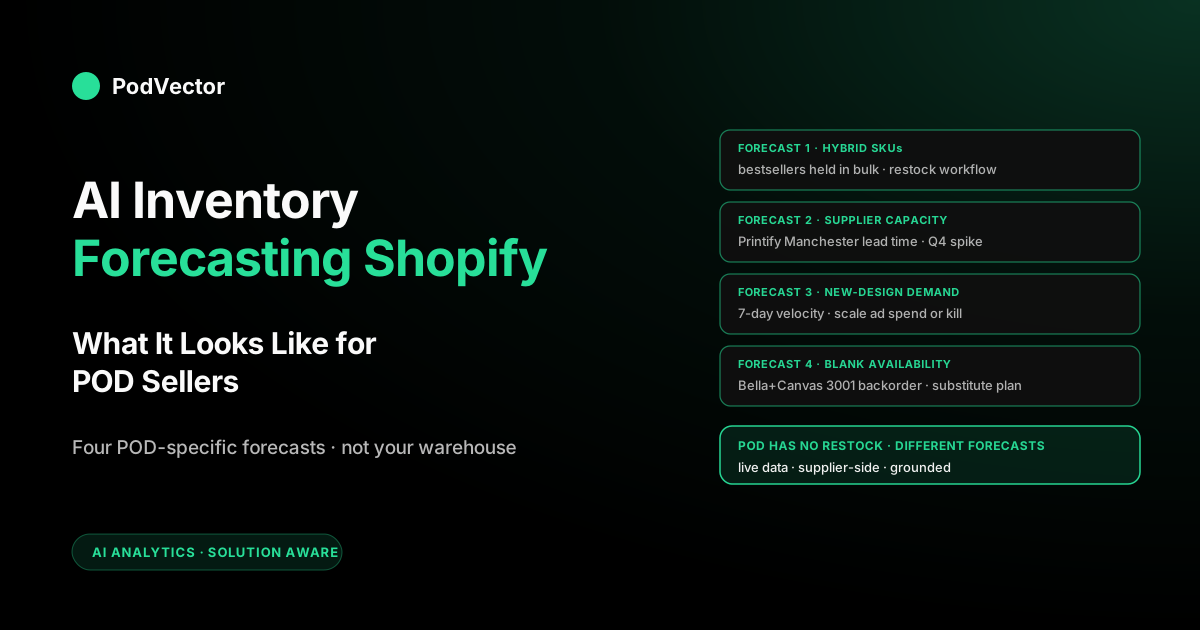
What you actually need is forecasting for four POD-specific situations: bestseller SKUs you've moved into bulk inventory, supplier capacity during Q4 crunch, new-design demand before scaling ad spend, and blank availability so a Bella+Canvas backorder doesn't kill a launch. This guide covers all four, grades the popular apps for POD fit, and shows where the live-data AI employee (Victor) sits in the stack.
What "AI inventory forecasting" actually means on Shopify in 2026
The category has matured. By 2026 the working definition for AI inventory forecasting on Shopify is software that pulls your historical sales, inventory levels, supplier lead times, and seasonal patterns; trains a model (usually a blend of classical time-series and ML — exponential smoothing or ARIMA for short-history SKUs, gradient boosting or neural nets where there's enough data); and produces three outputs your team can act on. A demand forecast at the SKU level, a recommended reorder quantity per supplier, and an alert when something is about to go wrong — a likely stockout in N days, an overstock that's eating your cash, a SKU whose velocity just changed enough to break the previous forecast.
The apps that win the Shopify SERP — Prediko, Forthcast, Inventory Planner by Sage, Assisty, Monocle — all share that shape. The differences are mostly in how many SKUs they handle, how they expose the forecast (PO drafts vs alerts vs charts), how they integrate with the rest of your stack (Amazon FBA, TikTok Shop, multi-warehouse), and how aggressive they are with automation (some draft POs you approve, some place them).
That's the standard market. It assumes your business model is "buy or make goods, hold them in a warehouse, ship them to customers." Most Shopify stores fit that model. POD doesn't.
The POD twist — you don't have inventory the way the apps assume
Print-on-demand inverts the inventory problem. There is no warehouse.
There is no SKU sitting on a shelf waiting to be sold. When a shopper places an order, your supplier — Printify, Printful, Gelato, SPOD — produces that exact item from a blank, prints your design, and ships it. Your "inventory" is one row in your design catalog and a contractual relationship with a supplier who holds blanks.
That changes which questions an inventory forecast can answer for you. The standard ones lose meaning: "how many units of SKU 12345 should I reorder this month" doesn't apply because you don't reorder. "What's my dead-stock risk on the slow movers" doesn't apply because there is no dead stock. "What's my safety stock target" doesn't apply because your safety stock is whatever the supplier holds.
If you stop there, the conclusion is "AI inventory forecasting is irrelevant to POD" — which is what most operators in our category quietly believe and why the apps in the SERP don't have a "POD plan." That conclusion is half right. The standard product is irrelevant. But four forecasting problems are real on POD, and each one is worth solving.
The four forecasts that actually matter for POD
Translate the generic forecasting category into the POD operator's actual workflow and you get four distinct forecasts. Different data inputs, different acting parties, different tools. We'll take them one at a time.
1. Hybrid-SKU demand forecasting
Almost every POD store that crosses $30k/month in revenue ends up with a hybrid model. A handful of bestseller designs sell consistently enough that you order them in bulk from a manufacturer (or you screen-print a run yourself), warehouse them, and fulfill from your own stock at margin two-to-three points higher than the POD version. The rest of the catalog stays on Printify or Printful so you don't tie capital up in slow movers.
This is where the standard apps suddenly become useful — for the bulk-held SKUs. You're forecasting demand on a small set of SKUs (5–50, typically), with reasonable history, and you have a real reorder decision to make every few weeks. Prediko, Forthcast, Inventory Planner all work fine here once you tell them to ignore the rest of your catalog.
The non-obvious part: the forecast on a held SKU should be net of what you'd lose to your POD version. If a shopper bought the bulk version because it was cheaper or shipped faster, but they would have bought the POD version anyway, that's not incremental demand — it's substitution.
None of the apps model this on their own. You either feed them an "incremental conversion lift" assumption from a holdout test, or you accept the forecast will overstate by 10–25% and adjust your safety-stock target accordingly.
2. Supplier capacity and lead-time forecasting
The POD version of "stockout risk" is not "we ran out of inventory." It's "Printify Manchester just told me production lead time on the shirt I'm running ads to is now 9 days, my Meta retargeting frequency cap is going to fire before the order even ships, and shoppers are going to refund." Or in November: "Printful Mexicali is now 14-day lead time on hoodies, and every order from a Black Friday Meta campaign is going to land after the holiday."
Forecasting that is real work, and none of the inventory apps do it. The data you need is supplier-side production status, by region, by product family, by week — and historical patterns showing how Q4 ramps up.
Printify and Printful both publish current lead times, but neither shows a forward-looking capacity forecast. The forecast you want is "what will lead time look like on this product family three weeks from now, given seasonal patterns and current load?"
The employee capability of this lives in an AI employee that watches your supplier's API and your historical lead times together. Victor's roadmap puts this in scope — the question "is Printify Manchester going to choke on hoodies in two weeks" should be answerable from live data plus the prior three years of seasonal patterns. Today the workaround is checking the supplier dashboards weekly and being conservative on Q4 ad budget; in 12 months an agent should be flagging this preemptively.
3. New-design demand forecasting
You launch a new design Tuesday. It does 4 orders Wednesday, 11 Thursday, 27 Friday.
Is this a winner that justifies a $200/day ad budget on Saturday or a flash that will die by Sunday? The forecast is over 7–14 days, on a single SKU with almost no history, blended with the conversion rate at the ad-spend level you'd pump it to.
This is not what the standard inventory apps do — it's a forecast of demand under different ad-spend scenarios, which is closer to a marketing-mix model than a restock model. The relevant inputs are first-week sales velocity, ad spend and ROAS curve so far, the design's similarity to past winners and losers in your catalog, and the supplier's lead time at that volume.
The honest tools for this in 2026 are AI employees that pull all four signals into one place. The SKU watch we wrote about in our overview of AI agents for ecommerce is exactly this workflow. The thing you don't want is a generic Shopify forecasting app trying to extrapolate two days of data — it'll either overcommit you to a flash or kill a slow-builder before it warmed up.
4. Blank availability and substitution forecasting
Bella+Canvas 3001 goes on backorder for two weeks every November. Gildan 18000 spikes in lead time when Mexico's plants slow down.
Bella+Canvas 6004 gets discontinued in a color you've been selling for two years. Each one of these can break a launch — your top SKU is suddenly unavailable, the substitute the supplier offers has slightly different fit, returns spike, refunds spike, ad spend goes to negative ROAS.
The forecast you want is "which blanks in my catalog are likely to have an availability problem in the next 90 days, and what's the substitution plan." This isn't an inventory forecast in the conventional sense — there's nothing to reorder — but it's the same shape of problem: "what's about to go wrong with the supply side of my business." Today you do this manually by following Bella+Canvas's stock notifications and the Printify status emails. The agent version watches your supplier's variant catalog for changes and flags impact-weighted by your sales mix.
Why generic Shopify forecasting apps misfire on POD
If you do install Prediko or Forthcast on a pure POD store, here's what breaks. Knowing this saves you a few hours of frustration before you bounce off.
- They expect inventory levels per SKU. Shopify's "inventory level" for a POD SKU is either ∞ (you set it that way) or unmanaged. The forecasting model needs starting inventory to compute a stockout date. With ∞ it returns "no stockout ever," which is technically true and operationally useless.
- They expect a reorder action. The output of every forecasting workflow is a draft purchase order to a supplier. On POD, there's no purchase order — there are individual orders the supplier produces on demand. The reorder workflow has no destination.
- They model lead time as a fixed property of the SKU. Printify and Printful lead times depend on which provider produced that order, which region, which product family, and what the current load looks like. Apps that model lead time as a single number per SKU will be wrong by 5–10 days in either direction during Q4.
- They report COGS as a flat percentage. POD COGS varies by line item — a $24 hoodie has $14 base cost, a $24 t-shirt has $9 base cost, and the same SKU has different cost depending on which provider routed it. Forecasting "margin" with a flat COGS is wrong by 30+ points and ruins the prioritization (the apps will tell you to push your worst SKU because they think it's your best). For more on this, see our complete guide to Printify costs, fees and discounts.
- They want multi-warehouse routing logic. POD multi-region routing happens at the supplier, not in your inventory. Setting up the app's multi-warehouse feature on a POD store gives you a phantom inventory split that doesn't match reality.
None of these are bugs. They're correct behavior for the model the app was built for, which is stocked-inventory ecommerce. They just don't translate.
The popular apps, graded for POD fit
Here's how the apps that show up in every "best AI inventory forecasting Shopify" roundup actually grade for POD use. Pure-POD stores can mostly skip this section. Hybrid stores should look at the first two columns.
Prediko (apps.shopify.com/prediko)
The default recommendation in most SERP roundups. Pricing starts ~$49/month, scales to $300+ for higher SKU counts. Pure-POD fit: low — the forecast is built around restock decisions you don't make. Hybrid fit: good — works fine on the bulk-held SKU subset once you exclude the rest of the catalog. POD-specific gap: no Printify or Printful integration; cost data is generic, not itemized supplier costs.
Forthcast (apps.shopify.com/forthcast)
Newer entrant, growing share since Stocky's deprecation. Pricing comparable to Prediko. Pure-POD fit: low — same shape of problem. Hybrid fit: good — multi-channel forecasting (Shopify + Amazon FBA + TikTok Shop) is useful if you have bulk SKUs across multiple channels. POD-specific gap: same as Prediko — no supplier-side integration.
Inventory Planner by Sage
The enterprise-tier option, $249+/month. Pure-POD fit: low. Hybrid fit: good if your bulk-held catalog is large (100+ SKUs) and you want financial-grade forecast outputs your CFO will recognize. POD-specific gap: same as the others, plus the price floor doesn't make sense for sub-$100k MRR stores.
Assisty
The cheap end of the market — $29/month entry. Pure-POD fit: low. Hybrid fit: okay for small bulk-held catalogs (<25 SKUs). POD-specific gap: same as the others. Useful if you're hybrid and just want reorder alerts without a full forecasting platform.
Monocle
AI-driven reordering suggestions, ~$99/month. Pure-POD fit: low. Hybrid fit: okay. The "AI" branding here is meaningful — the underlying forecast is decent — but the workflow is again restock-first.
AI employees (Victor, Triple Whale Moby, Polar)
These don't show up in inventory roundups because they're a different kind of tool — they answer your business questions in plain English, using your store's real data. But for POD operators, they cover the four POD-specific forecasts above better than the dedicated inventory apps cover them.
The reason: they ground on itemized supplier costs and live data, not on a Shopify-only inventory snapshot. Trade-off: they don't draft purchase orders for your bulk-held SKUs the way Prediko does. Most hybrid operators end up running both — Prediko or Forthcast on the bulk SKUs, an AI employee for everything else. For more on the AI-employee category, see our complete guide to AI agents for ecommerce analytics.
Setting up forecasting on a hybrid POD store
If you've decided you're hybrid (some bulk-held SKUs, rest on POD) and want to set up forecasting properly, here's the realistic sequence. Skip the vendor's "10-minute install" pitch — the data prep is the work.
- Week 0 — split your catalog. Tag every SKU as "bulk" (held inventory you reorder) or "POD" (made-to-order via Printify/Printful). Most stores haven't done this cleanly; the tagging exercise will surface a few SKUs that are misclassified.
- Week 1 — clean the data on the bulk side. The forecasting model needs at least 90 days of clean sales history per bulk SKU, plus accurate inventory levels in Shopify, plus your supplier's lead time. If you've been letting Shopify's inventory drift, fix it now — a wrong starting inventory makes every forecast wrong.
- Week 2 — install the forecasting app, scope it to bulk SKUs only. Prediko or Forthcast for most operators; Inventory Planner if you're past $200k MRR and want enterprise-grade outputs. Configure the app to ignore SKUs tagged "POD" — you don't want it forecasting infinite-inventory items.
- Week 3 — run the forecast in shadow mode. Don't act on the recommendations yet. For two weeks, compare what the app predicts against what actually sells. You'll find the forecast is biased one way or the other on certain SKU categories; tune the model parameters or accept the bias and adjust safety stock manually.
- Week 4 — wire in the supplier side for POD-specific forecasting. This is where the standard apps end and the operator-agent layer begins. If you're using an AI employee (Victor, Triple Whale, Polar), connect supplier APIs and ad-spend data so the agent can answer the four POD forecasts above on demand.
- Week 6 — go live on bulk-side reorders, keep POD-side forecasting on-demand. Approve the first auto-drafted POs from the inventory app. Use the AI employee to answer supplier-capacity, new-design, and blank-availability questions ad hoc until you trust the patterns enough to set up alerts.
The pure-POD operator (no bulk-held SKUs) skips steps 1–3 entirely and works only on step 4 — wire supplier data into an AI employee so you can ask the four POD-specific forecast questions when they come up.
The operator-agent angle — live data for the questions the apps don't ask
The pattern the SERP roundups miss is that on POD, "inventory forecasting" is mostly a question about your supply side and your demand side, not about your warehouse. You don't have a warehouse.
You have a supplier relationship with shifting capacity, a design catalog with shifting demand, and a blanks library that occasionally goes out of stock. The natural tool for that shape of problem isn't a dedicated inventory app — it's an AI employee that grounds on live data and answers questions in plain English.
That's where Victor sits. Ask "what's the lead time trend on Printify Manchester for hoodies over the last 60 days?" and Victor looks at your orders and supplier production data together, and gives you a chart.
Ask "which of my new designs from the last 14 days is converting at a rate that justifies $150/day ad spend?" and you get a sorted list with the unit economics computed against itemized Printify costs. Ask "which Bella+Canvas variants in my catalog had a stock event in the last six months?" and you get the SKU list plus impact-weighted by your sales mix.
None of that fits inside the workflow of Prediko or Forthcast — they're built around the restock decision. None of it has to. The operator-agent layer is the right home for the POD-specific forecasts; the inventory app is the right home for the bulk-held SKU subset if you're hybrid.
The agentic-roadmap framing matters here too. Victor answers these questions and takes action on them — with your approval — pause an ad campaign on a SKU whose supplier just went 14-day lead time, swap a depleted blank for a substitute on the live product page, alert the team when a new design crosses the velocity threshold that justifies more spend.
Each action gets gated on operator authority and reversibility. The same pattern we wrote about in the broader analytics-agent guide applies here: the agent earns trust by answering well first, then earns action authority once the failure modes are understood.
ROI math, with POD numbers
Use a representative hybrid POD store: $80k/month revenue, 1,800 orders/month, 70% on POD, 30% on bulk-held SKUs (the bestsellers).
- Inventory app on the bulk side. Cost: $99/month for Prediko mid-tier on 30 bulk SKUs. Win: cuts stockout days from 8/month to 2/month, recovering ~$2,400/month in lost sales (calculated as average daily revenue per stockout SKU × stockout-days reduced × conversion rate). Cost-side win: cuts overstock by $4,000 in working capital, saving ~$80/month at typical SMB cost of capital. Net payback: under one month.
- Operator-agent on the POD side. Cost: $200–$400/month depending on vendor. Wins are episodic — catching a Printify Manchester capacity spike one week before it would have wrecked a Q4 launch saves $3,000–$8,000 in burned ad spend; flagging a Bella+Canvas backorder before you launched a campaign on it saves the launch budget; identifying a new design as a winner three days earlier means $500–$1,500 of compounded ad-spend efficiency. Hard to put a clean monthly number on, but a single avoided incident usually pays for the year.
- Combined. $300–$500/month total. Payback in month one if you're hybrid; payback in month one or two if you're pure-POD and the operator-agent catches a single supplier-side or design-launch incident.
The numbers scale up roughly linearly through $500k MRR. Past that, custom data work and bespoke alerts start to dominate, and the question shifts from "how much do these tools save" to "what decisions can the team make that they couldn't make without them."
Common mistakes POD sellers make with forecasting
The same five errors come up across stores. Each one is recoverable but expensive while it lasts.
- Installing a generic forecasting app on a pure-POD store. The app spends a week trying to forecast inventory you don't have, returns "no stockout ever," and you uninstall confused. The right move was to scope the app to the bulk SKU subset (if any) or skip the category entirely and put the budget toward the operator-agent layer.
- Forecasting margin with a flat COGS percentage. Every standard inventory app assumes COGS is a percentage of revenue. On POD it varies by line item, and the app's margin number will be wrong enough to push you toward your worst SKUs. Either configure per-SKU COGS in the app (tedious, easy to drift) or do margin reporting outside the app entirely.
- Treating supplier lead time as a fixed property. Printify and Printful lead times move week to week. If your forecast assumes "5 business days" year-round, your Q4 ad spend will fire before orders ship. Build the seasonal lead-time pattern into your media-spend pacing, not into a static SKU field.
- Skipping the new-design demand-forecasting step. First-week sales velocity is noisy; operators either overcommit on a flash or kill a slow-builder. The fix is to look at the velocity curve in the context of conversion rate, ROAS, and similarity to past winners — which is what the operator-agent is for, not what the inventory app does.
- Ignoring the blanks-library risk. A Bella+Canvas backorder during a holiday push is the most expensive failure mode in this whole category — your top SKU is unavailable, the substitute fits differently, returns spike, ad ROAS goes negative on the campaign that was your bestseller two weeks ago. Watch supplier variant changes proactively; this is where an agent earns its keep.
For the broader supplier-side context (where Printify ships from, regional choices, and how that affects the variables above), our Printify shipping locations guide covers the supplier-network shape in detail. For an outside read on the standard category, the Prediko explainer is a clean tour of the conventional model — useful background even if you skip the product.
FAQs
Do I need AI inventory forecasting if my store is 100% POD?
Not in the conventional sense. There's no inventory to forecast restocks for.
What you do need is forecasting on the supply side (supplier capacity and lead time), the design side (which new designs deserve more ad spend), and the blanks side (which materials might go out of stock). Those forecasts live in an AI employee, not in a dedicated inventory app.
Will Prediko or Forthcast work for a Printify or Printful store?
For the parts of your catalog that are bulk-held, yes. For the parts that are POD, no — the apps will return "no stockout ever" because they see infinite inventory. Scope them to your bulk SKUs only and they'll do the job they're designed for.
How much should I budget for forecasting on a hybrid POD store at $80k MRR?
$300–$500 per month total. About $99–$200 for the inventory app on the bulk side, and $200–$400 for an AI employee on the POD side. The combined cost almost always pays back in month one if you're hybrid, and in month one or two if you're pure-POD and the agent catches one supplier-side or design-launch incident.
What's the most important forecast for a POD operator?
Supplier capacity during Q4. Every other failure mode in POD forecasting is recoverable; running ads to a SKU your supplier can't fulfill on time during the holiday window is the one that destroys the campaign and the customer relationship simultaneously. Build a forward-looking view of supplier lead times into your weekly cadence from October through December, even if it's a manual check at first.
Can an AI agent automatically reorder for me?
Yes, on the bulk side. Most inventory apps now draft a PO that you approve, and a few will place it for you under authority limits you set.
On the POD side there's no reorder action to automate — the supplier produces on demand. The "automation" worth pursuing on POD is the operator-agent flagging supplier-capacity issues before they hit your campaigns.
How accurate is AI demand forecasting for POD designs?
Accuracy is high for designs with 30+ days of clean sales history and stable ad spend. Accuracy is low for new designs in their first 7–14 days; the noise is real and any forecast in that window is closer to a probability range than a number. The right approach is to use the forecast as one input alongside conversion rate, ROAS curve, and similarity-to-past-winners — not as a sole signal.
Does Victor do inventory forecasting?
Victor handles the four POD-specific forecasts described above — supplier capacity and lead time, new-design demand, blank availability, and bulk-SKU profitability — by answering your questions in plain English using your store's real data. It's not a replacement for Prediko or Forthcast on the bulk-side restock workflow if you're hybrid; Victor is the AI employee that covers everything those apps don't reach. The roadmap moves from answering to acting (pausing campaigns on supplier-constrained SKUs, alerting on blank-availability events, flagging design winners early) over the next 12–18 months.
What changes if Stocky shuts down?
Shopify's Stocky is being phased out (deprecation announced for August 2026), so the migration path matters. For pure-POD stores, the answer is "you didn't need Stocky anyway, skip the migration." For hybrid stores, Forthcast and Prediko have migration paths from Stocky that handle the historical-data import; pick whichever fits your SKU count and price band.
Forecasting on POD isn't about restock — it's about the supply side and the design side.
If you're hybrid, install Prediko or Forthcast on the bulk-held SKUs and let it do the restock work it's designed for. For everything else — supplier capacity during Q4, new-design demand under different ad-spend scenarios, blank availability before a launch, profitability per SKU after itemized Printify and Printful costs — you want an AI employee that works from your real-time data. Victor answers those questions in plain English, using your orders, supplier costs and ad spend together.
Try Victor free