
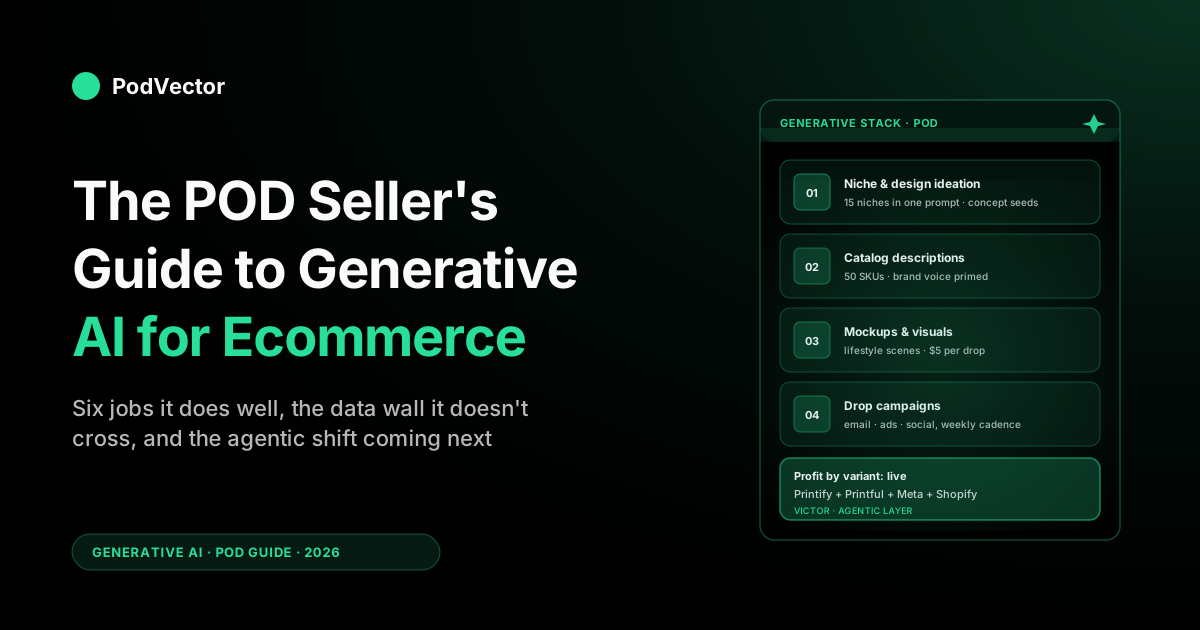
Quick Answer: Generative AI for ecommerce means six concrete jobs for a print-on-demand store: niche and design ideation, catalog-scale product descriptions, mockup and visual generation, ad and email copy, customer support drafting, and SEO metadata at scale. According to Shopify's 2026 enterprise guide, generative AI use cases now span marketing channels, customer support, product descriptions, and operational data analysis — and the fastest-moving frontier is agentic AI that takes action against live data, not just generates content. As Easync's 2026 guide frames it, generative AI operates across three layers: synthesis (generating copy from raw supplier data), understanding (parsing signals from orders and reviews), and action (triggering pricing and fulfillment logic) — and the action layer is where most merchants are still underinvested. Standalone generative tools cannot see your Printify production costs, your Meta ad spend, or your live Shopify orders. That data gap is why the agentic layer exists. This guide covers what to use today, what each tool is genuinely good at, and exactly where the line is.
What "generative AI for ecommerce" actually means in 2026
The phrase has stretched a long way from where it started. In 2023 it meant "I paste a product into ChatGPT and get a description back." In 2026 it covers four distinct surfaces, and conflating them is the most common reason a POD seller's AI stack ends up expensive and underused.
The first surface is standalone generative tools — ChatGPT, Claude, Gemini, Midjourney, DALL-E, Sora. These are the chat windows and image generators you tab over to. They're general-purpose, model-of-the-month best, and unaware of your store. You generate something, you paste or upload it into the admin.
The second is generative AI baked into ecommerce platforms — Shopify Magic, Shopify Sidekick, BigCommerce's AI tools, Wix's AI site builder, the AI features inside Klaviyo, Mailchimp, and Meta Ads Manager. These are convenience layers that put a generative model one click away from the field you're filling, with some awareness of your store's data inside the platform's own walls.
The third is third-party AI apps — the App Store ecosystem. Yodel for bulk descriptions, HeiChat and Rep AI for chatbots, Tinyalbert for SEO copy, Octane AI for quizzes, hundreds more. Most are wrappers around foundation model APIs with a Shopify-native UI for one specific job.
The fourth — the most important shift in 2026 — is agentic commerce. Tools that don't just generate text or images but take actions: surface your products inside a chat, navigate your admin, execute multi-step workflows. As Easync's 2026 generative AI guide makes clear, generative AI now operates across three functional layers — synthesis, understanding, and action — and it is the action layer where the greatest financial leverage lives and where most merchants remain underinvested. The line between "AI tool" and "AI employee" gets blurry here.
For a POD seller, all four matter, but they earn their keep at different stages of the operation. The first three help you ship more product faster. The fourth changes who finds your store and how decisions get made about which products to scale.
Why POD is a different problem than DTC
Most generative AI ecommerce coverage flattens print-on-demand into a generic "online seller" persona. That misses the three structural differences that change which AI tools actually pay back.
POD catalogs are wide and shallow. A typical DTC apparel brand has a small, curated SKU count and writes each description by hand. A POD store has hundreds to thousands of SKUs across the same handful of designs replicated on tees, hoodies, mugs, totes, stickers, posters, sweatshirts, and tank tops. As Clawify's 2026 ecommerce guide puts it, "a store with 500 SKUs needs 500 distinct descriptions" — and generative AI eliminates that bottleneck entirely. Bulk generative work is not a luxury for a POD seller; it is the only economically viable way to populate the catalog.
POD margins are thin and per-variant. Each Printify or Printful SKU has its own production cost that varies by base provider, plan tier, and shipping zone. The same artwork on different base garments changes your margin meaningfully per unit. Most generative AI tools cheerfully write descriptions without knowing any of this; the gap between content production and profit awareness is wider in POD than in any other ecommerce model. For context on how that cost math plays out, see our net profit margin benchmark guide.
POD ships continuously, not seasonally. A new design every week, sometimes every day. Each drop needs a launch email, ad creative, social posts, and listing copy across multiple product types. Generative AI is the only tool that makes the cadence sustainable. Without it, you either slow the drop schedule or burn out the operator.
Those three facts — wide catalogs, per-variant margins, continuous drops — drive the entire generative AI return on investment for a POD seller. The use cases below are ranked roughly in order of leverage given those constraints.
The six jobs generative AI does well for a POD store
Niche and design ideation
The job that determines everything else. Before there is a product to describe, there is a design to make, and before there is a design, there is a niche to design for. Generative AI compresses what used to be hours of Etsy and Pinterest scrolling into a structured brainstorm session.
The pattern that works: prime the chat with three or four niches you've already won in (say, "ironic dad shirts, niche fishing apparel, vintage-style coffee mugs"), describe one constraint ("low-competition, high-AOV, holiday-evergreen"), and ask for fifteen adjacent niches with a one-line audience description, one design hook, and one likely product type for each. ChatGPT and Claude both do this well. Half the suggestions will be obvious; two or three will be ideas you would not have surfaced through Pinterest scrolling alone.
The follow-up is design ideation inside a chosen niche. Image generators (Midjourney, DALL-E, Stable Diffusion via tools like Leonardo) produce concepts quickly at low cost. The fidelity is not yet print-ready for most POD applications — fingers, text, and complex symmetry still misbehave — but the concept-exploration phase is much cheaper and faster than commissioning an illustrator. Most sellers settle on a workflow where AI generates the seed concept and a human (or commissioned artist) finalizes the print file.
Catalog-scale product descriptions
The highest-volume job, and the one where bad output costs you visibility. According to Shopify's 2026 generative AI use case guide, generative AI use cases span marketing channels, customer support, product descriptions, and operational data analysis — and the right description workflow is to feed structured product attribute data to the AI, have it draft descriptions, then route output for human review before publishing.
As Clawify's 2026 guide explains, modern LLMs can take structured product data — title, category, material, dimensions, key features — and produce descriptions that are optimized for search engines, written in your brand voice, and tailored to your target audience. For a POD seller this maps to: supply the product title, type, colors, sizes, design concept, and target buyer; get descriptions back in one batch; review for accuracy before uploading.
The compounding move is brand-voice priming. Pre-load the chat with five descriptions you wrote yourself, then run the batch. According to Wisepim's 2026 guide, using poor source data leads to low-quality descriptions — AI needs accurate product details to write helpful content, and generic prompts without guidelines create repetitive, robotic text. The 2024-vintage AI tell gets meaningfully quieter once voice samples are in the prompt.
For sellers running thousands of SKUs, App Store apps (Yodel, ShopMagic, Tinyalbert) wrap this workflow into a one-click bulk operation. Brand-voice fidelity is lower than the manual pre-load approach, but for stores filling hundreds of empty description fields the time savings outweigh the quality drop. A deeper comparison of those tools sits in the PodVector AI POD strategy guide.
Mockups and visual content
Two distinct sub-jobs that get conflated. Product mockups (your design on a tee, on a model, in a lifestyle setting) and visual content (banners, social tiles, ad creatives, email headers).
For mockups, the leading workflow in 2026 combines Printify or Printful's native mockup generator (free, accurate to actual production) with AI-generated lifestyle scenes for hero and social images. Tools like Placeit, Mockey, and Canva's AI mockup feature handle the lifestyle composition; Midjourney generates aspirational background imagery you composite the product over.
For visual content, the 2026 standard is generate-then-edit. Generate a banner concept in Midjourney or DALL-E, refine in Canva or Figma, export. The gain is not "fully automated marketing visuals" — that workflow still produces uncanny output — it's compressing the design-to-publish cycle from a half-day to fifteen minutes.
The newer wrinkle is generative virtual try-on. Tools that drop your design onto an AI model in any body type, pose, or setting — and visual search, where a shopper uploads a photo and the store returns the closest match — are now standard in larger-brand coverage. For a single-operator POD store these are mostly app-layer features (Shopify's Search & Discovery, third-party try-on apps) rather than something you build, but they matter for the same reason good mockups do: they shrink the gap between "design on a flat file" and "shopper picturing it on themselves."
Ad and email copy at drop cadence
Generative AI's most reliable win for POD specifically. A store shipping a new design every week ships fifty-two campaigns a year. Each campaign needs a launch email, a Meta ad set with multiple variants, Instagram captions, and social posts across platforms. Hand-writing all of that is a full-time job that shouldn't be a full-time job.
According to Shopify's 2026 enterprise guide, the right workflow for ads is to provide structured product claims and specific audience demographics along with offer details, then have the AI generate multiple ad angles and landing-copy drafts for human review and A/B testing. Apply the same logic to email: provide the design name, design story, target audience, the offer, and three past launch emails for voice, then request a subject line set, preheader, body with a clear single CTA, Meta primary text variants, and Instagram captions.
As Clawify's 2026 ecommerce guide notes, generative AI now makes true one-to-one personalization achievable even for small teams — individualized subject lines, product recommendations, and body copy generated from purchase history and engagement patterns. For a POD seller, the practical version is segment-specific email copy per audience (fishing niche list, dad-humor list, coffee niche list) rather than one blast for the whole subscriber base. For the mechanics of setting up those audience flows, see our Klaviyo browse abandonment flow setup guide.
The native AI inside Klaviyo, Mailchimp, and Meta Ads Manager handles the in-flow version of this. Useful when you're already in the platform and want a one-field assist; weaker than a primed external chat for full-campaign output. Most operators end up using both. For context on how ad spend connects to real margin, see our guide to increasing AOV with AI.
Customer support drafting
POD support volume clusters around three questions: where is my order, does this fit, can I get the design on a different product. Generative AI drafts empathetic, on-brand replies to all three faster than you can type them.
The workflow most sellers settle on isn't real-time chatbot — it's draft-and-edit. Paste the customer message into the chat with one line of context ("Printify order, delayed at production, ETA pushed back 3 days"), get a draft in your store's voice, edit for accuracy, send. Cuts response time per ticket meaningfully once you have two or three reusable system prompts saved.
For sellers with enough volume that draft-and-edit is no longer sustainable, the AI chatbot route handles tier-one questions automatically. As AutoDS's 2026 guide notes, AI tools can take basic product data and instantly generate optimized content — the same principle applies to support templates built from your FAQ data and past ticket resolutions.
SEO and metadata at scale
The least-glamorous job, and the one with the highest ROI per minute. POD catalogs accumulate hundreds of products with missing meta titles, missing alt text, generic URL slugs, and no schema markup. Each missing field is a small visibility tax; multiplied across a catalog, it's a meaningful chunk of organic traffic left on the table.
According to Wisepim's 2026 guide, bulk generation lets you create thousands of optimized descriptions at once — and the same principle applies to meta titles, alt text, and structured data fields. Apps like Tinyalbert, Smart SEO, and Yoast Shopify run the AI API across your full catalog in one pass.
The same generative SEO discipline now applies to AI search itself. According to Alea IT Solutions' 2026 ecommerce guide, GEO and AEO (optimizing content to be cited inside AI answers, not just ranked on Google) are now as important as traditional SEO for ecommerce visibility. For POD, this means being specific about the product, the wearer, the occasion, and product taxonomy — the same hygiene that ranks a listing in Google now also surfaces it inside AI shopping assistants. This discipline is what practitioners call Generative Engine Optimization (GEO): structuring content to surface in AI-generated answers, not just blue-link search results. For the conversion side of that traffic, see our CRO techniques guide.
From raw supplier data to live product copy
One subtopic the top-ranking pages cover in 2026 that this article has historically underweighted: the workflow for turning raw Printify or Printful supplier data into structured, conversion-ready product pages at scale.
As Easync's 2026 generative AI guide frames it, the synthesis layer of generative AI in ecommerce is specifically about "generating product copy, email sequences, ad variants, and catalog descriptions from raw supplier data." The challenge for POD sellers is that Printify and Printful provide product attributes — material, weight, sizes, print area, base garment — but not descriptions written for your brand voice or your niche audience. That raw attribute data is the input; the AI's job is to transform it into copy that converts.
As Experionglobal's 2026 analysis puts it, generative AI helps "standardize titles, extract attributes, and create SEO-friendly descriptions from raw supplier data" — automatically restructuring and enhancing listings to ensure consistency and discoverability at catalog scale.
According to Databricks' analysis of scaling product copy creation, generative AI can be used "to extract baseline descriptions from product imagery and combine information about a product to craft draft copy that reflects a tone or style aligned with the needs of a brand." Writers and operators then use these drafts as a starting point significantly closer to the final state than a blank page.
The practical POD workflow:
- Export the supplier attribute sheet. From Printify's product catalog or Printful's product API, pull material, sizes, weight, print area, and base-garment name for every SKU you're listing.
- Pair attributes with your design brief. Add the design concept, niche audience, and intended use case to the attribute row. This is the data that makes the output specific rather than generic.
- Run a batched generation prompt. Feed the combined data to your general-purpose chat with your brand-voice samples pre-loaded. Request descriptions, meta titles, and alt text in one pass.
- Review for accuracy before publishing. As Shopify's enterprise guide specifies, the guardrail is simple: restrict outputs to provided attributes and prohibit invented features. A human checks that no AI-hallucinated product claim (a size that doesn't exist, a material that isn't used) made it through.
- Push to Shopify in bulk. Use a CSV import or a bulk-editor app to upload the reviewed content. The product page is live within minutes of the design file being approved.
The data-quality caveat matters here. As Easync's guide notes, the principle is simple: fix your titles, supplier feeds, and attribute accuracy before the model touches them. Incomplete product information is among the most documented causes of ecommerce friction, and AI amplifies whatever data quality exists in the input, for better or worse. For a deeper look at how Printify structures its supplier network and what data is available to pull, see our guide to sourcing and fulfillment data reconciliation.
Attribute grounding: preventing AI hallucinations at catalog scale
A subtopic the current top results now explicitly cover that older versions of this article did not address directly: the technical discipline of anchoring AI output to verified product data so hallucinated claims never reach the live catalog.
As Channable's 2026 generative AI guide explains, the key principle is "grounding via attributes: prevent AI hallucinations by anchoring output to your actual product data (color, size, material etc)." This is not a nice-to-have — at catalog scale, a single hallucinated claim (a fabric weight that doesn't exist, a size that isn't offered) multiplied across hundreds of SKUs becomes a customer service problem and a returns driver.
For a POD seller, attribute grounding works in three steps:
- Lock the input schema. Before any prompt touches the AI, define which fields are allowed to appear in output — and which are prohibited unless they appear in the supplier attribute sheet. Material, colors, sizes, print area, and care instructions are locked fields. Claims about softness, durability, or fit that aren't in the supplier spec are prohibited fields.
- Use a structured prompt format, not open-ended requests. As LatentView's 2026 retail AI guide notes, generative AI generates titles, descriptions, and specifications automatically from product attributes and brand guidelines, "maintaining consistent style even when information arrives from different suppliers in varying formats." The prompt structure enforces that consistency — a free-form request does not.
- Run a post-generation accuracy check. Before bulk upload, a human (or a secondary AI pass with the original attribute sheet loaded) flags any description that contains a claim not traceable to a source attribute. This step is what separates a defensible catalog from one that generates refund requests.
The grounding discipline also directly supports GEO performance. AI shopping assistants that read your product pages to formulate recommendations are doing the same thing a grounding check does — verifying that product claims are specific, attributable, and internally consistent. Vague or hallucinated descriptions do not get recommended with confidence; grounded, attribute-rich descriptions do. For how that specificity connects to checkout performance, see our average checkout completion rate benchmark.
The tool stack most POD sellers settle on
After a few months of trial-and-error, most POD operators converge on a small, opinionated stack. The exact tools rotate quarter to quarter as models improve; the categories are stable.
One general-purpose chat. ChatGPT Plus or Claude Pro. The workbench you tab over to for descriptions, emails, support drafts, and research. ChatGPT has the wider Shopify-specific tuning; Claude has the longer context window and arguably better brand-voice fidelity when pre-loaded with many voice samples. Pick one, learn its quirks, save reusable prompts.
Native platform AI. Shopify Magic and Shopify Sidekick. Free, in-context, one-click. Handles the high-frequency in-the-flow tasks where convenience beats quality ceiling.
One image generator. Midjourney for hero and lifestyle imagery, DALL-E or Sora when you need integration with the chat workflow. Most sellers don't need both.
One bulk-content app. Either a description-focused app (Yodel) or a metadata-focused app (Tinyalbert, Smart SEO). One catalog-wide cleanup pass at install, then occasional drift-fixes. According to Channable's 2026 guide, tools that can optimize thousands of SKUs instantly — without a fleet of copywriters — are now table-stakes for any store managing a large catalog.
One support layer. Either a chatbot app (HeiChat, Rep AI) for high-volume stores or saved prompts in your general-purpose chat for moderate volume.
Five line items, modest monthly spend for a typical POD store. The stack expands when volume grows; it shouldn't expand to chase shiny new tools that overlap with what's already working. For Meta advertising strategy that connects to this content stack, see our Facebook ads for Shopify POD strategy guide.
The data wall generative AI does not cross
Everything generative AI does well for a POD store sits on one side of a hard line. On the other side is the question that matters most: which of my products and ad campaigns are actually making money?
POD profit lives in a five-system mess. Shopify has order revenue. Printify or Printful has per-order production cost (varies by product, plan tier, and shipping zone). Meta and Google Ads have spend by campaign, ad set, and creative. The connection between an ad click and an order — the attribution layer — usually lives in a tracking pixel of varying reliability. And monthly fixed costs (apps, Printify Premium, design tools) sit in a spreadsheet nobody opens.
Generative AI cannot see any of this by default. ChatGPT can write a description for a tee, but it cannot tell you the tee's contribution margin. It can draft a Meta ad, but it cannot tell you the ad's ROAS net of production cost. It can summarize a CSV you upload, but the moment your dataset changes — every order, every refund, every ad spend tick — the summary is stale.
As Easync's 2026 guide frames it, the action layer — "triggering pricing rules, reordering workflows, and fulfillment logic based on AI-interpreted conditions" — is where most sellers still aren't using AI, and it's where the real money is. This isn't because the AI isn't smart enough. A smarter chatbot won't fix it. What fixes it is a tool that can see your real data — your orders, your ad spend, your costs — and then act on it. That's why the next kind of AI tool, one that can see your live data and take action on it, is the one that actually closes the loop. For the profit-layer benchmarks that make this concrete, see our net profit margin benchmark guide.
The agentic shift: from generating to acting
The 2026 step-change in ecommerce AI is not a better generative model. It is the move from "AI that writes content" to "AI that takes action against your live data."
According to Shopify's 2026 enterprise guide, the fastest-moving frontier is agentic AI that takes action against live data — not just generates content. AI shopping assistants embedded in platforms now field shopping queries at scale, and the stores that get found inside those surfaces are the ones that have invested in clean product data and accurate structured content.
As Easync's 2026 analysis puts it, generative AI operates across three functional layers — synthesis, understanding, and action — and it is the action layer where the greatest financial leverage lives. The query changes from "write me a description for this product" to "identify my five lowest-margin SKUs this month, draft replacement descriptions that emphasize the higher-AOV variants, and queue them as a bulk update for my approval." The first sentence is generative. The second is agentic — it requires reading live cost data, joining it to live revenue data, making a recommendation, and queuing an action for human approval.
For a POD seller, the practical argument for treating AI shopping assistants as a live channel today is visibility: your products need to be structured and described in a way that AI agents can read, interpret, and confidently recommend. According to Alea IT Solutions' 2026 ecommerce guide, GEO and AEO — optimizing content to be cited inside AI answers — are now as important as traditional SEO for ecommerce visibility, and the stores that get found are the ones with clean, attribute-rich product data.
The PodVector AI positioning bet is that this is where POD-specific AI lives. Victor reads Printify and Printful order invoices live, joins them to Shopify orders, layers in Meta and Google ad spend from those platforms, and answers profit questions in plain English against the reconciled dataset. Asked "which Printify variants are losing money on the Premium tier this month," a general-purpose chat explains how you'd figure that out; Victor returns the variants — and can execute Shopify-side actions (repricing to a target margin, adjusting collections, setting discounts, scheduling a Klaviyo email campaign) with your approval. The merchant approves or rejects; Victor executes the approved Shopify writes. See how margin connects to your ad efficiency in our guide to increasing AOV with AI, and how Meta budget structure affects the returns Victor reads in our Facebook ads for Shopify POD strategy guide.
None of this replaces the generative tools above. ChatGPT, Claude, Magic, Midjourney, the App Store apps — all stay in the stack. The agentic layer is a separate category that handles the data-aware decision work the content tools structurally cannot.
Getting started in under a week
A workable starting setup, in order:
- Pick one general-purpose chat. ChatGPT Plus or Claude Pro. Don't pay for both yet. The free tiers are fine to test with; daily store work hits rate limits quickly.
- Build three reusable prompts. One for descriptions (including your raw supplier attributes as a structured input), one for drop-launch emails, one for customer support replies. Each pre-loaded with five samples of your existing voice. Save them as Custom GPTs, Claude Projects, or in a notes app you can paste from.
- Audit your catalog for empty fields. Empty descriptions, missing meta titles, missing alt text. Export supplier attributes from Printify or Printful, pair them with your design briefs, and generate replacements in batches — anchoring every claim to the supplier attribute sheet (see the attribute grounding section above). This single pass moves the SEO floor on a long-tail catalog more than any other AI work you'll do this year.
- Install one bulk-content or SEO app. If your catalog has hundreds of empty descriptions, Yodel for the bulk pass. If your metadata is the gap, Tinyalbert or Smart SEO. One install, one pass, then leave it alone.
- Set up native platform AI. Turn on Shopify Magic and Shopify Sidekick. Free, in-context, immediate. Used in-the-flow for everything you'd otherwise tab over to ChatGPT for.
- Pick one image generator. Midjourney for most sellers. Generate a small library of lifestyle scenes per niche; reuse across drops.
- Connect a profit layer. Pair the content tooling above with a tool that actually reads your Printify, Printful, and ad spend data live, so the "is this making money" question has a real answer instead of a generative-AI guess. For context on what a healthy margin looks like before you connect anything, see our net profit margin benchmark guide.
Total setup time: under a week. Expected leverage: an operator who previously shipped one design a week credibly ships two or three with the same hours.
Mistakes POD sellers make with generative AI
Treating generative output as finished work. The drafts are a strong starting point; the final edit is where brand-specific differentiation lives, and it is still a human job. As Shopify's enterprise guide notes, humans are still necessary at every step to ensure consistency for brand voice and positioning. Skipping the edit produces the same beige content every other AI-using seller is shipping.
Skipping attribute grounding. As Channable's 2026 guide makes explicit, preventing AI hallucinations requires anchoring output to your actual product data. At catalog scale, a hallucinated material claim or nonexistent size multiplied across hundreds of SKUs creates real customer service exposure. Lock your input schema before the model touches it.
Feeding the AI bad supplier data. As Wisepim's 2026 guide specifies, using poor source data leads to low-quality descriptions — AI needs accurate product details to write helpful content. Export and clean your Printify or Printful attribute data before it goes into the prompt. Garbage in, garbage out applies especially to bulk runs of hundreds of SKUs.
Stacking five overlapping AI apps when one would do. Each app is a separate subscription, a separate UI, and a separate point of failure. Pick the app that addresses your single biggest volume problem; do the rest in your general-purpose chat. Model quality differences between tools are smaller than tool-switching overhead.
Asking a generative tool for store-specific numbers. ChatGPT, Claude, Magic — none of them can see your store. Every answer they give about your data is a hallucination unless you pasted the data in seconds before, and even then it's stale on the next order. Use them for the work that doesn't depend on live numbers; use a connected analytics tool for the work that does.
Skipping the brand-voice setup. Pre-loading voice samples saves dozens of hours of editing across hundreds of generations. Sellers who skip this step ship visibly worse content and edit harder for it.
Ignoring agentic commerce because "my customers don't shop in chatbots yet." According to Alea IT Solutions' 2026 ecommerce guide, GEO and AEO are now as important as traditional SEO for ecommerce visibility — the AI shopping surfaces from major platforms are already fielding queries at scale. The cost of being listed is near zero; the cost of waiting is being late to a channel competitors are already building ranking history in.
Conflating generative with agentic. They are different categories with different jobs. Don't expect ChatGPT to answer your profit questions; don't expect a profit agent to write your ad copy. Stack them, don't substitute one for the other.
FAQs
What is generative AI for ecommerce?
Generative AI for ecommerce refers to AI tools that produce text, images, audio, or video for online stores — product descriptions, ad copy, marketing emails, mockups, customer chat replies, SEO metadata. According to Alea IT Solutions' 2026 ecommerce guide, unlike traditional AI systems that primarily analyze data, generative AI creates new content such as product descriptions, images, videos, and personalized marketing messages. The category includes general-purpose chats (ChatGPT, Claude, Gemini), image generators (Midjourney, DALL-E), platform-native AI (Shopify Magic and Sidekick), and the third-party app ecosystem. In 2026 it sits alongside agentic AI, which takes actions against live store data rather than just generating content.
Is generative AI worth it for a print-on-demand store?
Yes, for most POD operators. The structural reasons — wide catalogs, continuous design drops, thin margins that punish slow execution — make generative AI more valuable for POD than for almost any other ecommerce model. According to AutoDS's 2026 guide, instead of spending days writing individual listings manually, sellers can produce content for hundreds of items in just a few minutes — a speed advantage that compounds across continuous design drops. A typical POD seller using a primed general-purpose chat plus Shopify Magic recovers significant weekly hours on description writing, ad copy, and support drafting against modest AI subscription costs.
Will Google penalize AI-generated product descriptions?
No, not in 2026. Google's stated position is that AI-generated content is acceptable when it's helpful, accurate, and meets the same quality bar as human content. The risk isn't AI generation per se; it's publishing low-effort, generic AI content at scale without the brand-specific edit. As Wisepim's 2026 guide notes, skipping human review can lead to false information, and AI sometimes invents product features that do not exist — which means the review step is non-optional for quality and compliance reasons, not just brand reasons. POD descriptions generated by AI and lightly edited for accuracy and brand voice rank fine. Bulk-published filler with no editing is what gets penalized — the same rule that has always applied to human content.
Can generative AI see my Printify or Printful production costs?
No. Standalone generative tools (ChatGPT, Claude, Midjourney) and platform-native AI (Shopify Magic, Sidekick) have no native connection to Printify or Printful. You can paste data in manually for a one-off analysis, but the moment a new order or refund comes in, that pasted data is stale. For continuous, live access to production cost joined to Shopify orders and ad spend, you need a tool that connects to the supplier APIs directly — and importantly, production costs enter through completed order invoices, so a store with no sales yet cannot get a true per-variant margin answer even with a connected tool. That's an agentic-analytics job, not a generative-content one.
What is attribute grounding and why does it matter for POD catalogs?
Attribute grounding means anchoring every AI-generated product claim to a verified field in your supplier attribute sheet — material, size, color, print area — so the model cannot invent specifications that don't exist. As Channable's 2026 guide explains, grounding via attributes is the primary mechanism for preventing AI hallucinations in bulk content generation. For a POD store generating descriptions across hundreds of SKUs in a single batch, one hallucinated claim (a fabric weight, a size tier, a care instruction) that makes it to the live catalog creates a real customer service and returns exposure. The grounding discipline is also what makes your descriptions readable and trustworthy by AI shopping assistants, which is increasingly where product discovery happens.
What is the difference between generative AI and agentic AI in ecommerce?
Generative AI produces content — text, images, audio. Agentic AI takes actions against live data — reads your orders, joins them to costs, executes multi-step workflows. As Easync's 2026 guide frames it, generative AI handles the synthesis layer (generating copy from raw supplier data), while the action layer — triggering pricing rules, reordering workflows, and fulfillment logic based on AI-interpreted conditions — is where most merchants are still underinvested and where the greatest financial leverage lives. The distinction matters because they answer different questions. Generative AI answers "write me a description for this product"; agentic AI answers "which of my products are losing money this month and what should I do about it." Most POD stores need both — generative for the content layer, agentic for the decisions.
How much should a POD seller spend on generative AI tools per month?
For most single-operator POD stores, a modest monthly budget covers one general-purpose chat, one image generator, one bulk-content or SEO app, and a chatbot app if support volume justifies it. Spending more than that without a corresponding revenue tier usually means tool sprawl, not real leverage. Stores that scale to higher revenue tiers tend to add a profit-analytics layer on top. The key principle: pick the smallest stack that covers your actual bottlenecks, not the most comprehensive one that covers every imaginable job.
Can generative AI personalize product recommendations for a POD store?
Partly, and it's worth being precise about where the line is. As Clawify's 2026 guide explains, generative AI now makes it possible to generate individualized subject lines, product recommendations, and body copy for each customer based on their purchase history, browsing behavior, and engagement patterns. For a POD seller, most of that personalization infrastructure lives in the app and platform layer, not in a chat window: Shopify's Search & Discovery, recommendation apps, and email platform segmentation already run the models. A general-purpose chat helps you write the personalized variants (segment-specific email copy, audience-specific ad angles), but it does not decide who sees what — that's a data-driven job the platform handles. The recommendation engine and the content generator are two different tools; use the chat for the copy, the app for the targeting. For thinking about how AOV-focused recommendations connect to ad strategy, see our guide to increasing AOV with AI.
What is Generative Engine Optimization (GEO) and does it matter for POD?
GEO is the discipline of structuring content so it surfaces in AI-generated answers — ChatGPT, Perplexity, Google's AI Overviews — not just traditional blue-link search results. According to Alea IT Solutions' 2026 ecommerce guide, GEO and AEO (Answer Engine Optimization) are now as important as traditional SEO for ecommerce visibility. For POD, GEO mostly converges with good product taxonomy: clear titles, specific descriptions, accurate tags, populated metafields, real reviews, transparent shipping turnaround. The investment is the same as good basic SEO; the surface it pays back on is wider in 2026 than it was two years ago. For the conversion mechanics that turn that traffic into revenue, see our CRO techniques guide.
Should I use ChatGPT or Claude for POD content work?
Either works for the core jobs (descriptions, emails, support drafts). ChatGPT has wider Shopify-specific tuning and the larger third-party app ecosystem; Claude has a longer context window — useful when you're priming with many voice samples — and arguably better brand-voice fidelity for nuanced tones. Most sellers settle on one based on which they already pay for. Don't pay for both unless you have a clear reason — the marginal quality gap is smaller than the workflow-switching overhead.
Will AI replace POD sellers?
Not in any near-term horizon worth planning around. As Shopify's enterprise guide makes clear, generative AI reduces the bottlenecks that occur in production — setting up new product pages, drafting campaigns, scaling copy — but it does not remove the operator from the loop. AI replaces specific tasks — description writing, mockup generation, ad copy drafting, support tier-one — not the operator. The decisions that determine whether a POD store makes money (which niche to enter, which design to commission, which ad to scale, which supplier to switch to) still require judgment grounded in live, joined data. The AI shift makes one operator do the work of three; it does not eliminate the operator.
Where does generative AI stop being enough for a POD store?
The line is data access. Generative AI does the content and writing layer well across the full surface of a POD store — descriptions, emails, ads, support, research, mockups. It cannot do anything that depends on live, joined data from Shopify, Printify, Printful, Meta Ads, and Google Ads. Profit by variant, ROAS by campaign net of production cost, monthly P&L, "what should I scale and what should I cut" — these questions need a tool that reads your actual systems, not a chat interface that depends on what you paste in. For the full picture of what those profit benchmarks look like, see our net profit margin benchmark guide and our checkout completion rate benchmark.
Generative AI writes the content. Victor answers the profit questions.
Generative AI is the right tool for the content layer of a print-on-demand store — descriptions at scale, drop emails, support drafts, ad copy, mockups, brand voice cloning. It cannot see your Printify production costs, your Printful shipping tiers, or your Meta and Google ad spend, which is where POD profit actually lives. Victor reads those systems live, joins them to your Shopify orders, and answers profit questions in plain English against the reconciled dataset — then executes approved Shopify-side actions like repricing to a target margin, organizing collections, or scheduling a Klaviyo email campaign. Pair generative for the writing, Victor for the decisions.
Try Victor free