
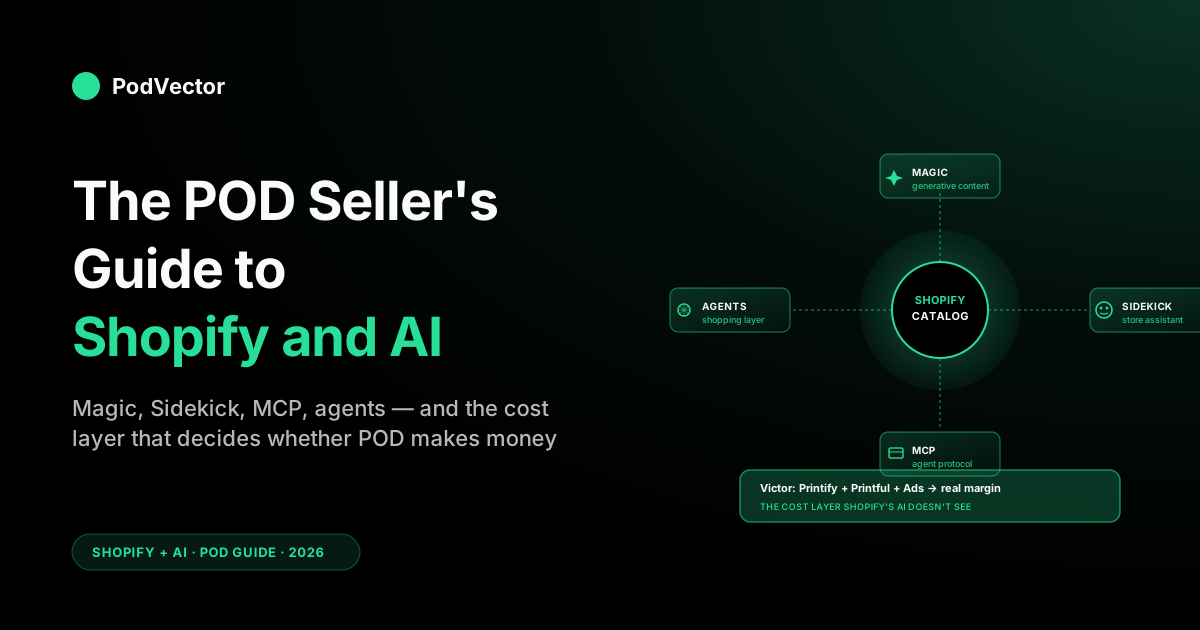
Quick Answer: "Shopify and AI" in 2026 is four headline surfaces baked into the platform: Shopify Magic (generative content), Sidekick (a conversational store assistant), the AI Toolkit and Storefront MCP (developer hooks for third-party agents), and the AI Store Builder (zero-to-store onboarding). Underneath those sit the quieter AI features merchants use every day — semantic search, product recommendations, fraud detection, and demand forecasting. Together they cover content production, store admin, and a growing slice of the shopper-facing experience — including the AI shopping agents Shopify now routes through ChatGPT and its public Catalog.
For a print-on-demand store, the built-in AI handles the content grind well and the in-admin assistant well enough for surface-level questions. What it cannot see is your Printify or Printful cost layer, your Meta and Google ad spend, or your real per-variant margin — the data that decides whether a POD store actually makes money.
That's the gap a POD-aware AI employee fills: one that reads those costs and acts on them — reallocating ad spend, pausing losing campaigns, and updating Shopify listings, with your approval on each material move.
What "Shopify and AI" actually means in 2026
"Shopify and AI" used to mean a couple of generative buttons sprinkled across the admin. In 2026 it's a coordinated platform strategy with three distinct audiences: merchants, developers, and the AI shopping agents that are starting to mediate consumer purchases inside ChatGPT and other conversational AI assistants.
The merchant-facing AI is everything you interact with as a store owner — Magic for content generation, Sidekick for conversational store admin, and the AI Store Builder for new-store onboarding. The developer-facing AI is the AI Toolkit and Storefront MCP — the protocol layer that lets external AI agents read product data, build carts, and guide checkouts on your store. The shopper-facing AI is what happens when a buyer never visits your storefront because they bought your product through a third-party agent that pulled it from Shopify's public Catalog.
For a print-on-demand seller this matters more than for most ecommerce categories, and not entirely in your favor. POD stores typically have wide catalogs (one design across many SKUs), thin margins (supplier cost takes most of the price), and content production as their biggest day-to-day bottleneck.
Shopify's AI is excellent at the content side, decent at admin assistance, and largely silent on the cost side — which is exactly the area where POD economics live or die. The rest of this guide walks each surface, what it does, and where the POD-specific edges are.
The four surfaces of Shopify's AI
Shopify's AI footprint splits cleanly into four products. They share an underlying model and ship for free on every plan, but the jobs they do are distinct enough that it's worth treating them as separate tools.
Shopify Magic — generative content across the admin
Magic is the "Generate with Magic" button that shows up wherever you'd normally type content into Shopify: the product description editor, Shopify Email's campaign builder, the blog post composer, the image editor, the theme content blocks, the Inbox reply suggestions. It's generative — it produces assets — and it's catalog-scale by design.
For POD specifically, Magic earns its keep on three jobs: product description generation across hundreds of SKUs in a design family, supplier-mockup background removal and re-comping, and email subject lines for the weekly drop calendar. Brand voice cloning, added in the Winter '26 release, lifts the quality of every generation by training on your existing content (up to roughly 1,000 samples). For a deeper feature-by-feature breakdown, see the POD seller's guide to Shopify Magic AI features.
Sidekick — the conversational store assistant
Sidekick is the chat-style assistant that lives in the bottom-right of every admin page. You ask a question in plain English ("what were my top three products last week?", "set up a 15% off discount for Black Friday weekend"), and it answers with reference to your live store data and, where authorized, executes the action on your behalf.
Sidekick is genuinely useful as an admin shortcut — it removes the click-trail friction of finding settings, drafting basic discount logic, and pulling top-line numbers without manually filtering reports. For POD it's particularly handy on the storefront-config side (creating product collections, setting up shipping zones, drafting email automations) and less useful for cost or margin questions, since Sidekick reads Shopify-side data and Shopify doesn't see your supplier cost layer. Full breakdown: the POD seller's guide to Shopify Sidekick AI.
The AI Toolkit and Storefront MCP
The AI Toolkit is Shopify's developer-facing surface — a set of plugins, skills, and an MCP server that lets external AI tools read and write Shopify data. The Storefront MCP, built on the open Model Context Protocol (MCP), is the public-facing slice of that: a standardized way for AI agents (yours or somebody else's) to discover products, answer shopper questions, build carts, and route checkouts. In 2026 Shopify pushed this further, announcing the Universal Commerce Protocol (UCP) — an open standard co-developed with Google to let AI agents transact across any merchant at scale.
You don't need to be a developer to care about this. Storefront MCP is the protocol that lets ChatGPT and emerging shopper agents transact directly with your store without scraping.
If you've enabled the public Shopify Catalog (the default for most plans), you're already discoverable by these agents — your products show up when someone asks an AI "find me a tee with a tiger dad pun on it" and the AI's catalog index includes Shopify's. For POD stores with a long-tail design library, this is a bigger deal than it sounds: tail-of-the-distribution products that never ranked on Google can surface in conversational shopping in a way they couldn't in keyword search.
AI Store Builder
The AI Store Builder is Shopify's onboarding flow for new merchants — describe your business in a few sentences and it stands up a working store, complete with a theme, a starter product catalog, brand colors derived from your description, and seeded marketing content. For an established POD seller migrating from Etsy or Redbubble, this is faster than picking a theme and configuring it manually, though most growth-stage stores end up customizing far enough past the AI-generated baseline that the upfront speed is mostly a soft launch benefit. For first-time sellers it's the lowest-friction zero-to-store path Shopify has ever shipped.
The other AI baked into Shopify: search, recommendations, fraud, forecasting
The four headline surfaces get the press, but Shopify also runs AI quietly in places you never click a "Generate" button. Most "what is Shopify AI" guides lead with these, so they're worth naming — and each one lands differently for a POD store.
Semantic search and product recommendations
Shopify's Search & Discovery uses AI to match shopper intent to products, even when the query doesn't match your exact title. The "tiger dad tee" buyer who types "funny dad animal shirt" still finds the SKU. Recommendation blocks ("complete the look," "you may also like") are AI-ranked from browsing and purchase patterns.
For POD this is free cross-sell on a wide catalog. A buyer who lands on one design in a family gets nudged toward the hoodie and mug versions without you building manual collections — provided your tags and descriptions are populated enough for the ranker to connect them.
Fraud and risk analysis
Every order gets an AI-scored fraud signal in the admin, flagging high-risk transactions before you fulfill. For POD this matters more than for stocked retail: a fraudulent order you fulfill is a supplier production cost you eat with no recourse, since the item shipped from Printify or Printful is already gone.
Demand and inventory signals
Shopify's forecasting leans toward stocked inventory — reorder points, low-stock alerts — which is a soft fit for made-on-demand POD where there's no shelf to run dry. The useful slice for POD is the sales-trend surfacing: which designs are accelerating, so you know what to launch variants of next. It reads Shopify-side units sold, not margin, so treat it as a popularity signal, not a profit one.
AI customer service in Inbox
Shopify Inbox drafts AI replies to common shopper questions — shipping times, sizing, return policy — and suggests answers your team can send in one tap. For a one-person POD shop, this absorbs the repetitive "where's my order" and "does this run small" load that otherwise eats the evening. It answers from your store policies and FAQs, so the quality tracks how well those pages are written.
None of these four touch your supplier cost or ad spend either — they help people find your store, trust it, and get support, but that stays inside Shopify. That split is the big idea of this whole guide, and it's where a POD store's profit decisions actually live.
AI shopping agents and the Shopify Catalog
The most important shift in "Shopify and AI" for 2026 isn't in the admin — it's in the Catalog. Shopify is positioning the Catalog (the public, structured product feed every Shopify store contributes to) as the canonical product index for AI shopping agents, and Shopify president Harley Finkelstein has been explicit that the company is preparing for a world where a meaningful share of consumer purchases originate inside conversational AI rather than search.
Shopify's partnership with OpenAI makes this concrete: through Instant Checkout in ChatGPT, a shopper can buy a Shopify product without leaving the chat window. What that looks like in practice: a buyer asks ChatGPT or another AI assistant for "a soft cotton tee with a tiger pun for my dad's birthday" and the agent searches the Shopify Catalog (alongside other indexed inventories), surfaces three options with images and prices, lets the buyer pick one, and routes them to checkout — sometimes inside the chat, sometimes via a deep link to your store. The merchant doesn't see a Google query, doesn't pay for a click, and may not see the user's session at all in a recognizable form.
For POD this has three implications worth thinking through:
- Long-tail discoverability gets a meaningful lift. AI shopping agents are better than Google at matching idiosyncratic product queries to the right SKU. The "weird specific design that nobody searches for in keyword form" type of POD product is exactly the kind of inventory that benefits.
- Product data quality matters more, not less. The agent reads structured fields (title, description, tags, variant attributes, images). A catalog with sparse or generic descriptions surfaces less often. This is one of the highest-leverage uses for Shopify Magic — getting the catalog populated correctly so that the agent layer can actually find your products.
- Attribution gets murkier. Agent-driven traffic doesn't carry the same UTMs and referrer signals as paid or organic. Your Shopify Analytics can lose track of where the buyer came from. This is solvable, but it shifts the analytics burden onto whatever layer can reconcile orders against ad spend, organic traffic, and now agent-mediated channels — all in one view.
The big-picture framing Shopify itself uses: agents are the next interface layer on top of ecommerce, the way mobile was on top of web. The platform is investing heavily in being the index those agents read from, which is generally good for merchants on the platform. The work for sellers is making sure the data the agents see is good.
What this changes for print-on-demand sellers
Most "Shopify and AI" coverage is written for a generic ecommerce reader — fashion brands, cosmetics, DTC packaged goods. POD economics are different enough that the practical implications shift.
Catalog production goes from bottleneck to baseline
The single biggest constraint on most POD stores is content velocity: launching a new design means writing a description, picking a mockup, removing the background, drafting an email, drafting social posts, and updating the storefront — multiplied by however many product types the design lives on. A four-product design family (tee, hoodie, mug, tote) can take a couple of hours of content work per launch.
Magic plus Sidekick collapses most of that to minutes. Generated descriptions, AI-cleaned mockups, AI-drafted email and social copy, and conversational discount setup all stack to a launch cadence that wasn't economical for a one-person operation a year ago. The constraint shifts from "can I produce the content?" to "can I design the artwork fast enough to feed the system?" That's a healthier bottleneck.
Brand voice cloning matters more for POD than for DTC
POD stores live or die on brand affinity — the niche-specific personality that makes a buyer pick your tiger dad tee over the seven other tiger dad tees on Etsy. Generic AI-written descriptions actively hurt this. Magic's brand voice cloning, trained on your prior content, raises the floor on every generated asset to "sounds like the store" instead of "sounds like every other AI-written ecommerce page in 2024." For a POD store with even a year of self-written content, this single feature does more for brand consistency than every other Magic capability combined.
Cost-aware decisions remain off-platform
This is the one Shopify's AI doesn't solve, and it's specifically a POD problem. Shopify sees revenue, refunds, and Shopify Payments fees.
It does not see Printify or Printful production cost, supplier shipping by zone, supplier-side promotional discounts (Premium membership savings, volume tiers), or your Meta and Google ad spend. Sidekick can tell you which products sold the most last week. It cannot tell you which products were profitable last week — because the data needed to compute profit doesn't live in Shopify.
For a POD store this is a load-bearing distinction. A best-selling tee can lose money once you back out the Printify Premium tier price plus shipping plus the Meta ad CAC that drove the order.
A modest seller with a wide print-on-receipt margin can be the actual profit engine of the business. Without a cost-aware layer, you're optimizing on revenue and hoping margin follows. It often doesn't.
Where Shopify's built-in AI hits a wall for POD
The walls aren't bugs — they're the natural edge of what an admin-side AI can do given the data it has access to. Worth naming explicitly so you know where the floor stops.
Per-variant margin questions
"Which Printify variants are losing money on the Premium tier this month?" Sidekick has no answer. The supplier cost data isn't synced into Shopify. Printify and Printful both publish APIs that expose this data, but Shopify's admin AI doesn't read them — that's a different vendor's job to plug in.
Cross-channel ROAS reconciliation
"What's the true ROAS on the spring drop campaign across Meta and Google, attributed back to actual reconciled orders?" Shopify Analytics has a "Marketing" section, but it leans on platform-side reporting (Meta's reported spend, Google's reported spend) without pulling raw spend or accounting for Shopify-side iOS attribution loss. Sidekick will summarize what Shopify Analytics shows; it won't reconcile across the gap. For a POD store running paid ads, this is the difference between scaling profitable ads and scaling losing ones.
Forecasting demand for designs you haven't launched
"Which of these three new tiger-themed designs is most likely to sell well in May?" Magic can write the description; it can't model demand. There's no time-series forecasting, no comparable-design lookups, no supplier-capacity-aware launch planning. POD-specific forecasting tools exist, but they live outside the Shopify admin.
Supplier-side cost optimization
"Should I switch this design from Printful to Printify for the hoodie variant given current supplier costs?" Magic and Sidekick read your Shopify catalog, not your supplier-side configuration. Cost optimization across suppliers — which is meaningful money for any POD store with a multi-supplier setup — needs a tool that sees both supplier ledgers and your reconciled order history. Worth pairing with the comparison breakdown in best AI for ecommerce, compared, which goes deeper on what each tool sees and where the gaps stack up.
Customer-LTV-aware acquisition decisions
"What's the 90-day LTV of buyers acquired through Meta vs. organic, and how much should I be willing to pay per first-order acquisition?" Shopify Analytics has a basic LTV view but doesn't join cleanly to ad spend at the cohort level. Sidekick can read what's there; it can't compute what isn't. For most POD operators this question is the difference between a profitable and unprofitable ad budget.
Pairing built-in AI with a POD-aware analytics layer
The shape of a healthy 2026 POD stack: Shopify's built-in AI for the content and admin layer, plus a POD-aware analytics layer for the cost and margin layer. The two don't compete — they sit on different sides of the data.
Shopify Magic writes content for your store, using only Shopify's own data. Sidekick answers questions about your store, also using only Shopify's own data. Storefront MCP lets outside apps read your store's data too. None of these tools know your supplier costs, your ad spend, or the real profit you made on each order. Victor does — he brings your supplier costs, ad spend and orders together so you can see true profit on every order.
A POD-aware analytics layer reads the data Shopify can't see — Printify and Printful invoices live, Meta and Google ad spend live, your Shopify orders — and joins them into a single reconciled dataset. The output is the layer of questions Shopify's AI can't answer: "what's my true profit per design family this month?", "which Printify Premium upgrades are paying for themselves?", "which Meta campaigns are actually profitable on a 30-day window?", "should I launch this design on Printify or Printful given current cost curves?"
This is what Victor (PodVector AI's AI employee) does. Victor reads your supplier and ad data live, joins it to your Shopify orders, and acts on it — reallocating Meta and Google ad spend, pausing campaigns that lose money, and updating Shopify listings, asking for your approval before each material change.
It's complementary to Shopify's AI — Magic produces the catalog, Sidekick handles the storefront-side admin, Victor runs the cost-aware decisions. For the deeper take on what an AI employee looks like sitting on top of a POD store, see the complete guide to AI analytics for print-on-demand and the broader AI overview cluster.
A 30-day plan to use Shopify's AI without overbuying
The trap a lot of stores fall into is enabling every AI feature, getting overwhelmed, and ending up using none of them. A staged rollout works better.
Week 1 — Magic, set up correctly
Spend 30 minutes setting up brand voice cloning. Point Magic at your existing blog posts, top product descriptions, and email archive. This is a one-time investment that lifts every subsequent generation. Then test Magic on one product description and one email — judge the output, tweak the brand voice settings if needed.
Week 2 — Catalog cleanup
Run Magic across the gaps in your catalog. Fill missing descriptions on the long tail of SKUs (the ones you never got around to writing). Clean up product images using background removal where supplier mockups look stale. Goal: every SKU has a real description and a clean image, so the Storefront MCP and AI shopping agents can find them.
Week 3 — Sidekick for admin
Replace your three most repetitive admin tasks with Sidekick. Common candidates: setting up promotional discounts, building product collections, drafting basic email automations. Notice where Sidekick speeds you up and where it falls short — usually the falls-short cases involve cost or supplier-side data, which is the cue to add the analytics layer.
Week 4 — Connect the cost layer
Bring in a POD-aware analytics tool that connects your Printify/Printful and ad-platform data to your Shopify orders. Validate that the numbers reconcile against a few invoices and ad statements. Now you can ask the cost questions Shopify's AI can't answer, and the stack is complete: content + admin + cost-aware decision layer.
What to watch over the next 12 months
Three threads worth tracking, since they'll change what "Shopify and AI" looks like by mid-2027:
- Agent-driven traffic share. Watch what fraction of your sessions come through AI shopping agents (ChatGPT shopping and similar agent-driven checkout flows). Shopify is publishing breakdowns in admin analytics now. If this share crosses ~10% of sessions for your store, the catalog-quality work pays back fast.
- Sidekick's action surface area. Sidekick is moving from "answer admin questions" toward "execute multi-step admin actions." The boundary between "Sidekick can do this" and "you have to click through manually" is shifting every quarter. Re-test the surface every couple of months.
- Shopify's stance on cost-side data. Over time, Shopify has added a few supplier details, like cost per item and supplier names, to its product pages. But it still hasn't built real tools to track your supplier costs and show you profit. Whether Shopify builds this itself, teams up with cost-tracking tools, or leaves it to outside apps will shape what's possible for POD sellers. Right now, outside apps are the only path. PodVector AI already pulls your Printify, Printful and Gelato costs before you sell anything, so Victor can show you margin on a product with zero orders. That may stay true for a while.
For more on the agentic side specifically — what an AI agent does on top of a Shopify store today and what it'll do in 12 months — see the POD seller's guide to Shopify AI, which covers the broader assistant landscape.
FAQs
Is Shopify Magic free?
Yes. Magic ships free on every Shopify plan, including Basic. There's no separate AI subscription, no per-token billing, and no usage caps that meaningfully bite for typical store usage. Heavy bulk operations (hundreds of sequential generations per day) hit a soft rate limit on lower-tier plans, but normal merchant use never approaches it.
What's the difference between Shopify Magic and Sidekick?
Magic generates content (descriptions, emails, blog posts, images, theme blocks). Sidekick is a conversational assistant that answers questions about your store and takes admin actions. Both share the same underlying model and the same admin shell, but the jobs are distinct: use Magic when the job is "create this asset," use Sidekick when the job is "answer this question" or "do this multi-step task." Shopify covers both in their official Magic and Sidekick documentation.
Does Shopify's AI work with Printify and Printful?
It works with whatever Shopify-synced data Printify and Printful push into your Shopify product catalog — titles, descriptions, variants, images. It does not read supplier-side data Shopify doesn't sync, like per-order production cost, supplier shipping by zone, or supplier-promo membership savings. So Magic-generated descriptions reference your synced product attributes correctly, and Sidekick can tell you which products sold, but neither can answer cost-aware questions like "which Printify variants are losing money on the Premium tier." For that, you need a tool that connects to the supplier APIs directly.
Will AI shopping agents replace traditional Shopify storefronts?
Not in the next two years, and probably not entirely ever. Agents augment the storefront — they become an additional discovery surface, not a replacement for direct-to-store buyers.
Shopify's framing is that the storefront becomes one of several places customers can buy, alongside marketplaces and now agent-driven flows. For POD specifically, the storefront still does a lot of brand and trust work that an agent's product card can't replicate. Plan for both, not for either.
Can Shopify's AI tell me which products are profitable?
It can tell you which products generate the most Shopify-side revenue and what your Shopify Payments fees were. It cannot tell you which products are profitable, because profit requires knowing supplier cost (Printify, Printful, or whoever fulfills) and ad-attributed customer acquisition cost — neither of which lives in Shopify.
This is the specific gap a POD-aware AI employee fills. Victor reads supplier and ad data live, joins it to your Shopify orders, and acts on the gaps — reallocating ad spend, pausing losing campaigns, and updating listings with your approval.
Does enabling Shopify's AI share my store data with other merchants?
No. Shopify uses your store data to power Magic generations and Sidekick answers for your store, but does not train the underlying foundation models on your content for use across other merchants' stores. Brand voice cloning trains a per-store voice profile that stays inside your store. Public Catalog visibility is a separate setting — it makes your structured product data discoverable by AI shopping agents, but doesn't share private metrics, costs, or customer data.
Should new POD stores use the AI Store Builder?
Yes, with a caveat. The AI Store Builder is the fastest path from "I have an idea" to "I have a working store." For first-time sellers it's an unambiguous time saver.
For experienced sellers migrating from Etsy or Redbubble, the upfront speed advantage is real but most growth-stage stores end up customizing far enough past the AI baseline that you'd build the same store in a few hours either way. Either path is fine; the AI Store Builder isn't a trap, it's just optional once you're past the first store.
How much do I need to know about AI to use Shopify's AI features?
Almost nothing. Magic, Sidekick, and the AI Store Builder are designed to be used by merchants with zero AI background — you click "Generate," you ask a question in plain English, you describe your business in a sentence.
The AI Toolkit and Storefront MCP are developer-facing and require some technical depth, but those are opt-in. The merchant-facing surface is built for non-technical operators.
Where does this fit alongside ChatGPT for content work?
Magic wins on integration depth — it's the only tool that lives natively in the Shopify admin, uses your store data, and outputs to the right field automatically. General-purpose AI assistants like ChatGPT have a higher absolute quality ceiling for long-form writing and complex prompts, but you lose the one-click "save to the right field" benefit when you have to copy-paste between tools. The pragmatic split for most POD stores: Magic for catalog-scale content (hundreds of descriptions, mockups, weekly emails), a general assistant like ChatGPT for high-stakes content where the quality ceiling matters (homepage copy, About page, hero campaign emails).
Shopify's AI handles content and admin. Victor runs the cost layer.
Magic, Sidekick, and the AI Store Builder do real work on the content and admin side of a POD store. What they can't see — Printify and Printful supplier costs, Meta and Google ad spend, true per-variant margin — is exactly the data that decides whether your store actually makes money. Victor reads those systems live, joins them to your Shopify orders, and acts on what he finds: reallocating ad spend, pausing losing campaigns, and updating listings, with your approval on every material move. Pair Shopify's AI for the content grind, Victor to run the profit decisions.
Try Victor free