
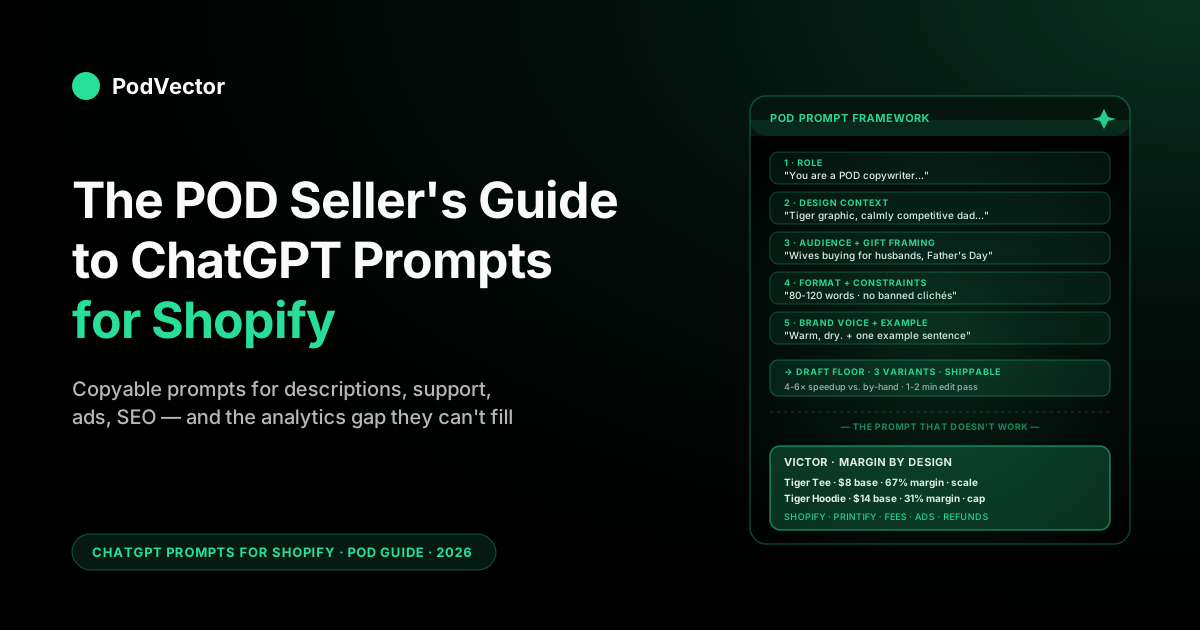
Quick Answer: The ChatGPT prompts that move the needle for a print-on-demand Shopify store in 2026 are the ones that hand the model context it can't infer — the design's audience and gift framing, the Printify or Printful base in play, the personalization carve-out, the brand voice, and the channel format constraints. The five prompt categories that pay back daily are product descriptions, customer support replies, ad and social copy, SEO and blog drafts, and supplier-email triage.
The category where ChatGPT structurally fails is analytics — it cannot see your live Shopify, supplier, payment-fee, ad-spend, or refund data, so margin and "what to scale" prompts return confidently wrong answers. Use the prompts in this guide for content and operations; use a POD-aware analytics layer for cost-stack decisions.
Why POD prompts differ from generic Shopify prompts
Most "ChatGPT prompts for Shopify" roundups are written for a generic ecommerce store with one supplier, one inventory model, and one cost structure. Print-on-demand violates all three assumptions.
Your supplier is Printify or Printful (or both). Your inventory is "infinite" but routed through a base whose cost varies by garment, by region, by print method.
Your margin per design swings 15-30 percentage points depending on which base you pick before you ever write a description. The prompts that work for a beauty brand running on a Shopify-fulfilled DTC stock keep don't carry over cleanly because they don't carry your cost reality.
Three POD-specific frictions show up in the prompts that earn their keep:
The wearer or giver is the SKU. A POD design isn't a product the way a serum is a product. It's a graphic that lives on twenty garment variants, each with its own audience and gift framing.
The same "calmly competitive dad" tiger graphic is one product on the unisex tee, a different product on the youth hoodie, and a different product again on the ceramic mug. The prompt has to specify which variant context it's writing for or the output drifts to a generic mid-funnel description that doesn't convert.
The personalization layer is on or off, never half. Personalized POD products are the highest-margin category and the hardest to write copy for, because the description has to telegraph the personalization without showing the empty input field as a friction. Generic prompts ignore this; POD prompts have to call it out.
The base cost is invisible to the model. ChatGPT writing a Father's Day promo email cannot know that your $24 dad tee runs on an $8 base versus a $14 base. The prompt either bakes the cost reality in (so the model writes copy that defends the price point on the cheaper base) or it doesn't (and you ship copy that sells the wrong margin tier).
For the bulk of content prompts, the cost reality is metadata you can hand the model. For analytics prompts, no amount of pasting fixes it — the data is in five systems, not one prompt.
The prompts in this guide assume a POD operator running on Shopify with Printify or Printful as the supplier, selling in 2026 across direct store, agentic surfaces (ChatGPT, Perplexity, Google AI Mode), and a Meta or TikTok ad layer. They're written to be copy-pasted with three or four substitutions per prompt — the design context, the audience, the variant, and the brand voice. Each prompt is structured so the model has the inputs it needs to return draft-floor work, not generic-ceiling work.
The POD prompt framework: five context blocks every prompt needs
The single biggest lift on prompt quality for a POD store is replacing one-line prompts ("write a product description for my dad tee") with five-block prompts that hand the model the context it can't guess. The framework, lifted from how the better POD-prompt operators we work with structure their batches:
- Role. Tell ChatGPT what role to play — copywriter for a POD brand, customer support rep at a small Shopify store, SEO strategist for a print-on-demand catalog. Role anchors voice and reading level.
- Design context. What is the design about? What's the genre, the joke, the cultural reference, the visual element? Two sentences is enough; the model fills in around the spine.
- Audience and giver context. Who buys this — for themselves or as a gift? What's the giver's relationship to the recipient? What's the gift occasion or the self-expression moment?
- Format and constraints. Word count, character limits for the channel (Meta caption, TikTok caption, Pinterest pin, product description block), tone register (irreverent, warm, technical), structural format (paragraphs, bullets, headline + body).
- Brand voice anchor. One sentence on how your brand sounds, plus one example sentence in that voice. The example sentence is where 80% of the quality lift comes from — it's faster to imitate one good sentence than to follow a paragraph of voice description.
Every prompt in this guide assumes you have these five blocks in your head before you paste. The prompts themselves include placeholders for each block.
The first three or four times you use a category of prompt, you'll spend 30-60 seconds filling them in; by the tenth time, the substitutions take ten seconds. The output quality difference is 3-4× over a one-line prompt, which is the difference between "draft floor" and "throw away and start over."
Product description prompts
The bulk of the time savings POD operators get from ChatGPT lives in this category. A 50-product drop that took a half-day to describe by hand collapses to a 60-90 minute batch when the prompts are structured. The trick is one prompt that returns three voice variants, then a quick pick-and-tune pass, rather than one prompt per variant.
The base description prompt (single product, three voice variants):
You are a copywriter for a print-on-demand Shopify brand.

Design context: [two-sentence description of the design — genre, visual elements, cultural reference, the joke or sentiment]

Variant in scope: [garment type, fit, material, fabric weight if relevant, e.g. "Bella+Canvas 3001 unisex tee, soft cotton, true-to-size"]

Audience: [who buys this, e.g. "millennial dads who self-identify as 'calmly competitive' — their kids' soccer coach, the guy who runs a half-marathon for fun"]

Gift framing: [self-purchase or gift; if gift, the giver and occasion, e.g. "primary audience is wives buying for husbands for Father's Day"]

Brand voice: [one sentence + one example, e.g. "Warm, dry, slightly self-deprecating. Example sentence: 'Built for dads who say they're not competitive, then check the leaderboard at the 5K.'"]

Format: 80-120 word product description, one paragraph, written for the Shopify product page block. No hashtags, no emojis, no bullet points. Do not use the words "perfect," "amazing," or "high-quality."

Return three variants:
1. Lean into the gift-giver framing
2. Lean into the wearer's self-identification
3. Lean into the design's specific cultural reference

Each variant should be standalone and immediately publishable.
The "do not use" line at the end is a small move with outsized impact. Generic POD descriptions are saturated with "perfect for any occasion," "high-quality fabric," "amazing gift" — banned-word lists give you the lift of a stricter editor without the latency of one.
The bulk-drop prompt (10-50 products at once):
You are a copywriter for a print-on-demand Shopify brand.

I'm doing a [N]-product Father's Day drop. Each design has the same audience and brand voice but a different cultural reference or joke.

Audience: [...]
Brand voice: [one sentence + one example]
Variant in scope: [garment type, fit, material]
Format constraints: 80-120 words, one paragraph, no banned words ["perfect," "amazing," "high-quality," ...]

Below is a list of [N] designs with a one-line description each. Return one product description per design, in the same order, separated by "---".

DESIGNS:
1. [design name] — [one-line description]
2. [design name] — [one-line description]
...
N. [design name] — [one-line description]
This is the prompt that turns a half-day batch into a 90-minute batch. The model holds the brand voice constant across all N descriptions because the voice anchor is set once, not N times.
The trade-off: the output gets a little flatter around N=30+ as the model averages toward its center. If you're shipping a 50-product drop, run two batches of 25 and re-anchor the voice between them.
The personalization-aware prompt:
You are a copywriter for a personalized POD product on Shopify.

Design context: [...]
Personalization input: [what the shopper customizes — name, date, pet name, sport position, etc.]
Variant: [...]
Audience and gift framing: [...]
Brand voice: [...]

Format: 90-130 word product description. The first sentence has to telegraph the personalization clearly enough that a shopper scanning the page in 3 seconds knows this is a customizable product. Avoid making the empty personalization field feel like friction — phrase it as the part where the gift becomes "theirs" rather than "the form you have to fill out."

Include a one-line preview of how a personalized example would read (e.g. "Hudson, age 9, soccer team Tigers, position striker"). Mark it as an example, not a real product detail.
The depth treatment for description writing across the whole catalog — bulk workflows, voice tuning, the Shopify Magic vs. ChatGPT trade-off — is in the POD seller's guide to Shopify AI product description.
Customer support reply prompts
POD support is mostly five recurring tickets — sizing, shipping delay, print quality, personalization error, gift-receipt request — repeated across thousands of orders. ChatGPT collapses the per-ticket reply time from 5-7 minutes to 60-90 seconds when the prompts are structured for the POD ticket pattern, not the generic ecommerce one.
The base support reply prompt:
You are a customer support rep for a small print-on-demand Shopify brand. The brand sounds [warm and direct / dry and friendly / etc.] and treats every ticket like the customer is going to remember the reply.

Brand context: [POD store, fulfills via Printify / Printful, normal processing time is X-Y business days, return window is N days, personalized items are non-returnable except for defects, supplier handles reprints on quality issues].

Ticket from the customer: [paste the ticket verbatim]

Return a reply that:
1. Opens with a one-sentence acknowledgment (not "I'm sorry to hear that" — something more specific).
2. Offers a clear one-step resolution (reprint, refund, replacement, or what we need from them).
3. Stays under 90 words.
4. Closes with a low-friction next step, not a sign-off boilerplate.

If the resolution requires me to make a judgment call (e.g. eat the cost vs. push back on the supplier), flag it with [DECISION:] and ask the question I'd need to answer before sending.
The [DECISION:] flag is the move that makes this prompt safe for a small operator to run at scale. ChatGPT will draft you a one-tap reply for the easy 80% of tickets and explicitly hand you the harder 20% to look at, instead of confidently shipping a generic answer on a ticket that needed a judgment call.
The shipping-delay reply prompt (the most common POD ticket):
Customer ticket: "It's been [N] days since I ordered and the tracking still says 'pre-shipment.' I needed this for [date]. Where is it?"

Context: We sourced this from [Printify / Printful], the base is [base name], the supplier's posted production time is [X] business days plus shipping. The order was placed on [date], so we're [on time / late / borderline].

Return a reply that names the actual production stage they're at, sets honest expectations about the new ETA, offers [a partial refund / expedited replacement / shipping refund] if we're past the SLA, and doesn't make excuses about "carrier issues" if the actual delay was on the supplier's print queue.
The print-quality reply prompt:
Customer sent a photo of [chipped mug handle / faded shirt print / wrong color tee / blurry text on personalized item].

Context: The supplier is [Printify / Printful]. Their reprint policy is [no-cost reprint within 30 days with photo evidence / etc.]. Our store policy is to send a reprint without asking for the original back.

Return a reply that takes responsibility (without throwing the supplier under the bus to the customer), offers the reprint as the default resolution, asks for the supplier-required photo if we don't have it yet, and keeps the personalization details from the original order intact.

Stay under 80 words. The tone is "we'll fix it" not "I'm sorry, here's our policy."
The customer-facing AI work in support is also the doorway to a fuller chatbot deployment, which the broader treatment is in the AI chatbot for Shopify guide.
Ad and social copy prompts
POD ad operations live or die on creative volume. The store running 4 hooks per ad set across 6 ad sets per week needs 24 hooks weekly per niche; ChatGPT is the only economic source of that volume for a sub-$50K/month store.
The Meta ad hook batch prompt:
You are a Meta ads copywriter for a POD Shopify brand.

Product: [design name and one-line context]
Audience: [persona — interests, age band, gift-buying or self-purchase context]
Hook angle to try: [humor / nostalgia / gift-anxiety / identity / social proof / urgency]
Brand voice: [one sentence + one example]

Return 8 hook variants for the same product, all using the [hook angle] frame. Each hook should be:
- Maximum 75 characters (Meta primary text first line)
- Start with a pattern interrupt (question, contradictory claim, specific number, or named scenario)
- Avoid generic POD ad clichés ("Get yours today!", "Limited time only!", "The perfect gift")
- One hook per line, no numbering, no commentary

Below the hooks, return a 2-line breakdown of which hook is the strongest pattern interrupt and why.
The TikTok caption + hook prompt:
You are writing TikTok captions for a POD Shopify brand.

Video concept: [one-sentence description of the video — e.g. "showing the tee folded next to a coffee cup with a tiger graphic peeking out"]
Product: [...]
Audience: [...]
Brand voice: [...]

Return 5 caption + hook combos. Each combo:
- Hook (the on-screen text overlay for the first 3 seconds, max 7 words)
- Caption (the actual post caption, 80-130 chars, includes 1-2 niche hashtags)
- The combo should work as a thumb-stopper for someone scrolling, not as a "buy now" pitch

Don't use "POV:" or "Tell me you ___ without telling me ___" — those are saturated as of 2026.
The Pinterest pin description prompt:
You are writing Pinterest pin descriptions for a POD Shopify brand.

Product: [design name + one-line context]
Pin visual: [what the pin shows — flat lay, lifestyle, mockup, gift-wrapped, etc.]
Pinterest search intent we're chasing: [e.g. "Father's Day gift ideas," "vintage band tee outfit ideas"]
Brand voice: [...]

Return 6 pin description variants:
- Each is 100-200 chars
- Each opens with the search-intent phrase verbatim or close to it
- Each ends with a soft CTA (not "Shop now" — something more native to Pinterest like "Save for the gift list" or "Pin to remember")
- Include 3-4 pin-relevant hashtags after the description

Pinterest indexing is keyword-heavy. Repeat the core search intent 2-3 times naturally across the variants.
The cross-channel ad-and-creative discipline is treated in more depth in the POD seller's guide to AI marketing for ecommerce.
SEO and blog draft prompts
The SEO opportunity for a POD store has two layers — product-page SEO (where you want to rank for "personalized golf dad mug") and editorial SEO (where you want to rank for "Father's Day gift ideas for runners"). ChatGPT handles both, with different prompt structures.
The product-page SEO rewrite prompt:
You are an SEO copywriter for a POD Shopify store.

Current product title: [paste current title]
Current product description: [paste current description]
Current meta description: [paste or note "missing"]

Primary keyword: [the buying-intent phrase you want to rank for, e.g. "personalized golf dad mug"]
Secondary keywords: [3-4 related phrases]
Audience and gift framing: [...]

Return:
1. A rewritten product title, 60-65 chars, primary keyword in the first 30 chars, written to read like a buying-query phrase not a stuffed string
2. A rewritten meta description, 140-155 chars, primary keyword once, secondary keyword once, ends with a soft action phrase
3. The first 100 words of a rewritten product description that naturally weaves all secondary keywords without keyword-stuffing
4. 3 H2 subheadings for the rest of the description, each one targeting a distinct buying-intent angle (gift, personalization, material, occasion)

Do not use "click here," "buy now," or any all-caps phrases.
The blog post draft prompt:
You are a blog writer for a POD Shopify brand.

Topic: [e.g. "Father's Day gift ideas for runners who don't want another mug"]
Primary keyword: [...]
Audience: [the reader — who they are, what they're searching for, what they already know and don't]
Brand voice: [one sentence + one example]
Word count: 1200-1500 words
Format: H2-driven with one H1, 5-7 H2 sections, an FAQ block at the bottom with 4-5 Qs

Return the full draft. Constraints:
- The intro doesn't start with "Are you looking for..." or any rhetorical question
- Each H2 section is 150-250 words, opens with a concrete claim, ends with a transition to the next H2
- Mention specific POD product types (tees, hoodies, mugs, hats, totes) but don't link to specific products — that's a manual pass after
- The FAQ block uses real questions a buyer would search, not made-up scaffolding questions
- Don't use the word "elevate," "curated," "thoughtful," or "perfect"

After the draft, return a 5-line outline of the internal links I should add (not the actual links, just the topics) for an interlinking pass.
The SEO-for-POD treatment is broader than this one prompt — meta description structure, AI Overviews surfacing, agentic-storefront retrieval — and the cluster context is in the POD seller's guide to AI SEO for ecommerce.
Supplier-email triage prompts
The supplier-email category is where most POD operators don't realize ChatGPT belongs. Printify and Printful send emails about base outages, print-quality complaints, fulfillment delays, policy changes — and you have to translate them into customer-facing language fast, often in volume during a sale. The prompts below cut the per-email translation time to under a minute.
The supplier-to-customer translation prompt:
You are translating a supplier email into customer-facing language for a POD Shopify brand.

Supplier email: [paste the supplier message verbatim]
Affected orders: [N orders / a specific order ID / the whole [base] catalog]
Customer-facing brand voice: [one sentence]

Return:
1. A subject line for the customer notification email (under 50 chars, no all-caps, no "URGENT")
2. A 90-150 word customer email body that explains what happened in plain language, what the new ETA is, what we're doing about it, and what the customer's options are (wait, refund, switch to a different base)
3. A one-line ticket-system macro version (60-80 words) for the support team to paste into individual replies as tickets come in

Don't use "unfortunately," "we apologize for the inconvenience," or "supply chain issues" — they read as evasive.
The base-switch decision prompt:
I sell a [garment type] design currently routed through [Printify / Printful] on the [base name] at a base cost of $[X]. The supplier just notified me that [base name] will be out of stock for [duration] starting [date].

Alternative bases I could route to: [list 2-3, with their base costs]

Return a one-page decision brief:
1. The margin impact per unit if I route to each alternative (assume retail price stays at $[Y])
2. The customer-experience differences I should know (fabric weight change, fit difference, color availability)
3. Which alternative I should default to, and the reasoning
4. The customer-comms language I should use if I make the switch (do I notify them, or just route the next order silently?)

Be honest about which alternatives flip the unit economics negative — don't sugarcoat the math.
That last prompt is the one that crosses the line from operational triage into something close to analytics. ChatGPT can do the per-unit math because you handed it the inputs. The prompt that crosses the line all the way — "should I scale this design" — is where it stops working, and that's the next section.
The analytics prompts that don't work — and why
This section is the one most "ChatGPT prompts for Shopify" guides skip because it's the one that breaks the implied promise. The promise is: ChatGPT can do anything. The reality for a POD store: ChatGPT cannot see your live data, and the prompts that ask it to make data-driven decisions return confidently wrong answers.
The pattern is structural, not solvable by better prompting. Your live data lives in five systems:
- Shopify (orders, refunds, payment fees, channel attribution)
- Printify or Printful (per-line-item supplier base cost, shipping cost, supplier refund offsets)
- Meta Ads Manager (ad spend by campaign, attribution windows)
- TikTok Ads / Pinterest / Google Ads (other channels' spend and attribution)
- Email and SMS platforms (Klaviyo, Postscript — campaign-attributed revenue)
The join that determines whether your store is profitable — Shopify revenue × supplier base cost × payment fee × ad spend × refund cost — runs across all five. ChatGPT can read a CSV you paste, but it cannot query the live state of all five systems and reconcile them. The result is that any analytics prompt in ChatGPT is operating on a partial view of the data, and the model has no way to know what's missing because the missing fields don't exist in its prompt context.
The three prompts that fail most expensively:
"Which of my products is most profitable?" ChatGPT will pull the per-order revenue from the Shopify export, ignore the per-line supplier cost (because it's not in the export), ignore the ad spend (because it's in Meta), ignore the refund offsets (because they're booked separately), and rank by gross revenue minus payment fees. The "most profitable" product in the answer is often the one with the highest base cost and worst margin — the opposite of the right answer.
"Should I scale this campaign?" ChatGPT will look at ROAS pasted from Meta, divide by some assumed margin, and return a confident yes or no. The actual decision needs the per-design margin (which depends on the base, which depends on the supplier), the post-attribution-window refund rate (which the Meta export doesn't show), and the cannibalization of organic and email orders the campaign is taking credit for. None of those are in the prompt.
"Why did revenue drop last week?" ChatGPT will pattern-match on the data you paste — usually a Shopify analytics screenshot or CSV — and generate plausible-sounding hypotheses (seasonality, ad fatigue, market shifts). The actual answer in 80% of POD cases is more boring and more specific: a base went out of stock and got auto-substituted to a higher-cost alternative, or a supplier production-time slipped and refund rate spiked, or a single best-seller's ad set lost the algorithm's favor. ChatGPT cannot see any of that.
The right pattern for analytics work in a POD store is the agentic-analytics layer — software that holds the joins live, runs the reconciliation continuously, and answers questions against ground truth instead of pasted snippets. Victor sits on top of your Shopify, Printify or Printful, Shopify Payments, and ad-platform data and answers the questions ChatGPT can't reach.
Victor answers — "what's my real margin on the Father's Day collection," "which channel cleared cost last week," "which design's refund rate flipped the unit economics." Victor acts on those answers with your approval. The deeper treatment is in the complete guide to AI analytics for print-on-demand and the agent-shaped framing in agentic AI for ecommerce: what it looks like for POD sellers.
Chaining prompts: the bulk-drop workflow
The single highest-leverage use of ChatGPT prompts in a POD store isn't a single prompt — it's the chain that runs across a 25-50 product drop and produces shippable copy across every channel in one sitting. The chain pattern below is the one we see working repeatedly in stores doing $20-100K/month who haven't hired a copywriter.
Step 1: Audience and voice anchor (one prompt, run once per drop). Hand ChatGPT the design family, the audience, the gift framing, and three example sentences in your brand voice. Ask it to summarize the audience in 4 lines and the voice in 3 lines. Save the summary at the top of your working doc — every subsequent prompt in the chain references it.
Step 2: Bulk product descriptions (one prompt, returns N descriptions). The bulk-drop prompt from the descriptions section, with the audience and voice block from Step 1 pasted in. Output: 25-50 product descriptions in one paste. Edit pass takes 1-2 minutes per description — 30-100 minutes total instead of half a day.
Step 3: Meta ad hooks (one prompt, returns N×8 hooks). Loop through the design list with the Meta ad hook batch prompt, three angles per design (humor, gift, identity), 8 hooks per angle. Output: 600-1200 hooks for a 25-product drop. You ship the best 4 per ad set; the rest sit in the ad-copy library.
Step 4: Email campaign drafts (one prompt per email). The drop typically gets 2-3 emails — launch, mid-drop reminder, last-chance. Each one is a single prompt with the audience and voice block plus the design highlights from Step 1.
Step 5: SEO meta descriptions (one prompt, returns N meta descriptions). Lighter than the full SEO rewrite — just the title and meta description for each of the N products, batched in one pass. The full description SEO rewrite is a higher-effort pass you do later for the products that start performing.
The whole chain runs in 90-120 minutes for a 25-product drop, replacing what was a 2-3 day batch in a pre-LLM workflow. The judgment work — picking which voice variant, deciding which hooks make it into the rotation, validating the SEO keywords against actual search volume — stays with you. The mechanical work of producing the volume sits with the chain.
For the broader generative-AI surface area on Shopify (Magic, Sidekick, third-party apps, the agentic storefront layer), the cluster-level treatment is in the POD seller's guide to Shopify generative AI and the cross-cluster overview in the AI analytics topic hub.
Mistakes POD sellers make with ChatGPT prompts
The mistakes cluster into a few patterns we see weekly across operators trying to make ChatGPT pay back at scale:
- Writing one-line prompts and judging the model on the output. The five-block framework lifts output quality 3-4×. Operators who never adopted it conclude "ChatGPT is mid for product copy" — accurate, but only because their prompts are mid.
- Not banning the saturated POD copy clichés. "Perfect for any occasion," "high-quality," "elevate your wardrobe," "thoughtful gift" — every POD store ships them. The 3-line "do not use" block at the end of every prompt is the cheapest quality lift available.
- Skipping the brand-voice example sentence. Voice descriptions ("warm and dry") get the model halfway. Voice descriptions plus one example sentence in that voice get it 90% there.
- Using ChatGPT for analytics decisions. The cost-stack join is not in the prompt. The model will return confidently wrong answers on profitability, scaling, and channel attribution every time.
- Running the same prompt batch across 50+ items without re-anchoring. The model averages toward its center on long batches. Two batches of 25 with a re-anchor between them outperform one batch of 50.
- Treating ChatGPT-generated copy as ship-ready. The output is a draft floor, not a finished ceiling. The 1-2 minute editing pass per description is the difference between "AI-generated and obvious" and "draft-floor with human polish."
- Pasting customer PII into prompts without redacting. The support reply prompts in this guide should run on redacted tickets — replace the customer's name and email with "[customer]" before pasting. ChatGPT's data handling has improved, but the operational discipline matters either way.
FAQs
What ChatGPT model should I be using for Shopify prompts in 2026?
The default model in chat.openai.com is sufficient for product descriptions, ad copy, and support replies. For longer blog drafts and prompts where you're asking for structured analysis (the SEO rewrite prompt, the supplier-decision brief), the reasoning-tier model returns noticeably better output at the cost of 30-60 seconds of latency. The voice and content quality difference between the tiers is smaller than the prompt-quality difference, so spending energy on the prompt structure pays back more than spending it on model selection.
Can I use these prompts with Shopify Magic instead of ChatGPT?
Most of them, partially. Shopify Magic is in-admin and faster than ChatGPT for tasks where you already know what you want — the product description rewrite, the email subject line.
Magic's prompt control is shallower, so the multi-block prompts in this guide get truncated. The five-block framework still works in Magic, but you'll want to compress each block to one line. The deeper compare is in the POD seller's guide to Shopify Magic AI.
Do these prompts work for Etsy POD as well as Shopify POD?
Mostly yes, with two adjustments. Etsy product descriptions get truncated at the fold differently — the first 160 chars matter more on Etsy than on Shopify, so the description prompts should specify "first sentence has to stand alone as the listing preview." Etsy SEO is tag-driven rather than meta-description-driven, so the SEO prompts need a tags-output block instead of (or in addition to) the meta-description block. Everything else — voice, audience, ad copy, support replies — transfers cleanly.
How do I keep my brand voice consistent if I use ChatGPT across hundreds of products?
Two moves. First, save your audience and voice anchor (the output of Step 1 in the chain) and paste it at the top of every prompt — never re-derive it.
Second, batch in groups of 20-25, not single products, so the voice carries from one description to the next within the batch. The pattern that fails is one-off prompts where the voice anchor isn't pasted; the voice drifts toward generic POD copy within five products.
Can ChatGPT analyze my Shopify sales data and tell me what to scale?
No. ChatGPT can read a CSV you paste, but it cannot query your live Shopify, Printify or Printful, Shopify Payments, Meta, or Klaviyo systems. The cost-stack join that determines profitability runs across all of them, so any analytics answer ChatGPT returns is missing the layer that matters.
For real per-design margin and channel-clearance analysis, you need a layer that holds the join live. The treatment for POD specifically is in the complete guide to AI analytics for print-on-demand.
Are there prompts that work for the new ChatGPT agentic storefront optimization?
The optimization for agentic-surface retrieval — titles, descriptions, tags, metafields tuned for buying-intent queries — is closer to traditional SEO than to copywriting prompts. The product-page SEO rewrite prompt in this guide is the right starting point. The deeper treatment of the agentic storefront itself is in the POD seller's guide to ChatGPT for Shopify stores.
How do I prevent ChatGPT from making up product features or specs?
Hand the model the spec sheet in the prompt context. The "variant in scope" block in the description prompts is where you paste the actual fabric weight, fit, GSM, care instructions — whatever's true for the base.
ChatGPT will not invent a fabric weight if you give it the real one, but it will invent one if you don't. The same rule applies to ad copy ("don't claim 100% cotton if the base is cotton/poly blend") and SEO copy ("don't claim ships in 2 days if production runs 5-7").
What's the best prompt for writing a Shopify FAQ section?
The best FAQ prompts work backwards from real customer support tickets, not forward from imagination. Paste in 10-20 of your most recent support tickets, ask ChatGPT to cluster them by question type, and return the top 8 question patterns.
Then run a separate prompt asking for a 2-3 sentence answer per question, in your brand voice. Made-up FAQs read as scaffolding; ticket-derived FAQs reduce real ticket volume.
Can I get ChatGPT to write prompts for other tools like Midjourney or DALL-E?
Yes, and this is one of the highest-leverage uses of ChatGPT for a POD designer. Hand it the design brief, ask for 10 image-generator prompt variants in the target tool's syntax, and pick the best 3 to actually run.
The model is better at writing image-generator prompts than at generating images itself. The treatment is in the POD seller's guide to AI image generators that integrate with Shopify.
Use ChatGPT for content. Use Victor for the cost stack.
The prompts in this guide will compress your description, support, ad copy, SEO, and supplier-triage workflows by 4-6×. The category they can't help with is the one that decides whether your store stays profitable — the live join across Shopify orders, Printify or Printful base costs, Shopify Payments fees, ad spend, and refund offsets. Victor holds that join continuously and answers the questions ChatGPT structurally can't reach: which design clears cost this week, which channel's margin is bleeding, which campaign's refund rate flipped the unit economics. Victor answers. Victor acts on those answers with your approval.
Try Victor free