
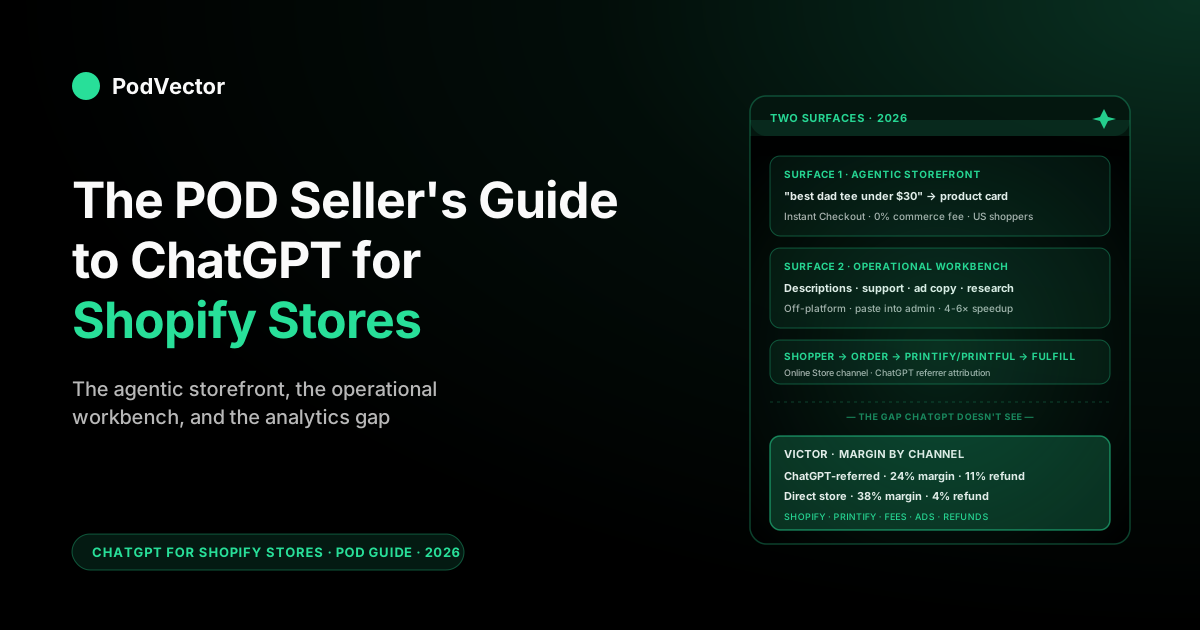
Quick Answer: "ChatGPT for Shopify stores" in 2026 covers two very different surfaces. The first is the new agentic storefront — when a U.S. shopper asks ChatGPT a buying question, your live Shopify catalog can surface in the chat with a one-tap Instant Checkout, with no fees beyond your normal payment processing.
The second is ChatGPT as an operational tool — descriptions, support replies, ad copy, supplier-email triage — that lives outside Shopify and gets pasted into the admin or wired into the App Store apps you already run. Both are real. Neither sees your Printify or Printful base costs, your ad spend, or your real per-design margin, which is the gap a POD-aware analytics layer fills.
The two things "ChatGPT for Shopify stores" actually means in 2026
The phrase carried one meaning in 2023 — "I paste my product into ChatGPT and get a description back." It now carries two, and POD sellers searching for it usually want one or the other without realizing they're different products.
The first is the ChatGPT agentic storefront. This is the channel piece.
When a U.S. shopper types a buying-intent prompt — "best matching family pajamas for cats," "personalized golf dad mug under $25," "vintage-style band tees for my husband" — ChatGPT can surface your Shopify products inside the chat with a one-tap Instant Checkout. The shopper never visits podvector.shop or yourbrand.com; the order routes straight to your Shopify back end and fulfills the way every other order does. This rolled out through 2025 and 2026 to eligible Shopify merchants and is expanding into Microsoft Copilot, Google AI Mode, and Gemini in early access.
The second is ChatGPT the operational tool. This is the workbench piece.
You open chat.openai.com or the desktop app and use it for descriptions, blog drafts, ad copy, customer-support reply triage, supplier email rewrites, niche research, prompt iteration. The output goes into your Shopify admin via copy-paste, or into a third-party Shopify app that wraps the OpenAI API (Yodel for descriptions, HeiChat or Rep AI for chat, dozens of email-and-SEO tools).
For a print-on-demand store both surfaces matter, but they earn their keep at different stages of operations. The agentic storefront is a discovery channel you opt into and optimize for.
The workbench is a content-and-ops accelerator that compounds with every catalog drop. The first one moves traffic; the second one moves throughput. Treating them as the same thing — or assuming "ChatGPT for Shopify" just means "Shopify Magic" — is the most common confusion we see.
The agentic storefront — your store as a discovery channel inside ChatGPT
This is the headline shift. ChatGPT became a buying surface in 2025 with the Agentic Commerce Protocol, and Shopify was the first major commerce platform to wire it in at the merchant level. The mechanics are worth getting right before the optimization work, because the mechanics determine the optimization work.
When a ChatGPT user asks a buying question, the model decides whether to answer with a product carousel. If it does, it pulls live product cards from participating merchants — title, image, price, review snippet — and lets the shopper pick one.
Tapping a card opens a checkout sheet inside ChatGPT (or the in-app browser, depending on platform), pre-filled with the shopper's stored payment and shipping. They confirm; the order lands in your Shopify admin attributed to the Online Store channel with ChatGPT as the referrer. Payment, tax, fulfillment, and refund handling all run through your existing systems.
Three things follow from how the protocol actually works.
It is organic, not paid. Ranking is based on how well your product data matches the shopper's query, not bids. The store with cleaner titles, more specific descriptions, and accurate metafields will outrank the store with "Black Tee #4587" — even if the second store is paying for ads elsewhere. The long-tail discoverability discipline POD sellers built for Etsy and Google search transfers cleanly into this channel.
It is fee-free. Per the Shopify ChatGPT agentic storefront documentation, there are no commerce fees on top of your normal Shopify Payments processing rate. ChatGPT is not Etsy; the discovery surface does not take a cut. Whatever you'd ordinarily clear on a checkout, you clear here.
It is U.S.-shopper-only at the moment. Your store can be based anywhere, but the buying surface only fires for shoppers in the United States. International expansion is on the roadmap but is not the ship-now reality.
For a POD store specifically, the implication is that ChatGPT is now in the same mental bucket as Etsy, TikTok Shop, and Pinterest — a discovery channel that surfaces your catalog to buying-intent traffic you couldn't otherwise reach, with no per-order tax beyond your existing payment fees. The right framing isn't "should I do this" — it's "how fast can my catalog be ready for it."
Opting in: what a POD store needs to qualify
The eligibility gate is simple on paper and stricter in practice. The official requirements:
- Your store sells to U.S. customers. The store itself can be based anywhere; the buyers must be in the U.S.
- USD pricing on the catalog you want surfaced.
- Terms of service, privacy policy, and return/refund policy completed in Settings > Policies.
- Accurate inventory and active product catalog (no draft-only or out-of-stock-only stores).
- A Shopify Payments setup that can process U.S. transactions.
For a POD store, the policy section is the easiest place to fail. Most POD sellers running through Printify or Printful inherit a 30-day return window with restrictions on personalized items, but the policy in the Shopify admin is often blank or generic placeholder text.
ChatGPT's eligibility check is policy-text-aware. Write the actual policy.
State the personalization carve-out plainly. State the return window.
State who pays return shipping. The agentic storefront will deprioritize stores with thin or contradictory policy text because the shopper is buying inside ChatGPT and OpenAI doesn't want to surface stores it can't stand behind.
The second non-obvious gate is inventory accuracy. POD inventory is "infinite" in the sense that your supplier prints on demand, but your Shopify product still needs to be marked as in-stock with realistic processing-time messaging.
If your variant is set to "track quantity" with zero stock, ChatGPT will not surface it. If your processing time says "2-3 business days" but actually runs 7-14 because you're routing through Printify with a slower base, expect refund pressure when the shopper escalates to ChatGPT support. Set processing time to the truth.
Once the gates pass, opt-in itself is a single toggle in the agentic-storefronts area of your Shopify admin. There is no API to wire up at the merchant level — the Agentic Commerce Protocol handshake happens between Shopify and OpenAI and your store rides on it.
Optimizing your catalog so ChatGPT actually surfaces it
Eligibility just gets your products into the candidate pool. Surfacing on a real shopper's prompt is an optimization problem that maps onto five concrete catalog disciplines.
Product titles that read like search queries. ChatGPT's retrieval treats your title as the strongest signal. "Funny Dad Tiger Tee, Soft Black Cotton, Father's Day Gift" beats "Tiger Tee Black" the same way it does on Google. The difference: ChatGPT is willing to match on intent ("Father's Day," "gift") that Google often filters as fluff. Lean into intent words where they're true.
Descriptions that name the wearer or the giver. A description that says "for the dad who's calmly competitive" surfaces on prompts that include "dad," "competitive," and gift framing. A description that lists fabric weight and care instructions surfaces on technical prompts.
Most POD descriptions today live on the technical side because Shopify Magic generates them that way by default. The retrieval upside in 2026 is on the audience side.
Tags and metafields aligned to buying-intent queries. If your design family is "vintage band tees," tag the genre, the era, the audience, the gift occasion. Metafields ChatGPT respects include occasion, recipient, fit, material, and personalization options. Empty metafields are missed retrieval opportunities.
Reviews surfaced and recent. Product cards in ChatGPT show review counts and snippet quotes. A product with 47 reviews averaging 4.8 will outrank a sibling with 3 reviews averaging 4.7, even at slightly lower relevance. POD stores that haven't asked for reviews are leaving discovery on the table.
Price clarity. ChatGPT respects price filters in the prompt ("under $30"). If your variant pricing is irregular — base $24, "+$3 for XL," "+$2 for personalization" — make sure your default variant lands in the most common buying band. The shopper who said "under $30" will not see a $32 final-cart variant.
The deeper retrieval pattern: ChatGPT re-uses the same signals across surfaces. The work you do for the agentic storefront also lifts your store on Perplexity Shopping, Google AI Mode product cards, and Microsoft Copilot Checkout when those surfaces reach general availability. The cluster context for this is the broader AI overview cluster and the cross-surface treatment in the POD seller's guide to Shopify and AI.
ChatGPT as an operational tool for a POD store
The non-channel half of "ChatGPT for Shopify stores" is the workbench. This is where most POD sellers already use ChatGPT today, often without thinking about it as a Shopify integration. Six jobs do real work.
Product descriptions at scale. Paste in design context (genre, audience, recipient, fit, fabric) and ask for three description variants in different voice registers. The 60-90 second turn-around per design takes the description-writing job from a half-day batch to a one-hour batch on a 50-product drop.
The output reads as 70-80% publish-ready; the editing pass is voice-tuning, not from-scratch writing. Treat the output as a draft floor, not a finished ceiling.
Customer support reply triage. Paste in a tricky shopper email — "my mug arrived chipped on the handle but I don't have the box anymore" — and ask for a reply that opens with empathy, offers a one-step resolution, and stays under 80 words. The reply pattern transfers across categories: refund requests, sizing questions, shipping delay complaints, personalization errors, gift-receipt asks. Most POD sellers see a 4-6× speedup on this work.
Ad copy iteration. Five hooks for a Father's Day "calmly competitive dad" tee in Meta's character limits. Three TikTok captions for the same design with three different hooks (humor, nostalgia, gift-anxiety). Eight Pinterest pin descriptions. The volume problem in POD ad operations is the killer of a lot of POD stores; ChatGPT collapses it.
Supplier email triage. Printify or Printful sends a supplier-side email — base out of stock, print quality issue, fulfillment delay — and you need to translate it into customer-facing language fast. ChatGPT does this in one prompt. The reply pattern stays consistent across suppliers.
Niche research. Asking ChatGPT "what are the common gift-buying objections for [niche] in 2026" or "what design themes are trending in [subculture]" generates a research baseline you can validate with five minutes of forum reading. The output isn't a substitute for primary research; it's a faster cold start.
Prompt iteration for other tools. Mid-journey or other image generators take prompts; ChatGPT writes prompts better than you do. The workflow of "ask ChatGPT for 10 prompt variants, run the best 3 through your image generator, pick the winner" outperforms manual prompt engineering for most POD operators.
None of this is Shopify-native — it all happens in chat.openai.com — but it's the half of "ChatGPT for Shopify stores" that pays the rent. The dedicated treatment is in the POD seller's guide to ChatGPT for Shopify, which goes deeper on prompts and the third-party app layer.
ChatGPT vs. Shopify Magic and Sidekick: who does what
Shopify shipped its own generative AI surfaces in 2024-2025 (Magic and Sidekick), and the question every POD operator asks is whether they replace ChatGPT. They don't. They overlap on the easy half of the work and split on the hard half.
Shopify Magic is the in-admin generation layer. Every "Generate" button across product editors, blog editors, email campaigns, and theme sections.
Magic has direct access to your store data — products, customers, orders, settings — which means it can pre-fill prompts with context you'd otherwise have to type. For in-admin tasks where you already know what you want, Magic is faster than ChatGPT because there's no copy-paste round trip.
The trade-off: Magic's prompt control is shallow. You can't tell Magic "rewrite this as if a 70-year-old grandmother is giving it as a gift to her son who's a firefighter" and get the same fidelity ChatGPT gives.
Shopify Sidekick is the conversational admin agent. You ask it to do an admin task — "create a 15% off discount for repeat customers active in the last 30 days" — and it executes the task.
Sidekick is faster than ChatGPT for any in-admin action because Sidekick has tools and ChatGPT doesn't (yet, in your store). Sidekick is not a content generator and not an analyst; it's an admin executor.
ChatGPT is the off-platform workbench. It outperforms Magic on creative-direction-heavy work (niche audience copy, brand-voice tuning, multi-pass editing) and outperforms Sidekick on research-and-thinking work (competitive analysis, niche-trend exploration, ad-platform strategy). It underperforms both on in-admin actions because it can't see or touch your store directly.
The right working pattern for a POD operator: Magic for in-admin first drafts, Sidekick for in-admin actions, ChatGPT for everything else. The deeper compare is in the POD seller's guide to Shopify Magic AI and the POD seller's guide to Shopify Sidekick AI.
POD-specific risks of selling through ChatGPT
The POD operating model creates risks under agentic checkout that don't exist under direct-store checkout. Three are worth flagging before you opt in at scale.
Fulfillment SLA exposure. ChatGPT shoppers expect Amazon-grade delivery timing because that's what every other agentic surface trains them to expect. POD fulfillment runs 5-12 business days from order to delivery on the cheaper bases, longer for some Printify and Printful options.
If your processing-time field says "2-3 days" but the supplier reality is "7-10," ChatGPT support will refund the shopper and pull your store's surfacing weight. Set processing time to the worst-case truth, not the marketing truth.
Refund and replacement liability. Under standard POD economics, you eat the supplier base cost on a refund. If a ChatGPT shopper hits "request refund" inside the chat — which is a one-tap action — you owe the shopper the full price they paid and you owe the supplier the base cost, with no offsetting revenue.
A 4-5% refund rate is normal for POD; a 10-15% refund rate (which is plausible on agentic-checkout impulse buys) flips the unit economics on cheaper-base catalogs. Track refund rate by traffic source from day one.
Personalization mismatch. Personalized POD products are the highest-margin category and the most exposed to agentic-checkout misalignment. The shopper picked a "personalized" product in ChatGPT but never typed a name; ChatGPT's product card flow may or may not surface the personalization input correctly. Until the protocol stabilizes its custom-field handling, restrict personalized items to your direct store and route only non-personalized items to the ChatGPT channel.
The deeper agentic-storefront risk treatment for POD is in agentic AI for ecommerce: what it looks like for POD sellers.
Where ChatGPT stops being useful: POD analytics
Every section above is on ChatGPT's strong side. The cliff is on the analytics side, and it's the cliff that matters most for a POD store running on thin per-unit margin.
ChatGPT cannot see your live data. It can read a CSV you paste in, but it cannot query your Shopify orders, join them against your Printify or Printful supplier line items, layer in your Shopify Payments fees, attribute your Meta and Google ad spend, and answer "which design family is actually clearing margin this week." That join — Shopify revenue × supplier cost × payment fee × ad spend × refund rate — is the join that determines whether your store is profitable, and no LLM in 2026 holds it natively.
The concrete failure mode we see weekly: a POD operator asks ChatGPT "is my Father's Day collection profitable" by pasting in a Shopify order export. ChatGPT runs a margin calculation on the order data, ignores the supplier base costs (because they're not in the export), ignores the refund returns (because they're booked in a different report), ignores the ad spend (because it's in Meta), and returns a confidently wrong answer.
The operator acts on it. Three weeks later the cash position tells the truth.
The other failure mode: ChatGPT can't see what's not in the prompt. Asking "should I scale my best-converting design" is the wrong question if conversion is high but the design runs on a $14 base in the 60% margin tier instead of an $8 base in the 70% margin tier. ChatGPT will tell you to scale; the right answer might be "switch the base, then scale." The decision needs the supplier-cost layer the LLM doesn't have access to.
This is why a POD-aware analytics layer matters as the agentic storefront scales. ChatGPT is excellent at content, decent at support triage, useful at research, and structurally blind to your live cost stack.
Pretending otherwise is the most expensive mistake in POD AI tooling. The deeper treatment is in the complete guide to AI analytics for print-on-demand and the agent-shaped framing in the complete guide to AI agents for ecommerce analytics.
Mistakes POD sellers make with ChatGPT for Shopify stores
The pattern of mistakes maps onto the same two-surface confusion. The expensive ones:
- Treating the agentic storefront opt-in as a one-time checkbox. Surfacing is an ongoing optimization job, not a setup job. Stores that opt in and walk away rank below stores that iterate on titles, descriptions, and metafields monthly.
- Setting processing time to marketing-team optimism. ChatGPT's refund flow uses your stated processing time as the SLA. Lying about it costs more than telling the truth.
- Routing personalized items to the ChatGPT channel before the protocol stabilizes custom fields. The refund rate on misconfigured personalized orders is brutal.
- Using ChatGPT for analytics decisions. The LLM cannot see your cost stack. Use it for content, support, and research; do not use it to decide which products to scale.
- Treating Shopify Magic and ChatGPT as substitutes. They're complements. Magic for in-admin first drafts, ChatGPT for off-platform creative direction.
- Skipping reviews. Review count and recency are visible signals on the ChatGPT product card. Stores without reviews lose the impression race against stores with them at lower relevance.
- Ignoring the chat-referrer cohort. ChatGPT-referred orders behave differently — higher impulse, higher refund rate, lower repeat — and need their own segmented analysis. Lumping them into "Online Store" averages hides the truth.
FAQs
Does ChatGPT charge fees on orders that come through the agentic storefront?
No. There are no commerce fees on top of your standard Shopify Payments processing rate. Whatever you'd ordinarily clear on a direct-store checkout, you clear on a ChatGPT-referred checkout. This is the structural difference between ChatGPT-as-channel and Etsy-as-channel — Etsy takes a cut, ChatGPT does not.
Can my Shopify store sell through ChatGPT if I'm not based in the U.S.?
Yes, as long as your store sells to U.S. customers in USD. The merchant location can be anywhere. The shopper, for now, must be in the United States. International expansion is on the roadmap but not yet broadly available.
How do I know if my store is eligible for the ChatGPT agentic storefront?
Check Settings > Sales channels and Settings > Policies in your Shopify admin. You need completed terms of service, privacy policy, and return policy text (not placeholder), USD pricing, U.S. shipping zones, an active catalog, and Shopify Payments enabled. If those gates pass, the agentic-storefront opt-in toggle will be live for your store.
Will ChatGPT replace my Shopify store?
No. The Instant Checkout flow uses ChatGPT as a discovery surface and your Shopify store as the back end. The order, payment, fulfillment, tax handling, and refund processing all run through your existing Shopify infrastructure. Your store is still the system of record; ChatGPT is a referrer with a streamlined checkout experience layered on top.
How is the ChatGPT agentic storefront different from the Shopify App Store ChatGPT apps?
The agentic storefront is an official Shopify × OpenAI integration that turns ChatGPT into a discovery and checkout surface for your products. The third-party ChatGPT apps in the Shopify App Store (Yodel, HeiChat, Rep AI, etc.) are independent apps that wrap the OpenAI API for specific in-store jobs — bulk descriptions, customer chat, email copy.
Different products, different purposes. Most POD stores benefit from both.
Can I use ChatGPT to write product descriptions for my POD catalog?
Yes, and most POD operators do. The output is 70-80% publish-ready when you give it design context (genre, audience, recipient, fabric, fit) and a voice spec.
Treat it as a draft floor that compresses description writing from hours to minutes per design, not as a fully autonomous copywriter. The deeper how-to is in the POD seller's guide to Shopify AI product description.
Can ChatGPT analyze my Shopify sales data and tell me which products to scale?
It can analyze data you paste in, but it cannot query your live Shopify, Printify or Printful, Shopify Payments, or ad-spend systems. That means any analysis is missing the cost layer that determines whether a "best-selling" product is actually profitable.
For real per-design margin analysis, you need a layer that joins live revenue against live supplier costs, fees, refunds, and ad spend. The treatment for POD specifically is in the complete guide to AI analytics for print-on-demand.
How do I stop ChatGPT from surfacing my personalized products?
In Settings > Sales channels > ChatGPT, you can exclude specific products or collections from the agentic storefront feed. Until the Agentic Commerce Protocol stabilizes its handling of personalization input fields, restricting personalized SKUs to your direct store is the safer route — the refund rate on misconfigured personalized orders can flip the unit economics on the channel.
What's the difference between selling on ChatGPT and selling through Shopify Sidekick?
Sidekick is an admin agent inside your Shopify back end — it doesn't surface your products to shoppers. The ChatGPT agentic storefront is a shopper-facing discovery channel. Sidekick helps you operate your store; ChatGPT (the channel) brings shoppers to your store. They sit at opposite ends of the funnel and don't overlap.
See whether ChatGPT-referred orders are actually making you money
The agentic storefront brings you new orders with no commerce fees on top — but ChatGPT-referred orders carry their own refund profile, their own impulse curve, and their own supplier cost exposure. Shopify Analytics shows revenue. It does not show margin by traffic source. Victor sits on top of your live data — Shopify orders, Printify or Printful supplier costs, Shopify Payments fees, ad spend, refunds — and tells you which channels, designs, and campaigns clear their cost on a per-order basis. Victor answers. Victor acts on those answers with your approval.
Try Victor free