
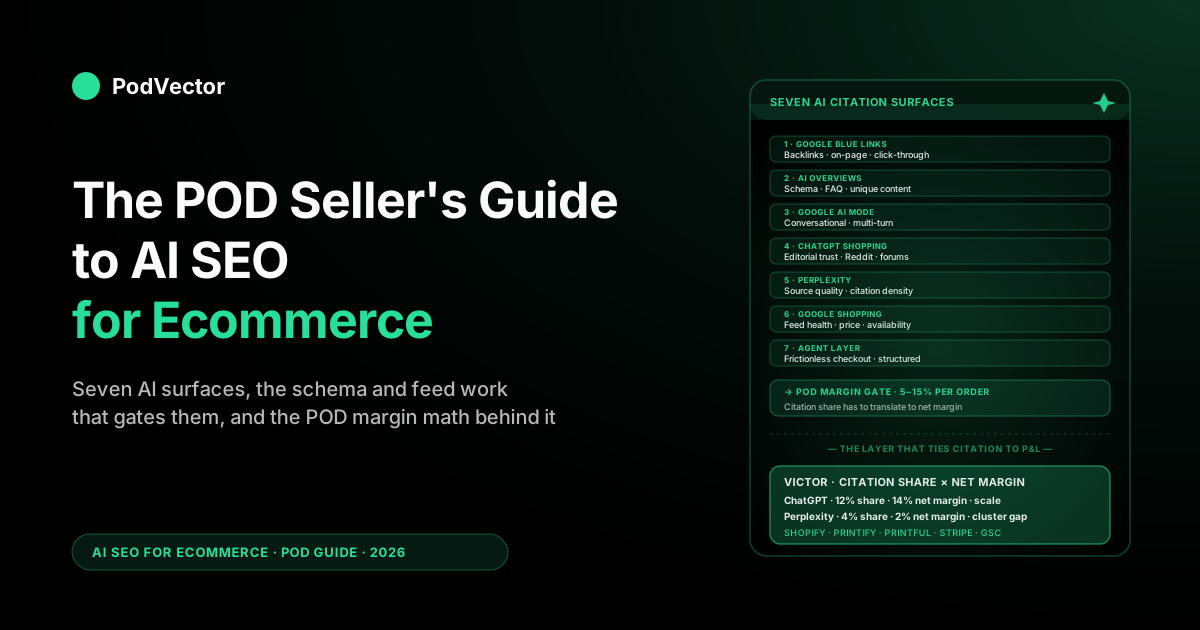
Quick Answer: AI SEO for ecommerce in 2026 is the work of getting your store mentioned, cited, and recommended by ChatGPT, Perplexity, Google AI Overviews, Google AI Mode, and Amazon Rufus — not just blue-link Google. For print-on-demand, the seven moves that matter are: making AI bots crawlable, rewriting product pages for conversational queries, fixing your Shopify and Printify/Printful product feed, layering schema (Product, Review, FAQ, BreadcrumbList) the agents can quote, building topical clusters around niche-and-occasion (not just keyword), earning off-site mentions on sites AI trusts, and tracking citation share across AI surfaces. The POD-specific gating constraint is margin: a POD store nets 5–15% per order, so any AI SEO tool or agency needs to clear that bar — which means measuring lift on AI-cited revenue, not vanity impressions.
Why AI SEO hits POD sellers differently
Most 2026 AI SEO guides are written for a generic DTC brand with a 200-SKU catalog of distinct products, a 40–60% gross margin, and budget for a six-month optimization sprint. POD is structurally different on three axes, and each one bends the playbook.
First, the variant-explosion problem. A graphic tee design on a generic DTC store is one product page.
The same design on a POD store is one product, but it ships across a unisex tee, a fitted tee, a youth tee, three hoodie weights, a long-sleeve, a sweatshirt, a tank, and a mug — each with its own size matrix, its own giver-occasion fit, and its own optimal phrasing for an AI agent fielding a query like "good Father's Day gift for a competitive dad who runs marathons." Generic AI SEO tools that recommend "rewrite your product descriptions for conversational queries" don't reckon with the fact that the same design needs eight different conversational framings, one per product type. The tools that work either generate variant-aware copy at scale or sit on top of a feed that already does.
Second, the margin math. A POD store on Printify or Printful through a Shopify front end nets 5–15% per order after the base, the print, the shipping, the payment fee, and refund slippage.
A standard SEO agency engagement at $2,000–4,000/month, an AI-SEO platform at $300–800/month, and a content-generation tool at $100–300/month easily totals $4,000/month. At a $20 average net margin per order that's 200 orders per month just to break even on tooling, before any uplift. The POD operators winning AI SEO budget AI SEO spend the way they budget ad spend — measured against incremental net margin, not vanity traffic.
Third, the trust layer. AI agents like ChatGPT and Perplexity weight citations toward sites with established editorial reputation, schema-correct product data, and unique content.
A POD store with the same Printify mockup on the same product page that 50 other POD stores also list is structurally invisible to an AI agent looking for something distinctive to cite. The AI SEO work that pays back for POD is disproportionately about owning a niche-and-occasion angle nobody else owns, then signaling it loud enough in your structured data and editorial content that the AI agent has reason to surface you over a generic competitor.
If you're coming to this from the Shopify-specific angle, the POD seller's guide to AI SEO for Shopify covers the platform-specific levers in more depth. This guide takes the broader cross-platform view.
What AI search actually changed about ranking
You'll see this work labeled a dozen ways — AEO (AI engine optimization), GEO (generative engine optimization), LLMO (large-language-model optimization), and AIO (optimizing for Google's AI Overviews). They're the same discipline under different acronyms: getting an AI surface to surface your store. Don't get distracted by the vocabulary; the moves below are what actually pay back.
The shift from blue-link search to AI-mediated search changed three things that matter for POD sellers, and a fourth that matters more than the operator playbooks have caught up to.
Change 1: queries got longer and more specific. A buyer typing "father's day shirt" into Google gets blue links and clicks one. A buyer asking ChatGPT "what's a good Father's Day shirt for my dad who's into trail running and likes dry humor" gets a synthesized recommendation with three or four product citations.
The query is conversational and embeds the giver, the occasion, the recipient's interest, and a tone preference. AI SEO is the work of making your product page legible to that query.
Generic tee descriptions ("100% cotton, available in five colors") don't carry the giver-occasion-tone semantic load. Descriptions that name the giver context, the occasion, the recipient persona, and the tone do.
Change 2: AI Overviews and AI shopping panels eat top-funnel clicks. Google's AI Overviews now appear on a meaningful share of shopping queries, and click-through to underlying sites drops 30–60% on queries where the Overview answers the question outright. The published estimate from ALM Corp's tracking of AI Overviews on shopping queries puts the appearance rate around 14% as of mid-2026, with a 5.6× growth over the prior four months. For POD operators, this means the work of "ranking #3 in Google" matters less than the work of "being one of the products the Overview cites." Same SEO, different surface, different optimization.
Change 3: citation surfaces multiplied. In 2024 there were two surfaces that mattered for ecommerce SEO — Google blue links and Google Shopping. In 2026 there are at least nine: Google blue links, Google AI Overviews, Google AI Mode, Google Shopping, ChatGPT shopping, Perplexity shopping, Microsoft Copilot, Amazon Rufus (the surface that matters most if you also run an Amazon Merch on Demand catalog), and the agent layer (Operator, Comet, etc.) that reads pages on behalf of a buyer.
Each one weights signals differently. Blue-link Google still rewards backlinks and on-page keyword fit.
AI Overviews reward schema completeness and unique editorial content. ChatGPT and Perplexity reward third-party mentions on sites the model trusts (Reddit, YouTube reviews, niche forums, established editorial). The operator who optimizes for one surface and ignores the others leaves 60–70% of their AI-mediated demand on the table.
Change 4 (the underrated one): AI agents shop on the buyer's behalf. The agent layer is the fastest-growing of the nine and the one most operators are not yet optimizing for. An AI agent reading product pages to make a purchase recommendation cares about machine-readable price, machine-readable availability, machine-readable shipping time, machine-readable size guidance, and machine-readable reviews.
Anything the agent has to infer from prose is a coin flip. POD stores with weak structured data lose the agent battle even when their human-readable copy is strong. We've sketched where this is heading in the POD seller's guide to AI search for ecommerce.
The seven-step AI SEO playbook for POD stores
The seven moves below are the floor for a POD store that wants to compete on AI-mediated discovery in 2026. Skip any of them and you give up citation share to a competitor who didn't.
1. Make sure AI bots can actually crawl you
The first failure mode is the dumbest one: AI bots blocked at robots.txt, JavaScript-rendered product pages the bots can't parse, or Cloudflare bot challenges that bounce GPTBot, ClaudeBot, PerplexityBot, and Google-Extended. Audit your robots.txt for blocks on the AI user agents you actually want crawling you.
Audit your page-rendering: a Shopify Liquid theme renders product data server-side and is fine; a heavy headless theme that lazy-loads price and stock client-side may not be parseable to a non-JS-executing crawler. Audit your bot-protection layer: aggressive Cloudflare challenges block more legitimate AI crawlers than abusive ones.
The fix is boring infrastructure work. The payoff is that you stop being invisible to the citation surfaces you're trying to rank in.
2. Rewrite product pages for conversational queries
The product page is still the unit of AI SEO. The shift from keyword search to conversational search means the page needs to answer questions, not just list features. A POD product page that ranks in 2026 carries: a clear giver-occasion-recipient framing in the first 200 words, a feature list that maps to common buyer concerns ("does it run small," "is the print soft to the touch," "what's the gift-wrap option"), an FAQ block that mirrors actual buyer questions, and review excerpts the agent can quote.
Format for chunk retrieval, not just for human readers. AI surfaces lift answers in passages, so the page that gets quoted uses descriptive headers, a one-line key takeaway up top, question-shaped subheads, and bullets or a spec table instead of one dense paragraph. A wall of prose forces the agent to infer; a clean chunk gives it something to copy verbatim into the answer.
The pattern that works for POD: write the product description in three layers. Layer 1 is the giver-occasion-recipient framing.
Layer 2 is the feature-and-fit detail (cotton weight, fit, sizing), ideally as a scannable spec block. Layer 3 is the FAQ, written as questions and answers an AI agent can extract verbatim.
The same three-layer pattern works for Printify and Printful catalog products, and the structure scales across variants when you template it. We've covered the prompt patterns for generating layer-1 and layer-3 content at scale in the POD seller's guide to AI for ecommerce product content creation.
3. Fix your product feed before you write any content
Your Shopify product feed plus your Printify or Printful supplier feed are the data the AI surfaces actually read. If the feed is broken, the content optimization on top of it is wasted work.
Walk through: are GTIN, MPN, and brand fields populated for every variant; does the price match what the storefront shows including any active promo; is availability accurate at the variant level; does shipping time reflect Printify's or Printful's current production estimate plus the carrier window; are at least three product images supplied per variant. We unpack this in detail in the feed section below.
4. Layer schema AI agents actually quote
The Schema.org types that matter for POD AI SEO in 2026: Product (with Offer, AggregateRating, Review nested), BreadcrumbList, FAQPage, and Organization. The ones that pay back disproportionately are AggregateRating (because AI agents quote ratings to justify recommendations) and FAQPage (because AI Overviews surface FAQ-marked content with high frequency).
The Shopify default schema covers Product and Offer adequately; the gaps are usually FAQPage on collection and product pages, and Review schema on individual product pages where you have customer reviews flowing in. Schema is a low-effort, high-leverage block of work — usually a one-time theme edit plus an app for FAQPage rendering.
5. Build topic clusters around niche-and-occasion
Generic ecommerce SEO advice says build topic clusters around product categories. POD is different because the buyer's mental model isn't product-first, it's occasion-and-recipient-first. The cluster that works for a POD store selling dad-themed designs is "Father's Day gift guides," "gifts for sporty dads," "gifts for funny dads," "personalized Father's Day gifts," "last-minute Father's Day shipping" — five to eight pieces of editorial content that each anchor a giver-recipient-occasion query and link back to the product collections that fulfill it.
The cluster does two things at once: it covers the long-tail giver-occasion queries AI agents synthesize answers to, and it builds topical authority that signals to ChatGPT and Perplexity that you're a credible source for the niche. The trap is generic content — a "10 Father's Day gift ideas" listicle that 500 other sites have published doesn't move the needle. The content has to embed your specific niche perspective (e.g., trail-running dads, whiskey-collector dads, woodworking dads) tightly enough that an agent recognizing the niche would have a reason to cite you over a generic gift-guide site.
6. Earn off-site mentions on sites the AI trusts
AI agents don't cite a store because it claims to be the best — they cite the store that credible sources agree on. That consensus is the single biggest off-site lever in 2026: the model reads Reddit, YouTube reviews, publisher roundups, and forum threads, and surfaces the product that shows up favorably across several of them. One self-published "we're the best" page carries almost no weight; three independent mentions that line up carry most of it.
The source list that feeds that consensus, roughly in order of weight: Reddit (high, especially niche subreddits), YouTube reviews and haul/unboxing videos (AI surfaces increasingly pull from video transcripts, and POD operators almost always ignore this one), established niche editorial (industry blogs, hobbyist publications), product roundup sites (Wirecutter, NYT Wirecutter, niche equivalents), and forum-style communities (Discord transcripts that get indexed, niche forums). Generic guest posts on low-authority blogs don't move the needle anymore — they did in 2022.
The pattern that works for POD: identify three to five niche communities where your buyer persona actually congregates, build genuine presence there (not drop-and-link spam), seed a few honest YouTube reviews of your bestselling designs, and pursue earned mentions on the editorial side from journalists and bloggers covering the niche. The work is slow and the payoff is asymmetric — one mention in a Wirecutter-tier roundup or a high-traffic Reddit thread pays back for a year of AI-citation share. The off-site dimension is the floor that the StudioHawk team unpacks at length in their 7-step ecommerce AI SEO playbook, and it's the dimension most POD operators undervalue.
7. Track citation share across the AI surfaces
You cannot improve what you cannot see. The new metric for AI SEO is citation share — what percentage of relevant prompts on ChatGPT, Perplexity, AI Overviews, and AI Mode cite your store.
The tooling for this matured in 2025–2026: Profound, Sight AI, Otterly, Peec AI, and a handful of others all sample relevant prompts on a recurring basis and report which sites get cited. None of the tools are perfect; all of them are better than guessing.
The POD-specific use is to track citation share on the niche-and-occasion query patterns your topic clusters target. If your "Father's Day gifts for trail-running dads" cluster doesn't show up in citation share for that query family after 60–90 days, the content needs work. We've gone deeper on AI search analytics tooling in the best AI search analytics tools for ecommerce comparison.
Schema and structured data AI agents actually quote
Schema is the AI SEO move with the highest ratio of compounding return to one-time effort, and it's the one most POD operators do partially or wrongly. The minimum viable schema stack for a POD store in 2026 is six types working together.
Product schema is table stakes. Every product page carries Product with name, image (multiple), description, brand, sku, gtin (where available), category. Variants are modeled as nested Offer entries with price, priceCurrency, availability, itemCondition, and url. The Shopify default does most of this; the gaps are usually around the variant-level Offer detail.
AggregateRating and Review are the schema types that move the needle hardest in 2026, because AI agents quote ratings and review text to justify recommendations. If your store has reviews flowing in, surface them as Review schema with author, reviewRating, datePublished, and reviewBody.
Surface AggregateRating with ratingValue and reviewCount on the parent Product. POD operators with new stores that lack reviews are at a structural disadvantage here, and the fix is to actively solicit reviews on the first 30–90 orders before scaling ad spend.
FAQPage schema on product, collection, and editorial pages. AI Overviews surface FAQ-schema content with disproportionate frequency. The FAQ doesn't need to be on a separate page — it can render at the bottom of the product page or the collection page. The questions need to be the actual questions buyers ask, not synthetic SEO bait.
BreadcrumbList is small but high-value. It tells the AI agent the structure of your site (Home → Father's Day Gifts → Trail-Running Dads → This Specific Tee) and gives the agent context to cite the right page. Most Shopify themes ship this; verify it's rendering correctly.
Organization schema on the homepage with name, url, logo, sameAs (social profiles), and contactPoint. AI agents weight this when deciding whether you're a real brand. Critical for POD stores that may not have the editorial footprint of an established DTC brand.
HowTo schema where it fits — sizing guides, gift-wrapping how-tos, customization walkthroughs. Optional but pays back on the editorial pages that anchor your topic clusters.
Validation step: run every schema-bearing page through Google's Rich Results Test and Schema.org's validator before assuming it works. Shopify themes routinely render almost-correct schema with one or two missing required fields, which AI agents downrank as if the schema weren't there.
Your product feed is your AI-SEO surface
The single most underrated AI SEO move for POD is fixing the product feed. Your Shopify product feed (consumed by Google Merchant Center, Bing Merchant Center, Pinterest, TikTok Shop, and increasingly the AI-shopping surfaces) is the canonical machine-readable representation of your catalog.
AI agents rely on it for price, availability, and shipping data they cite verbatim. A broken feed produces broken citations.
The POD-specific feed pitfalls:
- Stale availability data. Printify or Printful suppliers occasionally drop a product or run a size out. If your Shopify-Printify sync is on a 24-hour cadence and the supplier dropped a product 12 hours ago, your feed shows it as available when it isn't. AI agents that recommend an unavailable product look bad and downrank you on the next prompt.
- Inaccurate shipping windows. Printify production time plus carrier transit is the actual delivery window, not the shipping carrier transit alone. Feeds that report "ships in 2 days" when production is 4–6 days and shipping is another 3–5 set the buyer up for a complaint and the agent's recommendation up for a downrank.
- Missing GTIN/MPN on variants. POD products often lack manufacturer GTIN because the supplier hasn't issued one. Use the supplier's identifier in MPN, the supplier name in brand, and explicitly set
identifier_exists: falsefor products that genuinely have no GTIN. This is a Google Merchant Center policy point but the AI agents read the same fields. - Variant-level price drift. If your storefront shows variant pricing that differs from the feed (because of an active discount, a tax setting, or a currency conversion), AI agents see one price, the buyer sees another, and the trust gap kills the conversion.
- Image quality below 600×600. AI Shopping panels and AI Overviews preview product images at higher resolution than the old Google Shopping panels. Mockup images at 400×400 that worked in 2022 look bad in 2026. Push at least 800×800, ideally 1200×1200, for hero variants.
- Attributes that don't match across channels. AI surfaces validate a product by cross-referencing it — the price, title, material, and product identifier on your Shopify page against your Google Merchant feed, your Amazon Merch listing, and any marketplace mirror. When the same tee is "Unisex Heavy Cotton Tee" at $24 in one place and "Premium Cotton T-Shirt" at $22 in another, the agent can't confidently match them and drops you from the recommendation rather than guessing. Keep title, price, material, and identifier identical everywhere the product appears.
The fix is a feed audit (run once) plus a feed monitor (run continuously). The feed monitor doesn't need to be expensive — a daily diff that flags new errors against last known good is enough for most POD stores. The audit is where most operators leave money on the table by skipping.
How to measure AI SEO when impressions don't show in GSC
Before you measure, separate the three ways an AI surface can show you, because they pay back differently. A mention names your brand with no link — pure reputation, hard to attribute. A citation links your page as a source — credibility plus referral traffic. A product recommendation surfaces the specific item with price, rating, and a buy path — the one that converts. A POD store can rack up mentions in gift-guide answers and still get zero product recommendations because its feed and schema are too weak for the agent to recommend a specific variant. Track all three, but optimize hardest for the product-recommendation slot, because that's the one with margin attached.
The hardest unsolved problem in AI SEO for POD in 2026 is measurement. Google Search Console reports clicks from blue-link Google and gives you an aggregate "Search Appearance" view that includes AI Overviews, but it does not tell you which specific prompts on ChatGPT, Perplexity, or AI Mode cited you.
Server-side referrer headers from AI agents are inconsistent — some send them, some send opaque ones, some send none. The result is that the operator working on AI SEO is partially blind to whether the work is paying back.
The measurement stack that works in 2026 has four layers:
Layer 1 — Citation tracking via dedicated tools. Profound, Sight AI, Otterly, and similar sample queries on a recurring basis and report which domains get cited. This gives you a leading indicator of citation share, sampled rather than complete. Pick one and track the prompt families that map to your topic clusters.
Layer 2 — Referrer and direct-traffic deltas. Some AI surfaces send a referrer (chatgpt.com, perplexity.ai). Track these in GA4. Direct traffic with no referrer that lands on long-tail editorial pages is a noisy proxy for AI-cited traffic. Both grow when the AI SEO work is paying back, but neither is exact.
Layer 3 — Branded search volume. When AI agents cite your brand, a fraction of buyers branch out and search for you directly. Branded search volume in GSC is one of the cleanest leading indicators that AI citation is happening at scale.
Layer 4 — Margin attribution. The piece most operators miss. Every uplift in AI-cited traffic has to translate to incremental net margin to justify the spend.
The conventional ecommerce attribution stack reports revenue attribution by source. The POD operator needs net-margin attribution by source, after the supplier base, the print, the regional shipping, the payment fee, and the refund slippage. Without this, an AI SEO program can grow the top of the funnel and shrink the bottom of the P&L simultaneously.
This is the gap PodVector AI's Victor was built into. Victor is an AI employee who reads your live Shopify, Printify, Printful, and ad-platform data, so he can see your orders, costs, ad spend, and true profit together in one place.
Ask it "what was the net margin per order on traffic from AI surfaces last 30 days" and it joins the referrer and source data with the supplier-itemized cost data and the order-level revenue data and answers from numbers, not LLM guesses. We've gone deeper on the analytics architecture in the complete guide to AI analytics for print-on-demand and the complete guide to AI agents for ecommerce analytics.
The agentic future: when AI agents shop on your behalf
This is not a slow-moving shift. Triple Whale's network reported roughly 59× growth in AI-attributed orders in 2025 versus 2024 — the kind of curve that turns "nice to have" into "table stakes" inside a single season.
The next 18 months of AI SEO is not about which surfaces cite you. It's about which surfaces buy from you. The agent layer — Operator, Comet, the in-development ChatGPT shopping flow, Perplexity's agent mode — is moving from "recommends a product to a human" to "completes a purchase on the human's behalf." The optimization that wins this layer is different from the optimization that wins citation.
An AI agent completing a purchase needs a frictionless checkout the agent can navigate (no captcha, no aggressive bot-block, no fragile JS-rendered cart), a machine-readable price and availability that match what the agent saw at recommendation time, a return policy the agent can quote, and a shipping ETA the agent can rely on. The POD operators who optimize for this in 2026 are the ones who get the agent's preferred-vendor slot when the agent makes a purchase recommendation it intends to act on.
This is also where Victor fits in. Victor can answer questions you'd normally need an analyst for — "what's my real margin on AI-cited traffic," "which topic-cluster pages converted best last month," "did my schema changes move my citation share." With your approval, Victor can also take action — pausing ad campaigns that cost more than they bring in, drafting the schema changes for a low-citation product page, and queuing up the content brief for the niche-cluster gap that's costing you citation share. We've laid out this thinking in more detail in agentic AI for ecommerce: what it looks like for POD sellers.
POD-specific AI SEO pitfalls
Optimizing for citation count instead of citation quality. Being cited 50 times in low-relevance contexts is worth less than being cited 5 times in high-buying-intent contexts. The cluster work has to target the queries that convert, not the ones easiest to rank in.
Generic content that 50 other POD stores also publish. "10 best Father's Day gifts" with the same Printify mockups everyone else uses is invisible to AI agents looking for distinctive sources. Your editorial content has to embed a niche angle (the giver, the recipient, the occasion specificity) that competitors don't credibly own.
Leaving Printify/Printful supplier cost data outside the SEO loop. AI SEO that grows traffic to low-margin variants is faster wrong, not faster right. The measurement layer has to read supplier-itemized cost data, not just revenue, or you'll scale a program that loses money per order.
Trusting AI-generated content without an editorial pass. AI-generated cluster articles ship faster than human-written ones, and AI agents are increasingly good at detecting low-effort AI-generated content and downranking the source. The pattern that works is AI-drafted, human-edited, with a real perspective and real examples — not unedited AI output.
Skipping schema because the theme "already does it." Most Shopify themes render incomplete schema with one or two required fields missing. Validate every schema-bearing page through the Rich Results Test before assuming it's working.
Buying an AI SEO platform before installing the analytics layer. A platform that reports citation share without reporting downstream net margin tells you the program is working when it might be losing money. Install the analytics layer first, then add tooling that connects to it.
Treating AI SEO as a one-and-done project. The citation surfaces update their weighting on a monthly cadence. The cluster, schema, feed, and content work is a continuous program, not a quarterly sprint.
The AI SEO checklist for POD stores
The checklist below is the floor. A POD store that works through all of it sits in the top quartile of AI SEO maturity in 2026.
- Crawlability: robots.txt allows GPTBot, ClaudeBot, PerplexityBot, Google-Extended; product pages render server-side or with progressive enhancement; bot-protection layer doesn't bounce legitimate AI crawlers.
- Product page rewrite: three-layer description (giver-occasion-recipient framing, feature-and-fit, FAQ) on every variant; size-guide content with HowTo schema; review excerpts visible on the page.
- Schema: Product, Offer, AggregateRating, Review, FAQPage, BreadcrumbList, Organization rendered correctly and validated through Rich Results Test.
- Feed health: GTIN/MPN populated or explicitly absent; price, availability, shipping window match storefront and supplier reality; image resolution at 800×800 minimum; daily diff against last-known-good.
- Topic clusters: 5–8 cluster pieces per major niche-and-occasion combination, each anchored by a giver-recipient angle competitors don't own.
- Off-site mentions: earned presence on 3–5 niche communities; pursued mentions on Wirecutter-tier editorial; honest YouTube reviews on bestsellers; Reddit and forum activity that builds genuine reputation, not drop-and-link — the goal is consensus across independent sources, not one self-published claim.
- Citation tracking: one of Profound / Sight AI / Otterly / Peec AI installed, sampling the prompt families your clusters target.
- Margin attribution: AI-cited traffic measured against net margin per order, not gross revenue.
- Agent readiness: frictionless checkout the agent can navigate; price and availability machine-readable and accurate; return policy and shipping ETA quotable in structured form.
If your store hits all nine, you're ahead of 90% of POD operators. If you hit five or fewer, the AI SEO upside is large and the work is mostly mechanical. For the broader cross-cluster context, the AI overview cluster hub consolidates how AI SEO sits inside the larger AI-for-POD stack, and the AI analytics topic hub covers the measurement layer that gates everything else.
FAQs
Is AI SEO different from regular SEO for ecommerce?
Yes, in three ways. First, the surfaces multiplied — blue-link Google, AI Overviews, AI Mode, ChatGPT, Perplexity, and the agent layer all weight signals differently.
Second, the queries got longer and more conversational, so product-page copy needs to answer questions, not just list features. Third, citation share is a new metric layered on top of traditional rank and click-through data.
Most of the foundational work — schema, crawlability, content quality, off-site mentions — overlaps with traditional SEO. The new work is conversational rewriting, citation tracking, and feed-level rigor for AI shopping surfaces.
How long does AI SEO take to pay back for a POD store?
Crawlability and schema fixes pay back in days to weeks because AI agents recrawl frequently. Product-page rewrites and feed cleanup pay back in 4–8 weeks.
Topic-cluster content and off-site mentions pay back in 3–6 months. Agent-layer optimization is just emerging and the payback curve is still steepening. The defensible expectation for a POD store starting from a baseline of "working but not optimized" is measurable citation share growth in 60 days and material AI-cited revenue uplift in 90–120 days.
Should a POD seller hire an AI SEO agency or do it in-house?
Hire for the off-site, link-building, and editorial-PR work, where the relationships matter and the work is hard to fake. Do in-house the schema, feed, product-page rewrite, and analytics work, because it benefits from operator-specific knowledge of your supplier setup and margin reality.
Tools like ChatGPT and the in-platform AI features in Shopify let a single operator handle the in-house work at a fraction of the agency cost. The hybrid model — agency for off-site, in-house for on-site and analytics — is what most successful POD operators run.
What schema types matter most for POD AI SEO?
In order of leverage: Product (with Offer nested), AggregateRating, Review, FAQPage, BreadcrumbList, Organization, and HowTo. AggregateRating and Review move the needle hardest in 2026 because AI agents quote ratings and review text to justify recommendations.
FAQPage is a close second because AI Overviews surface FAQ-marked content disproportionately. BreadcrumbList and Organization are foundational and small effort. HowTo is optional but pays back on sizing guides and customization walkthroughs.
Can ChatGPT and similar AI tools do AI SEO for me?
For the content-generation half (product descriptions, FAQ blocks, cluster article drafts), yes — a structured ChatGPT workflow handles 70–85% of what a $200/month content-AI platform delivers, at $20/month. For the analytics half (citation tracking, margin attribution, feed monitoring), no — those require live data integrations that ChatGPT alone can't do.
The substitution is "ChatGPT for drafting plus a POD-aware analytics layer for measurement," not ChatGPT alone. The prompt patterns are unpacked in the POD seller's guide to ChatGPT prompts for Shopify.
How does AI SEO interact with traditional Google ranking for POD?
The work is mostly additive. The crawlability, schema, content-quality, and link-building moves that win AI citation are the same moves that win blue-link Google, with one caveat: AI surfaces weight unique editorial perspective and structured data more heavily, while blue-link Google still weights backlinks and on-page keyword fit.
A program optimized for AI SEO produces incidental gains on traditional Google. A program optimized only for traditional Google leaves AI citation share on the table. We covered the optimization mechanics in the POD seller's guide to AI optimization for ecommerce.
How much should a POD store budget for AI SEO?
For a POD store doing $30–100k/month, the defensible AI SEO budget is $300–1,000/month, allocated roughly: $50–150 on citation tracking, $100–300 on AI content tooling and ChatGPT, $0–500 on agency support for off-site work, and the operator time for in-house schema, feed, and product-page rewrite. The bigger spend is operator hours, not tool fees — budget 6–10 hours per week for the first 90 days and 3–5 hours per week thereafter.
What's the relationship between AI SEO for ecommerce and AI marketing for ecommerce?
AI SEO is one of the five categories inside the broader AI marketing stack — specifically, it overlaps with the AI copy and SEO category and feeds into the attribution and analytics category. The full five-category frame is unpacked in the POD seller's guide to AI marketing for ecommerce. AI SEO is the discoverability and citation layer; AI marketing is the broader stack of creative, copy, personalization, attribution, and execution that monetizes the discoverability.
See whether your AI SEO program is actually paying back
Victor connects your live Shopify, Printify, Printful, and ad-platform data into a single margin view, so you can answer "is AI-cited traffic actually netting positive margin per order" in plain English. Victor answers your questions and acts on the answers — with your approval.
Try Victor free