
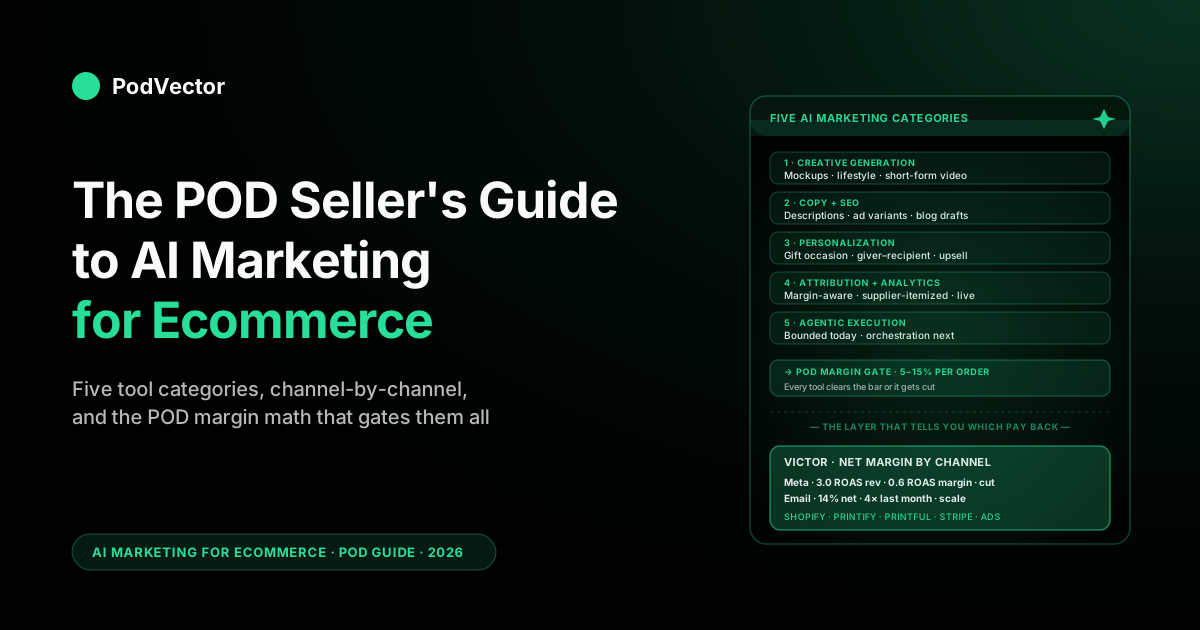
Quick Answer: AI marketing for ecommerce in 2026 means five tool categories — creative generation, copy and SEO, personalization, attribution and analytics, and agentic execution — wired into your channels (store, email, Meta/TikTok ads, search, and the new agentic surfaces). For print-on-demand sellers, the gating constraint is margin: a POD store nets 5-15% per order versus 40-60% for stocked DTC, so any AI tool needs to clear that bar before it earns its seat.
The categories that pay back fastest for POD are creative generation (mockups and lifestyle visuals at near-zero marginal cost), AI copy for product descriptions and ad variants, and AI analytics that pulls live Shopify, Printify, Printful, and ad-spend data into a single margin view. The category to be skeptical of is broad "AI marketing platforms" with monthly seat licenses that don't connect to your actual cost stack.
Why AI marketing hits POD sellers differently
Most 2026 ecommerce-marketing guides are written for a generic DTC brand with one supplier, one warehouse, and a 40-60% gross margin to play with. That stack absorbs experimentation.
You can put $400/month into a fancy attribution platform, $200/month into a creative AI suite, $300/month into a personalization engine, lose three months figuring out which one paid back, and still finish the quarter in the black. Print-on-demand cannot.
A POD store running on Printify or Printful through a Shopify front end nets somewhere between 5% and 15% on a typical order after the base, the print, the shipping, the payment fee, the ad cost, and the refund slippage. Layer on a $900/month tool stack that doesn't move conversions and you've burned through the margin on 100-200 orders before you noticed.
That's the first reason this guide reads differently. The second is that POD has a marketing problem the generic DTC operator doesn't have: the wearer or giver is the SKU.
A graphic tee for a "calmly competitive dad" is one product on a unisex tee, another on a youth hoodie, another on a ceramic mug — and each variant has a different audience, a different gift occasion, a different optimal channel. AI marketing tools that assume one SKU equals one ad equals one landing page break on POD's variant explosion. The tools that work either generate variant-aware creative at scale, or they cleanly join SKU-level cost data with SKU-level revenue and ad-spend data, so the operator sees which variants of which design are actually printing money.
The third difference is the supplier-cost layer. A typical Shopify-fulfilled brand has one cost-of-goods value per SKU.
A POD operator has a supplier base cost, a print cost, a shipping cost that varies by region, and a fulfillment slippage from refunds and reprints. AI marketing tools that route attribution and ROAS off "revenue minus ad spend" miss 70% of the cost stack.
The ones that earn their keep either expose POD-specific cost fields, or they sit downstream of an analytics layer that already does. We'll come back to this in the agentic-roadmap section, because it's where the next 12 months of AI marketing for POD is heading.
The five AI marketing categories that matter for POD
The most useful frame in 2026 is not "AI marketing tool" as a single bucket — it's five separable categories, each with its own ROI logic. The categories below mirror what the better ROAS-focused operator playbooks have settled on (LayerFive's 2026 framework for AI marketing tools is one of the cleaner public versions), tuned for POD's cost reality.
1. AI creative generation (mockups, lifestyle, video)
This is the category with the fastest payback for POD. A POD operator running 30-50 designs per quarter needs lifestyle imagery — a model wearing the tee in three lighting setups, a flat-lay shot for Pinterest, a vertical video for TikTok — for every variant that justifies the spend.
Sourcing that traditionally meant a $200-600 photoshoot per design or $40-100 per variant on a stock-mockup service. Generative image and video models in 2026 push that marginal cost to near zero. The same Father's Day dad tee design can ship with a generated wearing-the-tee shot, a flat-lay, and a 6-second TikTok hook for under $5 in API spend.
The catch is taste. Generic AI mockups read as AI mockups, and conversion drops 15-25% versus real photography on top-funnel cold traffic. The POD operators winning this category use AI for the long tail of variants and channels (Pinterest, retargeting, less-trafficked SKUs) and reserve real photography for the hero designs and top-of-funnel ads.
2. AI copy and SEO (descriptions, ad variants, blog drafts)
Product descriptions, Meta and TikTok ad copy variants, email subject lines, and blog drafts are where ChatGPT and its peers earn the most billable hours back per month for a typical POD operator. The work is bounded, the brand voice is portable across drops, and the variant-explosion problem maps cleanly to "give me 8 variations" prompts. A 50-product drop that took a half-day to describe by hand collapses to 90 minutes of structured prompting and editing.
SEO sits in the same category but with a longer payback. AI-generated cluster outlines and draft articles let a single operator publish at 3-5× the prior cadence, and the discoverability gains compound.
Where AI copy underdelivers for POD is anywhere a hallucinated detail can hurt — sizing claims, fabric specs, shipping times. Those have to be templated from the supplier feed, not generated. We've covered the prompt patterns in detail in the POD seller's guide to AI for ecommerce product content creation and the SEO mechanics in the POD seller's guide to AI SEO for Shopify.
3. AI personalization (recommendations, email, on-site)
Personalization is the highest-leverage category in DTC and a tricky one in POD. The standard play — recommend the next product based on browsing history — works fine when your catalog is 200 SKUs of distinct items. It works less well on POD, where 200 SKUs might be 8 designs across 25 variants each, and "more like this" can mean "more of this exact design in a slightly different color." The personalization angles that actually move POD revenue are gift-occasion personalization (Father's Day buyers see Mother's Day designs three months later), giver-recipient personalization (the wife buying for her husband sees the men's catalog reframed), and personalized-product upsell (offer the input field for a name or date on the cart page).
Most off-the-shelf personalization tools assume a stocked catalog. Operators have to either configure the rules carefully or use a layer that knows POD's variant logic. We've gone deeper on this in the POD seller's guide to AI for ecommerce personalization.
4. AI attribution and analytics
This is the category where the generic DTC playbook breaks hardest for POD. Standard attribution platforms route on revenue minus ad spend.
They don't see the supplier base, the print cost, the regional shipping variance, or the refund slippage. Run a Meta ad set that returns 3.0 ROAS on revenue and 0.6 ROAS on margin and the standard tool tells you to scale; the POD reality is that you're losing money on every conversion. AI marketing tools that don't connect to Shopify, Printify, Printful, your payment processor, and your ad accounts simultaneously are guessing at half the equation.
This is the gap PodVector AI's Victor was built to fill. Victor is an AI employee who sees your live Shopify, Printify, Printful, and ad account data all in one place, so he always has the full picture of your store.
Ask it "which Meta ad set actually netted positive margin last 30 days" and it joins the ad-platform spend data with the supplier-itemized cost data and the order-level revenue data and answers from numbers, not LLM guesses. We've gone deeper on the analytics architecture in AI-powered ecommerce analytics: what it looks like for POD sellers and the complete guide to AI analytics for print-on-demand.
5. Agentic AI execution
The category that didn't exist as a real product in 2024 and is the headline of every 2026 vendor pitch. The pitch: an AI agent that doesn't just analyze your store, it acts on it — pauses underperforming ad sets, drafts and ships email campaigns, adjusts retargeting audiences, reorders bestsellers. The reality in mid-2026: agentic execution works in narrow lanes (ad-budget reallocation, audience expansion, support reply drafting) and is still maturing in the broader lanes (autonomous campaign creation, end-to-end promo planning).
For POD specifically, the agentic future is more constrained than for stocked DTC, because every "act on the store" decision has supplier and margin implications the agent has to reason about. We've laid out where the technology is and where it's going in agentic AI for ecommerce: what it looks like for POD sellers. The short version: Victor is an AI employee, not a dashboard — it already answers the margin questions you'd otherwise dig out by hand and acts on the answers with your approval, and the roadmap widens the set of actions it can take on your behalf.
AI marketing across your POD channels
The category frame above is a tool-shopping frame. The day-to-day frame is channel-by-channel. Here's how AI marketing actually shows up across the channels a typical POD operator runs in 2026.
Shopify storefront
The Shopify storefront is where AI personalization, AI search, and AI-generated copy compound the hardest. Shopify's native AI surface (Sidekick, Magic) handles a lot of the basics — description rewrites, blog drafts, automated tagging — and a POD operator running on Shopify gets a free baseline lift just by turning those features on.
Where the native tools end is anywhere your supplier-itemized cost data needs to inform a marketing decision, which is most of the interesting decisions. The pattern that works: use Shopify's native AI for content and on-site personalization, layer a POD-aware analytics tool over the top for margin-driven decisions. We unpack the Shopify-native AI surface in the POD seller's guide to Shopify and AI.
Email and SMS
The category where AI has compressed the most operator hours in 2026. AI-drafted subject lines, segment-aware body copy, and dynamic product blocks turn what used to be a half-day campaign workflow into a 45-minute one.
The POD-specific gotcha is segmentation: gift occasion, giver-recipient, and personalization-product affinity matter more than browse-recency for a POD list. Klaviyo and similar platforms have shipped AI segmentation that handles the basics; the long-tail segments (e.g. "buyers who ordered a personalized item on Mother's Day 2025") usually need a custom query against your live data, which is where an AI analytics layer pays for itself.
Meta and TikTok ads
Both platforms have shipped agentic ad-buying surfaces (Meta's Advantage+ family, TikTok's Smart+ family) that take more of the bid, audience, and creative-rotation decisions away from the operator. For POD, the wins are real on the creative-rotation side — the platforms cycle through 30 generated thumbnails to find the winning creative far faster than a human operator could test.
The losses show up where the platform's optimization metric (revenue, conversions) diverges from your actual goal (margin). A Meta campaign optimizing for purchase-conversion will happily push your $9 net-margin tee variant at the same rate as your $22 net-margin variant, because revenue per conversion looks similar. The POD operator either sets up custom-conversion events that approximate margin or runs the campaigns at a constraint (cost cap, ROAS cap) that backs into margin discipline.
Search and the agentic-search layer
Three audiences search for POD products in 2026: humans on Google, humans on TikTok, and AI agents on ChatGPT, Perplexity, and Google AI Mode. The third audience is the new one.
AI agents reading your product pages to answer "what's a good Father's Day tee for a competitive dad" need structured data, clear giver-occasion framing in the body copy, and reviews the agent can quote. The optimization is closer to traditional SEO than to ad-buying — and the payoff curve is just starting to bend up. We've covered the AI-search optimization mechanics in the POD seller's guide to AI optimization for ecommerce.
Support and conversational commerce
The channel the generic guides file under "service" and POD operators should file under "retention." AI support agents now handle the bulk of POD's repeat questions — where's my order, can I change the size, is this print machine-washable — and the better ones double as a marketing surface: a pre-purchase chat that answers "which design suits a competitive dad" is doing top-of-funnel work, and a post-purchase one that surfaces the matching mug is doing the upsell.
For POD the gotcha is the same as everywhere else in this guide: a support agent that quotes shipping times or restock dates has to read your live supplier and fulfillment data, or it will confidently promise a delivery window Printify can't hit. We've walked through what good looks like in the POD seller's guide to conversational AI for ecommerce.
Pinterest, Etsy, and the discovery long tail
The channels generic AI marketing guides skip and POD operators live or die on. Pinterest in particular rewards AI-generated lifestyle imagery at scale, because the platform's algorithm rewards posting cadence and visual variety as much as engagement.
A POD operator who can ship 10-15 generated pins per design per week is playing a different game than one who can ship two photographed pins. Etsy is more constrained (the platform's policy on AI-generated listings is stricter) but the back-end optimization — title generation, tag generation, description variants — is fair game and pays back.
The POD margin math: what AI marketing has to clear
The POD margin reality is the gating constraint on every AI marketing tool decision. Walk through the math for a typical $24 dad-tee SKU on Printify:
- Customer pays $24 plus $5 shipping = $29 collected
- Printify base + print = $11
- Shipping cost to Printify = $4.50 (regional variance)
- Stripe fee at 2.9% + $0.30 = $1.14
- Refund/reprint slippage at 3% = $0.87
- Net before ad spend = $11.49
- Meta CPA at $7.50 (a healthy POD CPA in 2026) = $7.50
- Net margin per order ≈ $3.99 (≈14% on collected)
That $3.99 is the budget every AI marketing tool has to fit inside. A $300/month creative-generation subscription at 200 orders per month adds $1.50 to the cost per order — it lands at $2.49 net per order, a 38% haircut to margin.
If the tool can lift conversion 1-2% on the ads it touches, it pays back. If it can't measurably lift anything, it's pure margin compression.
The way the better POD operators we work with structure the decision: every AI marketing tool gets a 30-90 day window to demonstrate either a measurable conversion lift, a measurable cost-per-order reduction, or a measurable operator-time saving large enough to absorb the seat cost. Tools that can't prove one of those three after the window get cut. AI analytics tools that show you which other tools are paying back are, for obvious reasons, the first ones to install.
From answering to acting: the AI employee roadmap
The arc of AI marketing for ecommerce over the next 18 months is the move from "AI that answers questions about your store" to "AI that takes actions on your store." Where on that arc your stack should sit depends on how much trust you can extend to the agent and how much of your margin you want to expose to its judgment.
The first phase, where most operators are now, is AI that reads and answers. The agent joins your live data across systems (Shopify, Printify, Printful, and ad platforms) and answers margin-aware questions in natural language. "What was my net margin per order on the Father's Day collection last week" returns a number with the supplier-itemized cost stack already subtracted, not a guess. Victor does this today — but unlike a reporting dashboard, it's built as an employee that can act on what it finds, not just surface it.
The second phase, which the leading-edge POD operators are piloting in 2026, is AI as operator on bounded tasks. The agent doesn't just report that the Meta ad set lost margin last week — it pauses the ad set, drafts the email to inform the team, and queues the budget reallocation for human approval. The bounded part matters: the lanes where this works in 2026 are ad-budget reallocation, audience expansion within an existing platform, support-reply drafting, and email-campaign drafting. Lanes where it doesn't yet work reliably: autonomous design selection, autonomous supplier switching, autonomous price changes.
The third phase, which is 12 to 24 months away, is AI running connected workflows for you. The AI reads a product launch brief, makes the creative, writes the copy, sets up the ads across Meta and TikTok, schedules the email, and posts to social — with you approving each step along the way.
None of the public 2026 vendors deliver this end-to-end yet, despite the marketing claims. The pieces work in isolation; the orchestration layer is the gap.
For POD specifically, this future depends on something the generic DTC tools don't have to worry about: the AI has to understand your supplier costs. Pausing an ad set because Meta says it's underperforming on revenue is a different decision than pausing it because the product it's pushing has a $1.20 net margin you can't survive. The way Victor works — an AI employee who always knows your supplier costs alongside your sales and ad spend — is the only way the math comes out right once the AI starts taking actions for you.
A four-step rollout that doesn't burn cash
The mistake POD operators make most often when they go all-in on AI marketing is buying the stack before they've measured the baseline. A four-step rollout that respects POD's margin reality:
Step 1 — Install the analytics layer first. Before adding any creative, copy, or personalization tool, install an AI analytics layer that joins Shopify, Printify or Printful, Stripe, and your ad platforms. You need a clean read on net margin per order, per design, per ad set, per channel.
Without this, every subsequent tool decision is guesswork. The faster you can answer "what's my real margin on this design" in plain English, the faster every other tool earns or fails to earn its seat. The complete guide to AI analytics for print-on-demand walks through what good looks like.
Step 2 — Add AI creative and copy at the long tail. Use AI creative for variants, channels, and SKUs that don't justify human photography. Use AI copy for descriptions, ad variants, and email body. Reserve human work for hero designs and top-funnel ads. Measure conversion at the variant level — your analytics layer is what makes this measurable.
Step 3 — Add personalization carefully. Personalization tools have the highest claimed lift and the messiest measurement. Run an A/B test against a control segment for at least 30 days before scaling spend. POD-aware personalization (gift occasion, giver-recipient, personalized-product upsell) outperforms generic browsing-history personalization for POD catalogs.
Step 4 — Selectively adopt agentic execution. Start with bounded lanes — automated ad-budget reallocation, support-reply drafting — where the failure mode is small and reversible. Expand only after you've watched the agent's decisions for 60-90 days and they reliably match what your judgment would have done. This is the lane where Victor is moving in 2026.
The shape of the rollout is sequential, not simultaneous. Each step's spend is gated on the previous step's measurable return. A POD operator who follows this path adds $100-400/month of AI tool spend over six months and clears it because each layer is paying back before the next one is installed.
POD-specific pitfalls in AI marketing
Buying tools that don't connect to your supplier data. Any AI marketing tool that works out ROAS from revenue minus ad spend is blind to your real margin. For POD, knowing your supplier costs is half the equation. If a tool can't read your itemized Printify or Printful costs, it can give you a confident wrong answer.
Trusting platform-side optimization metrics. Meta optimizing for "purchase" and TikTok optimizing for "complete payment" are not optimizing for your margin. They optimize for the metric the platform can see, which is revenue. Either supply a custom event that approximates margin or constrain the campaign with a cost cap or ROAS cap that backs into margin discipline.
Generating creative that hurts the brand. Generic AI mockups on a hero ad pull conversion down. Generic AI lifestyle imagery in retargeting works fine. Know which channels and which funnel stages can absorb generated creative and which can't.
Letting an AI pricing tool move prices without the cost stack. Dynamic-pricing AI is one of the loudest 2026 pitches, and it's the most dangerous one for POD. A tool that nudges prices on demand and competitor signals — but doesn't see your Printify base, print, and regional shipping cost — can quietly drop a variant below break-even on a "demand dip" it misread. If you run AI pricing at all, it has to read supplier-itemized margin per variant, not just revenue, or it's optimizing you into a loss.
Personalization on a thin variant catalog. "More like this" recommendations on a POD store often surface the same design in different colorways. The customer reads it as a glitch, not a recommendation. Configure personalization rules to surface across designs, not within them.
Letting the agent loose before you trust the analyst. Agentic execution layered over a wrong analytics read is faster wrong, not faster right. The Victor architecture's ordering — analytics first, then bounded execution, then orchestration — is the one that compounds. Getting the order wrong burns cash.
Subscribing to tools you don't measure. The POD margin math is unforgiving on tool spend. If you can't answer "did this $200/month tool change my conversion or my cost per order" after 60 days, you're paying for a feeling. Cut.
FAQs
What's the highest-ROI AI marketing tool for a POD seller?
For most POD operators in 2026, the highest-ROI category is AI creative generation, because it collapses the per-variant photography cost from $40-100 to under $5. The second-highest is AI analytics that joins live supplier and ad-platform data, because it's what tells you which of the other tools are paying back. The lowest-ROI category for most POD stores is broad "AI marketing platform" subscriptions that bundle features without connecting to supplier-itemized cost data.
How much should a POD store budget for AI marketing tools?
The defensible range for a POD store doing $30-100k/month in revenue is $200-500/month total across all AI marketing tooling, layered in over six months as each tool pays back. Above that range, the margin math gets tight unless the tools are demonstrably lifting conversion or cutting cost per order. Below that range, you're probably leaving time savings on the table. The 2026 trend worth riding is consolidation: the typical ecommerce team now runs five to eight separate AI tools across support, content, personalization, and analytics, and the store owners with the best margins are cutting that sprawl down to fewer, more capable platforms that share the same data, instead of paying for five separate tools that each only see a slice of the store.
Can ChatGPT replace a marketing AI platform for a POD store?
For copy, descriptions, ad variants, blog drafts, and email subject lines, yes — a structured ChatGPT workflow handles 80-90% of what a $200/month copy-AI platform delivers, at $20/month. Where ChatGPT doesn't replace a platform is anywhere live data, supplier costs, or campaign automation are involved. The substitution is "ChatGPT plus a POD-aware analytics layer," not "ChatGPT alone." We've broken down the prompt patterns in the POD seller's guide to ChatGPT prompts for Shopify.
Is agentic AI ready to run my POD ads autonomously?
In 2026, agentic AI is ready to handle bounded tasks (budget reallocation within a campaign, audience expansion, creative rotation) and not yet ready to handle unbounded tasks (autonomous launch planning, autonomous price changes, autonomous supplier switching). For POD specifically, the agent needs to read supplier-itemized cost data to make safe decisions, which most generic agentic-marketing platforms don't yet support. Start with bounded execution, watch for 60-90 days, expand from there.
Does AI marketing change Etsy POD differently than Shopify POD?
Yes, in two ways. First, Etsy has stricter policies around AI-generated listings and imagery, so the creative-generation category is more constrained.
Second, Etsy's internal search and recommendation engine is the dominant channel for most Etsy POD sellers, which shifts the AI marketing focus toward title and tag optimization rather than off-platform ads. Shopify POD operators have more channel diversity and more room for the full five-category stack.
How does AI marketing for POD relate to AI personalization specifically?
Personalization is one of the five AI marketing categories and the most POD-sensitive. Generic personalization rules — "show more of what the visitor browsed" — work poorly on POD catalogs where 200 SKUs cluster into 8-12 designs.
POD-aware personalization uses gift occasion, giver-recipient, and personalized-product affinity as the segmentation axes. The mechanics are covered in depth in the POD seller's guide to AI personalization for ecommerce and the POD seller's guide to AI for ecommerce personalization.
Where should I start if I run a POD store and have never used AI marketing tools?
Start with the analytics layer — install something that joins Shopify, Printify or Printful, Stripe, and your ad platforms into a single margin view. Without that, every other tool decision is guesswork.
From there, add AI copy (ChatGPT or similar) for descriptions and ad variants, then AI creative for long-tail variants, then personalization, then agentic execution. The full overview lives at the AI overview cluster hub and the broader analytics framing at the AI analytics topic hub. For a deeper read on the AI-for-ecommerce stack, see the POD seller's guide to AI for ecommerce.
See your real margin before you buy another marketing tool
Victor connects your live Shopify, Printify, Printful, and ad-platform data into a single margin view, so you can answer "is this AI marketing tool actually paying back" in plain English. Victor answers your questions and acts on the answers — with your approval.
Try Victor free