
Quick Answer: "AI solutions development for ecommerce" used to mean hiring engineers to build models against your store data. In 2026 it mostly means a build-vs-buy-vs-configure decision: a thin layer of custom prompts and workflow glue on top of vendor AI you didn't write.
For print-on-demand sellers specifically, the calculus tilts hard toward configuration — the data shape (Printify and Printful itemized costs, design-as-SKU sprawl, ad spend per design) is too unusual for off-the-shelf tools but too narrow to justify a custom build. The right move is a purpose-built POD agent (Victor) plus light prompt engineering and a few n8n-style workflows, not a six-month engineering project.
What "AI solutions development for ecommerce" actually means in 2026
In 2022, "AI solutions development for ecommerce" meant hiring data scientists to train a recommendation model on your order history, or commissioning an agency to build a custom chatbot against your product catalog. The work was real engineering — model training, infrastructure, MLOps, drift monitoring. The price tag was real engineering money.
In 2026 the term covers three very different activities that share a name and almost nothing else:
- Configuration of vendor AI. Setting up Shopify Magic, Sidekick, Inbox, BigCommerce's AI features, or platform-native generation tools. No code. Days of work, not months.
- Light development on top of vendor models. Building n8n or Zapier-style workflows, writing prompt templates, wiring an LLM API into a Google Sheet, gluing two tools together with a webhook. Some technical literacy, no engineering team.
- Custom AI engineering. Training models, building agents from scratch, writing tenant-isolated SQL agents that answer plain-English business questions against a live data warehouse. Months of work, real engineering budget.
Most "AI solutions development" articles aimed at ecommerce conflate the three. A solo POD operator reading them comes away thinking they need a developer; a venture-backed brand reading them comes away thinking they can ship custom AI in a sprint. Both are wrong, in different directions.
The center of gravity has moved to configuration
The biggest shift since 2024: most ecommerce AI capability now ships as a feature of the platform you're already paying for, not as a custom project. Shopify Magic, Sidekick, and Inbox cover description writing, image editing, and customer service.
Klaviyo's AI handles segmentation and send-time optimization. Meta's ad creative and Google's Performance Max already use AI inside the bidding loop. The work isn't to develop those capabilities — it's to configure, evaluate, and stitch them together. The POD seller's guide to AI for ecommerce covers the full vendor landscape; this guide is about what's left to develop yourself once you've adopted the off-the-shelf layer.
The remaining development surface is narrower than it looks
What's actually worth developing in-house in 2026 is mostly the connective tissue: a few prompt templates that enforce brand voice across description batches, an n8n flow that runs an inventory-anomaly check every night, an LLM-powered triage step that routes shopper emails before a human picks them up, a custom report that joins Shopify orders to supplier invoices. None of these are model-training projects. All of them benefit from light AI engineering.
Why POD sellers face a different solutions-development tradeoff
The standard ecommerce "build vs buy" frameworks assume two things that don't hold for print-on-demand. First, that COGS is a typed-in number per SKU. Second, that fulfillment is a single warehouse. Both assumptions are baked into off-the-shelf ecommerce AI tools — and both are wrong for POD.
The data shape is unusual enough to break vendor defaults
A POD store has thousands of design-as-SKU combinations, two suppliers (typically Printify and Printful) with different price curves, per-order fulfillment costs that vary by destination and product type, and ad spend that has to be attributed back to the design level rather than the product level. Vendor-built AI tools modeled on wholesale ecommerce see margin numbers that are wrong by exactly the amount POD operates on. The complete guide to AI analytics for print-on-demand walks through the math; the implication for AI solutions development is that the data layer underneath any AI tool matters more than the AI itself.
The catalog is too unusual for off-the-shelf, too narrow for custom
This is the squeeze most POD operators sit in. A generic Shopify plugin that estimates margin from a typed COGS field doesn't fit.
Building a custom AI analytics platform from scratch is a six-figure engineering project that only makes sense at scale most POD stores never reach. The third option — a purpose-built vertical AI agent that already understands Printify itemized costs, design-level aggregation, and ad-spend reconciliation — is almost always the right choice. That third option is what Victor is.
The team size makes "build" structurally hard
Most POD operations are one to three people. A "build your own AI solution" project that takes 200 engineering hours is, in practical terms, the entire team's quarterly capacity.
Even if the build is technically feasible, the opportunity cost — designs not launched, ads not iterated, customer issues not addressed — usually dwarfs the upside of owning the IP. Configuration plus light development is the only path that doesn't require headcount you don't have.
The build / buy / configure spectrum, decoded
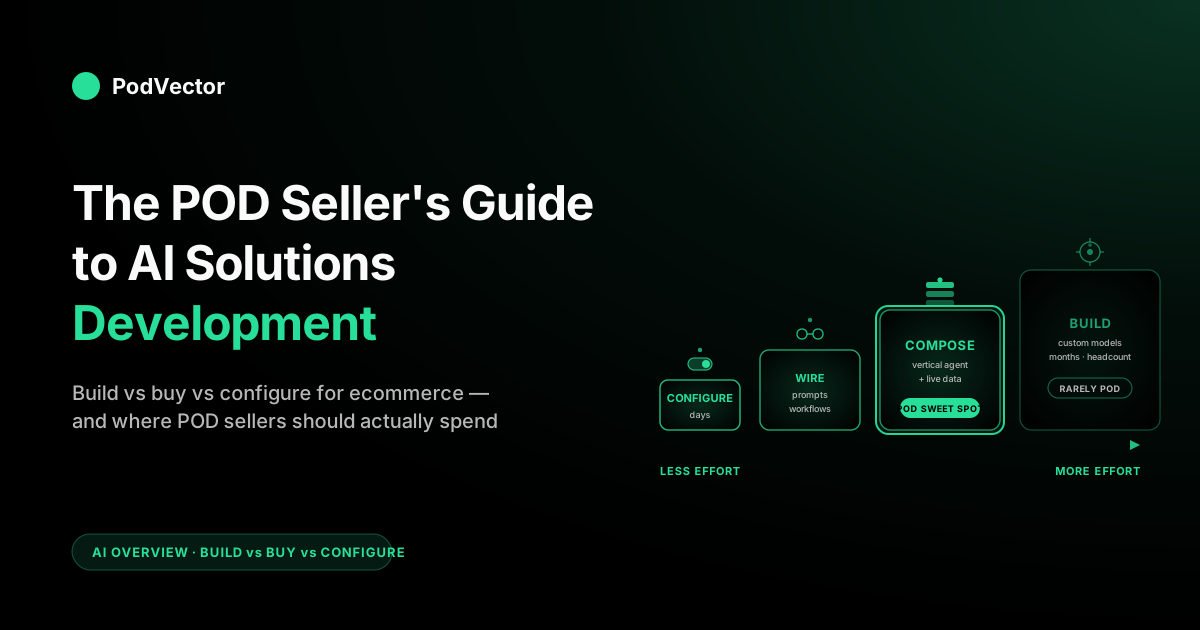
The development question isn't "should I build AI?" — it's "where on the spectrum from configure to build does this specific capability sit?" Most POD operators benefit from a clear-eyed read on each of the major capability areas.
Configure (no code, days of work)
Shopify Magic for descriptions and image edits. Sidekick for storefront Q&A.
Inbox for customer service. Klaviyo's AI segmentation.
Meta Advantage+ creative variants. Google Performance Max.
These ship on by default or behind a toggle. Your "development" work is reviewing outputs, setting brand-voice guardrails, and deciding which features to leave on. The POD seller's guide to Shopify Magic AI features covers the configuration moves specifically.
Configure-plus (light prompt and template work, a week of work)
Brand-voice prompt templates for AI description generation. ChatGPT or Claude prompt libraries for product naming, ad copy variants, email subject lines.
A standardized prompt for the support team to triage tickets. Output validators to catch hallucinations on launch announcements. Most of this lives in a shared doc, not a codebase. The POD seller's guide to ChatGPT prompts for Shopify covers the prompt-template patterns directly.
Wire (workflow glue, a few weeks of work)
n8n, Zapier, or Make flows that chain vendor AI together: a webhook fires when a Printify order ships → an AI step drafts a delivery email → it goes out via Klaviyo. Or a daily cron that pulls supplier invoices, summarizes anomalies via an LLM, and posts to Slack.
Some technical literacy required, no full-stack engineering. This is where most POD AI gains live in 2026.
Compose (vendor agent + your data, weeks to months of work)
Connect a ready-made AI employee to your data: Victor already reads your Shopify, Printify, Printful, Meta, and Google numbers for you, all the time. He does the hard work — keeping your data current and turning it into answers you can act on — so you don't have to build or connect anything yourself. The POD seller's guide to AI solutions for ecommerce covers the broader category of vertical AI solutions.
Build (custom engineering, months of work)
Train your own embedding model on your design library. Build a recommendation engine from scratch against your event log.
Stand up a custom tenant-isolated SQL agent. Engineer a multi-agent orchestration framework for catalog management.
This is where "AI solutions development" originally lived. For 95% of POD operators it's the wrong answer in 2026 — there's a vendor or vertical agent that already covers the use case. For the other 5%, it can still make sense at scale, with engineering team and a defensible IP thesis.
Where the standard ecommerce AI solutions land for POD
Almost every "AI solutions development for ecommerce" page lists the same catalog of capabilities — product recommendations, chatbots and virtual assistants, visual and voice search, dynamic pricing, demand forecasting and inventory automation, returns and fraud handling. Agencies frame each as a "develop" project. For a POD operator, almost none of them are. Mapped onto the spectrum above:
- Recommendations and personalization — configure. Shopify's native recommendations and a handful of apps cover it; a custom engine rarely beats them at POD order volumes. The POD seller's guide to AI personalization for ecommerce covers the configuration moves.
- Chatbots and customer service — configure plus light wiring. Shopify Inbox and Sidekick plus an LLM triage step (solution #3 below) is the POD-right version, not a from-scratch bot.
- Visual and voice search — buy if at all. High build cost, low payoff for most POD stores; revisit only if discovery is a measured bottleneck.
- Dynamic pricing — skip or configure carefully. POD margins are thin and supplier-cost-driven; dynamic pricing run on a typed (wrong) COGS number loses money faster than it makes it.
- Demand forecasting and inventory — mostly not applicable. POD is made-to-order, so the classic inventory-AI use case largely disappears; the real analog is design-demand signal, which a vertical agent surfaces from sales data.
- Returns and fraud — configure. Platform and payment-gateway tools already cover it; there's nothing POD-specific to build.
The one category that stays a genuine "develop" decision for POD is the contribution-margin data layer — the thing no generic ecommerce AI vendor builds, because no wholesale store needs it. That's the through-line of the rest of this guide.
Six AI solutions a POD operator can develop without engineering headcount
The realistic build list for a one-to-three-person POD operation. None of these require model training. All of them are deployable in days to weeks and pay for themselves in operating-time savings or revenue lift.
1. A brand-voice prompt template library
A versioned doc of prompt templates for descriptions, ad copy, email subject lines, social captions, and listing titles. Each template enforces brand voice (tone, sentence length, vocabulary boundaries, perspective) and includes a few high-quality example outputs the LLM can pattern-match against.
Pay-off: every batch of AI-generated content comes out closer to your brand, and onboarding a virtual assistant means handing them the doc, not hand-holding the prompts. See the POD seller's guide to AI writing for ecommerce for the patterns that work.
2. A nightly anomaly digest
An n8n or Zapier flow that runs at 6am: pulls yesterday's Shopify orders, supplier invoices, and ad spend; calls an LLM with a "summarize anomalies" prompt against a baseline; posts to Slack or email. Catches the obvious failure modes — an ad campaign that 3x'd in spend without 3x'ing in revenue, a supplier price change buried in a quarterly notice, a return spike on a single SKU. Five hours to wire up; saves a week per quarter of dashboard-staring.
3. A customer-service triage agent
An LLM-powered first-pass on incoming Shopify or Helpscout tickets that classifies (refund, sizing, shipping, design issue), drafts a response, and routes to the right queue. You still review every response before send. The savings are in the classification and drafting steps, which collectively eat 30% of support time on a busy POD store. The POD seller's guide to conversational AI for ecommerce covers the implementation patterns.
4. A design-launch checklist automation
Every new design launch hits a small flow: AI generates lifestyle mockups, AI drafts a description from a brand-voice template, AI fills attributes, the listing goes live, an AI-summarized "launch report" lands in Slack. The flow exists once and runs every time. Saves the cognitive overhead of "did I remember to fill in the audience tag" on every launch.
5. A weekly profit-by-design report
This is the highest-ROI item on the list and the one most often skipped. A scheduled query that joins Shopify orders to Printify and Printful itemized cost lines and Meta and Google ad spend, computes contribution margin per design, and surfaces the top and bottom 20.
If you don't have a tool that already tracks this for you (Victor does), you can still build it yourself in a Google Sheet with the right webhook. Without it, every other AI optimization runs on wrong margin numbers.
6. A weekly brand-voice audit
An LLM batch job that re-reads a sample of last week's AI-generated content and grades it against a brand-voice rubric. Catches the slow drift that always happens when no one's auditing AI outputs. Costs a few cents per audit run; saves you from waking up in week six to a thousand near-identical descriptions Google has decided to deduplicate.
Notice what's not on this list: training a custom recommendation model, building a custom chatbot from scratch, fine-tuning an LLM on your design library, engineering a multi-agent catalog-management system. Those are real projects with real value at scale, but they're not the right early bets for a POD operator. The POD seller's guide to AI automation for ecommerce covers the broader automation category if those use cases become relevant later.
The data foundation that decides whether any of it works
Every AI solution above shares one prerequisite: the underlying data has to be clean, joined, and reachable by an LLM or workflow. Most POD AI projects fail not at the AI step but at the data step. The pattern is consistent enough to call out as its own section.
The four data sources you need joined
- Shopify orders, products, variants, customers. The customer-facing source of truth.
- Printify and Printful itemized cost lines. Per-order, per-line fulfillment costs — the thing typed-COGS analytics gets wrong.
- Meta and Google ad spend, attributed to product or campaign. The acquisition-cost side of contribution margin.
- Email and customer-service event data. Klaviyo opens and clicks, ticket resolution times — the engagement signal that informs retention and segmentation work.
Joining these in a way that an LLM or workflow can query against is the gate. If you can't get an answer to "what's the contribution margin on design X in April after Printify costs and Meta spend" without spending an hour in spreadsheets, no amount of AI tooling on top will save you.
The cleanest path is a managed warehouse (Snowflake) with vendor-supplied connectors loading each source on a schedule. The cheapest path is a Google Sheet with webhooks; it works up to a point and falls over around 50K orders.
Why this is the section vendors gloss over
"AI solutions development" articles love to talk about model selection, prompt engineering, and vendor comparisons. They rarely talk about data plumbing because it isn't sexy. But the actual ROI distribution among POD AI projects splits cleanly along data-readiness lines: stores with their data joined ship AI capabilities in days; stores without spend the entire project budget on the data step and never reach the AI step. The complete guide to AI agents for ecommerce analytics goes deeper on the analytics-data-foundation side specifically.
What Victor solves for you
Victor already connects to Shopify, Printify, Printful, Meta, and Google for you. He keeps all of it up to date and ready to use, so you never have to set up a connection, fix a spreadsheet, or manage anything behind the scenes.
You ask Victor plain questions, like "which designs were profitable in April after fulfillment and ads," and he looks at your real numbers to answer. All the setup work that would normally sit in front of you — getting your data ready, writing the right questions, keeping things safe — is already done for you when you sign up. For a comparison of POD-aware analytics options, see the best AI tools for ecommerce data analysis comparison.
Where the DIY path breaks down for POD specifically
The "build it yourself with Claude and a Google Sheet" path is genuinely viable for a surprising number of AI use cases. It also has predictable failure modes when applied to POD. Knowing them in advance saves a quarter of dead-end work.
Itemized supplier cost ingestion
The Printify and Printful APIs return per-order line items, but the schema is irregular and the rate limits make naive polling impossible. A DIY ingestion that pulls "today's orders" every hour will work for a month and fall over the first time you have a 10K-order day.
This is the most common spot where home-grown POD AI dies. Either pay a connector vendor or use a tool that has the connectors built in.
Design-level aggregation across variants
A POD seller decides at the design level (scale this design, kill this design) but Shopify and the suppliers report at the SKU level. Building a clean design-to-SKU mapping that survives the next variant launch is harder than it sounds.
Tag-based mappings break; metafield-based mappings work but require discipline. Off-the-shelf analytics tools that don't model design as a first-class entity will report at the SKU level and force you to aggregate manually.
Ad spend reconciliation back to the design
Meta and Google attribute at the campaign or ad set level. Mapping spend back to the design that drove the order requires a UTM convention you actually enforce, plus a join from order to campaign to design that handles attribution windows.
Doable, but the most labor-intensive piece of the data layer. Most home-grown projects skip this and report ROAS instead of contribution margin — and ROAS lies on POD economics often enough to make the AI optimization worse, not better.
Schema drift
The way Shopify stores your data changes a few times a year. Printify and Printful change theirs even more often. A system you build yourself to pull in that data can work fine in February and break by May. Keeping a home-built system like this running costs real time and money every quarter, more than solo store owners usually expect.
The "agent that takes actions" jump
Building an AI agent that just answers questions is a Saturday project. Building one that takes bounded actions — pausing an ad set when contribution margin drops, re-routing a SKU between Printify and Printful based on shipping geography — is a different category of work.
It needs allow-listed actions, audit logging, rollback paths, and operator approvals. Most POD operators don't have the engineering background to ship that safely. Agentic AI for ecommerce: what it looks like for POD sellers covers what bounded-action agents actually look like in practice.
A 90-day rollout playbook for POD AI solutions
The realistic sequence for a one-to-three-person POD operation that wants to develop AI capability without burning a quarter on a dead-end project.
Days 1-14: Configure first, measure baseline
Turn on every relevant vendor AI feature: Shopify Magic, Sidekick, Inbox, Klaviyo's AI, Meta Advantage+, Google PMax. Document what each one is doing.
Pull a baseline of revenue, AOV, conversion rate, ad spend, support response time. The work in this phase is mostly clicking toggles and reading documentation, not engineering. Most POD operators get more lift from this two-week phase than from any custom development that follows.
Days 15-30: Prompt-template library
Write the brand-voice prompts for descriptions, ad copy, email subject lines, social captions. Document the templates. Train any virtual assistants on them. Audit the first batch of outputs against the templates manually. The investment is a week of focused work; the payoff is every downstream AI batch comes out 30% better than it would have without templates.
Days 31-60: Connect your data and add an AI helper to analyze it
Connect Shopify, Printify, Printful, Meta, and Google to a managed warehouse, or onboard to a vertical agent (Victor) that handles the connectors. This is the highest-leverage technical work in the rollout — it's what unlocks contribution-margin reporting, design-level aggregation, and any AI optimization that follows. Don't skip to AI optimization before this is in place; you'll be optimizing against wrong numbers.
Days 61-75: Workflow glue
Build the n8n or Zapier flows: nightly anomaly digest, customer-service triage, design-launch checklist automation. Each individual flow is a few hours; the cumulative effect is a meaningful reclamation of operating time. Don't try to wire all of them at once — ship one, validate it for a week, then ship the next.
Days 76-90: Audit and iteration
The AI solutions you've shipped are now generating outputs in production. The work in the final phase is auditing them: brand-voice drift, hallucination rates, attribution accuracy, classification precision.
Define the rubrics, sample the outputs, write the corrections. The teams that do this consistently get long-term lift; the teams that ship and walk away find their AI tools quietly degrading by month four.
Notable absence from this playbook: any phase labeled "build a custom model." For most POD operators, the 90 days above gets them to most of the available value without ever hitting that step. How to use AI for ecommerce step by step covers the broader implementation arc if you want a longer timeline view.
Mistakes that sink POD AI development projects
Treating it as an engineering project instead of a product project
The temptation is to staff this like a traditional software project: scope, design, engineer, deploy. AI solutions development in 2026 is closer to product work — small experiments, fast iteration, ship-and-measure cycles. Teams that wireframe AI capabilities for two months and ship none of them lose to teams that ship a flawed version of three capabilities in two weeks and iterate.
Building before your data is ready
The most common pattern: a store owner gets excited about an idea, sets up a workflow, runs it for a week, and discovers the numbers are wrong because the underlying data wasn't connected correctly. Fix the data first. Build on top second. Doing it in the wrong order is the single most common reason POD AI projects break.
Custom-building what a vertical agent already covers
The "I'll build my own AI tool to analyze my own store data" project is real engineering work — months writing code to keep each store's data separate and safe, teach the tool how your store is set up, limit what it's allowed to do, and guard against bad AI answers. By the time you've shipped version one, a tool built just for POD sellers, like Victor, has already shipped version three with features you haven't thought of. Reach for the ready-made tool first; save custom-building for things nobody else covers.
Skipping the audit step
AI outputs degrade silently. Without a weekly or monthly sampled audit, the tools you shipped in month one are quietly producing worse outputs by month four. Build the audit step into the rollout from day one — five minutes a week is the difference between AI as productivity multiplier and AI as quietly corroding output quality.
Ignoring the action layer's safety needs
The minute an AI agent moves from answering questions to taking actions on your store (pausing an ad, re-routing a supplier, archiving a listing), the safety bar jumps up. Allow-listed actions, audit logs, rollback paths, operator approvals — none of this is optional. Operators that wire up an agent with broad write access "just to see what it can do" are one prompt-injection away from a bad day.
Underestimating maintenance
Home-grown AI workflows have ongoing upkeep costs that solo store owners routinely underestimate. Things like Shopify or your suppliers changing how their data is set up, prompts that stop working well, AI models getting retired, and the apps you connect to changing without warning.
Budget 20% of initial build cost per quarter for keeping it running. If that math doesn't work, lean harder on managed tools where the vendor absorbs the maintenance burden. Shopify's overview of AI in ecommerce covers the broader vendor landscape.
FAQs
Should a POD seller develop their own AI solutions or buy off the shelf?
For 95% of POD operators, the answer is configure plus light development on top of vendor AI, not custom-build. The exceptions: stores at $5M+ revenue with engineering capacity and a defensible IP thesis, or operators with technical co-founders who treat AI engineering as the core competency. For everyone else, vendor configuration plus prompt templates plus n8n-style workflow glue plus a vertical AI agent like Victor covers most of the value at a fraction of the cost.
Do I need to learn machine learning to do AI solutions development for ecommerce?
No. Most of the work in 2026 is about setting up tools, not building AI models from scratch: turning on vendor features, writing prompts, connecting workflows, and checking that the results make sense. Knowing machine learning helps if you're building something custom, but most useful AI work for POD doesn't need it. Being comfortable with spreadsheets, apps, and automatic data updates is enough.
What's the cheapest viable AI development setup for a POD store?
Shopify Magic and Sidekick (free with Shopify plan), a ChatGPT Team or Claude subscription for prompt work ($20-30/month), an n8n or Zapier subscription for workflow glue ($20-50/month), and a vertical AI agent for analytics ($50-200/month). Total: roughly $100-300 per month, no engineering headcount. That setup covers most of the value most POD stores can extract from AI today.
What about custom AI agents — when does that make sense?
When you've exhausted what vertical agents and configuration cover, and you have engineering capacity. The honest answer for most POD operators in 2026: rarely. A purpose-built POD agent already handles itemized supplier costs, design-level aggregation, and ad-spend reconciliation. The remaining custom-build territory is narrow and getting narrower as vertical tools mature.
How do I know if my AI development project is succeeding?
Two metrics. First: operating-time saved per week (description writing, customer service triage, anomaly detection). Second: revenue lift attributable to AI-driven decisions (which designs to scale, which to kill, which campaigns to pause). Industry-wide, custom ecommerce AI builds tend to show first results in 3-6 months and full ROI in 12-18 months — but that curve assumes you're building. The POD configure-first path compresses it hard: vendor features and prompt templates pay off in the first two weeks, and Victor — seeing all your orders, costs, and ad spend together — pays off inside the first month. If neither metric moves after 60 days, the project isn't working — most often because your numbers are wrong, not because the AI is bad.
What should I avoid building first?
A custom recommendation model, a custom chatbot from scratch, a custom multi-agent orchestration system. These are tempting because they sound technically interesting, but they're the highest-cost, lowest-immediate-ROI items on the list. Start with prompt templates, workflow glue, and a vertical analytics agent. Add custom engineering if and when you've outgrown the vendor layer.
How does AI solutions development for ecommerce differ for POD specifically?
The data shape is the difference. Wholesale ecommerce assumes typed COGS and single-warehouse fulfillment; POD has itemized per-order costs across two suppliers, design-as-SKU sprawl, and ad spend that needs design-level attribution.
Generic ecommerce AI tools modeled on wholesale assumptions produce wrong margin numbers when applied to POD. Either choose tools built for the POD data shape or be ready to do the data plumbing yourself before any AI optimization can run on accurate inputs.
Is "AI solutions development" the same as "AI agent development"?
Overlapping but not identical. "AI solutions development" is the broader category — anything from configuring Shopify Magic to building a custom recommendation model. "AI agent development" is the narrower category of building autonomous or semi-autonomous agents that can take actions. The agent layer is the most engineering-heavy slice of solutions development; for POD operators, vertical agents (Victor) cover most of the agent territory without the engineering. The POD seller's guide to AI assistants for ecommerce covers the agent and assistant category specifically.
Where is AI solutions development for ecommerce heading in 2027?
Toward more configuration, less code. The vendor layer keeps absorbing capabilities that used to require custom builds — Shopify, Klaviyo, Meta, and Google all keep shipping AI features inside their platforms.
The remaining development surface is shrinking to workflow glue, vertical agents, and the long-tail use cases nobody else has covered. For POD specifically, the trend is toward agentic tools that take bounded actions on the catalog, ad accounts, and supplier routing. BigCommerce's overview of ecommerce AI covers the generic trajectory; the POD-specific implementation is what this guide is for.
Skip the build. Get the agent that already understands POD.
Victor is an AI employee built just for print-on-demand sellers. He knows your real Printify and Printful costs, works out true profit for each design, and matches your ad spend to the orders it brought in. No custom engineering, no typed-in cost guesses, no borrowed tools made for other kinds of stores. Ask him plain questions and get real numbers back.
Try Victor free