
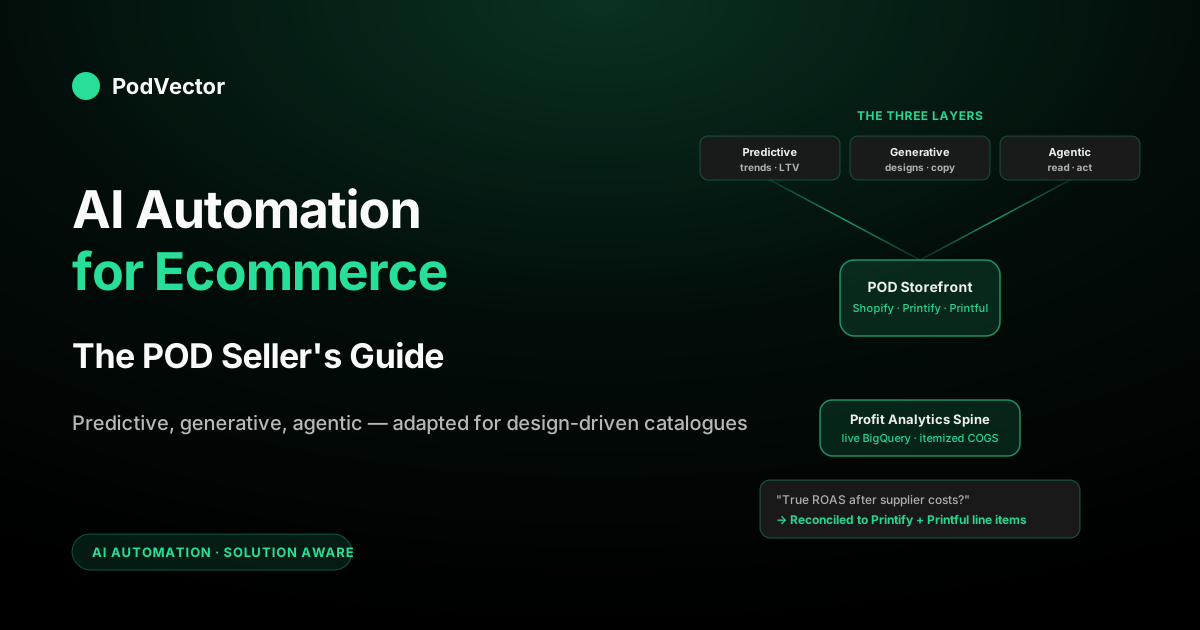
Quick Answer: AI automation for ecommerce in 2026 is a stack of three layers — predictive AI that forecasts demand and pricing, generative AI that produces creative and copy, and agentic AI that reads live data and takes action. For Print on Demand sellers, the generic playbook breaks: there's no inventory to forecast, no fulfillment to route, and design-as-SKU economics turn classic automation use cases into noise. This guide covers the seven automation surfaces that actually move POD margin, the three-layer framework adapted for design-driven catalogues, and a 30-day rollout sequence that doesn't waste budget on tools built for inventoried DTC brands.
What "AI automation for ecommerce" means in 2026
"AI automation for ecommerce" is the bundle of AI systems that take ecommerce work that used to need a human and runs it without one — or with a human only for the judgment calls. In 2026, the term covers everything from a Klaviyo email flow that segments buyers automatically, to an AI agent that pauses an unprofitable Meta campaign at 2 a.m. without waiting for the operator to wake up. The phrase has gotten broad enough to be useful and vague enough to be misleading.
The market context: the AI-in-ecommerce market reached roughly $8.65B globally in 2025, up from $7.25B in 2024, with 89% of retailers either deploying AI or running structured trials. The general guides — BigCommerce's automation overview and DigitalApplied's 2026 tools guide — frame the opportunity around inventory forecasting, dynamic pricing, fulfillment routing, and customer support.
That framing is right for inventoried DTC brands. For Print on Demand it's mostly wrong, because three of those four use cases don't apply to a zero-inventory operation. We've covered the broader landscape across our AI overview cluster hub and the AI analytics topic hub; this guide narrows in on what "automation" specifically means when the operation is POD.
The three-layer model: predictive, generative, agentic
The most useful frame for AI automation in ecommerce — and the one most major platforms are converging on — is a three-layer model. Predictive AI looks at historical data and tells you what's likely.
Generative AI produces new content from a prompt. Agentic AI reads live data and takes action against goals you've set. Most ecommerce automation in 2026 is some combination of all three, but understanding which layer a tool sits in tells you what it's actually doing and where it's likely to fail.
Predictive AI
Forecasting demand, predicting which campaigns will pay off, scoring leads, estimating churn risk. The math is statistical with a deep-learning veneer; the value is in the input data.
Predictive AI on bad data produces confident wrong answers, which is worse than no AI at all because operators trust the output. For POD, the high-leverage predictive use cases are trend forecasting (which design themes are about to spike), LTV prediction at the design-family level, and ad-spend ROAS prediction net of supplier costs. The low-leverage ones — inventory demand forecasting, multi-warehouse stock routing — are the headlines of every general guide and irrelevant to POD operations.
Generative AI
Creating ad copy, product descriptions, design variants, mockups, email subject lines, support replies. Speed is the unlock; brand voice is the failure mode.
Generative AI that produces generic SEO-shaped sludge for a niche POD store erodes the niche affinity that's the whole point of running the store. The discipline is using AI to scale the brand voice, not to replace it. Our guide to generative AI for ecommerce goes deeper on the POD-specific tradeoffs.
Agentic AI
Reading live data and taking action — pausing a campaign, drafting a reply, kicking off a supplier-routing rule, raising a price during a viral moment, restocking a sold-out variant. The newest layer and the one most rapidly evolving.
The distinction every vendor now leads with: older automation follows pre-programmed rules and breaks the moment a situation falls outside the script, while an agent reads its environment, adapts, and handles multi-step tasks without a human stepping in. That's the line between a Klaviyo flow that fires on a fixed trigger and an agent that decides which campaign to pause. In 2026, most "agentic" AI ecommerce tools are actually answers-tier (you ask, it answers from your data) on the way to true actions-tier (it acts on its own within guardrails). The trajectory matters more than today's exact capability, because every serious ecommerce AI vendor is shipping toward actions and the brands that wire up answers-tier first end up with the right data foundation. Our agentic AI for ecommerce guide walks through the curve.
Why POD breaks the generic AI automation playbook
Most ecommerce AI automation guides assume an inventoried operation: a few hundred SKUs you bought in advance, fixed COGS, predictable per-unit margin, warehouses to route from, and a fulfillment cost you can pin down at the unit level. Print on Demand changes the inputs enough that the same playbook produces wrong answers, not just suboptimal ones.
No inventory to forecast
The headline use case in every general guide — AI inventory forecasting and demand planning — does not exist for POD. You don't hold stock.
You don't reorder. You don't allocate across warehouses.
Tools sold on this use case are pricing in value you cannot capture, and dashboards that lead with "stock-out risk" are showing you a metric that's structurally always zero. The equivalent POD problem isn't "do I have enough inventory" — it's "which designs are about to trend, and can I launch them faster than competitors."
No fulfillment to route
The second headline use case — multi-warehouse fulfillment routing — also does not apply. Printify and Printful route orders to providers based on rules you set once or based on their own routing logic.
The "AI fulfillment optimization" pitch that headlines BigCommerce and digitalapplied is not a POD product; it's a 3PL product. POD has a related but different problem — picking the right Printify or Printful provider for each product variant based on per-order cost and shipping speed — and we've covered that decision in our complete guide to AI analytics for print-on-demand.
Per-order variable cost, not per-SKU fixed cost
An inventoried brand sets COGS once. A POD seller's cost varies by product type, print method, supplier, and shipping destination — the same hoodie costs different amounts depending on which provider fulfills it and where it ships.
Generic AI automation dashboards default to a fixed-COGS column, so the ROAS, margin, and "profitable campaign" labels they generate are approximate at best and wrong at worst. AI automation built on the wrong margin number automates against the wrong target.
Design-as-SKU catalogue scale
An inventoried brand might run 200 SKUs. A POD brand can run 10,000 designs across 30 product types — that's 300,000 effective SKUs from an attribution and personalization standpoint.
Generic personalization engines that segment on "previous purchase" hit a long-tail wall fast. The automation that works for POD has to segment on design family, niche aesthetic, and visual style — a layer that off-the-shelf engines weren't built for.
Tighter margins that punish small mistakes
Inventoried DTC brands often run 50–70% gross margins. POD typically runs 20–35%.
A 4% pricing or attribution error an inventoried brand can absorb turns a profitable POD design unprofitable. AI automation for POD has to be precise about the small numbers, because the small numbers are most of what's left after supplier costs, payment fees, and ad spend.
7 AI automation surfaces that actually move POD numbers
Generic guides list 12–14 automation use cases assuming inventoried economics. These seven are the ones where POD operators consistently see margin gains, time savings, or both.
1. Profit reconciliation across Shopify, Printify/Printful, Stripe, and ad accounts
The single highest-leverage automation for POD. Most stores reconcile margin manually at month-end (or never), pulling Stripe payouts, supplier invoices, and ad spend into a spreadsheet that's wrong by the time it's done.
AI automation that reads all four sources continuously, attributes itemized supplier costs to specific orders, subtracts payment fees, and shows live ROAS-after-COGS by campaign and design — that's the foundation everything else sits on. Operators who skip this and adopt creative or email automation first end up running beautiful campaigns against fictional margin.
2. AI design generation tied to niche signals
POD's defining advantage is launch speed. AI image generation (Midjourney, Adobe Firefly, Ideogram, Canva Magic) compresses the design pipeline from days to minutes — but the bottleneck has shifted from production to selection.
Brands that pair AI design generation with niche-trend signal scraping (TikTok hashtags, Reddit subreddit growth, Etsy search volume) launch designs while competitors are still researching. The automation isn't the image generator; it's the loop that pipes trend signals into prompts and surfaces the highest-probability designs to test.
3. Listing and mockup automation across product types and providers
One design fans out across 30+ product types and dozens of color/size variants. Manually writing descriptions, generating mockups, and setting variant pricing is the most operator-time-expensive task in POD.
AI automation that takes a single design plus a niche keyword set and generates mockups for every product type, writes variant descriptions in a brand voice you've trained, and reconciles per-variant supplier cost into the price field — that's a multi-hour-per-design job compressed into minutes. We cover the listing side in detail in our guide to AI for ecommerce content creation.
4. Ad creative iteration tied to live performance
POD ad creative has a unique pattern: the design is the creative, and the framing — hook, audience, copy angle — is what varies. AI that generates 8–12 variant hooks for a single design, ships them to Meta or TikTok, watches CTR and ROAS net of supplier costs, then kills the bottom variants automatically — that's the test cycle compressed from weeks to days.
The brands running this discipline well win their niche; the brands ignoring it leak ad spend on stale creative for months. Our AI for ecommerce marketing guide goes deeper on the creative loop.
5. Customer support automation tuned for POD-specific issues
POD support tickets are different from inventoried DTC support tickets. The most common ticket isn't "where's my order" generically — it's "where's my order, my supplier shows it shipped but tracking says nothing, can you check?" — a question that requires reading supplier-side data, not just the Shopify side.
AI chatbots trained on generic ecommerce intents miss this. The ones that pull in your supplier data alongside your Shopify orders can answer POD-specific questions without passing them to a human. We compare the options in Best AI Chatbot for Ecommerce.
6. Email and SMS lifecycle flows segmented by design preference
Generic email tools segment on purchase history and category. POD buyers don't fit cleanly — they buy a graphic tee once, disappear for nine months, then come back for a different design in the same niche.
AI email automation that segments on design family, niche aesthetic, and visual preference (not just SKU history) lifts open rates and conversion meaningfully. Klaviyo, Postscript, and Omnisend can be coaxed into this segmentation; the automation is in the data piping that keeps design-preference signals flowing into the segments.
7. Generative-search visibility automation
When a buyer asks ChatGPT, Perplexity, or Google AI Mode "what's a good vintage motocross t-shirt brand," your store either shows up in the answer or it doesn't. AI automation that tests prompts weekly, tracks which brands get cited, and flags content gaps where your store is missing — that's a discoverability monitor for the channel that's eating Google. The acquisition cost for traffic from generative search in 2026 is structurally low, and brands optimizing now are buying market position the brands waiting will repurchase at premium CPCs in 2027.
A minimum AI automation stack for a POD operation
Most generic guides recommend a sprawling stack — twelve to twenty tools across forecasting, fulfillment, pricing, content, ads, email, analytics, support, and search. For a POD brand under $5M ARR, the realistic stack is small and tightly integrated. The platform-fragmentation problem is real: 89% of retailers are deploying AI, and the biggest drag on ROI in 2026 is having too many disconnected tools, not too few.
- One profit analytics layer that reads supplier invoices. The spine. This is where Victor sits, and where most POD AI automation conversations should start. Without this, every other automation is downstream of approximate numbers.
- One AI design + mockup pipeline. Midjourney or Firefly for generation, Placeit or Printify's mockup generator for product visualization, a prompt library you maintain.
- One AI ad creative + copy assistant. Foreplay, Pencil, AdCreative.ai, or in-house workflows on top of GPT-5 or Claude. The vendor market is unstable; most POD brands rotate annually.
- One email/SMS platform with AI segmentation. Klaviyo, Postscript, or Omnisend with segmentation set up around design family, not SKU history.
- One AI support layer. Gorgias, Tidio, or Fin — connected to your supplier API, not just Shopify, so it can answer the POD-typical "where's my order" tickets correctly.
- One trend signal source + one quarterly generative-search audit. Either a paid tool (Trendalytics, Spate) or a homegrown scraper, plus a manual or tool-assisted (Profound, Goodie) quarterly check on AI search visibility.
Six components, one of which (profit analytics) does most of the load-bearing work. Brands that try to bolt on twelve tools end up with a fragmented stack and worse decisions, not better ones — exactly the consolidation pattern the broader market is now moving toward. Our complete guide to AI tools for POD sellers walks through the vendor selection in more detail.
Where Victor fits in the automation stack
Victor — PodVector AI's AI employee — sits in the analytics layer, which is the layer most POD brands skip when they shop for AI automation. The visible automations get most of the attention because they produce visible artifacts: an ad creative, a chatbot reply, a generated design. The analytics layer is invisible until your other automations start running against the wrong margin numbers.
What Victor does in a POD automation context: he looks at your live Shopify, Printify or Printful, and ad account data together, so he can answer profit questions in plain English. Examples operators ask weekly:
- "Which campaigns lost money last week after itemized supplier costs and payment fees?"
- "What's my true margin on the top 20 designs by revenue this month?"
- "Which Printify providers cost the most per fulfilled order on my hoodie line?"
- "What's the ROAS-after-COGS on Pinterest spend this quarter, by design family?"
Today Victor sits in the answers tier of the agentic curve — you ask, Victor reads the warehouse, Victor answers. The roadmap is the actions tier: pausing the unprofitable campaign, switching the supplier rule, drafting the description, raising the price on a viral SKU.
The "answers today, acts tomorrow" trajectory is where serious agentic-commerce products are converging — applied specifically to POD economics that generic ecommerce AI tools weren't designed for. The reason to wire up the answers tier first is that the data foundation it builds is the same foundation the actions tier needs.
A 30-day AI automation rollout for POD sellers
If you're starting from "I should do something with AI automation" and don't know where to begin, this is the sequence that consistently works for POD brands under $1M ARR.
Week 1 — Fix the data foundation
Before adopting any AI automation tool, make sure your numbers are right. Itemized supplier costs need to flow into one place.
Ad spend needs to reconcile to actual orders, not platform-reported attribution. Payment fees and refunds need to be subtracted from revenue.
If you skip this and adopt AI automation on top of approximate data, the AI just makes the wrong decisions faster. Most brands want to skip this step; the brands that don't pull ahead within a quarter.
Week 2 — Add the analytics layer
Once the data is right, layer an AI employee on top so you can ask profit questions in plain English instead of building dashboards. This is where margin gains start showing up — not because the AI made a clever recommendation, but because you can finally see which campaigns and designs actually pay for themselves. Most operators find 2–4 unprofitable campaigns to kill in the first week of having this visibility.
Week 3 — Pick one operational automation and ship it
Choose between AI ad creative iteration, AI listing/mockup automation, or an AI support layer. Don't do all three. Whichever you pick, set a clear measurement: did this lift CTR, conversion, or save measurable operator hours over 30 days? If yes, expand. If no, kill it and pick a different one in month two.
Week 4 — Run a generative-search audit and trend-signal loop
Test 20–40 prompts in ChatGPT, Perplexity, and Google AI Mode that a buyer in your niche would plausibly ask. Note which competitors get cited. In parallel, set up a weekly trend-signal report from TikTok, Reddit, and Etsy for your niche keywords. Both are cheap to start; both are durable advantages once running.
Common mistakes POD brands make with AI automation
Buying inventory-forecasting or fulfillment-routing tools that don't apply to POD
Many "AI ecommerce automation" tools lead with use cases — multi-warehouse stock allocation, demand forecasting, fulfillment routing — that are structurally irrelevant to a zero-inventory operation. Brands that buy these on the assumption "ecommerce AI = AI for our store" pay for value they cannot capture. Read the use cases before signing anything.
Adopting creative or support automation before fixing analytics
The creative tool is the visible part. The analytics layer is the load-bearing part. Brands that adopt creative or support automation first end up generating beautiful ads and friendly support replies for unprofitable campaigns. Reverse the order.
Trusting platform-reported ROAS without subtracting itemized supplier costs
Meta, Google, and TikTok show ROAS based on attributed revenue. That's not your real margin. POD operators routinely find that 15–25% of what their ad platform calls "profitable" is actually break-even or worse once supplier costs and payment fees are included. AI automation that scales spend against platform-reported ROAS scales loss.
Generic AI copy and design that erodes niche identity
POD brands win on niche affinity. AI-generated product copy and design output that reads like every other Etsy listing breaks that affinity for everyone who knows what your store is supposed to feel like.
If you use AI for content, train it on your existing voice and edit ruthlessly. Generic content at scale is worse than less content with personality.
Personalization tuned for inventoried brands
Off-the-shelf personalization engines segment on past purchases and category preference. POD buyers fit those signals badly. Tune your segmentation on design family, niche aesthetic, and visual style — and accept that the engines that work best for POD often need configuration the engines don't ship with by default.
Adding tools instead of integrating data
Six AI automation tools that don't talk to each other are worse than one tool that reads your whole stack. Platform fragmentation is the biggest drag on AI ROI in 2026 across ecommerce — the right question isn't "what new AI automation tool should I add?" but "what's my data foundation, and what reads from it?"
Ignoring generative search
Some POD brands wave off ChatGPT shopping and AI Overviews as too early. The brands waving it off in 2026 will be the brands buying the same traffic at premium CPCs in 2027. Cheap-acquisition windows close.
FAQs
What's the difference between AI automation and AI tools for ecommerce?
AI tools is the broader category — anything where AI plays a role in your store, from a chatbot to a copy generator to a forecasting engine. AI automation is the subset that specifically removes operator work, either by running on a schedule or by reading live data and acting on it. A copy generator that produces text on demand is an AI tool; a flow that generates 10 ad variants every Monday and ships the best 3 to your account automatically is AI automation.
What's the highest-leverage AI automation for a POD brand under $500K ARR?
Profit reconciliation across Shopify, Printify or Printful, Stripe, and ad accounts. Without it, every other automation runs against the wrong margin number. The visible automations — ad creative, support, email — are higher in the stack and easier to add later. The analytics foundation is the precondition for all of them being right.
Can I use generic ecommerce AI automation tools for a POD store?
Mostly yes for the upper-stack tools (email, ad creative, support, copy), with caveats. The analytics, fulfillment, and inventory layers are where generic tools fall down for POD because they assume fixed COGS, multi-warehouse stock, and inventory ownership. Use generic tools where they work; build or buy POD-specific tools for the analytics layer and ignore the inventory/fulfillment categories entirely.
How much should a POD brand spend on AI automation?
For a POD brand under $1M ARR, 1–3% of revenue across the AI automation stack is reasonable, with the analytics layer as the biggest line item. Above $1M ARR the spend ratio usually drops to 0.5–1.5% as the stack stabilizes. Brands spending more than that without measurable margin or operator-time gains are usually compensating for a missing analytics foundation by buying more upper-stack tools.
Will agentic AI replace POD operators?
It shifts what humans do. The repeated decisions — pausing campaigns, drafting copy, segmenting audiences, generating creative variants, replying to "where's my order" tickets — become AI-handled.
The judgment calls — niche identity, brand voice, partnership decisions, big creative bets, picking which trends are real — stay with humans. POD brands that try to AI-out everything tend to lose niche identity and decline; brands that AI-out the repeated work free up humans for the judgment calls.
How do I know if an AI automation tool is actually working?
Two questions, both 60-day: did it produce a measurable margin or CAC gain you can point at, and did it free up operator time you can point at? If both answers are no, it's a sunk cost.
Cancel it. POD brands that treat their AI automation stack like an investment portfolio — pruning quarterly — end up with a sharper, smaller toolkit than brands that hoard everything they've ever subscribed to.
What's the difference between answers-tier and actions-tier agentic AI?
Answers-tier agents read your live data and answer questions — "what's my margin on Meta this week?" — but don't take action. Actions-tier agents do both: they read the data and execute a change against goals you've set, like pausing the campaign that's losing money or switching a supplier rule when costs spike.
Most "agentic" ecommerce AI in 2026 is answers-tier on the way to actions-tier. Wiring up the answers tier first builds the data foundation the actions tier needs.
Build POD automation on numbers that are actually right
Victor reads your live Shopify, Printify or Printful, and ad-account data and answers profit questions in plain English — true ROAS after itemized supplier costs, margin by design family, which campaigns and providers actually pay for themselves. The analytics layer most POD brands skip when they shop for AI automation, and the one your other automations depend on to make right decisions. And start with the spine of an AI-ready POD automation stack.
Try Victor free