
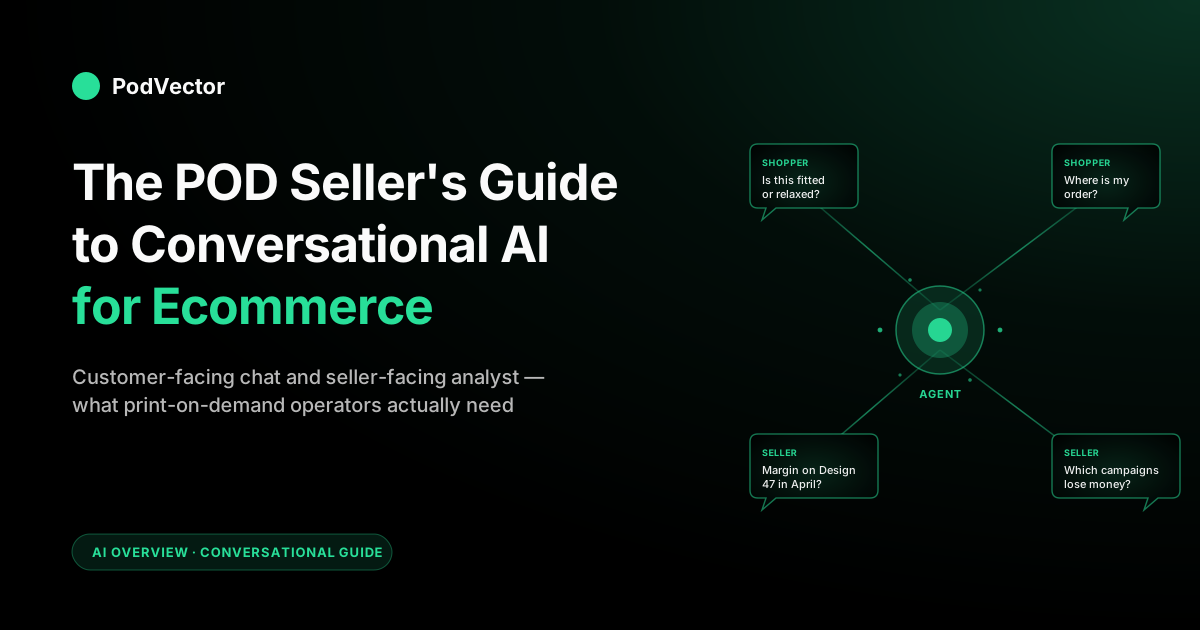
Quick Answer: Conversational AI for ecommerce is software that holds a natural-language conversation — over chat, voice, messaging apps, or a search bar — and resolves a task at the end of it, from answering a shipping question to closing a sale. For print-on-demand, it now splits into two surfaces that get talked about as if they were one thing. The customer-facing surface — chatbots, voice agents, conversational search, and omnichannel messaging — is what most ecommerce brands are deploying in 2026 to handle support, recover carts, and close sales.
The seller-facing surface — an AI employee you talk to about your own data — is the version that actually moves margin for print-on-demand operators, because it answers questions about per-order Printify and Printful costs, design-level profit, and ad attribution that no dashboard can hold. This guide walks through both, the POD-specific tradeoffs, and what to expect as conversational AI becomes agentic and starts taking actions, not just answering questions.
What conversational AI for ecommerce means in 2026
Conversational AI is software that holds a back-and-forth conversation in natural language and resolves a task at the end of it. In 2022, that meant a scripted chatbot with a button-tree fallback and a 30% containment rate on a good day. In 2026, it means a large language model wired into your store data, your supplier APIs, your help center, and increasingly your operational tooling — with the conversation happening over chat, voice, search bar, or even a CLI prompt to your own analytics.
The numbers tell the adoption story. By 2026, roughly 80% of online retailers are using AI chat or planning to deploy it, AI now handles a large share of routine ecommerce interactions, and shoppers who engage an AI chat are several times more likely to buy than those who don't. The economics are part of why: an AI interaction runs on the order of $0.50 versus roughly $6 for a human-handled one, so the question stopped being "can we afford it" and became "which interactions do we route to it." On the store owner side, asking an AI plain questions about your own sales numbers has gone from a research idea to something that actually works, because these tools have gotten good enough to pull the right numbers and give you a straight answer instead of guessing.
For POD specifically, the change matters in both directions. On the customer side, your storefront has the same conversational expectations as any other Shopify store. On the operator side, your data is uniquely complex — itemized supplier costs, multi-platform fulfillment, design-level SKUs, ad spend across networks — which is exactly the kind of data that benefits most from talking to it instead of clicking through dashboards.
How conversational AI is different from a 2022 chatbot
Four shifts moved the category:
- LLMs replaced decision trees. Older chatbots picked from a fixed list of intents. Modern conversational AI parses arbitrary natural language, holds context across turns, and reasons about edge cases the designer never anticipated.
- Tool use became routine. Today's agents don't just answer — they call APIs to look up an order, query a database, generate a return label, or pull a profit report. The conversation is a façade over real actions.
- Voice arrived in commerce. Not through smart speakers, but through voice in chat — speak the question, see the answer rendered visually, complete checkout the same way. The POD seller's guide to voice AI for ecommerce covers that surface in depth.
- The data caught up. Conversational AI is only as good as the numbers behind it. Now, tools can pull together your orders, costs and ad spend cleanly enough that you can ask a real question about your business and get a real answer.
Two surfaces, one category: customer-facing vs seller-facing
Most articles about conversational AI for ecommerce only cover one surface — the customer-facing one — because that's where most vendors play. The seller-facing surface is newer, smaller, and the more interesting half of the category for a POD operator. Knowing which surface a tool sits on is the single most useful filter when you're shopping the market.
The customer-facing surface
This is the surface shoppers see. Chat widgets in the corner of your storefront, voice interfaces inside mobile apps, conversational search bars that replace the keyword search experience, and post-purchase chat that handles tracking and returns.
The job is conversion, support deflection, and average-order-value lift. Tools in this surface are mostly designed for storefronts in general, not POD specifically — most of them have no idea what Printify is.
The seller-facing surface
This is the surface you, the operator, see. Chat with your analytics.
Ask "what was my margin on Design 47 last week after fulfillment and ads" and get an answer. Ask "which SKUs are losing money on Meta after Printify cost lines" and get a ranked list.
The job is decision support — replacing a dashboard you stare at with a conversation you have. Tools in this surface are far rarer, and the POD-native ones rarer still, because they require the system to understand per-order itemized supplier costs, not a flat COGS field.
Why this distinction matters
Most "conversational AI for ecommerce" buying guides treat the two surfaces as the same product. They're not.
A customer-facing chat agent and a seller-facing analytics agent have different data sources, different success metrics, different vendors, and very different ROI for a POD store. Conflating them leads sellers to deploy a $200/month support chatbot and miss the seller-side operator that would have unlocked an actual margin decision.
Customer-facing conversational AI for POD stores
For a working POD storefront, the customer-facing surface is table stakes. Shoppers expect instant answers, especially on shipping and sizing, and a chat agent that handles those questions deflects support load and lifts conversion at the same time. The use cases that earn their keep:
Sizing and product Q&A
POD apparel runs across dozens of garment types from multiple suppliers, each with its own size chart. A conversational agent that can answer "is this Bella+Canvas 3001 fitted or relaxed" or "what's the difference between Gildan 5000 and Gildan 64000" reduces returns more than any policy page. The best implementations ground the answer in your actual blank catalog, not a generic apparel database.
Order tracking and post-purchase support
POD orders go through fulfillment routing before shipping, so "where's my order" can be a multi-step lookup. A conversational AI integrated with Printify or Printful can resolve the status, surface the carrier tracking, and proactively explain delays — without a customer ever seeing a ticket queue. This alone deflects the largest support category for most POD stores.
Returns and refunds
POD returns are different from wholesale returns: the standard policy is "no returns on print errors that aren't supplier-caused," and customers don't always know that. A conversational agent that can verify the order, check the supplier's claim window, and route the request to the right policy bucket cuts the human-handled return queue significantly. Conversational AI chatbot for ecommerce — what it looks like for POD sellers walks through this flow end-to-end.
Conversational product discovery
The most interesting newer use case: a chat agent that helps a shopper articulate what they want when they don't know the right keywords. "I'm looking for a funny shirt for my brother who's into mountain biking and bourbon" is a search query no keyword index handles well, but a conversational agent grounded in your design catalog can. This is most valuable for stores with deep niche catalogs and weak on-site search.
Cart abandonment recovery in chat
Proactive chat triggered by exit intent can recover a meaningful share of abandoning carts — published numbers cluster in the 20–35% range for stores that do it well. The trick is to make the chat genuinely helpful (answering an unstated objection) instead of feeling like a popup with extra steps.
Loyalty, reviews, and repeat purchase
The use case the current market leans into hardest after support is post-purchase loyalty — the conversation that keeps a one-time buyer coming back. A conversational agent can follow up after delivery to request a review, surface a related design from the same niche, or answer a reorder question without the shopper digging through email. For POD, where repeat purchase is the cheapest growth a store has, an agent that nudges a satisfied buyer toward a second design in the same collection is doing conversion work the storefront alone can't. The lighter-weight version — automated review and feedback requests in chat — also feeds the product content that AI shopping agents read when they shortlist your catalog, so it compounds.
Channels and languages: meeting shoppers where they already are
The customer-facing surface is no longer just a widget on your storefront. The vendors that rank for this category now lead with omnichannel deployment — the same conversational agent answering on your site, in WhatsApp, in Instagram and Facebook DMs, over SMS, and increasingly inside email — so a shopper who asks about shipping on Instagram gets the same grounded answer as one who asks on your product page. For a POD store running paid social, this matters: the conversation can start in the ad channel where the shopper already is, instead of forcing them back to a chat bubble they have to find.
Language is the other axis the current market emphasizes. Modern conversational AI handles multilingual support natively — answering a sizing or tracking question in the shopper's language without a separate translation workflow. If you sell internationally (most POD stores do, even unintentionally, through paid social reach), a single agent that speaks a dozen languages deflects support that would otherwise sit unanswered until a human with the right language logs on.
For a head-to-head comparison of the customer-facing tools, the best AI chatbot for ecommerce comparison ranks the major options on POD-relevant criteria.
Seller-facing conversational AI: the operator in your pocket
The seller-facing surface is where the bigger margin opportunity sits for POD operators, and it's the part of the market most articles ignore. The premise is simple: instead of clicking through Shopify Analytics, Printify reports, Meta Ads Manager, and a Looker dashboard to assemble an answer, you ask the question in plain English and an agent reads the underlying data and answers.
What you ask a seller-facing conversational AI
The questions worth automating are the ones you ask repeatedly and dread:
- "What's my contribution margin on Design 47 in April after Printify cost and Meta spend?"
- "Which campaigns are losing money once fulfillment is included?"
- "Which design and product combinations have the highest profit per visitor this month?"
- "Did supplier costs on long-sleeve tees go up this week?"
- "Show me orders where shipping cost ate more than 30% of the order revenue."
Each of those is answerable with the data already flowing through your store — but only if a system can read Shopify orders, Printify or Printful itemized cost lines, ad spend, and shipping invoices, and stitch them together. That stitching layer is where most generic ecommerce AI breaks for POD.
Why warehouse-native architecture matters
A seller-facing conversational AI is only as good as the data it reads. Two architectures dominate:
- App-based — the AI sits inside a Shopify app and reads whatever the app's developers chose to import. These tools are easy to install but miss anything outside the app's data model. Most POD-relevant fields (per-order supplier cost, design metadata, ad spend reconciliation) are outside the model.
- All your data in one place — the AI employee can see your Shopify orders, Printify or Printful costs, Meta Ads spend, and shipping costs all together. You ask a plain question, and it looks at your real numbers to answer. This is what makes "ask your data" actually work at the detail level POD sellers need.
Victor — PodVector AI's AI employee — uses the warehouse-native pattern, reading itemized supplier cost lines from Printify and Printful APIs against a live warehouse, so a question about Design 47's April margin returns a real number, not an interpolation from a flat COGS field. The complete guide to AI analytics for print-on-demand goes deeper on the data architecture and what to look for in a vendor.
Conversational analytics vs traditional dashboards
The fair question is: do you actually need conversational AI on top of analytics, or is a well-designed dashboard fine? Two reasons conversational wins for POD operators:
- The question space is huge. A POD store has thousands of designs, dozens of products per design, a handful of campaigns, two or more suppliers, and shipping zones. The number of "what about this slice" questions is combinatorial. A dashboard is built for the questions the designer anticipated; a conversation handles the ones nobody anticipated.
- The follow-up is the answer. A dashboard chart often raises a follow-up question — "okay, but break that down by supplier." In a conversation, the follow-up is the next message. The decision loop closes faster.
Why POD changes the math on conversational AI
Most conversational AI buying advice assumes a wholesale DTC brand: predictable inventory, fixed COGS, single fulfillment model. POD inverts the assumptions. Here's what shifts.
Per-order variable cost is unknown until the supplier invoices
A wholesale brand knows its unit cost when inventory arrives. A POD seller doesn't know an order's true cost until the Printify or Printful invoice prints — and the cost depends on product, print method, color, garment, shipping zone, and which supplier fulfilled it.
That means a conversational AI that lifts margin numbers from a "COGS" field is lying. The seller-facing tool you want has to read itemized invoice lines from the supplier API, not a manual average.
Design is the SKU, and the catalog is enormous
Wholesale brands have dozens of SKUs. A working POD store has hundreds or thousands of designs across multiple products.
That combinatorial explosion is exactly the surface where a conversational AI tool beats a dashboard — but only if it can track your designs, not just your products. Most generic ecommerce AI tools track by SKU, the product code, and miss the design behind it entirely.
Ad attribution must include itemized fulfillment cost
POD margins are tight enough that a 4x ROAS campaign can still lose money once fulfillment is netted out. A useful conversational AI for POD computes contribution margin (revenue minus ad spend minus itemized fulfillment minus Shopify fees minus payment processing), not vanity ROAS. If your tool can't reconcile those four sources, the numbers it tells you in chat are wrong by design.
The customer-side conversational layer has POD-specific edge cases
Customer-facing chat has POD-specific support flows that generic ecommerce chatbots fumble. "When does my order ship" depends on supplier production time, not warehouse handling. "Can I change the size after ordering" depends on whether the supplier has started production. "Where's my order" depends on which fulfillment center routed it. A conversational agent that doesn't speak the supplier API ends up with a 50% containment rate on the easiest questions a POD store gets.
The agentic shift: from talk to action
The defining shift in conversational AI between 2024 and 2026 is that agents stopped just answering and started acting. The chat is the interface; the action is the substance. This applies on both surfaces.
Customer-side agency
Shopper-facing agents are starting to research, compare, and even initiate checkouts on a customer's behalf. The implication for POD stores is that your product content and structured data start mattering for how AI agents (not human shoppers) shortlist your designs. The POD seller's guide to AI search for ecommerce walks through what this means for catalog optimization.
Seller-side agency
This is the bigger shift for operators. The transition path looks like this:
- Today: "What's my margin on Design 47?" → AI answers with a number.
- Next: "Pause campaigns where contribution margin dropped below 10% this week" → AI proposes the action, you approve, AI executes.
- Then: "Keep my Meta ROAS above 3x net of fulfillment, route the rest as you see fit" → AI runs continuously, escalates exceptions.
Victor follows this pattern: he answers questions against your live data and takes bounded actions you delegate — with your approval. The architectural decision that matters is that bounds — what the agent can and can't act on — are enforced at the system level, not the prompt level. The complete guide to AI agents for ecommerce analytics covers the action layer in detail.
What to ask any vendor about agency
Three questions filter credible employee capabilities from marketing copy:
- What actions are on the roadmap to take autonomously, and on what timeline?
- How does the architecture enforce bounds — at the prompt level, or at the system level with permission scopes?
- What's the audit trail when the agent takes an action — can I replay the chain of reasoning that led to the decision?
If a vendor's answer to any of those is hand-wavy, they're selling yesterday's product with new branding.
How to evaluate conversational AI tools as a POD seller
The market is noisy. Here's a five-question filter that cuts through fast:
1. Which surface does this tool serve?
Customer-facing or seller-facing — the answer determines what evaluation criteria apply. Customer-facing tools are judged on conversion impact, support deflection rate, and integration with your help-center content. Seller-facing tools are judged on data fidelity, question coverage, and how close they get to live numbers.
2. How does it handle Printify or Printful itemized costs?
If the answer is "we use the cost field you typed into your Shopify product," it's not POD-native. The right answer is "we pull your real, line-item costs straight from your supplier and match them up to each Shopify order." This single question filters most of the market.
3. What's the data refresh rate?
"Live" should mean live, or at most a few minutes behind. Some tools refresh data nightly. For ad-spend decisions during a launch, nightly is too slow. Ask specifically: when an order lands at 9am, what time can the conversational AI answer a margin question about it?
4. What's the action surface?
Today, can the tool only answer questions, or can it also take actions? On what timeline will it act autonomously, and within what guardrails? A vendor with a credible action roadmap is a different bet than one with chat-only forever.
5. What's the cost relative to your store size?
Most POD stores under $500K/year do best with operations and creative AI in the $50–200/month range total. Customer-facing chatbots usually price by conversation volume, so cost scales with traffic. Seller-facing analytics agents typically price by data sources or seats. Watch for tools where the "AI" upcharge doubles a baseline plan that already covers your needs — sometimes the AI feature is real, sometimes it's a margin lever for the vendor.
A realistic 30-day implementation plan
If you're starting from zero, here's how to spend the next month productively.
Week 1: instrument the data
Before any conversational AI is useful, it needs to be connected. Hook up your Shopify store, Printify or Printful accounts, and your ad platforms to whichever tool you choose.
This means connecting your orders, supplier costs, and ad spend into one tool, or installing the app and connecting your accounts if you're going app-based. Don't skip connecting your supplier accounts — that's the highest-value data source for figuring out your real margins.
Week 2: deploy the seller-facing surface first
Counter-intuitive recommendation: start with the seller-facing tool, not the chatbot. The seller-facing tool changes which decisions you make next, including which customer-facing chatbot to deploy and how to configure it.
Spend a week asking the AI employee the questions you've been putting off. Keep track of the ones that give useful answers, and flag the ones that don't. Those gaps show you what's missing from your setup.
Week 3: deploy the customer-facing surface
Pick a chatbot vendor based on your support volume and integration needs. Configure it on your most common support intents first — order tracking, sizing, returns. Hook it into your supplier APIs if the tool supports it. Set the human handoff threshold conservatively in week 1; tighten it as the agent earns trust.
Week 4: tune and measure
For the seller-facing tool, you're looking at decision velocity — are you killing losing campaigns or scaling winning designs faster than before? For the customer-facing tool, you're looking at containment rate, customer satisfaction, and support cost. Both surfaces need a month of data to give honest signal; don't yank a tool too early.
For the broader AI stack context, the POD seller's guide to AI for ecommerce walks through how conversational AI fits alongside operations and creative AI in a complete stack.
Mistakes POD sellers make with conversational AI
Buying a chatbot before understanding the surface split
Most POD sellers' first conversational AI purchase is a customer-facing chatbot. It's not a wrong call — but it's almost always the smaller-impact half of the category for a working POD store. Operators who deployed an AI employee first usually report the customer-side spend was lower-priority than they expected.
Trusting answers without auditing the data
A conversational AI tool is only as good as the numbers behind it. If those numbers are wrong, the chat answer will sound confident but be wrong too. Spot-check it yourself — pick a known order, ask the AI for its margin, then do the math by hand and compare. If the numbers don't match, the problem is the data, not the AI.
Letting the chatbot speak for the brand without bounds
A customer-facing agent will, eventually, say something the brand wouldn't have said. Set guardrails — topics it won't engage on, escalation rules, profanity filters. Most credible vendors expose these as configuration; some don't. Verify before deploying.
Skipping the agentic question
Tools sold today are sold on their answer quality. Tools that win in 2027 will win on their action quality. If the vendor you're evaluating has no plan to take actions on your behalf, you're buying a feature that's about to be commoditized. Pick vendors with credible roadmaps even if today's product is roughly equivalent.
Treating voice as a future problem
Voice in chat is no longer experimental. Mobile shoppers prefer it for product discovery; many support flows are faster spoken than typed. If your tooling doesn't support voice as a first-class input on either surface, it'll feel dated by mid-2026. Oscar Chat's overview of 2026 conversational commerce covers the voice trend in more depth.
Ignoring the data plumbing
Conversational AI projects fail more often because of bad data than bad AI. If your supplier costs aren't connected, your ad spend isn't matched up, and your designs aren't labeled, no AI can answer the questions you actually want to ask. Spend the first week of any rollout fixing your data before you judge the answers.
FAQs
What's the difference between a chatbot and conversational AI?
A chatbot is the older, narrower product — usually scripted with decision trees and a small set of intents. Conversational AI is the broader, modern category, built on large language models that handle arbitrary natural-language input, hold context, and call tools to take real actions. Every modern chatbot is conversational AI; not every conversational AI is a chatbot (some are voice agents, some are AI employees, some are conversational search bars).
Do small POD stores need conversational AI?
Yes, in the right form. A seller-facing AI employee earns its keep at any revenue level because the decisions it unlocks compound. A customer-facing chatbot is more dependent on traffic — at low volume the support load is small enough that a person answers it, but the moment traffic grows past a threshold (usually a few thousand monthly visits), deflection starts to matter.
Can conversational AI replace my support team?
No, and you don't want it to. The role shifts: your team handles the harder cases, the brand-sensitive cases, and the escalations the AI flags. Most stores end up with one human supporting more volume than they did before, not zero humans. The leverage is real; the replacement framing is wrong.
Is voice AI worth deploying in 2026?
For mobile-first stores, increasingly yes — voice handles product discovery and basic support faster than typing. For desktop-heavy stores, it's lower priority. Voice is also a good fit for accessibility, which is a brand and compliance consideration on top of the conversion case.
What's the ROI of seller-facing conversational AI?
Hardest to quantify because the ROI is in decision quality, not deflection. The pattern most operators report: the agent surfaces a losing campaign or a margin-bleed design that would have run another two weeks unnoticed. One catch like that pays for the year. The downside risk is bounded — the upside is uncapped.
How do I know if a conversational AI tool actually understands POD?
Ask one question: does it pull your real, itemized costs from Printify and Printful automatically, or does it ask you to type in one flat cost number by hand? If it's the second one, it's not POD-native. It's a generic store tool you're using by analogy. That single test filters the market faster than any feature comparison.
What does conversational AI for ecommerce cost?
Customer-facing chatbots range from $30/month for low-volume Shopify apps to several hundred per month for enterprise platforms. Seller-facing AI employees range from $50/month for app-based products to a few hundred for warehouse-native ones. Most working POD stores can cover both surfaces for under $300/month total. Watch for usage-based pricing on the customer-facing side — it scales with traffic, which is fine but worth budgeting for.
Will agents replace dashboards?
Partially, not fully. Dashboards still win for at-a-glance recurring visuals — the daily revenue chart, the margin sparkline. Conversation wins for the long tail of questions and the follow-ups. Most operators end up running both, but with the conversation taking over the questions that used to require pulling a custom report.
How does conversational AI fit alongside other AI for my store?
Conversational AI is the interface, not the whole stack. Underneath it, you still have analytics, creative, and operations AI. Think of it as the chat layer on top of the rest of your tools. The POD seller's guide to generative AI for ecommerce covers the creative layer; the POD seller's guide to AI for ecommerce covers the full stack at the category level.
Where should I start if I'm new to all of this?
Start by reading the topic hub at AI Analytics for POD and the cluster overview at AI Overview, then pick one surface to deploy first. If you have to choose, start with the AI employee — it changes which other decisions you make next.
Stop clicking through dashboards. Start talking to your data.
Victor is an AI employee built for POD sellers. Ask plain-English questions like what Design 47's margin was in April, which campaigns lose money after Printify costs, or whether your long-sleeve supplier costs jumped this week — Victor reads your real Printify and Printful costs against your live store data and answers with real numbers.
Try Victor free