
Quick Answer: A conversational AI chatbot service for ecommerce is a managed SaaS — not a DIY framework — where the vendor runs the model, knowledge ingestion, widget, integrations, and uptime in exchange for a monthly fee. The 2026 versions are agentic: they don't just answer questions, they take actions — look up an order, generate a discount code, initiate a return — inside the conversation. For a print-on-demand seller the right service is the one that can surface Printify or Printful production status (through a custom action), handle made-to-order refund logic correctly, and not tank your Lighthouse score on mobile. Ten services are worth evaluating; the list below ranks them by how much operator work they save on a POD store, not by vendor marketing.
What "service" means vs platform vs solution
The three terms get used interchangeably in vendor marketing, but they describe different purchase decisions. If you don't know which one you're buying, you'll overpay or under-scope.
- A conversational AI chatbot service is a managed SaaS. You pay a monthly fee; the vendor runs the model, the knowledge ingestion, the widget, the dashboard, and the uptime. You configure. You don't host. Gorgias, Tidio, Intercom, Ada, and Zowie are services.
- A conversational AI chatbot platform is a framework. You build the bot on top of it, often with developer time. The vendor supplies the runtime and tooling; you supply the flows, prompts, and integrations. Rasa, Botpress (self-hosted), and Dialogflow are platforms. Voiceflow is also firmly in this camp — it gives you "both simplicity and advanced customization options" but the operative word is building, not configuring.
- A conversational AI chatbot solution is an umbrella term — anything that solves "shopper asks a question, bot answers." Can be a service, a platform, a custom build, or some combination. Read as "we haven't told you what we're actually selling yet."
The "service" category is where most POD sellers land, because the economics of a full-time developer on the chatbot only work at significant scale. If that's not you, you're buying a service. The rest of this article covers that decision.
For the platform side of the same category, see our guide to AI chatbot platforms for ecommerce. For the broader decision tree across all three, see our guide to AI chatbot solutions for ecommerce.
What a conversational AI chatbot service actually does
Strip the pitch deck and a real conversational AI chatbot service delivers seven capabilities on day one — without you writing code for any of them.
- Free-text intent detection. The shopper types in their own words; the bot classifies into an intent (order status, return, sizing, refund, product question). No menus to pick from.
- Multi-turn context retention. The shopper says "the navy one" in message three, and the bot remembers that reference when the shopper asks about sizing in message five.
- Grounded answers from your store data. The bot looks up product, order, and policy data and writes an answer from what it found — not a canned reply.
- Agentic tool use. The bot can generate discount codes, initiate returns, send replacement orders, and modify open orders — from inside the conversation — through registered tools the vendor exposes. This is the line that separates a 2026 service from a 2023 widget: it takes the action, it doesn't just describe the action and hand off.
- Brand voice. You feed the bot your tone, your policies, your signature phrases, and it answers in voice instead of vendor boilerplate.
- Graceful handoff. When the bot isn't confident, when sentiment analysis flags a frustrated shopper, or when the intent is on an always-escalate list, the conversation routes to a human with full context attached — not a fresh ticket. According to BigCommerce, "smart escalation workflows route complex or sensitive issues to live agents with full context, improving customer satisfaction."
- Analytics and tuning. A dashboard shows deflection rate, CSAT, top failure intents, and lets you retrain on them weekly. The bot gets better with use.
If a vendor is missing any of these seven, they're selling a widget, not a service. Walk.
The agentic shift: what changed in 2025–2026
The roundups that now rank above older chatbot articles share one theme: the category has moved from answering to acting. According to delight.ai's 2026 roundup, "the next generation of chatbots is AI agents" — systems that "can perceive, reason, and act autonomously on behalf of users and business systems in real time." The practical effect for ecommerce is that a shopper can now complete a return, receive a replacement, or redeem a generated discount code without the conversation ever leaving the chat widget.
Two other 2026 shifts matter for POD sellers specifically:
- Agentic checkout. According to BigCommerce, chatbots "now assist with shopping transactions — all within a single conversational interface." For POD stores this is coming but requires custom-action wiring; no service ships it out of the box for Printify/Printful-fulfilled stores today.
- Conversational product search. Rather than keyword search → PLP → PDP, the shopper describes what they want in natural language and the bot guides them to the right product. Vendors like Clerk.io and Rep AI lead here; the major services are catching up.
For POD operators, the honest note is: these 2026 capabilities raise the ceiling but don't change the integration work. The Printify/Printful custom-action requirement is the same regardless of how agentic the underlying service has become.
Managed service vs build-your-own — when each makes sense
The honest tradeoff:
- Managed service wins when: your engineering bandwidth is near zero, your ticket volume is under 500/week, your use cases are 80% standard ecommerce (status, sizing, returns, product questions), and you'd rather tune prompts than maintain a runtime. This is where every POD operator under $5M in revenue sits.
- DIY platform wins when: you have a full-time engineer on the bot, you're running very high conversation volume daily, you need per-conversation control the vendor won't give you, or your compliance team requires the model to run in your own cloud. Most POD stores never cross this line; the operators who do usually also have custom fulfillment.
The decision is almost always a service. The mistake most sellers make is underestimating the tuning work on a managed service (it's real — budget 20 hours over the first 60 days) and overestimating what "no code" means (integrations with Printify and Printful are almost never no-code).
10 conversational AI chatbot services worth evaluating in 2026
Ranked by how much operator work they save on a POD store. Vendors with the best default POD story (Printify/Printful awareness or custom-action depth) rank higher than vendors with better marketing.
1. Gorgias AI Agent
The clearest fit for Shopify POD stores. Gorgias's native Shopify integration is deep, custom actions are well-documented, and the AI Agent handles multi-turn conversations with real tool calls out of the box. No native Printify/Printful integration, but a custom action connected to the supplier API takes a couple of days of dev time.
Pricing: starts around $50/month for chat; AI Agent is an add-on that scales with usage. Best for: Shopify stores with 500+ tickets/month that want a one-tool support stack.
2. Tidio Lyro
The lightweight-deep option. According to chatbot.com's 2026 roundup, Tidio with Lyro AI delivers a 67% resolution rate on a conversation-based pricing model. Shopify integration is solid; custom actions are more limited than Gorgias but enough for most POD flows.
Pricing: entry plan around $29/month, Lyro conversations metered. Best for: POD operators under 1,000 tickets/month who want the AI on day one without a deep rebuild.
3. Intercom Fin
The high-end answer. Fin is Intercom's AI agent with deeper ticketing and knowledge-base features than Gorgias or Tidio. According to ProProfs Chat's 2026 review, "Intercom's AI customer service capabilities come at a price that scales steeply with seat count and usage." Priced for bigger shops: per-resolution pricing on top of seat pricing. Best for: POD stores with $2M+ in revenue or multi-brand operators; overkill for sub-$500k stores.
4. Zowie
Purpose-built for ecommerce. Zowie scrapes your site, pulls Shopify data, and runs a conversational AI tuned on customer profile, behavior, and purchase history. No native Printify integration (requires a custom endpoint), but the ecommerce defaults save weeks of setup elsewhere. Pricing is custom and enterprise-tier. Best for: stores with $1M+ in revenue that want conversational commerce baked in, not bolted on.
5. Ada
Enterprise-service-y. Ada's AI Agent handles voice and chat, scales to global brands with deep customization and aggressive SLAs. Starts at a significant monthly commitment. Best for: enterprise POD operators (multi-brand, $10M+ in revenue) who need SOC 2 Type II, multi-lingual support, and dedicated success management.
6. Shopify Inbox + Sidekick
The "it's already in your Shopify bill" option. Inbox is the free chat widget; Sidekick is Shopify's own conversational AI layered on top, pulling natively from your catalog and orders. Limited outside-Shopify integrations (no Printify data, no custom actions in the enterprise sense), but the baseline answers are solid. Best for: POD operators who want something working this afternoon and will graduate to a dedicated service later.
7. Zendesk AI
The incumbent choice if you already run Zendesk for support. Conversational AI is layered into existing Zendesk tickets; the learning curve is zero for teams that know the product. Pricing ties to your Zendesk tier. Best for: teams already on Zendesk who want AI without switching stacks.
8. Zipchat AI
Newer entrant, aggressively ecommerce-focused. Zipchat pulls live order data, generates discount codes, recommends products, and executes tasks in-conversation. Pricing starts at $49/month with metered AI. Best for: performance-focused POD operators who care more about conversion lift than enterprise polish.
9. Botsonic (by Writesonic)
Quick-setup AI chatbot that trains on your site and docs. Shopify integration is present but shallow; custom actions are limited. Best for: newer POD stores that want conversational AI without a platform-level investment.
10. ManyChat
Different category — ManyChat leads on social-channel conversation (Instagram DMs, Messenger, WhatsApp) where a lot of POD sales start. According to chatbot.com's 2026 roundup, ManyChat is the clear "best for social commerce" pick with Instagram and Messenger automation. Shopify integration has improved; AI features are newer but functional. Pricing starts free, Pro at $15/month, AI add-on extra.
Best for: POD operators whose traffic comes primarily through Instagram or Messenger rather than direct-to-site. For a deeper look at where chatbot services fit alongside the broader AI stack, see our overview of AI chatbots for ecommerce.
Also worth watching in 2026: a wave of ecommerce-native "agentic commerce" services has appeared that lead with conversion and product discovery rather than ticket deflection. Rep AI positions itself as an agentic commerce platform that turns shopper conversations into revenue, support resolution, and insight. Clerk.io Chat is an AI chatbot purpose-built for ecommerce search and recommendations. Neither has a native Printify/Printful story yet, so for a POD store they carry the same custom-action requirement as the ten above — but if conversion lift matters more to you than support volume, they belong on the shortlist.
A useful cross-check on format: Shopify's own roundup of AI chatbot customer service tools lists many of the same vendors — the category is consolidating around agentic, action-taking agents.
POD-specific gotchas every service misses by default
Every chatbot service in the roundup above assumes a stocked-inventory ecommerce store. POD breaks six of their defaults. If you don't fix these on the way in, the bot will look wrong in its second message.
- Supplier ETA isn't shipping ETA. The default status answer pulls from Shopify's fulfillment field, which stays "unfulfilled" until the supplier (Printify, Printful) ships. A POD-aware bot needs the supplier's production-queue status translated into a shopper-facing sentence. None of the 10 services do this out of the box; a custom action solves it.
- Made-to-order refunds. POD items don't go back to inventory. The bot's default refund flow almost always assumes a return shipment — which is the wrong default for a defect. Needs rewriting in the service's configuration.
- Mockup vs reality. Product images are CGI mockups; real prints have drift, fabric hand, and color differences the mockup can't capture. The bot needs in-conversation language for this, not just a disclaimer footer.
- Print-method specifics. DTG holds detail but fades faster; DTF is more durable; embroidery has thread-count limits; sublimation only works on polyester. Shoppers ask about wash durability and thread count — the bot needs to know which method is behind each SKU.
- Blank-specific sizing. The same "L" fits very differently across Bella+Canvas 3001, Gildan 64000, Next Level 6210, and AS Colour. A size-chart link is insufficient. The bot needs the blank behind each SKU and the right chart for each. For our field guide on how POD shoppers actually ask these questions, see the parent guide on conversational AI chatbots for ecommerce.
- Itemized unit economics live outside the chatbot. Base cost + print cost + shipping + Shopify/payment fees stack per line item. A chatbot service has no business seeing these numbers — but you do, and it matters for pricing decisions the bot can't help with. More on the operator side in our complete guide to AI agents for ecommerce analytics.
Compliance: GDPR, the EU AI Act, and consent
This section appears in every roundup now ranking above the original article — it's a gap worth closing.
If you sell to EU shoppers (common for POD stores running Meta and Google ads internationally), your chatbot is a data processor. According to gisuser.com's June 2026 analysis, "your bot must follow GDPR, the EU AI Act, and clear consent rules." The practical checklist:
- Consent before data collection. The widget must not transmit personally identifiable information (email, name, order ID) before the user has acknowledged your privacy policy or opted in. Most services handle this with a pre-chat form; confirm it's GDPR-mode enabled, not just offered.
- Data residency. Enterprise-tier services (Ada, Intercom Pro, Zowie) offer EU data residency. Starter-tier services typically route data through US infrastructure. If your EU sales are meaningful, check the data processing agreement (DPA) before you sign.
- EU AI Act transparency. Under the EU AI Act (enforcement ongoing in 2026), users must know they are interacting with an AI system. A "Hi, I'm an AI assistant" disclosure in the first message is the minimum. Most services include this; confirm it hasn't been disabled in the configuration.
- Right to erasure. A shopper can request deletion of their chat history. Confirm the service supports a per-user data deletion API or admin flow, or you're holding data you may legally need to purge.
For POD stores under $100k in revenue selling primarily to US shoppers, compliance overhead is low. For stores with meaningful EU traffic or plans to run EU campaigns, run the DPA check before you sign any enterprise contract.
How to choose a service for a POD store
The decision collapses to five questions. Answer these honestly before a sales call.
- What's your ticket volume? Under 200/month: Tidio Lyro or Shopify Inbox. 200–2,000/month: Gorgias or Tidio Lyro Pro. 2,000+/month: Intercom Fin, Zowie, or Ada. Matching the tier to the load is the biggest single cost lever.
- Where does your traffic come from? Direct-to-site: Gorgias, Tidio, Intercom, Zowie. Mostly Instagram or Messenger: ManyChat. Mixed: run both (different tools, same product knowledge base).
- What's your engineering bandwidth? Any dev time at all: pick the vendor with the best custom-action documentation. No dev time: pick the vendor with the best default Shopify depth. The Printify/Printful connection cannot be avoided forever; the question is whether you build it now or later.
- What's your AOV? Under $40: deflection matters more than tone; lean Tidio, Botsonic. Over $80: tone matters as much as deflection; lean Intercom, Zowie. The service that "works" on a $20 tee can cheapen a $150 hoodie.
- What's your data hygiene? If your product descriptions don't mention the blank, if your size charts are buried, if your Printify-to-Shopify mapping is messy — fix the data before you pick the service. The bot grounds on what it can read; it can't fix your catalog. See our deep dive on deploying AI chatbots on an ecommerce website for the pre-launch data audit.
One cross-cutting question that didn't matter in 2024 but does now: does the service support Shopify Admin API write actions? The best agentic services can now create orders, apply discounts, and update customer records through Shopify's API. If that's in your roadmap, confirm the service has a documented Shopify Admin API integration — not just a read connector. For context on what that kind of Shopify-side automation looks like, see our guide to Shopify Admin API store modifications and automation.
What you'll actually pay (and for what)
Vendor pricing pages are designed to obscure the total. Three tiers are the honest shape of the category.
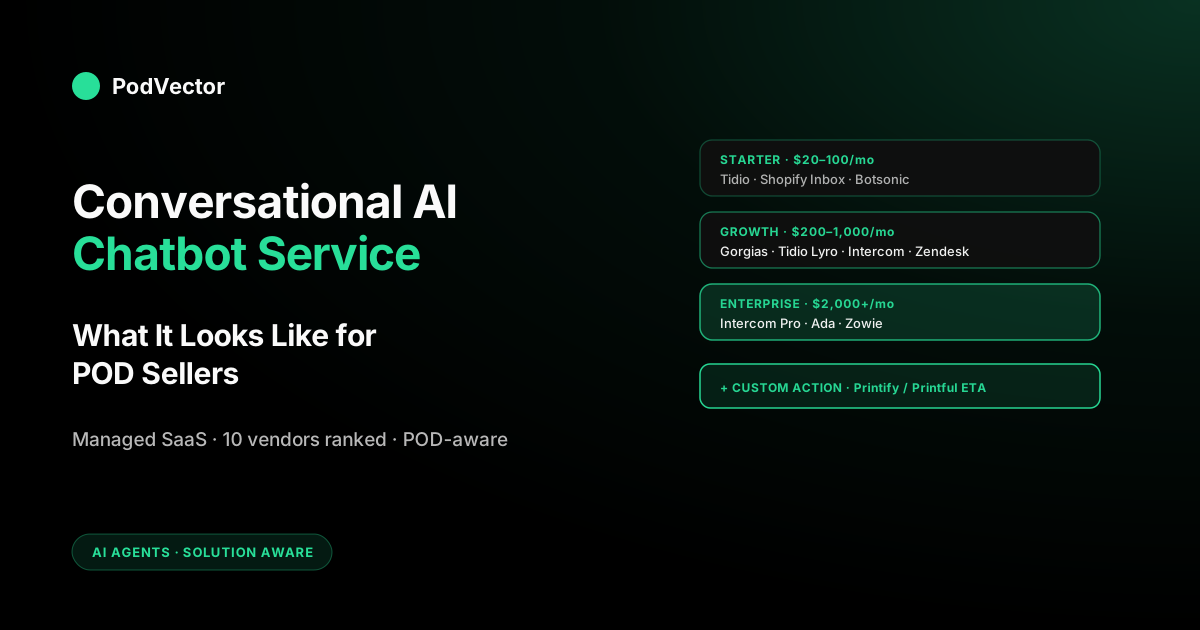
- Starter tier: $20–$100/month. Tidio, Botsonic, ManyChat, Shopify Inbox (free). Includes chat, basic AI, metered conversations. Covers stores doing under $100k/year with under 500 tickets/month. Expect to pay more as you grow out of it.
- Growth tier: $200–$1,000/month. Gorgias mid-tier, Tidio Lyro Pro, Intercom Starter, Zendesk AI. Custom actions work, deflection rates hold, support team gets meaningful time back. Covers stores from $100k to $2M/year.
- Enterprise tier: $2,000+/month. Intercom Pro/Premium, Ada, Zowie. Dedicated success management, SOC 2, multi-lingual, deep custom-action environments, EU data residency options. Only worth it above $2M/year or in multi-brand POD setups.
Hidden costs nobody advertises: 10–30 hours of tuning in the first 90 days (budget a part-time support lead), one-time integration work for Printify/Printful (a few days of developer time), and the occasional prompt-rewrite when the bot delivers an incorrect shipping promise. Plan for them; they're real. chatbot.com's 2026 ecommerce roundup documents similar pricing tiers across the non-POD segment.
Metrics that prove the service is earning its keep
Every vendor dashboard throws twenty metrics at you. Four matter on a POD store.
- Deflection rate. Percentage of conversations resolved without a human. For routine flows (status, sizing, returns), a solid rate after tuning is achievable. Under 50% means the bot is a friction-adding intake form.
- Conversion lift on engaged sessions. Sessions that used the bot vs comparable sessions that didn't, same traffic source and SKUs. Measure this inside 60 days. If there's no positive lift, the service isn't carrying its weight.
- CSAT. Post-chat rating. A bot that resolves but feels rude shrinks repeat-purchase rate — harder to recover than any one lost ticket. Target a rating that would satisfy you as a shopper.
- Lighthouse LCP impact. Chat widgets are heavy. Run Lighthouse before and after. If LCP drops more than 0.3s on mobile, the service is costing you organic traffic. Negotiate optimizations or switch vendors.
According to BigCommerce, the right ongoing metrics to track are "completion rate, escalation rate, and first contact resolution" — these drive continuous optimization. Ignore "total conversations handled" and "AI response rate" — they're vanity metrics. A chattier bot inflates both numbers without resolving anything.
Customer chatbot service vs analyst agent — don't conflate them
The most expensive mistake POD operators make in this category: buying a customer chatbot service and expecting it to tell them which products are profitable. It cannot. Different data, different job.
A conversational AI chatbot service for ecommerce talks to shoppers. Its data is customer-facing: orders, products, shipping, policies. Its job is to answer pre-sale questions and resolve post-sale tickets. Vendors: Gorgias, Tidio, Intercom, Zowie, Ada — the ten above.
An AI employee talks to you, the merchant. Its data is business-internal: itemized Printify and Printful supplier costs, ad spend, margin per SKU, customer lifetime value by segment. Its job is to answer your questions about the business and propose the next profitable move. Victor (PodVector AI) is in this category — he looks at your Shopify, Meta Ads, Google Ads, Printify, and Printful data together, so he can see the true profit on every order, find the highest-profit next move, and take approved actions in Shopify (repricing worst-margin SKUs, bulk price updates, discount creation, collection organization, and more).
The customer chatbot's roadmap is more channels, deeper context, richer actions inside the shopper conversation. Victor's job is entirely different: he doesn't answer shoppers, he answers you — "which SKUs are losing margin at current promo pricing," "what does my POAS look like after fulfillment costs last week." Neither substitutes for the other.
If your Meta or Google ad ROAS numbers don't line up with what Shopify reports, that's a data reconciliation problem a customer chatbot service cannot touch — see our guides on why Facebook Ads ROAS doesn't match Shopify and why Google Ads ROAS doesn't match Shopify for the underlying causes. For the full analyst side of the stack, see our guide to AI agents for ecommerce and our broader agentic-ecommerce overview. For the topic-level pillar, start with our complete guide to AI analytics for print-on-demand.
FAQs
What is a conversational AI chatbot service for ecommerce?
A managed SaaS that provides a conversational AI chatbot on your storefront — model, knowledge base, widget, integrations, support — in exchange for a monthly fee. You configure flows and tone; the vendor runs the stack. According to BigCommerce, today's chatbots "resolve support requests in real time, guide shoppers through product discovery, and even automate key parts of the sales process." Gorgias, Tidio, Intercom, Zowie, and Ada are the most widely used services in 2026.
How is a service different from a platform?
A service is managed: the vendor runs the runtime, you configure. A platform is a framework: you build the bot on top of it, often with an engineer. Rasa, self-hosted Botpress, and Voiceflow are platforms; Gorgias and Tidio are services. For POD stores under $5M in revenue, a service is almost always the right choice.
Which conversational AI chatbot service works best with Shopify?
Gorgias has the deepest native Shopify integration and the best custom-action story for adding Printify or Printful on top. Tidio is the best lightweight option. Intercom is the best high-end option. Shopify's own Sidekick is the cheapest baseline but won't go far beyond the Shopify data layer. For a Shopify-first deep dive, see our Shopify AI chatbot guide.
Do any chatbot services support Printify or Printful natively?
None of the 10 ship with a native Printify or Printful integration. The workaround on every service is the same: expose a custom API action (an endpoint in your backend that calls the supplier's API) and register it as a tool the bot can use. A couple of days of developer time up front, then the bot can answer supplier-ETA questions correctly.
How much should a POD store budget for a conversational AI chatbot service?
Under $100k in revenue: roughly $20–$100/month (Tidio, Botsonic, Shopify Inbox). $100k–$2M: roughly $200–$1,000/month (Gorgias, Tidio Lyro Pro, Intercom Starter). $2M+: $2,000+/month (Intercom Pro, Ada, Zowie). Add 10–30 hours of tuning in the first 90 days and a few days of Printify/Printful integration work regardless of tier.
Will a chatbot service replace my support team?
It can absorb a significant share of routine ticket volume — status, sizing, returns, design changes, order modifications — but won't replace humans for nuanced calls (defect borderlines, VIP orders, chargebacks, bulk inquiries). The realistic outcome is one person handling volume that used to require three.
How fast does a conversational AI chatbot service pay for itself?
The biggest payoff usually shows up in conversion lift on pre-purchase sizing and shipping questions — that's where conversational beats scripted by the largest margin. On the support side, the math depends on your ticket volume, your current cost per resolution, and how quickly you tune the bot. Most POD operators who publish case studies report the service paying for itself within 60–90 days of full deployment.
Do I need to worry about GDPR or the EU AI Act?
If you sell to EU shoppers, yes. According to gisuser.com's June 2026 analysis, your bot must comply with GDPR, the EU AI Act, and clear consent rules. The practical requirements are: a consent disclosure before PII is transmitted, a first-message AI disclosure, a data processing agreement with the vendor, and a per-user data deletion path. Enterprise services handle most of this with configuration; starter-tier services vary. Check before you sign.
Is Victor a conversational AI chatbot service for ecommerce?
No — Victor is an AI employee for POD sellers. He looks at your Shopify, Meta Ads, Google Ads, Printify, and Printful data together, so he can see the true profit on every order. He finds the highest-profit next move, shows it to you as a clear recommendation, and makes the change in Shopify once you approve it. Current Shopify actions include repricing worst-margin SKUs, bulk price updates, discount creation (BOGO, free shipping), raising free-shipping thresholds, and organizing products into collections.
The conversational chatbot service on your storefront talks to shoppers; Victor talks to you. Different tools, different jobs — most POD operators end up with both.
What's the biggest mistake POD sellers make when buying a chatbot service?
Picking the vendor with the best marketing instead of the vendor with the best custom-action story. Every POD store eventually needs Printify or Printful data in the bot, and services vary wildly in how painful that integration is. Check the custom-action docs before you sign — that's the real differentiator for POD, not the hero video.
Your chatbot service answers your shoppers. Victor answers your business questions.
Pick any service above for your storefront — they all handle conversational customer chat fine once you wire in Printify or Printful. But none of them can tell you which campaigns made money last week after itemized fulfillment costs, or which SKUs are eroding your margin at current promo pricing. Victor looks at your Shopify, Meta Ads, Google Ads, Printify, and Printful data together, finds the highest-profit next move, and makes approved changes in Shopify — so the answer doesn't stop at the insight.
Try Victor free