
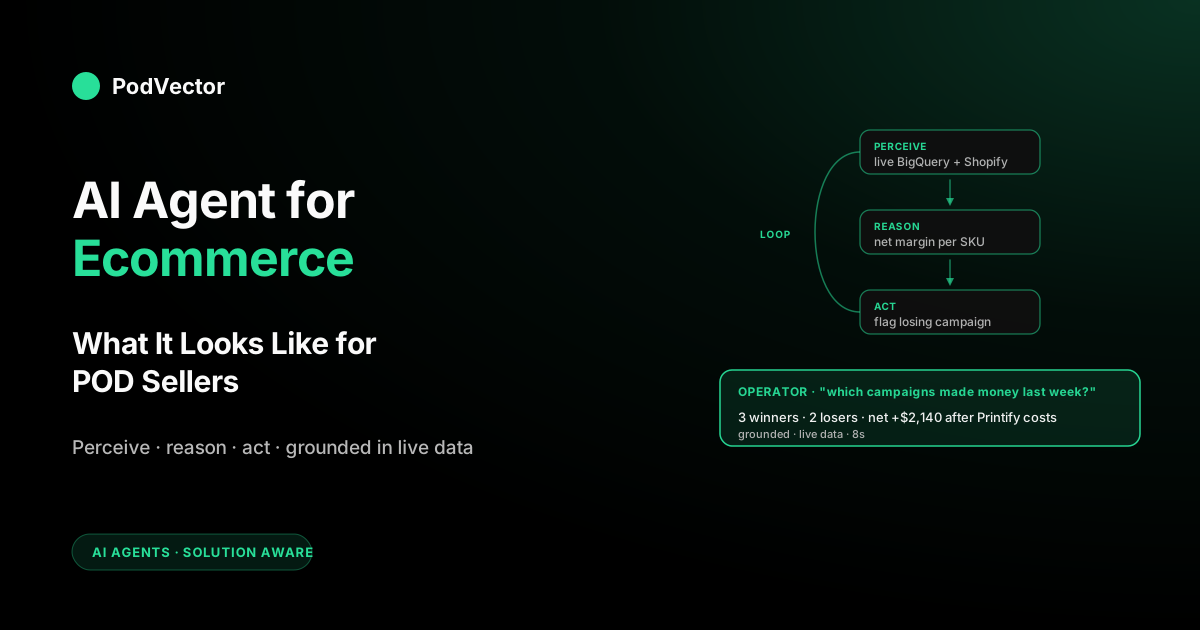
Quick Answer: An AI agent for ecommerce is software that perceives a piece of your store (orders, ad spend, support tickets, fulfillment data), reasons about it against a goal, and either answers a question or takes an action — all without you stepping through every option. For a print-on-demand seller in 2026 the term splits three ways: buyer-side shopping agents that browse and buy on the shopper's behalf (Google's AI Mode, Amazon's "Buy for Me," ChatGPT shopping); customer-facing agents you deploy (the chatbot that resolves a "where's my order" thread end-to-end); and operator-facing agents — the AI employee that tells you which campaigns made money last week after itemized Printify and Printful fulfillment costs, then acts on your approval. The meaningful differentiator is not the model — it is whether the agent truly understands POD's specifics: supplier ETAs, made-to-order refund logic, and the per-order cost stack that decides whether you have a business.
What an AI agent for ecommerce actually is in 2026
The term "AI agent" was abused heavily in 2024 and 2025. By 2026 it has a tighter working definition that most serious vendors now stand behind.
An ecommerce AI agent is software that does four things in a loop: it perceives state from your store data, reasons about that state against a stated goal, calls tools to either gather more context or take action, and then reports or commits the result. The loop is what makes it an agent.
A chatbot that returns a canned answer is not agentic. A model that writes a product description is a generator. An "agent" is the thing that sees an abandoned cart, decides whether to message the shopper, picks the right channel, drafts the message in your brand voice, and sends it — without a human writing each step.
The reason this matters for a POD seller: the same vendor will sell you a chatbot, a workflow tool, and an "agent" with heavily overlapping capability claims. Holding the four-step loop in mind keeps you from paying agent prices for chatbot capability. If the product can't decide between two actions on its own — if it just runs a fixed playbook you authored — it's a workflow tool, and you should price it accordingly.
The other 2026 shift is that the better agents now ground every answer or action in live data, not on a snapshot from last night's batch. For AI employees this means always working with your current orders, costs and ad spend, not a daily CSV export. For shopper-facing agents this means a live call to the supplier for an order ETA, not the Shopify "unfulfilled" status that's stale by definition for POD. Vendors still relying on cached or batched data are a generation behind, and the gap shows the first time a shopper or operator asks a question whose answer changed an hour ago.
A practical test: can the agent take a multi-step action you never rule-coded? If not, it is a workflow tool with a language model in the middle — useful, but not agentic.
AI agent vs chatbot vs workflow automation — pin down the difference
The cleanest way to distinguish the three categories is by what each one decides for you.
- Chatbot. Decides nothing about the business. Decides what to say next given the conversation. Examples: a Tidio bot answering "where do you ship to?" or an Intercom Fin reply on return policy. The decision space is conversational.
- Workflow automation. Decides nothing on its own; runs a fixed if-this-then-that you wrote. Examples: a Zapier zap that emails you when a Shopify order over a threshold lands; a Klaviyo flow that fires messages after cart abandonment. The decision space is "did the trigger fire."
- AI agent. Decides which action to take from a set of options, given a goal and live context. Examples: an agent that decides which abandoned-cart shopper gets a discount and which gets a sizing nudge based on what they viewed; an AI employee that decides which slice of last week's data is worth surfacing because margin dropped on those SKUs. The decision space is open-ended within a stated goal.
The categories blur in practice — a "chatbot platform" today usually has agentic features bolted on, and a "workflow tool" today usually has a language model step you can drop in. But the underlying question to ask any vendor is: does this product decide between actions, or does it execute the action I picked?
The answer changes the price you should pay and the metrics you should hold it to. For more on the chatbot end of this spectrum, see our overview of AI chatbots for ecommerce and our deep dive on conversational AI chatbots.
Seven categories of AI agents POD operators encounter
The roundup posts list anywhere from five to thirteen categories, mostly overlapping. The seven below are the ones that meaningfully change how a print-on-demand operation runs. Each is evaluated by what it would actually do on a POD store — not a stocked-inventory DTC brand, not a marketplace seller.
1. Customer support agents
Resolves shopper conversations end-to-end: order status, sizing, returns, defect claims. The good ones for POD also call the supplier API for production state instead of relying on Shopify's "unfulfilled" status. Vendors: Gorgias AI Agent, Intercom Fin, Tidio Lyro, Ada, Zowie. The metric to hold them to is deflection rate on POD-specific ticket types — not generic retail deflection benchmarks, which are inflated by simpler ticket categories.
2. Analyst / AI employees
Answers your business questions on demand. Instead of you opening a reporting tool, joining Printify costs to Shopify orders to Meta spend, and computing margin per SKU, you ask in plain English and the agent runs the query against live data and returns the answer — with the reasoning visible so you can verify the number.
Vendors: Victor (PodVector AI, POD-specific), Triple Whale Moby, Polar Analytics. The differentiator is whether the agent grounds on itemized supplier costs — most generic ecommerce AI employees do not, which makes their margin numbers wrong by definition for POD. More on this in our complete guide to AI agents for ecommerce analytics.
3. Personalization and recommendation agents
Decides what to show each shopper — landing-page hero, product grid order, related-product widget — based on browsing context, purchase history, and inferred intent. On POD, this matters most for stores with deep design catalogs (50+ SKUs of related artwork) where the manual merchandising overhead is real. Vendors: Klaviyo AI, Rebuy, Nosto. ROI shows up as AOV and conversion lift.
4. Inventory and demand-forecasting agents
Less critical for pure POD because there is no stocked inventory — but increasingly relevant for hybrid models (POD + held inventory of bestsellers, or POD + bulk pre-orders for events). The agent watches sales velocity, supplier lead times, and seasonal patterns to decide when to switch a SKU from POD to bulk-ordered. Vendors: Prediko, Inventory Planner, Cogsy. Hold the vendor accountable on stockout rate on the inventory side, and no degradation in lead time on the POD side.
5. Pricing agents
Decides price changes based on competitor data, demand signal, or margin targets. For POD, the more useful framing is margin protection rather than dynamic pricing — because POD margins are already thin, an agent that flags when a promo would push a SKU below target margin (given current Printify or Printful base costs) is more valuable than one that races competitors to the bottom. For the cost side of that calculation, see our Printify Bella+Canvas 3001 base price breakdown and our Printful shipping and cost breakdown. Vendors: Competera, Prisync, Intelligence Node.
6. Marketing-creative agents
Generates ad copy, product descriptions, email subject lines, social posts. The 2026 version goes further — generates ad creative variants, picks which ones to run, and reallocates budget based on early performance signals. Vendors: Jasper Campaigns, Copy.ai, AdCreative.ai, Pencil. Be careful: the "agent" framing here is sometimes thin; many are still "generator + dashboard" rather than true agentic loops.
7. Fraud and risk agents
Reviews each order for fraud signals, flags or blocks the high-risk ones, and learns from chargeback history. Less critical on POD than on stocked inventory (there is nothing for a fraudster to resell), but still relevant for high-AOV custom or embroidered goods stores. Vendors: Signifyd, Riskified, Kount.
Two categories that appear in the SERP roundups but rarely earn their keep on a POD store: visual-search agents (most POD shoppers arrive via paid social already knowing the design they want) and supply-chain optimization agents (your supply chain is Printify or Printful; there is not much for an external agent to optimize). Skip them unless your store has unusual traffic patterns.
Shopper-facing vs operator-facing — the split nobody draws
The single most useful distinction the roundup posts skip: every AI agent in ecommerce sits on one side of a hard line. It either talks to your shoppers or it talks to you. The data, failure modes, accountability metrics, and pricing models are all different.
Shopper-facing agents (categories 1, 3, 5, 6 above) are paid for in part by saved support time and in part by lifted conversion. Their failure modes are public — a hallucinated answer to a shopper is a brand problem and sometimes a refund. Their data is customer-side: orders, products, shipping, policies. Their accountability metrics are deflection rate, CSAT, conversion lift, and page-performance impact (because the widget loads on every page).
Operator-facing agents (categories 2, 4, 7 above) are paid for by saved analyst time and better decisions. Their failure modes are private — a wrong margin number on Tuesday is your problem until Wednesday's report — but the cost of a wrong decision compounds. Their data is business-internal: itemized supplier costs, ad spend, customer LTV by segment, fulfillment economics. Their accountability metrics are time-to-answer, accuracy on unit economics, and the dollar impact of decisions made differently because of the agent's context.
Most POD operators end up with at least one of each. Trying to pick a single agent that does both is the single most expensive mistake in this category. The information each one works with does not overlap; the way they are built is different; the security boundaries are different. A vendor that pitches "one agent for everything" is selling you a chatbot with a reporting tab grafted on, and you will regret it in month three.
Buyer-side shopping agents — the agentic commerce shift
The shopper-facing and operator-facing agents above are both ones you deploy. The 2026 development that the big-platform guides now lead with is a third kind you do not control at all: the buyer-side shopping agent that browses, compares, and buys on the shopper's behalf. This is what the industry means by "agentic commerce," and it is a different threat-and-opportunity surface than anything an operator wires up.
The live examples in mid-2026 are Google's AI Mode (Gemini-powered shopping that compares products across stores), Amazon's "Buy for Me" (which completes purchases on third-party sites from inside Amazon), and ChatGPT's shopping and checkout flow. According to PodVector AI's AI risk management guide, OpenAI's Operator, Perplexity's Comet, and the broader AI-shopping-agent category are projected to drive meaningful ecommerce traffic share within five years. For a POD seller, the practical question is no longer "what agent do I install" but "is my store legible to the agents my customers are already using."
Being legible to a buyer-side agent comes down to four things, and POD stores are usually weak on the ones that matter most:
- Structured product data and schema markup. Buyer-side agents read Product, Offer, and AggregateRating schema, not your hero image. If your POD store leans on a design-heavy theme with thin structured data, the agent cannot reliably parse price, variants, or availability — and it shortlists a competitor that ships clean markup. Titles, descriptions, variants, tags, material, and colors all need to be machine-readable at the same quality level you would give a human-facing product page.
- Honest, agent-readable shipping and production windows. This is where POD breaks worst. A buyer-side agent comparing delivery dates will read your Shopify shipping estimate and rank you against a stocked-inventory seller who ships next day. If your real timeline is "3-day production + shipping" and that is not expressed in machine-readable terms, the agent silently down-ranks you or quotes a date you will miss.
- A checkout an agent can actually complete. Agentic checkout favors one-click, guest, and token-based payment paths. A POD store gated behind a custom multi-step checkout or a mandatory account creation is a store the agent abandons.
- Consistent product descriptions across every channel. Agents cross-reference your feed, your storefront, and any marketplace listing. Contradictions (different price, different variant naming) read as low-trust and cost you the shortlist slot.
The operator angle the generic guides miss: you cannot manage what you cannot measure. When buyer-side agents start sending — or withholding — traffic, the only way to know whether agentic channels are profitable is the same itemized unit-economics layer an AI employee already needs: net margin per order after Printify or Printful costs, segmented by the channel the order came through. The store that already runs an AI employee can answer "are agent-driven orders making money" on day one; the store that does not will be flying blind exactly when it matters.
POD-specific gotchas the generic guides skip
The standard roundup posts all assume a stocked-inventory ecommerce model. Several of their default assumptions break on POD, and an agent that does not know that will look wrong in the second prompt.
- Production lead time is not shipping time. A shopper-facing agent that quotes the Shopify shipping estimate without adding the supplier's production window will create complaint tickets when the order arrives later than promised. Every shopper-facing agent on POD needs a live read on supplier production status, not just on tracking.
- Returns do not restock. POD items are made-to-order; refund logic should default to "refund without return shipment" for most defect cases. Almost no platform ships with this as a default; you have to override it. An agent that follows the default flow will demand return shipping the shopper cannot do.
- Per-order itemized cost is the whole game. An AI employee that does not pull base cost, print cost, supplier shipping, and payment fees per line item cannot tell you margin per SKU. Generic ecommerce analytics agents pull a flat COGS percentage; on POD that number is far enough off true margin on bad SKUs to be useless for decisions. For more on the cost-modeling side, see our complete Printify review covering quality, costs, and real margins.
- Mockup-vs-reality language. Your product images are CGI mockups; the print drifts. Shopper-facing agents need language for "what arrives may vary slightly from the digital mockup" baked into the relevant answers, not buried in a footer disclaimer.
- Multi-storefront brands. POD operators often run several Shopify stores under one operator entity. An agent deployed per-store loses cross-store context (a returning customer from a sister brand). The platform's multi-store handling matters more for POD than for single-brand DTC.
- Print-method context. DTG holds fine detail; DTF is more durable; embroidery has thread-count constraints; sublimation only works on poly. The shopper-facing agent needs to know which method is behind each SKU and explain the tradeoffs when a shopper asks "will this hold up in the wash?"
- Catalog legibility for buyer-side agents. As agentic commerce matures, your product catalog needs to be machine-readable at the same quality you would give a human-facing page — titles, descriptions, variants, tags, material, and colors all structured and consistent across every feed.
Five real workflows an agent runs on a POD store
The roundup posts list ten use cases per category. The five below are the ones that change the operator's day on a POD store specifically.
1. The "where's my order" deflection workflow
Shopper messages the storefront chat at 9pm. The agent recognizes the intent (order status), pulls the order from Shopify, calls the Printify or Printful production API, translates the supplier's "in production, expected to ship Tuesday" into a one-sentence answer, and sends it. Closes the conversation. No human ever sees it. On a POD store with a high support volume, this single workflow typically represents the majority of the inbound ticket load.
2. The Monday-morning margin question
You wake up Monday and want to know which Meta campaigns made money last week after fulfillment. You ask the AI employee in plain English. The agent runs a query against a live warehouse, joins itemized Printify or Printful costs to Shopify orders to Meta ad spend by attributed UTM, and returns a table sorted by net margin — with the reasoning shown so you can check the numbers. Time: seconds. Time the same answer used to take in a spreadsheet: the better part of a morning if exports were not already staged.
3. The defect-refund triage
Shopper uploads a photo of a misaligned print. The shopper-facing agent classifies the defect, checks the supplier's defect policy, and either issues a free replacement (default), a refund without return shipment (for low-cost SKUs), or escalates to a human (for borderline calls or high-AOV orders). Most defect threads close without a human; the human picks up only the calls that actually need judgment.
4. The pre-purchase sizing recommendation
Shopper viewing a Bella+Canvas 3001 tee asks "what size for a 6'1" 195lb guy with a relaxed fit?" The agent knows the SKU, pulls the brand's size chart, applies a relaxed-fit adjustment, and recommends Large. Conversion on the SKU lifts on stores that run this flow well — the sizing confidence removes a key pre-purchase objection on apparel. See our Printify Bella+Canvas 3001 base-price breakdown for the cost side of this SKU.
5. The post-launch SKU watch
You launched a new design Tuesday. By Friday the AI employee flags it: at current promo pricing and ad traffic cost, the blended margin per acquired order is negative. You decide whether to pause the campaign, raise the price, or kill the SKU. The agent did not make the call; it made the call obvious. This is the operator loop in its current form — answer first, then action on approval.
The ROI math for a POD store
Vendors quote broad lift figures. For a POD store the math is more grounded. Pick a representative store doing meaningful volume — say, hundreds of orders per month and a proportionate support load.
- Shopper-facing agent. The cost of a mid-tier platform with custom Printify or Printful integration runs a few hundred dollars a month. The value is in deflected tickets (human cost saved per resolved conversation) plus any conversion lift on engaged sessions. For most POD stores running this stack, payback lands in the first month if the supplier integration is built correctly.
- Operator-facing agent. Cost varies by vendor and tier. The value is in time saved (analyst hours per month recovered) plus the decision impact of catching a losing SKU or campaign one week earlier — which on a store running paid traffic can recover multiples of the tool cost in a single week. Payback in month one if even one decision moves.
The numbers scale roughly linearly into the mid-six-figure monthly revenue range. Above that, custom pricing and custom data work start to dominate, and the ROI calculation shifts from "save analyst time" to "make decisions the team could not have made manually."
How to pick the right agent for your store
Five questions to ask any vendor, in order. If they fail one, move on.
- Does it integrate with Printify or Printful natively? If "no, but you can build it via webhook" — you can, but you are a couple weeks of dev work into the project before the agent earns anything. Discount the price accordingly. If "yes, native" — verify it actually pulls production status, not just the order webhook.
- Does it ground on live data, or on a daily snapshot? Working from your current, up-to-date numbers is the floor in 2026. Daily CSV export is a generation behind. Hourly micro-batches are middle ground.
- Can I see a transcript of how it decided to take a specific action? Agents that cannot show their work should not be trusted with refund authority or pricing changes. Auditability is a hard requirement, not a nice-to-have.
- What is the failure mode on low confidence? "Falls silent" or "guesses" both lose. The right answer is "escalates to human with full context attached" — and you should test it during the trial.
- Who else in POD is running it in production? "We have tens of thousands of ecommerce customers" is irrelevant — you want to know how it handles your specific stack. Ask for POD references, not just any reference.
For a deeper comparison of customer-facing platforms specifically, see our comparison of the best AI chatbots for ecommerce and our guide to AI chatbot platforms for ecommerce. For the ad-side context behind the operator's margin questions, see our guide to running Facebook Ads for a Shopify store.
A realistic deployment sequence
Skip the vendor's "10-minute install" pitch. A real rollout:
- Week 0 — pick the side. Decide whether you are solving a shopper problem or an operator problem first. Do not try both at once. Most POD operators get more leverage from the AI employee because the support load is already manageable; conversely, stores with overflowing support inboxes start with the shopper-facing agent.
- Week 1 — audit how your data is set up. For a shopper-facing agent: are your product descriptions blank-aware, are size charts on-page, is your supplier account cleanly tied to Shopify? For an operator-facing agent: are your itemized costs showing up correctly, can you see which ad spend led to which sale, is the information fresh enough to trust?
- Week 2 — pick the platform and wire the integration. For shopper-facing, this is usually a Shopify app install plus a custom action for the supplier API. For operator-facing, this is connecting your warehouse and ad accounts.
- Week 3 — build the top-10 flows or queries manually. For shopper-facing: sizing, shipping ETA, defect refund, design change, order status, payment failure, discount code, return policy, custom personalization, gift card. For operator-facing: campaign-level net margin, SKU-level net margin, repeat-rate by acquisition source, weekly P&L by channel, AOV by funnel, refund rate by supplier, ad CAC by campaign, gross-margin trend, fulfillment cost ratio, top losing SKUs.
- Week 4 — soft launch. Shopper-facing: a partial traffic split, watch conversion lift, deflection, CSAT, and page performance for two weeks. Operator-facing: you and one other operator use it daily for two weeks; flag every wrong answer.
- Week 6 — ramp or pause. If metrics hold, ramp to full traffic and full team. If they do not, pause and tune. Most rollouts find one or two failure modes that need a fix before scaling.
The employee roadmap — answers your questions and acts on them with approval
The honest framing of where AI agents are in 2026: most of them answer well; very few of them act safely. The shopper-facing chatbots can refund and reship within constrained authority limits — that is the easier half, because the actions are reversible and the dollar amounts are small. Operator-facing agents are still in an earlier stage of action capability: they tell you which campaigns are losing money, but the merchant executes ad-platform changes directly.
That changes over the next 12–18 months. The pattern is: agents get a narrow action surface, prove safety on it, then expand. Victor already executes Shopify-side writes with your approval — repricing products to a target margin (single or bulk), creating or updating discounts (including buy-one-get-one, free-shipping, and customer-specific), creating collections, and raising or setting a free-shipping threshold. Ad-platform writes, Printify and Printful writes, and email actions are on the roadmap; they are read surfaces today.
Victor reads and works with Shopify, Meta Ads, Google Ads, Printify, Printful, Gelato, and Klaviyo. Right now, the only thing he sends you on his own is a Weekly Health Report. For everything else, you ask a question, and Victor answers using your store's real, up-to-date data. If he suggests a change, he shows you the action first as a card. He only makes the change after you approve it. Other vendors are moving in the same direction, but their first automatic step may look different.
The implication for the POD operator picking an agent today: weight the vendor's roadmap and audit story equally. The vendor that ships actions first without auditability will burn a customer publicly within a year. The vendor that ships actions last will lose customers to the ones that shipped responsibly. The middle path — narrow actions, full audit log, operator authority gates — is where durable agents land.
For the ad-agency context that often sits alongside the AI-employee layer, see our piece on what POD operators should know about Facebook Ads agencies. For platform setup that feeds the data layer, see our guides on connecting Printify to Etsy, connecting Printify to TikTok Shop, and connecting Printify to Squarespace. For the operator-side architecture and where Victor sits in this trajectory, see our complete guide to AI agents for ecommerce analytics.
FAQs
What's the difference between an AI agent and an AI chatbot for ecommerce?
A chatbot decides what to say next given a conversation. An AI agent decides which action to take from a set of options given a goal. In practice, the chatbot is a subset of the agent — most modern shopper-facing chatbots have agentic features (the bot can issue a refund, edit an order, look up a supplier ETA). The label matters less than the question: does this product decide between actions, or does it execute the action I picked?
Do AI agents work with Shopify and Printify or Printful?
Shopify integrations are universal — every major agent platform has a Shopify app. Printify and Printful are the gap. Almost no platform ships with native integrations to either supplier. The standard workaround is a custom API action registered as a tool the agent can call. A few hours of dev work; once done, the agent can answer "where's my order" with a real production ETA instead of "your order is unfulfilled."
How much does an AI agent for ecommerce cost?
Shopper-facing agents start at the lower end for basic chat platforms and scale into the thousands per month for enterprise tiers from Gorgias, Intercom, and Ada. AI employees run in the low-to-mid hundreds per month for SMB tiers (Triple Whale Moby, Polar, Victor) and into custom enterprise pricing for larger platforms. For a POD store in the five-to-six-figure monthly revenue range, plan for a few hundred dollars per month total across both categories — and compare that against the analyst time or support cost you are currently spending.
What is agentic commerce, and what does it mean for my POD store?
Agentic commerce is shopping done by a buyer-side AI agent — Google's AI Mode, Amazon's "Buy for Me," ChatGPT shopping — that browses, compares, and sometimes buys on the shopper's behalf without them visiting your storefront. For a POD seller it means being legible to those agents matters as much as your own ad creative: clean Product/Offer schema, machine-readable production and shipping windows (so you are not ranked against next-day stocked sellers on a stale Shopify estimate), an agent-completable checkout, and consistent product data across channels. The catch unique to POD is that you also need to know whether agent-driven orders are profitable after itemized fulfillment cost — which is the same operator-side unit economics you need anyway.
Can one AI agent handle both customer support and analytics?
You will see vendors pitch this. It rarely works in practice. The information each agent works with does not overlap (customer-facing data vs business-internal data), the security boundaries are different, the failure-mode tolerances are different, and the users are different. Most POD operators end up with at least one shopper-facing and one operator-facing agent. A vendor pitching "one agent for everything" is usually a chatbot with an analytics tab grafted on.
What's the biggest mistake POD sellers make with AI agents?
Installing a generic ecommerce agent, leaving it hooked up to Shopify only, and wondering why the answers are wrong. The integration with the supplier — Printify or Printful — is non-optional for POD; without it, the shopper-facing agent gives wrong shipping ETAs and the operator-facing agent reports wrong margins. The fix is the custom integration; the discipline is doing it before the agent goes live, not after the first round of complaints.
Will an AI agent replace my analyst or my support team?
It compresses both. A shopper-facing agent typically lets a smaller support team handle a volume that used to require more headcount. An operator-facing agent typically lets a non-analyst operator answer the questions that used to require a part-time analyst. Neither replaces senior judgment moments — pricing strategy, campaign creative direction, defect escalation calls — but both eliminate the routine load that was eating those people's time.
Is Victor an AI agent for ecommerce?
Yes — Victor is the AI employee for POD sellers. He answers your business questions ("which campaigns made money last week after fulfillment costs," "which SKUs are losing margin at current promo pricing") by looking at your real orders, your supplier costs, and your ad spend together. Beyond answering, Victor can take action with your approval — on Shopify (repricing, discount creation, collection creation, free-shipping threshold), and also in Google Ads, Meta Ads, and Klaviyo. He reads Shopify, Meta Ads, Google Ads, Printify, Printful, Gelato, and Klaviyo. He never acts without your approval.
Victor is not the shopper-facing chatbot — that is a separate category, and most POD operators end up running both.
How do I know if an AI agent is actually agentic or just a chatbot in a costume?
Ask the vendor to walk you through one decision the agent made on a real customer's account that was not pre-scripted. If they can show you a record of it — what it looked at, how it reasoned, what it did, and the result — it is agentic. If they show you a flowchart with a model in the middle, it is a workflow tool with a language model step. Both are useful; only one should be priced like an agent.
Does Victor monitor my store around the clock?
The only proactive surface today is a Weekly Health Report. Everything else is query-driven — you ask, Victor reads live data, answers, proposes a Shopify-side action if relevant, and executes it only after you approve. Continuous autonomous monitoring is not the current model; the Weekly Health Report is the proactive touchpoint.
Pick the agent that fits the side of the line you're on.
Shopper-facing agents close support tickets faster and lift conversion. Pick any of the platforms above for that side; they all handle the conversational load fine once you wire in Printify or Printful. But none of them can tell you which campaigns made money last week after itemized fulfillment costs, which SKUs are eroding your margin at current promo pricing, or reprice your catalog to a target margin — with your approval — before another week burns. Victor does, because he sees every order, every supplier cost, and every ad dollar together, so his numbers match the true economics of each POD order.
Try Victor free