
Quick Answer: An AI chatbot platform for ecommerce is the underlying system — models, integrations, dashboards, APIs, workflow builder — that a vendor like Gorgias, Tidio, Intercom, Rep AI, Botpress, or Tolstoy sells you, on top of which you deploy one or more chatbots. For a print-on-demand seller, the right platform is the one that can read your Shopify catalog, your Printify or Printful fulfillment queue, and your customer history in one place — then ground its answers in that data.
In 2026 the category has shifted from reactive chatbots to agentic commerce: the leading platforms don't just answer, they take actions (look up an order, start a return, recommend a SKU, trigger a discount) and proactively guide shoppers. Generic ecommerce chatbot platforms can handle Shopify fine; almost none natively understand POD fulfillment. That gap is what this guide is about.
What an "AI chatbot platform for ecommerce" actually is
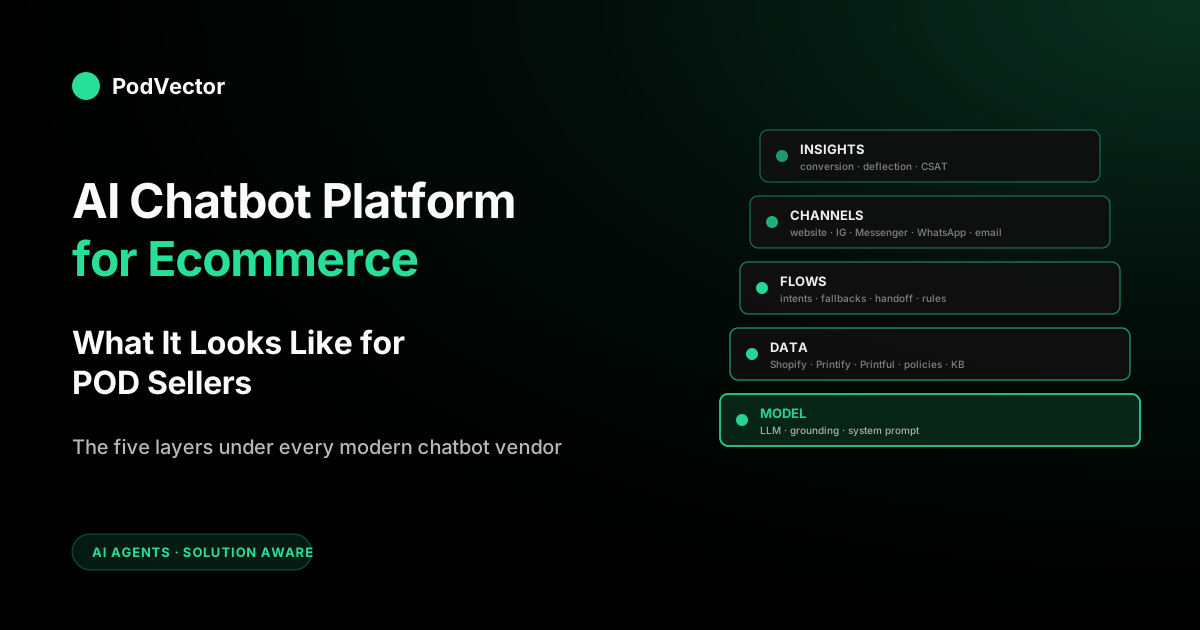
The word "platform" is doing a lot of work here. When a vendor calls their product an AI chatbot platform, they usually mean the combination of five things sold as one subscription: a large-language-model layer (sometimes proprietary, usually a thin wrapper over OpenAI, Anthropic, or Google models), a flow and intent builder for scripted fallbacks, a library of integrations into your commerce stack, a dashboard for agents and analytics, and an API or SDK for customization. Buying a "platform" instead of a standalone chatbot means you're buying the ability to deploy many bots — website widget, email auto-reply, Instagram DM responder, post-purchase WhatsApp — from the same console, with shared data, shared training, and shared reporting.
This is the mental shift from the 2018-era chatbot market, which was mostly single-channel rule-based trees, to the 2026 market, which is multi-channel and AI-grounded. The vendor is no longer selling you a bot; they're selling you the infrastructure to run many bots. That distinction is the whole reason platform pricing ($200–$2,000/month) is higher than legacy chatbot pricing ($30–$100/month) — you're paying for the orchestration layer, not the widget.
The five layers in a modern ecommerce chatbot platform
- Model layer. The LLM that generates responses. Sometimes the vendor's own (Tidio's Lyro, Gorgias's AI Agent). Usually under the hood it's OpenAI, Anthropic, or Google models with a vendor-specific system prompt and RAG retrieval layer on top.
- Data layer. Connectors into Shopify, WooCommerce, BigCommerce, Magento — plus CRM, helpdesk, and (rarely) ad platforms. This is where platforms differentiate most; a fancy model grounded on empty data loses to a mediocre model grounded on rich data.
- Flow layer. A visual builder for scripted fallbacks when the LLM isn't confident or when the business requires a compliance-bound path (refunds, subscription cancellations, warranty claims).
- Channel layer. The set of surfaces the platform can deploy to — website widget, Messenger, Instagram, WhatsApp, email, SMS, voice. The platforms that truly cover all of these are rare; most are strong in 2–3 channels.
- Action layer. The 2026 differentiator. Beyond answering, can the bot do things mid-conversation — update an order, start a return, apply a discount, hand off with full context, fire a webhook into your stack? This is the line between a chatbot (it talks) and an agent (it acts). Platforms like Rep AI and Gorgias lead here; legacy flow-builders lag. For a POD seller, the action layer is where a custom Printify/Printful production-ETA lookup or defect-refund routine actually executes.
- Insights layer. Reporting on conversation volume, deflection rate, CSAT, revenue attribution. This is where platforms diverge wildly in quality — the reporting a shopify merchant needs ("did this bot drive revenue") is different from what a support-ops buyer wants ("did it reduce ticket volume").
Why "platform" is the right unit of evaluation (not "chatbot")
Most evaluation advice on the internet treats each chatbot vendor as a chatbot — a widget you install, evaluated against UX and conversion. For a one-channel deployment that's fine. For a print-on-demand store running Shopify plus Instagram plus TikTok plus email, the vendor is a platform whether you wanted one or not, and evaluating the platform matters more than evaluating the widget.
The practical implication: you're not just picking "the best chatbot" — you're picking an infrastructure commitment that will live in your stack for 2–3 years minimum, will absorb the training effort of learning your catalog and your brand voice, and will determine which channels you can automate without buying a second vendor. A platform decision rolled back after 6 months is expensive, even when the contract is monthly.
That's why this guide is organized around platform-level requirements — data integrations, channel coverage, model grounding, POD-specific knowledge — instead of platform-level feature bingo. The features everyone lists (no-code builder, omnichannel, analytics, guardrails, human handoff) are table stakes in 2026. What actually separates platforms is how well the data layer understands your specific business.
What POD sellers need that generic buyers don't
Print-on-demand sellers are a niche inside ecommerce, and most chatbot platforms are built for the general DTC market. The gap shows up in predictable places:
- Supplier-aware shipping ETAs. A generic ecommerce chatbot answers "when will my order ship" from the Shopify fulfillment status, which for POD is useless — the order is almost always "unfulfilled" until the supplier ships it. The chatbot needs to pull Printify's or Printful's production queue for that specific order, not just the Shopify order status.
- Variant-aware sizing. Every POD blank (Bella+Canvas, Gildan, Next Level, AS Colour, Stanley/Stella, Champion) has a different fit. The chatbot needs to know which blank is behind each SKU, and which size chart to quote when asked.
- Mockup-vs-reality framing. POD mockups are CGI renders; what arrives at the customer's door has print drift, fabric hand, and color fidelity that mockups can't represent. The chatbot that acknowledges this proactively outperforms one that over-promises.
- Print-method clarity. DTG, DTF, embroidery, sublimation, AOP — each has different durability, color handling, and minimum order economics. The chatbot needs to know which method is behind each SKU and explain the tradeoffs when asked.
- Refund routing for non-restockable goods. POD orders are made-to-order; they aren't returned to inventory. The chatbot has to know the difference between a print defect (replace, no return shipment) and buyer's remorse (refund or store credit, usually without return shipment).
- Itemized cost awareness on the back end. For merchants who want their chatbot to answer internal questions like "what did the last 100 orders cost us?" — the chatbot's data layer needs to itemize base cost, print cost, shipping, and Shopify fees per order. Most generic platforms don't.
None of the mainstream chatbot platforms (Gorgias, Tidio, Intercom, Ada, Botpress) ship with native Printify or Printful integrations. The closest they get is generic "Shopify fulfillment" context.
That means for a POD merchant, the platform choice is partly about which vendor's API surface is flexible enough to add the POD-specific data you need via custom actions, webhooks, or RAG knowledge bases. For a deeper breakdown of the cost side of that data, see our complete guide to Printify costs and complete guide to Printful costs.
Platform features that matter (and the ones that don't)
Vendor landing pages list dozens of features. Most are table stakes or marketing. The features that actually differentiate a platform for a POD seller:
What matters
- Native Shopify integration depth. Not just "installs from the app store" — check whether the platform can read customer lifetime value, segment by tag, fire webhooks on cart abandonment, trigger discount creation, and subscribe to fulfillment updates. Shallow Shopify integration is the #1 platform weakness.
- Custom API actions. Can the bot call your own endpoints? A POD-aware bot usually needs to hit a Printify or Printful API that the vendor doesn't support natively. If the platform can't fire custom actions mid-conversation, you'll hit a wall in month three.
- RAG knowledge base quality. The LLM needs somewhere to look up your size charts, return policies, and FAQ. Platforms that let you upload PDFs, URLs, and Notion docs — and that re-index them on a schedule — keep the bot honest. Platforms that rely only on canned intents get stale.
- Grounding and citation behavior. When the bot answers a factual question, does it cite its source (Shopify product, help article, order record)? Grounded bots hallucinate less. This is a platform property, not a model property.
- Channel consolidation. Can the same bot definition run on the website widget, Instagram DM, and WhatsApp? Multi-bot maintenance across single-channel vendors is how small teams waste their Q4.
- Live-data freshness. How recent is the Shopify data the bot can see? Platforms that sync every 15 minutes miss questions about orders placed 10 minutes ago. Real-time streams (via webhooks) beat scheduled syncs.
- Agentic action-taking. The fastest-moving differentiator in 2026. Can the bot autonomously complete tasks — process a return, cancel an order, apply a discount, update a shipping address — instead of just routing the shopper to a human or a form? The platforms now ranking for "ecommerce chatbot" (Rep AI, Gorgias, the newer ProProfs "action-based agents") sell this hard. Verify it does the specific actions your POD flows need, not just the demo ones.
- Guided product discovery. For a large POD catalog, conversational discovery — the bot narrows from "I want a funny cat shirt" to a specific SKU and variant — converts browsers better than a search bar. This is where Octane AI and Rep AI focus; a generic support bot won't do it well.
What's table stakes (every modern platform has this — don't negotiate over it)
- No-code flow builder
- Omnichannel inbox for agents
- AI-generated response suggestions
- CSAT collection and basic analytics
- Multi-language support (via the model's native multilingualism)
- GDPR compliance and SOC 2
What's marketing (sounds impressive, rarely moves revenue)
- "Proprietary LLM" — almost always a wrapper on a frontier model
- "Enterprise-grade" — means they have a six-figure contract sales team, not that the product is better for a $50k MRR store
- "AI-powered analytics" — usually generic reporting with an AI summary paragraph bolted on top
- "Brand voice matching" — every model does this now; the hard part is the data, not the tone
The platforms POD sellers actually encounter
A shortlist of the platforms you're most likely to see recommended — the ones covered in Botpress's 2026 roundup and Tolstoy's 2026 buyer guide — viewed through a POD lens:
Gorgias
Shopify-native helpdesk with an AI Agent layer. Deepest Shopify read access on the market; an Order Management rules engine that POD sellers can bend toward Printify/Printful logic with custom tags; strong AI deflection metrics out of the box. Downside: priced for mid-to-upper SMB ($60–$900+/month), and the AI Agent add-on is metered per resolution.
Tidio
SMB-friendly chatbot + live chat with Lyro AI. Lower price floor ($24–$750/month), good Shopify app, a flow builder that's forgiving for non-technical founders. Custom API actions exist but are less polished than Gorgias. A good fit for a POD store doing <$100k MRR that wants a fast install and is willing to accept less depth.
Intercom
Support platform with Fin (their AI agent). Strong deflection rates on large knowledge bases, great Messenger-style widget, enterprise-grade reporting. The price floor is higher than most POD stores need, and Shopify integration is shallower than Gorgias. Best for POD brands north of $500k MRR with a real support team.
Botpress
Developer-first chatbot platform. Open-source core, full API control, BYO-model support (OpenAI, Anthropic, Groq). The most flexible platform for POD sellers who want to wire in a custom Printify/Printful action — but it assumes engineering capacity. Not a turnkey install.
Rep AI
Agentic-commerce platform that frames itself as an "agentic commerce operating system." Proactively detects buying hesitation, runs guided product discovery, and takes actions (returns, cancellations, order tracking) without a human. Strong Shopify/Klaviyo/Gorgias integrations and claimed AOV lift; pricing starts around $49/month. The most representative example of the 2026 shift from reactive chatbot to action-taking agent — but, like the rest, it reads Shopify, not Printify/Printful fulfillment, natively.
Octane AI
Shopify-specific quiz and chat platform. Best-in-class product-finder quizzes that route shoppers to the right SKU; the AI layer is newer and less deep than Gorgias or Tidio. Worth the look if your POD catalog has >500 SKUs and discovery is the main blocker.
Tolstoy
Video-first AI sales assistant. The differentiator is interactive video and virtual try-on; the chatbot layer sits on top. If your POD brand does a lot of mockup-vs-reality conversion work, the video surface may move the needle more than a text-only bot.
ManyChat
Social-channel specialist. Instagram, Messenger, WhatsApp, SMS — strongest presence on any of those surfaces. Weakest native website widget of this list. The right choice if your POD sales come mostly through Instagram; the wrong choice if Shopify is your primary surface.
Ada
Enterprise AI platform with strong guardrails and compliance tooling. Over-engineered for most POD stores, but the multi-brand / multi-region support is useful if you operate multiple storefronts under one company.
The AI-employee category (different buyer, often confused)
Platforms like Victor (PodVector AI), Triple Whale Moby, and Polar aren't customer-facing chatbot platforms — they're AI employees that answer your business questions from live data. A POD seller often needs both: a customer chatbot platform (one of the above) for shoppers and an AI employee for operators.
Confusing the two is the single most common shopping mistake. More on this distinction in our complete guide to AI agents for ecommerce analytics.
Pricing tiers and what you're paying for
Platform pricing clusters into three tiers. Understanding the tier matters more than comparing sticker prices, because the tier determines what kind of POD store you are, not which platform wins in the abstract.
Tier 1 — starter ($20–$100/month)
Tidio's entry plan, ManyChat's Pro tier, Botpress's cloud hobby plan. AI features are present but metered (limited monthly conversations or model calls). Integrations are shallow. Suits a POD store doing under $20k MRR that's testing whether a chatbot moves revenue at all before committing.
Tier 2 — growth ($200–$1,000/month)
Gorgias's mid-tier, Tidio's AI plan with Lyro, Intercom's growth plan, Octane AI's full Shopify integration. AI resolution is included up to a reasonable volume; integrations are deep; reporting is actionable. The sweet spot for most POD stores doing $50k–$500k MRR. This is where the ROI math starts working clearly.
Tier 3 — enterprise ($2,000+/month)
Gorgias enterprise, Intercom Premium, Ada, most custom Botpress builds, LivePerson. Dedicated CSM, SLA on response latency, multi-brand support, sandbox environments. Overkill for a single-brand POD store but necessary if you run multiple storefronts or need compliance-grade audit trails.
The rule of thumb: don't skimp on the platform if the bot's data access is gated on it. A $30/month plan with shallow integrations costs you the conversion lift every day it runs; the $200/month plan with deep integrations earns its price back in one or two conversations that would have otherwise gone to a human.
Customer chatbot platform vs AI employee platform
These two categories get conflated constantly in buyer conversations, and picking the wrong one is an expensive mistake.
A customer chatbot platform is deployed against your shoppers. It lives on your website, in Instagram DMs, in Messenger, maybe in email. Its job is to answer product questions, recover carts, and deflect support tickets. Vendors: Gorgias, Tidio, Intercom, Ada, Botpress, Octane AI, Tolstoy, ManyChat. Buyer: marketing / support ops. Success metric: revenue lift, deflection rate, CSAT.
An AI employee platform is deployed against you, the merchant. It lives in your dashboard or Slack.
Its job is to answer questions about your business — "which ad campaigns made money last week after fulfillment costs," "which SKUs have negative margin at current promo pricing," "what's the reorder rate on the relaxed-fit tee vs the heavyweight one." Vendors: Victor (PodVector AI), Triple Whale Moby, Polar, Motion. Buyer: founder / ops. Success metric: time-to-answer, decisions made, margin recovered.
The confusion usually plays out like this: a POD founder reads that "AI chatbots boost ecommerce revenue," installs a customer chatbot on their storefront, and then wonders why the chatbot can't tell them which product is most profitable. The chatbot can't, because that's not its job, and the data it sees is customer-facing inventory, not internal unit economics.
Victor is built for that job. He matches your Printify and Printful costs to each Shopify order and to your ad spend, so his answers show you the real economics of your business, not a vague summary. More on the AI employee category in our complete guide to AI analytics for POD, and on the broader AI tooling landscape in the complete guide to AI tools for POD sellers.
The answer for most POD sellers is: you need both. They're not substitutes. Budget them separately, evaluate them separately, and don't let a customer-chatbot vendor sell you on their reporting as a replacement for a AI employee.
How a POD seller should deploy one
A realistic rollout sequence, not the "deploy in 10 minutes" one the vendor sells you:
- Week 0 — data audit. Before picking a platform, audit what's actually available. Do your product descriptions have variant-level detail? Are your size charts live on the product page or buried in a collection footer? Is your Printify or Printful account connected cleanly to Shopify? Any chatbot is only as good as the data it can access.
- Week 1 — platform pick and install. Install the chatbot app in Shopify, connect integrations, import your existing help content as a knowledge base. Don't turn the widget on for shoppers yet.
- Week 2 — flow and tone setup. Build the 5–10 most common conversation flows manually (sizing, shipping, returns, design change requests, order status). Tune the system prompt to match your brand's voice. Test every flow as a shopper would.
- Week 3 — POD-specific integration work. Wire in whatever custom actions you need for Printify or Printful — production ETA lookups, defect refund routing, print-method explanations. This is the work that differentiates your bot from every other Shopify store's.
- Week 4 — limited launch. Turn the widget on for 20% of traffic (most platforms support split testing). Monitor conversion lift, deflection rate, CSAT, and LCP impact daily. Fix the top three failure modes before scaling.
- Weeks 5–8 — scale and tune. Ramp to 100%. Review chat transcripts weekly; every misstep is a flow or knowledge-base gap to close. Track your AI-employee side separately — the chatbot data isn't going to tell you which campaigns are profitable.
Mistakes POD sellers make picking a platform
- Picking on price alone. The $30/month tier saves you $170/month and costs you the conversion lift that would have paid for the $200/month tier ten times over.
- Assuming POD-awareness is built in. It isn't. You have to build the Printify/Printful integration yourself via custom actions or a RAG knowledge base.
- Optimizing for the number of channels. Every channel you enable is a flow you have to maintain and a tone you have to tune. Start on one channel (your website), get it right, then expand.
- Confusing the customer chatbot with an AI employee. They're different tools with different buyers and different ROI math. Don't expect the bot talking to your shoppers to also tell you which SKU is profitable.
- Ignoring the performance tax. Every chatbot platform adds weight to your site. Run Lighthouse before and after; if LCP drops more than 0.3s, negotiate optimizations or switch platforms.
- Not testing human handoff. Every platform claims seamless handoff. Half of them drop context. Test the handoff as a shopper before you commit to an annual contract.
- Locking into a long contract before proving ROI. Every serious platform has a monthly plan. Use it for at least two months before you sign annual for the discount.
FAQs
What's the difference between an AI chatbot and an AI chatbot platform?
An AI chatbot is one bot on one surface — your website widget, your Instagram DM responder. An AI chatbot platform is the infrastructure layer (models, integrations, flow builder, dashboard) on top of which you deploy multiple chatbots across channels. Buying a platform is how you avoid maintaining four single-channel chatbots from four vendors.
Which AI chatbot platform is best for a POD store on Shopify?
There's no single winner. For most POD stores in the $50k–$500k MRR band, Gorgias has the deepest Shopify integration and the strongest AI deflection data.
Tidio is friendlier for sub-$100k MRR. Botpress wins if you have engineering capacity to wire in Printify/Printful custom actions.
Octane AI is strong if discovery (not support) is your blocker. None of them are POD-native out of the box.
Do these platforms work with Printify and Printful?
Not natively. Almost every major chatbot platform integrates with Shopify; almost none integrate directly with Printify or Printful.
The workaround is to expose a custom API action (an endpoint you host that calls the Printify/Printful API) and register it as a tool the chatbot can call during a conversation. Gorgias, Tidio, Intercom, and Botpress all support this; the setup is a few hours of developer work.
How much should a POD store pay for a chatbot platform?
Budget $200–$500/month for the first year for a store in the $50k–$500k MRR range. Below $50k MRR, the $30–$100/month tier is fine for testing. Above $500k MRR, you're probably in $1,000+/month territory, and the platform's AI deflection volume is priced by usage anyway.
Can an AI chatbot platform replace my customer support team?
No, but it can absorb 50–80% of the ticket volume — sizing questions, shipping ETAs, order status, returns eligibility. That lets a one-person support team handle the volume of what used to require three. The remaining 20–50% — the nuanced defect claims, the bulk orders, the VIP conversations — still need a human, and the chatbot is the funnel that routes them there with full context.
What platform does PodVector AI use — is Victor a chatbot platform?
Victor isn't a customer chatbot platform. Victor is an AI employee built for POD store owners — he answers your business questions using your real Printify and Printful costs, your Shopify orders, and your Meta and Google ad spend.
The customer chatbot on your storefront talks to shoppers; Victor talks to you. You probably want both; they solve different problems.
What's the difference between an ecommerce chatbot and an "agentic" AI agent?
A chatbot answers — it talks to the shopper and routes them to a human or a form when action is needed. An agentic platform acts — it completes the task itself (starts the return, applies the discount, updates the order, runs guided product discovery) inside the conversation. The 2026 platforms that now rank for "ecommerce chatbot" (Rep AI, Gorgias, ProProfs) are selling the agent, not the chatbot. For a POD seller the practical test is the action layer: can it execute your specific Printify/Printful flows — production-ETA lookups, defect-refund routing — via custom actions, not just answer questions about them?
Is a generic AI like ChatGPT enough, or do I need a dedicated platform?
For a storefront widget that talks to shoppers in real time and has to be grounded on your catalog, your orders, and your policies — you need a dedicated platform. ChatGPT alone can't read your Shopify data, can't deploy a website widget, and can't hand off to a human agent. The platform is the integration layer; the LLM is the engine.
How do I measure if a chatbot platform is working?
Four metrics in priority order: conversion lift on engaged sessions (sessions that chatted vs sessions that didn't, same traffic source, target 10%+ within 60 days), deflection rate (percent of conversations ending without escalation, target 70%+ for routine flows), CSAT (post-chat rating, target 4.2+/5), and Lighthouse impact (LCP regression, keep below 0.3s). Ignore total conversation volume; a chatty bot boosts that number without resolving anything.
Your customer chatbot platform handles shoppers. Victor handles your business questions.
Pick any of the platforms above for your storefront widget — they all work fine for customer-facing chat. But they can't tell you which campaigns made money last week after Printify/Printful costs, or which SKUs are eating your margin at current promo pricing. Victor does. He uses your real Printify and Printful costs to show you the numbers behind your business.
Try Victor free