
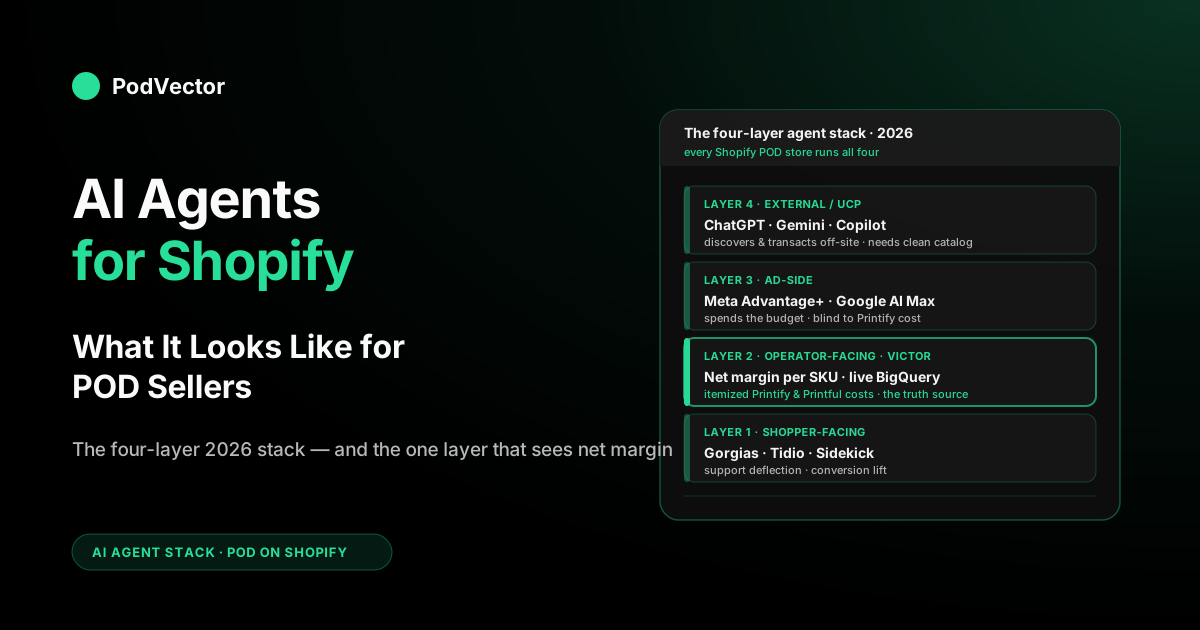
Quick Answer: AI agents for Shopify in 2026 aren't one tool — they're a stack across four surfaces. A shopper-facing agent (Fin, Gorgias, Tidio, Sidekick) handles support and product discovery. An operator-facing agent answers what the business actually did last week. Ad-side agents (Meta Advantage+, Google AI Max) spend the budget, and external agents (ChatGPT, Copilot, Google's assistant) discover and check out through Shopify's Universal Commerce Protocol.
For print-on-demand the stack has a POD-specific twist. Only an operator-facing agent wired into itemized Printify or Printful costs can tell you net margin per SKU — the number every other agent is implicitly optimizing against. This guide is about how those agents compose, not which single one to buy.
Why "AI agents" on Shopify is now plural
Twelve months ago a Shopify merchant asking about "AI agents" meant one thing: a shopper-facing chatbot inside the storefront. The SERP today still leans that way — most of the Shopify AI agent roundups are customer-service tool comparisons. That's a narrow read.
What's actually happening on real 2026 Shopify stores is that the agent count has gone up. Sidekick ships in the admin.
A Gorgias or Tidio agent handles support. Meta's Advantage+ and Google's AI Max are autonomous agents inside the ad stack.
ChatGPT, Microsoft Copilot, and Google's assistant all transact through the storefront via Shopify's Universal Commerce Protocol. And a growing category of AI employees — Victor is one — answers questions about the business itself.
The interesting question is no longer "which agent should I install" but "which agents am I already running without realizing, and how do they compose." For a print-on-demand store on Shopify that composition matters more than for a typical DTC brand, because POD margin is thinner and the agents all assume they can see costs they can't actually see.
The four surfaces every 2026 Shopify stack touches
Every 2026 Shopify merchant — POD or otherwise — ends up running agents against four surfaces of the business. Most merchants don't realize it until they count.
| Surface | What the agent does | Representative agents (2026) | Lives where |
|---|---|---|---|
| Shopper-facing | Answers customer questions, recommends products, processes returns, deflects tickets | Sidekick (limited), Gorgias AI, Tidio Lyro, Re:amaze, Shopify Inbox | Storefront chat, helpdesk, email |
| Operator-facing | Answers the merchant's own questions about revenue, margin, cohorts, and costs | Victor, Shopify Inbox Magic (basic), custom GPTs wired to exports | Slack, email, dashboards |
| Ad-side | Bids, budgets, creative rotation, audience targeting across ad platforms | Meta Advantage+, Google AI Max / Performance Max, TikTok Smart+ | Ad platform consoles |
| External / UCP | Discovers products and executes checkout from outside your storefront | ChatGPT, Microsoft Copilot, Google's assistant, AI shopping search | Anywhere the shopper is — not your site |
The four surfaces don't replace each other. A well-run Shopify POD store in 2026 has agents touching all four. And no single vendor covers more than two.
Stack 1 — shopper-facing agents (support + conversion)
This is the surface the SERP is built around. A shopper-facing agent sits on your storefront, answers pre-sale questions ("does this shirt run small?"), handles post-sale ones ("where's my order?"), processes simple returns, and — increasingly — recommends SKUs to close a cart.
The near-consensus 2026 leaderboard across the top roundups looks like this, with Gorgias and Tidio dominating the POD/DTC mid-market and Fin now leading the customer-service comparisons:
- Fin (by Intercom) — now usually ranked #1 for Shopify customer service; resolution-based pricing (~$0.99 per resolved conversation) and a published ~76% resolution rate across its customer base.
- Gorgias AI Agent — deepest Shopify integration, strong at refund/reorder flows. The 2026 update split it into a Shopping Assistant (pre-purchase recommendations) and a Support Agent (post-sale), and it reports up to 60% automation out of the box.
- Tidio Lyro — lighter, cheaper (from ~$39/month or a free tier), strong on product recommendations and cart recovery.
- Re:amaze — helpdesk-first, agent is a deflection layer on top of a mature ticketing system.
- Shopify Sidekick / Inbox — native, free, improving quarterly, but limited to conversational help in the admin and basic chat.
- Richpanel, Zowie, Ada, Zendesk AI — enterprise-leaning, usually overkill for POD until you hit meaningful ticket volume.
One 2026 shift worth internalizing: the top customer-service roundups now grade on resolution rate (the agent fully solved it, no human escalation) rather than the older deflection rate (the agent kept a ticket out of the queue). Deflection can mean a frustrated customer gave up; resolution means they actually got an answer. For POD, where a chunk of tickets are print-quality or production-delay issues a bot can't truly close, the resolution number is the one that predicts whether the agent earns its subscription.
If you want the full shortlist, comparison, and selection framework for this one surface, that's the scope of our best AI chatbot for Shopify comparison and the broader AI chatbot for Shopify guide. We're not re-litigating it here.
The POD-specific wrinkle on this surface is that shopper-facing agents need access to your Printify or Printful production state to answer order-status questions that don't live in Shopify. A Gorgias or Tidio agent that only sees Shopify orders will confidently tell a customer their shirt is "processing" when Printify has already flagged a production delay. Wiring the POD provider into the agent's context — usually via a custom API action or a middleware like Order Desk — is the difference between a shopper-facing agent that works for POD and one that creates more tickets than it deflects.
Stack 2 — operator-facing agents (the POD-native AI employee)
The second surface is the one most roundups skip entirely. Shopify's own Sidekick gives you a limited version — you can ask it "what were my sales last week" and it'll summarize Shopify Analytics. What it can't do is tell you net margin, because Shopify doesn't know what Printify or Printful charged you for each item.
That gap is where agents like Victor come in. Victor pulls together your orders, your ad spend and your supplier costs into one place, so he can show you:
- Shopify orders, refunds, shipping
- Printify or Printful itemized costs per line item (blank + print + shipping + platform fee)
- Ad spend from Meta, Google, TikTok by campaign and creative
- App fees, payment processing, and any other per-order variable
When the join works, the agent can answer questions the shopper-facing agent literally cannot: "what's my contribution margin per SKU after Printify costs?", "which Meta campaign had the best net ROAS last week?", "am I losing money on any product after the full cost stack?". Those are the questions that drive decisions — and they're the questions a POD operator asks every week.
The generic Shopify roundups list a separate "operational automation" or "inventory" agent here — demand forecasting and automated reordering. For POD that surface mostly collapses into the operator one. You don't hold stock; items are made on demand, so there's no reorder point to forecast. What you do need to watch operationally is cost drift (a Printify blank price change, a shipping-zone hike) and SKU-level margin erosion — which is exactly what an operator-facing agent already tracks. POD swaps "how much inventory do I buy" for "which SKUs still make money," and the same agent answers both.
We covered the operator-facing surface end-to-end in AI agent for ecommerce, and the broader ecosystem in The Complete Guide to AI Agents for Ecommerce Analytics. If you're on Shopify and running POD, this surface is almost always the one with the highest marginal dollar value for the owner's time, because a shopper-facing agent optimizes ticket deflection (hours of CX labor) while the operator-facing agent surfaces margin leaks that compound (dollars of profit).
Stack 3 — ad-side agents (what Meta and Google are doing with your budget)
The third agent most POD Shopify merchants run — usually without framing it that way — is on the ad platforms themselves. Meta's Advantage+ Shopping, Google's AI Max / Performance Max, and TikTok's Smart+ are all autonomous bidding-and-creative agents. They take a budget, an objective, and some creative, and they go spend it.
These agents are not installed from the Shopify App Store. They're installed from the ad platform, and they're usually already on by default in 2026.
They're also, by dollars deployed, probably the most consequential agents on your business. A POD store spending $20k/month on Meta has an agent making ~600 bidding decisions per day about those dollars.
The POD-specific wrinkle here is the one the platform-side agent can't solve: these agents optimize against what Shopify reports as the conversion value. They don't know Printify's cost. So a Meta Advantage+ campaign can happily scale a SKU where Shopify shows $32 revenue per conversion and your actual net after Printify is $4, because the agent sees $32 and ROAS 3.2 and assumes that's all profit contribution.
The fix is either server-side value adjustment (sending net-of-cost conversion values back to Meta via the Conversions API) or using your operator-facing agent to catch the error after the fact. Most POD operators do the second. A small but growing number do both.
Stack 4 — external agents (ChatGPT, Copilot and UCP)
The fourth surface is the newest and — if Shopify's leadership is right about it — the one reshaping the other three. Shopify spent 2025 and early 2026 building Agentic Storefronts and co-developing the Universal Commerce Protocol (UCP) with Google. The short version: any merchant on Shopify can now be discovered, recommended, and checked out by external AI agents — ChatGPT, Microsoft Copilot, Google's assistant, and AI search tools — without the shopper ever visiting your storefront.
The category is real, not hype. McKinsey estimates agentic commerce could influence $3 trillion to $5 trillion of global consumer spending by 2030, and Shopify products are now discoverable across ChatGPT, Google AI Mode, Gemini, and Microsoft Copilot. Most of that volume is still concentrated in a handful of verticals, and POD isn't the top one yet — generic categories (home goods, apparel basics, pet supplies) are where external agents close the most. But the direction of travel is clear.
The plumbing is arriving fast too. Alongside UCP, payment rails like Visa, Mastercard, and Google's Agent Payments Protocol (AP2 — a standard that lets an agent buy on a shopper's behalf inside a user-set budget) are in pilot. That means an external agent can soon not just recommend your SKU but complete the purchase, with no human at the keyboard.
For a POD operator the implication isn't "install another agent." It's that your catalog needs to be agent-legible. Titles, descriptions, variants, tags, material, colors — they need to be machine-readable at the same level of quality you'd give a human-facing PDP.
External agents don't click through your beautifully designed landing page. They parse your product feed.
If you're thinking about this surface right now, the adjacent background is in Agentic AI for ecommerce and the chatbot-layer implications in AI chatbots Shopify integration. It's early — but the merchants who win here in 2027 are the ones whose catalogs are already cleaned up in 2026.
How the four agents coordinate — and where they don't
The honest answer is: mostly they don't.
There is no central orchestrator for the multi-agent stack on a typical Shopify POD store. Each agent runs in its own context, optimizes its own objective, and is blind to the others. Here's what that actually looks like on a single order:
- Meta Advantage+ decides to serve an ad to a lookalike — it sees a $32 conversion value.
- The shopper lands on the storefront; Tidio Lyro answers a sizing question and closes the cart.
- Gorgias later handles the "where's my order" ticket three days in; it sees the Shopify order but not the Printify production delay.
- The Printify print order runs; the operator-facing agent (Victor) later computes the full stack — $32 revenue minus $14 Printify cost minus $11 Meta CAC minus $2 app/payment fees = $5 net.
- ChatGPT, entirely separately, recommended a different SKU from your catalog to a different shopper via UCP; that order never touched Shopify's on-site funnel at all.
No agent in that chain saw the whole sequence. That's the default state of a 2026 Shopify POD stack. The merchant (or the AI employee) is the orchestrator by default.
The good news is that this is the right default for 2026 — agents that try to centralize too aggressively tend to under-perform the specialist ones. The bad news is that you can't manage what you can't see, which is what makes the operator-facing surface non-optional on a multi-agent stack.
The build order for a POD store deploying agents
If you're building the stack from scratch — new Shopify store, new Printify account, nothing installed yet — the order that maximizes marginal value per install looks roughly like this, and it's different from what most roundups recommend:
- Sidekick (free, native). Already in your admin. Use it for admin-side productivity and basic chat. Zero install cost.
- An operator-facing agent wired to itemized POD costs. Before you spend $5k/month on a shopper-facing enterprise agent, know your unit economics. This is where Victor lives, and it's counter-intuitive that it comes before the support agent in the sequence — but support volume scales with orders, and you don't know which orders are worth supporting until you have the cost stack.
- Clean catalog + UCP-readiness. This isn't technically installing an agent — it's making sure the external agents that already exist can transact on your store. Title hygiene, variant consistency, structured attributes. Easy to defer, expensive to defer.
- A shopper-facing agent, usually Gorgias or Tidio, wired into your POD provider state. Install this when either (a) you're processing enough tickets that an hour/day of CX labor is meaningful, or (b) you have SKUs with high pre-purchase question rates where a storefront agent lifts conversion directly.
- Ad-platform agents (if you're not already using them). Most POD operators on Shopify are already on Advantage+ by 2026. The work isn't installing — it's tuning what conversion value you send back. Once your operator-facing agent exists, this becomes the obvious next move.
The order moves operator-facing ahead of shopper-facing. That's the biggest deviation from the public SERP, which almost universally assumes "AI agent for Shopify" = "support chatbot" and everything else is a secondary concern. For POD specifically, margin visibility is the lead; support automation is the follower.
Auditing the multi-agent cost stack
A Shopify POD store running four surfaces of agents is running four subscriptions — sometimes more. A realistic 2026 cost stack for a sub-$1M store looks like:
- Shopify plan — $39–$399/month depending on tier; Sidekick is bundled.
- Shopper-facing agent — $39 (Tidio) to $650+ (Gorgias at mid-volume); note that Fin and parts of Gorgias now bill per resolution (~$0.90–$1.00 each), so your bill scales with ticket volume rather than sitting flat.
- Operator-facing agent — $0 (homegrown GPT on exports) to $200–$500/month (purpose-built, warehouse-wired).
- Ad platform agents — no direct cost; they're free with the ad budget.
- External / UCP agents — no direct cost; usage-based at the platform side.
Total agent subscription cost is usually $100–$1,500/month on top of Shopify itself. The audit question isn't whether that's too much — it's whether each agent is paying for itself in a measurable way.
A shopper-facing agent deflecting 40% of tickets on 1,200 tickets/month at $2/ticket of CX labor is paying for a $250/month subscription ~4x over. An operator-facing agent that catches one margin leak per quarter on a single SKU at $400 of monthly P&L impact is paying for itself ~10x over.
Most POD operators under-measure both. The single most common audit finding on a multi-agent stack is a shopper-facing agent paid for six months after the free-trial "wow" wore off without anyone checking whether it was still deflecting anything. Run the check quarterly.
POD-specific wiring gotchas across the stack
A handful of issues show up on every multi-agent Shopify POD stack, and none of them are in the generic roundups:
- Cost blindness. Every agent except the operator-facing one sees Shopify's gross revenue and assumes it's informative. It's not — Printify can eat 40–60% of it. If only one agent in your stack sees itemized cost, that's the one you trust for business decisions.
- Production state lag. Shopify's order status doesn't update in real time with Printify's production state. A shopper-facing agent answering "where's my order" based only on Shopify will confidently give wrong answers. Wire the POD provider into the agent's context or expect complaints.
- Returns that aren't returns. Most POD items don't accept returns — they're made on demand. Your shopper-facing agent needs a POD-aware return policy, not the generic Shopify one. Otherwise it'll offer RMAs that don't exist.
- Variant explosion. A POD apparel catalog with 50 designs × 10 sizes × 15 colors is 7,500 variants. Agents that index "products" without handling variants well (most 2026 shopper-facing agents now handle this correctly, but older ones don't) will recommend sold-out or non-existent combinations.
- Ad-feed mismatch. Meta and Google ad agents pull from Shopify's product feed. If your feed has stale inventory or broken variants, the ad-side agent spends against non-convertible traffic. This is one of the most common six-figure leaks on a POD store.
Where the stack converges — the employee roadmap for POD on Shopify
The fragmentation above is real in 2026 but it's not permanent. The direction all four agent surfaces are moving is from answer → act → coordinate. Today most of them answer or suggest; next year more of them will act; the year after, they'll start to coordinate through shared protocols.
Concretely, the 2026-to-2028 trajectory we expect on a Shopify POD stack:
- Shopper-facing agents already process refunds; next they'll reorder without operator input, and eventually they'll proactively prevent churn by offering a replacement SKU before the customer asks.
- Operator-facing agents — Victor's category — already answer margin questions; next they'll push cost anomalies to Slack unprompted (we're building this now), and eventually they'll pause ad campaigns when net margin drops below a threshold.
- Ad-side agents are already autonomous inside their platform; the direction is cross-platform coordination (MMM-style) and real-time net-value feedback from the merchant's warehouse.
- External / UCP agents will grow from single-shot recommendations to multi-turn shopping journeys on behalf of the consumer — meaning your catalog has to answer questions, not just list specs.
The merchants who'll do well through that transition are the ones who built the operator-facing surface first — because when agents start acting, you need a truth source that sees across all of them. If you're planning to run one agent in 2028, run that one.
For the rest of this surface, browse the full AI agents cluster or step up to the broader AI analytics hub for how the AI employee connects to the rest of your POD reporting.
FAQs
What's the difference between an AI agent and a chatbot on Shopify?
A chatbot answers; an agent takes action. A chatbot for Shopify might say "your order is processing"; an agent can process a refund, reorder a damaged item, or update the customer's shipping address without a human.
In 2026 most of the vendors on the SERP are technically agents by that definition, though many started as chatbots. The deeper distinction for POD is between shopper-facing agents (which act on the customer's behalf inside the storefront) and operator-facing agents (which act on the merchant's behalf against the back-end data).
Do I need multiple AI agents or just one?
You already have multiple, even if you haven't installed a thing. Sidekick is running in your admin; Meta Advantage+ is running on your ad budget; ChatGPT and other external assistants can transact against your catalog via UCP.
The question isn't whether to run multiple — it's whether to install anything on top of those defaults. For a POD store on Shopify, the two most commonly worth installing are a shopper-facing support agent and an AI employee. Both, not one.
Which AI agent works best with Printify and Printful?
For shopper-facing: Gorgias has the deepest helpdesk integration and can be wired to Printify/Printful via Order Desk or a custom action to surface production state. For operator-facing: you need an agent that pulls in Printify or Printful's cost breakdown (blank, print, shipping, platform fee) for every single item and matches it to your Shopify orders. Victor does this automatically for print-on-demand sellers; most generic ecommerce agents don't — they only look at the whole order and miss the profit on each product.
How much does a multi-agent Shopify stack cost?
For a POD store under $1M/year, typical 2026 spend is $100–$1,500/month on agent subscriptions on top of Shopify itself. The low end is Sidekick (free) plus a basic Tidio plan (from ~$39/month) plus a homegrown AI employee.
The high end is Gorgias Enterprise ($650+), a purpose-built operator-facing agent, and paid integrations. Ad-platform agents and external UCP agents are included with their platforms and have no direct subscription cost.
What is Shopify's Universal Commerce Protocol (UCP)?
UCP is an open standard Shopify co-developed with Google in late 2025 that lets external AI agents — ChatGPT, Copilot, Google's assistant, and AI search tools — discover and transact on any Shopify store without the shopper visiting the storefront. For merchants it's opt-in at the admin level.
For POD operators the practical implication is that your product feed now has two audiences: humans on your PDP and agents elsewhere. Feed hygiene matters more than it did a year ago.
Will AI agents replace my customer support team?
For POD specifically, current 2026 deflection rates on Gorgias and Tidio top out around 50–60% for simple tickets (shipping, sizing, return policy). The remaining 40% — damaged items, print quality complaints, custom-order questions — still need a human. The realistic shape is 1 support person handling 2–3x the ticket volume with an agent, not zero-human support.
How do AI agents handle POD's no-return policy?
Only if you configure them to. The default policy a shopper-facing agent will apply is Shopify's default return window, which doesn't match POD's production-on-demand reality. Explicit policy configuration — "no returns on printed items; replacements for quality issues; refunds within X days of delivery only if damaged" — is a required setup step, not a nice-to-have.
Should I run an agent on Shopify Sidekick or install a third-party one?
Both. Sidekick is free, ships with Shopify, and covers admin-side questions well.
A third-party shopper-facing agent handles the storefront side and integrates with POD providers in ways Sidekick doesn't. The decision is not Sidekick vs. third-party — it's Sidekick plus something for the storefront, plus something for the operator side. See our single-agent Shopify selection guide if you're choosing between specific shortlisted third-party tools.
The one agent in the stack that sees everything
Shopper-facing agents close tickets. Ad-side agents spend budget. External agents discover catalog. None of them show you your real profit after Printify or Printful costs. Victor is the agent built for POD sellers on Shopify — he knows your item-level costs and matches every order to the ad dollar that brought it in. Ask him what your business actually did last week and get an answer in seconds.
Try Victor free