
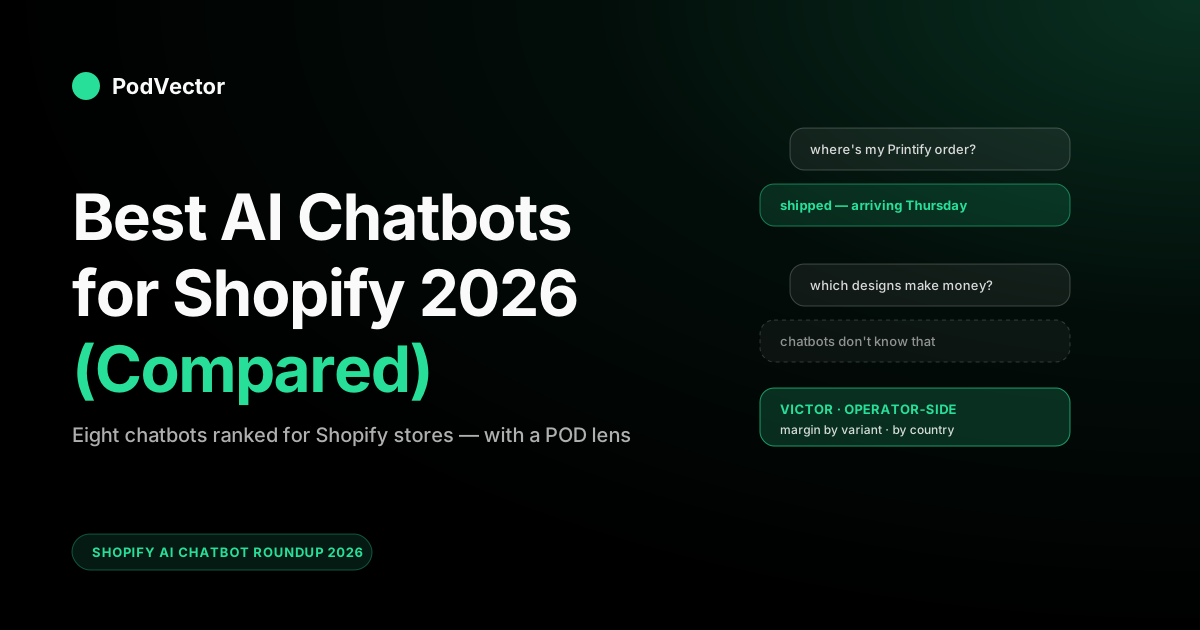
Quick Answer: The best AI chatbots for Shopify in 2026 are Tidio (Lyro AI) for small-to-mid stores wanting an all-in-one live chat plus AI agent, Gorgias AI for stores with a real support queue and Shopify-native action depth, and Zipchat AI for pure pre-purchase sales conversion. Shopify Inbox is the free native starter. Intercom Fin wins on benchmark resolution rate at scale.
For print-on-demand sellers, the honest framing most roundups miss: chatbots answer shopper questions. They don't tell you which Printify variants are profitable after Meta ad spend.
If that's the job you're trying to hire for, you want an AI employee like Victor by PodVector AI, not a chatbot. Most POD stores end up running one of each.
What Is an AI Chatbot for Shopify?
An AI chatbot for Shopify is a conversational layer that sits on your storefront — usually a widget in the bottom-right corner — and handles shopper questions without a human. By 2026 the category has split cleanly in two. The older wave (rule-based flows, decision trees, keyword matching) is being retired; the current wave uses large language models to generate replies, call Shopify admin and app APIs, and take multi-step actions like refunds, order edits, address changes, and tracking lookups.
Most vendors in this space now market the word "AI agent" instead of "chatbot". The practical capability is what matters: can the tool actually execute an action — refund the order, apply the discount, recommend the variant the shopper is hinting at — or does it just reply with the right sentence? For the fuller framing on that distinction see AI chatbot for Shopify: what it looks like for POD sellers and the best AI agents for ecommerce 2026 roundup, which covers the broader agent category.
The 2026 shift worth noting: storefront chatbots are increasingly doubling as on-site sales agents — guiding product discovery and recovering carts, not just closing support tickets. Zipchat, in particular, has repositioned around what it calls "Agentic Commerce": rather than managing flows and nodes, the merchant sets a goal and a single AI brain executes across sales, support, and marketing channels simultaneously.
One job this article does not cover, because chatbots don't do it, is operator analytics. A shopper chatbot can tell your customer where their order is. It can't tell you which designs are losing money after ad spend, or how Printify margin compares to Printful on your top twenty SKUs. That's a different tool — see the POD lens section below.
A note on Profound: some roundups comparing "ecommerce AI automation" platforms include Profound in this search cluster. Profound is focused on AI search visibility and answer-engine monitoring — it is not a day-to-day Shopify execution tool and is not a substitute for a chatbot or an operator-side AI employee.
At-a-Glance Comparison Table: Best AI Chatbots for Shopify 2026
| Chatbot | Best For | Starting Price | Install Effort | What It Actually Does |
|---|---|---|---|---|
| Tidio (Lyro AI) | Small-to-mid Shopify stores | Free / Growth from $49/mo | 10 min | Live chat + AI agent; product cards in chat; returns and tracking actions; fastest usable free tier |
| Gorgias AI | Shopify stores with a support team | From $10/mo (automation add-on) | 1–2 days | Deepest Shopify-native actions — refund, edit, cancel, discount — inside the ticket |
| Zipchat AI | Pure sales conversion and WhatsApp recovery on Shopify | From $49/mo | 30 min | Single AI brain for sales, support, and marketing; proactive triggers; WhatsApp cart recovery; 95+ languages |
| Shopify Inbox | Any Shopify merchant wanting free native chat | Free | 5 min | Native messaging with Shopify Magic AI drafts; no true agent actions yet |
| Intercom Fin | Mid-to-enterprise deflection at volume | $0.99 per resolution | 1 week | Highest benchmark resolution rate; outcome-based pricing; action tool-use |
| Zendesk AI | Stores already on Zendesk | From $55/agent/mo | 1–2 days | Intent routing and answer bot; Shopify actions via app integration |
| Re:amaze | Multichannel helpdesk on a budget | From $29/agent/mo | 1 day | Email + chat + social in one helpdesk; AI drafts and classification |
| TailorTalk | Shopify stores selling on WhatsApp and Instagram | Custom | 2–3 days | Full-stack sales agent across WhatsApp, Instagram, web; places orders, takes payments |
Pricing reflects publicly listed tiers at time of writing; enterprise plans vary. Strong adjacent picks worth evaluating: eesel AI (layers AI onto an existing helpdesk without migrating), Richpanel, Juphy, Chatling, Rep AI, Quickchat AI, Wonderchat, Chatty, Wizybot, VanChat, Maisie AI, Willdesk, Ada, and ManyChat. For phone-heavy stores, AI voice agents (e.g. Ringly) sit alongside text chat rather than replacing it.
The 8 Best AI Chatbots for Shopify in 2026
1. Tidio (Lyro AI) — Best all-in-one chatbot for small-to-mid Shopify stores
Best for: Shopify, WooCommerce, and BigCommerce stores doing up to a few thousand chats a month that want one widget for live chat, AI answers, and product recommendations.
What it is: Tidio is one of the most widely installed chat plus AI chatbot combos in the Shopify App Store. It combines live chat, its Lyro AI chatbot, and a visual automation builder. Its AI layer handles first-touch shopper questions — order status, shipping, returns, product availability — and surfaces product cards inside the chat for recommendations. It takes narrow actions (return flows, tracking lookups) and escalates cleanly to a human when it's unsure.
Standout features: Fastest install on Shopify (a 10-minute job from click to first AI reply); product recommendation cards rendered inside the chat; a genuinely usable free tier for small stores to trial without committing budget; visual flow builder for cases you want rule-based; native Shopify order lookup.
Known limitation (2026): Tidio's Flows automation and its Lyro AI layer are separate systems that don't share logic. According to Zipchat's 2026 Tidio review, a merchant who wants a proactive trigger — for example, initiating a conversation when a shopper has been on a product page for 90 seconds — must choose between a scripted flow with no AI intelligence or an AI response with no proactive trigger; the two systems cannot execute this cleanly together. This is a meaningful ceiling for stores that want sophisticated, event-driven pre-purchase sequences.
Pricing: Free plan available; Growth plan starts at $49/mo (per Zipchat's 2026 Tidio review). Lyro AI conversations priced separately on higher tiers. Enterprise plans are custom.
Limitations: Action depth is shallower than Gorgias. Flow-plus-AI coherence lags Zipchat on proactive engagement. No visibility into your cost structure (Printify/Printful COGS, ad spend). Lyro AI availability on WhatsApp has been reported by users as inconsistent without complex configuration. For pure sales conversion on pre-purchase chat, Zipchat is more focused.
Verdict: If you're a Shopify store with moderate monthly chats and want one tool that handles live chat, AI answers, and lightweight automation, Tidio is the default. For a deeper alternative comparison see best AI chatbot for Shopify (compared).
2. Gorgias AI — Deepest Shopify-native action depth
Best for: Shopify stores doing several hundred tickets a month where deflection carries real dollar value and there's a support team to supervise.
What it is: Gorgias is a Shopify-first helpdesk with an AI chatbot and agent layer. The distinguishing trait versus every other vendor on this list is the range of actions the AI can take natively inside a Shopify ticket — refunding orders, editing items, applying discount codes, cancelling subscriptions, triggering return flows — without a human touching the conversation. It reads from the Shopify order graph and writes back to it.
Standout features: Deepest Shopify-native action surface of any chatbot on this list; mature macro and rule system for constraining agent behavior (refund caps, SKU whitelists, time windows); transparent reporting that attributes deflected tickets to real dollar value; strong agent-assist on human handoffs.
Pricing: Starter helpdesk from $10/mo, Basic $60/mo, Pro $360/mo. AI automation add-on is billed per resolution or as a flat bundle.
Limitations: Overkill for stores under a few hundred tickets a month — you're paying for action depth you won't use. Seat pricing stacks for larger teams. No view of your cost side; it's a pure shopper-facing agent.
Verdict: For Shopify stores past the point where support tickets pile up, Gorgias is the action-depth leader. The question isn't whether it's capable — it is — but whether your ticket volume justifies the spend.
3. Zipchat AI — Best for pure sales conversion and WhatsApp recovery
Best for: Shopify stores where the main reason to add a chatbot is to lift pre-purchase conversion or recover carts via WhatsApp — not to deflect support tickets.
What it is: Zipchat has evolved in 2026 into what it calls an "Agentic Commerce" platform. According to Capterra's 2026 Zipchat listing, the platform gives stores "one intelligent AI Agent that sells, supports, and markets automatically" — the merchant sets a goal and Zipchat acts, with specialized sub-agents for sales, support, and marketing working together in real time. Where Tidio, Gorgias, and Intercom are helpdesk-first with sales assist bolted on, Zipchat inverts it: the single AI brain is optimized for recommending products, resolving pre-purchase objections, and nudging shoppers toward checkout across web and WhatsApp simultaneously.
Standout features: Single unified AI brain across proactive triggers, conversation, product recommendation, and cart recovery — no disconnected flow/AI split; WhatsApp cart recovery and proactive outreach as a first-class channel; explicit revenue attribution from chat to checkout; multilingual support across more than 95 languages; setup in minutes with no technical skills required.
Pricing: From $49/mo for starter plans; revenue-share and custom tiers available for larger stores.
Limitations: Support depth is shallower than Gorgias on complex post-purchase actions (refunds, edits, cancellations). If your chat volume is mostly "where's my order?", you're paying for capabilities you won't fully use. Less mature than Tidio or Gorgias on pure helpdesk-style agent-assist workflows.
Verdict: If your hypothesis is "a well-placed AI recommendation or a WhatsApp recovery sequence lifts revenue," Zipchat is the sharpest tool for that job on Shopify in 2026. Pair it with a cheaper or free helpdesk (or Gorgias) for post-purchase ticket depth.
4. Shopify Inbox — Best free native chatbot
Best for: Any Shopify merchant who wants a free chat widget on their storefront without installing a third-party app.
What it is: Shopify Inbox is Shopify's own messaging app. It runs as the chat widget on your storefront and funnels conversations into a unified inbox you read on mobile or desktop. The AI layer comes from Shopify Magic — it drafts replies, suggests FAQ answers from your policies pages, and can auto-send quick responses for the obvious questions (order status lookups, shipping, returns).
Standout features: Free. Native — zero integration headaches. AI-drafted replies that get better as you approve them. Quick replies auto-populated from your shipping, returns, and product pages. Direct Shopify order lookup in-thread.
Pricing: Free with any Shopify plan.
Limitations: This is messaging with AI assist, not a true autonomous agent. It drafts replies; it doesn't take actions like refunds, edits, or cancellations on its own. The AI won't deflect tickets without human approval. No product recommendations in chat. No conversation analytics beyond Shopify's basic messaging metrics.
Verdict: For a new Shopify store with low volume, Inbox is the right starter — free, native, zero friction. Graduate to Tidio or Gorgias once chat volume makes a dent in your time.
5. Intercom Fin — Highest benchmark resolution rate
Best for: Mid-to-enterprise Shopify stores with high chat volume that want the market's best-deflecting AI chatbot and can stomach outcome-based pricing.
What it is: Fin is Intercom's AI agent layer. It is the enterprise-grade option that handles complex resolution workflows end to end and consistently benchmarks near the top for first-touch resolution on support questions. Pricing is outcome-based at $0.99 per resolved conversation, which aligns incentives: you pay for value delivered, not seat count or message volume.
Standout features: Best answer quality in the category on ambiguous questions; multi-step tool-use (order lookups, refunds, cancellations) when wired to Shopify; outcome pricing that scales with success; Fin works across channels (web, email, SMS, WhatsApp).
Pricing: Fin is $0.99 per resolution on top of Intercom's platform pricing (from $39/seat/mo for the base tier).
Limitations: The full Intercom platform around Fin is priced for scale — small Shopify stores rarely justify the suite. Per-resolution math gets expensive on high-volume months. Less Shopify-native than Gorgias.
Verdict: If you're a growing DTC brand on Shopify past the point where seat-based pricing feels cheap, Fin plus Intercom is the serious enterprise alternative to Gorgias. Evaluate both in a parallel trial.
6. Zendesk AI — Best if you're already on Zendesk
Best for: Shopify stores already running Zendesk as their helpdesk who want to turn on an AI chatbot without changing vendors.
What it is: Zendesk has repositioned in 2026 as a "Resolution Platform," offering an official Shopify app that syncs order and customer data into tickets, with AI features through Zendesk AI and its Answer Bot successor. For teams on the Zendesk stack already, it's a no-migration path to live-chat AI.
Standout features: Zero-migration for existing Zendesk customers; strong intent classification; good agent-assist on human handoffs; Zendesk's reporting rigor is unmatched.
Pricing: Suite Team from $55/agent/mo, Suite Growth from $89, Suite Professional from $115. AI Agents add-on layers on top at custom pricing.
Limitations: If you're not already on Zendesk, you'd pick Fin or Gorgias before paying the suite platform fee just to get to the AI. Action depth on Shopify trails Gorgias. Setup takes a beat — Zendesk rewards teams who configure it carefully.
Verdict: Defensible pick if you're already paying Zendesk. Not a reason to switch to Zendesk.
7. Re:amaze — Best multichannel helpdesk on a budget
Best for: Smaller Shopify stores that want email, chat, SMS, Facebook, and Instagram in one helpdesk with AI drafts layered in.
What it is: Re:amaze is a multichannel customer service platform with a Shopify integration and an AI chatbot plus agent-assist layer. It's priced below Zendesk and Gorgias and covers more channels than Tidio for stores whose support questions come through Instagram DMs and email as much as live chat.
Standout features: Multichannel coverage (email, chat, SMS, social) at helpdesk-entry pricing; AI drafts, summarization, and sentiment classification; Shopify order lookup and action macros; good middle ground between live chat and full helpdesk.
Pricing: Basic $29/agent/mo, Pro $49, Plus $69.
Limitations: AI action depth is shallower than Gorgias or Fin. UI is utilitarian — functional, not polished. Less Shopify-native depth on order-side actions than Gorgias.
Verdict: A solid mid-market pick for Shopify stores that need multichannel before they need best-in-class AI.
8. TailorTalk — Best for Shopify stores selling on WhatsApp and Instagram
Best for: DTC brands where a meaningful share of sales happens in WhatsApp or Instagram DMs, not just on the storefront.
What it is: TailorTalk is a full-stack AI sales agent that recommends products, shares product images, places orders, takes payments, and handles post-purchase support — from the same "brain" — and deploys across WhatsApp, Instagram, and your Shopify storefront. Most Shopify chatbots treat social as an afterthought; TailorTalk makes it the primary surface.
Standout features: Deep WhatsApp Business API and Instagram integration; agent can transact (not just reply) in DMs; unified order history across channels; multilingual support tuned for international DTC.
Pricing: Custom pricing on Shopify store plans; demo-driven sales motion.
Limitations: Overkill if your sales are purely on-site. Custom pricing means you're in demo-and-contract mode, not self-serve. Less mature than Tidio or Gorgias on pure storefront widget UX.
Verdict: For Shopify stores in markets where WhatsApp and Instagram carry real GMV (Latin America, India, MENA, Southeast Asia DTC), TailorTalk is the category leader. For US/EU DTC where storefront chat dominates, Tidio or Gorgias fit better.
Tidio vs Zipchat: Head-to-Head for Shopify
This comparison surfaces in a large number of searches because both tools target Shopify merchants, both have strong App Store presences, and both are pitched as AI-first chatbots. But they solve different versions of the chatbot problem, and the choice between them is less about quality and more about the job you're hiring for.
Architecture: unified brain vs separate systems
The most important difference in 2026 is structural. According to Zipchat's own analysis of Tidio published in May 2026, Tidio's automation Flows and its Lyro AI layer are separate systems that do not share logic. A merchant who wants a proactive engagement — for example, triggering an AI conversation when a shopper idles on a product page — must choose between a scripted flow (no AI) or an AI response (no proactive trigger). Zipchat runs a single AI brain: the proactive trigger, the conversation, the product recommendation, and the cart recovery all happen inside the same system without a handoff seam.
WhatsApp: core channel vs unreliable add-on
Tidio lists WhatsApp as a supported channel, but multiple user reports (noted in Zipchat's 2026 review of Tidio, sourcing Capterra reviews) describe Lyro AI as not reliably available on WhatsApp without complex, poorly documented configuration. Zipchat treats WhatsApp as a primary channel — its AI executes cart recovery and proactive outreach natively on WhatsApp, not just as a forwarding layer.
Support depth vs sales depth
Tidio's strongest position is on support deflection: it handles WISMO, returns, and product questions well, and it has a larger user base and more mature documentation than Zipchat. Zipchat's strongest position is on pre-purchase conversion: the AI is tuned to resolve objections and guide shoppers toward checkout, and it attributes revenue from chat to order explicitly.
Pricing parity at entry
Both tools start at $49/mo at their paid entry tier (per Zipchat's 2026 Tidio review noting Tidio's Growth plan at $49/mo). Zipchat's pricing scales with GMV on higher tiers; Tidio's scales with conversation volume and Lyro AI add-on usage.
Which to pick
- Pick Tidio if you want a proven, well-documented all-in-one tool for live chat plus AI support deflection, you don't need sophisticated proactive triggers, and WhatsApp isn't a priority channel for your store.
- Pick Zipchat if your primary goal is pre-purchase conversion, you want proactive AI engagement (not just reactive replies), or WhatsApp cart recovery is on your roadmap.
- Run both (or Zipchat for conversion plus Gorgias for post-purchase) if you have meaningful volume on both jobs.
What POD Sellers Actually Need From a Shopify Chatbot (And Where Chatbots Stop)
Most "best AI chatbots for Shopify" roundups assume a default Shopify merchant: a DTC brand with owned inventory, a warehouse, and a busy support queue. Print-on-demand breaks part of that picture and leaves chatbot buyers asking the wrong question.
Here's the honest version for POD.
What a Shopify chatbot can do for a POD store
- Answer WISMO at scale. Printify and Printful fulfillment ETAs are the single biggest source of "where's my order?" questions. A good chatbot (Tidio, Gorgias, Fin) can look up tracking and return a straight answer without a human. For more on what to expect from Printful shipping specifically, see our Printful API shipping rates: endpoint times, costs, and what to expect guide.
- Handle refund and exchange policy questions. POD returns rules are distinctive (often no returns on personalized items). A chatbot trained on your policy page deflects a large share of this category without a human.
- Recommend products from your catalog. Shoppers browsing a design-heavy POD store often want "show me more like this one in a hoodie". Zipchat and Tidio both handle this well.
- Reduce pre-purchase friction. Sizing questions ("does this shirt run small?") and variant availability questions are classic conversion-blockers. A sales-focused chatbot answers them in seconds.
What a Shopify chatbot can't do for a POD store
- Tell you which designs are actually profitable after ad spend. Your Shopify revenue number is the top line. Your Printify/Printful COGS, your Meta and Google ad spend, Shopify fees, refunds — those live in other systems. A chatbot sees none of them. For the cost side of Printful, see our Printful Pro membership cost: full breakdown for POD sellers.
- Compare Printify vs Printful margin at the variant level. The same design can have materially different profitability depending on the supplier and shipping destination. Chatbots average these or ignore them entirely because they weren't designed to model cost. For a supplier comparison, see Printify vs Printful: which is best for POD sellers.
- Flag losing ad campaigns. If you're spending on Meta and your return on a specific variant dropped below breakeven last week, a chatbot has no way to know or tell you. For the attribution side, see our guide to Shopify Google Ads integration for ROAS reporting and for ad channel comparison see Facebook Ads vs Google Ads: which is best for POD sellers.
- Answer operator questions about your own business. "What was my true operating profit on Design X this month after Meta spend?" is not a shopper question. It's an employee question, and it needs a different tool.
That gap is the reason Victor by PodVector AI exists as a separate category from the chatbots on this list. Victor isn't a storefront widget. He's an AI employee who keeps an eye on your Shopify store, your Printify and Printful costs, and your Meta and Google Ads accounts, all in one place. You can ask him "which Printify variants are losing money in Germany this week?" and he hands you a ranked list with the math shown — then, with your approval, he can make the Shopify-side moves: repricing products to hit a target margin, creating or updating discounts, or adjusting your free-shipping threshold.
For POD sellers, the healthiest 2026 stack is usually two AI tools: a shopper chatbot on the storefront (Tidio free or Zipchat for conversion, Gorgias if volume justifies it) plus an AI employee like Victor in the back office. Paying one enterprise suite covers half the problem at double the price and still can't answer the margin question. For more on POD business models see print-on-demand business ideas, and for the ad-side of your POD operation see our Facebook Ads vs Google Ads comparison for POD sellers.
How to Set Up an AI Chatbot on Shopify
Setup effort varies from 5 minutes (Shopify Inbox) to a week (Intercom Fin with full tool-use wiring). The shape is the same across vendors.
- Install from the Shopify App Store. Every vendor on this list is a Shopify App — install from the app page, approve the permissions, and the chat widget appears on your storefront with default styling.
- Connect your data sources. Most chatbots want at least: your products catalog (auto-synced from Shopify), your policies and FAQ pages (point the bot at your shipping, returns, and help pages), and your order graph (via the Shopify admin scope the app requests at install).
- Train the AI on your content. Vendors call this different things (Tidio: Lyro training; Gorgias: Help Center; Fin: content ingestion). The mechanism is the same — point the AI at your knowledge base URLs, let it crawl, review the first batch of test conversations, correct the bad answers.
- Configure action scope. Decide what the AI is allowed to do unsupervised. A reasonable starter policy: answer shipping, returns, product, and tracking questions autonomously; escalate billing and complex refunds to a human; apply discount codes only from a whitelist; cap unsupervised refunds by value until you trust the agent — every serious vendor lets you configure this. Start narrow, widen after a few weeks of watching the action log.
- Style the widget. Match your brand colors and voice. Set your greeting, your out-of-office fallback, and your human-handoff rules.
- Simulate before you go live. The better tools now let you replay the AI against your last few hundred real tickets in a sandbox before any shopper sees it — you get a projected resolution rate and a list of answers that would have gone wrong, with no live risk. eesel AI and several others ship this "simulation mode"; if your shortlisted vendor offers it, run it first. It's the cheapest way to catch product-specific hallucinations before launch.
- Go live and monitor. Watch the first hundred conversations closely — every vendor has a dashboard for this. Look for hallucinations, wrong answers on your specific products, and escalation patterns. Tune weekly for the first month.
For Tidio, Re:amaze, and Shopify Inbox, the whole sequence fits in an afternoon. For Gorgias, Zendesk AI, and Fin with real action depth, budget a week and probably an agency if you've never set up a helpdesk before.
How to Choose the Right AI Chatbot for Your Shopify Store
Run this decision tree.
- What's your monthly chat volume? Under a few hundred chats/month: Shopify Inbox (free) plus Tidio's free tier. A few hundred to a couple thousand: Tidio paid, Zipchat, Gorgias automation add-on, or Re:amaze. Higher volume: Gorgias, Intercom Fin, or Zendesk AI, where Fin's outcome pricing starts to look attractive.
- What's the job? Support or sales? Post-purchase ticket deflection (WISMO, returns, tracking): Gorgias, Tidio, Fin. Pre-purchase conversion (recommendations, objection handling, cart recovery): Zipchat first — its single unified AI brain handles proactive triggers and conversion in one system. Both: Tidio for small stores, Gorgias plus Zipchat as you scale.
- Where do your customers talk to you? Storefront only: Tidio, Gorgias, Zipchat, Shopify Inbox. Storefront plus WhatsApp (primary revenue channel): Zipchat or TailorTalk. Storefront plus Instagram and WhatsApp as secondary channels: TailorTalk or Re:amaze. Email plus chat plus social: Re:amaze or Zendesk. International with many languages: Fin, Zipchat (95+ languages), or Ada.
- Are you already on a helpdesk? If you're on Zendesk, turn on Zendesk AI before shopping around. If you're on Gorgias, same. Migrating helpdesks is a multi-week project — the AI upsell on your current helpdesk is usually the right first move.
- Are you a POD seller? Pick a chatbot from this list for the shopper-side job. Then add Victor as your AI employee for the margin question your chatbot can't answer. Victor reads your Shopify, Meta Ads, Google Ads, Printify, Printful, and Klaviyo data, proposes specific moves with rationale, and executes the ones you approve on the Shopify side. See AI agents for Shopify: what it looks like for POD sellers. For setting up your supplier side, see our Amazon and Printify setup guide for POD sellers.
- How do you want to pay? Outcome-based (Fin) fits spiky volume and aligned incentives. Seat-based (Zendesk, Gorgias helpdesk) fits predictable volume. Flat monthly (Tidio, Re:amaze, Zipchat) fits when you want chat volume to grow without your bill exploding. Revenue-share (Zipchat higher tiers) aligns vendor incentives with your GMV.
No single chatbot wins every Shopify store. For most operators — and especially most POD operators — the right 2026 answer is one focused shopper chatbot plus (if you sell print-on-demand) a separate AI employee. The tools for those two jobs are different categories, not different tiers.
FAQs
What is the best AI chatbot for Shopify in 2026?
There's no single winner — it depends on your volume and job. For small-to-mid Shopify stores wanting one widget for live chat, AI answers, and product recommendations, Tidio (Lyro AI) is the default.
For stores with a real support queue and the need to actually refund and edit orders autonomously, Gorgias AI has the deepest Shopify-native action depth. For pure pre-purchase sales conversion and WhatsApp cart recovery with a unified AI brain, Zipchat AI is the sharpest tool.
For free native chat on any Shopify plan, Shopify Inbox is the right starter. For the broader category comparison see best AI chatbots for ecommerce (compared).
Is there a free AI chatbot for Shopify?
Yes, several. Shopify Inbox is free with any Shopify plan and includes Shopify Magic AI-drafted replies. Tidio offers a free plan for low-volume stores. Chatty and Re:amaze offer free trials. The honest caveat: "free" AI chatbots cap the AI resolution count — once you cross the cap, you either pay or watch the AI stop responding. For a low-volume Shopify store with very modest monthly chats, the free tiers are genuinely usable.
Does Shopify have a built-in AI chatbot?
Shopify Inbox is Shopify's built-in chat product, and it includes AI-drafted replies powered by Shopify Magic. Shopify Sidekick is the admin-side AI inside Shopify admin — that's different; it handles operator tasks (edit products, create discounts, pull reports) rather than shopper chat.
Neither one currently matches the action depth of Tidio, Gorgias, or Fin on the storefront side. See AI chatbot Shopify: what it looks like for POD sellers for the native-versus-third-party breakdown.
Can AI chatbots on Shopify actually refund orders and edit shipping addresses?
Gorgias has the deepest action surface — refund, edit, cancel, discount, return — inside the ticket and on the storefront chat. Intercom Fin takes the same actions when wired to Shopify.
Tidio Lyro takes narrower actions (return flows, tracking). Shopify Inbox and Re:amaze draft replies but don't autonomously refund. The right policy is to cap unsupervised refunds by value and time window until you trust the agent — every serious vendor lets you configure this.
Do Shopify AI chatbots work with Printify and Printful?
Most Shopify AI chatbots don't integrate directly with Printify or Printful. They see your Shopify orders and can refund or cancel on the Shopify side; the fulfillment side is handled by the Printify and Printful apps themselves, which push tracking numbers back into Shopify where the chatbot reads them.
This works fine for WISMO deflection. It doesn't work for margin analysis — that's the gap POD operators hit with chatbots, which is why an AI employee like Victor exists as a separate category. For Printful's cost structure see our Printful free shipping and delivery time estimates: full breakdown for POD sellers, and see AI data solution for ecommerce: what it looks like for POD sellers for the AI-employee layer.
How much does an AI chatbot for Shopify cost?
Shopify Inbox is free. Tidio offers a free plan for low-volume stores; its Growth paid plan starts at $49/mo (per Zipchat's 2026 Tidio review). Gorgias helpdesk starts at $10/mo with automation add-ons per resolution. Zipchat starts at $49/mo.
Intercom Fin is $0.99 per resolved conversation on top of Intercom platform pricing. Zendesk AI starts around $55/agent/mo for the full suite. Re:amaze is $29/agent/mo. TailorTalk is custom. Budget nothing for a starter setup using free tiers, a modest monthly sum for a setup with basic AI, and considerably more for enterprise configurations with real action depth.
Which Shopify chatbot has the highest resolution rate?
Intercom Fin is the enterprise-grade option that handles complex resolution workflows end to end and consistently benchmarks near the top for first-touch resolution on support questions. Gorgias claims competitive numbers on Shopify-native resolution specifically.
Resolution rates are sensitive to training quality and ticket mix — benchmarks are a rough guide, not a guarantee of what you'll hit on your specific store.
What's the difference between Tidio and Zipchat for Shopify?
The core difference is architecture and primary job. Tidio separates its automation Flows from its Lyro AI — they don't share context, which limits proactive AI engagement. Zipchat runs a single AI brain across triggers, conversations, recommendations, and cart recovery, making it stronger for pre-purchase conversion sequences. Tidio is stronger on support deflection breadth and documentation maturity. Zipchat is stronger on unified proactive sales flows and WhatsApp as a revenue channel. See the full Tidio vs Zipchat head-to-head above for the detailed breakdown.
How long does it take to install an AI chatbot on Shopify?
Shopify Inbox: 5 minutes. Tidio and Re:amaze: 10–30 minutes to reply to first chats, an afternoon to tune. Zipchat: setup in minutes (no technical skills required per Zipchat's own documentation).
Gorgias with meaningful automation rules: 1–2 days. Zendesk AI: 1–2 days to turn on, a week to configure well. Intercom Fin with full tool-use wiring: roughly a week. TailorTalk with WhatsApp and Instagram deployment: 2–3 days. The estimates assume someone on the team has set up a helpdesk before — double them if this is your first.
What's the difference between an AI chatbot and an AI agent for Shopify?
A chatbot answers questions — picks or generates a reply from a knowledge base. An AI agent takes actions: refunds orders, edits carts, applies discounts, places orders, using tools and multi-step reasoning.
By 2026 most vendors market the word "agent" regardless of capability. The practical test is whether the tool can execute a task you didn't rule-code end-to-end, not just produce the right sentence. For the full framing see AI agent for Shopify: what it looks like for POD sellers and the top AI agents for Shopify (compared).
Can I use an AI chatbot and an AI employee together?
Yes, and for POD sellers this is usually the right move. The two tools solve different jobs: the chatbot handles shopper questions on the storefront; the AI employee answers your questions about your own business from live data — and can execute approved Shopify-side moves like repricing, discounts, and collection management.
Running Tidio or Zipchat (shopper) and Victor (operator) side-by-side costs less than most enterprise suites and covers both jobs properly. For the broader roundup see the best AI agents for ecommerce 2026 (compared).
How were these Shopify AI chatbots evaluated?
We evaluated across five dimensions: (1) action depth — can the chatbot actually execute refunds, edits, and discounts on Shopify, not just reply; (2) Shopify integration quality — native order lookup, product sync, admin action scope; (3) pricing predictability versus per-resolution or seat-based drift; (4) setup effort, from widget install to first usable AI reply; (5) POD relevance — how well the chatbot handles Printify and Printful WISMO, policy explanations, and variant-level questions. Sources referenced this run include Zipchat's May 2026 Tidio review and Capterra's 2026 Zipchat listing. The POD-specific evaluation is grounded in PodVector AI's work building Victor for print-on-demand operators.
A chatbot handles your shoppers. Victor handles your numbers.
Add any chatbot on this list to answer your shoppers' questions. Add Victor to answer yours — which Printify variants are profitable after Meta ad spend, where your margin is weakest this week, which Shopify SKUs are losing money. Victor reads your live Shopify, Meta Ads, Google Ads, Printify, Printful, and Klaviyo data, proposes a specific move with rationale, and executes it on Shopify the moment you approve.
Try Victor free