
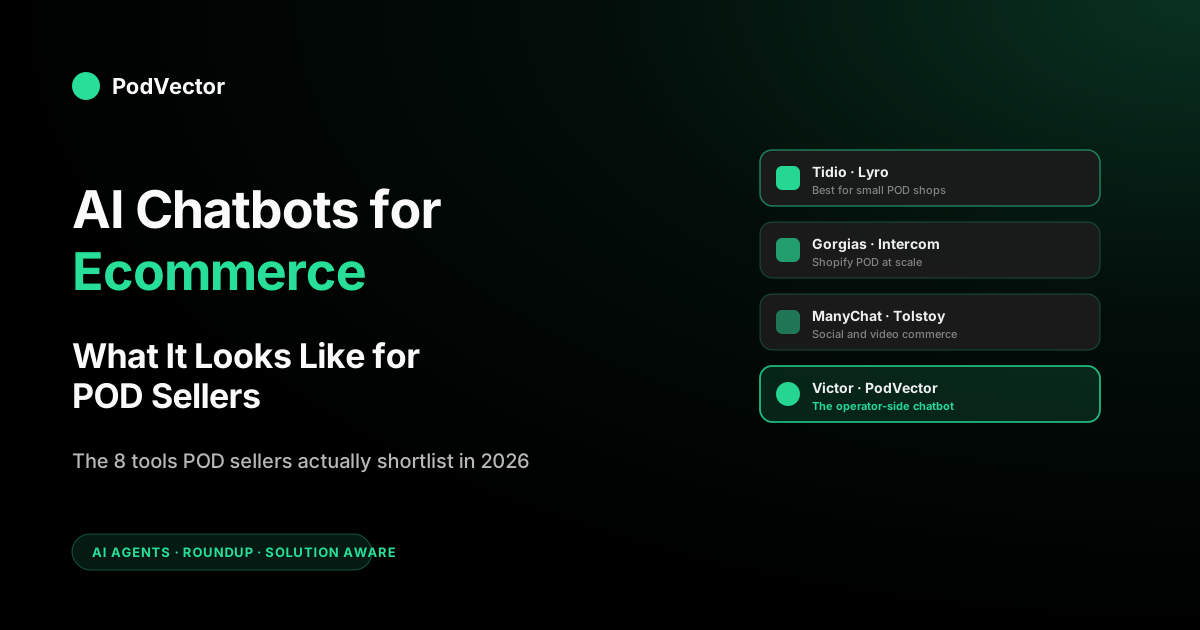
Quick Answer: The best AI chatbots for ecommerce in 2026 are Tidio, Gorgias, Intercom, Shopify Sidekick, ManyChat, Tolstoy, Chatfuel, and — on the operator side — PodVector AI's Victor. For print-on-demand stores the right pick depends less on raw feature count and more on how cleanly the chatbot integrates with your Printify or Printful data. A generic bot that can't quote production time for a specific variant will lose conversions the moment a real POD shopper asks a real POD question.
Why POD sellers need a different chatbot shortlist
Most "best AI chatbot for ecommerce" roundups treat every store the same — apparel brand, beauty brand, electronics reseller, POD side hustle. That's a problem, because the questions a print-on-demand shopper asks sit in a different distribution than the ones a regular DTC shopper asks.
More sizing questions. More "will the print look like the mockup" questions. More questions about shipping windows that change per SKU because one product ships from Texas and another from Lithuania.
A generic ecommerce chatbot is trained on the generic ecommerce question distribution. It handles carts and order tracking fine.
It falls apart the moment a shopper asks something only a POD-aware bot can answer — which is more often than you'd think. The best AI chatbots for POD sellers are the ones with either (1) a real Printify or Printful integration or (2) a data layer flexible enough that you can wire one in without a migration project.
If you want the deeper framing on how these bots work under the hood, our explainer on AI chatbots for ecommerce walks through the architecture. This piece is the shortlist: the actual tools you'd shortlist if you were buying this week.
The two kinds of chatbots a POD store actually needs
Before the list, a distinction most roundups blur past. POD stores run two categories of conversational AI, not one:
- Shopper-facing chatbots. They live on your storefront, talk to your customers, and drive conversion lift and ticket deflection. This is the category every other roundup covers. Tidio, Gorgias, Intercom, ManyChat all fit here.
- Operator-facing chatbots. They live in your back office, talk to you (the merchant), and answer business questions like "which SKUs lost money last week after ad spend and fulfillment." Different buyer, different ROI math, different tool category. Victor, Triple Whale's Moby, and Polar's Hera sit here.
Most POD sellers running over $10k/month need both. The first converts more shoppers into customers; the second helps you figure out which products and campaigns are actually profitable so you stop reinvesting in losers. The comparison chart at the end of this piece shows which tool covers which side.
8 best AI chatbots for POD stores in 2026
1. Tidio (Lyro) — best for small POD shops starting out
Tidio's AI agent, Lyro, is the default pick for POD stores under $50k/month. You can install the Shopify app in 10 minutes, point it at your help center, and have a working chatbot by dinner.
Lyro handles order tracking, sizing FAQs, product recommendations, and cart recovery out of the box. Pricing starts around $29/month for the base plan, $39/month once you turn Lyro on.
Where it wins for POD: fast setup, cheap, fluent in Shopify data. The product-recommendation engine uses your catalog out of the box, so variant-level questions get sensible answers without configuration.
Where it struggles: no native Printify or Printful integration means the bot can't quote production time for a specific variant. Shipping ETAs are approximate, not live. Once your ticket volume climbs past a few hundred a week, Lyro's hit rate starts dropping relative to a purpose-built POD integration.
2. Gorgias — best for Shopify POD stores scaling into real ticket volume
Gorgias is the ecommerce helpdesk most Shopify DTC stores land on once they're doing serious volume. The AI Agent layer launched in 2023 and has matured into a credible first-line responder. It reads your Shopify order data, drafts responses, issues refunds against a rules engine you set, and hands off to a human when it's not confident.
Where it wins for POD: deep Shopify integration, excellent macro system, strong handoff UX. The AI Agent's ability to act (issue a refund, create a draft order, update a shipping address) rather than just talk is the most useful thing in this category.
Where it struggles: pricing jumps fast — $10/ticket once you get past the base tickets — so for very high-volume POD stores the math can hurt. No native POD supplier integration; you'll build the Printify or Printful data layer yourself or via a partner app.
3. Shopify Sidekick and Shopify Magic — best for Shopify-native workflows
Sidekick is Shopify's first-party AI assistant for merchants; Magic is the content-generation layer that shows up across the admin. For POD stores already deep in the Shopify ecosystem, the main advantage is there's nothing to install and the data access is native. Sidekick can answer questions about your shop in plain language: "which products are trending this week," "draft a discount for my bestsellers," "set up a campaign for Father's Day."
Where it wins for POD: zero setup, free on your existing plan, and the data access is straight into Shopify's core. Great for the operator-side "help me navigate my admin faster" use case.
Where it struggles: it's not a shopper-facing chatbot. Sidekick is for you, not your customers. If you came here looking for a store widget, this isn't it. It also doesn't cross the Shopify boundary — it won't read your Printify cost data or your Meta ad spend.
4. Intercom (Fin) — best for POD brands at scale
Fin is Intercom's AI resolution agent and the one most serious support teams benchmark against. It reads your help center, your product catalog, and your historical ticket data, then resolves tickets autonomously. Intercom charges $0.99 per resolution, which aligns the vendor's incentives with yours in a way seat-based pricing doesn't.
Where it wins for POD: highest autonomous-resolution rate in the category when the knowledge base is well-maintained. Strong analytics on where the bot is failing, so you can fix the gaps. The pay-per-resolution model works well for POD stores with seasonal spikes.
Where it struggles: Intercom is expensive to even sit on — the platform itself runs hundreds a month before resolutions. For a POD store doing under $100k/month you're probably better off on Tidio or Gorgias. No native POD supplier integration.
5. ManyChat — best for Instagram and TikTok POD sellers
ManyChat isn't really a "storefront" chatbot — it's a social-commerce automation platform that lives on Instagram DM, Messenger, WhatsApp, and TikTok. If you drive most of your POD sales from organic Reels or paid Meta ads, ManyChat is how you turn DM replies into conversions. AI layering on top of the rule-based flows lets you do intent detection without building a decision tree.
Where it wins for POD: where POD shoppers actually live — on Meta platforms. Best-in-class for Instagram DM conversion flows ("comment SHIRT to get the link"). Pricing starts free and scales reasonably.
Where it struggles: not a support chatbot. If you need a widget on your Shopify store answering order-status questions, ManyChat isn't it. You'd pair it with Tidio or Gorgias on the store side.
6. Tolstoy — best for shoppable-video POD brands
Tolstoy started as a shoppable-video platform and added a conversational AI layer that sits on top of the video experience. For POD brands leaning into TikTok-native content or Reels-driven discovery, the video-plus-chat combo converts differently than a traditional chat widget. You can embed a Tolstoy storefront flow where the shopper watches a product demo, asks a question in chat, and gets an answer tied to the exact frame.
Where it wins for POD: video-native discovery pairs well with print-on-demand apparel where "show don't tell" is the whole game. Virtual try-on features land well for tees and hoodies where sizing is the purchase blocker.
Where it struggles: it's a narrower use case. If your store isn't leaning into video, Tolstoy's value collapses to a generic chat widget that costs more than the alternatives.
7. Chatfuel — best for Meta-heavy POD operators
Chatfuel is the Meta-focused cousin of ManyChat, with heavier emphasis on WhatsApp Business and full conversational workflows. The AI layer can generate product recommendations, handle ordering inside WhatsApp, and route escalations cleanly. For POD sellers running internationally — WhatsApp is still the dominant chat app across Latin America, India, and much of Europe — Chatfuel covers what ManyChat misses.
Where it wins for POD: WhatsApp commerce is the strongest of any tool in this list. Meta Verified badge support, click-to-WhatsApp ad funnels, built-in catalog browsing inside the chat thread.
Where it struggles: the storefront-widget story is weaker than Tidio or Gorgias. If your traffic is US-dominant and web-first, this isn't your tool.
8. Victor (PodVector AI) — best AI chatbot for POD operators, not shoppers
Everyone else on this list talks to your customers. Victor talks to you.
Ask it "which products lost money last week after Printify fulfillment costs and Meta ad spend," and it answers in plain English, with your orders, supplier costs and ad spend all pulled together and already matched up for you. It's the kind of AI help most POD sellers don't realize they need until they spend a Saturday trying to pull the same answer out of Shopify and Printify by hand.
Where it wins for POD: purpose-built for print-on-demand. Reads itemized Printify and Printful costs per order, reconciles against Shopify payouts and your Meta and Google Ads spend. No dashboard to configure and no charts to read — you just ask questions in plain English and Victor runs the store's numbers for you, the way a sharp operator would.
Where it struggles: it's not a customer-facing widget. Victor is the AI employee, not the support bot. You'll want both: one of the seven above for your shoppers, Victor for the questions only you need answered.
Comparison at a glance
| Tool | Category | Best for | POD-native? | Starting price |
|---|---|---|---|---|
| Tidio (Lyro) | Shopper-facing | Small POD shops starting out | No (Shopify-aware) | $29/mo + Lyro add-on |
| Gorgias | Shopper-facing | Shopify POD stores scaling ticket volume | No (Shopify-native) | $10/mo + per-ticket |
| Shopify Sidekick | Operator-facing (Shopify-only) | Shopify-native admin tasks | No | Free with Shopify plan |
| Intercom (Fin) | Shopper-facing | POD brands at scale | No | ~$300/mo + $0.99/resolution |
| ManyChat | Social commerce | Instagram/TikTok POD sellers | No | Free, paid from $15/mo |
| Tolstoy | Shopper-facing (video) | Shoppable-video POD brands | No | Free, paid from $79/mo |
| Chatfuel | Social commerce | Meta/WhatsApp-heavy POD | No | Free, paid from $15/mo |
| Victor (PodVector AI) | AI employee | POD operators on Shopify + Printify/Printful | Yes | Free trial |
How to pick the right chatbot for your store
A decision tree that actually resolves instead of listing feature checklists:
- Under $30k/month in revenue? Start with Tidio. The ROI on a more expensive tool isn't there yet. Pair it with Victor on the operator side when you want to actually understand your P&L.
- $30k–$300k/month? Gorgias for the storefront, ManyChat for social, Victor for the back office. This is the sweet spot the three best-in-class tools were priced for.
- Over $300k/month or complex ticket routing? Intercom Fin for resolution volume, Gorgias or Front for the helpdesk layer, Victor for operator analytics. Intercom's pay-per-resolution math starts to look good at this scale.
- International, WhatsApp-heavy? Chatfuel over ManyChat. Same category, different regional strength.
- Video-native brand? Tolstoy for the shoppable-video storefront, plus one of the traditional tools for support-desk tickets.
The tool you pick matters less than you'd think. What really moves the outcome is making sure whichever bot you choose has clean access to your product catalog, current size charts, live Printify or Printful production times, and accurate cost per product. Our guide to AI agents for ecommerce analytics covers the same clean-data problem, but for running the business side of your store instead of chatting with customers.
POD-specific chatbot use cases
Your tool choice should map to the use cases you're trying to cover. The ones with the biggest POD impact:
- Variant-level sizing recommendations. "I'm 5'10" 175lb, what size in the Bella+Canvas 3001?" A good chatbot pulls the brand-specific size chart, not a generic one. Top conversion-recovery use case for POD apparel.
- Live production-time quotes. "If I order today, when does it arrive?" Needs real-time access to Printify or Printful's production queue plus your shipping zones. Most chatbots default to a generic range and get it wrong half the time.
- Misprint and replacement handling. Shopper uploads a photo of a bad print, the bot files the replacement claim with your supplier and issues the replacement without a human. Massive deflection opportunity, most generic bots aren't wired for it.
- Margin-aware cart recovery. The bot offers a discount to save the cart, but only within the profit margin you've pre-authorized per SKU. Needs a clean cost-per-SKU layer — the same data POD profit calculation depends on.
- Design personalization intake. For made-to-order POD (custom names, custom dates), the bot can handle the personalization flow inside chat instead of forcing the customer to a separate form. Reduces drop-off sharply for personalized products.
- Operator analytics queries. "Which campaigns lost money last week?" "Which variants are my highest-margin?" The Victor use case — not something a shopper-facing chatbot is built for.
From chatbot to AI agent: what's next
The line between "AI chatbot" and "AI agent" is dissolving. A chatbot today answers questions; an AI agent takes actions on your behalf. The best tools on this list are already crossing that line — Gorgias's AI Agent issues refunds, Fin creates draft orders, Victor will soon take actions like adjusting campaign budgets or pausing losing SKUs. AI agents for ecommerce walks through that shift in detail.
What this means for your buying decision: don't buy a chatbot that's only good at talking. Buy one with a credible path to acting.
The bigger shift the 2026 roundups are all circling is agentic commerce — the checkout itself moving off the search bar and into the conversation. Transactional bots now complete a purchase inside the chat thread, and AI shopping agents (the ones living in ChatGPT, Gemini, and Perplexity) increasingly do the browsing on the shopper's behalf. For POD that cuts two ways: a shopper-facing bot that can finish the sale in-thread captures conversions a static product page would lose, and your catalog data needs to be clean enough for an external shopping agent to quote your variant, price, and shipping window correctly — or it gets skipped. The economics are why everyone's moving: an AI interaction runs roughly $0.50 against about $6 for a human-handled one, and a well-grounded bot deflects up to 80% of routine tickets. Both numbers only hold when the bot is grounded in accurate POD data — the same cost-per-SKU and live production-time layer the operator side depends on.
The tools whose roadmaps explicitly name "autonomous resolution" or "agent actions" are the ones worth betting on for 2026 and beyond. The ones still talking about "conversational UX" in isolation are about to feel dated.
For a broader look at the tool shift, Tolstoy's 2026 roundup covers ten of the same platforms above from a video-forward angle, and our pillar on AI analytics for print-on-demand covers the operator side of the same transition.
FAQs
What's the best AI chatbot for a small POD store on Shopify?
Tidio, for most cases. It's the fastest to set up, cheapest to run, and covers the majority of POD shopper questions without much configuration. Pair with Victor for the operator side when you want real answers about your P&L.
Can AI chatbots handle POD-specific questions like variant colors and Bella+Canvas sizing?
Only if you feed them the right data. Out of the box, most generic chatbots default to reading your product descriptions, which aren't detailed enough. The bots that handle POD-specific questions well are ones configured with the brand-specific size charts, the variant-level product photos, and the live Printify or Printful production data.
How much should a POD store expect to spend on an AI chatbot?
For a POD store doing $10k–$100k/month in revenue, $30–$200/month is the realistic range. Tidio and ManyChat at the low end, Gorgias in the middle. Intercom's $300+/month base makes more sense once you're past $100k/month. Victor's operator-side pricing is separate — it's a different buyer (you, not your customer).
Do I need one chatbot or several?
Most POD stores over $30k/month end up with two tools: a storefront chatbot (Tidio or Gorgias) plus a social-commerce chatbot (ManyChat or Chatfuel). The operator-side is a separate third category — that's where Victor fits. Three tools, three different jobs, no overlap.
What's the difference between an AI chatbot and an AI agent?
A chatbot talks — it answers questions in a conversational UI. An AI agent acts — it takes actions on your behalf against tools, APIs, and your data. The best 2026 chatbots are increasingly agentic. For POD specifically, the shopper-facing chatbot and the AI employee are still distinct buying categories even if they use similar underlying models.
Will an AI chatbot replace my customer-support team?
No. It will deflect the 60–80% of tickets that are routine — order status, sizing, shipping, simple replacements — and free your team to handle the 20–40% that need human judgment. POD stores that try to fully automate usually see CSAT drop and end up rehiring within 90 days.
How do I know if my AI chatbot is actually working?
Track conversion lift on engaged sessions (sessions that talked to the bot vs sessions that didn't), ticket deflection rate (percent resolved without human escalation), and post-conversation CSAT. Aim for 10%+ conversion lift within 60 days, 60–80% deflection, 4.0+ CSAT. Below those numbers, the data layer usually needs work before the bot does.
Does Shopify Sidekick replace the need for a separate chatbot?
No. Sidekick talks to you inside your Shopify admin — it's an employee tool, not a shopper tool. You still need a separate chatbot on your storefront. For the same reason, Sidekick doesn't replace Victor either: Sidekick is limited to what's inside Shopify, while Victor reads across Shopify, Printify or Printful, Meta Ads, and Google Ads for the full POD P&L picture.
Pick a chatbot for your shoppers. Pick Victor for yourself.
You need one of these tools for your customers. You also need one for the questions you ask about your business — "which SKUs lost money last week?" — that no storefront chatbot can answer. Victor is the AI employee for POD, wired to live Printify and Printful cost data and warehouse-backed attribution.
Try Victor free