
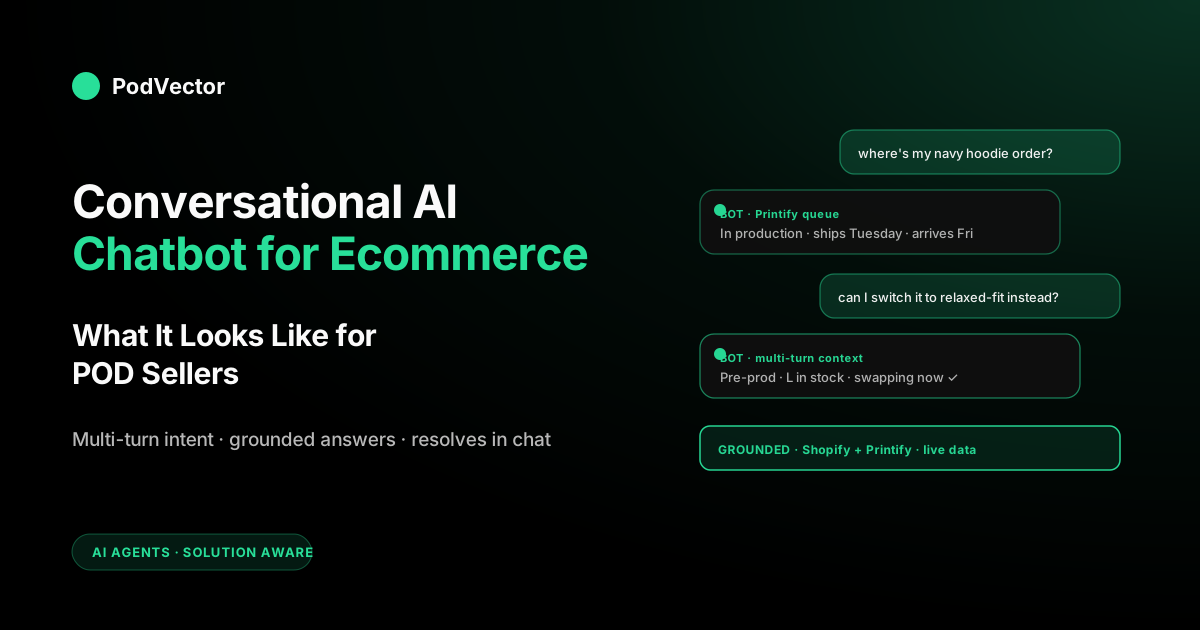
Quick Answer: A conversational AI chatbot for ecommerce is a chatbot that understands intent, holds a multi-turn dialogue, and grounds its answers in your live store data — instead of running a fixed if/then script. For a print-on-demand seller, that means a shopper can ask "where's my order, and is the navy hoodie still going to arrive before Christmas?" and the bot resolves both questions against Shopify and the Printify or Printful production queue without forcing the shopper through a menu.
The hard part isn't the AI model. It's whether the chatbot actually knows your POD business — supplier delivery times, sizing that depends on the blank product, mockup-vs-reality disclaimers, and your made-to-order refund rules.
What "conversational" actually means in 2026
Five years ago, "conversational chatbot" was marketing for any bot that sent a sentence instead of a button. The bar has moved. In 2026, when a vendor calls a product a conversational AI chatbot, they mean four specific capabilities — and you should hold them to all four.
- Intent detection without menus. The shopper types in their own words. The bot classifies what they want — order status, return, sizing, refund, product question — without forcing them to pick from a list.
- Multi-turn context retention. If the shopper said "the navy one" two messages ago, the bot still knows which product they mean when they ask "what size for a 6'1" 195lb guy?"
- Grounded generative answers. The bot looks up the answer in your data — product catalog, order record, return policy — and writes a sentence based on what it found, instead of pasting a canned response.
- Graceful fallback and handoff. When the bot isn't confident or when policy requires a human, it escalates with full conversation context attached, not a fresh ticket.
Anything missing one of those four is a glorified FAQ widget. The reason this matters is shopper expectation: the same person asking your bot a question has used ChatGPT this week. If your bot feels noticeably worse than that baseline, the conversation gets abandoned and the support ticket gets opened anyway — meaning you paid for the bot and still ate the human cost.
One more shift to watch for in 2026: most vendors have stopped saying "chatbot" entirely. Gorgias, Bloomreach, Rep AI, and Cognigy now market the category as conversational (or "agentic") commerce — the framing being that the bot doesn't just answer, it acts: edits the order, issues the refund, applies the discount, books the exchange. That's the real bar in 2026. A bot that can talk but can't take an action against your store is last-generation, whatever the vendor calls it. Adoption has caught up to the hype — roughly 85% of retail and ecommerce businesses now run some form of chatbot — so "do I need one" has quietly become "is mine actually resolving things."
Conversational AI vs scripted chatbots — the practical difference
The fastest way to see the gap is to put a real shopper question through both styles.
Shopper question
"Hey, I ordered a black tee Saturday, can I change it to the relaxed-fit instead before it ships?"
Scripted bot
- Bot: "What can I help you with? 1. Order status 2. Returns 3. Other"
- Shopper picks 3.
- Bot: "Please describe your issue."
- Shopper retypes their question.
- Bot: "I'll connect you with a human."
Time to resolution: 10+ minutes (queued behind every other ticket). Shopper experience: friction. Your cost: a full human ticket.
Conversational AI bot
- Bot recognizes intent (order modification) and entity (relaxed-fit variant) in one pass.
- Looks up the order, checks Printify or Printful production status — order is still in pre-production, modification is allowed.
- Confirms variant availability in the customer's size.
- Issues the swap, sends a confirmation, updates Shopify line items, and re-fires the supplier order.
Time to resolution: under 60 seconds. Shopper experience: feels like the brand is on top of things. Your cost: roughly the per-conversation charge from your platform vendor — the industry benchmark sits near $0.50 per AI interaction versus about $6 for the same query handled by a human.
This is the gap conversational AI is actually closing. Not "answers the FAQ better" — that's table stakes — but "resolves a transaction without a human in the loop." Every percentage point of that resolution rate is real money for a POD store, where support cost compresses already-thin margins.
How a conversational AI chatbot works under the hood
Strip the marketing and the architecture is consistent across vendors. Five things happen between the shopper hitting Send and the bot replying.
- NLU pass. The model parses the shopper's message into an intent (e.g.
change_order_variant) plus entities (order ID inferred from session, product, target variant, size). - Context lookup. The bot pulls the relevant data — order record from Shopify, production status from the supplier API, customer profile, return policy — and assembles it into a prompt context.
- Tool selection. If the request requires action (issue refund, edit order, send replacement), the bot picks from a registered set of tools (functions the platform allows it to call).
- Generative response. The AI writes an answer based on your store's real information, in your brand voice, and shows clearly what it checked or did to get that answer.
- Confidence check and handoff. If the model's confidence falls below a threshold, or if the intent is on a "always escalate" list (chargebacks, legal complaints), the bot routes the conversation to a human with full transcript attached.
The five steps look the same on every modern platform — Gorgias's AI Agent, Tidio's Lyro, Intercom's Fin, Botpress, Ada. What differs is the depth of step 2 (context lookup) and the breadth of step 3 (tool inventory). For more on the platform layer underneath all of this, see our guide to AI chatbot platforms for ecommerce and our guide to AI chatbot solutions for ecommerce.
Five use cases where it earns its keep on a POD store
The Sprinklr and Cognigy roundups list use cases that mostly assume a stocked-inventory ecommerce model. Here's what actually moves revenue or saves cost on a POD storefront.
1. Pre-purchase sizing assistance
Sizing is the single biggest pre-purchase blocker on POD apparel. Different blanks (Bella+Canvas 3001, Gildan 64000, Next Level 6210, Stanley/Stella, AS Colour) fit differently.
A conversational bot that knows which blank is behind each SKU and can ask the shopper for height/weight/preferred fit and recommend a size — citing the correct size chart — converts at materially higher rates than a static size chart link. Average lift seen on Shopify Plus stores running this flow: 8–14% conversion rate on the sized SKU.
2. Order status with supplier ETA
The most common support ticket on every POD store is "where's my order?" — and it's the one Shopify's own status page handles worst, because the order sits in "unfulfilled" until the supplier ships. A conversational bot that pulls Printify's or Printful's production queue and translates "in production, expected to ship Tuesday" into a one-line answer for the shopper takes 60–80% of those tickets off the human queue. For more on the upstream cost side of this same data, see our complete guide to Printify costs, fees and discounts.
3. Defect refund routing
POD orders are made-to-order; they don't get returned to inventory. A conversational bot can ask for a photo of the defect, classify it (print misalignment, color drift, fabric issue), check the supplier's defect policy, and either issue a free replacement, a refund, or escalate to a human for a borderline call — all inside the chat window. Done well, this kills 80% of the back-and-forth a human would otherwise eat.
4. Cart-abandonment recovery as a conversation
Instead of an automated email blast, the bot pings the shopper from where they left off ("Hey, you were looking at the navy heavyweight in L — is the size what stopped you?") and answers whatever the actual hesitation was. Conversion rates on conversational recovery beat email recovery by 2–4× in the studies the platform vendors publish; the catch is that the bot needs a channel the shopper actually opens (Messenger, WhatsApp, IG DM) — email recovery still wins on raw reach.
5. Post-purchase upsell tied to design intent
When a shopper buys a graphic tee, the bot follows up 24 hours later through their preferred channel: "We noticed you bought the floral skull design — same artist just released a hoodie version, want to see it?" This works because the conversation is grounded on the actual design, not a generic "you might also like" widget. POD stores running design-aware post-purchase prompts see AOV lifts in the 6–12% range over a 90-day window.
POD-specific gotchas the generic guides skip
Most ecommerce chatbot guides — including the Botpress, Cognigy, and Sprinklr ones — assume a stocked-inventory store. POD breaks several of their default assumptions, and a conversational bot that doesn't know it will look stupid in the second message.
- Mockup-vs-reality. Your product images are CGI mockups; the actual print has drift, fabric hand, and color fidelity that the mockup can't capture. The bot needs language for "what arrives may vary slightly from the digital mockup" baked into the answers about color and detail — not as a disclaimer footer, as part of the conversation when relevant.
- Print-method context. DTG holds detail; DTF is more durable; embroidery has thread-count constraints; sublimation only works on poly. The bot needs to know which method is behind each SKU and explain the tradeoffs when a shopper asks "will this hold up in the wash?"
- Supplier-side delays. Production lead time isn't shipping time. A bot that quotes the Shopify shipping estimate without adding the supplier's production window will create complaints when the order arrives a week later than promised.
- No-restock returns. Standard ecommerce return flows assume the item goes back to inventory. POD items don't. The bot's refund logic needs to default to "refund without return shipment" for most defect cases, which is unusual enough that most platforms don't ship with it as a default.
- Per-order itemized cost. A POD order has a base cost, print cost, shipping, and Shopify/payment fees stacked per line item. If you ever want the bot — or a related analyst agent — to surface margin context internally, this data has to be itemized at order level. Most chatbot platforms don't pull it; an AI employee has to. More on the operator side in our complete guide to AI agents for ecommerce analytics.
- Multi-storefront brands. Many POD operators run several Shopify stores under one operator. A bot deployed per store loses cross-store context (a returning customer from your sister brand). The platform's multi-store handling matters more for POD than for single-brand DTC.
Real examples of conversational AI in ecommerce
The patterns from the big-brand case studies in the Sprinklr piece — Sephora's Virtual Artist, H&M's style assistant, Walmart's voice ordering, Shopify's Sidekick — translate into smaller, less glamorous versions on POD storefronts. A few representative deployments:
The 200-SKU artist apparel store
A POD operator selling band-merch tees and hoodies plugged Tidio Lyro into Shopify with a custom action that calls the Printify production API. The bot answers "where's my order" with a real ETA (production status + carrier ETA), and routes design-defect claims through a photo upload + automatic replacement order. Result over 90 days: support ticket volume cut roughly in half; AOV up because the bot can suggest related designs from the same artist.
The seasonal holiday-niche store
A POD seller running a Halloween-themed store had a Q4 support spike that killed margins every year. They switched on Gorgias's AI Agent ahead of October with custom rules for Printify production lead times.
The bot handled 70% of "will it arrive by Halloween?" questions with the actual supplier ETA, and escalated only the borderline cases. Net: same revenue, materially fewer reshipped orders for shoppers who wouldn't have gotten theirs in time.
The custom-product personalization store
A POD store selling personalized name/date apparel used Botpress with a custom Printful integration. The bot validates personalization input live ("you've entered 24 characters; the design supports up to 18 — want to shorten?"), then submits the corrected order. Cuts the personalization error rate (printed wrong, refunded) by 60–80%, which is the single biggest hidden cost in custom POD.
The cross-channel social brand
A POD operator with most of their sales coming through Instagram DMs deployed ManyChat with conversational AI on the IG channel and a separate Tidio install on the website. Same product knowledge, different surface. They report the IG bot handles roughly 40% of pre-sale questions before the shopper ever clicks through to Shopify, which compresses the funnel materially. Because modern conversational AI translates in real time, the same bot answers a German shopper's sizing question in German and a US shopper's in English off one knowledge base — a real edge for POD stores that sell internationally without a multilingual support team. Cognigy's published Mister Spex deployment is the at-scale version of this: one AI agent automating 70% of identity-verification queries and 52% of "where's my order" tickets across channels and languages.
The high-AOV embroidered goods store
A POD seller with $80+ AOV (embroidered jackets, premium hoodies) needed a higher-touch conversation than a default chatbot. They used Intercom's Fin with a curated knowledge base on embroidery specs and care, plus easy handoff to a human for orders over $200.
The bot covers the routine questions; humans handle the consideration moments. AOV held because the bot didn't cheapen the experience.
How to deploy one without breaking your storefront
The vendor's "10-minute install" pitch leaves a lot out. A realistic POD-specific rollout:
- Audit your data. Are your product descriptions blank-aware? Are size charts on the product page or buried? Is your Printify or Printful account cleanly tied to Shopify? The bot can only ground on what's accessible.
- Pick a platform that supports custom actions. You'll need to connect Printify or Printful yourself through custom integrations — almost no platform includes this out of the box. See our overview of AI chatbots for ecommerce and our Shopify-specific deep dive for platform comparisons.
- Build the top 10 conversation flows manually. Sizing, shipping ETA, defect refund, design change request, order status, payment failure, discount code, return policy, custom personalization, gift card. Tune each in your brand voice before turning the widget on.
- Test the supplier integration end-to-end. Place a real test order. Ask the bot for status. Confirm it pulls the supplier production state, not the Shopify "unfulfilled" default.
- Soft launch on 20% of traffic. Most platforms support a traffic split. Watch conversion lift, deflection rate, CSAT, and Lighthouse LCP daily for two weeks. Fix the top three failure modes.
- Ramp to 100% only after the metrics hold. If conversion lift is flat or LCP regressed more than 0.3s, pause and tune before scaling.
For a more detailed rollout that mirrors the platform-level decisions, see our deep dive on AI chatbots for ecommerce websites.
Metrics that prove it's working
Vendor dashboards will throw twenty metrics at you. Four matter for a POD store:
- Conversion lift on engaged sessions. Sessions that interacted with the bot vs comparable sessions that didn't, same traffic source, same SKUs. Target 8%+ lift inside 60 days. Anything less, the bot isn't carrying its weight.
- Deflection rate. Conversations that resolved without escalating to a human. For routine flows (status, sizing, returns), 70%+ is reasonable; under 50% means the bot is mostly a friction-adding intake form.
- CSAT. Post-chat rating. Target 4.2+/5. A bot that resolves issues but feels rude shrinks repeat-purchase rate, which is hard to recover.
- Lighthouse LCP impact. Bot widgets are heavy. Run Lighthouse before and after install. If LCP drops more than 0.3s, the bot is costing you organic traffic. Negotiate optimizations or switch.
Ignore "total conversations handled" and "AI response rate" — they're vanity. A chattier bot inflates both numbers without resolving anything.
Conversational chatbot vs AI employee — don't conflate them
The most expensive mistake POD operators make in this category: assuming the conversational chatbot they install for shoppers will also tell them which products are profitable. It won't.
A conversational AI chatbot for ecommerce talks to your customers. Its data is customer-facing — orders, products, shipping, policies. Its job is to answer shopper questions and resolve transactions. Vendors: Gorgias, Tidio, Intercom, Botpress, Ada, ManyChat.
An AI employee talks to you, the operator. Its data is business-internal — itemized supplier costs, ad spend, margin per SKU, customer LTV by segment. Its job is to answer your questions about the business in seconds instead of waiting on a spreadsheet rebuild. Victor (PodVector AI) sits in this category, alongside Triple Whale Moby and Polar.
You probably need both. They're not substitutes.
Victor sees your exact Printify and Printful costs next to every Shopify order and every dollar spent on Meta and Google ads. That means his answers are based on the real profit or loss on each order — something a customer-facing chatbot can never see. Victor is also different in what he does, not just what he says: he doesn't just tell you which campaigns lost money last week — with your approval, he pauses them.
The customer chatbot's roadmap is more conversation, deeper context, more channels. Different tools, different jobs.
FAQs
What's the difference between a conversational AI chatbot and a regular chatbot?
A regular chatbot runs a fixed script — buttons, menus, decision trees. A conversational AI chatbot understands free-text intent, holds multi-turn context, and writes grounded responses from your live data. The shopper experience is the difference between filling out a form and talking to a knowledgeable rep.
Do conversational AI chatbots work with Shopify?
Yes — every major platform (Gorgias, Tidio, Intercom, Botpress, Ada, ManyChat) has a Shopify app or integration. The depth varies a lot. Gorgias and Tidio go deepest; Botpress is the most flexible if you want to wire custom actions. Native Shopify integration is the floor; how well the bot uses it is the differentiator.
Will a conversational chatbot understand my Printify or Printful orders?
Not natively. Almost no chatbot platform ships with Printify or Printful integrations.
The standard workaround is exposing a custom API action — an endpoint that calls the supplier API — and registering it as a tool the bot can call. A few hours of developer work; once it's done, the bot can answer "where's my order" with a real production ETA instead of "your order is unfulfilled."
How much does a conversational AI chatbot for ecommerce cost?
Tier 1 starter platforms (Tidio, ManyChat) start at $20–$100/month with metered AI. Tier 2 growth platforms (Gorgias mid-tier, Tidio Lyro, Intercom Pro) sit at $200–$1,000/month with much deeper AI usage included.
Tier 3 enterprise (Gorgias enterprise, Intercom Premium, Ada) starts around $2,000/month and goes up. For most POD stores in the $50k–$500k MRR range, budget $200–$500/month for the first year.
Can a conversational chatbot replace my support team?
It can absorb 50–80% of routine ticket volume — sizing, shipping ETAs, returns, design changes, order status — but won't replace humans for nuanced calls (defect borderlines, VIP orders, chargebacks, bulk inquiries). The realistic outcome is one person handling the volume that used to require three.
How fast does a conversational chatbot pay for itself on a POD store?
If you're paying $200/month and the bot deflects 50% of a 100-ticket-per-week support load (about 200 tickets/month), at $5 of human support time per ticket the math works on day one. The bigger payoff usually shows up in conversion lift on pre-purchase sizing questions — that's where conversational beats scripted by the largest margin.
Is Victor a conversational AI chatbot for ecommerce?
No — Victor is an AI employee for POD sellers. He answers your business questions ("which campaigns made money last week after fulfillment costs," "which SKUs are losing margin at current promo pricing") using your real Printify, Printful and Shopify data, not guesses.
The conversational chatbot on your storefront talks to shoppers; Victor talks to you. Different tools, different jobs — most POD operators end up with both.
What's the biggest mistake POD sellers make with conversational AI chatbots?
Installing a generic ecommerce chatbot that only looks at Shopify, then wondering why shoppers get the wrong shipping dates. For print-on-demand, the bot needs your supplier data too — Printify or Printful — or it will guess wrong almost every time. The second-biggest mistake is treating a chatbot's reports as the answer to "is my business profitable." That's a question for an AI employee like Victor, who looks at your orders, costs and ad spend together — not a basic chatbot.
Your conversational chatbot answers your shoppers. Victor answers your business questions.
Pick any of the platforms above for your storefront — they all handle conversational customer chat fine once you connect Printify or Printful. But none of them can tell you which campaigns made money last week after itemized fulfillment costs, or which SKUs are eroding your margin at current promo pricing. Victor can, because he sees the real profit on every POD order.
Try Victor free