
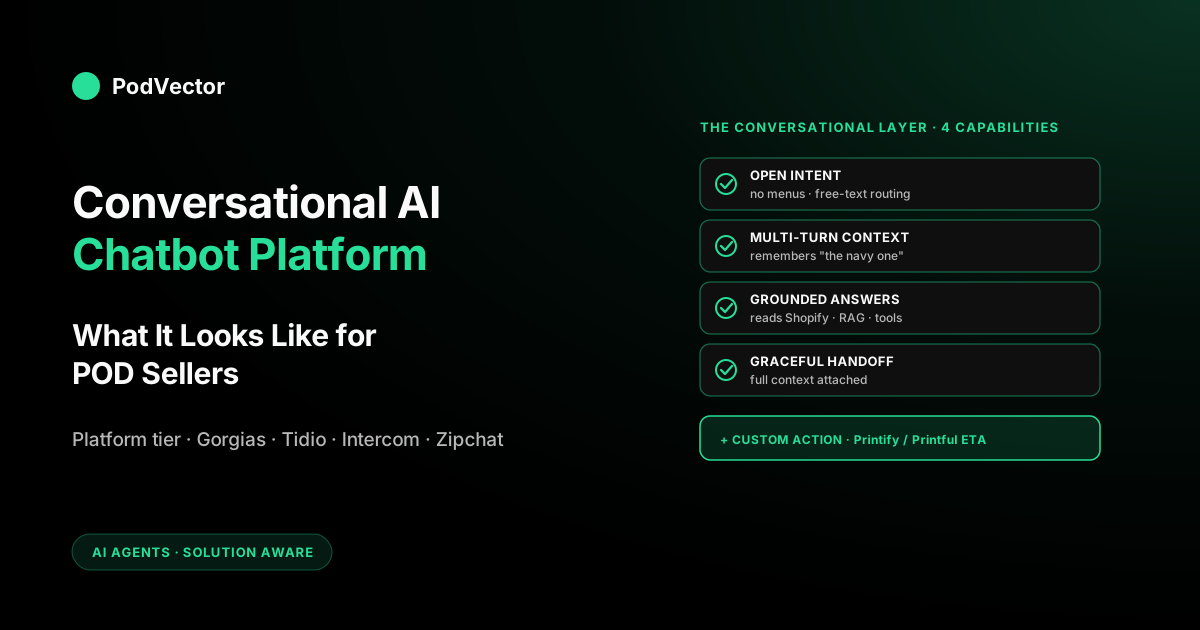
Quick Answer: A conversational AI chatbot platform for ecommerce is a single-vendor stack — model layer, data integrations, flow builder, multi-channel deployment, and analytics — where the conversational layer (open intent detection, multi-turn context, grounded generation, graceful handoff) is a first-class product capability rather than a marketing adjective. As of mid-2026 the category leaders have pushed past ticket deflection into agentic commerce: the bot now resolves and acts — cancels orders, issues discounts, upsells — inside the conversation. Gorgias shipped AI Agent 3.0 in Summer 2026.
For a print-on-demand seller, the platforms that actually deliver — Gorgias, Tidio (Lyro), Intercom (Fin), Zipchat, Rep AI, ChatBot (by Text), Botpress — are also the ones flexible enough to wire in Printify and Printful data, so the bot stops answering shipping questions from an empty Shopify fulfillment field.
The platform decision is roughly 10% LLM choice and 90% data access. Pick on what data the bot can read and act on, not on the model behind it.
What a "conversational AI chatbot platform" actually is
Two words in that phrase do most of the work, and vendors swap them in and out depending on what they want to sell. "Platform" is the commercial unit — a single-vendor subscription that gives you model access, data connectors, a flow builder, multi-channel deployment, and reporting, instead of stitching those pieces together yourself. "Conversational AI" is the capability tier — the difference between a bot that holds a real dialogue (intent detection, multi-turn memory, grounded generation, graceful escalation) and a bot that runs a scripted decision tree with an LLM bolted on for the fallback.
A conversational AI chatbot platform is the intersection. You're buying a vendor stack where the conversational layer is treated as the product, not a feature flag.
The reason that distinction matters is that almost every legacy chatbot vendor has shipped an "AI upgrade" since 2023 — and most of those upgrades are still scripted flows with an LLM-generated answer on the last branch. True conversational platforms were either built post-2022 (Zipchat, Rep AI) or rebuilt their core (Gorgias's AI Agent, Intercom's Fin, Tidio's Lyro, ChatBot by Text). Telling those apart before you sign is the entire point of this guide.
For the adjacent framings — a conversational chatbot without the platform framing, or a service-wrapped version instead of self-serve — see our guide to conversational AI chatbots for ecommerce and guide to conversational AI chatbot services. This page is specifically about the platform cut: what you're committing to when you pick a self-serve conversational vendor as infrastructure.
The four conversational capabilities every real platform must deliver
If you ignore the vendor's feature list and look at what actually earns a "conversational AI" label in 2026, the bar is four things. A platform missing any of them is a chatbot platform with AI marketing, not a conversational AI platform.
- Open-ended intent detection. The shopper types their question in their own words, on any channel, without being pushed through a menu of pre-defined options. The platform classifies it into an intent the bot can resolve — or routes it to a human. No "press 1 for shipping, press 2 for returns" anywhere in the flow.
- Multi-turn context retention. If the shopper mentioned the navy hoodie three messages ago, the bot still resolves "the navy one" when they ask "what size for a 6'1" 195lb guy?" — without the shopper restating the product. Context survives across tool calls, channel switches (if supported), and session pauses up to a vendor-specific window.
- Grounded generative answers. When the bot answers a factual question — sizing, shipping, return policy, print method — it looks that answer up in your Shopify data, your Printify or Printful record, or your knowledge base, then generates a sentence from what it found. It doesn't hallucinate from pre-training. The platform surface for this is retrieval-augmented generation (RAG) plus custom tool-calling. As Tolstoy's 2026 chatbot guide puts it, "a chatbot is only as good as the data it can access."
- Graceful handoff. When confidence is low, policy requires a human, or the conversation hits an edge case the bot doesn't own, the platform escalates with the full transcript and tool-call history attached to the human agent's ticket. The shopper never has to repeat themselves.
Vendors routinely claim all four. Half of them are overstating, usually on the second and third. The evaluation section below walks through how to catch that on a demo before you pay.
The conversational AI platforms POD sellers actually encounter
The shortlist below reflects platforms appearing in multiple mid-2026 roundups — including Botpress's 2026 guide, the Rep AI blog's 2026 chatbot comparison, Tolstoy's 2026 list, and ChatBot.com's updated evaluation — viewed through the conversational-layer lens a POD seller actually needs.
Gorgias (AI Agent 3.0)
Shopify-native helpdesk with the most mature conversational layer in the SMB-to-mid-market band. Gorgias shipped AI Agent 3.0 in Summer 2026, positioning it to "turn browsers into buyers and automate routine support from one unified platform trained on your brand." Multi-turn context is strong; Shopify grounding — live order data, customer history, product catalog — is the deepest on the market among the helpdesk-first platforms. Custom actions let you wire in Printify or Printful endpoints for production ETAs, which most POD sellers will need.
Priced $60–$900+/month with AI resolution metered per ticket. Best fit for a POD store doing meaningful monthly revenue that wants deep Shopify grounding and wants the helpdesk and the AI in one place rather than bolted together.
Tidio (Lyro)
SMB-friendly platform with Lyro as the conversational layer. According to ChatBot.com's 2026 evaluation, Tidio with Lyro AI posts a resolution rate around 67% and uses conversation-based pricing. The flow builder is the most forgiving for non-technical founders, and Lyro's context retention is respectable on short conversations. Tidio also integrates with Meta channels — Messenger, WhatsApp, and Instagram — alongside live chat.
Grounding on Shopify live order data is shallower than Gorgias; custom actions exist but the developer experience is rougher. Good fit for a POD store under $100k MRR that values install speed over integration depth.
Intercom (Fin)
Enterprise-leaning support platform with Fin as the conversational AI. Consistently posts high deflection rates on large knowledge bases — partly because Fin's retrieval quality is strong, partly because the platform enforces strict grounding and will say "I don't know" rather than hallucinate.
Great for POD brands with a real help-center corpus. Shopify integration is shallower than Gorgias; you'll spend more engineering time on custom actions. Pricing trends toward $500+/month at meaningful scale.
Zipchat AI
Shopify-specific conversational platform built post-LLM. Pulls real-time order data, generates discount codes, recommends products from your catalog, and executes tasks during the conversation — closer to an agent than a chatbot. Resolution-based pricing. Worth a hard look for POD stores where the bot needs to recover carts and answer shipping questions in the same conversation without losing context.
Rep AI
Conversational AI built specifically as a Shopify sales assistant. Rep AI markets itself as an "agentic commerce platform" tuned for purchase-intent dialogues more than post-purchase support. The Rep AI blog's 2026 chatbot list places it first among Shopify tools "seeking both sales and support automation." Useful complement to a helpdesk-first platform, sometimes a full replacement for a pure-DTC POD store focused on conversion.
ChatBot (by Text)
No-code conversational platform whose AI agent trains directly on your product catalog and help articles, then answers routine questions in real time without scripted menus. According to ChatBot.com's own 2026 evaluation, its Text AI Agent posts a native Shopify integration and a 74% resolution rate with product recommendations surfaced as interactive cards. The build experience is the most approachable for a non-technical founder, but grounding on live order data and POD-specific custom actions is shallower than Gorgias or Zipchat. A reasonable starter for a small POD store that wants fast catalog-grounded answers before committing to a deeper helpdesk.
Botpress
Developer-first conversational platform with an open-source core and bring-your-own-model support. According to Botpress's own 2026 update, the platform has shipped over 750,000 AI agents and now offers an AI-native helpdesk for teams handling complex support operations. The most flexible of the group for wiring in bespoke Printify or Printful logic, but it assumes engineering capacity — this is not a one-click Shopify App Store install. The conversational quality is as good as the model you bring, which in 2026 is usually excellent.
YourGPT
An AI chatbot platform that trains on your knowledge base, supports multi-lingual chat, and offers a direct Shopify integration. Suited for stores that need multilingual coverage or want to build custom workflows on top of GPT-class models without the full engineering overhead of Botpress. The conversational depth is lighter than Gorgias or Zipchat but stronger than a generic scripted chatbot.
Ada
Enterprise conversational AI with strong guardrails, compliance tooling, and multi-brand support. Overkill for a single-brand POD store; the right tool if you operate multiple storefronts under one company and need audit trails the SMB-tier platforms don't ship. Six-figure annual commitment in practice.
ManyChat
Best-in-class on social channels — Instagram DM, Messenger, WhatsApp, SMS, Telegram. According to ChatBot.com's 2026 evaluation, ManyChat works with Instagram, WhatsApp, SMS, Facebook Messenger, and Telegram and integrates with Shopify. The conversational layer improved post-2023, but the platform is still strongest as a social commerce automation tool rather than a support-first AI. Right choice if your POD sales come primarily through Instagram; wrong choice if your Shopify storefront is the primary surface.
Octane AI
Shopify-specific platform built around conversational product-finder quizzes. Conversational in the sense that shoppers can type free-text answers, but the underlying flow is more structured than Gorgias's or Zipchat's. Worth the look if your POD catalog has hundreds of SKUs and the primary blocker is discovery, not support.
Alhena, Tolstoy, Oscar Chat
Three platforms gaining traction in 2026 mid-market roundups. Alhena leads for guided selling on complex catalogs; Tolstoy's AI Shopper brings video into product discovery for Shopify brands; Oscar Chat focuses on intent-driven sales conversations. All three are website-first and Shopify-compatible. None are POD-native, but they're worth evaluating if your primary gap is pre-purchase product discovery rather than post-purchase support.
Kayako, LivePerson, BotStar, Salesloft, Drift
These appear in most 2026 roundups. Kayako and LivePerson are enterprise-grade support suites with strong conversational layers, typically out of budget for a single-brand POD store. BotStar and Salesloft are more sales-ops oriented. Drift has pivoted largely into B2B sales; DTC POD is no longer its sweet spot. Evaluate them only if a specific workflow you have maps cleanly onto what they sell.
For side-by-side comparison rather than a profile-by-profile walk-through, see our best AI chatbot for ecommerce comparison. For the broader AI-tooling landscape POD sellers should be aware of, see the complete guide to AI tools for POD sellers.
What POD sellers need that generic buyers don't
Print-on-demand sits inside ecommerce but runs on different plumbing than a standard DTC brand. A conversational platform that looks fine on a Shopify demo will fail in predictable places on a POD store the moment a real shopper asks a real question:
- Supplier-aware shipping ETAs. "When will my order ship?" is answered from Shopify fulfillment status on a generic store. On a POD store, the Shopify fulfillment field is empty until the supplier ships — so the bot confidently answers "your order is still processing" when the production queue already shows it'll take several more business days. The platform needs a custom action that reads Printify's or Printful's production status for that specific order.
- Variant-aware sizing. Every POD blank (Bella+Canvas, Gildan, Next Level, AS Colour, Stanley/Stella, Champion) has a different fit, and sometimes the same brand has multiple cuts (relaxed, fitted, boxy). The bot's grounding layer needs to know which blank each SKU uses and which size chart to surface when asked "will a medium fit me?"
- Mockup-vs-reality honesty. POD mockups are CGI renders. What arrives at the customer has print drift, fabric hand, and color fidelity the mockup can't represent. A conversational bot that proactively sets expectations outperforms one that over-promises and ships a return.
- Print-method clarity. DTG, DTF, embroidery, sublimation, all-over print — each has different durability, color handling, washing behavior, and order economics. The bot needs to know which method is behind each SKU and explain the tradeoffs when asked "will this fade after 20 washes?"
- Refund routing for made-to-order goods. POD orders don't come back to inventory. The bot has to distinguish a print defect (replacement order, no return shipment) from buyer's remorse (refund or store credit, usually no return shipment either) and route each to the right policy. Generic platforms default to inventory-returnable logic.
- Pre- and post-purchase AI coverage. As Tolstoy's 2026 chatbot guide puts it, chatbots should handle both pre-purchase questions (fit, availability, product comparison) and post-purchase questions (order status, returns, address updates). POD stores have more complexity on both sides than standard DTC brands — the platform has to cover the full journey.
- Itemized cost awareness on the store owner's side. If you want to ask your own questions — like "what did my last 100 orders cost me?" — the system needs to show base cost, print cost, shipping, and Shopify fees for each order. No customer-facing chatbot does this on its own. That takes a separate tool. See our guide to contribution margin for ecommerce for the math behind that question.
None of the mainstream conversational platforms (Gorgias, Tidio, Intercom, Ada, Botpress) ship with native Printify or Printful integrations. The closest they get is generic Shopify fulfillment context. That means for a POD merchant, the platform choice is partly about which vendor's custom-action and RAG surfaces are flexible enough to inject POD-specific data without a rebuild every quarter.
For the cost-side breakdown that usually drives the merchant questions, see our Printify t-shirt cost and profit breakdown.
How to evaluate a platform's conversational layer (not its marketing)
Every vendor's landing page promises conversational AI. The fast way to catch the ones who don't actually deliver is a ten-minute demo protocol. Run these tests on any platform before you sign:
- The menu test. Send an ambiguous, free-text opening message — "hi i need help with my order" — and see whether the bot responds with a menu ("Please choose: 1. Order status 2. Returns 3. Shipping"). If it does, the conversational layer is branded over a decision tree. Move on.
- The pronoun test. Ask two consecutive questions where the second uses a pronoun or partial reference — "What sizes does the navy hoodie come in?" followed by "Is it available in medium?" — and see whether the bot resolves "it" to the hoodie without asking you to restate. Many "conversational" platforms fail here.
- The citation test. Ask a question that requires reading your data — "when does order 1028 ship?" or "what's your return policy on defective prints?" — and check whether the answer references your data source (order record, policy doc) or confabulates from general ecommerce knowledge. Grounded platforms will often show the source inline; ungrounded ones hedge with general language.
- The edge-case test. Ask something the bot can't resolve — "my package was left in the rain and the hoodie has water damage, what do I do?" — and watch the escalation. A good platform attaches full context to the ticket; a bad one hands off with a blank subject line.
- The real-action test. Ask a question that needs a live action — "can you give me a discount code for 15% off?" — and see if the bot actually creates a real Shopify discount code, or if it just tells you to contact support. This test is what separates a chatbot from an agent.
Ten minutes per platform. You'll eliminate three out of every five before you ever talk to sales. For a deeper look at how the underlying category is shifting from chat to action, see our guide on agentic AI for ecommerce.
Pricing tiers and what you're paying for
Conversational AI platform pricing clusters into three tiers. Understanding the tier matters more than comparing sticker prices.
Tier 1 — starter ($20–$100/month)
Tidio's entry plan, ManyChat's Pro tier, Botpress's cloud hobby plan. Conversational features are present but metered — limited monthly AI resolutions or model calls. Integrations are shallow. Suits a POD store at early revenue stages that's testing whether conversational AI moves the needle before committing. At this tier, expect to compromise on grounding depth and custom-action flexibility.
Tier 2 — growth ($200–$1,000/month)
Gorgias's mid-tier, Tidio's AI plan with Lyro, Intercom's growth plan, Zipchat's standard plan. AI resolution is included up to a reasonable monthly volume. Integrations are deep, custom actions are usable, reporting is actionable. The sweet spot for most POD stores in the mid-revenue band — this is where the conversion-lift math starts working clearly.
Tier 3 — enterprise ($2,000+/month)
Gorgias Enterprise, Intercom Premium, Ada, LivePerson, most custom Botpress builds. Dedicated CSM, SLA on response latency, multi-brand support, sandbox environments, audit trails. Overkill for a single-brand POD store. Necessary if you run multiple storefronts under one company or need compliance-grade controls.
The general rule: don't skimp on the platform if the bot's data access is gated by tier. A lower-priced plan with shallow grounding costs you the conversion lift every day it runs; a properly tiered plan with deep grounding earns its delta back in conversations that would have otherwise escaped to email.
Customer conversational platform vs AI employee platform
This is the single most common shopping mistake, and a POD founder tripping over it loses a month's worth of evaluation time. These are different categories with different buyers and different ROI math.
A customer conversational platform is deployed against your shoppers. It lives on the storefront, in Instagram DMs, in Messenger, in email. Its job is to answer product questions, recover carts, deflect support tickets, and convert browsing sessions. Vendors: Gorgias, Tidio, Intercom, Zipchat, Rep AI, ChatBot (by Text), Botpress, Octane AI, Ada, ManyChat. Buyer: marketing or support ops. Success metrics: revenue lift on engaged sessions, deflection rate, CSAT.
An AI employee platform is deployed against your business, for you the merchant. It lives in your dashboard. Its job is to read your live business data — Shopify, Meta Ads, Google Ads, Printify, Printful, Stripe — then propose and execute specific operations, such as repricing a product to a target margin, creating a discount, or flagging a margin-eating listing, asking for your approval before each move. Vendors: Victor (PodVector AI). Buyer: founder or ops. Success metric: decisions executed with confidence, margin recovered, time saved.
The usual failure mode: a POD founder reads that conversational AI lifts ecommerce revenue, installs a customer conversational platform, then wonders why it can't answer "which product is most profitable?" The platform can't, because that's not its job — it only sees the customer-facing catalog and order status, not your real costs and profit. Victor is built for the store owner's side: he brings together your Printify and Printful costs, your Shopify orders, and your Meta and Google ad spend, so the moves he suggests are grounded in your actual numbers. That's also why the checkout-side picture matters — see our ecommerce checkout conversion rate optimization guide for the revenue-side math that complements what Victor watches on the cost side.
More on the AI employee category in our complete guide to AI agents for ecommerce analytics and the complete guide to AI analytics for POD.
The short answer for most POD sellers: you need both. They're not substitutes. Budget them separately, evaluate them separately, and don't let a customer-chatbot vendor sell you on their reporting as a replacement for an AI employee.
How a POD seller should deploy one
A realistic rollout — not the "ten minutes to launch" the vendor pitches on the demo:
- Week 0 — data audit. Before picking a platform, audit what's available. Are your product descriptions variant-aware? Are your size charts live on the product page or buried in a collection footer? Is your Printify or Printful account cleanly connected to Shopify? Any conversational bot is only as good as the data its grounding layer can read. For the Shopify-side data hygiene that matters most, see our guide to Shopify Admin API store modifications and automation.
- Week 1 — platform pick and install. Install the app in Shopify, connect integrations, import existing help content as a knowledge base. Do not turn the widget on for live shoppers yet.
- Week 2 — flow and tone setup. Build the 5–10 most common conversation flows manually — sizing, shipping, order status, returns, design change requests. Tune the system prompt to match your brand voice. Run the five-test protocol from the evaluation section above against your own bot.
- Week 3 — POD-specific integration work. Wire in whatever custom actions you need for Printify or Printful — production ETAs, defect refund routing, print-method explanations. This is the work that differentiates your bot from every other Shopify store's. Budget one to two engineering days.
- Week 4 — limited launch. Turn the widget on for a portion of traffic (most platforms support split testing). Monitor conversion lift, deflection rate, CSAT, and Lighthouse LCP daily. Fix the top three failure modes before scaling.
- Weeks 5–8 — scale and tune. Ramp to 100%. Review transcripts weekly; every misstep is a knowledge-base or custom-action gap to close. Track the AI employee side separately — customer conversations will not tell you which campaigns are profitable or whether ad spend is eating margin. For that, see our guide on how to avoid ad fatigue and the related ad frequency guide.
Mistakes POD sellers make picking a conversational platform
- Buying on "AI" instead of "conversational AI." Every chatbot vendor has an AI checkbox. Not all of them pass the five-test protocol. Run it.
- Ignoring the grounding layer. A strong model grounded on empty data loses to a weaker model grounded on rich data. The majority of your evaluation should be on what data the platform can read, not on which model sits behind it.
- Assuming POD awareness is built in. It isn't. You have to build Printify or Printful integration yourself via custom actions or RAG.
- Optimizing for channel count. Every channel you enable is a flow you have to maintain. Start on one channel — your website — get it right, then expand.
- Confusing the customer bot with an AI employee. Different buyers, different ROI math, different data. Don't expect the shopper-facing bot to also answer your margin questions.
- Signing an annual contract before proving ROI. Every serious platform offers monthly billing. Use it for at least two months before you sign for the discount.
- Ignoring Lighthouse impact. Every widget adds weight. Measure LCP before and after. If it regresses more than 0.3s, negotiate a lighter embed or switch vendors.
- Skipping profit-side visibility. A conversational platform on the storefront doesn't show you whether fulfillment costs are eroding your margins. Pair it with a profit analytics layer — see our contribution margin guide to understand what to track.
FAQs
What's the difference between a conversational AI chatbot platform and a regular chatbot platform?
A conversational AI chatbot platform treats the four conversational capabilities — open intent detection, multi-turn context, grounded generation, graceful handoff — as first-class product features. A regular chatbot platform wraps an LLM around a scripted flow builder and calls it AI. The gap shows up on the first ambiguous question a shopper asks. Run the five-test protocol in the evaluation section above to tell them apart.
Which conversational AI platform is best for a POD store on Shopify?
No universal winner. Gorgias has the deepest Shopify grounding plus a mature AI Agent (now at version 3.0 as of Summer 2026); Tidio is friendlier for smaller stores; Zipchat is worth a hard look if conversion lift is the main goal; Botpress wins if you have engineering capacity for custom Printify/Printful actions; ChatBot by Text is the easiest no-code starting point. None are POD-native out of the box.
Do these platforms work with Printify and Printful?
Not natively. Every major conversational platform integrates with Shopify; almost none integrate directly with Printify or Printful. The workaround is to expose a custom API action — an endpoint you host that calls the Printify/Printful API — and register it as a tool the bot can call mid-conversation. Gorgias, Tidio, Intercom, Zipchat, and Botpress all support this pattern. Setup is typically one to two engineering days.
How much should a POD store pay for a conversational AI platform?
Budget $200–$500/month for the first year if you're doing meaningful revenue. At early stages, the $30–$100/month tier is fine for testing. At significant scale, expect $1,000+/month with AI resolution priced by usage. Tier pricing often gates grounding depth, so don't buy the cheapest tier and wonder why the bot can't read live order data.
Can a conversational AI platform replace my customer support team?
No, but it can absorb a substantial share of ticket volume — sizing, shipping, order status, routine returns. The remaining complex cases — nuanced defect claims, bulk orders, VIP conversations — still need a human, and the bot is the funnel that routes them there with full context attached. Most successful implementations use a hybrid approach with seamless handoffs between AI and humans.
What platform does PodVector AI use — is Victor a conversational AI chatbot platform?
Victor isn't a customer-facing conversational platform. Victor is an AI employee for POD sellers — he looks at your Shopify, Meta Ads, Google Ads, Printify, and Printful data together, then suggests specific moves (repricing, discounts, collections, margin fixes) and only makes the ones you approve. The conversational platform on your storefront talks to shoppers; Victor talks to you. You probably want both; they solve different problems.
Is a general-purpose chatbot like ChatGPT enough, or do I need a dedicated platform?
For a storefront widget that has to be grounded on your catalog, your orders, and your policies in real time, you need a dedicated platform. A general-purpose AI assistant alone can't read your Shopify data, can't deploy a widget, and can't hand off to a human with context. The platform is the integration and orchestration layer; the AI model is one component inside it.
How do I measure if a conversational AI platform is working?
Four metrics in priority order: conversion lift on engaged sessions, deflection rate (target strong majority for routine flows), CSAT, and Lighthouse LCP impact (keep regression below 0.3s). Ignore raw conversation volume — a chatty bot boosts that number without resolving anything. Separately, watch your unit economics with a profit analytics layer: a great customer bot can mask a margin problem the chatbot transcripts will never surface.
Will a conversational AI platform help me on Instagram and WhatsApp too?
Some platforms cover social natively — ManyChat is strongest there (Instagram, WhatsApp, SMS, Facebook Messenger, Telegram), Gorgias and Tidio have decent Instagram/Messenger reach, Intercom and Ada cover WhatsApp. Others are website-first. Decide which channels matter before picking, and expect the depth on non-website channels to be lower than on your storefront widget unless the vendor is explicitly social-first.
How does funding or working capital interact with a chatbot investment?
A conversational platform is a recurring cost that should be weighed against its deflection and conversion returns. If you're scaling and need working capital to fund both tooling and inventory, see our guide to how to get Shopify Capital — and our breakdown of whether Shopify Capital checks credit if you're wondering about eligibility.
Your conversational platform talks to shoppers. Victor runs the business.
Pick any of the platforms above for your storefront — they all deliver on customer-facing conversational AI to some degree. But none of them will flag a margin-eating listing, propose a reprice to a target margin, set up a buy-one-get-one, or show you what Printify and Printful are actually costing you per order. Victor does — he brings together your Shopify, Meta Ads, Google Ads, Printify, and Printful data, proposes moves grounded in your real numbers, and only makes the ones you approve. Let Victor run your ops.