
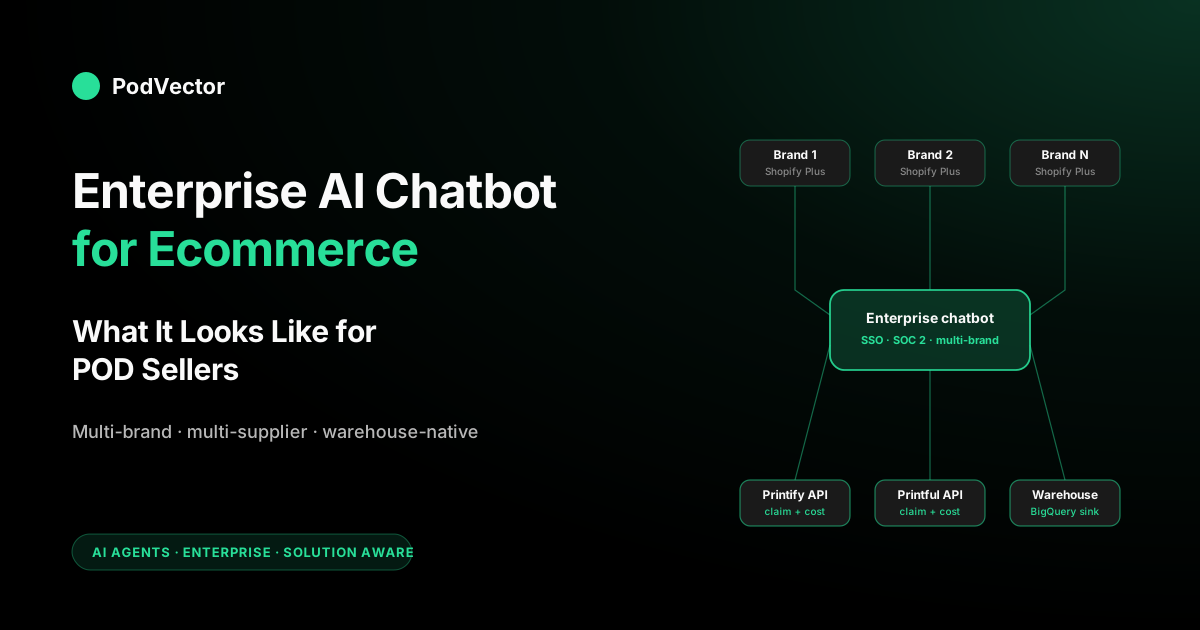
Quick Answer: An enterprise AI chatbot for ecommerce is one that clears the procurement bar — SSO, SOC 2, a 99.9% SLA, multi-brand tenancy, audit logs — and resolves high-volume support autonomously by acting on live order data, not just answering FAQs. In 2026 that means it edits and cancels orders, files carrier claims, and closes "where is my order?" (WISMO) tickets end-to-end.
For a print-on-demand operator at enterprise scale — multi-brand, multi-supplier, thousands of SKUs, seven-plus figures a month — "enterprise" adds a harder test: the bot has to reason about Printify and Printful production at once, hold a margin floor per variant, and file supplier claims itself.
Most platforms that top the enterprise-chatbot lists were built for inventory-holding retailers and miss half the POD reality. Pick the ones that can learn POD economics and connect to your tools — not the ones with the loudest "enterprise" badge.
What "enterprise AI chatbot" actually means in 2026
Every SaaS vendor calls their top tier "Enterprise." Most of the time it means "the plan where we turn on SSO and charge you 4x." For a serious buyer, the enterprise label is a specific bar, not a marketing one. An enterprise AI chatbot for ecommerce clears all of the following in 2026:
- Agentic resolution: the 2026 bar moved past "deflect with an FAQ answer" to "resolve by acting." The bot reads live order and shipping data, edits or cancels orders, files carrier and supplier claims, and closes WISMO ("where is my order") tickets without a human. Vendors still pitching scripted deflection are a tier behind.
- Security and compliance: SOC 2 Type II, ISO 27001, GDPR and CCPA data-processing agreements, and — for larger programs — HIPAA BAAs or FedRAMP if you sell into those verticals.
- Identity: SAML and OIDC SSO, SCIM provisioning, role-based access control, and audit logging that survives a compliance review.
- Multi-tenant architecture: more than one brand or storefront under one contract, with data isolation between brands and consolidated reporting above them.
- Scale: SLAs in the 99.9%+ range, latency budgets in milliseconds, and concurrency that doesn't wobble during a Black Friday peak.
- Integration breadth: native connectors to Shopify Plus, Salesforce Commerce Cloud, BigCommerce Enterprise, commonly Klaviyo, Zendesk, Gorgias, Snowflake or Redshift as a data sink, and a public API for anything else.
- Observability: conversation logs you can send to your security system, clear records you can check when something breaks, and rules that hide customer data so you can prove it in an audit.
- Procurement posture: net-60 or net-90 payment terms, MSA redlines, vendor security questionnaires (SIG Lite, CAIQ) answered without a three-month delay.
That bar is real regardless of what you sell. The part of the bar that nobody writes about is the operational one: at enterprise scale, you have a procurement team, an InfoSec team, a legal review, and an ops team that all have to sign off before the chatbot ships. The platform has to satisfy all of them, not just the CX lead who championed it.
If you want the ground-floor explainer on what any chatbot looks like for POD before we stack enterprise requirements on top, start with our piece on AI chatbot for ecommerce through a POD lens. This guide assumes you already know you need one and are shopping at the enterprise tier.
Why enterprise looks different for a POD operator
Traditional enterprise ecommerce — a brand running Salesforce Commerce Cloud with a Cybersource payment stack and Manhattan WMS — has its own well-understood chatbot requirements. POD operators at enterprise scale have a different shape:
- You're multi-brand by default. Enterprise POD programs are usually a portfolio of niche stores — sports fanwear, band merch, influencer stores, licensing holders — rather than one large brand. Multi-tenancy isn't a nice-to-have, it's the architecture.
- You're multi-supplier by necessity. A single design might fulfill through Printify's Monster Digital for one color and Printful's Charlotte facility for another. The chatbot has to quote ship-windows that reflect the routed supplier, not a corporate average.
- Your catalog is enormous and generated. 50,000–500,000 live SKUs is normal when you multiply designs × bases × colors × sizes. You can't manage this by hand; the system has to pull from your catalog automatically and stay up to date on its own.
- Returns are usually not refunds. They're supplier claims. An enterprise POD chatbot has to know when a photographed defect is a Printify Gold Star replacement, a Printful quality replacement, or a customer-service-discretion gesture.
- Margins vary per variant, per campaign, per supplier plan. A 10% discount looks generous on one hoodie and existential on the next. The chatbot has to know your margins — which means it needs to see the cost of each variant live, not once a week.
- Your operator-side question load is unique. Enterprise DTC brands ask "what's the LTV of the cohort acquired in Q3?" Enterprise POD brands ask "after Printify cost and Meta ad spend, which 20 SKUs lost money last week across all seven stores?" Most enterprise chatbots aren't built to answer that — you need a second, operator-facing agent that sits on top of reconciled P&L data.
None of those concerns show up in Gartner's enterprise chatbot evaluations because the scored criteria were written for inventory-holding retailers. The platforms that win those evaluations sometimes do, sometimes don't, fit POD once you test them against the shape above.
The enterprise capability checklist, applied to POD
Use this as your RFP scoring rubric. Each row has two parts — the general enterprise requirement, and the POD-specific test that tells you whether the vendor actually understands your shape or is flexing a generic feature.
| Capability | Enterprise requirement | POD-specific test |
|---|---|---|
| Identity and access | SSO (SAML/OIDC), SCIM, RBAC, audit logs | Can a brand manager on Store 3 be scoped out of Store 1 conversations and analytics? |
| Your product data | RAG over catalog + help center + orders | Can it read Printify and Printful production estimates live and route by supplier per variant? |
| Tool use | Connecting to your other tools | Can it file a Printify or Printful claim end-to-end with photo evidence, not just draft a ticket for a human? |
| Orchestration | Policy engine with guardrails and escalation | Can you set a margin floor per variant and have the bot refuse any discount below it automatically? |
| Multi-brand tenancy | Data isolation + consolidated reporting | Does a single contract cover N stores without quadrupling the token bill? |
| Analytics sink | Stream to warehouse (Snowflake, Redshift) | Do resolved conversations land in the same warehouse as your Shopify + Printify + ad-platform data, so you can join on customer and SKU? |
| PII and data governance | Configurable retention, redaction, regional storage | Can you prove to a licensing partner their fans' data never leaves EU regions when served from a European store? |
| Scale and SLA | 99.9%+ uptime, Black Friday concurrency | Has the vendor survived a POD-style launch spike (10x normal traffic for 90 minutes)? |
| Procurement | SOC 2, ISO 27001, DPA, MSA redlines | Can legal get a signed MSA with POD-specific data flow language (supplier sub-processors) in under 45 days? |
| Roadmap transparency | Agentic action plan, model versioning | Will the vendor commit in writing to which tools the agent will execute autonomously by end of next year? |
Score each vendor out of 10 on every row. Any 0 in the POD-specific column is not a "we'll figure it out later" — it's the item that will make your post-launch quarter painful. The rows about your product data and tool connections matter most; the identity and procurement rows have standard solutions at the enterprise tier but the POD rows don't.
Enterprise chatbot platforms, evaluated through a POD lens
No platform today is purpose-built for enterprise POD. The shortlist is the small set of platforms that clear the enterprise procurement bar and are flexible enough with your data and tools to be taught the POD reality. Here's how the realistic options look when you test them against the checklist above.
Intercom (Fin)
Strong enterprise story: SOC 2, HIPAA, granular RBAC, multi-workspace, good SAML. Fin's reasoning quality and resolution rate on CX tickets are at the top of the field.
Where it gets POD-interesting is the Fin Tasks framework — you can teach it to execute procedures like "file a Printify claim" if you wire up the Printify API through their function-calling layer. Native Printify or Printful integrations don't exist; you build them via API or via a partner. Strong enterprise posture, average POD fit out of the box, high POD fit after an integration build.
Gorgias Automate + AI Agent
Deepest native Shopify integration in the CX space and the only platform that executes Shopify-native actions (cancel orders, change addresses, issue credits) without integration work. Multi-brand Shopify stores consolidate cleanly.
Enterprise SSO and audit logs are there. Printify and Printful require a partner integration or Zapier-style bridge; the AI Agent can call custom actions, so you can teach it supplier-claim workflows. Best fit when your ops live inside Shopify Plus; weaker if your own data system is the primary source of truth.
Zendesk AI (Advanced AI)
Heavy enterprise gravity: used across many Fortune 500 CX stacks, excellent admin tooling, strong reporting. The AI layer is solid but slower-moving than native AI-first vendors.
POD fit depends entirely on whether your team already lives in Zendesk; if it doesn't, you're paying for enterprise features you won't use. The agent-side framework (Advanced AI Agents) can be taught POD workflows through its action framework.
Salesforce Agentforce
Worth considering only if you're on Service Cloud or Commerce Cloud anyway. Enterprise features are all there and then some, multi-brand tenancy is native, and the Data Cloud story is genuinely strong for the POD-style data joins you care about. The cost curve is steep and the POD-aware tools don't exist yet — you'll be building integrations to Printify and Printful as custom Agentforce actions, which is doable but expensive.
Ada
Omnichannel AI platform with a strong enterprise footprint and good tool-use story. Multi-brand tenancy and data isolation are first-class.
Ada's Reasoning Engine handles procedural workflows well, which is the critical capability for POD claims and escalations. Native POD supplier integrations don't exist but the tool framework is open, and Ada's team has historically been responsive to enterprise customer build requests.
Kustomer
Positioned for enterprise CX, with a strong omnichannel story and solid WhatsApp and Messenger support from its messaging heritage (now independent again after Meta divested its stake). Enterprise features are comprehensive. POD fit is weaker — it's built for retailers with inventory, and the workflow builder is less flexible than Ada's or Intercom's for the supplier-claim pattern.
LivePerson
Deep enterprise heritage, especially for regulated industries. Conversational Cloud is capable and the AI layer has matured. POD fit requires significant custom work; most of the out-of-the-box playbooks assume inventory retail or telco/finance, not print-on-demand supplier workflows.
The honest ranking for enterprise POD
If you're a multi-brand POD operator in the $1M–$20M/month range and procurement will sign off on any of the above, the two most POD-teachable platforms are Intercom (Fin) and Ada. If your ops gravity is inside Shopify Plus and you want the lightest integration work, Gorgias AI Agent is the short path. If your company standard is Salesforce or Zendesk, you'll use what you have — just be honest about the additional six months of custom Agentforce or Zendesk tool-building that the POD shape requires.
For a narrower SMB-tier shortlist (before you're at enterprise scale), our head-to-head on the best AI chatbots for ecommerce and the deeper dive into AI chatbot platforms for ecommerce in POD terms cover the under-$1M/month range. For external corroboration of the current enterprise landscape, Outvio's 2026 enterprise chatbot roundup walks through the vendor list from a general-retail, post-purchase angle.
The procurement checklist nobody wrote for POD
Generic enterprise chatbot RFPs have a standard InfoSec and legal annex. The POD-specific items to add before you send the RFP:
- Supplier sub-processor disclosure. When the chatbot calls Printify or Printful to resolve a claim, their API sees the conversation context it needs. Your DPA must name those sub-processors correctly or compliance will flag it in year two.
- Image-based PII in photo uploads. Customers send defect photos that sometimes include their face or address labels. Your data-governance policy needs a redaction or short-retention rule for image uploads, and the vendor must support it.
- Cross-brand data bleed test. If your portfolio includes brands with conflicting licensing (e.g., two competing sports teams in the same platform instance), require the vendor to demonstrate data isolation in a staging environment — not just in slides.
- Where your data lands. Insist the vendor sends resolved conversations into your own data system, in a format you approve. If the contract doesn't include it, the ops and analytics team will rebuild it themselves at triple the cost.
- Retention for fulfillment disputes. POD disputes sometimes surface months after the order — chargebacks, quality claims escalating through card networks. Conversation logs need 18–24 month retention at minimum, not the default 30–90 days some platforms ship with.
- Margin-floor enforcement audit. Require the vendor to give you a log of every discount the bot offered and its effect on margin after costs, that you can look up anytime. Without this, quiet margin erosion is invisible.
- Shopify Plus app-load budget. Some enterprise chatbots add 200–600ms of script load to every page. At POD catalog scale with ad-paid traffic, that's a measurable conversion cost. Test it before you sign.
For the underlying cost reality most teams miss — what Printify and Printful actually charge, and how cost-per-variant changes by plan tier and campaign — our guide to Printify's per-shirt charges and the broader piece on whether Printify Premium is worth it at scale explain why the margin-floor enforcement item above matters more than it sounds.
Build vs buy at enterprise scale
At SMB scale the answer is almost always buy. At enterprise POD scale the calculus shifts — not because building is cheaper but because the system that pulls all your data together might not exist off the shelf. The three real paths:
Buy + extend (most common enterprise POD path)
Pick one of the enterprise platforms above. Use its AI, logins, and reports. Then connect it yourself to Printify, Printful, your product catalog, and your margin-tracking tool. The platform handles security, multiple brands, and uptime guarantees; your team handles the print-on-demand connections.
- Time to production: 3–6 months
- Year-one cost: $150k–$600k (platform + integration build + maintenance)
- Sweet spot: Multi-brand POD operators doing $5M–$50M/year
Build on foundation models (rare, but reasonable above $50M/yr)
Build the chatbot directly on GPT-5 or Claude Sonnet 4.6+, with your own system for connecting it to your data and tools. You get full control over how your data and print-on-demand tools work together. You also take on all the security and reliability work the platforms would normally handle for you — things like security certifications, secure logins, audits, handling problems, and having someone on call.
- Time to production: 9–18 months
- Year-one cost: $600k–$2.5M (engineering team + infra + model spend)
- Sweet spot: POD operators over $50M/yr with unique workflows that platforms can't model
Hybrid (the sleeper path)
Buy one enterprise platform for shopper-facing CX (where the enterprise features matter most) and build or buy a second, narrower agent for operator-side analytics (where the POD-specific data joins live). The two agents don't share a platform — they share a warehouse. This is where most serious POD operators are actually landing in 2026.
- Time to production: 4–9 months
- Year-one cost: $200k–$900k combined
- Sweet spot: Multi-brand POD operators $10M–$100M/year who already have a system that keeps all their data organized in one place
The operator-side chatbot enterprise POD brands also need
Every enterprise chatbot conversation in the vendor sales cycle is about shoppers. The conversation nobody sells against is the one your ops team has every Monday morning: which SKUs lost money last week after supplier cost, shipping, and ad spend?
Which of our seven stores had cart-recovery offers cross the margin floor? Which supplier routed the most claims, and what's the trendline?
Those questions don't get answered by a shopper-facing chatbot, no matter how enterprise-grade it is. They get handled by a second agent that sits on top of your reconciled P&L — Shopify orders, Printify and Printful costs, Meta and Google ad spend, shipping and processor fees.
And it doesn't stop at answering: it pauses losing ad sets, raises prices on overperformers, and files supplier claims, each behind an approval gate. That's the "agentic AI employee for POD" gap in the category, and the one Victor is built for.
The pattern we see at enterprise POD operators: the shopper-facing bot is a big enterprise SaaS (Intercom, Gorgias, Ada). The operator-facing bot is a POD-native agent connected to all your business data, matched up correctly across systems.
They coexist. Either one alone leaves half the value on the table. Our pillar on AI agents for ecommerce analytics and the broader frame in the complete guide to AI analytics for print-on-demand go deeper on this operator-side role.
A 90-day enterprise implementation plan
Enterprise implementations fail when they try to compress to the SMB timeline. They also fail when they stretch to nine months. Ninety days, run tight, is the sweet spot for Buy + Extend.
Days 1–15: procurement and infrastructure
Finalize vendor selection against the capability checklist. Legal redlines, MSA signed, DPA covering Printify and Printful as sub-processors.
InfoSec runs the vendor security questionnaire and the penetration test results review. IT provisions SSO via SAML or OIDC and SCIM. No chatbot work yet — this is the table-stakes step most teams try to skip and then regret in month four.
Days 16–35: connecting your data and tools
Stand up the integrations: Shopify Plus (orders, products, customers, metafields per brand), Printify API (production, costs, claims), Printful API (production, costs, claims), your help center (knowledge base per brand), your margin lookup service or PIM, and your warehouse sink. Multi-brand mapping — which store maps to which workspace — gets locked down. The PII redaction policy on photo uploads ships in this window.
Days 36–55: orchestration, guardrails, and pilot
Define the conversation policies: when the bot resolves, when it escalates, when it offers a discount and under what margin floor, when it stays quiet. Set up the supplier-claim playbook — what the bot does when a customer uploads a defect photo, including when it auto-files and when it escalates.
Run dry-runs against historical tickets per brand to catch the weird cases. Launch the pilot on one brand at 10–25% of traffic.
Days 56–75: measurement and scaling
Watch resolution rate, conversion lift on engaged sessions, CSAT, margin impact, and supplier-claim volume. Fix the data gaps that show up (there will be five to ten — wrong supplier routing on certain variants, missing size charts on new bases, stale help content).
Scale the pilot to 100% on the pilot brand. Start rolling brands 2–N onto the same contract.
Days 76–90: enterprise handoff and ops rhythm
Set up the ongoing ops rhythm. Monthly vendor business review, weekly failure-mode triage, quarterly policy audit. The warehouse sink gets joined into your analytics layer so you can answer "bot-touched revenue vs not-touched revenue" by cohort. Year-two renewal prep begins in month 11, so the ops rhythm is the thing that lives.
Enterprise ROI math — honest version
Vendor decks quote 40% conversion lift and 85% deflection. Your actual numbers at enterprise POD scale will be different and the math is worth doing with real inputs. Here's the honest baseline per brand for a multi-brand POD operator:
- Conversion lift on engaged sessions: 8–18% within 90 days. POD catalogs with heavy variant complexity see the higher end because the bot answers "which base, which size" questions faster than a size chart can.
- Ticket deflection: 55–75% within 120 days once the supplier-claim workflow is wired. Below 50% means the Printify or Printful tool use isn't actually resolving — it's just logging.
- Cost per resolved ticket: $0.30–$1.20 at enterprise volume, against a fully-loaded human cost of $6–$14 per ticket. The savings are real but smaller than case studies imply because the bot escalates the hardest 25–45%.
- CSAT on bot-handled conversations: 4.0–4.4 once tuned. Below 3.8 means the escalation threshold is too permissive and customers feel trapped.
- Margin impact on bot-recovered carts: This is the one enterprise POD operators consistently under-measure. Without a hard margin floor in the orchestration layer, bot-offered discounts erode realized margin by 2–5 points on recovered carts. With the floor in place, the damage is 0–1 point.
- Pricing model shift: most enterprise vendors now bill per resolution (roughly $0.99 per resolved conversation on some plans) rather than per agent seat. At POD volume that rewards a bot that truly resolves and punishes one that logs a "resolution" then escalates. Model your TCO on real resolution rate, not the list price.
The ROI question at enterprise scale isn't "does it pay back?" — it almost always does. The question is "what's the margin on the traffic it touches, net of all the quiet discounts the bot offered to get resolution and conversion rates to the vendor-quoted targets?" If you can't answer that from your own numbers by month six, the deployment is only half set up.
The employee roadmap your RFP should ask about
Every enterprise chatbot vendor is pivoting toward agentic — the chatbot doesn't just describe what to do, it does it. The RFP question that separates serious agentic vendors from marketing-department agentic vendors is specific: name the tools the agent will execute autonomously by end of year, with success metrics.
For POD specifically, the agentic shortlist the vendor should have an answer for:
- File a Printify Gold Star replacement claim with photo evidence and customer comment, end-to-end, no human in the loop.
- File a Printful quality claim with the same autonomy bar.
- Apply a discount only within a per-variant margin floor fetched live at decision time.
- Swap a routed supplier mid-order when the primary production queue exceeds a latency threshold.
- Respond to a sizing exchange by creating the replacement order in Shopify and filing the original for supplier credit.
- Write a conversation-summary record to the warehouse keyed to customer ID and SKU, not just to ticket ID.
Today most platforms can do two or three of those; by late 2026, the winners will do all six. The vendors still using "conversational AI" without specifying what the agent will autonomously execute are the ones you should not sign a three-year agreement with today.
Victor's employee capability for POD work covers both: he answers live questions against your Shopify, Printify or Printful, and Meta and Google ad data, and pauses losing ad sets, raises prices on overperformers, and files supplier claims when patterns emerge. Our companion piece on what an AI agent looks like for POD walks through this agentic shift from the operator's seat.
FAQs
What makes a chatbot "enterprise" vs mid-market?
The checklist: SSO, SCIM, SOC 2 Type II, multi-tenant data isolation, SLAs in the 99.9%+ range, warehouse-stream analytics, and a procurement posture that handles redlined MSAs without months of delay. Mid-market tools may check some of these; enterprise tools check all of them as defaults. For POD, the extra bar is the ability to reason about Printify and Printful suppliers and execute claims end-to-end.
Which enterprise chatbot platform is best for a multi-brand POD operator?
There's no single winner. Intercom Fin and Ada are the most POD-teachable from a flexibility standpoint.
Gorgias AI Agent is the short path if your ops live inside Shopify Plus. Salesforce Agentforce only if you're already on the Salesforce stack. The right answer depends more on your existing CX stack and data-warehouse choice than on any vendor's inherent POD capability, because none of them are POD-native today.
Do enterprise chatbots integrate natively with Printify and Printful?
No enterprise chatbot platform in 2026 ships with a native Printify or Printful integration. Every serious enterprise POD deployment requires either a partner app or a custom integration built to the vendor's function-calling or MCP interface. Budget 4–10 weeks of engineering time for this even on platforms that have an open integration framework.
How long does enterprise implementation take for a POD operator?
90–180 days end-to-end, depending on how many brands you're onboarding and how ready your data setup is. The buying and setup stage alone is 2–4 weeks at enterprise scale. Getting your data organized is the biggest variable — operators with clean, organized data and a product catalog system are at the fast end; operators still running per-store spreadsheets are at the slow end.
What's the total cost of ownership for an enterprise AI chatbot at POD scale?
For a multi-brand POD operator in the $5M–$50M/year range, year-one TCO is typically $150k–$600k on the buy-and-extend path. That covers platform fees, integration build, PII and governance work, and ops maintenance.
Year-two drops to 60–75% of year-one as the integration build is amortized. Enterprise custom builds start at $600k/year and can pass $2.5M at the largest operators.
Does the chatbot need to connect to my business data?
At enterprise scale, yes. Finished conversations should flow into your own data system so you can match them up with your Shopify, supplier, and ad data by customer and product. Platforms that can't send data to your system force your analytics team to rebuild that connection themselves, usually at triple the cost. This is a deal-breaker requirement, not a nice-to-have.
Can one enterprise chatbot cover both shopper-facing CX and operator-facing analytics?
Almost always, no. The shopper-facing chatbot is optimized for response quality, tone, and resolution.
The operator-facing agent is optimized for analytical queries over reconciled P&L data. Mixing them usually produces a bot that's mediocre at both. The pattern at serious enterprise POD operators is two agents — one enterprise SaaS for shoppers, one purpose-built analytical agent (Victor for POD specifically) for the ops side.
What's the risk of picking the wrong enterprise chatbot platform?
At enterprise scale, switching cost is high — not the platform fee itself but the months of integration work, training data migration, and policy translation. Signing a three-year agreement with a vendor whose employee capability doesn't ship what you need by year two is the most common failure mode. Mitigate by requiring written roadmap commitments in the contract, with exit ramps tied to roadmap slippage.
How does margin-floor enforcement actually work in an enterprise chatbot?
The bot calls a margin-lookup tool at decision time, with the variant SKU and the proposed discount. The tool returns allowed or blocked based on current COGS, shipping, and fees.
If the lookup isn't live — e.g., it reads a nightly export — you're flying blind on any supplier cost change since yesterday. Real margin-floor enforcement requires a live cost-per-variant service that most enterprise chatbot platforms don't ship with. You build it.
Buy the enterprise chatbot for your shoppers. Build the second agent for your ops.
Enterprise POD operators end up with two chatbots — one enterprise SaaS for shopper CX, one purpose-built agent for the operator-side question load your shopper bot was never designed to answer. Victor is the second one: a POD-native AI employee that reads your live Shopify, Printify, and Meta data, spots the SKUs bleeding money across all your stores after supplier and ad spend, and acts on it — pausing the losing ad sets, raising prices on the winners, and filing supplier claims, with your approval on every move. Free to try while you spec your enterprise CX RFP.
Try Victor free