
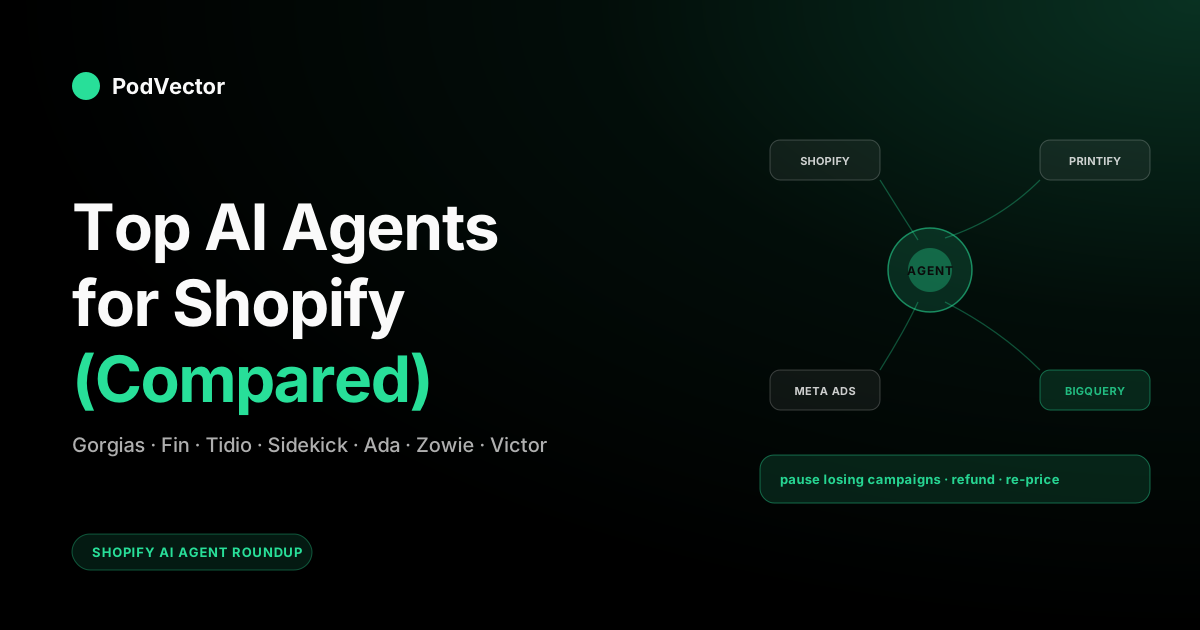
Quick Answer: The top AI agents for Shopify in 2026 split into two camps. On the shopper-facing side — the agent sits on your storefront deflecting tickets, refunding orders, and answering WISMO questions — Gorgias leads on depth of action, Intercom Fin leads on resolution rate, Tidio (Lyro) wins value on small-to-mid stores, and Shopify Sidekick is the free native baseline.
On the operator-facing side — the agent lives in your back office, reasons over your store data, and (increasingly) acts on it — the category is much younger.
If you run a Shopify print-on-demand store and what you actually want is an agent that can answer "which Printify variants are profitable after Meta ad spend?" and eventually pause the campaigns that aren't, Victor by PodVector AI is purpose-built for that. The rest of this guide covers when to pick which, and why a POD Shopify store usually wants one agent from each camp.
AI Agent vs AI Chatbot on Shopify
Most "best AI agent for Shopify" roundups use chatbot and agent interchangeably. They're not the same thing.
A Shopify chatbot answers questions. It pattern-matches a shopper's message against a knowledge base or a generative model, picks a reply, and maybe hands off to a human. Pre-2023, most of them were rule-based. Today's generative layer is better but the core job is the same: send the right message.
A Shopify AI agent does things. It reasons about what the shopper or operator is trying to accomplish, picks tools (Shopify admin, Printify API, a warehouse, Meta Ads), executes steps, checks its own work, and returns a result.
Refunding an order from inside the chat counts. Pausing a Meta campaign because it's spending against unprofitable variants counts. Replying politely with a tracking link doesn't.
In 2026, the line is fuzzy — nearly every "chatbot" vendor is rebranding as an "AI agent" — but the test is the same: can the thing take a multi-step action on your behalf, with tools it wasn't explicitly rule-coded for?
For the broader framing, see agentic AI for ecommerce: what it looks like for POD sellers.
Two Camps: Shopper-Side vs Operator-Side Agents
Once you grant that agents take actions, the next split is whose actions.
- Shopper-side agents act on the storefront and in the helpdesk. They refund orders, cancel subscriptions, edit shipping addresses, trigger returns, and recommend products. Gorgias, Intercom Fin, Tidio Lyro, Shopify Sidekick (shopper-facing), Ada, Zowie, Richpanel, Re:amaze, eDesk live here.
- Operator-side agents act on your business. They run queries against your live Shopify + Printify/Printful + ads data, explain the math, flag losing campaigns, and — as the category matures — pause them, reallocate budget, re-price SKUs. Victor by PodVector AI is the POD-native example. Shopify Sidekick's admin-side capabilities are an early, narrower version of this camp.
A third, narrower group has grown loud in 2026 roundups: on-site discovery and merchandising agents — AI search, product-finder quizzes, and pre-purchase recommendation bots (Wizzy, Klevu, Rep AI, Octane AI, lookfor). These sit between the two camps: they act on the storefront like a shopper-side agent, but their job is conversion, not deflection. Useful if on-site search is your bottleneck; orthogonal to the margin question a POD operator is asking. We treat them as adjacent picks rather than core, because they don't see your cost side either.
Most SERP roundups only cover the shopper side. That's fine for DTC brands with owned inventory and a large support queue.
For a Shopify print-on-demand operator running a few hundred designs against variable Printify COGS and unpredictable ad spend, the shopper side is half the picture — often the smaller half. See the complete guide to AI agents for ecommerce analytics for the operator-side deep dive.
At-a-Glance Comparison Table: Top AI Agents for Shopify
| Agent | Camp | Best For | Starting Price | What It Actually Does (Actions) |
|---|---|---|---|---|
| Victor by PodVector AI | Operator-side | Shopify POD sellers on Printify / Printful | From $29/mo | Victor reads your live Shopify orders, Printify/Printful costs, and ad spend, shows you the true profit on every product, and can act on what he finds, with your approval. |
| Gorgias AI | Shopper-side | Shopify stores with a support team | From $10/mo (automation add-on) | Refunds, edits, cancels, discounts, returns — all Shopify-native, from inside the ticket |
| Intercom Fin | Shopper-side | Mid-to-enterprise deflection at volume | $0.99 per resolution | Highest benchmark resolution rate; outcome-based pricing; tool-use for order actions |
| Tidio (Lyro) | Shopper-side | Small-to-mid Shopify stores | Free / from $39/mo | Answers + narrow actions (returns, tracking); fastest Shopify install; product cards in chat |
| Shopify Sidekick | Both (narrow) | Any Shopify plan — free native | Included with Shopify | Admin-side tasks (edit products, generate discount codes, pull basic reports) via chat in Shopify admin |
| Ada | Shopper-side | Enterprise, multilingual stores | Custom | 50+ languages; no-code reasoning workflows; multi-step tool-use |
| Zowie | Shopper-side | Mid-enterprise DTC on Shopify | From $499/mo | Workflow automation; strong resolution on repetitive Shopify tickets; selling-assist agent |
| Richpanel | Shopper-side | Shopify DTC wanting branded self-service | From $99/mo | Self-service portal actions (track, return, cancel); AI agent layer on top of the portal |
| Zendesk AI Agent | Shopper-side | Shopify stores already on Zendesk | From $55/agent/mo | Intent routing + answer bot; native to Zendesk ticket graph; actions via Shopify app |
| Re:amaze | Shopper-side | Mid-size DTC with multichannel inbox | From $29/user/mo | Unified inbox actions across email, chat, IG, SMS; AI drafts + narrow automations |
Pricing reflects publicly listed tiers at the time of writing. Enterprise plans and negotiated rates vary. eDesk, Heyday, and Skara are strong adjacent picks covered in the FAQs.
The 10 Top AI Agents for Shopify in 2026
1. Victor by PodVector AI — Best operator-side agent for Shopify POD sellers
Best for: Shopify print-on-demand sellers on Printify or Printful who want an AI agent that can reason over their own Shopify + fulfillment + ads data, not just answer shoppers.
What it is: Victor is the AI employee built into the PodVector AI dashboard. He pulls in your live Shopify orders, Printify and Printful costs (broken out by variant and destination country), Meta and Google ad spend, fees, and refunds, so he can show you the real profit on every order.
Ask "what's my operating profit this month on Design X after Meta spend?" and Victor plans the query, runs it, and returns a structured answer with the math shown. Ask "which Printify blue T-shirt variants are losing money in Germany?" and it returns a ranked list.
Agent-native strengths: POD-native cost modelling (Printify and Printful are separate, not averaged); queries live data, not a trained snapshot; explains its reasoning so you can verify the number. The roadmap is explicitly agentic: Victor answers and acts on those answers — with your approval — pausing the Meta campaigns spending against unprofitable variants, suggesting price changes, flagging where Printify beats Printful on margin.
Limitations: Not a shopper-facing storefront agent. It won't sit on your storefront refunding tickets. Most POD Shopify stores pair Victor with a cheap/free shopper bot (Tidio free, Shopify Inbox, Chatty) and get both jobs done.
For the foundational framing, see what an AI agent for Shopify looks like for POD sellers.
2. Gorgias AI — Best shopper-side agent on deep Shopify actions
Best for: Shopify stores doing ~500+ tickets/month where deflection carries real dollar value, with a support team to supervise.
What it is: Gorgias is a Shopify-first helpdesk with an AI agent layer on top. Its defining trait is the range of actions the agent can take natively inside a Shopify ticket — refunding, editing orders, applying discounts, cancelling subscriptions, triggering return flows — without a human touching the conversation.
Agent-native strengths: Deepest Shopify-native action surface of any agent on this list — Gorgias cites up to 60% automation of inbound support inquiries. Mature macro/rule system for constraining the agent's behaviour. Transparent reporting on deflected-ticket dollar value.
Limitations: Overkill for stores doing fewer than a few hundred tickets a month. Seat pricing stacks for larger teams. No view of your cost side — it's still a shopper-side agent.
3. Intercom Fin — Highest benchmark resolution rate
Best for: Shopify stores with high ticket volume that want the market's best-deflecting shopper AI agent.
What it is: Fin is Intercom's AI agent layer. Intercom reports a ~76% average resolution rate across 8,000+ customers, with ecommerce brands regularly landing in the 70–84% range — among the highest published numbers in the category. Pricing is outcome-based — $0.99 per resolved conversation — so you pay for value delivered, not seat count or activity.
Agent-native strengths: Genuinely strong answer quality; multi-step tool-use (order lookups, refunds, cancellations) when wired to your Shopify stack; outcome pricing aligns incentives.
Limitations: The full Intercom platform around Fin is priced for scale — small stores rarely justify the suite. Per-resolution math gets expensive on high-volume months. Works on Shopify but feels less Shopify-native than Gorgias.
4. Tidio (Lyro AI) — Best value on small-to-mid Shopify stores
Best for: Shopify stores doing up to a few thousand tickets a month that want one widget for live chat, AI agent, and email.
What it is: Tidio is the most-installed chat + AI agent combo in the Shopify App Store. Lyro, its AI layer, handles a large share of first-touch shopper questions — order status, shipping, returns, availability — and pulls product cards into the chat for recommendations. It takes narrow actions (return flows, tracking) and escalates cleanly.
Agent-native strengths: Fastest install on Shopify; product recommendations inside the chat; a free tier that's genuinely usable for stores starting out. Lyro's action scope has grown meaningfully over the past year.
Limitations: Action depth is still shallower than Gorgias. Conversation caps on the Lyro plan get expensive as volume scales. Doesn't know your cost structure.
5. Shopify Sidekick — Best free native AI agent (narrow scope)
Best for: Any Shopify merchant who wants an AI agent inside Shopify admin without installing anything.
What it is: Sidekick is Shopify's own AI agent baked into the admin UI. It's a chat interface where you can ask things like "create a 10% discount code for the weekend", "pull me a report of last month's top products", or "edit all T-shirts tagged summer to add a new meta description".
It executes those tasks using Shopify admin permissions. It also powers some shopper-facing suggestions via Shopify Inbox.
Agent-native strengths: Genuinely agentic for admin tasks — it edits, creates, and queries inside Shopify without you clicking through the UI. Free. Native. Zero setup.
Limitations: Scope is narrow. Sidekick doesn't see outside Shopify — it can't reason over your Printify COGS, your Meta ad spend, or your true operating margin. For a Shopify-only merchant with owned inventory, Sidekick plus a support bot is the cheapest sane stack. For a POD seller, it answers the wrong side of the question.
6. Ada — Best enterprise and multilingual agent
Best for: Large Shopify brands with support in 5+ languages and complex escalation logic.
What it is: Ada is an enterprise AI customer-service agent platform. No-code workflow builder, 50+ languages with true contextual handling (not just translation), and a reasoning layer that executes multi-step requests against your Shopify backend.
Agent-native strengths: Multilingual depth that no one else matches; workflow builder non-engineers can maintain; transparent reporting on where the agent fails.
Limitations: Enterprise pricing and a six-to-eight-week implementation. Not a fit for one-person Shopify stores.
7. Zowie — Best mid-enterprise Shopify DTC agent
Best for: Mid-enterprise Shopify DTC brands wanting strong resolution on repetitive tickets plus a selling-assist agent.
What it is: Zowie is an agent platform focused on DTC. Two modes: a care agent handling WISMO, returns, and product questions, and a sales agent that recommends products and assists pre-purchase. Workflow automation is its wheelhouse.
Agent-native strengths: Tight Shopify and helpdesk integrations; measurable resolution rates on repetitive categories; the sales agent is actually useful for stores where pre-purchase chat drives revenue.
Limitations: Pricing is mid-market ($499/mo+), not for solo sellers. Action scope on Shopify is narrower than Gorgias.
8. Richpanel — Best self-service portal agent
Best for: Shopify DTC brands that want shoppers to self-serve on the storefront and in email.
What it is: Richpanel's pitch is that most support tickets can be resolved by a branded self-service portal before ever hitting an agent. The AI layer sits on top: it triages incoming questions, routes to the right portal flow, and handles free-text requests via tool-use (track order, initiate return, cancel subscription).
Agent-native strengths: The self-service-first model deflects well on WISMO-heavy stores. Strong Shopify-native actions inside the portal. Competitive pricing for mid-market.
Limitations: Best value when your ticket mix is heavy on order-status and returns. Less compelling if your support is truly bespoke.
9. Zendesk AI Agent — Best if you're already on Zendesk
Best for: Shopify stores already on Zendesk who want to turn on an AI agent without changing vendors.
What it is: Zendesk's AI Agent (the successor to Answer Bot plus agent-assist) is competent and native to the ticket graph you're already using. It routes intents, drafts replies, and takes Shopify actions via the Shopify app integration.
Agent-native strengths: Zero-migration for existing Zendesk customers; strong intent classification; good agent-assist on human handoffs.
Limitations: If you're not already on Zendesk, you'd pick Fin or Gorgias before paying $55/agent/mo for the ticket platform. Action depth on Shopify trails Gorgias.
10. Re:amaze — Best multichannel agent
Best for: Mid-size Shopify stores that want one tool for email, chat, Instagram, Messenger, and SMS with an AI layer across all of them.
What it is: Re:amaze is a customer service platform with an AI agent attached. Its strength is consolidating channels — you see email, on-site chat, Instagram DMs, Facebook Messenger, WhatsApp, and SMS in one inbox, with AI drafting replies and taking narrow automations across all of them.
Agent-native strengths: Multichannel inbox in a single pane; reasonable per-user pricing; solid Shopify integration for order-lookup actions.
Limitations: The agent layer works but doesn't lead the category; best thought of as "helpdesk with AI" rather than "AI-first". Other strong adjacent picks worth evaluating: eDesk (multi-marketplace consolidation), Heyday (conversational commerce), and Skara (agentic commerce with revenue attribution).
What Makes a Real Shopify AI Agent (Not Just a Chatbot)
Every vendor on this list now markets the word agent. Use these four tests to sort marketing copy from capability.
1. Autonomy: does it act, or just reply?
A chatbot suggests an answer. An agent executes.
On Shopify, the practical test is whether the tool can refund an order, cancel a subscription, edit a shipping address, issue a discount, pause a Meta campaign, or update a product — from inside the chat, with the permissions you granted. If the transcript always ends with "I've asked an agent to help you", it's a chatbot wearing an agent hat.
2. Reasoning and planning
A real agent breaks a goal into steps. "Find all Printify variants where margin is below 15% after Meta spend, then flag the ones with negative ROAS for the past 14 days" is four retrieval steps and a join. A chatbot will either pick a single best-match answer from a knowledge base or hallucinate a plausible one. An agent plans, executes, and checks.
3. Tool use
AI agents need to reach into your real systems to get work done. On Shopify, that means reading and changing orders and products, reading support tickets, and reaching into Printify and Printful for fulfillment, plus (for AI employees) your store's full order, cost, and ad history. Gorgias, Fin, Ada, Zowie, and Victor all score here. Sidekick scores narrowly (Shopify admin only). Many "agents" still don't.
4. Memory and learning
An agent that forgets everything at the end of each conversation isn't really agentic; it's a stateless function. The better shopper agents carry conversation context and customer history across channels. The better AI employees (Victor included) learn your margin thresholds and alert patterns so the second week of use is sharper than the first.
Why POD Shopify Stores Evaluate Agents Differently
Every SERP roundup on "top AI agents for Shopify" assumes a default Shopify operator: a DTC brand with owned inventory, a warehouse, stable COGS, and a visible support queue. Print-on-demand breaks most of those assumptions.
- No owned inventory. Your COGS is set by Printify or Printful per unit, not per batch. Ad spend, refunds, and Shopify fees swing real margin wildly. A shopper-side agent that deflects tickets is useful, but it does nothing to stop the margin leak.
- Two fulfillment providers, two cost models. The same T-shirt design might be 18% more profitable on Printify than Printful for US orders and the other way around for Germany. Generic Shopify agents average these or ignore them. A POD-native AI employee itemizes them — see our Printful costs guide and the complete guide to AI analytics for POD.
- Long design tail, small profitable core. POD stores have thousands of SKUs with twenty true winners. "Which twenty designs are actually profitable after ads?" is the highest-leverage question a POD operator can ask — and no shopper-side agent on this list can answer it.
- Ad spend is the biggest line item. For most POD Shopify stores, Meta + Google ad spend outweighs product COGS. A support agent saving ticket hours is nice. An AI employee saving ad dollars is transformative. See the complete Meta Ads playbook for POD for the surrounding economics.
That asymmetry is why POD Shopify operators usually want two agents, not one: a cheap/free shopper agent (Tidio free, Chatty, or Shopify Inbox + Sidekick) plus an employee-side agent like Victor. Paying for a single enterprise support suite covers half the problem at four times the price. For a side-by-side with the chatbot category, see best AI chatbot for Shopify (compared).
How to Choose the Right Shopify AI Agent
Run this decision tree:
- Which camp first — shopper or operator? If tickets are drowning you, start shopper-side. If you're flying blind on which designs are profitable, start operator-side. POD sellers almost always need both eventually, but sequence by the bigger pain.
- What's your Shopify store size? Under 100 tickets/month on the shopper side: Shopify Sidekick + Tidio free or Chatty free. 100–1,000/month: Tidio paid, Gorgias, or Zowie. 1,000+/month: Gorgias, Intercom Fin, or Ada.
- Are you a POD seller? If yes, pair your shopper agent with an AI employee. Shopper bots can't see your Printify margin or your Meta ROAS per variant — they weren't designed to.
- What's your existing stack? Already on Zendesk? Zendesk AI Agent first. Already running heavy Shopify support? Gorgias. Social-first DMs? Re:amaze or a Juphy-class tool. Multichannel (chat + email + SMS)? Re:amaze.
- How do you want to pay? Outcome-based (Fin) fits spiky volume. Seat-based (Zendesk, Gorgias) fits predictable volume. Flat monthly (Victor) fits when question volume is what you want to grow, not ration.
No single Shopify AI agent wins every scenario. For most POD operators, the right answer is two agents doing two jobs rather than one jack-of-all-trades.
How to Install an AI Agent on Your Shopify Store
For shopper-side agents, installation is near-identical:
- Open the Shopify App Store and find the app (Tidio, Gorgias, Re:amaze, Richpanel all live there; Fin and Ada install via direct integration).
- Click Install. Shopify handles permissions and, for chat agents, injects the widget script into your theme.
- Complete in-app onboarding: import your FAQ content, connect email / Instagram / SMS as relevant, set handoff rules and the action scope you want the agent to have (refund up to $X, cancel only within Y hours, etc.).
- Test with your own phone on the storefront before going live. Pay attention to action correctness, not just answer correctness.
For Shopify Sidekick, it's already in your admin — open the chat icon inside Shopify admin and start asking.
For Victor, installation is different because it's not a storefront widget. You connect your Shopify, Printify/Printful, Meta, and Google accounts, and Victor pulls in your data so he can answer questions about it. No theme edits. The first sync runs overnight; same-day you can ask about historical data and start getting answers.
FAQs
What is the top AI agent for Shopify in 2026?
There's no single winner — it depends on the job. For shopper-side action-taking on Shopify stores with a support team, Gorgias leads.
For the highest benchmark resolution rate at scale, Intercom Fin leads. For small-to-mid stores on value, Tidio (Lyro) wins.
For any Shopify merchant who just wants a native admin agent, Shopify Sidekick is free and competent within its narrow scope. For POD Shopify sellers who need an operator-side agent that reasons over their own margin data, Victor by PodVector AI is purpose-built.
What's the difference between an AI agent and a chatbot for Shopify?
A chatbot answers questions by picking or generating a reply. An AI agent takes actions — refunding a Shopify order, cancelling a subscription, pausing a Meta campaign, editing a product, running a data query — using tools and multi-step reasoning. Most 2026 vendors market the word "agent"; the real test is whether the tool can execute a multi-step task on your behalf, not just send the right message.
Which Shopify AI agent can actually refund orders and edit shipping addresses?
Gorgias has the deepest action surface (refund, edit, cancel, discount, return) directly inside the ticket. Intercom Fin can take the same actions when wired to Shopify via their app.
Ada handles multi-step actions via its reasoning layer. Tidio Lyro takes narrower actions (tracking, returns).
Shopify Sidekick takes admin-side actions (edit products, generate discounts, pull reports) but not shopper-side ticket actions. Shopify Inbox does not take actions — it's a messaging inbox with AI-drafted replies.
Is Shopify Sidekick a real AI agent?
Yes, within a narrow scope. Sidekick is baked into Shopify admin and can genuinely execute admin tasks — creating discount codes, editing products in bulk, generating reports — through its chat interface.
Its limitation is scope: it only sees Shopify, so it can't reason over your Printify COGS, Meta ad spend, or true operating margin. For a Shopify-only merchant with owned inventory it's the cheapest sane agent. For a POD operator it answers the wrong half of the question and you'll want to pair it with an operator-side agent like Victor.
Do Shopify AI agents work with Printify and Printful?
Most shopper-side agents don't directly integrate with Printify or Printful. They see your Shopify orders and can trigger refunds and cancellations on the Shopify side; the fulfillment side is handled by the Printify/Printful apps themselves.
For AI employees, integration matters much more — Victor pulls your Printify and Printful product costs (broken out by variant and country) before you even sell anything, and uses them in every margin and ROAS calculation. See the complete guide to Printful costs and how to make money with Printful.
How much does an AI agent cost for a Shopify store?
Shopify Sidekick is free. Tidio's Lyro AI starts around $39/mo and has a usable free tier.
Gorgias's automation add-on is $10/mo on top of helpdesk seats. Intercom Fin is $0.99 per resolved conversation.
Zendesk AI starts at $55/agent/mo. Zowie starts around $499/mo.
Ada is enterprise (custom pricing, typically several thousand per month). Victor starts at $29/mo flat regardless of query volume — the pricing assumption is that question volume is what a POD operator should be growing, not rationing.
How long does it take to set up an AI agent on Shopify?
For Tidio, Re:amaze, Chatty, and Shopify Inbox: 10–30 minutes to install and answer basic FAQs. Sidekick is already there — zero setup.
For Gorgias with meaningful automation rules: a day or two. For Intercom Fin, Ada, or Zowie with deep tool-use integrations: a week or more. For Victor: connecting your Shopify, Printify/Printful, and ads accounts takes about 20 minutes; the first data sync runs overnight.
Can an AI agent actually increase Shopify revenue, or just cut support costs?
Both, in different places. Shopper-side agents cut support costs and measurably reduce cart abandonment (typical lift 5–15% on recovered sessions).
For Shopify POD stores, the larger revenue impact usually comes from operator-side agents: once you can see which SKUs are truly profitable after ad spend, reallocating ad budget toward winners moves revenue faster than deflecting more tickets. See the complete guide to AI agents for ecommerce analytics for the operator-side revenue case.
What about AI search and merchandising agents like Wizzy, Klevu, or Rep AI?
These are on-site discovery agents — AI site search, product-finder quizzes, and pre-purchase recommendation bots (Wizzy, Klevu, Rep AI, Octane AI, lookfor). They take storefront actions like a shopper-side agent, but the job is conversion rather than ticket deflection, so they're worth evaluating when on-site search or product discovery is your conversion bottleneck.
For a POD store, treat them as adjacent picks: they lift conversion on the storefront but, like the support agents, they don't see your Printify/Printful COGS or Meta ROAS — so they don't replace an operator-side agent on the margin question.
Which AI agent is best for small Shopify stores starting out?
Shopify Sidekick (free, native, admin-side) plus Tidio's free Lyro tier or Chatty's free tier (shopper-side) is the cheapest sane stack for a small store. It covers admin tasks, storefront deflection, and product recommendations for $0. Once you're doing 100+ tickets a month or spending real money on Meta/Google, upgrade the shopper-side to Tidio paid or Gorgias and — if you're POD — add Victor on the operator side.
Are Shopify AI agents safe to let refund orders without a human?
With policy guardrails, yes. Every serious agent (Gorgias, Fin, Ada, Zowie, Tidio) lets you cap the agent's action scope: refund only within X days of purchase, up to $Y, only for specific SKUs, only after the shopper confirms.
Production POD operators typically start tight (low cap, narrow scope), watch the action log for two weeks, and loosen once the agent proves its accuracy. The ROI comes from unsupervised resolution of the obvious cases, not from letting the agent touch edge cases.
Want an AI agent that actually knows your Shopify POD store?
Support agents deflect tickets. Victor answers — and will soon act on — questions about your business. Ask which Printify variants are profitable after Meta ad spend, which Shopify SKUs are losing money, and where Printful beats Printify on margin — all from your live store data.
Try Victor free