
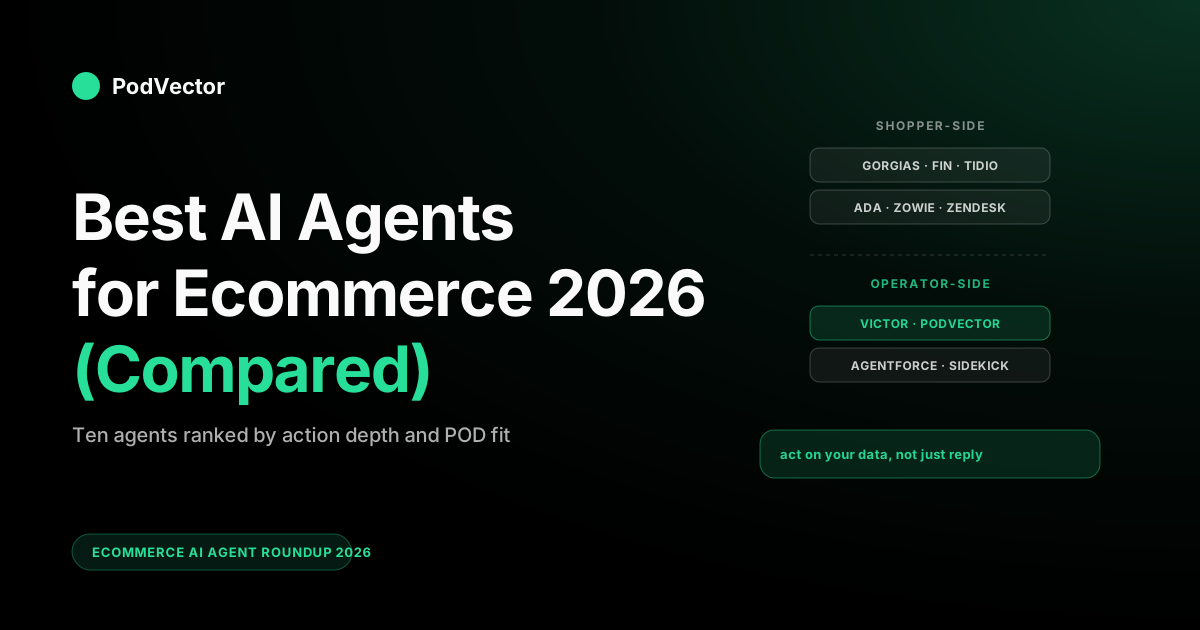
Quick Answer: The best AI agents for ecommerce in 2026 split into three jobs that most roundups conflate. Shopper-side helpdesk agents sit on your storefront deflecting tickets, refunding orders, and recommending products — Gorgias leads on Shopify-native action depth, Intercom Fin leads on benchmark resolution rate, and Tidio Lyro wins value for small-to-mid stores.
Operator-side agents live in your back office, reason over your live data, and act on it with your approval. If you run a print-on-demand store on Shopify with Printify or Printful fulfillment, what you usually want is an agent that can answer "which variants are profitable after Meta ad spend?" — not just deflect another tracking question. Victor by PodVector AI is purpose-built for that POD operator job.
The third job is new in 2026: agentic-commerce buying agents — Google's AI Mode, Amazon's "Buy for Me", and ChatGPT/Perplexity shopping — that browse, compare, and check out on the shopper's behalf. You don't buy these; you get found by them. Most serious ecommerce teams run one helpdesk agent and one AI employee, then make sure their catalog is legible to the buying agents. The rest of this guide ranks 10 agents and shows POD operators where to start.
What Is an AI Agent for Ecommerce?
An AI agent for ecommerce is software that can think through a goal, pick the right tools, take multiple steps, and check its own work — whether it's working for the shopper or the store owner. The big difference from the chatbots of 2022–2024 is that it can actually take action, not just answer questions. As the Sagepilot 2026 ecommerce operations guide puts it, a chatbot follows scripts to answer questions and routes anything harder to a person — an AI agent reasons through the request and completes the task in your systems. An agent doesn't just generate a reply; it can refund an order in Shopify, look at your orders, ad spend and costs together to spot a losing campaign, or update a product listing — all with the permissions you grant it.
By 2026 that capability is table-stakes. As the Kore.ai 2026 agentic retail guide notes, AI agents are now handling product discovery, resolving customer inquiries, automating returns, optimizing inventory, and personalizing journeys at scale. Nearly every vendor that used to call itself a "chatbot" now markets the word agent.
The practical test is unchanged: can it take a multi-step action you didn't rule-code — not just send the right message? For the foundational framing from a POD perspective, see the POD seller's guide to AI automation for ecommerce.
Ecommerce AI agents span two distinct jobs, and that split — rather than feature count or price — is the thing you should sort by when evaluating. The next section is the most useful part of this roundup.
Shopper-Side vs Operator-Side: The Split Most Roundups Miss
Once you accept that agents act rather than just reply, the next question is whose actions. As the HappyRobot 2026 retail roundup puts it, across storefront sales, customer support, and back-end operations, retailers now have purpose-built agents for each layer — and picking by layer is how you avoid buying the wrong tool.
- Shopper-side agents act on the storefront and in the helpdesk. They refund orders, cancel subscriptions, edit shipping addresses, trigger returns, recommend products, and deflect WISMO questions. Gorgias, Intercom Fin, Tidio Lyro, Ada, Zowie, Zendesk AI, Re:amaze, Richpanel, and Insider Agent One live here. This camp is crowded because it's the camp Gartner and most incumbent helpdesks have spent the last three years building into.
- Operator-side agents act on your business. They run queries against your live Shopify + fulfillment + ads data, explain the math, flag losing SKUs and campaigns, and — as the category matures — reprice, reallocate, and execute approved actions on your behalf. Victor by PodVector AI is the POD-native example. Salesforce Agentforce and Shopify Sidekick are early admin-side attempts at the same job from the incumbent side.
- Workflow-first back-office agents are a growing third category distinct from both helpdesk and analyst work. Platforms like Lindy (highlighted in Yotpo's 2026 guide) let lean ops teams build internal assistants that track supplier communications, flag inventory discrepancies, and automate operational work that piles up — acting as an operational multiplier rather than a customer-facing chat widget.
- Post-purchase and operations agents are a fourth layer that current roundups often fold into the shopper side but which is genuinely distinct. Tools like HappyRobot handle carrier calls, delivery coordination, and post-purchase communication at scale — the operational layer most storefront agents cannot touch. This layer matters more as order volumes grow and post-purchase workload outpaces support team capacity.
Most SERP roundups on "best AI agents for ecommerce" only cover the shopper side. That's fine for DTC brands with owned inventory, stable COGS, and a large support queue where deflection moves real money. For a print-on-demand operator running hundreds of designs against variable Printify/Printful COGS and unpredictable Meta spend, shopper-side agents solve half the problem — often the smaller half.
The rest of this article ranks both camps honestly and flags which one you should evaluate first based on what kind of ecommerce store you actually run. For the ad-side complement, see Meta Ads CBO vs ABO for small-budget testing.
At-a-Glance Comparison Table: Best AI Agents for Ecommerce 2026
| Agent | Camp | Best For | Starting Price | What It Actually Does (Actions) |
|---|---|---|---|---|
| Victor by PodVector AI | Operator-side | Print-on-demand sellers on Printify / Printful | From $29/mo | Looks at your live Shopify, Printify/Printful, Meta/Google Ads and Klaviyo data together; with your approval, makes changes in Shopify (pricing, discounts, collections), sets up Klaviyo flows, and manages your Google Ads and Meta Ads campaigns. |
| Gorgias AI | Shopper-side | Shopify stores with a support team | From $10/mo (automation add-on) | Refunds, edits, cancels, discounts, returns — Shopify-native, executed inside the ticket |
| Intercom Fin | Shopper-side | Mid-to-enterprise deflection at volume | $0.99 per resolution | Highest benchmark resolution rate; outcome-based pricing; tool-use for order actions |
| Tidio (Lyro AI) | Shopper-side | Small-to-mid Shopify / WooCommerce stores | Free / from $29/mo | Answers + narrow actions (returns, tracking); product cards in chat; fastest install |
| Salesforce Agentforce | Both | Commerce Cloud / Salesforce-stack enterprises | $2 per conversation (plus Salesforce licensing) | Reasoning layer across Commerce, Service, and Marketing Cloud; multi-step actions via Salesforce data |
| Ada | Shopper-side | Enterprise, multilingual stores | Custom | Structured enterprise-scale automation; governed workflows; multi-step tool-use across your commerce stack |
| Zowie | Shopper-side | Mid-enterprise DTC | Custom / mid-market | Workflow automation; separate care agent + sales agent; strong resolution on repetitive tickets |
| Zendesk AI Agent | Shopper-side | Stores already on Zendesk | From $55/agent/mo | Intent routing + answer bot; native to Zendesk ticket graph; Shopify actions via app integration; omnichannel and multilingual support at scale |
| Shopify Sidekick | Operator-side (narrow) | Any Shopify merchant wanting a native admin agent | Included with Shopify | Admin tasks (edit products, create discount codes, pull basic reports) via chat in Shopify admin |
| Insider Agent One | Shopper-side | Enterprise omnichannel personalization | Custom | Cross-channel (web, mobile, email, SMS) personalization; autonomous product recommendations |
Pricing reflects publicly listed tiers at time of writing; enterprise plans vary by negotiation. Strong adjacent picks worth evaluating: Sierra AI, Netomi, Decagon, Richpanel, Re:amaze, eDesk, Yuma AI, Rep AI, Kore.ai, Alhena AI, HappyRobot, Lindy, and ManyChat.
The 10 Best AI Agents for Ecommerce in 2026
1. Victor by PodVector AI — Best operator-side agent for POD ecommerce
Best for: Print-on-demand sellers on Shopify with Printify or Printful fulfillment who want an AI agent that can reason over their own orders, COGS, and ad spend — not just answer shopper questions.
What it is: Victor is the AI employee built into the PodVector AI platform. He keeps track of your live Shopify orders, your Printify and Printful item costs (including cost differences by country), your Meta and Google ad spend, revenue, fees, and refunds — all in one place, with your Klaviyo email results right alongside them.
Ask "what's my operating profit this month on Design X after Meta spend?" and Victor plans the query, runs it against live data, and returns a structured answer with the math shown. Ask "which Printify variants are losing money in Germany this week?" and it returns a ranked list you can act on.
<<<<<<< Updated upstreamAgent-native strengths: POD-native cost modelling — Printify and Printful are tracked separately, not averaged. Queries live warehoused data rather than a stale snapshot. Shows reasoning so operators can verify every number. On the action side, Victor can reprice a single product or bulk-reprice to a target margin, set up buy-one-get-one discounts, create free-shipping or customer-specific discounts, raise the free-shipping threshold, revert a price change, create or update Shopify collections, and draft, schedule, or build Klaviyo email campaigns and flows (abandoned-cart, welcome, post-purchase) — all executed on Shopify or Klaviyo with your approval before anything runs. The roadmap is explicitly expanding write automation to more surfaces. For a deeper look at how Victor connects to your ad strategy, see the product map guide for POD sellers.
Each Monday, Victor sends a Weekly Health Report analyzing the prior week — the one proactive surface outside query-driven sessions. For ad platforms (Meta, Google), Victor reads spend and surfaces analysis; the merchant executes any campaign changes on the ad platform directly. For the fuller framing see the POD seller's guide to AI automation for ecommerce.
Honest limitations: Victor isn't a shopper-facing storefront widget. He won't sit on your checkout handling refund tickets. Victor reads data from Shopify, Meta Ads, Google Ads, Printify, Printful, and Klaviyo — he doesn't pull data from Etsy, Amazon, or TikTok. With your approval, Victor can also make changes on Google Ads, Meta Ads, Printify and Printful, not just in Shopify. Each chat starts fresh — he doesn't remember past conversations. Victor can't generate designs, mockups, or print-ready files. Most POD operators pair Victor with a cheap or free shopper bot (Tidio free or Shopify Inbox) and cover both jobs for less than a single enterprise suite costs. Also see how to improve purchase frequency for the retention lever that Victor's customer data helps inform.
=======Agent-native strengths: POD-native cost modelling — Printify and Printful are tracked separately, not averaged. Queries live warehoused data rather than a stale snapshot. Shows reasoning so operators can verify every number. On the action side, Victor can reprice products to a target margin, set up buy-one-get-one discounts, create free-shipping or customer-specific discounts, raise the free-shipping threshold, organize collections, and schedule or delay a Klaviyo email flow or campaign — all executed on Shopify with your approval before anything runs. The roadmap is explicitly expanding write automation to more surfaces. For a deeper look at how margin stacks up across your catalog, see the net profit margin benchmark for ecommerce.
Each Monday, Victor sends a Weekly Health Report analyzing the prior week — the one proactive surface outside query-driven sessions. For ad platforms (Meta, Google), Victor reads spend and surfaces analysis; the merchant executes any campaign changes on the ad platform directly. For the fuller framing see AI agents for ecommerce: what it looks like for POD sellers.
Honest limitations: Victor isn't a shopper-facing storefront widget. He won't sit on your checkout handling refund tickets. Victor reads data from Shopify, Meta Ads, Google Ads, Printify, Printful, and Klaviyo — he doesn't pull data from Etsy, Amazon, or TikTok. With your approval, Victor can also make changes on Google Ads, Meta Ads, Printify and Printful, not just in Shopify. Each chat starts fresh — he doesn't remember past conversations. Victor can't generate designs, mockups, or print-ready files. Most POD operators pair Victor with a cheap or free shopper bot (Tidio free or Shopify Inbox) and cover both jobs for less than a single enterprise suite costs. Also see how AI can increase average order value for the revenue-side lever Victor's margin data connects to.
>>>>>>> Stashed changes2. Gorgias AI — Best shopper-side agent for Shopify-native action depth
Best for: Shopify ecommerce stores doing substantial ticket volume where deflection carries real dollar value and there's a support team to supervise.
What it is: Gorgias is a Shopify-first helpdesk with an AI agent layer on top. Its defining trait is the range of actions the agent can take natively inside a Shopify ticket — refunding, editing orders, applying discounts, cancelling subscriptions, triggering return flows — without a human touching the conversation. According to the Swell 2026 agentic commerce guide, Gorgias serves more than 15,000 ecommerce brands on its platform and excels for Shopify merchants who want support automation with a path to revenue generation, not just cost reduction.
Agent-native strengths: Deepest Shopify-native action surface of any agent on this list. Mature macro/rule system for constraining agent behaviour. Transparent reporting that attributes deflected tickets to real dollar value.
Limitations: Overkill for stores with very low ticket volume. Seat pricing stacks for larger teams. No view of your cost side — it's still a pure shopper-side agent. For the AI writing complement, see the POD seller's guide to AI writing for ecommerce.
3. Intercom Fin — Highest benchmark resolution rate
Best for: Mid-to-enterprise ecommerce stores with high ticket volume that want the market's best-deflecting shopper AI agent, and can stomach outcome-based pricing.
What it is: Fin is Intercom's AI agent layer. Independent benchmarks consistently put it at or near the top for first-touch resolution. Fin is priced at $0.99 per resolution, with Intercom seat pricing running tier-based on top of that — so you pay for value delivered on the AI layer itself.
Agent-native strengths: Genuinely strong answer quality; multi-step tool-use (order lookups, refunds, cancellations) when wired to your Shopify or commerce stack; outcome pricing aligns incentives.
Limitations: The full Intercom platform around Fin is priced for scale — small stores rarely justify the suite. Per-resolution math gets expensive on high-volume months. Less Shopify-native than Gorgias.
4. Tidio (Lyro AI) — Best value on small-to-mid ecommerce
Best for: Shopify, WooCommerce, and BigCommerce stores doing up to a few thousand tickets a month that want one widget for live chat, AI agent, and email.
What it is: Tidio is the most-installed chat + AI agent combo across Shopify App Store, WooCommerce, and WordPress ecosystems. Lyro, its AI layer, handles a large share of first-touch shopper questions — order status, shipping, returns, availability — and pulls product cards into the chat for recommendations. It takes narrow actions (return flows, tracking) and escalates cleanly.
Agent-native strengths: Fastest install across platforms; product recommendations inside the chat; a free tier that's genuinely usable for stores starting out. Lyro's action scope has expanded meaningfully in the past twelve months.
Limitations: Action depth shallower than Gorgias. Conversation caps on the Lyro plan get expensive as volume scales. Doesn't know your cost structure. Pair with an AI employee if you need margin visibility. For the broader chat tool comparison, see best AI chat tools for ecommerce (compared).
5. Salesforce Agentforce — Best for Commerce Cloud / Salesforce-stack enterprises
Best for: Enterprises already running Salesforce Commerce Cloud, Service Cloud, or Marketing Cloud who want agentic behaviour across the unified data model.
What it is: Agentforce is Salesforce's agent platform (the 2024 rebrand of Einstein Copilot plus agent tool-use layer). It reasons over your Salesforce data — customer record, order history, cart state, marketing engagement — and executes actions across the clouds. Outcome pricing at $2 per autonomous conversation (on top of your Salesforce licensing).
Agent-native strengths: Deep reasoning over unified Salesforce data that standalone agents can't see; native to the CRM ecosystem enterprise ecommerce teams already run; out-of-the-box action library across Service, Commerce, and Marketing Clouds.
Limitations: Only compelling if you're already on Salesforce. For stores on Shopify, WooCommerce, or BigCommerce, Agentforce is effectively unreachable without buying the underlying stack. Implementation timelines reflect the Salesforce norm (weeks-to-months, not days).
6. Ada — Best enterprise multilingual agent
Best for: Large ecommerce brands supporting many languages with complex escalation logic.
What it is: Ada is an enterprise AI customer-service agent platform. No-code workflow builder, broad language support with true contextual handling (not just translation), and a reasoning layer that executes multi-step requests against your Shopify, Magento, or custom commerce backend. Ada is designed for structured, enterprise-scale automation in environments where governance, compliance, and control matter as much as automation itself.
Agent-native strengths: Multilingual depth few other vendors match. Workflow builder non-engineers can maintain. Transparent reporting on where the agent fails and why.
Limitations: Enterprise pricing and a multi-week implementation. Not a fit for solo sellers or small DTC teams. Best evaluated against Fin and Agentforce at the top end.
7. Zowie — Best mid-enterprise DTC agent
Best for: Mid-enterprise DTC brands wanting strong resolution on repetitive tickets plus a selling-assist agent in pre-purchase chat.
What it is: Zowie is an agent platform focused on DTC. Two modes: a care agent handling WISMO, returns, and product questions, and a sales agent that recommends products and assists pre-purchase. Workflow automation is its wheelhouse. Pricing is mid-market and custom for enterprise — verify current rates directly with Zowie.
Agent-native strengths: Tight Shopify and helpdesk integrations; measurable resolution rates on repetitive categories; the sales agent is actually useful for stores where pre-purchase chat drives revenue.
Limitations: Not suited for solo sellers. Action scope on Shopify is narrower than Gorgias. Less competitive outside the DTC category.
8. Zendesk AI Agent — Best if you're already on Zendesk
Best for: Ecommerce stores already on Zendesk who want to turn on an AI agent without changing vendors.
What it is: Zendesk's AI Agent is competent and native to the ticket graph you're already using. It routes intents, drafts replies, and takes Shopify actions via the Shopify app integration. According to Zendesk's own 2026 ecommerce guide, the platform brings AI agents, AI Copilot, knowledge, QA, analytics, and human handoff into one customer service platform — so teams can automate support without disconnecting the customer journey.
Agent-native strengths: Zero-migration for existing Zendesk customers; strong intent classification; good agent-assist on human handoffs; native QA monitoring for AI interactions.
Limitations: If you're not already on Zendesk, you'd pick Fin or Gorgias before paying for the ticket platform. Action depth on Shopify trails Gorgias.
9. Shopify Sidekick — Best free native admin agent
Best for: Any Shopify merchant who wants an AI agent inside Shopify admin with zero install.
What it is: Sidekick is Shopify's own AI agent baked into the admin UI. Chat interface where you can ask things like "create a 10% discount code for the weekend", "pull me a report of last month's top products", or "edit all T-shirts tagged summer to add a meta description". It executes those tasks using Shopify admin permissions.
Agent-native strengths: Genuinely agentic for admin tasks — it edits, creates, and queries inside Shopify. Free. Native. Zero setup.
Limitations: Scope is narrow. Sidekick only sees Shopify — it can't reason over your Printify COGS, your Meta ad spend, or your true operating margin.
For a Shopify-only merchant with owned inventory it's the cheapest sane admin agent. For a POD seller it answers the wrong half of the question, which is why operator-side specialists like Victor exist.
10. Insider Agent One — Best autonomous omnichannel personalization agent
Best for: Enterprise brands running cross-channel personalization (web, mobile, email, SMS, push) who want an agent anticipating shopper needs rather than reacting to questions.
What it is: Insider's Agent One is positioned as a purpose-built autonomous agent for customer engagement. Rather than a chat interface the shopper has to initiate, it operates across channels: product recommendations, lifecycle triggers, segmentation, and session-level personalization.
Agent-native strengths: Genuine multi-channel scope most shopper agents don't reach; anticipatory rather than reactive; enterprise-grade personalization depth.
Limitations: Enterprise pricing and implementation. Not a fit for small stores. Adjacent rather than a direct substitute for helpdesk AI agents — most customers run Insider alongside a Gorgias / Fin / Zendesk AI for actual ticket work.
What Actually Makes an AI Agent (Not a Chatbot)
By 2026 every vendor on this list markets the word agent. Use these four tests to separate marketing copy from capability.
1. Autonomy: does it act, or just reply?
A chatbot suggests an answer. An agent executes. As the Sagepilot 2026 operations guide explains, reputable platforms build in permissions, approval gates, traceable actions, and a human in the loop — the agent acts only within the limits you set, and every action is logged.
On ecommerce, the practical test is whether the tool can refund an order, cancel a subscription, edit a shipping address, issue a discount, or update a product — from inside the chat, with permissions you granted. If the transcript always ends with "I've asked an agent to help you", it's a chatbot wearing an agent hat.
2. Reasoning and planning
A real agent breaks a goal into steps. "Find all Printify variants where margin is below your target after Meta spend, then flag the ones with negative ROAS for the past 14 days" is a multi-retrieval, multi-join query — several steps that must execute in sequence. A chatbot will either pick a single best-match answer from a knowledge base or hallucinate a plausible one. An agent plans, executes, and checks its own output. As the V7 Labs 2026 buyer's guide frames it, AI agent platforms use large language models to understand context, handle unstructured data, and make decisions to complete multi-step workflows — which is fundamentally different from rule-based automation.
3. Tool use and integration depth
AI agents work by actually doing things in your other apps, not just chatting. On ecommerce that means making changes to orders and products in Shopify, answering tickets in your helpdesk, placing fulfillment orders with Printify or Printful, and adjusting Meta and Google ad campaigns. As the Sagepilot guide notes, the deeper these connections go, the more an agent can do on its own.
Gorgias, Fin, Ada, Agentforce, Zowie, and Victor all score here. Sidekick scores narrowly (Shopify admin only). Many vendors still claiming "agent" don't.
4. Memory and context
An agent that forgets everything at the end of each conversation isn't really agentic — it's a stateless function. The better shopper agents carry conversation context and customer history across channels. As the Kore.ai 2026 guide highlights, governance-first platforms provide full audit logs and monitoring of every agent decision — an important control mechanism for high-volume customer-facing workflows. Note that some AI employees (Victor included) start each session fresh — cross-session memory is a differentiator worth asking about when evaluating any platform.
How to Choose the Right AI Agent Platform for Your Ecommerce Store
The Kore.ai 2026 agentic retail guide frames it well: choosing the right agentic AI platform is a strategic decision with real consequences for conversion rates and operational efficiency. Run this decision tree.
Step 1 — Identify your primary layer first
As the HappyRobot 2026 roundup puts it, the right choice depends on which layer of your operation you are trying to automate first. If tickets are drowning you and you can quantify the deflection dollar value, start shopper-side. If you're flying blind on which designs or SKUs are profitable after ad spend, start operator-side. If delivery exceptions and post-purchase workload are the main pain, look at operations agents. POD sellers almost always need both shopper and operator layers eventually, but sequence by the bigger pain.
Step 2 — Match to your commerce platform
Platform fit determines integration depth, which determines how much an agent can actually do. Shopify: full field of options. WooCommerce / WordPress: Tidio, Intercom, Zendesk AI, Ada are the strongest fits. BigCommerce: Tidio, Gorgias (now BigCommerce-certified), Zendesk AI. Salesforce Commerce Cloud: Agentforce first, then Ada. Magento / Adobe Commerce: Ada, Zendesk AI. Custom stack: Intercom Fin or Ada, depending on integration depth. For the Shopify-specific Google Ads attribution context, see Google Ads attribution settings explained for POD sellers.
Step 3 — Check security and governance before you commit
As the V7 Labs 2026 buyer's guide advises, when evaluating platforms prioritize enterprise-grade security features — compliance certifications, end-to-end data encryption, granular access controls, and comprehensive audit logs. For shopper-facing agents taking refund and cancellation actions, ask specifically how the vendor constrains the agent's scope and what the approval or escalation path looks like for edge cases.
Step 4 — Match store size to tier
Under 100 tickets/month: Shopify Sidekick + Tidio free or Chatty free. 100–1,000/month: Tidio paid, Gorgias, or Zowie. 1,000+/month: Gorgias, Intercom Fin, or Ada. Enterprise with cross-channel personalization needs: add Insider Agent One alongside a helpdesk agent.
Step 5 — Are you a POD seller?
If yes, add an AI employee. Shopper bots can't see your Printify/Printful margin or your Meta ROAS per variant — they weren't designed to. For the POD strategy view, see PodVector AI's POD strategy guide.
Step 6 — Evaluate pricing model against your volume profile
Outcome-based (Fin at $0.99/resolution, Agentforce at $2/conversation) fits spiky volume. Seat-based (Zendesk, Gorgias) fits predictable volume. Flat monthly (Victor, Tidio) fits when question volume is what you want to grow, not ration. Don't rely on automation claims alone — as the Zendesk 2026 guide cautions, look for proof that the solution can improve real workflows in your business.
No single ecommerce AI agent wins every scenario. For most operators — and especially most POD operators — the right answer in 2026 is two specialized agents, not one generalist.
Agentic Commerce: The Buying Agents Reshaping Ecommerce in 2026
The two camps above are agents you deploy. The fastest-moving story in 2026 is a third kind you don't deploy at all — the shopper's own AI agent that browses, compares, and checks out on their behalf. As the Swell 2026 agentic commerce guide notes, agentic commerce — where autonomous AI agents plan, act, and complete purchases on behalf of customers — represents the next major evolution in ecommerce. Google's AI Mode in Shopping, Amazon's "Buy for Me", and checkout flows surfacing inside ChatGPT and Perplexity all point the same way: a growing share of orders will be placed by an agent acting for the customer, not by the customer clicking through your funnel.
This changes the operator's job rather than replacing it:
- Discoverability shifts from SEO to feed legibility. A buying agent reads structured product data — title, variant, price, availability, shipping — not your landing-page copy. If your Shopify catalog and product feed aren't clean and machine-parseable, the agent skips you. Getting found by agents is becoming as important as ranking in search.
- Agents optimize for the shopper, which squeezes margin. A comparison agent picks the cheapest qualifying variant. For a POD seller running variable Printify and Printful COGS, that means agent-driven orders can skew toward your thinnest-margin SKUs unless you know which variants you can afford to win on.
- The operator question gets sharper, not obsolete. "Which variants are profitable after ad spend?" becomes "which variants are still profitable when a buying agent forces me to the lowest price in my range?" That is squarely an operator-side, not a shopper-side, question.
So agentic commerce raises the value of operator-side agents like Victor: the back-office agent that tells you, in real time, whether the orders these buying agents send you are actually making money. Helpdesk deflection doesn't touch this; margin reasoning does. For the POD-native framing, see the POD seller's guide to AI automation for ecommerce.
Post-Purchase Automation: The Layer Most Agents Miss
A gap that most "best AI agents for ecommerce" roundups undercover is the post-purchase and operations layer — separate from both the helpdesk and the back-office analyst. As the HappyRobot 2026 retail guide frames it, today's best retail AI agents handle end-to-end workflows including calling carriers, updating customers on orders, deflecting WISMO tickets, and handling returns — all without a human in the loop.
For growing ecommerce teams, three post-purchase failure modes drive the most tickets and the worst reviews:
- Delivery exceptions. A carrier marks a package delayed or lost. A post-purchase agent can detect the exception, proactively notify the customer, and trigger a re-ship or refund — before the customer opens a ticket. For POD sellers, this matters more because Printify and Printful are responsible for production and shipping, so exception handling is often the only lever you control.
- Return and exchange flows. Most shopper-side agents handle returns reactively (the customer asks). Post-purchase agents can initiate return prompts proactively based on delivery confirmation and product category — reducing "where's my refund?" tickets.
- Operational scale at peak. Seasonal spikes — Q4, major sale events — produce volumes helpdesk agents and human teams struggle to absorb. According to the Zendesk 2026 ecommerce guide, AI agents support customers across web, mobile apps, messaging, and social channels — a connected approach that is critical for ecommerce teams hitting volume ceilings at peak.
For POD sellers specifically: your post-purchase loop is complicated by Printify/Printful production lead times sitting between order and shipment. Victor reads order-side data from both providers, which gives an employee visibility into where delays are concentrated — a useful input before a post-purchase automation agent escalates to a re-ship. For the ad-attribution side of this, see Google Ads attribution settings explained for POD sellers for how product data hygiene prevents downstream attribution gaps that generate the most confusion in post-purchase reporting.
Why POD Ecommerce Operators Evaluate Agents Differently
Every SERP roundup on "best AI agents for ecommerce" assumes a default ecommerce operator: a DTC brand with owned inventory, a warehouse, stable COGS, and a visible support queue. Print-on-demand breaks most of those assumptions.
- No owned inventory. Your COGS is set by Printify or Printful per unit, not per batch. Ad spend, refunds, and platform fees swing real margin wildly. A shopper-side agent that deflects tickets is useful, but it does nothing to stop the margin leak. For how margin analysis connects to ad scaling, see how to improve purchase frequency — the retention lever that margin visibility unlocks.
- Two fulfillment providers, two cost models. The same T-shirt design might be more profitable on Printify than Printful for US orders and the other way around for Germany. Generic ecommerce agents average these or ignore them. A POD-native AI employee itemizes them.
- Long design tail, small profitable core. POD stores have thousands of SKUs with a small number of true winners. "Which designs are actually profitable after ads?" is the highest-leverage question a POD operator can ask — and no shopper-side agent on this list can answer it. Operator-side agents like Victor are built around that exact question. For the ad-campaign side, see Meta Ads CBO vs ABO for small-budget testing for the structure that feeds Victor's spend analysis.
- Ad spend is the biggest line item. For most POD ecommerce stores, Meta + Google ad spend outweighs product COGS. A support agent saving ticket hours is nice; an AI employee surfacing unprofitable campaigns is transformative. The product map guide covers the catalog-to-ad mapping that Victor's analysis depends on.
- POD strategy is inseparable from product data. Which designs to scale, which to sunset, which provider to route to — these are operator decisions, not support decisions. For the strategic framing, see PodVector AI's POD strategy guide.
That asymmetry is why POD ecommerce operators usually want two agents, not one: a cheap or free shopper agent (Tidio free, Shopify Inbox, or a free Chatty tier) plus an employee-side agent like Victor. Paying for a single enterprise support suite covers half the problem at a much higher price, and it still can't answer the margin question.
FAQs
What is the best AI agent for ecommerce in 2026?
There's no single winner — it depends on the job. As the HappyRobot 2026 retail roundup frames it, retailers now have purpose-built agents for each layer — storefront sales, customer support, and back-end operations — and picking the right one means picking the right layer first.
For shopper-side action-taking on Shopify stores with a support team, Gorgias leads. For the highest benchmark resolution rate at scale, Intercom Fin leads. For small-to-mid stores on value across Shopify, WooCommerce, and BigCommerce, Tidio (Lyro AI) wins. For Salesforce Commerce Cloud enterprises, Agentforce is the obvious pick. For print-on-demand ecommerce operators who need an agent that reasons over their own margin data, Victor by PodVector AI is purpose-built.
What's the difference between an AI agent and an AI chatbot for ecommerce?
A chatbot answers questions by picking or generating a reply. An AI agent takes actions — refunding an order, cancelling a subscription, editing a product, running a data query — using tools and multi-step reasoning. As the Sagepilot 2026 guide explains, a chatbot follows scripts to answer questions and routes anything harder to a person — an AI agent reasons through the request and completes the task in your systems.
Most 2026 vendors market the word "agent"; the real test is whether the tool can execute a multi-step task on your behalf, not just send the right message. For the full framing see the POD seller's guide to AI automation for ecommerce.
Which ecommerce AI agents can actually refund orders and edit shipping addresses?
Gorgias has the deepest action surface (refund, edit, cancel, discount, return) directly inside the ticket. Intercom Fin takes the same actions when wired to your commerce stack.
Ada and Agentforce handle multi-step actions via their reasoning layers. Tidio Lyro takes narrower actions (tracking, returns).
Shopify Sidekick takes admin-side actions (edit products, generate discounts, pull reports) but not shopper-side ticket actions. Shopify Inbox is messaging with AI-drafted replies, not an action-taking agent.
Do ecommerce AI agents work with Printify and Printful?
Most shopper-side agents don't integrate directly with Printify or Printful — they see your Shopify orders and can trigger refunds and cancellations on the Shopify side; the fulfillment side is handled by the Printify/Printful apps themselves. For an AI employee like Victor, this matters much more — Victor pulls in your Printify and Printful costs, broken down by variant and country, and uses them to work out your true margin and ad return on every order.
That's the point of the operator-side category. See the POD seller's guide to AI automation for ecommerce for the operator-side mechanics.
How much does an AI agent cost for an ecommerce store?
Shopify Sidekick is free. Tidio's Lyro AI starts around $29/mo and has a usable free tier. Gorgias's automation add-on starts at $10/mo on top of helpdesk seats. Intercom Fin is $0.99 per resolved conversation. Zendesk AI starts at $55/agent/mo. Zowie is mid-market / custom enterprise pricing. Salesforce Agentforce is $2 per autonomous conversation on top of Salesforce licensing. Ada and Insider are custom enterprise pricing. Victor starts at $29/mo flat regardless of query volume — the pricing assumption is that question volume is what a POD operator should be growing, not rationing.
How long does it take to set up an ecommerce AI agent?
For Tidio, Re:amaze, Chatty, and Shopify Inbox: 10–30 minutes to install and answer basic FAQs. Shopify Sidekick is already there — zero setup.
For Gorgias with meaningful automation rules: a day or two. For Intercom Fin, Ada, Agentforce, or Zowie with deep tool-use integrations: a week or more.
For enterprise personalization tools like Insider Agent One: multiple weeks with their implementation team. For Victor: connecting your Shopify, Printify/Printful, and ad accounts takes about 20 minutes. Victor pulls in your past data overnight, so you can start asking him questions about your history the very next day.
Can an AI agent actually grow ecommerce revenue, or just cut support costs?
Both, in different places. Shopper-side agents cut support costs and can measurably reduce cart abandonment. Personalization agents like Insider push conversion and AOV directly.
For POD ecommerce stores, the largest revenue impact usually comes from operator-side agents: once you can see which SKUs are truly profitable after ad spend, reallocating ad budget toward winners moves revenue faster than deflecting more tickets. Support deflection saves cents; ad reallocation saves dollars. For the purchase-frequency angle, see how to improve purchase frequency.
Are ecommerce AI agents safe to let refund orders without a human?
With policy guardrails, yes. Every serious agent (Gorgias, Fin, Ada, Zowie, Tidio, Agentforce) lets you cap the agent's action scope: refund only within a defined window of purchase, up to a set dollar limit, only for specific SKUs, only after the shopper confirms.
Operator agents like Victor follow the same pattern by design — the merchant approves proposed actions before Victor executes them on Shopify. As the Sagepilot 2026 guide notes, reputable platforms build in permissions, approval gates, traceable actions, and a human in the loop — every action is logged. Start small, test with real transcripts, and keep approvals in place until you trust the agent's judgment on your ticket mix.
Which AI agent should a small ecommerce store start with?
Shopify Sidekick (free, native, admin-side) plus Tidio's free Lyro tier or Chatty's free tier (shopper-side) is the cheapest sane starter stack. It covers admin tasks, storefront deflection, and product recommendations for $0.
Once you're doing meaningful ticket volume or spending real money on Meta/Google, upgrade the shopper-side to Tidio paid or Gorgias — and if you're POD, add Victor on the operator side. For the broader chat tool comparison see best AI chat tools for ecommerce (compared).
What is agentic commerce, and what should ecommerce sellers do about it?
Agentic commerce is shoppers buying through their own AI agents — Google's AI Mode, Amazon's "Buy for Me", and checkout inside ChatGPT or Perplexity — which browse, compare, and complete purchases on the shopper's behalf. You don't deploy these agents; you get discovered by them, which means clean, structured product data matters more than landing-page copy. As the Swell 2026 guide notes, unlike basic chatbots that respond to queries, agentic platforms proactively guide customers through product discovery and process transactions — the operator's job is to make sure your catalog is machine-legible enough to be surfaced.
The practical move is two-fold: keep your Shopify catalog and product feed structured so buying agents can surface your products, and use an operator-side agent like Victor to confirm the agent-driven orders are still profitable once a comparison agent pushes you to your lowest viable price. For the Google feed side, see Google Ads attribution settings explained for POD sellers.
How were these AI agents evaluated?
We evaluated across five dimensions: (1) action depth — can the agent actually execute refunds, edits, and other tasks, not just reply; (2) ecommerce-platform integration — Shopify, WooCommerce, BigCommerce, Magento, Salesforce; (3) pricing predictability versus outcome- or seat-based drift; (4) POD-specific capabilities — itemized Printify/Printful COGS handling and margin visibility, the dimension most SERP roundups skip; (5) transparent reporting so operators can verify what the agent is doing. External sources for independent benchmarks on shopper-side resolution rates include the HappyRobot 2026 retail roundup, the Kore.ai 2026 agentic retail guide, the Zendesk 2026 ecommerce guide, the Swell 2026 agentic commerce guide, and the Sagepilot 2026 operations guide. The operator-side evaluation is grounded in PodVector AI's own work building Victor for POD sellers.
Want an AI agent that actually knows your POD ecommerce business?
Support agents deflect tickets. Victor answers questions about your business — and executes approved actions on Shopify. Ask which Printify variants are profitable after Meta ad spend, which Shopify SKUs are losing money, and where Printful beats Printify on margin — all from your live store data, with the math shown.
Try Victor free