
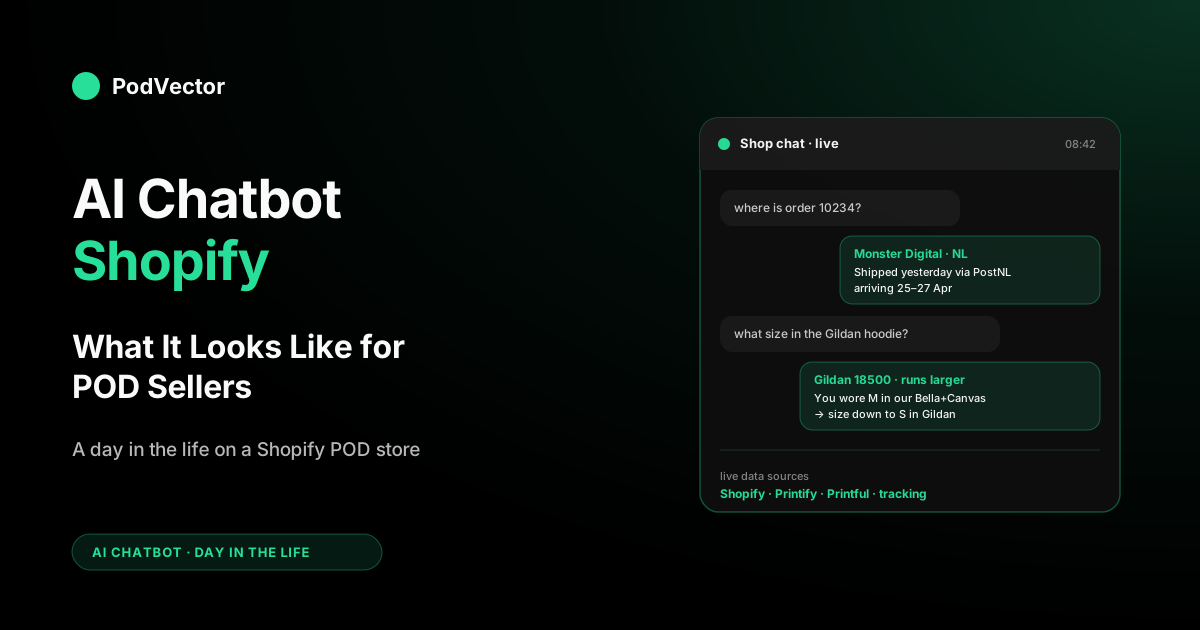
Quick Answer: An AI chatbot on Shopify is a chat widget that reads your live store data and answers shoppers in seconds — order status, sizing, returns — without a human. On a print-on-demand store it handles the six conversation patterns that make up the bulk of your ticket volume: where's my order, what size, which base, can I cancel, it arrived damaged, and will this design print clean.
The right setup reads live Shopify + Printify or Printful data, resolves the routine questions in under a minute, and hands the hard ones to a human with the full conversation attached. The wrong setup is a demo video. This article walks through what the bot actually does all day, what changes about your operation, and which apps are ready for a POD catalog in 2026.
What an AI chatbot on Shopify actually does all day
Most buyer's guides describe AI chatbots by feature matrix. That's backwards. The useful way to understand a Shopify chatbot is to watch a real one work across a twelve-hour window on a POD store doing $60k a month. Here's the rhythm.
The first three hours of the day are almost entirely order-status questions. European shoppers waking up, checking on orders placed yesterday evening.
The bot reads the Shopify order number, cross-references the Printify or Printful fulfillment status, checks the carrier tracking, and replies in seconds. A human queue would have sat on these until 9 a.m. Pacific.
Mid-morning shifts into pre-purchase. Shoppers on your storefront are comparing your Bella+Canvas tee to a competitor's Gildan.
They ask about fit, feel, and shipping speed. A good bot reads the exact variant on the product page, answers sizing from the base-specific chart, and quotes a realistic shipping window — not the generic one in your policy page. This is where most chatbots quietly lose revenue: they default to the store-level size chart and a boilerplate "4–7 business days" regardless of what the variant actually needs.
Afternoon runs heavier on support. Packages arriving, buyers discovering a print defect, sizing wrong, or a gift order they need to redirect.
The bot filters the easy cases — "your tracking shows delivered, check with a neighbor" — and escalates the real ones, with a photo already attached and the order, variant, and supplier context pre-loaded in the ticket. Your human support person doesn't re-ask the shopper for anything.
Evening is re-engagement. Abandoned carts from shoppers who left two hours ago, stuck on sizing or shipping.
The bot fires a proactive message when a session has been idle for a configurable window on a product page or checkout, offers to answer the specific hesitation it can detect from the browsing pattern, and respects a per-SKU discount floor you set in the admin. That last bit is the part that keeps a POD store profitable — a bot that discounts freely on a low-margin product costs you more than it earns.
At no point does a modern Shopify chatbot look like a scripted decision tree. It looks like a competent junior rep who never sleeps, answers in seconds, and never forgets to check tracking.
The three kinds of Shopify chatbot
Every roundup lumps these together, but they're three different products. Knowing which one a demo is showing you saves a month of buyer's remorse.
Rule-based bots follow a scripted decision tree. The shopper picks from buttons, the bot follows branches. Cheap, predictable, and brittle — anything off-script dead-ends. Fine for a pure FAQ deflector, wrong for a POD store with variant and supplier nuance.
AI Q&A bots read your store content and answer in natural language. This is the bulk of the 2026 field — Tidio's Lyro, Shopify Magic, most App Store entries. They resolve the six POD conversations well once you wire the supplier data, but they answer questions rather than take actions.
Autonomous resolution agents don't just answer — they act. They file the misprint claim, apply the credit, trigger the cancellation, and close the ticket without a human. Gorgias AI Agent, eesel AI, and Intercom Fin lead here. This is the tier that actually clears your queue on a POD store, and it's what the rest of this article assumes you're aiming for.
The six conversations you're about to offload
POD store ticket volume breaks down consistently. These six patterns make up the vast majority of inbound conversations on Shopify POD stores. The bot's job, in priority order, is to resolve these six cleanly.
1. "Where is my order?" — the single largest bucket
The question vendors abbreviate to WISMO — and the easiest to deflect. According to PodVector AI's integration guide, "where is my order" is 40–60% of every support team's inbox on a POD store. The bot reads the order number (or infers it from the logged-in customer), pulls the Printify or Printful fulfillment status, reads the carrier tracking event, and replies with the current location and realistic ETA.
If your chatbot is resolving fewer than three-quarters of these, it's not reading fulfillment data past the Shopify layer.
2. "What size should I get?" — the sizing bucket
Apparel POD's recurring headache. A shopper looking at your Next Level tri-blend tee needs a different answer than the same shopper looking at your Gildan heavyweight.
A bot that quotes a single "our sizes run true" line across the whole store is producing returns. A bot that reads the variant, knows the base, and quotes that base's chart is converting. This is one of the tests the better apps pass and most of the cheap ones fail.
3. "Which base is softer/warmer/fits truer?" — comparison questions
The shopper is choosing between two of your products that differ primarily by base fabric. The bot's answer depends on product-description depth and the variant metafield structure in your Shopify catalog. Spend an afternoon enriching metafields on your top 20 SKUs before you go live. It's the single highest-leverage prep task.
4. "Can I cancel or change this?" — time-sensitive cancellations
Printify and Printful have narrow cancellation windows — often two to six hours post-order, depending on base.
The bot checks the fulfillment status, tells the shopper accurately whether cancellation is still possible, and either triggers the cancellation flow or explains politely why it's now locked. Generic chatbots that don't read supplier status get this wrong either way: promising cancellations after cutoff or refusing cancellations that are still open.
5. "It arrived damaged / misprinted" — the high-friction one
A good bot asks for a photo, confirms the issue category, and files the misprint claim directly with Printify or Printful via their replacement API.
The shopper sees a single message: "We've filed the replacement — expect the new one within X days." Your human team never touches it for the clean cases. This is the workflow that pays for the whole chatbot bill on a POD store.
6. "Will this design print clean?" — pre-purchase print quality
Pre-purchase, usually on text-heavy or detail-heavy designs. The bot should explain what the base prints well, what it doesn't, and when to size up the design file. Only a few chatbots handle this well. For most, you'll need to load print-quality guidance as a source document at setup.
Everything else — discount code questions, tax/duty inquiries, wholesale asks, press or collab requests — should escalate. The value of the chatbot isn't trying to answer the long tail; it's cleanly resolving the six patterns above and handing off the rest with full context.
The four POD-specific conversations generic bots fumble
These are the conversations where a chatbot built for generic DTC looks fine on paper and breaks on your store.
Per-variant production time
A shopper asks "when will my Bella+Canvas hoodie arrive to Germany?" A generic bot reads your store's default shipping policy and answers "4–7 business days." As PodVector AI's integration guide notes, a chatbot answering "when will my order ship" from the Shopify fulfillment status alone is useless for POD — the order is almost always "unfulfilled" until the supplier ships it. The bot needs to pull the production queue for that specific order from Printify or Printful directly. The right answer accounts for the specific production center, base-level production time, and realistic carrier transit. The generic bot's answer is plausibly wrong and the shopper doesn't know until it doesn't arrive when expected.
Mixed-base size comparison
"I got a medium in your Bella+Canvas last time and it fit perfectly. What size should I get in your Gildan?" The honest answer: probably a small, because Gildan runs larger. Any chatbot quoting a generic "order your usual size" gets this wrong.
Misprint claim submission
POD returns are categorically different from DTC. Buyer's remorse gets store credit at best because you don't want to put a printed product back in inventory.
Misprints — wrong size, wrong color, bad print — file as a replacement claim with the supplier and cost you nothing beyond a small handling fee. A chatbot that treats all returns the same is destroying margin and confusing shoppers. A POD-aware bot asks for a photo, determines the category, and routes accordingly.
Margin-aware discounting on cart recovery
Abandoned-cart flows that offer flat discount codes can quietly destroy profit on your lower-margin SKUs. POD margins before ads vary significantly depending on base, retail price, and supplier.
A chatbot that doesn't enforce a per-SKU or per-collection discount floor is trading ad-driven profit for recovered cart volume at a loss. The better apps expose this ceiling as a configurable rule in the admin UI. Many cheaper ones don't.
If the chatbot demo you're watching doesn't explicitly show these four behaviors, the sales engineer is showing you a Shopify integration, not a POD Shopify integration. Ask directly. For a fuller look at how the integration layer actually works, see our AI chatbots for Shopify integration guide, which covers the four wiring layers that separate a demo from something that pays for itself.
The four data sources a Shopify POD chatbot must read
Regardless of which app you pick, a Shopify AI chatbot for POD needs live reads on four data sources. Any gap here is a ceiling on what the bot can resolve.
- Shopify Admin API. Products, variants, inventory, orders, customers, discounts. This is table stakes; every legitimate app has it. Check the scope list they request during installation to confirm they're reading what they need.
- Printify or Printful API. Live fulfillment status, production time per variant, misprint/replacement endpoints, base-level metadata (blanks, print areas, print-quality notes). This is where most apps either shine or collapse.
- Carrier tracking (USPS, DHL, Royal Mail, PostNL, etc.). Most apps handle this via a multi-carrier tracking API like EasyPost or 17TRACK. Shopify's order object includes tracking, but the richer event stream usually comes from the tracking provider layer.
- Your policy and FAQ content. Returns policy, sizing guide, shipping page, FAQ. The bot's non-data answers are only as good as these pages. If your policy says "5–7 business days" and your product pages say "business week," the bot picks one at random and shoppers get inconsistent answers.
Apps that only read source 1 are brittle. Apps that read 1–3 are competitive. Apps that read all four with sensible precedence rules (policy yields to variant, variant yields to live supplier status) are production-grade for POD.
A week on your Shopify POD store, before vs after
Useful to see the shift concretely. This is composite from operators we've talked to running Shopify + Printify or Printful + paid traffic, before and 60 days after installing a well-tuned AI chatbot.
Before
- You or a contractor handles tickets in two daily batches — morning and evening. Some Monday-morning tickets from weekend orders sit many hours without a reply.
- Cart abandonment recovery runs on a Klaviyo flow that emails at 1 hour and 24 hours.
- Misprint claims filed manually in the Printify or Printful admin, typically two days after the shopper reports them.
- Weekend ticket volume is handled Monday morning. CSAT on Monday-resolved tickets is noticeably lower than mid-week.
After
- The bot resolves the majority of inbound tickets automatically. Your queue shrinks to the hard cases requiring human touch, all with full context attached.
- Cart abandonment recovery now runs in two layers: the bot's proactive in-session message plus the Klaviyo email flow as a backstop.
- Misprint claims filed automatically when the shopper attaches a photo that passes pattern checks, typically within minutes of the complaint. Replacements arrive days faster.
- Weekend ticket queue resolves in minutes. CSAT on weekend-resolved tickets matches weekday tickets for the first time.
- Your own time reclaimed every week on routine tickets. That reclaimed time usually pays for the app many times over before you count conversion lift.
The shift isn't just volume. It's variability. Support quality stops degrading on weekends, holidays, and when you're in a meeting. That consistency is the real product.
The apps handling this competently in 2026
A short list, ordered by how well they handle the POD-specific behaviors above. Not a generic Shopify ranking.
Gorgias AI Agent
The serious pick once ticket volume reaches meaningful scale. Already the default helpdesk for mid-market Shopify, with ticket-workflow integration most competitors can't match. Printify and Printful integrate via pre-built apps. According to pricing listed by PodVector AI's platform guide, Gorgias runs roughly $60–$900+/month depending on tier, and resolved-by-AI tickets are metered separately. Worth the line item once the volume is real.
Tidio (Lyro AI)
Strongest pre-purchase conversational UX in the mid-tier. Lyro, Tidio's autonomous-resolution layer, uses a large language model that shows up in noticeably more natural replies than the rule-based bots it replaced. Shopify integration is mature, the onboarding is faster than Gorgias, and the free tier is genuinely usable up to a low monthly conversation cap. According to publicly listed pricing, Tidio tiers run roughly $24–$750/month.
POD awareness depends on how you wire product metafields at setup — out of the box, Tidio treats your catalog as generic Shopify. Plan a setup afternoon on your top 20 SKUs.
Shopify Inbox + Shopify Magic (native)
The free path. Handles FAQ answers grounded in store content, order-status lookups, and suggested replies for human agents. No Printify or Printful awareness — that's the hard ceiling. Right answer for stores at an early stage with a narrow catalog. Past that, you'll feel the gap on the POD-specific conversations above.
SmartBot
Aggressive on modern-AI positioning with a strong product-recommendation flow. Support workflows are shallower than Gorgias but the pre-purchase conversational UX is strong. Good fit for a growth-stage store that values shopper conversations over ticket automation.
Chatty AI Chatbot & Live Chat
The multi-channel pick. Reliable across Instagram, WhatsApp, Messenger, and Shopify chat without per-channel reconfiguration. Useful when your audience discovers you on social and comes to Shopify to buy. AI tier is competent but not category-leading.
Re:amaze AI
A reasonable Gorgias-adjacent choice at a lower price point. Printify and Printful integrations via Zapier or direct API. Fits the band between Shopify Inbox and Gorgias.
Second tier
Zipchat AI, VanChat, Wizybot, BestChat, Juphy, Jotform AI. All capable, all lean on current frontier models, all reasonably priced. None have a sharp POD edge out of the box. Fine for earlier-stage stores that outgrew Shopify Inbox.
Two names that now lead the autonomous-resolution conversation are eesel AI and Intercom Fin. Both lead with autonomous resolution — the bot doesn't just answer, it takes the action (files the return, applies the credit, closes the ticket). eesel layers over an existing helpdesk rather than replacing it; Fin is the enterprise-priced autonomous tier of Intercom. Neither reads Printify or Printful cost or fulfillment data natively, so on a POD store both still need the supplier layer wired by hand. Worth a look once your ticket volume justifies metered per-resolution pricing.
A few other names now surface on App Store and roundup searches: Flyweight (auto-trains on your store content, currently a top "AI chatbot" result on the App Store, strong storefront UX but no native supplier layer), Zendesk AI (the helpdesk-first choice if you already run Zendesk, priced per agent), and Richpanel (Gorgias-adjacent with per-conversation metering). All three are competent generic Shopify bots; none read Printify or Printful data out of the box, so the POD gap is the same one you'll wire by hand.
Also worth noting: TailorTalk has emerged as the strongest option when your audience discovers you via social DMs and arrives on Shopify to purchase. Oscar Chat is increasingly referenced for high-volume stores that have outgrown mid-market pricing.
Independent roundups worth skimming include the Tidio team's own Shopify chatbot ranking, which ranks Tidio first (obviously) but covers the broader field honestly.
How to add an AI chatbot to your Shopify store
The mechanical install is the easy part. The POD-specific tuning is what separates a bot that resolves tickets from one that invents wrong shipping dates. Here's the order that works.
- Install from the Shopify App Store. Pick the app, click Add app, approve the data scopes it requests. The widget appears on your storefront within minutes. This step is the same for every app named above.
- Connect Printify or Printful. Authorize the supplier integration (a pre-built app or API key, depending on the vendor). Skip this and the bot is guessing on a large share of order-status answers — fix it on day one, not later.
- Enrich your catalog. Clean variant names, load base-specific size charts, and write print-quality notes into metafields on your top 20 SKUs. This is the single highest-leverage afternoon of the whole setup.
- Load policy and FAQ content. Point the bot at one canonical returns, shipping, and sizing source so its non-data answers stay consistent.
- Set discount floors and the handoff rule. Configure per-SKU or per-collection discount ceilings so cart recovery can't sell below margin, and confirm escalations hand a human the full transcript.
- Test the six conversations, then go live. Run a WISMO, a sizing, a misprint, and a cancellation query through it before you flip it on for real traffic.
Budget an hour for steps 1–2 and an afternoon for 3–5. Shopify Inbox + Magic collapses to step 1; a fully tuned POD setup runs 4–6 weeks of part-time work.
What you'll actually pay
App Store list prices are the floor, not the final number. Resolved-by-AI tickets are often metered separately — model the unit economics before signing.
- Early-stage stores: Free on Shopify Inbox + Magic for most. Entry tiers of paid apps like Tidio or Jotform are available at low monthly costs.
- Growing mid-market stores: Tidio's paid tiers, a mid-tier Chatty plan, or a Re:amaze seat. This is the band where fit matters most — a poorly configured app at this price point feels indistinguishable from paying nothing.
- Established stores: Gorgias AI Agent metered on resolved tickets, plus a pre-purchase layer (Tidio or SmartBot) for the storefront widget. Most stores at meaningful scale run two chatbots — one for pre-purchase, one for post-purchase tickets.
- High-volume stores: Enterprise Gorgias or equivalent with custom integrations.
Budget two weeks of part-time operator time for setup and roughly half a day per month for ongoing tuning — updating size charts, policy docs, and discount ceilings as your catalog evolves.
Customer chatbot vs AI employee agent
The distinction that gets conflated more than any other in the AI-agent conversation. It costs real money when merchants buy the wrong category expecting it to do the other job.
A customer chatbot talks to your shoppers. It lives on your Shopify storefront. Every app named in this article is in this category. They're buy-side tools, measured on conversion lift and ticket deflection.
An AI employee agent talks to you. It lives in your back office. Its job is to read your business data and act on it with your approval — reprice the Printify SKU that lost money after ads last week, adjust collections, fix the mispriced listing. Shopify's Sidekick is the native entry; PodVector AI's Victor is purpose-built for POD sellers. He sees your Printify and Printful costs, your Shopify orders, and your Meta Ads and Google Ads numbers all together, so he can spot problems and make changes once you approve — in Shopify, Google Ads, or Meta Ads.
Most serious POD operators end up running both. A customer chatbot for the storefront and ticket queue. An AI employee for the weekly "what actually happened" conversation with your business. They solve different problems; neither replaces the other.
For the full picture on how these categories compose, see our complete Meta Ads playbook for POD sellers — which covers how ad spend, Shopify data, and fulfillment costs connect — and our Google Ads performance strategy for Shopify POD for the attribution layer Victor reads on the ads side.
Metrics to watch after you install
Vendor case studies often land in impressive deflection and conversion-lift ranges. But every vendor's best customer is also their front page. These are the five metrics to hold your own install to, in priority order.
- Conversion lift on chatbot-engaged sessions. Sessions that chatted vs sessions that didn't, controlled for traffic source. Under-performing lift within 60 days means the pre-purchase flow is weak.
- Ticket deflection rate. Percent of inbound conversations resolved without human escalation. A well-tuned POD bot should reach a meaningful deflection rate at the six-month mark. A low rate might mean something is set up wrong, like your Printify or Printful data not connecting the way it should.
- AOV lift on engaged sessions. Personalized recommendations should lift AOV measurably. Below expectation means the recommendation engine isn't reading your margin or catalog data correctly.
- Median resolution time. Sub-30 seconds for routine questions. Humans take minutes. The gap is the operating leverage and shows up in CSAT.
- Post-conversation CSAT. One-tap rating. Below 4.0/5.0 means the bot is frustrating people regardless of deflection rate.
Don't optimize for conversation count. A chatty bot that doesn't resolve anything inflates this number and does nothing for P&L. Resolution rate × CSAT is the real signal.
The mistakes that waste the first three months
- Installing before cleaning the catalog. Broken product titles and inconsistent variant naming become broken and inconsistent bot answers. Spend a day on the catalog first. It's the single highest-leverage prep task.
- Not wiring Printify or Printful on day one. A chatbot reading only Shopify data is directionally wrong on a significant share of order-status questions. Fix this at setup, not quarter two.
- Skipping the discount ceiling. The fastest way to burn the ROI of a Shopify chatbot on a POD store is letting it offer a large discount code on a thin-margin SKU. Per-SKU or per-collection floors, always.
- Treating the bot as pure deflection. Bots designed to keep customers away from humans tank CSAT inside a quarter. The bot's job is to resolve, not to gate.
- Forgetting the handoff. When the bot escalates, your human needs the full transcript. Apps that drop context on escalation are worse than having no bot at all.
- Buying a customer chatbot to answer merchant questions. Customer chatbots are optimized for shopper conversations, not business analysis. Asking Tidio "which campaigns lost money last week" returns polite nonsense. You want an AI employee for that — different category entirely.
- Optimizing for conversation volume. Vendors report this number because it's flattering. It's meaningless. Resolution rate and CSAT are the metrics.
FAQs
Does Shopify have a native AI chatbot?
Yes. Shopify Inbox is the free messaging app. Shopify Magic is the AI layer on top. Together they cover FAQ answers grounded in your store content, order-status lookups, and AI-suggested replies for human agents. Good enough for early-stage stores. No Printify or Printful awareness, which is the main POD ceiling.
What's the best AI chatbot for a Shopify POD store in 2026?
Stage-dependent. Early stage: Shopify Inbox + Magic. Growing mid-market: Tidio with Lyro AI, or Chatty for multi-channel. High volume: Gorgias AI Agent for post-purchase tickets, paired with Tidio or SmartBot for the storefront widget. At every stage, insist on Printify or Printful integration proof in the demo.
How much does a Shopify AI chatbot cost in 2026?
Free on Shopify Inbox + Magic. Entry tiers of paid apps start at low monthly fees. Mid-market POD stores typically pay somewhere in a wide band depending on ticket volume and the app's metering model — resolved-by-AI tickets are often charged separately. Enterprise scale carries a significantly higher price tag. Model the unit economics before signing.
How long does it take to deploy an AI chatbot on Shopify?
Shopify Inbox + Magic: under an hour. A third-party app with default flows: 1–2 weeks. Full tuning for a POD catalog with Printify or Printful integration, per-SKU discount ceilings, and automated misprint workflows: 4–6 weeks. Custom-built from scratch: 8–16 weeks minimum, and rarely worth it versus buying.
Will the chatbot handle Printify or Printful claims automatically?
The good ones, yes. The shopper attaches a photo, the bot routes the complaint into the misprint category, and files the replacement claim via the supplier API. Your human team only touches the edge cases. Gorgias, Tidio on higher tiers, and Re:amaze handle this out of the box. Entry-tier apps usually don't.
Can I just wire a general-purpose AI assistant directly into my Shopify store?
Technically possible via the Shopify App Bridge and a hosted AI API. Practically not worth it — you'd still need to connect all your store data, set up cart-recovery alerts, link up Printify and Printful, and build a way to hand off to a human. Most merchants install a purpose-built app rather than build.
Will an AI chatbot replace my customer support person?
It deflects the majority of routine tickets — order status, sizing, shipping ETA, simple replacements. Your humans get freed for the portion that needs judgment: escalated complaints, VIP customers, unusual edge cases. Teams that try to fully replace humans usually see CSAT drop within 90 days.
Does a Shopify chatbot replace the need for an AI employee agent?
No. Different categories entirely. A customer chatbot talks to your shoppers about their orders. An AI employee talks to you about your business — margin, P&L, ad performance, fulfillment cost. Shopify Sidekick is the native entry in the AI employee category. Victor is built for POD sellers. He reads your Printify and Printful costs together with your Shopify orders, Meta Ads, and Google Ads numbers, and he can make changes in Shopify, Google Ads, or Meta Ads once you approve. For how that ad-side data ties together, see our Printify production cost breakdown and the Printful vs Printify comparison for the fulfillment cost context Victor reads.
The storefront chatbot is half the job. Get the operator that runs the other half.
The right Shopify AI chatbot handles your shoppers. Victor handles the back office — he looks at your Printify and Printful costs, your Shopify orders, and your Meta Ads and Google Ads numbers together, spots the SKU bleeding margin, proposes the fix, and makes the change in Shopify once you approve. Purpose-built for POD sellers running Shopify + Printify or Printful + Meta/Google Ads.
Try Victor free