
Quick Answer: AI for ecommerce analytics means using an AI layer — instead of static dashboards — to answer operating questions about marketing, operations, customer experience, and pricing from your live store data. For a print-on-demand store, the version that actually works collapses the week-long loop between "campaign launches" and "operator knows whether it's profitable" into minutes, queries live data rather than a nightly dashboard refresh, and knows your Printify or Printful cost at the variant level so it computes true contribution margin (COGS-adjusted, after fulfillment, fees, and refunds) instead of a blended assumption.
Most of the "AI analytics for ecommerce" tools on the market today are just dashboards with a chat box on top. The ones POD sellers should pay attention to are the small handful that act like an AI employee on call — you ask questions in plain English, Victor looks at your real, up-to-date numbers, and he's starting to take small actions for you, with your approval.
What AI for ecommerce analytics covers in 2026
The phrase "AI for ecommerce analytics" covers three overlapping product shapes today, and confusing them is the most common reason POD sellers end up disappointed with what they bought. The shapes have genuine differences, and the differences matter at the POD scale where margins are thin.
The first shape is automated reporting and anomaly surfacing. Triple Whale's Moby, Polar Analytics, Glew, Daasity, and most of the DTC-native analytics category live here.
The tool pulls from Shopify, Meta, Google, Klaviyo, and sometimes Printify; it applies statistical models to flag when a metric is drifting; and it pushes alerts to Slack or email. The AI layer is doing a junior analyst's job of scanning dashboards. It's genuinely useful, and it's still reactive — you find out something broke after the damage happened.
The second shape is predictive modeling on top of ecommerce data. Klaviyo's predicted LTV, Shopify's ML churn models, and most inventory forecasting tools live here.
The AI makes a prediction; the dashboard displays it; the operator acts on it. For POD, this shape is narrower than it looks because most predictive ecommerce models assume stocked inventory, repeat-purchase patterns that match DTC averages, and a product catalog that's stable enough to train on. POD inventory is on-demand and designs turn over fast — two assumptions that break the generic models.
The third shape is agentic analytics — an agent that translates an employee's English question, runs it against a live warehouse, and returns a grounded answer with the query visible. Victor, Shopify Sidekick, Graas, and a small number of early-stage vendors fit here.
The answer isn't a chart to interpret, it's a number to act on. The loop between "having a question" and "having an answer" collapses from "schedule a meeting with the data person" to under a minute. This is the shape that actually changes how POD operators work.
Vendors blur these three shapes on purpose because the market pays premium prices for the third one. When reading marketing copy for any AI ecommerce analytics product, the first question to settle is which of the three shapes the product actually delivers. For the deeper breakdown of how the shapes differ at the architecture level, see the complete guide to AI agents for ecommerce analytics.
One more thing has changed in 2026: the sheer number of AI tools in a typical stack. The average ecommerce brand now runs two to three AI tools, and the more aggressive teams run five to eight across support, marketing, personalization, content, and analytics. That sprawl is the backdrop for every AI analytics buying decision now — the question is rarely "do I add an analytics tool" and increasingly "does this one consolidate the half-dozen dashboards I'm already paying for." For a POD operator, the consolidation that matters most is collapsing margin, ad-spend, and fulfillment-cost views into one place that knows your Printify economics, because that's the seam where the generic tools leak.
The four functional areas AI touches inside a POD store
A useful way to think about AI for ecommerce analytics is by the decisions it's supposed to improve, not by the features it ships. POD stores make four categories of operating decision every week, and AI analytics either improves them or doesn't.
1. Marketing decisions: channel allocation and creative iteration
The central marketing question is "which campaigns made money last week after costs." For a stocked-inventory brand, "cost" is wholesale unit price times quantity. For POD, cost is variant-specific and itemized — a Gildan 5000 T-shirt in size M costs $5.32 to fulfill with Printify, the same shirt in 2XL costs $7.10, and a dark heather color costs $0.45 more than white because it uses more ink. A campaign selling mostly 2XL hoodies in dark colors has a different break-even ROAS than one selling M T-shirts in white, even if they run the same creative.
AI for ecommerce analytics changes this by doing the variant-weighted math automatically. The operator asks "what's my break-even ROAS on the Summer Tumbler campaign" and the agent computes the variant mix the campaign is selling, joins it to the current Printify cost per variant, adds transaction fees, subtracts refund allowance, and returns a number.
The old way of getting that number was a spreadsheet rebuilt every quarter that went stale within a month. The AI way is on-demand, always-current, and variant-aware — which matters because most POD campaigns drift toward certain variants as they mature.
2. Operations decisions: fulfillment cost drift and supplier health
Printify and Printful adjust supplier costs continuously. A base garment price can move $0.80 or $1.50 without any customer-facing announcement, and the change applies from the effective date forward. A POD store that priced its products against a six-month-old cost table is silently eroding margin by 4–8 percentage points per quarter until someone notices and re-prices.
AI analytics worth the name watches for this. The agent reports on cost drift: "your Bella+Canvas 3001 cost increased by $1.20 on April 14, affecting 23 SKUs.
The weighted margin on those SKUs dropped from 42% to 37%. Suggested retail price adjustment: $2.50." That's a decision that used to get made every quarter in a batch review, triggered by someone noticing. With AI, it's surfaced within a week of the change.
The same pattern applies to supplier health more broadly. Which print provider has the lowest late-shipment rate on hoodies this month?
Which one has the fewest reprints? Which regional warehouse ships fastest to the Midwest?
These questions have answers in the data; dashboards rarely surface them because no one built the dashboard. An AI layer answers them because asking is cheap.
3. Customer experience decisions: refund timing and repeat behavior
POD refunds are asymmetric. An order cancelled before Printify starts fulfillment costs you the Shopify transaction fee only; the same order cancelled after fulfillment is a total loss of the blank, the print, and the shipping.
Generic ecommerce analytics tools model refunds as a blended percentage applied to revenue. AI-powered analytics for POD separates these events and reports cost-weighted refund impact — which campaigns and which SKUs and which customer segments are actually costing you money when they refund, not just which ones refund most often.
Repeat purchase behavior is the other place AI analytics earns its keep in CX. Which customers are likely to place a second order in the next thirty days?
Which first-time buyers look like high-LTV cohorts from past quarters? The predictive side of this is imperfect — POD has faster design turnover than most DTC categories, which makes LTV models harder to train — but the descriptive side is straightforward. An operator asking "what's the repeat-purchase rate on customers who bought from the January drop" should get a number back in seconds.
4. Pricing and product decisions: margin floor enforcement
The fourth functional area is product and pricing. A POD catalog of 200+ SKUs drifts at the variant level — some variants move into structural unprofitability as supplier costs rise, some cannibalize others, some only make money when bundled. Monitoring this at the variant level is a full-time job in a spreadsheet; with AI analytics, it's a daily report.
The agent surfaces the variants whose margin has dropped below a threshold you set ("flag anything under 25% margin this month"), the designs whose sell-through has slowed below a pace threshold, and the SKUs with outsized refund rates. The operator sees a short list each morning and decides: retire, reprice, or boost ad spend.
The decision cost drops from "do the analysis, interpret it, decide" to "review the list, decide." That collapse is what gets a solo POD operator managing the kind of catalog complexity that used to require an ops analyst. The best AI tools for ecommerce data analysis comparison covers which tools actually support variant-level views.
What a week looks like with AI analytics working
The clearest way to show what AI for ecommerce analytics looks like in practice is to walk through a week in a POD store that's using it well. The details will vary, but the cadence is the point.
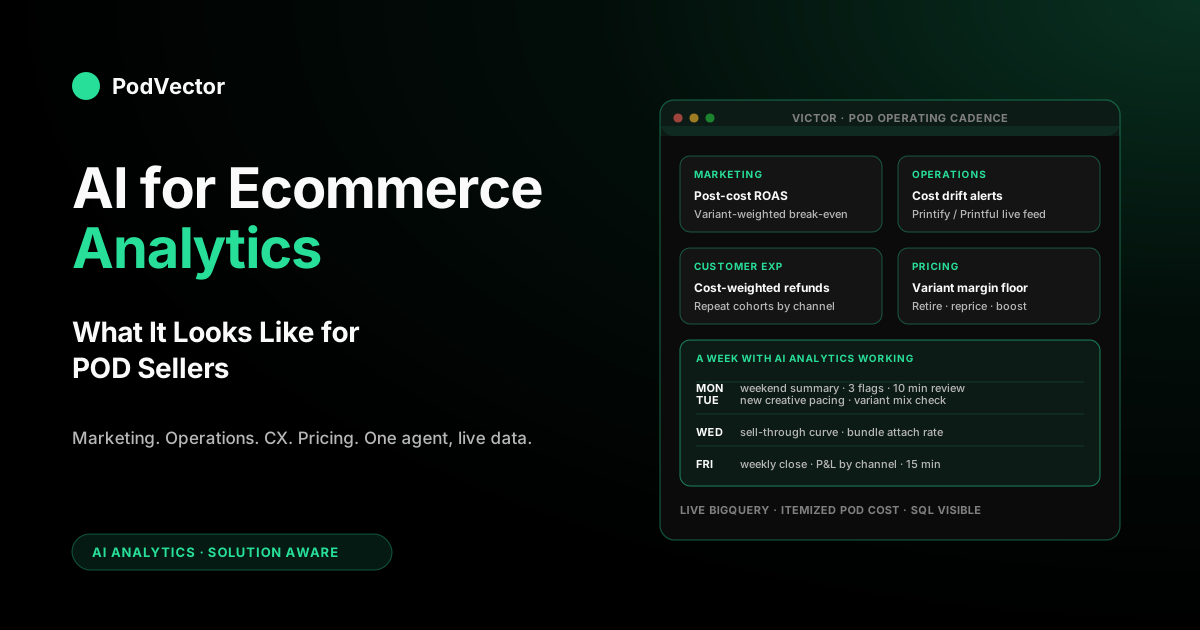
Monday morning. The operator opens Slack. The agent has posted a weekend summary: orders, revenue, blended margin after Printify cost, and three flagged items — a Meta campaign whose cost-adjusted ROAS dropped below break-even on Saturday, a variant that slipped below 25% margin because a supplier raised base cost on Sunday, and a customer segment whose refund rate ticked above threshold.
Each flag has a suggested action and a link to run a deeper query. The operator reviews in ten minutes, pauses the campaign, marks the variant for re-pricing that afternoon.
Tuesday. A new creative launches on Meta at 9 AM. By 11 AM, the operator asks the agent "how's the new creative pacing on cost per purchase, and is it selling the same variant mix as the campaign it replaced?" Agent returns a ranked breakdown: cost per purchase is 12% worse, but the variant mix has shifted toward higher-margin 2XL, so the post-cost margin is actually flat.
The operator decides to keep the creative running one more day instead of killing it on the lead-indicator number. In a pre-AI world this would have been a spreadsheet pull Wednesday evening, and the decision would have been made on cost per purchase alone.
Wednesday. Monthly reorder of a top-selling design's related merch. The operator asks "what's the sell-through curve on the Valentine's design 90 days out, and which related designs should I pair with it in a bundle." The agent pulls repeat purchase patterns, finds that customers who bought the primary design had a 23% attach rate on a specific sticker variant, and recommends the bundle. The operator sets up the bundle in Shopify in twenty minutes.
Thursday. A customer complaint escalates about a defective print. The operator asks "how many complaints of this type have we seen this month, and is it concentrated in a specific print provider?" Agent returns a count and a provider breakdown.
If it's concentrated, the operator files a Printify support ticket with specifics. In a pre-AI world, the operator might handle the single complaint and miss the trend.
Friday afternoon. Weekly close. The operator asks "what's my P&L for the week, broken down by channel, with last-week variance." Agent returns a clean table with spend, revenue, cost, fees, and net margin by channel, with green/red arrows on the variance.
The operator reviews, updates a Notion page, and leaves for the weekend. The whole close takes fifteen minutes instead of the Saturday morning spreadsheet session it used to require.
The cumulative effect over a quarter is not that any single decision was dramatically better — it's that every decision got made on fresher data with less friction, and the decisions that didn't get asked because the cost of asking was too high are now getting asked. That compounding shift in operating cadence is the real product of AI for ecommerce analytics for a POD store.
The data spine that makes it work for POD
The visible part of AI ecommerce analytics is the chat interface or the dashboard. The invisible part is the data spine — the pipes, tables, and transformations that determine whether the answers are right.
Most POD sellers end up evaluating the visible layer and under-weighting the spine, which is backwards. The spine is what separates tools that give you real numbers from tools that give you confidently wrong ones.
Source extraction. Connectors to Shopify (orders, line items, refunds, transactions, customers), Printify or Printful (itemized fulfillment cost per order — line item level, not order level), Meta and Google ads (campaign-level spend with UTM tagging), Klaviyo (flow-attributed revenue), the payment processor (transaction fees), and if applicable TikTok, Pinterest, and Microsoft ads. Missing the Printify or Printful line-item cost feed is the most common gap — and it's the one that invalidates every margin number downstream.
Cloud warehouse. Snowflake, or Redshift. Commodity at POD volumes. The choice that matters isn't the product, it's the refresh cadence. Streaming inserts mean an order placed at 10:02 AM is queryable by 10:03. Nightly batch means you're always reasoning about yesterday's data, which invalidates Tuesday-morning decisions about Monday's campaigns.
Turning messy data into clean answers. Victor takes the raw numbers from your store and suppliers and turns them into clean numbers you can trust. This is where his print-on-demand know-how lives — knowing which supplier cost belongs to which order, for example.
Order-level contribution margin (revenue minus itemized Printify cost minus transaction fees minus shipping after customer contribution) — the COGS-adjusted, SKU-level profit number, with the metric definition locked so finance, marketing, and the agent all read it the same way. A tool whose metric definitions drift between views gives you confident wrong answers. Campaign-level attributed revenue (with the attribution window explicitly chosen, not defaulted).
Variant-level margin history (so drift is detectable). Cohort revenue tables.
Break-even ROAS by campaign, computed from the variant mix each campaign sells. A generic ecommerce transformation layer misses all five — which is why generic tools give wrong POD numbers.
Understanding your question correctly. This is how Victor knows what your numbers mean and how they connect to each other, plus the guardrails that keep him from guessing. When you ask a question, Victor uses this to find the right numbers and give you the right answer. Without this, an AI can make up an answer that sounds right but isn't; with it, Victor stays honest.
Action layer. The frontier — where the agent doesn't just answer but executes. Auto-pausing a campaign that crosses a margin threshold. Pushing a price update to Shopify when supplier cost drifts. Drafting a Klaviyo flow for a cohort the agent flagged. Most vendors describe this layer; few deliver it in production today.
A useful evaluation move: ask the vendor which of these five layers they own, and which they assume you have. Vendors who own only the agent and action layers are selling a chat interface that depends on your data team having built the spine — which for most POD sellers, they haven't. The AI data solution for ecommerce guide walks through the build-vs-buy decision on each layer.
Integration pattern: Shopify, Printify, Meta, Klaviyo
A typical POD store has five systems that need to feed into the analytics layer, and the integration quality with each one matters in specific ways. Understanding the gotchas for each system is the difference between an AI analytics setup that runs cleanly for two years and one that quietly rots from one broken integration.
Shopify. The anchor. Orders, line items (with SKU and variant), refunds with timestamps, transactions with fees, customers with purchase history, and discounts.
Victor connects straight to Shopify to get the most complete picture of your store. He gets notified the moment something happens — a new order, an order update, a refund, a fulfillment change — so your numbers stay current without you lifting a finger.
The gotcha: Shopify's default reporting uses a different attribution model than most third-party tools. Reconcile early and know which model your AI layer is using.
Printify or Printful. The cost feed. Printify exposes itemized cost per line item via their API — blank cost, print cost, shipping cost, broken out.
Printful is similar but with slightly different fields. The gotcha: neither API exposes cost at the time of order, only current cost.
If a supplier base price changes between the order date and the query date, you need to snapshot the cost at fulfillment time to compute true historical margin. Tools that skip this step quietly give you wrong historical margin trends.
Meta ads. Campaign, adset, ad, and creative-level spend with UTMs flowing through to Shopify. Meta's attribution is aggressive on view-through conversions; the AI layer needs a configurable attribution window and ideally a data-driven or first-touch option.
The gotcha: Meta occasionally replays old campaign data with updated attribution, which can shift historical margin numbers. A good AI layer handles this gracefully by snapshotting; a bad one just updates silently and your past reports change.
Google Ads. Similar to Meta but with different attribution defaults. Performance Max campaigns are especially noisy; the AI layer should let you exclude or down-weight PMax data until Google's attribution stabilizes. The gotcha: GA4 and Google Ads sometimes disagree on conversion counts. Pick one as your source of truth.
Klaviyo. Flow-attributed revenue and segment membership. Klaviyo's attribution is owned-media-favorable, which means it will attribute revenue to a flow that also touched Meta. Know which attribution window is in play. The gotcha: Klaviyo's API rate limits bite on large accounts; the AI layer should batch requests intelligently.
Less common sources (TikTok, Pinterest, Microsoft ads, ShipStation, helpdesk tools) follow similar patterns but with less standardization. Plenty of POD operators also sell on marketplaces — Etsy and Amazon Merch on Demand — alongside their Shopify store, and the agentic tools that rank for "AI ecommerce analytics" increasingly pitch marketplace unification as a headline feature. The gotcha for POD is that marketplace fee structures and fulfillment economics differ from Shopify's, so a tool that treats an Etsy sale and a Shopify sale as interchangeable line items will report blended margin that's wrong on both. If a meaningful slice of your revenue runs through a marketplace, confirm the AI layer models that channel's fees and fulfillment cost separately rather than folding everything into one Shopify-shaped table. The integration quality you can achieve is a hard ceiling on the analytical questions the AI layer can answer.
An AI that can't see TikTok spend can't answer "which of my paid channels made money this week" correctly. For the cross-cluster view on the broader integration picture, see the complete guide to AI analytics for print-on-demand.
Buying checklist for POD operators
Most POD sellers buy the wrong AI ecommerce analytics tool the first time around because the sales demo optimizes for what looks good in thirty minutes. The questions below optimize for what holds up over eighteen months in production. Write them down, ask them all, and pay attention to the ones the vendor refuses to answer directly.
- Does the tool pull your real Printify or Printful costs for every single item? Not "you can upload a spreadsheet with your guessed costs" — the actual cost for each item, straight from Printify or Printful. Ask the vendor to connect to your live account and show you the breakdown.
- How fast does a new order show up in your numbers? Under an hour is a pass. Once a day is a fail.
- Does the agent show the work it ran? Yes is the only acceptable answer. Tools that hide the query are asking for a trust you can't verify.
- How does the tool handle historical cost drift? Does it snapshot supplier cost at fulfillment time, or re-query on every request? If it re-queries, your historical margin numbers silently change whenever Printify updates pricing.
- Can the attribution window be changed without a support ticket? Operator-level control over attribution is non-negotiable. Locked models hide assumptions.
- Can you take your data with you, or is it locked inside the vendor's app? If your numbers only live inside one vendor's tool, switching to another tool later gets expensive and painful. Pick a tool that lets you keep and export your own data.
- What's the quota and pricing model on agent queries? Per-query pricing can spiral at POD volumes. Per-seat or flat pricing is safer if you can negotiate it.
- Which action features are live today, and which are roadmap? Any vendor claiming "fully agentic" is overstating. The honest answer is a small list of live actions and a plan for more.
- What's the implementation timeline, and what does Week 2 look like after onboarding? Vendors promising "live in 48 hours" are skipping the reconciliation work. A realistic setup is two to four weeks with a spreadsheet reconciliation in Week 2.
A useful procedural trick: before the demo, write down five real questions from your own operation. Ask the vendor to answer them live with your own account connected. Vendors who defer ("we can set that up as a custom report post-onboarding") are telling you they don't have the spine built out for your case.
For head-to-head comparisons of the tools that survive this screening, the best AI tools for ecommerce data analysis comparison runs the category side by side.
Common false starts and how to avoid them
The failures in AI ecommerce analytics implementations cluster around the same handful of patterns. Each one is avoidable if you know it exists.
False start 1: Buying the chat interface without the spine. The vendor has a slick demo, the AI answers questions cleanly on a sample dataset, and the operator signs. Three weeks into implementation, the numbers don't match spreadsheet reality.
The root cause is that the vendor owns the agent layer but expected you to have a transformation layer with POD-aware modeling. You don't. Fix: when evaluating, ask explicitly which data model layer the vendor ships and which they assume the customer provides.
False start 2: Skipping the Week 2 reconciliation. Every implementation needs a reconciliation step where you compare the AI layer's weekly margin number against a known-good spreadsheet close. Tools that pass this test on Week 2 tend to work for the long run; tools that fail it tend to keep failing in ways that erode trust. Fix: treat reconciliation as a gate before you start using the tool for real decisions.
False start 3: Treating the AI's answer as always correct. AI models can make mistakes. The AI sometimes pulls numbers cleanly but answers the wrong question — wrong date range, wrong products grouped together, wrong filter.
The defense is seeing exactly how the AI got its answer, and checking that logic. Fix: require the tool to show its work, and build a habit of spot-checking results at least weekly.
False start 4: Confusing anomaly alerts with decisions. A tool that surfaces "your CAC is up 12% this week" isn't telling you what to do — it's telling you to look. Operators who treat alerts as decisions end up over-reacting to noise. Fix: pair every alert with a suggested investigation query and require the operator to run it before acting.
False start 5: Over-scoping the initial deployment. Teams try to solve every analytical question in the first month, fall behind, and abandon the tool. The POD stores that succeed start with one question they were previously unable to answer ("what's my post-cost ROAS by campaign this week") and expand from there. Fix: pick one question, get it working end-to-end, then expand.
False start 6: Running the AI tool without anyone in charge of it. The tool gets bought, the setup happens, and no one checks that the numbers still match reality or catches mistakes. The numbers drift and no one notices. Fix: assign one person to own the analytics tool, even in a solo store — the owner can be the founder, but someone has to.
False start 7: Locking in before scaling the question volume. Annual contracts look cheap on a per-month basis but lock you into pricing before you know your usage pattern. The operator ends up either over-paying for unused capacity or hitting a quota wall mid-quarter. Fix: prefer month-to-month or quarterly for the first year, and reassess on real usage data.
Where the category is heading: from passive to active
The current state of AI for ecommerce analytics is that the best tools answer questions accurately. The next state — which several vendors including Victor are shipping feature by feature — is the active layer.
The agent doesn't just report that a campaign is losing money; it asks whether to pause it and pauses it. It doesn't just flag a variant whose margin has drifted below threshold; it drafts a Shopify price update for review. It doesn't just report a customer segment's LTV is dropping; it sketches a Klaviyo flow to win them back.
The sequence in which these actions ship matters. The safer early actions are advisory — the agent suggests, the operator approves with one click, the agent executes.
Auto-pausing an underperforming campaign with a seven-day rolling margin threshold is in this category; so is drafting copy for a promotional email. The more ambitious actions are standing-authority — the agent has permission to take certain decisions within a budget or guardrails, with audit trails and rollback. For POD, the canonical standing-authority action is reallocating ad spend across a portfolio of campaigns within a daily cap.
The implication for a POD operator evaluating AI ecommerce analytics today is that the tool you pick should have a credible roadmap toward the action layer, not just a demo of it. Ask vendors to name which actions ship today, which are shipping in the next six months, and what the governance model is.
Vendors with actions live today are further along than vendors with only roadmap slides. The agentic AI for ecommerce guide covers the governance and audit-trail piece in more detail.
For the broader industry view on this transition, BigCommerce's overview of AI in ecommerce covers the agentic commerce trajectory from the platform perspective. The POD-specific version is narrower — fewer actions, more tied to Printify and Printful economics — and that's the part to push a vendor on.
FAQs
What's the difference between AI for ecommerce analytics and a regular analytics dashboard?
A dashboard shows you a chart and expects you to interpret it. AI-powered analytics answers questions directly — you ask "which campaigns made money last week after costs" and get a ranked list with dollar amounts.
The dashboard version requires you to already know which chart to look at. The AI version lets you ask whatever question the situation demands. For most POD operators, the dashboard approach quietly misses the questions that don't have a dashboard built for them.
Is AI ecommerce analytics worth it for a small POD store?
The rule of thumb is roughly 500+ orders per month across 50+ SKUs and three or more concurrent paid channels. Below that, a Sunday-evening spreadsheet close and Shopify's native reporting will handle it.
Above that, the compounding cost of slow, blended margin answers pays for a real tool quickly. The break-even point is about the complexity of your decisions, not the size of your revenue.
Do I need to hire a data person to run this?
For a well-packaged AI ecommerce analytics tool that ships with the transformation layer for POD, no. The operator runs the agent directly.
For a DIY setup — building and running your own system to track and clean your numbers — yes, you need someone with data skills, at least part-time. The buy-vs-build decision comes down to whether the vendor's tool actually understands print-on-demand costs and margins. Most don't.
Does this replace tools like Triple Whale or Polar Analytics?
Overlap, not full replacement. Triple Whale and Polar Analytics are dashboard-plus-anomaly-detection tools that recently added chat interfaces, and a newer wave of agent-first platforms like Graas pitch English-question answers across store, ad, and marketplace data.
They're genuinely useful for marketing-focused DTC stores. For POD specifically, the generic tools fall short on itemized Printify cost, variant-level margin tracking, and refund timing asymmetry — most are built for ad attribution and stop short of COGS-adjusted contribution margin, modeling fulfillment as a blended percentage rather than the line-item cost POD economics actually turn on — which is why POD stores either swap them out or run a POD-aware operator tool alongside.
Can I get started with just ChatGPT and CSV exports?
You can, and for one-off questions it works. The limits appear fast: ChatGPT doesn't stay connected to your store and supplier data, can't refresh it on its own, and you have to re-explain your numbers every time you start a new chat.
For a POD operator, the export-upload-explain loop exceeds the time saved on the answer within a few weeks. The whole reason the AI ecommerce analytics category exists is that the integration work is the hard part.
What about Shopify's own AI features like Sidekick?
Sidekick improved a lot in 2025, but it's scoped to Shopify's own data. It doesn't know your Printify cost, your Meta ad spend, your Klaviyo revenue, or your true blended margin.
For a single-channel Shopify-only store with no paid acquisition, Sidekick might be enough. For any POD store running ads, a cross-channel tool is necessary because the questions that matter — post-cost ROAS by campaign, variant-weighted break-even, refund cost impact — can't be answered inside Shopify alone.
How does this compare to AI for ecommerce chatbots or customer service tools?
Different category. AI chatbots for ecommerce focus on the customer-facing conversation — support questions, product discovery, returns.
AI for ecommerce analytics focuses on the operator-facing conversation — margin, campaigns, cohorts. They share the agentic tech stack but target different users and different decisions.
Some platforms offer both; most specialize. For the customer-facing side, see the AI chatbot for ecommerce guide.
How many AI tools do POD stores actually need?
Most POD operators back into a stack of five to eight AI tools — a support bot, an email tool with predictive flows, a creative generator, a personalization widget, and two or three analytics dashboards — without ever deciding to. The analytics layer is where the consolidation case is strongest, because the questions that decide whether you make money (post-cost ROAS by campaign, variant-weighted break-even, refund cost impact) need data from Shopify, Printify, Meta, Google, and Klaviyo joined in one place.
Running three analytics tools that each see one slice of that picture is worse than running one that sees all of it, because none of the three can answer the margin question correctly on its own. The practical answer: keep the specialized tools where they're genuinely best in class (support, email), and consolidate the analytics seat to one POD-aware operator tool rather than stacking dashboards that each give you a partial, blended number.
How long does implementation actually take?
For a POD store with Shopify, Printify, Meta, Google, and Klaviyo, a realistic implementation takes two to four weeks. Week one is connecting data sources and confirming the warehouse is getting clean rows.
Week two is reconciling the weekly margin number against a known-good spreadsheet close — this is the critical step. Weeks three and four are training the team on the question patterns that work and the ones that don't. Vendors promising 48-hour implementations are skipping reconciliation, and the numbers will be wrong downstream.
What's the single best acceptance test before signing a contract?
Ask the agent: "Which of my ad campaigns made money last week after Printify cost, transaction fees, and refunds?" If the answer is a ranked list with dollar amounts per campaign in under thirty seconds, using your own live data, the tool works. If the answer is a chart, a generic summary, a "we'll set that up post-onboarding," or the tool asking you to upload a CSV of your costs, the tool is a dashboard wearing AI clothing. This one question separates the useful from the decorative faster than any feature list.
Victor is AI for ecommerce analytics, built for POD economics
Victor is the AI employee built for POD sellers — he sees your orders, your real Printify and Printful costs for every item, and your Meta and Google ad spend, all together, and answers your questions in plain English with his work shown. Ask "which campaigns made money last week after costs" and get a ranked answer with dollar amounts in under thirty seconds. — no spreadsheet cost uploads, no waiting a day for numbers, no dashboards to figure out.
Try Victor free