
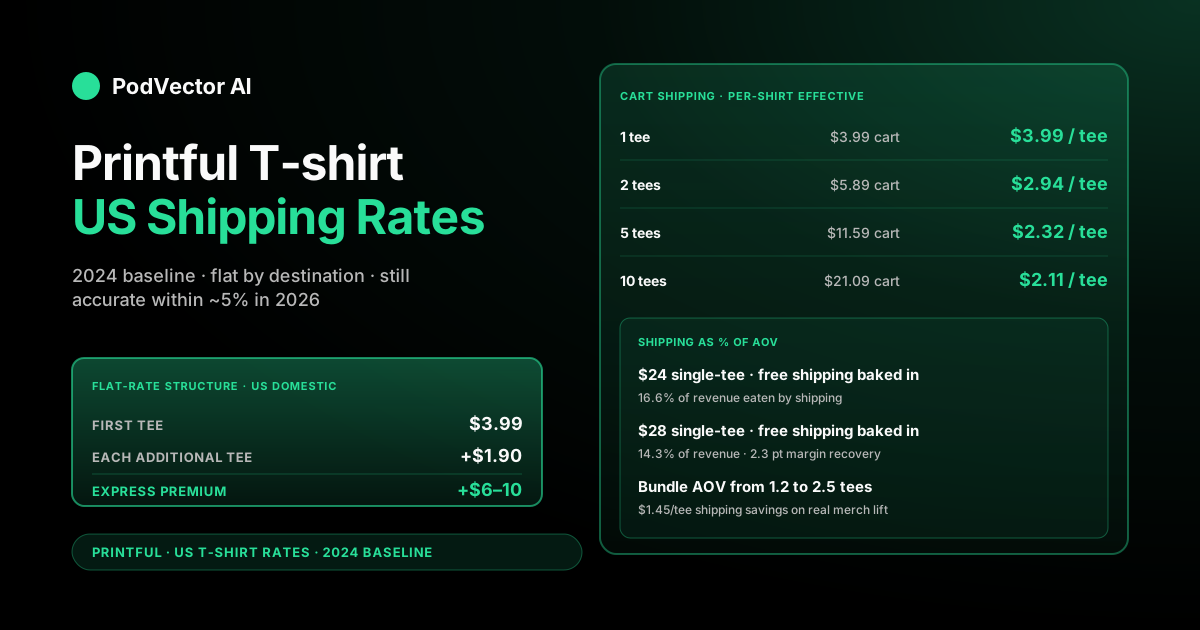
Quick Answer: Printful's 2024 baseline US shipping rate for a single t-shirt is $3.99, with each additional shirt in the same order at $1.90. A 2-shirt cart ships for $5.89, a 5-shirt cart for $11.59. Delivery runs 5 to 9 business days standard.
Those rates carried into 2025 and into the first half of 2026 with only minor adjustments. If you're benchmarking against 2024 numbers, you're within a few percent of today.
The number that should drive your pricing isn't the per-cart shipping rate — it's shipping cost as a percent of your AOV. We get to that math below.
The 2024 Baseline Rates (Still Current)
Printful's US t-shirt shipping rate set in 2024 was simple and flat: $3.99 for the first tee in an order, $1.90 for each additional tee. That structure held through 2025 and remains accurate as a planning baseline today.
"Flat" here means location-flat within the US — Printful charges the same $3.99 for a tee going to New York as for a tee going to California, even though the actual carrier cost differs. They absorb the variance internally so you don't have to model it.
The rates apply to standard ground shipping. Express is a separate line and runs $9.50 to $22 per order depending on weight and destination. For tees, Express adds about $6 to $10 over Standard.
One thing to flag: these are 2024 rates that Printful has held remarkably stable since. If you're reading a 2024-dated guide, you can trust the numbers as a planning baseline within roughly 5%. If you're costing out a 2027 launch, log into your Printful dashboard and re-check — Printful does adjust periodically, especially when carrier fuel surcharges shift.
Multi-Tee Math: Where Order Size Pays Off
The base rate ($3.99) hides where the actual margin sits. The marginal rate ($1.90) is where you make or lose money on multi-item carts.
Here's what a US t-shirt order ships for at each cart size:
- 1 tee: $3.99 shipping
- 2 tees: $5.89 ($2.94 per shirt)
- 3 tees: $7.79 ($2.60 per shirt)
- 5 tees: $11.59 ($2.32 per shirt)
- 10 tees: $21.09 ($2.11 per shirt)
Per-shirt shipping drops by almost half between a 1-tee and a 10-tee order. That's a big deal if your store sells bundles or runs gift-pack SKUs.
The operator move: if your AOV is around 1.2 tees per order — typical for a small POD store — you're paying close to $4 per shipment on average. If you can nudge AOV to 2.5 tees with bundling, your average shipping cost per tee drops to roughly $2.55. That $1.45/shirt savings is real margin you don't get without the merchandising work.
Most stores never run this math because the shipping cost shows up as a single line per order rather than per-SKU. You have to allocate it yourself.
Shipping as a Percent of AOV
The number that actually drives your pricing decisions is shipping cost as a percent of order revenue, not the absolute dollars.
Worked example. You sell a tee at $24 retail. Printful's cost (Bella Canvas 3001, DTG one-side, single color) is roughly $13. Shipping to a US customer is $3.99. The customer pays $24 + however much shipping you decide to charge them.
Scenario A: Free shipping baked in, $24 retail. You absorb $3.99. Your gross profit per tee: $24 − $13 − $3.99 = $7.01. Shipping is 16.6% of revenue.
Scenario B: Free shipping baked in, $28 retail. You absorb $3.99. Your gross profit per tee: $28 − $13 − $3.99 = $11.01. Shipping is 14.3% of revenue.
Scenario C: Customer pays $4.99 flat shipping, $24 retail. Your gross profit: $24 − $13 − $3.99 + $4.99 = $12. Shipping is 0% of margin (customer paid it plus $1).
Scenario C looks best on a single-tee order. It also has the highest cart abandonment rate of the three. The right answer depends on your store's price elasticity, which varies by niche.
The point: at $24 AOV, every dollar of shipping is 4% of revenue. At $50 AOV, every dollar is 2%. Higher-priced stores can absorb shipping more comfortably; lower-priced stores can't.
Flat Rate vs Live Rate
Printful offers two modes for how customer-facing shipping cost is calculated at checkout.
Flat rate means you set a shipping number in your store (e.g., $4.99) regardless of cart size or destination. The customer pays your flat number. You pay Printful's actual rate. The delta is yours to keep or lose.
Live rate means your store calculates shipping at checkout based on Printful's actual rate plus any markup you've configured. The customer pays what the carrier charges (plus your markup). You don't lose money on shipping, but you also don't profit.
Most POD stores under $50K/month run flat rate because it's simpler at checkout and the math is predictable. Most stores over $50K/month run live rate because the shipping margin (or loss) at scale matters.
If you're running flat-rate shipping and your store is growing, run this check: pull last month's orders, sum your actual Printful shipping cost, sum what you charged customers for shipping. The delta is your shipping margin (or shipping loss). If it's negative and you're scaling, switch to live rate before the loss compounds.
What This Means for Your Repricing Strategy
If you've ever heard "raise your prices by $5 and stop worrying about shipping" — that works, but only if your conversion rate doesn't drop more than 20% on the change. The right repricing decision depends on three variables that Printful's rate alone doesn't tell you.
1. Your customer's price sensitivity. A $24-to-$28 raise is a 17% lift. If your conversion rate drops from 2% to 1.8%, you're still up on revenue. If it drops to 1.5%, you're down. You need historical data on prior price changes to know which side of that line you're on.
2. Your marketplace fees. Etsy charges 6.5%. Shopify Payments charges roughly 3%. If you're on Etsy, every $1 of price lift gives you $0.93. On Shopify, you keep $0.97. Don't model shipping economics in isolation from the marketplace cut.
3. Your refund rate. Free shipping reduces "lost in transit" refund requests because customers are less price-anchored to the shipping cost. We've seen stores cut shipping-related refund rates by 30% by going from "$3.99 shipping" to "free shipping with $24+ minimum."
The fastest way to test all three: ship a 30-day A/B between two price points, measure conversion and refund delta, then bake the winner into the SKU.
Monitoring Your Actual Shipping Cost
Quoted rates and actual rates aren't always the same. Printful sometimes routes orders through different carriers based on warehouse capacity, and you'll see small variations from the $3.99 baseline on real invoices. They also recalibrate flat rates periodically without big announcements.
The manual version of monitoring: download your Printful order CSV monthly, sum the shipping column, divide by tee count, compare to the $3.99 baseline. Repeat next month. Look for drift.
This works. It also rarely gets done. Stores running multiple SKUs across multiple stores end up with shipping cost embedded in their P&L but never audited against per-SKU pricing.
The employee capability: connect Printful order data to a live data warehouse (your warehouse on Snowflake, BigQuery, Databricks, or equivalent), then ask an AI employee the questions in plain English. "What was my actual average shipping cost per tee last month?" "Which SKUs have the worst shipping-to-revenue ratio?" "Did my flat shipping margin go negative anywhere?"
That's what Victor, PodVector AI's AI employee for POD sellers, does. Victor pulls live Printful order data, your Shopify revenue, and your refund data into one view, then answers margin-and-shipping questions without the spreadsheet round-trip. Victor answers and acts on those answers — with your approval — flagging SKUs whose shipping math has drifted before they erode your monthly margin.
For a deeper teardown of how shipping costs feed POD margin, see our full breakdown of Printful shipping prices and the itemized shipping prices guide.
For shipping-time specifics on common US destinations, see our Printful US shipping time guide, the general US shipping time breakdown, and the India shipping time guide for international comparison. The full Printful shipping cluster and Printful topic hub have everything else.
For Printful's own current rate examples, see their documented rate-card walkthrough.
FAQs
What is Printful's US shipping rate for a single t-shirt in 2024?
$3.99 standard ground, with each additional tee in the same order at $1.90. Express is $9.50 to $22 depending on order weight. These rates set in 2024 and remain accurate as of 2026.
Have Printful's US t-shirt shipping rates changed since 2024?
No major changes. The $3.99 base and $1.90 marginal rates have held through 2025 and into 2026. Printful does adjust periodically when carrier fuel surcharges shift, but those adjustments have been single-digit percent.
How is shipping cheaper on multi-shirt orders?
The marginal rate ($1.90) is roughly half the base rate ($3.99). A 2-shirt order ships for $5.89 ($2.94 per shirt). A 10-shirt order ships for $21.09 ($2.11 per shirt). The math rewards bundle SKUs and minimum-quantity discounts.
Should I charge customers for shipping or build it into the price?
Depends on your AOV and niche. At $24 AOV, "free shipping" on a $28 sticker price typically converts better than "$24 + $4.99 shipping." At $50+ AOV, the customer-facing math matters less because shipping is a smaller percent of cart. Test both with a 30-day split before committing.
What's the difference between Printful's flat rate and live rate shipping?
Flat rate: you set a customer-facing shipping number and absorb the variance between your flat rate and Printful's actual rate. Live rate: your store quotes Printful's actual rate (plus any markup) at checkout. Flat rate is simpler at small scale; live rate protects margin at large scale.
Does Printful charge the same shipping rate everywhere in the US?
Yes — $3.99 single-tee, $1.90 additional, regardless of customer state. Internally, Printful's actual carrier cost varies (East Coast cheaper than West Coast from Charlotte), but they hold the customer-facing rate flat.
What's Printful's fulfillment fee on top of shipping?
The fulfillment fee is bundled into the product price for DTG tees — you don't see it as a separate line. For some specialty methods (embroidery, all-over print, hard goods), there are minimums ($2.95 fulfillment minimum applies in some cases). Always check the rate calculator in your dashboard for the SKU you're costing.
Stop running shipping math in spreadsheets.
$3.99 per tee sounds simple. Shipping as a percent of your AOV across 40 SKUs and three marketplaces isn't. Victor pulls your live Printful and Shopify order data into one place and answers shipping-margin questions in plain English.
Try Victor free