
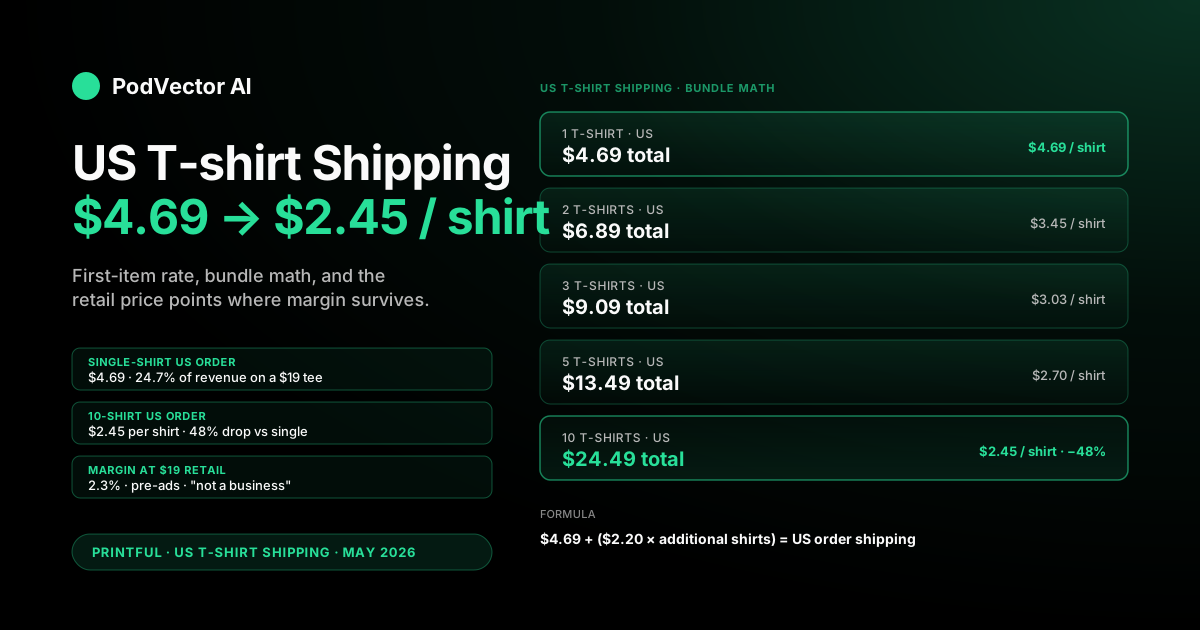
Quick Answer: Printful charges $4.69 for the first t-shirt shipped inside the US, then $2.20 for each additional t-shirt in the same order. Printful's own page currently shows $4.75 — both numbers reflect the May 2026 rate card.
Carrier is unnamed (third party), standard transit is 3–4 business days, fulfillment adds 2–5 business days on top.
Below: the full landed-cost stack per shirt, multi-item math that recovers 25–40% of shipping cost on bigger orders, and the retail-price scenarios where shipping quietly drains your margin.
Current Printful US t-shirt shipping rate
As of May 2026, Printful charges $4.69 for the first t-shirt shipped to a US address and $2.20 for each additional t-shirt in the same order. Printful's official shipping page currently displays $4.75 for the first item — the $0.06 delta is a recent micro-adjustment that has not yet propagated everywhere.
For modeling and pricing decisions, use $4.69 as the conservative floor. If you're already on $4.75 in your checkout flow, your margin assumptions are 6 cents per first-item shirt safer than this article assumes — not the other way around.
| Order composition | Shipping cost | Effective per-shirt |
|---|---|---|
| 1 t-shirt | $4.69 | $4.69 |
| 2 t-shirts | $6.89 | $3.45 |
| 3 t-shirts | $9.09 | $3.03 |
| 5 t-shirts | $13.49 | $2.70 |
| 10 t-shirts | $24.49 | $2.45 |
Two takeaways. Single-shirt orders carry the heaviest shipping load — $4.69 on a $19 retail tee is 24.7% of revenue going to one line item. Multi-item orders scale toward the marginal $2.20 floor, which is where the math finally favors you.
How Printful bills US t-shirt shipping
Printful uses a flat-rate model. You don't pay weight-based postage and your customer never sees a UPS or USPS quote at checkout. Three variables decide the number: product category (t-shirt), destination region (US), and item position (first vs additional).
Inside the US, the rate is uniform. A shirt going to Brooklyn pays the same as a shirt going to Honolulu — Printful absorbs the carrier variance internally. For POD operators this is good news: you can model US shipping as a constant per order, not a per-state lookup.
For a deeper look at every fee line beyond shipping, the Printful costs and charges hub indexes all our pricing breakdowns. The Printful topic hub ties production, membership, and shipping into a single decision framework.
Multi-item shipping math for US orders
This is the line item most sellers misprice. The $2.20 marginal rate is generous — it's roughly 47% of the first-item cost. That asymmetry creates a real lever.
If your average order value (AOV) is one shirt, you're paying $4.69 per shipment on every order. If you can shift AOV from 1.0 to 1.6 shirts via bundles or "buy 2 get $X off" mechanics, your blended shipping cost per shirt drops from $4.69 to roughly $3.32.
That's $1.37 per shirt of margin you didn't have. On 1,000 shirts a year, that's $1,370 of pure profit unlocked by changing one pricing page, not by selling more units.
| Average shirts per order | Shipping cost / order | Shipping cost / shirt | Margin gain vs 1.0 AOV |
|---|---|---|---|
| 1.0 | $4.69 | $4.69 | — |
| 1.4 | $5.57 | $3.98 | +$0.71/shirt |
| 1.8 | $6.45 | $3.58 | +$1.11/shirt |
| 2.5 | $7.99 | $3.20 | +$1.49/shirt |
Rate variation by t-shirt type (DTG, DTF, AOP, embroidered)
Printful treats every t-shirt as the same shipping product, regardless of decoration method. A DTG-printed Bella+Canvas 3001, a DTF-printed Gildan 5000, an all-over-print sublimated tee, and an embroidered polo all ship at the $4.69 / $2.20 cadence inside the US.
The exception is bulky packaging. If you ship an embroidered hoodie with a t-shirt, the hoodie takes the higher first-item rate and the t-shirt drops to the $2.20 add-on rate. Printful applies the highest-rate item first to anchor the order.
For decoration-method base costs (which do vary), see Printful base cost t-shirt and POD t-shirt base cost (Printful vs Printify).
The full landed cost of a Printful US t-shirt
Shipping is one line. POD operators who only track base cost mis-model their margin by 30–50%. The actual landed cost stack on a typical US Bella+Canvas 3001 DTG-printed tee looks like this:
| Cost line | Per shirt (single-shirt order) | Per shirt (3-shirt AOV) |
|---|---|---|
| Base garment (Bella+Canvas 3001) | $8.95 | $8.95 |
| DTG print (1 location, up to 12.5" × 16.5") | $3.50 | $3.50 |
| US shipping (allocated) | $4.69 | $3.03 |
| Stripe/PayPal fee (2.9% + $0.30 on $24 retail) | $1.00 | $1.00 |
| Sales tax remittance (varies, ~3% blended) | $0.72 | $0.72 |
| Total landed cost | $18.86 | $17.20 |
The print rate above is illustrative — Printful's actual DTG and DTF rates depend on garment, location count, and Growth/Business membership status. For the full Printful pricing structure across all line items, see Printful API pricing.
Two things jump out. On a single-shirt $24 order, your gross margin is $5.14 (21%). On a 3-shirt $72 bundle, the per-shirt margin climbs to $6.80 (28%) — entirely from the shipping allocation dropping by $1.66.
This is why bundle pricing isn't a marketing tactic. It's a structural margin lever.
Margin scenarios at $19, $24, $29 retail
Same Bella+Canvas 3001 DTG tee, same $12.45 production cost (base + print), same $4.69 shipping for a single-shirt order. Different retail prices:
| Retail price | Production + ship | Payment + tax | Gross margin $ | Gross margin % |
|---|---|---|---|---|
| $19.00 | $17.14 | $1.42 | $0.44 | 2.3% |
| $24.00 | $17.14 | $1.72 | $5.14 | 21.4% |
| $29.00 | $17.14 | $2.02 | $9.84 | 33.9% |
| $34.00 | $17.14 | $2.32 | $14.54 | 42.8% |
$19 is the price point most new POD sellers gravitate to because it looks competitive on Etsy. The actual margin is 2.3% before ad spend, before returns, before any operating cost. That's not a business — that's a charity.
$24 is the floor for sustainable margins on US t-shirts when shipping is charged separately. $29 is where you can afford paid acquisition. $34+ is where premium positioning becomes economically necessary, not stylistic.
"Free shipping" pricing — when it works, when it kills margin
"Free shipping" doesn't exist. It's shipping cost rolled into retail price. The question is whether your retail price can absorb $4.69 without crossing a customer-resistance threshold.
Consider the same shirt at $24 charged separately ($24 + $4.69 = $28.69 checkout total) versus $28.69 with free shipping. Same total. Same margin. Different psychological reading.
Free shipping wins when: you can hit a clean price point ($29, $30, $35), your AOV is consistently 1+, and your category benchmark shows "free shipping" as the norm. Charged shipping wins when: you sell mostly low-AOV singles, your retail floor is $19–$22, and breaking that floor costs you conversion.
The trap is hybrid pricing. "Free shipping over $50" sounds operator-friendly but creates a discontinuity at $49.99 where customers add a $6 item just to clear the threshold — and you ship a 2-item order at $6.89 shipping cost on $50 of revenue, which is 13.8% of revenue lost to logistics. Run the math before you set the floor.
Printful vs Printify US t-shirt shipping
Printify's US t-shirt shipping varies by print provider — there is no single Printify shipping rate. The cheapest US providers (Monster Digital, SwiftPOD) start at $3.99 first item / $2.49 each additional. Higher-quality providers (District Photo, Print Geek) run $4.85 first / $2.85 additional.
So Printful's $4.69 sits in the middle of Printify's range. The shipping cost itself isn't the wedge between the two platforms — base cost, print quality consistency, and fulfillment time matter more. See POD t-shirt base cost: Printful vs Printify for the head-to-head on garment economics.
For deeper shipping-rate detail across all destinations, see Printful shipping rates t-shirts USA 2025 and the broader Printful shipping rates guide.
Fulfillment, carrier, and delivery timing
US t-shirt timing breaks into two stages. Fulfillment (Printful printing and packing the order) takes 2–5 business days. Standard shipping (carrier transit) takes 3–4 business days inside the US.
End-to-end: 5–9 business days from order to doorstep, with the 6–8 day range being most common. Express shipping (additional $9.50–$22 surcharge on top of the flat rate) compresses transit to 1–3 business days, but doesn't speed up fulfillment.
Printful doesn't publicly name carriers, but US t-shirt shipments commonly arrive via USPS Ground Advantage, USPS Priority Mail, or UPS SurePost — Printful selects based on route, speed, and rate at the time of dispatch. From a margin-modeling perspective, this is irrelevant: you pay the flat rate regardless.
How to reduce shipping cost per US t-shirt
Five levers, ranked by impact for most POD operators:
1. Lift AOV. The biggest lever. Going from 1.0 AOV to 1.8 AOV cuts shipping cost per shirt from $4.69 to $3.58 — $1.11 of pure margin per shirt with no input cost change. Bundles, "second item 15% off," and threshold-based gifting all work.
2. Skip Growth/Business membership if your volume doesn't justify it. The membership fee applies to base costs, not shipping. If you're modeling shipping savings from a Printful subscription, the savings aren't there.
3. Don't ship single items to international customers. US-to-US shipping is the cheapest tier Printful offers. International shipping doubles or triples the cost. If 20% of your orders are international singles, that 20% is dragging your blended shipping cost up by 30–40%.
4. Use US-fulfilled inventory. Printful auto-routes US orders to US facilities, but cross-region routing (US order, EU facility) happens when stock is unavailable. Lock your top SKUs to US-fulfilled regions in your catalog settings.
5. Negotiate at scale. Above ~5,000 orders/month, Printful's Enterprise team will quote custom shipping rates. Below that volume, you pay the published rate.
Tracking shipping cost per SKU live
The hard part of POD margin work isn't knowing one shipping rate — it's stitching shipping, base cost, payment fees, and tax into one number per SKU and watching it drift over time. Most operators do this in a spreadsheet that goes stale within a week.
The better pattern is a live data layer: pull Printful order data, Stripe payouts, and Shopify order line items into a single warehouse (Snowflake, Redshift, BigQuery, Databricks — your pick), and run margin queries against the current numbers, not last month's CSV export.
This is the architecture PodVector AI's AI employee Victor sits on top of. You ask "which of my SKUs dropped below 20% margin after the February shipping update?" and it answers from current data, not from a dashboard built three quarters ago. The employee roadmap is to move from "answer the question" to "flag the SKU before it crosses the threshold" — but the foundation is the live warehouse, not the model.
FAQs
How much does Printful charge to ship a t-shirt in the US?
$4.69 for the first t-shirt and $2.20 for each additional t-shirt in the same order, as of May 2026. Printful's official site currently displays $4.75 for the first item — both are within the same rate-card window.
Is Printful US t-shirt shipping cheaper than Printify?
It's mid-range. Printify's cheapest US t-shirt providers ship from $3.99, the more expensive ones from $4.85+. Printful's $4.69 falls in the middle of Printify's range. The cost wedge between the platforms is bigger on base garment cost than on shipping.
Does Printful offer free US t-shirt shipping?
Printful does not offer free shipping to merchants. "Free shipping" at retail is shipping cost absorbed into the retail price — the merchant still pays $4.69 / $2.20 to Printful per t-shirt.
How fast does Printful ship a t-shirt to a US address?
Fulfillment takes 2–5 business days, and standard US carrier transit takes 3–4 business days. End-to-end is typically 5–9 business days. Express shipping adds $9.50–$22 and compresses transit to 1–3 business days, but doesn't speed fulfillment.
Did Printful raise US t-shirt shipping in February 2026?
Printful rolled out a targeted price increase on February 26, 2026, but standard apparel shipping rates were specifically excluded. US t-shirt shipping was not part of the increase. The minor $4.69 → $4.75 movement is a separate, smaller adjustment.
What does Printful US t-shirt shipping include?
The $4.69 / $2.20 rate covers carrier postage, packaging, label generation, and tracking. It does not include fulfillment (printing and packing) — that's a separate per-item cost rolled into the base cost. The shipping line on your Printful invoice is carrier-side only.
Which carrier does Printful use for US t-shirts?
Printful doesn't publicly name carriers. US t-shirt orders commonly route through USPS Ground Advantage, USPS Priority Mail, or UPS SurePost based on origin facility and ZIP destination. From a cost-modeling perspective, the carrier is irrelevant — you pay the flat rate regardless of which one Printful selects.
Can I ship a Printful US t-shirt with the customer's own shipping label?
No. Printful generates the label as part of the fulfillment workflow. You cannot supply your own carrier account or pre-paid label for a Printful-fulfilled order.
Stop modeling Printful t-shirt margin in a spreadsheet
Your shipping cost shifts. Your base cost shifts. Your AOV shifts. The spreadsheet doesn't.
PodVector AI's AI employee Victor pulls your live Printful and Shopify data and answers margin questions in plain English — "which SKUs dropped below 20% gross margin after the February shipping update?" — without you maintaining a single formula.
Try Victor free