
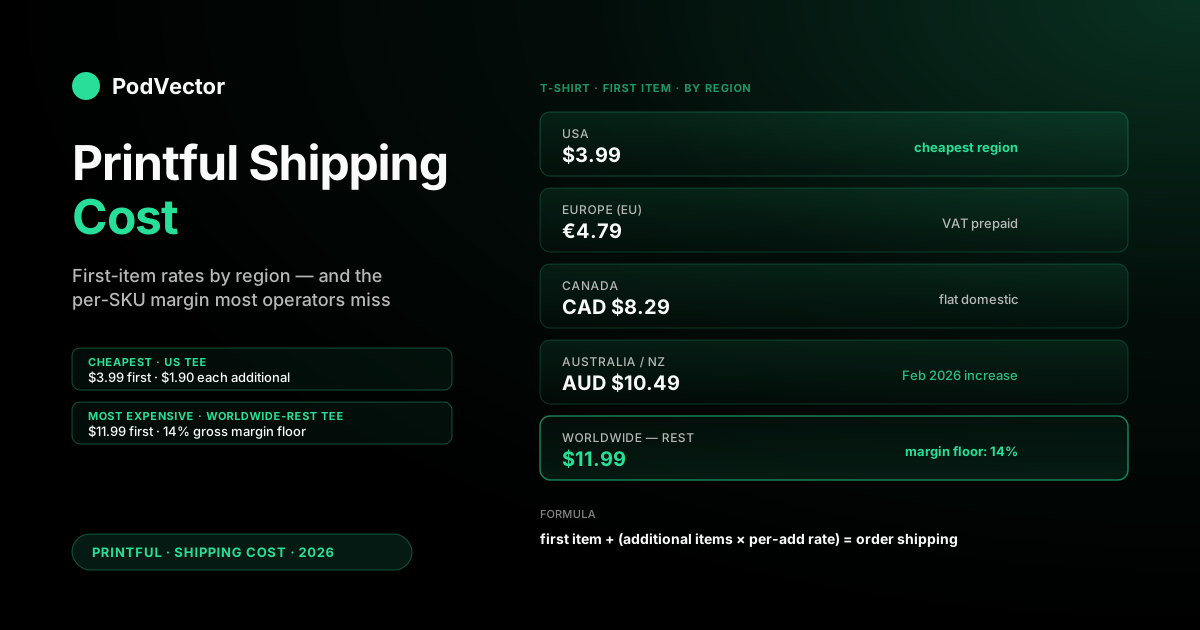
Quick Answer: Printful shipping uses flat regional rates with a "first item + each additional" structure. In the US, a t-shirt is $3.99 first / $1.90 additional, a hoodie is $7.19 first / $1.80 additional, and a mug is $4.69 first / $2.55 additional.
International shipping costs more and varies by region. Apparel to Europe starts at €4.79, to Canada at CAD $8.29, and to Australia at AUD $10.49 first item. Express shipping (1–3 business days) adds $9.50–$22 per order on top of standard rates.
This breakdown covers every shipping line item by product and region, the February 2026 rate changes, and the per-SKU margin math most POD sellers miss.
How Printful shipping is priced
Printful charges flat regional rates, not weight- or distance-based rates. Every product category has a fixed "first item" price and a smaller "each additional item" price within the same order.
That structure has two practical consequences. Multi-item orders are dramatically cheaper per unit than single-item orders. And the rate doesn't change between Idaho and Florida — only between the US and Europe.
The rate also depends on which fulfillment facility ships your order. Printful auto-routes to the closest facility with stock, so a US customer usually ships from the US, a European customer from Latvia or Spain. You can't override the routing.
For a deeper view of how this fits into the full Printful cost stack, see our complete guide to Printful costs and fees and the wider Printful costs and charges hub.
US shipping rates by product (2026)
US is Printful's cheapest region and the one most POD operators model first. Here's the full first-item / additional-item table for the most-shipped categories.
| Product | First item | Each additional | Notes |
|---|---|---|---|
| T-shirts (DTG) | $3.99 | $1.90 | Most-shipped Printful SKU |
| Hoodies / sweatshirts | $7.19 | $1.80 | Higher rate, smaller add-on premium |
| All-over-print apparel | $5.49 | $1.90 | Ships from separate facility |
| Hats / beanies / caps | $2.89 | $1.40 | Cheapest apparel category |
| Mugs (11oz / 15oz) | $4.69 | $2.55 | Fragile — ships in protective packaging |
| Stickers / postcards / patches | $4.29 | $1.65 | Rose from $3.99 in Feb 2026 |
| Phone cases | $4.99 | $2.60 | Rose from $4.59 in Feb 2026 |
| Posters / canvas / wall art | $4.99 | $2.90 | Rolled or boxed depending on size |
| Knitted apparel | $11.49 | $2.40 | Rose from $10.49 in Feb 2026 |
| Tote bags / backpacks | $4.99 | $2.10 | Higher for full-size backpacks |
The pattern: apparel is cheap, accessories are mid, anything heavy or fragile (mugs, knitted goods, big bags) costs more. The "each additional" rate is the lever — a two-tee order isn't $7.98, it's $5.89.
For specific SKU-level breakdowns, see our US t-shirt shipping deep dive and the year-anchored 2024 USA t-shirt shipping benchmark — useful for comparing how rates moved over time.
International shipping rates by region
Outside the US, Printful ships from facilities in Latvia (Europe), the UK, Spain, Mexico, Canada, Australia, and Japan. Rates depend on whether the customer's address falls inside or outside the closest fulfillment region.
Here's the first-item rate for a standard t-shirt across the main destinations.
| Region | T-shirt (first / additional) | Hoodie (first / additional) | Mug (first / additional) |
|---|---|---|---|
| USA | $3.99 / $1.90 | $7.19 / $1.80 | $4.69 / $2.55 |
| Europe (EU) | €4.79 / €1.85 | €6.99 / €1.85 | €4.95 / €2.50 |
| UK | £3.59 / £1.30 | £5.49 / £1.50 | £4.25 / £2.10 |
| Canada | CAD $8.29 / $2.05 | CAD $11.49 / $2.50 | CAD $7.95 / $3.10 |
| Australia / NZ | AUD $10.49 / $2.20 | AUD $14.99 / $2.70 | AUD $9.49 / $3.25 |
| Japan | ¥1,150 / ¥320 | ¥1,890 / ¥420 | ¥1,290 / ¥520 |
| Worldwide (rest) | $11.99 / $2.50 | $15.49 / $2.90 | $13.49 / $3.40 |
Two things to flag. Worldwide-rest rates (anything outside Printful's seven fulfillment regions) are where shipping eats serious margin — $11.99 for a single tee is more than the t-shirt's wholesale cost.
And currency matters. Printful invoices you in the currency of the fulfillment facility, not your store's currency. EU orders bill in euros; you absorb the FX swing on top of the rate itself.
For region-specific delivery-time context, our cross-cluster guides cover expedited shipping options and express shipping by region.
Express vs standard shipping
Standard shipping is the default. Express is an upgrade — faster, more expensive, and worth offering at checkout because a small share of buyers will pay for it.
Express adds $9.50–$22 per order on top of the standard rate, depending on product and destination. Domestic US express runs $9.50–$14. International express jumps to $18–$22.
The transit-time gain is real. Standard US shipping is 3–8 business days. Express is 1–3 business days via DHL or FedEx. International express compresses 5–20 days down to 3–5.
| Service | Transit time | Extra cost (over standard) | When it's worth offering |
|---|---|---|---|
| Standard (US) | 3–8 business days | — | Default for all orders |
| Express (US) | 1–3 business days | +$9.50–$14 | Q4, last-minute holiday buyers |
| Standard (international) | 5–20 business days | — | Default |
| Express (international) | 3–5 business days | +$18–$22 | Gift-deadline orders, B2B samples |
Critical caveat: express shipping doesn't shorten fulfillment time. Your order still takes 2–5 business days in Printful's facility before it ships at all. Express only compresses the transit leg.
Fulfillment time vs shipping time
Most operators conflate these two and quote wrong delivery windows on their product pages. They're separate.
Fulfillment time is how long Printful takes to print and pack your order. It runs 2–5 business days for DTG apparel, 3–7 for embroidery, and 1–3 for non-print items like mugs or stickers.
Shipping time is how long the package takes to travel from the facility to the customer's door. That's the 3–8 days (US) or 5–20 days (international) number.
Total delivery window = fulfillment + shipping. A US t-shirt customer should expect 5–13 business days door-to-door on standard. Quote that on your shipping policy page, not just the carrier transit time. Customer-service ticket volume drops noticeably once you do.
For embroidered orders specifically, the fulfillment leg gets longer — our expedited shipping breakdown walks through the cases where the fulfillment-time stretch makes express pointless.
February 2026 shipping price changes
Printful rolled out targeted shipping rate increases on February 26, 2026. They were small but real, and they specifically hit accessories — not apparel.
- Stickers, postcards, patches (US): $3.99 → $4.29 first item (+$0.30)
- Phone cases (US): $4.59 → $4.99 first item (+$0.40)
- Knitted apparel (US): $10.49 → $11.49 first item (+$1.00)
- Apparel to Australia/NZ: AUD $9.80 → AUD $10.49 first item (+AUD $0.69)
- Hats to Canada: CAD $8.95 → CAD $9.75 first item (+CAD $0.80)
If your top SKUs are tees and hoodies, the February update is noise. If you sell phone cases, stickers, or any accessories at volume, re-run your margin math — your old spreadsheets are now off by $0.30–$1.00 per order.
Knitted apparel took the biggest hit. If you run knit hats or beanies as Q4 inventory, that $1 first-item bump compounds across a 200–500 unit holiday season.
How shipping cost eats POD margin
The flat-rate structure is friendly to multi-item orders and brutal on single-item buys — which is most of POD. Here's the per-tee margin math at three retail prices.
| Scenario | Retail price | Product cost | Shipping cost | Gross margin |
|---|---|---|---|---|
| Single tee, US, customer pays shipping | $24.99 + $3.99 ship | $12.95 | $3.99 (passthrough) | $12.04 (48%) |
| Single tee, US, free shipping | $28.99 (shipping baked in) | $12.95 | $3.99 (absorbed) | $12.05 (42%) |
| Single tee, worldwide-rest, free shipping | $28.99 | $12.95 | $11.99 (absorbed) | $4.05 (14%) |
| Two-tee order, US, free shipping | $57.98 | $25.90 | $5.89 (first + additional) | $26.19 (45%) |
The "free shipping to worldwide-rest" line is where unprofitable orders hide. A single tee shipping to a country outside Printful's seven fulfillment regions can land you at 14% gross margin — before any payment-processing fees, Shopify subscription, or marketing cost.
Most POD operators discover this after the fact, when they reconcile a $28.99 sale against Printful's invoice and Stripe's settlement. The reconciliation gap is the shipping line they didn't model.
How to check live shipping rates before launch
There are three reliable ways to pull current Printful shipping rates, in order of precision.
1. The official shipping rates page. Printful publishes the full rate table by region with a destination selector. This is the source of truth and gets updated when prices move.
2. The Shipping Rate Calculator inside your Printful dashboard. Pick a product, enter a destination, get the exact rate including any current promos applied to your account. Use this before launching new SKUs.
3. Add the product to a test cart on your store. If you have live rates enabled in Shopify (or your platform), Printful pushes the actual shipping cost to checkout. The calculator and the checkout should match — if they don't, your live-rates config is broken and you're either overcharging or eating margin.
The fourth way most POD operators miss: pulling rates from Printful's help center shipping article directly, which mirrors the official page but loads faster on mobile.
Pass-through vs flat-rate: what to charge customers
Two viable strategies. Each one changes how your shipping cost flows through P&L.
Pass-through (live rates): charge the customer exactly what Printful charges you. No margin compression on shipping, but checkout sticker shock is real — a $3.99 shipping line on a $24.99 tee feels jarring to anyone trained on Amazon Prime.
Flat-rate "free shipping": raise the retail price by ~$4–$6 and offer "free shipping over $25." Better conversion math, but you absorb the shipping cost on every order, and international buyers either get blocked or quietly destroy your margin.
Hybrid is the operator move: free shipping domestic, live rates international. The hybrid pattern keeps US conversion friction low while protecting margin on the $11.99-shipping orders.
Whichever you pick, the rate floor is the same — you're paying Printful $3.99 first / $1.90 additional on a US tee regardless. The only question is who sees the line item.
Tracking shipping cost across every order
Shipping is the easiest line item to model wrong because it changes per order, per region, and per cart composition. A SKU with 48% margin on a single-item US order can drop to 14% on a single-item worldwide-rest order.
The math isn't hard — it's spread across Printful's invoice CSV, your Shopify orders export, and a destination-to-region lookup that nobody maintains by hand.
This is the gap PodVector AI closes. Victor reads every Printful invoice line and matches it back to the originating Shopify order in a live data warehouse, so the per-SKU shipping cost is itemized against the order it shipped on. The CFO sub-agent then answers questions like "which SKUs drop below 30% margin once I include shipping?" in real time, instead of you stitching CSVs together at month-end.
Victor can also propose specific actions when shipping cost flags a margin problem — raise the retail price on a low-margin worldwide-rest SKU, restrict shipping zones, or add a minimum order value — and execute them on Shopify with your approval. The action ledger writes back so next month's reconciliation already accounts for the change.
The combo of the POD playbook, live invoice-level data, and the ability to act is what turns "Printful shipping cost" from a one-time research task into a monthly operating loop. For the wider context on how this stitches together, see the Printful topic hub.
FAQs
How much does Printful shipping cost in 2026?
For a US t-shirt: $3.99 first item, $1.90 each additional. Hoodies: $7.19 / $1.80. Mugs: $4.69 / $2.55. International rates run 30–200% higher depending on region — Europe is closest to US pricing, worldwide-rest is the most expensive at $11.99+ for a single tee.
Does Printful offer free shipping?
No. Printful invoices you (the merchant) for shipping on every order. "Free shipping" at the customer's checkout means you absorbed the cost in your retail price — it's never free to you.
How long does Printful shipping take?
Total delivery time is fulfillment + shipping. US: 5–13 business days (2–5 fulfillment + 3–8 transit). International: 8–25 business days. Express shortens transit to 1–3 days (US) or 3–5 days (international) for an extra $9.50–$22 per order — but doesn't speed up fulfillment.
Did Printful raise shipping prices in 2026?
Yes. On February 26, 2026, Printful raised shipping on select accessories: stickers / postcards / patches ($3.99 → $4.29), phone cases ($4.59 → $4.99), knitted apparel ($10.49 → $11.49). Apparel shipping (tees, hoodies) was unchanged. International apparel to Australia/NZ rose AUD $0.69 first item.
How is Printful shipping calculated?
Flat regional rate with a "first item + each additional" structure. Same rate for everywhere within a region (Florida and Idaho are both $3.99 for a tee). The rate changes when you cross into a different fulfillment region — US, Europe, UK, Canada, Australia/NZ, Japan, or "worldwide rest."
Does Printful's Growth plan include shipping discounts?
No. The Growth plan ($24.99/month) discounts product base prices and branding services. Shipping is flat across all plans. Free, Growth, and Enterprise all pay the same $3.99 for a US t-shirt. See our Printful pricing plans breakdown for the full plan comparison.
Why is Printful shipping so expensive internationally?
Two reasons. First, transit costs more outside Printful's seven fulfillment regions — anything routed via "worldwide rest" goes through a longer carrier chain. Second, customs handling and last-mile delivery in non-fulfillment countries add baseline overhead Printful can't optimize away. A single tee to Brazil or India ships at $11.99 minimum.
Will my customers be charged customs fees?
Sometimes. Printful prepays VAT on EU and UK orders so customers don't get surprised at the door. Outside those regions, customs and import duties are the customer's responsibility — and they vary by country. Quote this on your shipping policy page, or you'll absorb the disputes.
Can I set my own shipping rates instead of using Printful's?
Yes — most operators do, via flat-rate "free shipping" pricing baked into the retail price. The catch: you're still paying Printful's rates on the back end. The customer-facing rate and your invoice rate are two separate numbers, and the gap is your shipping margin (positive or negative).
Do shipping rates differ between Printful and Printify?
Yes. Printify's rates vary by print provider — each provider sets their own shipping schedule. Printful uses one flat schedule across its own facility network, which makes it easier to model but sometimes more expensive than the cheapest Printify provider. The trade-off is consistency vs. floor price.
How do I track which orders are losing money on shipping?
Match your Printful invoice CSV to your Shopify order export by order ID, then subtract the per-order shipping line from the per-order net revenue. Repeat monthly. Or use an AI agent that does this against a live data warehouse — see our Printful sample order cost breakdown for the broader cost-tracking workflow.
Stop guessing which orders eat your shipping margin.
Printful's rates are flat, but your net margin per order isn't — it depends on cart composition, destination region, and the retail price you charged. Victor reads every Printful invoice line against your Shopify orders in a live data warehouse and tells you exactly which SKU-region combinations are below threshold, then proposes the specific Shopify action to fix it. And audit your shipping margin in under five minutes.
Try Victor free