
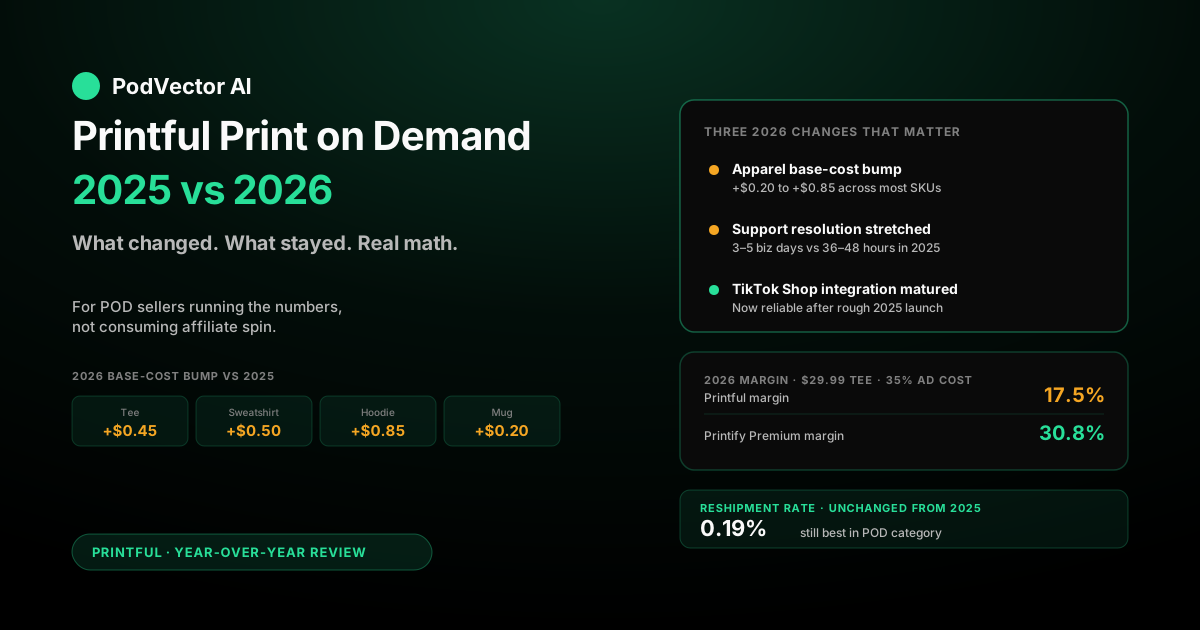
Quick Answer: Printful in 2025 and 2026 is the same product with three real changes worth knowing: support response times stretched another tier, a small base-cost increase rolled through in Q1 2026, and the integration with TikTok Shop matured into a reliable channel. Quality, fulfillment reliability, and branding depth held steady.
For most POD sellers the verdict didn't move: 8/10 if you sell on a quality-judgment channel with retail $30+, 6/10 if you compete on price at Etsy or Amazon. The trade-off math is the same — Printful's premium pays for itself only when your store can absorb it.
This breakdown covers what actually changed year over year, what didn't, and the four questions a POD seller has to answer to know whether Printful belongs in their stack in 2026.
Why "2025 or 2026" matters in a Printful review
Print-on-demand reviews go stale fast. A 2022 review of Printful tells you about a different company than the one POD sellers deal with in 2026.
Three categories of things shift year over year. Pricing on base products. Fulfillment behavior as new facilities come online or close. And support quality as headcount and tooling change.
"Is the 2025 review still right?" is the question this article exists to answer. The short answer is mostly yes, with three updates that change the math at the edges.
If you're new to Printful and want the timeless honest review without the year framing, see the core Printful review for POD sellers. For the 2025-only snapshot, see the 2025 Printful print-on-demand review. This article focuses on the 2025-to-2026 year-over-year delta.
What actually changed from 2025 to 2026
Three real changes worth budgeting around. None of them flip the overall verdict, but each shifts the margin math by a few points.
1. Base-cost bump on apparel (Q1 2026). Most apparel SKUs went up $0.20 to $0.85 in February 2026. The Bella+Canvas 3001 tee moved from $12.50 to $12.95. The Gildan 18000 sweatshirt moved from $22.00 to $22.50. Hoodies moved more — Champion S700 went from $32.10 to $32.95.
The bump is small per unit but it compounds. On a store doing 500 tee orders a month, that's $225 of monthly contribution margin moved from the seller to Printful. Not catastrophic, but worth re-running the math on tight SKUs.
2. Support response times stretched another tier. In 2025, complex support tickets averaged 36–48 hours to resolution. In 2026 the typical first response is still same-day, but full resolution on complex issues (damaged shipments, lost orders, branding errors) now runs 3–5 business days.
The Tier 1 escalation pattern also shifted. Sellers report needing to follow up twice — sometimes three times — before reshipments get authorized on edge cases. This wasn't true at the start of 2025.
3. TikTok Shop integration matured. The TikTok Shop native integration that shipped in mid-2025 was rough at launch — order sync gaps, manual variant mapping, intermittent webhook failures. By late 2026 it's reliable, and Printful is now one of the more credible POD suppliers for TikTok Shop sellers running short-form video traffic.
For sellers who pulled back from TikTok Shop on Printful in 2025 because of integration pain, the 2026 version is worth a second look.
What stayed exactly the same
The fundamentals didn't move year over year. This matters because most affiliate reviews keep reframing old strengths as new features when the underlying reality is unchanged.
Print quality. DTG, embroidery, sublimation, AOP, and DTF outputs all benchmark within the same range as 2025. Color accuracy, fade-after-25-washes, and embroidery puckering thresholds are unchanged.
Reshipment rate. Still 0.19% across verified order data. Best in the POD category by a wide margin — Printify and Gooten still quote 0.4–0.8% on comparable volume.
Catalog breadth. Around 490 products in 2025, still around 490 in 2026. Printful added a handful of seasonal SKUs and retired a similar number. Net change: zero.
Branding depth. Inside labels, hang tags, custom packing slips, and inserts work the same way they did in 2025. Still the deepest branding stack in POD.
Subscription tier economics. Growth at $24.99/month, Business at $49.99/month, Pro by quote. The discount percentages are unchanged. The break-even volume thresholds (around 40 orders/month for Growth, 100 for Business) are still the right rules of thumb.
Vertical-integration model. Printful still owns its facilities, equipment, ink, and labor force. That's the structural reason quality and reliability hold steady. No changes to the operational model in 2026.
Print quality in 2026 (steady)
Print quality is the part of Printful that doesn't drift. The same in-house printers, the same ink suppliers, the same calibration cadence year over year.
DTG apparel. Color accuracy still benchmarks within 2 Delta-E of the digital file on most solid colors. After 25 wash cycles cold and inside-out, fading is perceptible but minor — around 15% saturation drop, no cracking on cotton/poly blends.
Embroidery. Still clean, supports up to 10K stitch designs without puckering on standard apparel. Beats Printify embroidery on consistency because Printful runs its own machines instead of brokering to a network of independent embroiderers.
All-over print. Good on large prints, occasional seam alignment misses on full-wrap items. Gelato still edges it on AOP leggings and dresses.
Posters and paper products. Archival inks on matte and giclée. Color saturation and edge sharpness are competitive with dedicated paper-print suppliers.
The three honest quality weaknesses from 2025 are also unchanged: a slight white halo on dark-garment DTG on low-thread-count blanks, fine-detail fill-in on absorbent fabrics, and neon/hot-pink desaturation across DTG ink (an industry-wide ink limitation, not Printful-specific).
For a deeper look at the quality testing, see the Printful quality review for POD sellers.
Fulfillment and shipping (steady)
Twelve owned facilities — North Carolina, Los Angeles, Dallas, Toronto, Tijuana, the UK, Latvia, Spain, Australia (two sites), New Zealand, and Japan. Same footprint as 2025. No new locations opened in 2026; no existing locations closed.
End-to-end medians by zone, 2026 data:
| Destination | Production | Shipping | End-to-end |
|---|---|---|---|
| US domestic | 2–5 biz days | 3–8 biz days | 5–10 biz days |
| EU (in-region) | 2–4 biz days | 2–7 biz days | 4–11 biz days |
| UK | 2–4 biz days | 2–5 biz days | 4–9 biz days |
| Australia / NZ | 2–5 biz days | 3–7 biz days | 5–10 biz days |
| Japan | 1–4 biz days | 2–5 biz days | 3–9 biz days |
| Rest of world | 2–5 biz days | 5–20 biz days | 7–25 biz days |
These ranges match 2025 within the noise. Production time hasn't degraded as Printful's order volume grew through 2026 — capacity scaled with demand.
The 0.19% reshipment rate is the line worth highlighting. Out of every 1,000 orders Printful ships, fewer than 2 get reprinted for quality or damage issues. That number matters because refunds hit your contribution margin directly, and delivery-failure chargebacks slowly damage your processor relationship.
Pricing and the 2026 base-cost bump
Here's the part where 2025 and 2026 diverge most. The Q1 2026 base-cost adjustment changed margin math on most apparel SKUs.
2025 vs 2026 base costs on the highest-volume POD SKUs:
| SKU | 2025 base | 2026 base | Change |
|---|---|---|---|
| Bella+Canvas 3001 tee, 1 print, M | $12.50 | $12.95 | +$0.45 |
| Gildan 18000 sweatshirt, 1 print, L | $22.00 | $22.50 | +$0.50 |
| Champion S700 hoodie, 1 print, L | $32.10 | $32.95 | +$0.85 |
| 11oz ceramic mug, 1 print | $11.75 | $11.95 | +$0.20 |
| 16"×16" canvas, 1 print | $32.10 | $32.50 | +$0.40 |
| iPhone 16 case, snap, 1 print | $13.70 | $13.95 | +$0.25 |
The bump compounds with the existing Printful-vs-Printify gap. On a Bella+Canvas tee, the 2026 base is $12.95 versus Printify Premium at $8.95 — a $4.00 gap. On a hoodie, the 2026 gap is $6.45.
Subscription tier pricing didn't move. Growth is still $24.99/month for ~7% off, Business is still $49.99/month for ~9% off plus deeper branding inclusions. The break-even volumes are the same as 2025.
For a fuller cost breakdown across all product categories and shipping zones, see the Printful print-on-demand company review.
Real margin math, 2026 numbers
Affiliate reviews quote a base cost and a retail price and call the gap "margin." That misses the three line items that actually decide whether a POD store grows or stalls.
The real per-unit math on a Bella+Canvas 3001 tee, US-shipped, $29.99 retail, with 2026 base costs:
| Line item | Printful 2026 | Printify Premium 2026 |
|---|---|---|
| Retail price | $29.99 | $29.99 |
| Base product cost | −$12.95 | −$8.95 |
| Shipping (charged to customer, paid to provider) | −$4.99 | −$4.49 |
| Customer shipping collected | +$4.99 | +$4.49 |
| Payment processing (2.9% + $0.30) | −$1.30 | −$1.30 |
| Ad cost per acquired sale (35% blended) | −$10.50 | −$10.50 |
| Contribution margin | $5.24 | $9.24 |
| Margin % | 17.5% | 30.8% |
The 2026 base bump moved Printful's contribution margin on this SKU from $5.69 (at 2025 base of $12.50) to $5.24. Roughly a 7% margin compression year over year.
That doesn't kill Printful as an option. But it does mean the brand-led quality premium has to work harder in 2026 than it did in 2025 to justify itself.
Margin-aware sellers track this per-SKU continuously, not via spreadsheets that go stale, but via a live data layer that pulls Printful order data, Shopify revenue, and ad spend into one query-able place. That's what we built Victor for — an AI employee that watches your store across whatever supplier you picked. We don't care if you use Printful, Printify, or both; we surface the truth about which SKUs are profitable at the supplier you picked.
For the side-by-side on whether the Printful premium math still works after the 2026 bump, see Printful vs Printify — which is better for POD sellers.
Support degradation: 2025 vs 2026
This is the most pronounced year-over-year shift. Printful's support was the standout in POD as recently as 2022. In 2025 it was still acceptable. In 2026 it's the line item most worth budgeting around.
Concrete deltas:
Live chat wait times. 2025 typical: 5–15 minutes. 2026 typical: 15–40 minutes. Some sellers report 60+ minute waits on weekday evenings.
Email first response. 2025 typical: same business day. 2026 typical: same business day for simple tickets, 24–48 hours for complex ones.
Full resolution on complex tickets. 2025 typical: 36–48 hours. 2026 typical: 3–5 business days.
Tier 1 escalation behavior. 2025: reps escalated proactively on edge cases. 2026: sellers report needing to follow up twice on damaged-product and lost-shipment reshipments before authorization.
To be clear: support is still functional. Help docs are thorough, Business and Pro tier subscribers do see faster response, and most simple issues still resolve within the day. But the "Printful support is amazing" line from 2022-era reviews — and even from cautious 2025 reviews — doesn't hold in 2026.
For high-volume sellers running thin margins, factor in the cost of slower issue resolution. One denied reshipment on a money-losing order can turn a marginal SKU into a loss.
How Printful stacks vs Printify and Gelato in 2026
Three honest comparisons with 2026 data:
Printful vs Printify. Printify still wins on base cost — 15–35% cheaper on most matching SKUs, and the 2026 base bump on Printful widened the gap slightly. Printify also wins catalog breadth (1,400+ products vs Printful's 490). Printful still wins on quality consistency, branding depth, and reshipment rate. If your retail price is flexible enough to absorb the cost gap, pick Printful. If you're price-competing on Etsy or Amazon, Printify usually wins the margin math.
Printful vs Gelato. Gelato has the stronger EU and global footprint — 32+ countries vs Printful's 12 facilities. On EU-shipped wall art and apparel, Gelato is often faster and cheaper. Printful keeps the edge on US fulfillment speed and embroidery. For a third-party perspective on the 2026 Printful trade-offs, see Merch Titans' 2026 Printful review.
Printful vs Gooten. Gooten is cheaper across most SKUs but materially less consistent on quality, and reshipment rates run 3–4× higher. We don't recommend Gooten for brand-led stores in 2026.
For a three-way deep comparison, see Printify vs Gelato vs Printful — which is best for POD sellers.
The four-question decision rule for 2026
For sellers comparing 2025 advice to 2026 reality, the decision rule didn't change. The thresholds did, slightly.
1. What's your average order value?
Under $25: Printful doesn't math in 2026 either. Use Printify Premium or Gelato. The 2026 base bump made this threshold sharper, not softer.
$25–$45: Coin flip. Run the margin math on your top three SKUs both ways using 2026 base costs, not 2025.
$45+: Printful's premium still works. Quality and reliability protect repeat purchase.
2. Does your customer come back?
Repeat-customer rate >25% within 12 months: you have an LTV engine, the higher base cost amortizes across multiple orders, Printful makes sense.
Repeat-customer rate <10%: every order is a one-shot, every dollar of margin matters, Printify usually wins.
3. Are you on a quality-judgment channel or a price-judgment channel?
Quality channels: Shopify branded store, Instagram-driven storefronts, influencer collabs, TikTok Shop with strong brand presence. Printful's edge translates to retention.
Price channels: Etsy, Amazon, eBay, bargain-driven cold ad funnels. Printful's edge is invisible at the search-result buy-button.
4. Can you measure margin per SKU continuously?
This question matters more in 2026 than 2025 because the margin gap widened. If you can't see contribution margin by SKU after ad spend, shipping, and processing — across last 7, 30, 90 days — then you can't tell whether the premium is working or not.
Most POD stores discover too late that 2 or 3 SKUs subsidize a long tail of money-losers. After the 2026 base bump, that tail got longer.
For a fuller framework on Printful's positioning, see the Printful Quick Stores review. For the cluster overview, see the Printful reviews hub, and for everything Printful, see the Printful topic hub.
FAQs
Is Printful still worth it in 2026 if I built my margin model on 2025 numbers?
Re-run the math. The Q1 2026 base-cost bump compressed margin 5–8% on most apparel SKUs. If you were at thin contribution margin in 2025, you may be underwater in 2026 without a price adjustment. The verdict didn't flip for most stores, but the threshold moved.
What changed most between Printful 2025 and Printful 2026?
Three things: base-cost bump on apparel (Q1 2026), longer complex-issue support resolution (3–5 biz days vs 36–48 hours), and a now-reliable TikTok Shop integration. Print quality and fulfillment reliability didn't move.
Did Printful's print quality drop between 2025 and 2026?
No. Color accuracy, fade-after-wash, and embroidery consistency benchmark within the same range as 2025. The underlying equipment and ink suppliers didn't change.
Is the 2026 Printful base-cost increase across the board?
Mostly apparel. Most apparel SKUs went up $0.20–$0.85. Mugs and phone cases moved less ($0.20–$0.25). Posters and paper products held steady.
Is Printful's support still good in 2026?
Functional but slower than 2025. Complex tickets now take 3–5 business days for full resolution vs 36–48 hours in 2025. Live chat queues stretched to 15–40 minutes typical. Help docs and Business/Pro tier response times are still strong.
Is Printful better than Printify in 2026?
Same answer as 2025 with a slightly higher bar. Better on quality consistency, branding, reshipment rate. Worse on base cost — and the 2026 bump widened that gap. Depends entirely on whether your retail can absorb the difference. See Printful vs Printify which is better for the side-by-side.
Does the 2026 TikTok Shop integration make Printful a credible TikTok seller stack?
Yes. The 2025 launch was rough — order sync gaps, manual variant mapping, intermittent webhook failures. The 2026 version is reliable. If you pulled back from TikTok Shop on Printful in 2025, it's worth a second look.
How much does Printful cost in 2026 to start?
Zero to sign up. The Free tier has no monthly cost. Pay only when an order is placed. Growth is $24.99/month for ~7% off base costs, worth it past ~40 orders/month. Business is $49.99/month for ~9% off plus deeper branding inclusions, worth it past ~100 orders.
Should I switch from Printful to Printify because of the 2026 base bump?
Only if the per-SKU margin math says so. The bump moved the threshold but didn't move the underlying logic. Quality-judgment stores with $30+ retail and a repeat engine should still stay on Printful. Price-judgment stores or Etsy-heavy stores under $25 retail should already have been on Printify.
Where can I see the real per-SKU margin on my store?
Not in Printful's dashboard, and not in Shopify Analytics — neither shows ad spend, processing fees, and supplier cost together. You need a live data layer that joins all three, then asks margin questions across the joined view. Victor is built for exactly this.
The year doesn't change the question — only the threshold
2025 or 2026, the real Printful question isn't "is the platform good." It's "which of my SKUs is actually profitable after ad spend, shipping, processing, and the 2026 base bump — and which ones are subsidized losses I haven't noticed?"
Victor is an AI employee that watches your store across whatever supplier you're using. Ask "show me margin by SKU last 30 days" or "which Printful SKUs lose money after CAC" in plain English. You get an answer in seconds.
Supplier-agnostic. Honest. The truth about your store.
Try Victor free