
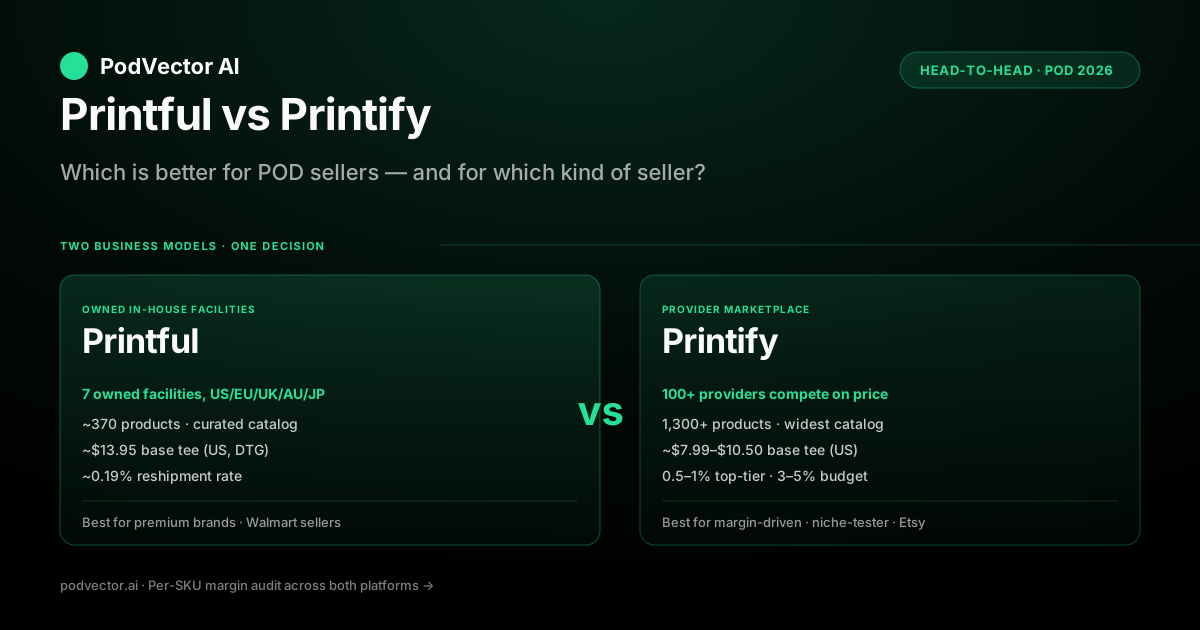
Quick Answer: Neither is universally better. Printify wins on raw margin and catalog breadth — ~$3–6 cheaper per tee, 1,300+ SKUs, and up to 33% off on the $39/month Premium plan.
Printful wins on consistency and brand polish — in-house production at ~0.19% reshipment rate, the most mature branded packaging program, and one of the few platforms with native Walmart integration.
For most US sellers in 2026 — especially anyone testing niches on Etsy or watching unit economics — Printify is the safer first bet. For premium brands and gift stores where packaging matters, Printful pays back its premium. The real answer depends on which SKUs you actually sell, which is what the rest of this guide unpacks.
The 30-second verdict
If you are running a US store, selling apparel, and squeezing every point of margin — Printify is better in 2026. The base costs are lower, the catalog is deeper, the provider network covers more of the country, and the quality gap with Printful has narrowed enough that the average buyer can't tell.
If you are building a premium or gift brand where the unboxing matters, where consistency across reorders is non-negotiable, and where you need branded inside labels and packaging inserts to look like a real fashion line — Printful is better. The same applies if you sell on Walmart Marketplace, which Printful supports natively and Printify does not.
Everyone else lives in the middle. The "better" platform depends on which specific SKUs you sell, which markets you ship to, and how much variance your customer base will tolerate. We cover both ends and the in-between below.
The business model split that drives everything
Almost every other tradeoff in this comparison flows from one structural difference.
Printful is a vertically integrated POD producer. It operates ~7 of its own fulfillment centers across the US, EU, UK, Australia, and Japan. Every order is printed and packed by Printful staff on Printful equipment.
That means quality is uniform. It also means base costs are higher — you are paying for owned real estate, owned presses, and direct employees, not a competitive supplier marketplace.
Printify is a print-on-demand marketplace. Printify itself doesn't print anything. The platform brokers your orders to 100+ independent print providers — Monster Digital, SwiftPOD, Drive Fulfillment, Dimona, Awkward Styles, and others — competing for your business.
That means base costs are lower because providers undercut each other. It also means quality varies. A T-shirt from Monster Digital looks different from a T-shirt from SwiftPOD, and your reorder may not arrive from the same provider that fulfilled the original.
Hold that distinction in mind. Every section below is a downstream consequence of it.
Pricing and plans: where your margin actually lands
Both platforms are free to start. The base subscription is $0, and you only pay when an order ships. The paid tiers buy you per-unit discounts.
Printful Growth runs $24.99/month. It gives you ~20% off product costs at volume tiers, free design transfers, premium support, and discounted branded inserts — and it becomes free once your store passes $12K in annual sales, so high-volume Printful sellers effectively stop paying for the tier.
Printify Premium runs $39/month (or roughly $24.99/month billed annually) and gives you a flat 20% off all products. Printify Enterprise is custom-priced and lifts the discount to ~33% at scale.
The discount math matters less than the base prices, though. On a Bella+Canvas 3001 unisex tee — the most-printed garment in POD — here's roughly where 2026 unit costs land:
| Platform | Free plan base | With paid plan discount | Print method |
|---|---|---|---|
| Printful (in-house) | ~$13.95 | ~$11.16 (Growth) | DTG |
| Printify (Monster Digital) | ~$9.50 | ~$7.60 (Premium) | DTG |
| Printify (SwiftPOD) | ~$8.00 | ~$6.40 (Premium) | DTG |
That's a $3–5 base-cost gap on the same garment. At a $24.99 sell price, that swing is the difference between an 11% net margin and a 28% net margin after shipping and Shopify fees.
Caveat: shipping is where the gap narrows. Printify provider shipping varies — some charge $4.99 for the first US tee, some charge $5.99, some $6.50 — and Printful's $4.69 first-item US shipping on apparel is one of the lowest in the industry. Always run the math at the order level, not the base-cost level.
For deeper unit-economics breakdowns: is Printify actually cheaper than Printful? and the full POD t-shirt base cost breakdown walk through the per-SKU math.
Product catalog: breadth vs curation
Printify lists 1,300+ products. Printful lists ~370.
That number gap is real, but it understates what's happening. Printify's catalog is wide because every provider brings its own SKUs. You'll find products on Printify that Printful simply doesn't offer — slipper socks, AOP performance wear, ceramic-decal mugs, weighted blankets, custom-shape die-cut stickers, pet bandanas.
Printful's catalog is narrower but more curated. The categories Printful does offer — apparel, embroidery, hats, drinkware, posters, accessories — tend to have multiple base options at multiple price points, all printed in-house. There's less optionality, but less variance.
For most apparel-first stores, this comparison is a wash. Both have Bella+Canvas, Gildan, Comfort Colors, AS Colour, Champion, and Stanley/Stella. If your business is "I sell t-shirts and hoodies on Shopify," catalog breadth isn't your decision driver.
For niche stores — pet products, home goods, accessories, or unusual product types — Printify wins on optionality, but you'll spend more time vetting which provider can actually print your specific design.
Print quality and consistency
This is where the SERP debate is loudest, and where the honest answer is the least exciting.
Printful's average quality is higher. Reshipment rate sits around 0.19%, meaning fewer than 1 in 500 orders gets a complaint serious enough to require a remake. Color fidelity is consistent across facilities. Reorders look like the originals.
Printify's top-tier providers match Printful's quality. Monster Digital, Swift POD, and Drive Fulfillment all run modern DTG and DTF equipment, and their output is functionally indistinguishable from Printful's at scale. Reshipment rates from these providers land in the 0.5–1% range.
Printify's budget providers are where horror stories come from. Some smaller providers run older equipment, looser QC, and reshipment rates that quietly drift into the 3–5% range. If you pick the cheapest provider for every product without checking ratings, you'll feel it in your support inbox.
The fix on Printify is to lock to two or three vetted providers and never let the platform default-route you to whoever's cheapest. The fix on Printful is to pay the premium and not think about it.
For a deeper quality teardown: our Printful vs Printify quality comparison covers the test-order results.
Fulfillment speed and shipping
Production times are similar on paper and similar in practice.
Printful averages 2–5 business days from order to ship-out. Printify averages 2–7 days, with the top-tier providers in the 2–4 day range and budget providers occasionally drifting to a full week.
Shipping speed once a package is in the carrier network is essentially identical — both platforms use USPS, UPS, FedEx, and DHL out of comparable US locations. The deciding factor is which provider is geographically closest to your customer.
Printify has a structural edge here: with 100+ providers across the US and several internationally, more orders ship locally and land faster. Printful's 7 owned facilities cover most of the world but can't match Printify's network density for last-mile speed.
For international sellers, both are competitive in the EU (Printful has Riga and Barcelona; Printify routes to Dimona in Lithuania and other EU partners). Printful has a slight edge in Australia (Melbourne facility) and Japan (Tokyo facility) — Printify routes those regions to a thinner network.
Branding and packaging
If you care about the unboxing, Printful wins. This isn't close.
Printful offers inside-collar labels ($2.49/item), sleeve prints, custom branded pack-ins (flyers, thank-you cards, stickers), branded packaging, and packing slips with your logo. All of it is configured once in the dashboard and applied consistently across every order.
Printify offers some of these — inside-collar labels are available via specific providers like Monster Digital, and packing slips can be customized — but the options vary by provider, and a buyer who reorders from a different Printify provider may receive a package that looks different from their first order.
For a hobby store, this doesn't matter. For a fashion brand where the buyer is supposed to feel like they bought from a real label, it matters a lot. Printful's branded packaging program is the most mature in POD, and it's the single biggest reason premium brands stay with Printful even after the unit-economics math tells them to move.
Design tools and ease of use
How fast you can go from idea to live product is a real cost, and this is where Printful pulls ahead for anyone who designs inside the platform.
Printful's design maker is the more mature tool. It ships with 25,000+ built-in clip-art graphics, quick-text and layout controls, curved-text and pattern fills, and it accepts image files up to 200MB. The mockup generator renders cleaner lifestyle and flat-lay shots, and bulk mockup export is smoother. For a beginner who wants to design in-browser and push a store live the same afternoon, Printful is the lower-friction path.
Printify's editor is functional but thinner. It offers roughly 250 stock graphics, a 100MB image cap, and a simpler mockup set. Most serious Printify sellers design in Canva, Kittl, or Photoshop and upload finished PNGs — the built-in tool is fine for placing and scaling art, not for creating it. The upside: because Printify assumes you bring your own artwork, its product-creation flow is fast once your files are ready.
On raw interface, both dashboards are clean and both ship mobile apps. Printful's is generally rated the easier onboarding experience; Printify's has a slightly steeper learning curve because you also choose and compare providers per product — the same flexibility that saves you money adds a step. If you sample before you sell, note that Printful discounts sample orders ~20% while Printify charges standard pricing, so proofing a catalog costs less on Printful.
Integrations: where you can actually sell
Both platforms cover the major sales channels. Both have native Shopify, Etsy, WooCommerce, Wix, Squarespace, BigCommerce, and TikTok Shop integrations.
The differences sit at the marketplace edges.
Printful supports Walmart Marketplace natively. Printify does not. If Walmart is part of your channel mix, that decision is already made.
Both support Amazon and eBay natively via their respective Merch programs and direct integrations.
Printful has slightly deeper Shopify automation — automatic mockup generation, design library sync, and bulk product updates work more smoothly. Printify's Shopify app is solid but slightly less polished.
For most sellers, integration parity is close enough that this section won't decide the platform. But if you're cross-listing to Walmart, Printful is the answer.
Customer support
Both platforms offer email support on the free plan and prioritized support on paid plans. Printful's support is widely reported to respond faster — usually within a few hours for paid-plan customers — while Printify's response times vary from a few hours to a full business day.
The bigger support difference is where escalations land. On Printful, every issue routes to Printful staff because Printful is the producer. On Printify, fulfillment issues often require Printify support to liaise with the provider, which adds a step.
If you're moving 50+ orders a day and a stuck order means real revenue at risk, the directness of Printful's support model is worth something.
What the Printful + Printify merger actually changes
Yes. Printful and Printify officially merged in November 2024, and both brands now sit under the same parent company.
In practice, nothing has changed for sellers as of mid-2026. The two platforms operate as independent product surfaces with independent pricing, catalogs, integrations, fulfillment networks, and dashboards. Orders placed on one don't appear in the other. Subscriptions are separate.
The merger may eventually drive shared infrastructure on the backend — unified shipping rates, shared provider pools, joint support — but that hasn't materialized in the seller-facing experience yet. Pick the platform that fits your business today, not the consolidation that might happen in 2027.
Which is better, by seller type
The platform answer is rarely universal. It's almost always a function of which kind of POD business you are running.
You're testing niches aggressively on Etsy
Printify. Lower base costs let you sell at the Etsy-typical $19–22 price point and still keep a margin. The catalog breadth lets you test product types beyond apparel. Picking SwiftPOD or Monster Digital gives you Printful-comparable quality at 30%+ lower cost.
You're building a premium apparel brand on Shopify
Printful. The branded packaging, inside-collar labels, and reorder consistency are exactly what a premium brand needs. The cost premium is real but it's also priced into your retail.
You sell on Walmart Marketplace
Printful. Native Walmart integration ends the discussion.
You sell niche non-apparel products (pet, home, accessories)
Printify, almost always. The catalog covers things Printful doesn't, and the marketplace model lets you find a provider that specializes in your specific product type.
You ship internationally outside the US/EU
Lean Printful for Australia and Japan (owned facilities). Both work in the EU. Both struggle in markets without local fulfillment — Latin America, the Middle East, and Southeast Asia route from the closest available facility, which usually means slower delivery and higher shipping cost.
You're a hobby seller doing under 50 orders a month
Either. Stay on the free plan, pick the catalog that has the products you want, and don't agonize. The subscription math doesn't kick in until you're past a few hundred orders a month.
You're a 1,000+ orders/month operation
Both, almost certainly. Most operators at this scale run a primary platform plus a backup, and many split SKUs by which platform fulfills that specific product best — Printful for branded apparel SKUs, Printify for novelty SKUs, with the order routing logic in Shopify or a third-party app. Our full Printful vs Printify pros and cons breakdown and the supplementary pros/cons walkthrough get into the multi-platform setup in more depth.
The 'better for my store' question only your data can answer
The honest answer to "which is better" depends on numbers most sellers never run.
How much profit does each SKU in your catalog actually make on Printful vs Printify, after all costs — base, shipping, Shopify fees, payment processing, refund rate? Which products are losing you money on one platform and making money on the other? If your ad spend is split across Meta and Google, which platform's order economics actually support the CPA you're paying?
The blog-post answer to that is a spreadsheet. The reality is that almost nobody maintains the spreadsheet — the catalog changes, costs drift, ad spend shifts, and the manual model goes stale within a month.
This is the kind of question PodVector AI's AI employee, Victor, is built to answer. Victor connects to your Shopify store, ingests your Printful and Printify order data into a live data warehouse alongside Meta Ads and Google Ads spend, and lets you ask in plain English: "which SKUs are more profitable on Printify than Printful right now, factoring in ad spend?" Victor proposes a route — e.g., shift these 12 SKUs to Printify, raise the price on these 3 — and executes Shopify-side actions like price changes or discount creation on your approval, with a full audit trail. It's an AI employee, not a dashboard.
If you've spent more than an evening trying to model this in a spreadsheet, it's worth a look.
FAQs
Is Printify better than Printful in 2026?
For most US sellers focused on margin, yes. Lower base costs, deeper catalog, and the quality gap has narrowed enough that top-tier Printify providers match Printful's output. Printful is still better for premium branding, Walmart sales, and operators who don't want to think about provider selection.
Are Printful and Printify the same company now?
They share a parent company after their November 2024 merger but operate as independent platforms with independent pricing, catalogs, integrations, and dashboards. Functionally, nothing has changed for sellers as of mid-2026.
Can I use both Printful and Printify at the same time?
Yes, and many sellers do. The common setup is to assign specific SKUs to specific platforms — branded apparel to Printful, novelty/niche products to Printify — and route orders via Shopify or a third-party app. There's no penalty for running both.
Which is cheaper, Printful or Printify?
Printify on base product costs, usually by $3–6 per unit on apparel. Printful can close the gap on shipping (lower first-item rates) and on subscription discounts (Growth at $24.99 vs Premium at $39), but Printify keeps the structural advantage.
Does Printful have better print quality than Printify?
On average, yes — Printful's in-house production yields a ~0.19% reshipment rate vs 0.5–1% for top-tier Printify providers and 3–5% for budget providers. But Printify's best providers are visually indistinguishable from Printful at the unit level. The difference is variance, not ceiling.
Which is faster, Printful or Printify?
Production times are similar (2–5 days Printful, 2–7 days Printify with provider variance). Printify's wider network sometimes ships faster to the customer because more orders fulfill locally. The deciding factor is provider geography, not platform.
Does Printify integrate with Walmart?
No. Printful does, natively. If Walmart Marketplace is part of your channel mix, that alone is enough to pick Printful.
Which is easier to use, Printful or Printify?
Printful, for most beginners. Its design maker is more mature (25,000+ built-in graphics, 200MB uploads, cleaner mockups) and onboarding is more streamlined. Printify's editor is thinner — most sellers design in Canva or Kittl and upload finished art — and comparing providers per product adds a step. That extra step is also what earns you the lower base costs.
What's the easiest way to actually decide for my store?
Run the unit economics on your top 10 SKUs across both platforms. Include base cost, shipping, Shopify and payment fees, and your actual refund rate. The platform that wins more SKUs is probably the right primary, with the loser kept as a backup for the SKUs it wins. The fastest way to do this without building a spreadsheet is to connect both platforms into a tool that already models POD margin — like Victor.
For more comparison angles, see our Printful comparison hub and the broader Printful articles. External reference: PrintOnDemandBusiness's 2026 Printful vs Printify guide covers similar ground with additional gotchas worth reading.
Stop guessing which platform is more profitable for your catalog
Printful or Printify? The honest answer depends on SKUs you sell, ads you run, and refund rates you hide from. PodVector AI's AI employee agent, Victor, connects your Shopify, Printful, Printify, Meta Ads, and Google Ads into one live data warehouse — then proposes specific actions (price changes, supplier shifts, discount creation) and executes them on Shopify with your approval. Free to start, no credit card required.
Try Victor free