
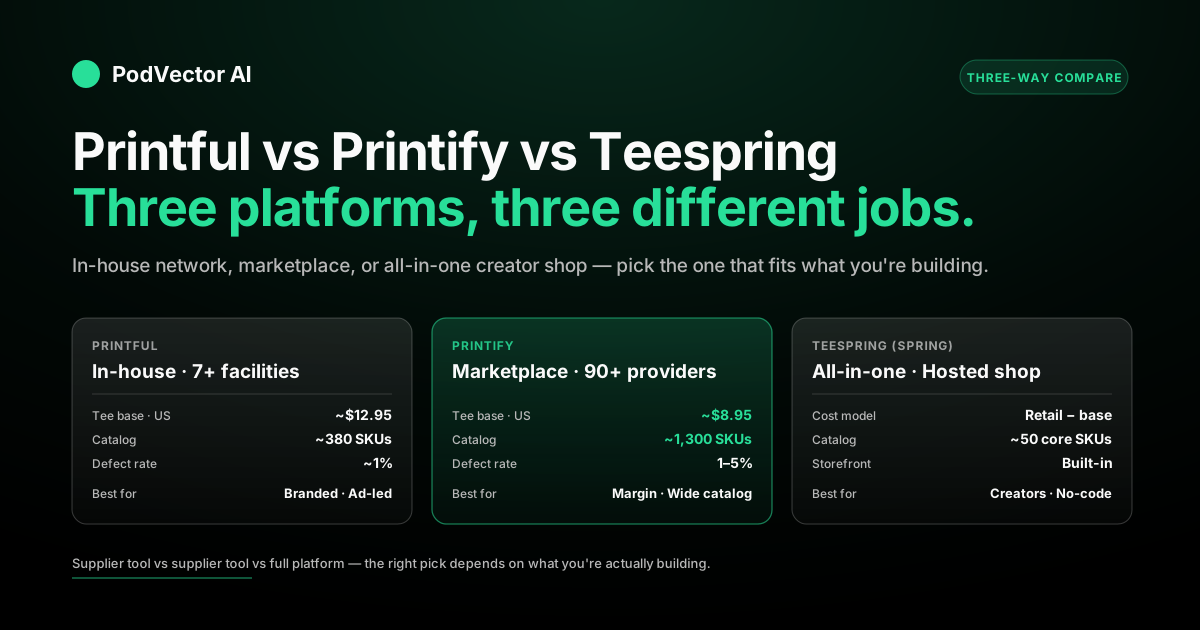
Quick Answer: Printful, Printify, and Teespring (now branded Spring) solve three different problems. Printful is the in-house fulfillment network with the tightest quality control. Printify is the marketplace with the widest catalog and the lowest base costs. Teespring is the all-in-one creator marketplace with no store setup needed.
The short version: pick Printful for a branded store with paid traffic, Printify for the widest catalog and lowest base costs, and Teespring if you have an audience and want a hosted shop you don't have to build. If you're building your own Shopify or Etsy store, the real choice is between Printful and Printify — Teespring sits in a different bucket entirely.
Below is the side-by-side breakdown — pricing, catalog, fulfillment, integrations, and the per-SKU economics most comparisons skip.
Three different business models
Most comparisons treat these three as equivalent options for the same buyer. They aren't.
Printful runs an in-house fulfillment network — seven owned printing facilities across the US, EU, Mexico, and Asia. You design products, push them to your own store (Shopify, Etsy, WooCommerce), and Printful prints and ships every order under one quality standard.
Printify is a marketplace, not a printer. It connects you to 90+ third-party print providers worldwide. You pick which provider fulfills each SKU, push products to your own store, and Printify routes the orders. Lower base costs, more variance.
Teespring (now Spring) is an all-in-one creator marketplace. You don't bring your own storefront — Spring hosts the shop, takes the payment, prints the order, and ships it. The trade-off: limited catalog, less customization, and you're operating inside Spring's ecosystem instead of your own brand.
If you only remember one thing: Printful and Printify are supplier tools. Teespring is a full platform. The comparison stops mattering once you decide whether you want a store of your own.
Side-by-side snapshot
The 30-second version. Each row is unpacked in its own section below.
| Dimension | Printful | Printify | Teespring (Spring) |
|---|---|---|---|
| Business model | In-house fulfillment | Marketplace of 90+ providers | All-in-one creator marketplace |
| Storefront | Bring your own | Bring your own | Built-in (free hosted) |
| Bella+Canvas 3001 base cost | ~$12.95 | ~$8.95 (Premium) | Set price; profit = listing − base |
| Catalog size | ~340 SKUs | 1,000+ SKUs | ~180 SKUs |
| Monthly fee | $0 free; $24.99 Growth; $49.99 Business | $0 free; $24.99 Premium | $0 — Spring takes a per-sale margin |
| Print quality consistency | ~1% defect rate | 1–5% (provider-dependent) | Single-line standard |
| Native integrations | Shopify, Etsy, WooCommerce, eBay, Amazon, TikTok Shop | Shopify, Etsy, WooCommerce, eBay, Amazon, TikTok Shop, Wix | None — Spring is the store |
| Best for | Branded apparel, ad-driven scaling | Margin-led, wide-catalog testing | Creators, influencers, no-code launches |
Pricing and fees
Three completely different pricing models. Comparing the headline base cost between them produces the wrong answer.
Printful pricing
Free tier with no commitment. Growth plan runs $24.99/month and discounts apparel by roughly 7%. Business plan is $49.99/month for deeper discounts and higher API limits.
Base costs are the highest of the three on most apparel. A Bella+Canvas 3001 unisex tee runs ~$12.95 before your markup and shipping. No per-order commission — Printful makes its money on the base cost spread.
Printify pricing
Free tier with full catalog access at standard prices. Printify Premium runs $24.99/month and unlocks up to 20% off the catalog, paying back at roughly 100–200 orders/month.
Base costs are the lowest of the three on most apparel. The same Bella+Canvas 3001 runs ~$8.95 on Premium — about $4 cheaper than Printful. No per-order commission either.
The catch: shipping rates depend on which provider fulfills each order, so total landed cost varies. For deeper itemized cost math on Printful's side, see the Printful embroidery pricing breakdown.
Teespring pricing
No monthly fees. No upfront cost. Teespring's model is the opposite of the other two — you set the retail price, Teespring keeps the difference between that and the base cost.
Effective base costs on tees run roughly $11–14 depending on the garment, and you control the markup. The simplicity is the appeal: no subscriptions, no per-app billing, no separate Shopify cost layered on top.
The trade-off is invisible until you scale. You don't get supplier-level cost transparency, and you can't shop alternative providers when costs rise. Spring's number is the number.
Product catalog and quality
Catalog breadth and print quality split cleanly across these three.
Printify wins on breadth. Over 1,000 SKUs across apparel, drinkware, home decor, accessories, pet products, and niche categories. Because it's a marketplace, new product types arrive as soon as one provider offers them.
Printful wins on quality consistency. Around 340 SKUs, all qualified across Printful's owned facilities with standardized DTG (direct-to-garment), DTF (direct-to-film), and embroidery equipment. Defect rates sit around 1%. The variance between an LA-printed order and a Riga-printed order is small.
Printify's quality depends on which provider you pick. Top-tier providers like Monster Digital and SwiftPOD match Printful's print quality. Lower-tier providers vary. Across the marketplace, defect rates run 1–5%.
Teespring sits in the middle on quality with a much smaller catalog. Around 180 SKUs — tees, hoodies, mugs, stickers, phone cases, basic accessories. Quality is consistent because Spring runs a tighter supplier line, but you simply don't have the catalog options for a full branded store with seasonal product lines.
The practical rule: if you're testing 100+ trend-driven SKUs, Printify is the only option that carries enough catalog. If you're building a 30-SKU branded apparel line, Printful covers it cleanly. If you're an influencer launching a merch drop with three designs, Teespring's catalog is plenty.
Fulfillment and shipping
Printful is the fastest and most predictable. Printify is the most flexible. Teespring is the most opaque.
Printful's median production time runs 1–3 business days, with regional auto-routing. A US order prints in LA or Charlotte; an EU order prints in Riga or Birmingham; a Japan order prints in Tokyo. Returns and reprints are handled centrally by Printful, not by you.
Printify's production time runs 2–5 business days, varying by provider. Top-tier providers match Printful's SLA; some lower-tier providers run slower during seasonal peaks. Printify Premium offers Express Delivery on eligible SKUs (2–3 business days print-and-ship).
Teespring fulfillment happens inside Spring's own supplier network. Production time runs 3–7 business days for most US orders. You don't pick the supplier and you don't see the routing — Spring handles it end-to-end. The customer never knows you weren't the one shipping.
For Etsy and TikTok Shop sellers, production speed matters. Both marketplaces weigh on-time shipping in their ranking algorithms. Printful's default tends to clear those thresholds without configuration; Printify needs careful provider curation.
Integrations and store setup
This is the dimension where the three platforms split most clearly.
Printful and Printify both plug into the major ecommerce platforms — Shopify, Etsy, WooCommerce, eBay, Amazon, TikTok Shop, Wix, Squarespace. The Shopify integration is the most polished for both: install the app, connect, push products, sync inventory automatically.
Printful adds slightly deeper BigCommerce and Walmart Marketplace support, plus a higher-resolution mockup generator. Printify's Shopify app surfaces broader catalog inside the same install — fewer "I need a second supplier for X" moments.
Teespring has no integrations because it doesn't need them. Spring is your storefront. You upload designs, set prices, and share your Spring URL. There's no Shopify subscription, no theme customization, no checkout configuration, no abandoned cart flows.
That's the trade-off in one sentence: Spring removes every operational friction by also removing every customization lever. If you want to A/B test product pages or run a Klaviyo email flow, you're not picking Spring.
For a deeper look at how Printful's integration footprint compares against other suppliers, see Printify vs Printful vs Gelato comparison.
Ease of use
Teespring wins on absolute ease of starting. Printful wins on ease of operating a real brand. Printify wins on ease of catalog expansion.
Teespring's onboarding is the lowest-friction in POD. Sign up, upload a design, pick products, set prices, share the link. You can have a live store inside an hour with no Shopify subscription, no domain, no design system. For YouTubers, podcasters, or anyone whose traffic source is their own audience, Spring is the path of least resistance.
Printful's interface is the most operator-ready for a real store. The mockup generator is polished, the product library handles brand assets cleanly, and the dashboard surfaces unit economics in a way that supports decision-making. The learning curve is steeper than Teespring's but worth it once you cross into scaling territory.
Printify's interface is built for testing volume. Bulk product creation, provider switching, and quick SKU duplication are all faster than Printful's equivalent flows. Provider quality variance is the hidden complexity — once you've picked top-tier providers and locked your SKUs to them, operating Printify becomes straightforward.
For the Reddit-sourced version of this same question — where actual sellers debate the trade-offs — see Printify vs Printful on Reddit.
Branding, packaging, and support
Most comparisons skip these two, but they decide whether a store feels like a brand or a dropshipper.
Printful is the only one built for white-label branding. Inside pack-ins, custom labels, branded packing slips, and logo stickers are all available, so the customer never sees the word "Printful." That branding layer is what lets an ad-driven store look owned rather than resold.
Printify's branding depends on the provider. Some print partners offer custom neck labels and branded inserts; many don't. If a consistent unboxing matters, you have to curate providers that support it — one more reason to lock SKUs to top-tier partners.
Teespring gives you the least branding control because the storefront is Spring's, not yours. Packaging is standardized and the shop lives on a Spring URL, so the brand people remember is the creator's, not a store's.
On support, Printful runs 24/7 live chat and email with the fastest median response of the three. Printify support is solid but routes provider-specific issues back through the print partner, which adds a hop. Teespring leans on help-center docs and email, which fits its lower-touch, creator-first model.
The operator takeaway: branding and support quality compound silently. A 2% lift in repeat purchase from branded packaging or a faster support resolution rarely shows up in a base-cost table, but it moves lifetime value more than a $2 SKU saving.
The margin question nobody answers
Every comparison above — including this one — frames the choice at the platform level. That framing produces a platform-level answer.
The actual question every POD seller has to answer is per-SKU. On your Bella+Canvas 3001 in heather grey, shipping to your top region, with your blended ad cost, which supplier produces the highest contribution dollar per order? The answer flips by garment, region, season, and volume.
None of the standard comparison articles fill that gap. They quote averages — $4 base-cost difference, 1% defect rate, 1–3 day fulfillment — and stop there. Your P&L runs on specifics, not averages.
Closing that gap requires three pieces working together. Every order's supplier-charged cost has to flow into a single source of truth alongside revenue, ad spend, refunds, and processor fees. The math has to run per-SKU and per-supplier, so a tee profitable on Printify and a hoodie profitable on Printful both show up clearly. The answer has to surface fast enough to act on — switching one SKU's supplier weekly is high-leverage if the data is current, useless if it's a quarter old.
This is the architecture PodVector AI built Victor on — an intelligent business employee for your POD store, with the POD playbook baked in (CFO sub-agent, profit-leak audits, supplier-level margin math), a live data layer that pulls Shopify, Printful, Printify, Meta, and Google per-order data, and the ability to propose and execute Shopify actions on your approval. Ask "which supplier is more profitable on my hoodies in EU shipments?" in plain English and get an answer in seconds. For embroidered SKUs specifically — where the cost math gets more complex — see the Printful embroidered t-shirt cost breakdown.
Which should you pick?
The platform-level "which is best" framing gives a useless answer. The real choice depends on what you're building.
Pick Teespring if you have an audience already (YouTube, Twitch, Instagram, podcast) and want a no-friction merch drop. Spring removes every operational step at the cost of brand control. Perfect for creators, wrong for sellers trying to build a defensible brand asset.
Pick Printful if you're building a branded apparel store with paid traffic in the mix. Tight SLA, low defect rate, branded packaging, and consistent quality all compound across thousands of orders. Higher base costs, lower variance, fewer surprises.
Pick Printify if you're margin-led, testing a wide product range, or running trend-driven catalogs. Lower base costs preserve margin on lower-AOV products, and the catalog breadth is the only one that supports "list 100 designs across 15 product types" workflows.
Run both Printful and Printify if you're past 5,000 orders/month with a stable catalog. Most established POD sellers at that volume split SKUs between platforms — Printful for premium-fabric and branded SKUs, Printify for trend-driven and margin-sensitive ones. Teespring rarely fits into that mix because the no-storefront tradeoff stops paying back at scale.
For the broader Printful-vs-alternatives picture including Gelato, see Printify vs Printful vs Gelato. For the full Printful cluster, see the Printful comparison hub and the Printful topic hub.
FAQs
Is Teespring the same as Spring now?
Yes. Teespring rebranded to Spring in 2021 after its acquisition by Amaze. The platform still functions the same way — creator-focused, all-in-one storefront with built-in fulfillment — but the public-facing brand is Spring. Most sellers still call it Teespring out of habit, including in search queries.
Which is cheapest — Printful, Printify, or Teespring?
Printify has the lowest base costs on most apparel SKUs, especially on Premium ($24.99/month). Printful's base costs are 15–35% higher depending on the product. Teespring's "cost" is hidden inside its retail-margin model, so direct base-cost comparison doesn't translate — but effective margins on Teespring are usually lower than Printify Premium for the same retail price.
Can I use Teespring with Shopify?
No. Teespring (Spring) is its own storefront — it doesn't integrate with Shopify the way Printful and Printify do. If you want a Shopify-based store, Printful or Printify are the two real options. Spring is for sellers who don't want a separate ecommerce platform at all.
Which has the best print quality?
Printful has the most consistent print quality across its catalog, with ~1% defect rates and uniform DTG/embroidery equipment across owned facilities. Printify's top-tier providers (Monster Digital, SwiftPOD) match Printful on quality, but quality varies across the broader marketplace. Teespring quality is consistent but uses a narrower supplier line — fine for basic apparel, less competitive on premium-fabric SKUs.
Which platform is best for beginners with no audience?
Printify on the free tier. The lower base costs preserve margin while you're learning, and the wider catalog gives room to test SKU types without locking into one product line. Teespring works if you already have an audience driving traffic, but without that audience the no-SEO, no-Shopify, no-ad-stack constraints are limiting.
Which platform handles international fulfillment best?
Printful for set-and-forget international auto-routing — EU orders print in EU facilities, Japan orders print in Japan, etc. Printify can be cheaper internationally if you list the same SKU through multiple regional providers and route by ship-to region, but the setup is meaningfully more work. Teespring routes through Spring's own supplier network with less transparency about per-region cost or speed.
Can I run all three at once?
Technically yes, but the operational overhead rarely pays back. Printful + Printify together is common at scale because both feed the same Shopify store. Teespring runs as a separate storefront with its own audience funnel, so combining it with a Shopify-based Printful/Printify setup usually means running two parallel businesses, not one diversified one.
Which is best for Etsy POD sellers?
Printful for new Etsy sellers — tighter SLA and lower defect rate help Etsy's on-time-shipping and review-score ranking. Experienced Etsy sellers with mature listings and review buffers often shift trend-driven SKUs to Printify for the margin advantage. Teespring doesn't integrate with Etsy.
How do I decide between Printful and Printify if Teespring is out?
By stage and traffic source. Hobbyists and side hustlers (under 500 orders/month) usually win on Printify's lower base costs and wider catalog. Full-time and ad-driven sellers (500+ orders/month) usually win on Printful's lower defect rate and branded packaging, which compound across thousands of orders. Past 5,000 orders/month, most established sellers run both. For an additional outside framing, see Bootstrapping Ecommerce's per-category breakdown.
Stop comparing platforms. Compare suppliers per SKU.
Printful and Printify both quote averages. Your P&L doesn't run on averages. Victor — PodVector AI's AI business employee — pulls every Printful and Printify order, every supplier-charged cost, every ad spend, and every refund into one live data layer. Ask "which supplier is more profitable on my hoodies shipping to the EU?" in plain English. Victor proposes the SKU-level routing change and executes it on your Shopify store on your approval. POD-native unit economics, no spreadsheets.
Try Victor free