
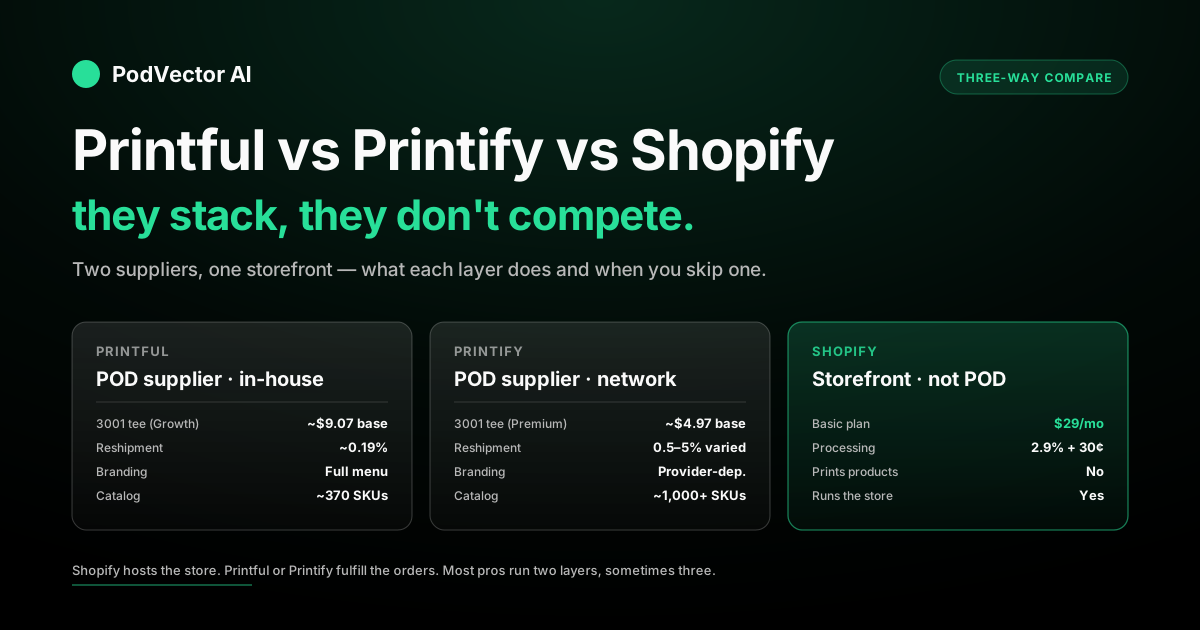
Quick Answer: Printful, Printify, and Shopify aren't really competing — they stack. Shopify is the storefront platform; Printful and Printify are the print-on-demand (POD) suppliers that fulfill orders behind it. Most successful POD sellers run Shopify plus Printful or Printify, not one instead of another.
If you have to pick one POD supplier: Printify usually wins on raw base price and catalog size; Printful usually wins on quality consistency, branding, and operational predictability. If you have to pick a storefront: Shopify is the default for serious sellers; Etsy and TikTok Shop are valid alternatives for early-stage discovery.
Below: what each one actually is, side-by-side pricing and integration mechanics, when you'd skip one, and the per-SKU profit question that beats picking a "winner" off a comparison table.
Why this is the wrong three-way comparison
The "Printful vs Printify vs Shopify" search is doing a lot of work because all three names live in the same conversation. They don't live in the same category.
Printful and Printify are print-on-demand suppliers. They print and ship the actual products — t-shirts, mugs, hoodies, posters — when an order comes in.
Shopify is an ecommerce platform. It's where your store lives — the storefront, checkout, inventory, customer accounts, payments, and admin. Shopify doesn't print anything.
So the real picture for most POD sellers looks like this: Shopify (storefront) + Printful or Printify (POD supplier) = a working print-on-demand business. You almost always use a storefront and a supplier, not one instead of the other.
The genuine choice in this three-way is two separate decisions: which POD supplier (Printful vs Printify) and which storefront (Shopify vs Etsy vs TikTok Shop vs a Printful/Printify-hosted micro-store). The rest of this article walks both.
Three-way snapshot: what each one actually does
One table to ground the rest of the article. Read by row, not by column — different categories on the same chart.
| Dimension | Printful | Printify | Shopify |
|---|---|---|---|
| Category | POD supplier | POD supplier | Ecommerce platform |
| What it does | Prints & ships orders in-house | Routes orders to 100+ third-party printers | Hosts the storefront, checkout, admin |
| Production model | In-house, ~15 fulfillment centers | Marketplace of independent providers | None — Shopify doesn't print |
| Catalog size | ~390 products | ~1,300+ products (network total) | Sells anything; not a catalog |
| Free tier | Yes — Growth is free past $12K/yr sales | Yes — free plan available | 3-day free trial, then $29+/mo |
| Paid plan | $24.99/mo Growth · $49.99 Business | $29/mo Premium · Enterprise (custom) | $29 Basic → $399 Advanced |
| Production turnaround | ~2–5 days (in-house) | ~2–7 days (provider-dependent) | N/A — supplier fulfills |
| Base t-shirt cost | ~$12.95 | ~$6.21 (Monster Digital) | N/A — depends on supplier |
| Quality consistency | High — single quality bar | Variable — provider-dependent | N/A — depends on supplier |
| Branding (neck label, inserts) | Full menu, $1.99–$4.99/item | Provider-dependent, mostly limited | N/A — depends on supplier |
| Direct integrations | 19 platforms & marketplaces | 10 platforms | Hosts apps for both |
| Native storefront option | Yes — Printful Quick Stores | Yes — Printify Pop-Up Store | Yes — Shopify is the storefront |
Two takeaways. Printful and Printify share a column type (both POD suppliers); Shopify doesn't belong there. And Shopify's row for "base t-shirt cost" is N/A because Shopify itself doesn't sell t-shirts — Printful or Printify (or another POD app) does, through Shopify.
Printful: the in-house POD printer
Printful runs around 15 fulfillment centers across the US, Europe, Mexico, Australia, and Japan. Every order ships from a Printful-owned facility on Printful-owned machinery with Printful-trained staff. The platform is the printer.
That structure produces three repeatable wins: consistent quality (same equipment everywhere), predictable shipping (one fulfillment network, one set of times), and branding execution (Printful controls the box, the insert, the inside-neck label).
It also produces a higher price floor. A Bella+Canvas 3001 unisex tee runs ~$12.95 base on Printful versus ~$6.21 on Printify's Monster Digital. That gap shrinks with the Growth plan (up to ~30% off) but doesn't disappear. You're paying for the consistency.
One pricing wrinkle in Printful's favor: the $24.99/mo Growth plan becomes free once your store clears ~$12K in annual Printful sales. At scale you keep the discount tier without the subscription line, which narrows the per-order cost gap further than the base prices suggest.
Printful's catalog is smaller — about 390 products versus Printify's 1,300+. The catalog is curated rather than aggregated. If the SKU you want exists on Printful, you'll get the same shirt month after month. If it doesn't, you wait.
Production turnaround is tight and predictable: Printful averages ~2–5 days to print and hand off an order, from one fulfillment network rather than a roster of providers with different queues. You get one set of times to promise customers, not a range that shifts with routing.
Reshipment rate is the cleanest signal here. Printful publishes ~0.19%. Printify reshipment rates vary 0.5–5% depending on which provider routes the order. On 1,000 orders a month, that's the difference between 2 reships and 5–50. Customer support time alone is a real cost line.
Printify: the multi-provider POD network
Printify is a marketplace, not a printer. It sits between you and 100+ independent print providers — Monster Digital, SwiftPOD, Dimona Tee, Print Geek, T-Shirt and Sons, Sensaria, dozens more. Each runs its own equipment, staffing, quality bar, and packaging.
The structural win is price. Because providers compete inside the Printify network, base prices stay low. A 3001 tee for $6.21 (Monster Digital, US, top-tier) or $5.50 (Dimona, budget tier) versus $12.95 on Printful is a $4–$7 per-unit gap before subscription discounts.
The structural cost is variance. The same SKU can ship from a different provider depending on stock, location, or routing rules. Quality differences between providers are real. Reships, returns, and printing flaws cluster around the lower-tier providers. You have to actively pick a primary provider and monitor it.
Catalog is the other structural win. Printify lists ~1,300+ products because it aggregates every provider's catalog. Long-tail niches — kids' apparel, pet beds, oddly shaped drinkware, all-over-print sublimation — are reliably on Printify before Printful adds them.
Branding execution is weaker. Inside-neck labels are available on a subset of providers ($1.50–$3.50/item, varied). Custom packaging inserts are mostly unavailable. If branded unboxing matters to your brand, that's a Printful argument, not a Printify one.
Production speed also moves with the provider. Printify orders average ~2–7 days to fulfill, and the spread is real — a top-tier provider can match Printful while a budget one drags. Pick your primary provider for speed as well as price, then watch the actual fulfillment times, not the advertised ones.
Shopify: the storefront, not a POD supplier
Shopify hosts the store. The product pages, cart, checkout, payment processing, customer accounts, order admin, inventory, discount engine, and email marketing all run on Shopify. None of that involves printing anything.
For POD specifically, Shopify works the same way any product app works. You install the Printful or Printify app from the Shopify App Store, design products inside the supplier app, and the products sync into your Shopify catalog. When a customer buys, the order routes to the supplier automatically.
Shopify's costs are platform costs, not product costs. Basic plan is $29/mo, Shopify plan is $79, Advanced is $399. Payment processing runs 2.9% + 30¢ on Shopify Payments (US), with extra fees if you use a third-party gateway. Apps and themes are extra.
What you get for those costs: a faster, more flexible storefront than anything Printful or Printify hosts themselves. Better SEO control, real product page customization, a real checkout, real cart abandonment recovery, real cross-sells, real reviews integration, real Meta and Google Ads pixel integration. The full ecommerce toolkit.
You don't have to use Shopify. Printful Quick Stores and Printify Pop-Up Store are no-cost storefronts that work for early testing. Etsy, eBay, Amazon, Walmart, and TikTok Shop are marketplace alternatives. Shopify wins when you outgrow simple storefronts and want full control over the buyer experience.
Pricing compared across the three
Pricing across these three isn't apples-to-apples — Shopify is a flat platform fee, Printful and Printify are per-order costs. Here's how they stack in a realistic month.
| Cost line | Printful (Growth) | Printify (Premium) | Shopify (Basic) |
|---|---|---|---|
| Monthly fee | $24.99 | $29 | $29 |
| Discount on base prices | Up to ~30% | Flat 20% | N/A |
| Bella+Canvas 3001 (with plan) | ~$9.07 | ~$4.97 | N/A |
| 11oz mug (with plan) | ~$6.27 | ~$4.08 | N/A |
| US shipping (first tee) | $4.69 | $3.99–$4.99 | N/A — supplier ships |
| Inside-neck label | $2.49/item | $1.50–$3.50/item | N/A |
| Payment processing | N/A — supplier charges store | N/A — supplier charges store | 2.9% + 30¢ (Shopify Payments) |
| Transaction fee (3rd-party gateway) | N/A | N/A | 2.0% Basic / 1.0% Shopify / 0.5% Advanced |
| Apps & themes (typical) | $0 | $0 | $20–$150/mo |
For a store doing 200 orders/month of tees at $25 retail:
- Printful + Shopify: $25 retail × 200 = $5,000 revenue. Product cost ~($9.07 + $4.69) × 200 = $2,752. Shopify $29 + processing ~$160 = $189. Plan $24.99. Net ~$2,034 before ads, apps, taxes.
- Printify + Shopify: Same revenue. Product cost ~($4.97 + $4.49) × 200 = $1,892. Shopify $29 + processing ~$160 = $189. Plan $29. Net ~$2,890.
The raw Printify margin advantage is real on apparel. But it assumes equivalent quality, equivalent reship rate, and zero time spent picking providers. Three assumptions that usually don't hold cleanly. The fuller cost picture is in our Printful vs Printify cost comparison.
Integrations: how they actually fit together
This is where the three-way picture clicks. Shopify is the hub; Printful and Printify are spokes. Same hub, different spokes — and you can run two spokes from one hub.
Printful + Shopify
Install the Printful app from the Shopify App Store. Create products inside Printful, publish to Shopify, and Printful pushes the listings into your Shopify catalog. When a Shopify order fires, the Printful webhook receives it, charges your card on file for the production cost, prints, ships, and writes the tracking number back to Shopify.
Inventory sync is automatic. Printful runs the fulfillment, Shopify runs the customer-facing experience. The handoff is clean.
Printify + Shopify
Same architecture, different app. Install the Printify Shopify app, design products inside Printify, publish to Shopify, and orders route to whichever Printify provider you picked for that product. Tracking syncs back.
One added wrinkle: provider routing. If your primary Printify provider runs out of stock, Printify can fall back to a backup provider — useful for uptime, risky for consistency. You set fallback rules in the Printify settings.
Running Printful and Printify side by side
Both can run on the same Shopify store simultaneously. Printful handles your high-margin and branded products; Printify handles the long-tail catalog or price-sensitive SKUs. Each app syncs its own products into Shopify with no conflict.
Most professional POD sellers run both. There's no "one POD supplier" rule — each app is just a publisher writing to your Shopify product catalog. Use Printful for the SKUs where consistency and branding matter; use Printify for the SKUs where margin and catalog breadth matter.
Other storefront integrations
Printful integrates with 19 storefronts and marketplaces, including Shopify, WooCommerce, BigCommerce, Squarespace, Wix, Etsy, Amazon, eBay, Walmart, and TikTok Shop. Printify supports about 10 — Shopify, Etsy, eBay, Walmart, Wix, Squarespace, BigCommerce, PrestaShop, WooCommerce, TikTok Shop. The Shopify channel is the most-developed integration on both.
AI tools: design help vs running the business
Every current comparison now flags AI features, because both suppliers shipped them. It's worth knowing exactly what they automate — and what they don't.
Printful's AI is design-side: an image tool that upscales low-resolution artwork and helps clean up files before print. Printify added a generative image creator (text-prompt artwork) plus an AI quality-control pass on uploaded designs. Shopify layers its own AI across the storefront — product copy, image editing, and on-site search.
All of that AI points at the same stage: making and listing the product. None of it touches the decision that actually moves margin — which supplier, which SKU, which channel earns its keep after costs.
That gap is the AI-employee layer. A design tool draws a shirt; it doesn't reallocate your ad spend or reprice the SKU that's quietly losing money. Victor, our agentic POD operator, sits on top of Shopify + Printful + Printify and acts on the numbers: it flags the SKU clearing more on the other supplier, drafts the Shopify price or discount change, and — on your approval — executes it. Supplier AI helps you publish; Victor helps you run the business.
When you might skip one of the three
The default stack is "Shopify + Printful or Printify." Not every business needs all three layers.
Skip Shopify (use a hosted POD storefront)
If you're validating a niche, testing five designs, or running a friends-and-family-only store, the Printful Quick Stores or Printify Pop-Up Store free options work. No monthly cost, no theme to manage, no checkout to set up. You give up most of the customization, SEO, and conversion tools — but you also pay nothing.
If your traffic is from Etsy or TikTok Shop and you don't need a standalone website, the Printful/Printify Etsy and TikTok Shop integrations skip Shopify entirely.
Skip Printify (Printful only)
If your brand depends on consistent quality across every order — premium positioning, gifting market, embroidered apparel, branded packaging — Printful alone is the cleaner setup. The price premium buys predictability. The fewer moving parts (one supplier, one quality bar, one shipping network) makes operational scaling easier.
Embroidered hats and inside-neck labeled apparel especially favor Printful's catalog and execution.
Skip Printful (Printify only)
If your strategy is "wide catalog at competitive prices, customer expectations are calibrated to under-$25 product price points, brand quality bar is good-enough-not-premium," Printify alone works. Margins are higher, catalog is wider, you can A/B-test more designs without dragging product cost up.
This is most low-CPA Facebook/TikTok ad stores, most generic graphic-tee shops, and most stores selling into the price-sensitive end of niche apparel.
Decision framework: by stage, channel, and SKU
A clean way to pick: answer three questions in this order.
1. What stage is the business?
- Validation (0–50 orders/mo): Free Printify Pop-Up or Printful Quick Stores. No Shopify yet. Test designs, not infrastructure.
- Early growth (50–500 orders/mo): Shopify Basic + one POD supplier. Pick by margin priority — Printify if margin matters, Printful if quality matters.
- Scaling (500+ orders/mo): Shopify Basic or Shopify + both POD suppliers running side by side. Route by SKU.
2. What's your primary channel?
- Your own website (paid ads or SEO): Shopify is the right storefront. Margins on every order have to clear paid CAC, so the POD supplier with the better margin on your specific SKUs wins.
- Etsy: Etsy is your storefront. Both Printful and Printify integrate. Quality bar matters more (Etsy review pressure), so the Printful argument strengthens.
- TikTok Shop: Both POD providers integrate. Speed and price matter more than branded unboxing. Printify often nets more.
- Amazon/Walmart: Printful integrates; Printify is more limited. Compliance and quality bar are high, which also pushes toward Printful.
3. What does your catalog look like?
- Apparel-only, generic styles: Printify usually wins on margin.
- Apparel with branded packaging, embroidery, or premium positioning: Printful usually nets more after returns.
- Long-tail niche (pet products, kids, all-over-print): Printify catalog breadth wins.
- Mixed: Run both on one Shopify store. Route by SKU.
The real winning question is per-SKU profit
The frame "which is best" hides the real operator question. "Best" is a per-SKU, per-channel answer, not a platform answer.
Two designs in the same store can have opposite right answers. Your top-selling embroidered hat clears more on Printful (because the embroidery execution is cleaner and reship rate is lower). Your high-volume graphic tee clears more on Printify (because the base cost is $5 lower and your customers don't care about the inside-neck label).
The only way to know is to model real numbers per SKU: base cost, shipping cost, reship rate, returns rate, attributed ad spend, blended CAC, and channel mix. Multiply across volume. Compare.
Most POD sellers don't model this. They pick one supplier, accept the margin, and don't notice they're leaving $2–$4 per order on the table for half their catalog.
This is one of the questions Victor, our agentic POD operator, was built to answer. Connect Shopify + Printful + Printify and Victor pulls every order, supplier cost, and channel attribution into a single live data warehouse. Then you ask, in plain English: "Which supplier is actually more profitable per SKU for my catalog this quarter?" and Victor returns the answer with the math behind it — and, on your approval, proposes specific Shopify actions (price changes, discount creation) to act on the result.
The supplier-versus-supplier comparison stops being a guess. It becomes a question with an evidence-backed answer per SKU per channel.
FAQs
Is Shopify a print-on-demand company?
No. Shopify is an ecommerce platform — it hosts your storefront, checkout, and admin. The actual printing and shipping is done by a POD supplier (Printful, Printify, Gelato, or others) that connects to Shopify via an app.
Do I need Shopify to use Printful or Printify?
No. Both Printful and Printify offer free hosted micro-storefronts (Printful Quick Stores, Printify Pop-Up Store) that work without Shopify. They also integrate with Etsy, eBay, Amazon, Walmart, TikTok Shop, WooCommerce, BigCommerce, Squarespace, and Wix. Shopify is the most-used integration but not the only path.
Can I use both Printful and Printify on the same Shopify store?
Yes. Both apps install independently and publish products to the same Shopify catalog without conflict. Most professional POD sellers route by SKU — Printful for branded or quality-critical items, Printify for margin-critical or long-tail items.
Which is cheaper overall: Printful + Shopify or Printify + Shopify?
Printify + Shopify is usually cheaper on apparel base costs (often $4–$7/unit lower on tees). Printful + Shopify is sometimes cheaper net of reship rate, returns, and branded packaging operational overhead. The true answer depends on your SKU mix and quality tolerance.
Did Printful and Printify merge?
The two companies merged on November 5, 2024 under a single parent company. As of 2026 they continue to operate as separate brands with separate catalogs, separate apps, and separate Shopify integrations. The pricing, catalog, and quality differences described in this article still apply — you still install and run them as two distinct apps.
What's the cheapest way to start a POD business?
Free Printify Pop-Up Store or Printful Quick Stores, free POD supplier plan, no Shopify. Total monthly fixed cost: $0. You pay only the per-order cost when an order comes in. Use this stack to validate a niche before adding Shopify.
When should I upgrade to Shopify from a hosted POD storefront?
When you're running paid ads, have SEO traffic, want a real checkout with cart abandonment recovery, or need real product page customization. Roughly the 100+ orders/month mark for most niches.
How do I decide between Printful and Printify if I can only pick one?
Default to Printify if margin is your scarcest resource and your customer expects sub-$30 prices. Default to Printful if quality consistency, embroidery, or branded packaging matters more. For a deeper breakdown, see the Printful vs Printify differences article and the Printful vs Printify cost walkthrough.
Does Shopify charge fees on top of the POD supplier fees?
Yes. Shopify charges a monthly platform fee ($29+) and payment processing fees (2.9% + 30¢ on Shopify Payments, US). The POD supplier charges separately per order for product and shipping. See does Printful price include shipping for the supplier-side cost breakdown and does Printful offer free shipping for the customer-facing shipping question.
Which is faster, Printful or Printify?
Printful averages ~2–5 days to produce and ship, from one in-house network with consistent times. Printify averages ~2–7 days, and the speed depends on which provider routes the order — a top-tier provider can match Printful, a budget one runs slower. If predictable delivery times matter for your channel (Etsy, gifting), Printful is the safer default; on Printify, pick a fast primary provider and monitor real fulfillment times.
Can I move from Printify to Printful (or vice versa) without changing Shopify?
Yes. Both apps publish independently. You can install both, migrate products SKU-by-SKU, and uninstall the one you're leaving. Shopify keeps your customer data, order history, and storefront untouched.
For more context on supplier selection, see Shopify's own comparison at shopify.com/blog/printful-vs-printify. To see how each comparison angle changes the picture, browse our Printful comparison cluster or the full Printful topic hub.
Stop guessing which supplier wins. Ask the data.
Printful, Printify, and Shopify aren't a single decision — they're three layers that interact. The right combination depends on your SKUs, your channels, and your CAC. Most POD sellers pick on intuition, then never check.
— connect Shopify + Printful + Printify and ask, in plain English: "Which supplier is more profitable per SKU for my catalog?" Victor pulls live orders, costs, and channel data into one warehouse, returns the answer with the math, and proposes the Shopify actions to act on it. You approve; Victor executes.
Try Victor free