
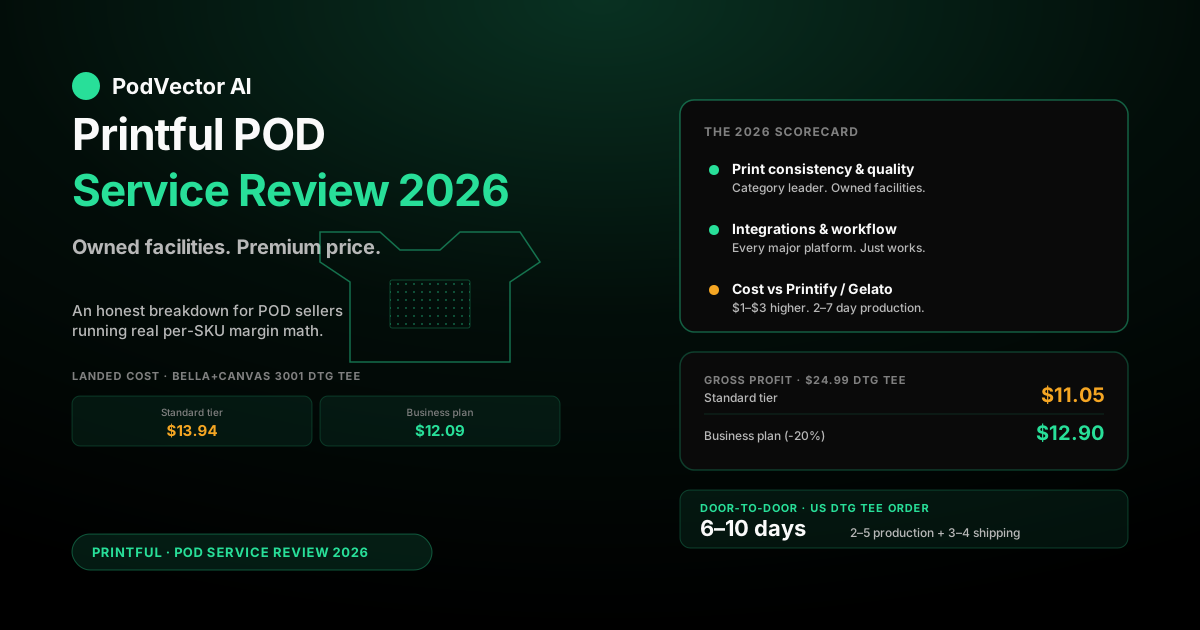
Quick Answer: Printful's print-on-demand service is the most reliable, highest-quality, best-branded operation in the category in 2026. Print is consistent across facilities, the catalog is broad, and the integrations don't break.
The catch is the price. According to reviewers at Capterra, pricing and shipping costs run higher than some alternatives — and production adds 2–7 days to every order on top of shipping.
Best fit: brand-led stores selling at a $30+ AOV with organic, email, or disciplined paid traffic. Worst fit: margin-first sellers running low-price tees on cold paid acquisition where every dollar of base cost matters.
The 2026 Verdict at a Glance
Printful in 2026 is the most polished print-on-demand service on the market. The catalog is broad, the print quality is at or above the top of the category on its core products, and the integrations with Shopify, Etsy, WooCommerce, Amazon, eBay, TikTok Shop, and the rest just work. The team has spent a decade smoothing the operator experience and it shows.
Where Printful loses points is cost and speed. According to Capterra user reviews published in 2026, base costs and shipping can be higher than competing POD services, making it harder to maintain strong profit margins — especially at lower retail price points. Production adds 2–7 days before shipping even starts. For a brand-led store at a healthy AOV that's a fair trade. For a low-priced listing on cold paid traffic, it's a margin trap.
The honest read for 2026 is this. If you're building a brand and the answer to "what does my store stand for?" is more than "I sell shirts," Printful is the right call. If you're testing dozens of designs at low retail prices, the math gets ugly fast and a cheaper supplier with a working partner network probably serves you better.
What Printful's Print-on-Demand Service Actually Is
Printful operates its own fulfillment facilities — not a network of third-party shops. The company runs in-house print and embroidery centers in the US (multiple states), Latvia, Spain, Mexico, Brazil, Canada, Australia, and Japan as of 2026. Your order is fulfilled by Printful staff on Printful machines.
That model is the core distinction from network-based POD platforms like Printify. With Printful, you don't choose a supplier — Printful routes the order to the closest facility with the item in stock. With Printify, you pick from multiple suppliers per product, each with different quality and turnaround.
As Merch Titans notes in their 2026 review, because Printful owns and operates its fulfillment centers rather than outsourcing to third-party printers, quality control is noticeably more consistent. Running owned facilities costs more than aggregating third-party shops — Printful absorbs that cost in higher base prices and recovers it through volume, retention, and the Growth membership upsell. Whether you'd pay that premium depends on what you're optimizing for.
From the seller side, the workflow is short. Connect a store, design a product in the mockup generator, push it to your storefront, and orders flow through automatically. When a customer buys, Printful charges your card for the base cost plus shipping, prints the item, ships it, and notifies the customer. You never touch inventory.
Print Quality Across Product Types
Quality varies by product category. Calling Printful "high quality" in aggregate is true but lazy. The honest read is product-by-product.
DTG (direct-to-garment) printing. This is the bulk of Printful's apparel business and where they're strongest. According to Merch Titans' 2026 review, Printful's DTG prints hold up better after multiple washes and their color accuracy is above average compared to competing POD services. DTG on dark fabrics is harder — there's a white underbase layer that can sometimes look slightly different from the digital mockup, especially on heathered or tri-blend fabrics.
All-over-print (AOP). Sublimation on polyester is consistent. Designs wrap correctly across seams on most garments. The catalog skews toward leggings, joggers, hoodies, and accessories — the natural sublimation categories. Quality is on par with the category leaders.
Embroidery. Best-in-class. Stitch density is high, color matching against thread codes is accurate, and the digitization team will email you about file issues before stitching rather than after. The full breakdown is in our Printful embroidery review.
Stickers, posters, prints. Solid, predictable, nothing exceptional. Color matches the mockup, paper stock is reasonable for the price, packaging protects the item in transit. Sticker print quality has improved noticeably since 2024.
Mugs, drinkware, accessories. Consistent. Sublimation on white mugs holds up to dishwasher cycles in most cases. Color mugs and specialty drinkware have more variability — worth ordering samples before launching a SKU.
Home and living (canvases, blankets, pillows, towels). Quality is good, costs are high. The category is profitable for brand-led stores but rarely for cold paid traffic. Our Printful company review walks through the broader product economics.
Catalog Breadth: What You Can Actually Sell
Printful's catalog spans hundreds of products across every major POD category. The breadth is broad enough that most stores can build a coherent product line without leaving the platform. The categories that actually move volume are:
- Apparel: t-shirts, long sleeves, hoodies, sweatshirts, tank tops, polo shirts, leggings, joggers, dresses, skirts, swimwear, baby and kids apparel
- Headwear: dad hats, snapbacks, trucker hats, beanies, knit beanies, bucket hats, visors
- Accessories: tote bags, weighted bags, drawstring bags, fanny packs, backpacks, scarves, socks
- Home and living: mugs, water bottles, posters, framed prints, canvases, blankets, throw pillows, beach towels, doormats
- Stickers, magnets, pins, keychains
- Embroidered items across hats, polos, outerwear, and bags
The catalog skews toward apparel and is strongest where embroidery and DTG are the primary decoration methods. Categories like phone cases, jewelry, and footwear are present but less mature — supplier quality varies more in these.
One catalog detail that matters: Printful drops or rotates SKUs more often than competitors. If a particular t-shirt model is core to your store, check whether Printful flags it as a "core" product (long-term commitment) or a standard catalog item (subject to discontinuation). Discontinued blanks are the most common cause of forced reformulations on POD stores.
Pricing and Fees: The Real Cost Picture
This is where most reviews wave their hands. Let's actually look at the cost structure.
The variables that move the number:
- Growth membership (replaces the old Business tier): Cuts product costs meaningfully and includes free embroidery digitization. According to Merch Titans' 2026 review, for sellers doing fewer than 50 orders per month the free plan is fine, but once you cross that threshold the Growth plan starts paying for itself through reduced base costs. Most sellers past their first few hundred orders per month consider it essential.
- Second print location: Adds a per-garment surcharge for back-of-shirt prints.
- All-over-print upcharge: AOP garments are sewn-after-print, so base prices are substantially higher than equivalent DTG SKUs.
- Embroidery surcharges: Stitch count over the standard threshold adds incremental cost per additional stitch block. Second embroidery locations add further cost.
- Shipping by region: US domestic shipping on tees runs a few dollars per first item. EU shipping from Latvia or Spain is comparable. Asia-Pacific from Japan adds transit days for most destinations.
The headline principle: anchor on base price plus shipping plus your platform fees plus your ad spend. It's the surcharges and second-location fees that quietly stack on top of the listed base price. Visit Printful's pricing page directly for current figures, as rates update periodically.
Our Printful Business plan review walks through whether the membership pays back at your sales volume. And if you're trying to understand how pricing decisions ripple into your net margin, see our guide on net profit margin benchmarks for POD stores.
Fulfillment and Turnaround
Production runs 2–5 business days on standard DTG, 3–6 days on embroidery, and 4–7 days on all-over-print. The slower categories are the sewn-after-print ones — those genuinely take more steps to make. According to Style Factory Productions, whose Printful review was updated in August 2026 with the latest shipping times and rates, current production and shipping windows remain in this range.
Shipping is layered on top. US domestic from a US facility is 3–4 business days. EU within EU is 4–6 days. Cross-region shipping (US-to-EU, EU-to-US) is 7–14 days and rarely the right call when Printful has a closer facility — usually it does.
Total door-to-door on a typical US DTG t-shirt order is 6–10 days. That's the number to put on your product page, with a buffer. Promising fewer days is how you generate refund requests.
Where fulfillment gets unpredictable: seasonal demand spikes (Q4, back-to-school) and specific high-volume launches. Printful's queue can stretch production during November and December. If you're running a paid-traffic launch in Q4, build that into your customer comms.
Stock-out routing is one of the operational details that separates Printful from a one-facility network. If a t-shirt size is out of stock at the closest facility, Printful auto-reroutes to the next-closest. The customer rarely notices. The downside is that the order may ship from farther away, adding a day or two of transit.
Integrations and Workflow
This is where Printful quietly dominates. According to EComposer's 2026 review, Printful has over 2,200 reviews and is one of the highest-rated POD apps on Shopify, with merchants highlighting seamless integration, easy product syncing, and automatic order processing. The integration list covers every channel a POD store actually uses:
- Ecommerce platforms: Shopify, WooCommerce, BigCommerce, Wix, Squarespace, Webflow, Magento
- Marketplaces: Etsy, eBay, Amazon, TikTok Shop, Walmart Marketplace, Wish
- Storefronts and tools: Storenvy, Ecwid, Square, Gumroad, BigCartel
- API access for custom integrations and headless setups
What "the integration works" means in practice: orders sync automatically without manual intervention, tracking updates flow back to your storefront, refunds and reprints can be handled inside Printful without round-tripping to support. The bar is low for what counts as an integration in POD; Printful clears it.
One feature worth flagging: the mockup generator. Printful's is the most polished in the category. The mockup library includes lifestyle photos (real people wearing the garment) for most apparel items, which dramatically improves listing conversion versus flat product photos.
The downside of the integration story is the same as for any POD platform: when your order volume gets large, the Shopify-Printful sync becomes a bottleneck during major sale events. The integration is reliable for hundreds of orders a day. At thousands per day, race conditions and timing issues become things you have to manage.
Pros and Cons
Pros
- Best print consistency across regions and across orders in the POD category
- Owned facilities (not third-party network) means no supplier audit needed
- Wide catalog spanning apparel, headwear, accessories, home and living
- Embroidery is best-in-class with digitization QA
- Integrations work across all major platforms and marketplaces
- Mockup generator with real lifestyle photos for most apparel
- Auto-routing across global facilities reduces shipping time and cost
- Customer service is professional and English-fluent
- Copyright and trademark infringement checks on uploaded designs (automated + manual review team)
Cons
- Base costs are higher than Printify on equivalent SKUs (according to Capterra 2026 reviews)
- Meaningfully higher than Gelato on EU orders
- Production adds 2–7 days to every order
- Support response times can stretch to 24+ hours
- Catalog discontinuations require occasional product reformulations
- Margin is tight on lower retail price points
- AOP and home/living base costs are high enough to be hard to scale on paid traffic
Who Printful's Service Is Best For
Printful makes the most sense when the brand is part of the product, not just the design.
Strong fit. Brand-led stores selling at a healthy AOV with margin to spare. Creator brands where the audience is buying the creator's identity, not the cheapest tee. Agencies producing branded merch for clients (consistency across orders matters here). Lifestyle and outdoor apparel where quality is the differentiator. Stores running disciplined paid traffic with strong creative and a real LTV story.
Mixed fit. Stores in the mid-range retail price band with paid acquisition. The math works if your CAC is low and your repeat rate is decent. It breaks down quickly if CAC creeps higher or if first-order margin is your only profit. If managing AOV is a lever you haven't pulled yet, see our guide on increasing AOV with AI.
Weak fit. Margin-first sellers running low-price tees on cold paid acquisition. POD sellers testing large numbers of designs at low retail price. International EU-only stores (Gelato's EU-local fulfillment is genuinely cheaper).
Bad fit. Anyone explicitly competing on price as the value prop. Printful isn't the cheap supplier and trying to make it one drains margin.
If you're undecided between Printful and Printify, our Printify vs Printful for Etsy comparison walks through the marketplace-specific math, and the Printify vs Printful prices comparison breaks down per-SKU costs across both.
Alternatives Worth Comparing
Printify. Network-based instead of in-house. Lower base costs on average, much wider supplier choice, and a more flexible pricing tier (the free plan is genuinely usable for testing). The trade-off is quality variability — finding a great Printify partner and sticking to them takes some auditing work, but once you do, costs are typically lower than Printful's (according to Capterra reviewers who've used both).
Gelato. Local-fulfillment network with the strongest EU coverage. If your store skews EU or APAC, Gelato's local printing usually beats Printful on both cost and shipping time. US catalog is smaller and less polished.
Gooten. B2B-focused. Strong on home and living categories. Quality is good, but the operator experience is less polished and integrations are narrower. Best for stores with custom workflows.
CustomCat. Strong on embroidery and select apparel. Cost-competitive on hats specifically. Catalog beyond apparel is thinner.
Sellvia / AliDropship. Different model — closer to dropshipping with print-on-demand layered in. Lower price points but different unit economics. For a working operator's overview of how the comparison shakes out, the AliDropship Printful review covers it from a competitor's lens.
None of these beat Printful on consistency or polish. Several beat Printful on cost if you're willing to manage the supplier-quality work yourself.
The Question Most Reviews Skip: Is Printful Actually Profitable for Your Store?
Every Printful review on the internet answers the same surface question: "Is Printful's print quality good?" Yes. That question is settled.
The question that actually decides whether Printful is the right call for your business is different. It's "After base cost, second-location surcharges, shipping, ad spend, platform fees, refunds, and the time you spend on product reformulations when a SKU gets discontinued — is the per-order net margin on my Printful SKUs actually higher than what Printify or Gelato would deliver for me?"
That question has no generic answer. Two stores selling identical Printful-printed dad hats can have completely different net margins because of ad efficiency, return rates, design rework cycles, region mix, and which size-color combos actually sell. The seller paying a high cost-per-acquisition on a mid-price hat is breaking even. The seller next door at a low cost-per-acquisition on the same hat is running healthy margins. Understanding what's "healthy" starts with knowing your benchmark — see our net profit margin benchmark for POD stores.
POD stores almost never see this clearly. Shopify shows revenue. Printful shows COGS at the order level — but not the surcharge split, the region-routed shipping variance, or the per-SKU margin trend over time. Meta and Google ads sit in another tab. Etsy fees are on a separate dashboard. By the time you reconcile across four screens, the data is a week stale and the next product launch is already in flight.
That gap is the reason "is Printful worth it?" gets answered with vibes instead of math. Operators feel like they're profitable, the bank balance moves up, and the question of whether Printful's premium pricing is actually being recovered by the brand premium your customers are paying — never gets answered with real numbers.
This is the problem an AI employee can finally solve. Victor reads your live Shopify, Meta Ads, Google Ads, Printful, and Printify data into one warehouse. Ask plain-English questions like "what's my actual net margin on Printful dad hats vs Printify dad hats over the last 90 days, after every fee and ad cost?" Get a number. Make the decision. For further context on the profitability levers that matter most, explore our guides on increasing AOV and repeat purchases and average checkout completion rate benchmarks.
Browse all our Printful reviews on the Printful reviews hub, or see the full coverage on the supplier at the Printful topic page.
FAQs
Is Printful's print-on-demand service worth it in 2026?
For brand-led stores selling at a strong AOV with disciplined paid traffic, organic, or email channels, yes. Print consistency, integrations, and embroidery quality justify the cost premium. For margin-first sellers running low-price tees on cold paid acquisition, Printify or Gelato will typically deliver better unit economics.
How much does Printful's print-on-demand service cost?
Base costs vary by product and update periodically — check Printful's pricing page for current figures. The Growth membership cuts costs meaningfully and includes free embroidery digitization. Most sellers past their first few hundred monthly orders find it essential.
How long does Printful take to ship?
Production is 2–5 business days for DTG, 3–6 for embroidery, 4–7 for all-over-print. US domestic shipping adds 3–4 days. EU within EU is 4–6 days. Total door-to-door on a US DTG t-shirt order is 6–10 days. Plan customer expectations accordingly.
Is Printify cheaper than Printful?
On most SKUs, yes. According to Capterra 2026 reviewers who have used both platforms, Printful's base costs run higher than some alternatives. The trade-off is that Printify is a network of third-party suppliers with variable quality, so getting consistent Printify quality requires auditing and committing to specific partners. Printful's price premium covers in-house operations and consistency.
Does Printful have a free plan?
Yes. The default Printful plan is free — you pay only for the products you sell. The Growth membership is a paid add-on that unlocks volume discounts and additional features. According to Merch Titans' 2026 review, for sellers doing fewer than 50 orders per month the free plan is fine; once you scale past that, the paid plan starts paying for itself. You don't need the paid plan to start.
What products does Printful offer in 2026?
Printful offers hundreds of products across apparel (tees, hoodies, polos, leggings), headwear (hats, beanies, bucket hats), embroidered items, all-over-print apparel, bags and accessories, home and living (mugs, posters, canvases, blankets, pillows), stickers, pins, and keychains. Apparel and embroidery are the strongest categories.
Can I use Printful with Etsy?
Yes. The Etsy integration is one of Printful's most-used. Orders sync automatically, tracking flows back to Etsy, and refunds can be processed inside Printful. Etsy's marketplace economics are different from a standalone Shopify store — the comparison is worth reading before committing.
Is Printful's quality consistent across facilities?
Yes, more so than any network-based POD competitor. Because Printful operates its own facilities with the same equipment, training, and QC standards, an order printed in Latvia is functionally identical to one printed in the US or Brazil. This is the single biggest reason brand-led stores pay the premium.
Does Printful check designs for copyright issues?
Yes. According to Style Factory Productions' 2026 review, when you upload a design file Printful uses automated technology to check for potential copyright and trademark infringement. If issues are detected, the design is rejected. Printful also has a legal and compliance team that reviews potentially infringing designs. Make sure you have the rights to every asset you upload.
What's the catch with Printful?
Cost and speed. According to Capterra 2026 reviews, base prices run higher than some competing POD services. Production adds 2–7 days. Support response times can stretch. None of these are deal-breakers for the right store, but they're real trade-offs, not marketing fluff.
Print quality is the easy part to evaluate. Whether Printful's premium pricing is actually being recovered by your brand premium is the hard part.
Shopify shows revenue. Printful shows COGS but not the per-SKU surcharge split. Meta sits in another tab. Etsy fees in yet another. By the time you reconcile, the next product launch is already running.
Victor is the AI employee that reads your live Shopify, Meta Ads, Google Ads, Printful, and Printify data and gives you the truth about your store — per-SKU margin, Printful-vs-Printify ROI, the leaks costing you money — all from one place.
Try Victor free