
Quick Answer: Printify wins the sticker fight. A Bella+Canvas 3001 tee is $8.95 on Printify Premium versus $9.50 on Printful Growth — and the gap stretches to $4–7 on hoodies, joggers, and heavyweight fleece.
But the per-SKU answer flips once you add shipping, branded labels, sample fees, and the reprint cost on defects. Printify's lower sticker hides Printful's tighter quality control on garment-heavy stores.
Below: every cost line in plain numbers, the subscription break-even math, and the merger context most pricing guides leave out.
Why "Printify is cheaper" isn't the whole answer
Open any "Printify vs Printful pricing" roundup and the headline is the same. Printify's base prices are lower, often by 30–40%. That part is true on the catalog page.
It's also incomplete. POD margins live or die on four lines, not one.
Base product cost. Shipping. Subscription discount. Per-order extras — branded inserts, inside-collar labels, sample fees, and the reprint cost on quality complaints. Skip any of those and your real cost per order is off by $1–4.
This guide walks each line. We'll end with the actual question — which one is cheaper for your specific catalog and order mix, not in the abstract.
Base product cost: Printify wins the line item
For most garment SKUs, Printify is cheaper at the base price. The gap is wider than the marketing screenshots suggest once you include both subscription discounts.
Here are the US-fulfilled prices on the SKUs POD operators actually sell, comparing each platform's paid plan tier (Printful Growth at $24.99/mo, Printify Premium at $29/mo or $24.99/mo annually).
| SKU | Printful Growth | Printify Premium | Printify advantage |
|---|---|---|---|
| Bella+Canvas 3001 unisex tee | $9.50 | $8.95 | $0.55 |
| Gildan 64000 softstyle tee | $8.47 | $4.97 | $3.50 |
| Gildan 18500 heavy blend hoodie | $21.50 | $17.99 | $3.51 |
| Bella+Canvas 3739 sponge fleece hoodie | $30.95 | $25.49 | $5.46 |
| Gildan 18000 crewneck sweatshirt | $20.95 | $15.49 | $5.46 |
| 11oz ceramic mug | $6.50 | $4.39 | $2.11 |
| Premium matte poster, 18×24 | $13.75 | $9.99 | $3.76 |
A few things stand out. The gap is small on Bella+Canvas tees — Printful runs its own DTG floors on that SKU, so its cost structure is competitive there. The gap blows out on Gildan basics and heavyweight fleece, where Printify routes to lower-cost third-party providers.
The mug, poster, and hard-good categories are where Printify is structurally cheaper. If your catalog skews accessories or wall art, this is where you'll see it most.
Subscription tiers: Premium vs Growth, side by side
Both platforms gate their best pricing behind a paid plan. The mechanics are different.
Printful Growth is $24.99/month and delivers up to 33% off, but the discount is variable by product. Tees get less; mugs, hats, and bags get more. Printful also gives free Growth renewal for sellers doing $12K+ in annual sales — useful if you're already at scale.
Printify Premium is $29/month (or $24.99/month billed annually) for a flat 20% discount on all products from Printify-vetted providers. Simpler math, smaller percentage, but it applies evenly across the catalog.
| Plan feature | Printful Growth | Printify Premium |
|---|---|---|
| Monthly price | $24.99 | $29 (or $24.99 annual) |
| Discount | Up to 33%, variable | 20% flat |
| Applies to | All Printful-fulfilled SKUs | Printify catalog (provider must opt in) |
| Free at scale | Yes, at $12K+ annual sales | No |
| Stores allowed | Unlimited | 10 stores |
The free tier still exists on both. If you're under 10 sales a month, the math says stay on the free plan and pocket the $25.
Break-even math: when each plan starts paying you back
The subscription only earns its keep if you sell enough units to cover the monthly fee in saved cost.
Take a Bella+Canvas 3001 tee. Printful Free is $12.95; Growth drops it to $9.50. That's $3.45 saved per tee. To clear the $24.99 plan fee, you need ~8 tees per month.
On Printify, the free Bella+Canvas 3001 is $10.95 and Premium drops it to $8.95. That's $2.00 saved per tee. To clear $29 (monthly billing), you need ~15 tees per month. On the $24.99 annual plan, ~13 tees.
Hoodie math is faster — bigger absolute discount per unit. Printful Growth saves ~$7.45 on the Gildan 18500 hoodie (break-even: ~4 hoodies/month). Printify Premium saves ~$4.50 (break-even: ~6 hoodies/month annual, ~7 monthly).
The point is simple. If you're under 10 orders a month, both subscriptions are negative ROI. If you're over 30, both pay off easily. The middle ground — 10–25 orders per month — depends entirely on your SKU mix, which we'll come back to.
Shipping cost: the line every guide downplays
Shipping is where many "Printify is cheaper" comparisons quietly become wrong.
Printful's shipping is bundled and predictable. US-to-US on a single tee: ~$4.69. Add a second tee in the same order: ~$1.30. The flat-rate structure rewards multi-item carts.
Printify shipping varies by provider. Monster Digital, SwiftPOD, and OPT (Owner Print Technology) each have their own rate cards. A single tee runs ~$4.99–$5.49 depending on the provider you've configured. Second-item rates are higher than Printful's on most providers — typically $2.00–$2.50.
| Cart | Printful (US) | Printify (US, median provider) |
|---|---|---|
| 1 tee | $4.69 | $5.19 |
| 2 tees | $5.99 | $7.49 |
| 1 hoodie | $7.49 | $8.29 |
| 1 mug | $6.99 | $5.99 |
| International tee (EU) | $5.69 (EU fulfillment) | $6.49–$11.99 (varies) |
The international gap is the big one. Printful runs its own facilities in Latvia, Spain, the UK, and Mexico. Printify routes international orders through whichever provider you've selected — if that's a US-only provider, your buyer pays international air rates.
If your store runs free shipping built into the product price, this is your cost, not your buyer's. A two-tee EU order can swing $4–6 in Printful's favor before you've even looked at base cost.
Branding fees: where Printful claws margin back
Branding is the second line where Printful's pricing tells a different story than its base costs.
Inside-collar labels are $2.49 on Printful and $2.50 on Printify (provider-specific — not every Printify provider offers them). Both are about the same on a single line item.
The divergence is in the rest of the pack.
| Branding option | Printful | Printify |
|---|---|---|
| Inside-collar label (printed) | $2.49 / item | $2.50 / item (provider-dependent) |
| Embroidered neck label | $3.95 / item | Not available |
| Custom packing slip | Free | Free (limited providers) |
| Branded pack-in card | $0.50 / item | Not native |
| Custom outside sticker | $0.50 / item | Not native |
| Branded poly mailer | $1.95 / order (US) | Not available |
If you're building a brand with an unboxing moment, Printful's branding stack is materially cheaper than rolling it yourself on Printify — because on Printify, half of those options don't exist. You either skip them or you accept your fulfillment looks generic.
For a Stage 4 POD business where margin is the only number, this might not matter. For a Stage 6 business chasing repeat purchase rate, the per-order branding gap can be worth the $1–2 sticker premium.
Defects, reprints, and the cost nobody quotes
Neither platform shows this in their pricing comparison, but it's the line that most operators feel by month four.
Printful runs its own facilities. Defect rates are tight — generally reported between 1.5–3% across DTG and embroidery. Reprints are at Printful's expense if the issue is on their end.
Printify is a marketplace. Quality varies by the provider you've configured. Top providers (Monster Digital, SwiftPOD, Drive Fulfillment) hold defect rates in the 2–4% range. Less-vetted providers can run 5–8% on garment-heavy SKUs, especially during Q4 surge.
On Printify, reprints depend on the provider's policy. Some cover defects at their cost. Some only cover obvious print errors, not garment defects.
The math: at a 3% defect rate with a $9 average cost per unit, you absorb $0.27 per order in expected reprint cost. At 6%, that's $0.54. On 500 orders/month, the difference is $135 in your pocket or out of it.
This is the cost line that gets ignored in every "Printify vs Printful pricing" comparison and the one that changes the actual ranking once you've been running long enough to see it.
All-in landed cost per SKU: the calculation that matters
Stack the lines together and compare on one product. Here's a Bella+Canvas 3001 tee, US-fulfilled, both platforms on their paid plans, with all-in cost.
| Cost line | Printful Growth | Printify Premium |
|---|---|---|
| Base product cost | $9.50 | $8.95 |
| Shipping (US, 1 tee) | $4.69 | $5.19 |
| Inside-collar label | $2.49 | $2.50 |
| Pack-in marketing card | $0.50 | — |
| Plan amortized (at 50 orders/mo) | $0.50 | $0.50 (annual) |
| Expected reprint at 3% / 5% | $0.29 | $0.48 |
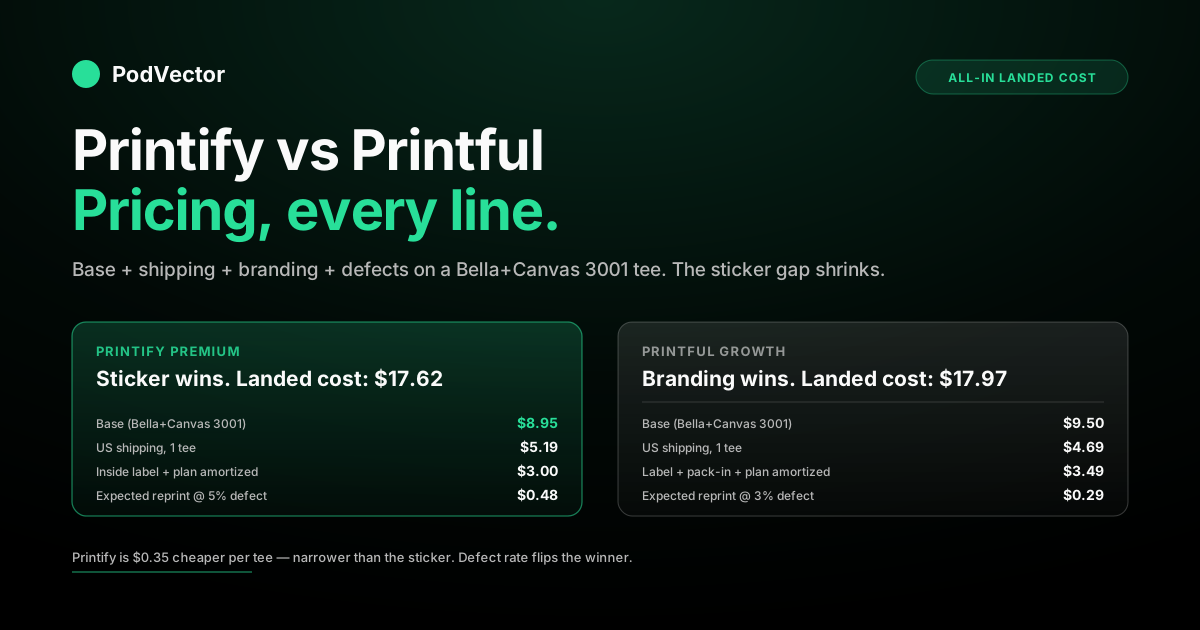
| Landed cost per tee | $17.97 | $17.62 |
Printify is $0.35 cheaper per tee — much narrower than the $0.55 sticker gap implied. And we're assuming a 5% provider defect rate, which is mid-pack for Printify's roster.
Drop Printify's provider defect rate to 3% and the gap widens to $0.54. Push it to 7% and Printful actually edges ahead. The pricing winner on a single SKU comes down to which provider you've routed to.
For a deeper line-by-line breakdown on Printful specifically, we've broken out every cost factor in our Printful cost per shirt breakdown and the Printful DTG t-shirt base cost breakdown.
When Printify is genuinely cheaper (and when it isn't)
Three scenarios where Printify wins on real all-in cost:
1. Hard-goods catalog. Mugs, tumblers, posters, canvases, phone cases. Printify's gap is widest here — $2–5 per unit — and defect risk on hard goods is lower than on garments. The math is straightforward.
2. Low-volume garment stores at 10–25 orders/month. The Premium plan break-even is reachable; the lower base cost compounds; defects haven't yet shown up at a volume that hurts. New stores in their first three months almost always win on Printify.
3. High-volume single-provider stores. If you've routed 80% of your volume to one vetted Printify provider and locked in a 3% defect rate, the lower base cost wins by 8–15% net margin against Printful.
Three scenarios where Printful is cheaper or even:
1. International-heavy stores. Once 30%+ of your orders are EU, UK, or AU, Printful's regional fulfillment beats Printify's "ship internationally from US" default. The shipping line alone closes the base-cost gap.
2. Branded-fulfillment stores. If your unboxing includes a label, pack-in card, and branded mailer, Printful's branding stack is materially cheaper than approximating it on Printify. The branding lines add up.
3. Garment-heavy stores past 500 orders/month. Defects compound. A 1.5-point defect-rate difference at 1,000 orders/month is $135–250/month in absorbed reprint cost. The base savings start to wash out.
For the broader pros-and-cons picture beyond pricing, the cluster covers it in Printify vs Printful pros and cons and the condensed pros/cons comparison. For a wider quality-and-features view, see our Printify vs Printful pricing, quality, and features rundown.
The merger: what changes for pricing in 2026
In late 2025, Printful and Printify announced an equal-partner merger combining Printful's in-house production with Printify's marketplace network.
As of May 2026, the platforms still operate independently. Separate catalogs. Separate pricing. Separate accounts. Existing integrations, plan structures, and per-SKU costs are unchanged.
What's likely to change post-integration: provider-mix routing inside a single dashboard, unified branding APIs, and consolidated subscription tiers. None of it is live yet.
What's not changing: the underlying cost structure. Printful's own facilities run at one cost profile; third-party Printify providers run at another. A merger doesn't change unit economics on either floor. Plan your store today against the prices that exist today.
For more on how each platform's broader cluster of comparisons stack up, see our Printful comparison hub.
The pricing answer your store data already holds
Here's the thing every pricing guide skips. The "cheaper" answer isn't general — it's specific to your SKU mix, your order geography, your branding choices, and your provider defect rate.
If you have a Shopify store running, the data to answer it precisely is already in your account. Order line items show your SKU mix. Shipping zone reports show your geography. Refund and chargeback notes show your defect signal.
The work is pulling it all into one view and running the supplier math against the SKUs you actually sell — not a generic "Gildan tee" benchmark from a roundup.
That's what PodVector AI's Victor is built for. Victor connects to your Shopify, ingests every order into a live data warehouse, and runs your real catalog through both supplier cost models. He'll tell you which SKUs are cheaper on Printify, which are cheaper on Printful once shipping and defects are loaded in, and where switching providers on a given product would move your margin. Then he proposes the price or collection change on Shopify and executes it when you approve.
The combo is the point: POD-specific cost knowledge, live data from your actual store, and the ability to act on it. None of the comparison guides above run the math against your data — they can't.
FAQs
Is Printify always cheaper than Printful?
On base product cost, almost always — Printify wins on 80%+ of SKUs at sticker. But once shipping, branding, and defect cost are loaded in, the gap narrows and on some SKUs Printful is genuinely cheaper, especially international orders and branded-fulfillment stores.
Which subscription is better value — Printful Growth or Printify Premium?
Growth ($24.99/mo, up to 33% off) is the better deal on Printful-fulfilled garments. Premium ($24.99/mo annual, 20% flat) is the better deal on Printify's broader hard-goods catalog. If you sell heavily across both garment and hard-good categories, you may be running both subscriptions.
What's the break-even for the Printify Premium plan?
Roughly 13 tees or 6 hoodies per month at annual billing. At monthly billing ($29), it's ~15 tees or ~7 hoodies. Anything below that and the free plan is better math.
Does the merger affect pricing today?
No. Printful and Printify still operate as separate platforms with independent pricing, catalogs, and subscriptions. The merger was announced in late 2025; operational integration is ongoing but unit pricing hasn't moved.
Can I split SKUs between Printful and Printify in one Shopify store?
Yes. Many POD stores route garments to Printful (defect rate, branding) and hard goods like mugs and posters to Printify (base cost). Each integration installs its own app on Shopify; the routing happens at the product level.
Does Printify have hidden fees the comparison tables miss?
The two that show up later: provider-specific shipping rate cards (international can run 2–3x the US base) and inconsistent reprint policy across providers. Both are knowable at setup but rarely surfaced in initial cost comparisons.
Where can I see the rest of the Printful comparisons?
The Printful topic hub indexes every comparison in this cluster, from cost breakdowns to integration and quality reviews. For a third-party take, Merch Titans' Printful vs Printify comparison runs the Gildan 64000 numbers with similar conclusions.
Run the pricing math on your own catalog, not a generic Gildan tee
Every "Printify vs Printful" guide compares the same demo SKU. Your store isn't a demo SKU. Victor connects to your Shopify, loads your actual SKU mix and shipping zones into a live data warehouse, and runs both supplier cost models against your real orders — then proposes the price or routing change and executes it on your approval. And see which platform is cheaper for your POD store.
Try Victor free