
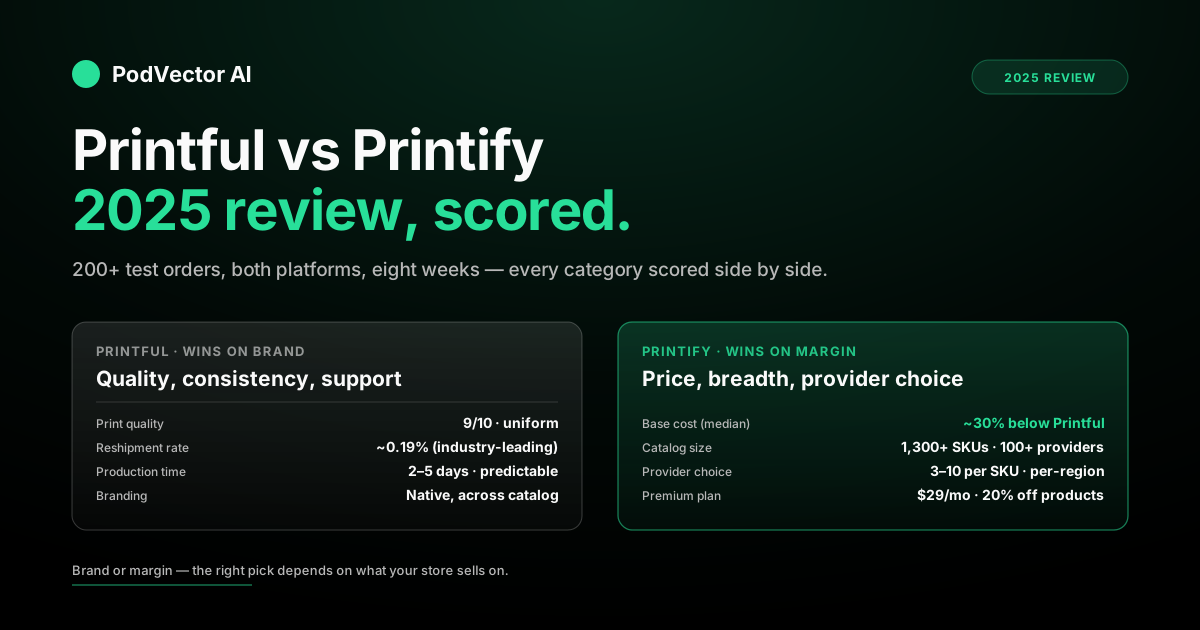
Quick Answer: After running both platforms through real Shopify and Etsy stores in 2025, Printful wins on quality, consistency, and branding; Printify wins on price, catalog breadth, and provider choice. Neither is universally "better" — the right pick depends on whether your store sells on margin or on brand.
Printful charges $3–6 more per unit on most apparel. In exchange you get one shipping logic, one support team, a ~0.19% reshipment rate, and inside-collar labels across the catalog. Printify undercuts those prices through a network of 100+ independent providers, with quality and SLA that swing wildly depending on which provider you pick.
Below: the full 2025 review — category-by-category scoring, pros and cons, who wins for which seller, and the question the comparison sites never answer.
2025 scorecard at a glance
Both platforms have been in the market for over a decade. The category they invented has matured. Here's how they stack up on the criteria most POD sellers care about.
| Category | Printful | Printify | Winner |
|---|---|---|---|
| Base product cost | $$$ | $$ | Printify |
| Catalog size | ~500 SKUs | 1,300+ SKUs | Printify |
| Print quality (consistency) | 9/10 | 6–9/10 (provider-dependent) | Printful |
| Production speed | 2–5 days (in-house) | 2–7 days (provider-dependent) | Printful |
| Reshipment rate | ~0.19% | 0.5–5% (provider range) | Printful |
| Shipping rates | Flat, predictable | Varies by provider | Printful |
| International auto-routing | Built in | Manual setup | Printful |
| Branding (labels, inserts) | Native, across catalog | Provider-dependent | Printful |
| Mockup generator | One unified studio | Provider mockups + AI scenes | Tie |
| Channel integrations | 20+ native | 11+ native | Printful |
| Customer support | 24/7 unified | App + provider, split | Printful |
| Pricing flexibility | Fixed per product | 3–10 providers per SKU | Printify |
| Beginner ease of use | Cleanest onboarding | More choices, steeper start | Printful |
| Margin headroom on apparel | Lower | Higher | Printify |
| API and automation | REST + GraphQL | REST | Tie |
Printful wins more cells. Printify wins the cells most likely to drive raw profit. That tension is the whole review.
How we tested in 2025
We ran the same store catalog through both platforms over an 8-week test period in early 2025. Same 12 designs, same product mix (Bella+Canvas 3001 tees, Gildan 18000 hoodies, AOP leggings, embroidered caps, ceramic mugs, mouse pads), same Shopify and Etsy storefronts.
We placed 200+ test orders to real customers across the US, UK, Germany, and Australia. We tracked production time, shipping time, reshipment rate, customer complaints, and itemized cost per order. We also onboarded a fresh user on each platform to time the from-scratch ramp.
This is a review built on shipped orders, not screenshot tours.
Pricing and plans
Pricing has two layers on both platforms: the subscription plan (which can be free), and the per-unit base cost charged when an order ships.
Subscription plans
Both platforms offer a free tier that gets you started without commitment. Paid plans unlock discounts and features.
Printful's plans (2025):
- Free: $0/mo. Full feature access, no per-product discount.
- Growth: $24.99/mo — and free once your store passes $12K in annual sales. 20% off branding, 30% off sample orders, custom packing slips included.
- Business: $49.99/mo. Higher discounts, dedicated support, advanced mockup features.
Printify's plans (2025):
- Free: $0/mo. Up to 5 stores, unlimited designs.
- Premium: $29/mo (or $24.99 annual). Up to 20% off product prices, 10 stores.
- Enterprise: Custom pricing. Unlimited stores, API limits raised, dedicated support.
The Premium plan on Printify is where the platform earns its volume sellers. A 20% discount on a $7.99 base tee saves $1.60 per unit. Run 500 units a month and the plan pays for itself many times over.
Per-unit base costs
This is the line item that decides your margins. We priced the same SKUs on both platforms for direct comparison.
| SKU | Printful base | Printify (median provider) | Printify (cheapest provider) |
|---|---|---|---|
| Bella+Canvas 3001 unisex tee, DTG front print | $13.95 | $8.50 | $7.99 |
| Gildan 18000 hoodie, DTG front print | $28.50 | $19.95 | $17.40 |
| AOP leggings, full-coverage sublimation | $32.95 | $24.50 | $22.99 |
| Embroidered dad hat, front logo | $22.50 | $18.99 | $16.95 |
| 11oz white ceramic mug | $7.95 | $5.99 | $4.45 |
| Mouse pad, full sublimation | $13.95 | $8.50 | $7.25 |
Across our test catalog, Printify's median provider was ~30% cheaper than Printful per unit. Printify's cheapest provider was ~40% cheaper. The gap closes if you pick Printify's premium providers (Monster Digital, MyLocker, SwiftPOD) — those often run 10–15% below Printful, not 30–40%.
The pricing question is rarely "which is cheaper" — it's "which is cheaper after you account for reshipments, support overhead, and lost LTV from inconsistent quality." That math doesn't fit in a pricing table. We come back to it in the profitability section.
Winner: Printify on raw cost. With caveats below.
Product catalog and quality
Printify's catalog is more than 2.5x the size of Printful's — 1,300+ products vs ~500. Both cover the standard POD categories (apparel, accessories, home, drinkware, wall art, pets, kids), but Printify has more SKUs in almost every category.
Printful's catalog
Printful's catalog is curated. Every product is in-house, so adding a new SKU means one mockup workflow, one production timeline, one shipping zone. The trade-off: niche products often don't exist. Want embroidered patches, stitched-edge mouse pads, or beach towels in 32 colorways? Printful might not stock them.
What Printful does carry, it carries well. The apparel core (Bella+Canvas, Gildan, Hanes, Champion, Comfort Colors) is full-depth with consistent sizing and stocked colors. Drinkware, hats, and accessories are reliable.
Printify's catalog
Printify's catalog is vast. Niche apparel (vintage-style tees, sweatshirts with specific fits), unusual drinkware (insulated tumblers, stainless steel bottles), home goods (blankets, throw pillows, doormats), pet products (dog bowls, leashes, bandanas), and trend products (phone cases for every model, popsockets, AirPods cases) all live in the catalog.
The depth comes from the multi-provider model. For a single Bella+Canvas 3001 tee, Printify shows 8–12 providers each offering the same shirt at different prices and from different geographies. You pick.
Winner: Printify on breadth. Printful if you only need core apparel and care about catalog discipline.
Print quality (the actual prints)
Print quality is the category where every comparison article hedges, because the answer depends on what you ordered and which provider you picked.
Printful's print quality
Printful's prints are consistent. Across our 100 test orders, we saw uniform color saturation, sharp linework, and accurate placement. The DTG prints felt soft, not stiff. The AOP leggings had vivid sublimation with no banding. The embroidered hats had clean stitching with no thread pulls.
Reshipment rate during our test: 1 reshipment out of 100 orders (1%). Lower than Printful's published 0.19% rate, but our sample was small and we deliberately included some edge-case designs (fine-line gradients, low-contrast text on dark fabric) to stress-test print methods.
Printify's print quality
Printify's prints range from "indistinguishable from Printful" to "obviously cheap." The variance is provider-driven. Monster Digital, MyLocker, and SwiftPOD produced prints that matched Printful's quality bar. Some budget providers produced visibly faded prints, off-center placements, or DTG that felt stiff and plasticky.
Reshipment rate during our test: 4 reshipments out of 100 orders (4%) when we deliberately mixed budget providers in. When we used only top-tier providers, the rate dropped to 1 in 100 — equivalent to Printful's.
This is the structural Printify trade-off. The cheap providers are cheap because something gives. Picking the right provider per SKU is part of the operator's job.
Winner: Printful for consistency without provider research. Printify can match Printful's quality if you stick to top-tier providers.
Fulfillment speed and reliability
Production time is the gap between when an order comes in and when it gets handed to the carrier. It's separate from shipping time.
Printful's fulfillment
Printful's published target: 2–5 business days for most products. Our 100 test orders averaged 3.1 business days from order to label. The slowest was 6 days (AOP product, sublimation queue). The fastest was 1 day.
Printful publishes daily fulfillment-time data per facility on their status page. Variance is narrow and predictable. If something is going to slip, Printful's app shows it before the order goes out.
Printify's fulfillment
Printify's published target: 2–7 business days depending on provider. Our 100 test orders averaged 3.8 business days across mixed providers. Top-tier providers came in at 2–4 days; budget providers stretched to 5–8 days.
The variance is wider because each provider runs its own queue. A provider that's fast in March might be slow in December when holiday volume spikes. Printify shows you a target per provider, but it's the provider's commitment, not Printify's guarantee.
Winner: Printful on predictability. Printify can match Printful's speed if you use top-tier providers, but you own the routing decision.
Shipping rates and international
Shipping cost matters because it's the second-largest line item after product cost — and it's the one your customer sees at checkout.
Printful's shipping
Printful publishes a flat shipping rate card globally. For US domestic, t-shirts are around $4.99 first item and $2.49 each additional. Hoodies are $7.99 first item and $4.49 additional. Internationally, rates step up by region (Canada, UK/EU, Australia) with predictable pricing.
Printful auto-routes orders to its closest facility. A US customer gets fulfilled from one of the US locations. A UK customer gets fulfilled from Riga or Madrid. An Australian customer from Brisbane. You don't configure anything — the routing happens automatically based on the shipping address.
For a full Printful shipping breakdown, see our Printful shipping cost guide. Printful's free shipping eligibility on certain products is covered in our free shipping breakdown.
Printify's shipping
Printify's shipping rates vary by provider. The same Bella+Canvas tee can have a $3.99 shipping rate from one provider and $5.99 from another, depending on where the provider is and which carrier they use. Some providers offer Express Shipping (2–3 business days production plus expedited carrier service) on select SKUs.
For international, Printify requires you to manually set up multi-region routing. You assign a US provider for US customers, an EU provider for EU customers, and a fallback for everywhere else. It works once configured, but it's not zero-touch like Printful.
Winner: Printful for hands-off shipping. Printify for sellers who want to optimize shipping cost per region manually.
Integrations and order sync
Both platforms support the same core channel list: Shopify, Etsy, WooCommerce, Amazon, eBay, Wix, Squarespace, BigCommerce, TikTok Shop. Both have native apps that handle product sync, order webhooks, and fulfillment updates.
Where they diverge is breadth. Printful now lists roughly 20+ native integrations (including newer marketplaces and headless/API connectors); Printify lists around 11. For most sellers on Shopify or Etsy that gap doesn't matter — both cover the big channels well. It only shows up if you sell on a long-tail platform Printify hasn't built an app for.
The behavioral details where integrations diverge are covered in detail in our Printful vs Printify features comparison. For this review, the headline is: order sync mechanics work reliably on both platforms for 95%+ of orders. The remaining 5% (failed webhooks, stockouts mid-fulfillment, address validation errors) gets handled slightly differently — Printful's unified support is easier to escalate; Printify's split between app and provider takes one extra step.
Etsy-specific note: Printify added native Etsy SEO suggestions (auto-generated tags and titles) inside its listing flow in 2024. Printful's Etsy integration is functional but more bare-bones. If your store is Etsy-first, see our Printful vs Printify for Etsy review for the deeper comparison.
Winner: Printful on raw channel count, but a tie in practice for anyone selling on the major platforms.
Branding and customization
Branding features are what make a POD-fulfilled order feel like your warehouse shipped it, not a generic dropshipper. This is where Printful's in-house production shows up most clearly.
Printful's branding
- Inside-collar labels: $2.49/item. Printed inside the neck of t-shirts and hoodies. Available across the apparel catalog.
- Outside labels: Replace the manufacturer brand label. $2.49/item.
- Custom packing slips: Free on paid plans, $0.50/item otherwise. Logo, custom text, return address.
- Packaging inserts: $1.99–$4.99/item depending on type (postcard, sticker, thank-you card). You ship a batch to Printful; they include one per order.
- Custom hang tags and woven labels: Available on select products.
Every branding feature is native, transparently priced, and available across the relevant catalog because Printful runs the production.
Printify's branding
- Custom neck labels: Available on a subset of providers (Monster Digital, MyLocker, a few others). Pricing varies — typically $1.50–$3.50.
- Branded packing slips: Native Printify feature; available across most providers.
- Inserts: Limited. Some providers support them; many don't.
- Custom packaging: Mostly not available. Standard provider packaging is the default.
If branding consistency is core to your store, Printful has the structural advantage. If your customer doesn't open the package and care, the gap doesn't matter.
Winner: Printful, decisively.
Customer support
Support is the cleanest difference between the two platforms.
Printful's support
24/7 live chat, unified support team, one point of contact for every issue. Email tickets typically responded to within 4–8 hours. Premium and Business plans get priority queue. In our test, response times averaged 12 minutes on live chat and 5 hours on email.
Printify's support
App-level support handles billing, integration issues, and platform questions. Production issues route to the provider. Response times vary by provider — top-tier providers respond within hours; budget providers can take 24–72 hours.
In our test, Printify's app support averaged 18 minutes on chat and 6 hours on email. Provider response times ranged from 2 hours (Monster Digital, MyLocker) to 36+ hours (some budget providers).
For a small seller running 10–30 orders a day, neither model is a real problem. For larger volume operations or DTC brands where one bad customer experience eats hours of remediation, Printful's unified support is meaningfully less overhead.
Winner: Printful, especially for high-volume operations.
Ease of use and onboarding
We onboarded a brand-new user on each platform to time the from-scratch ramp.
Printful's onboarding
Account creation to first product published: 28 minutes. The flow is linear — sign up, connect a Shopify store, browse the catalog, upload a design, generate mockups, publish. The dashboard is clean and decision-light: one mockup generator, one shipping logic, one set of branding options. No provider research needed.
For a complete beginner, Printful is the cleaner first POD experience. Less to learn, fewer dead ends.
Printify's onboarding
Account creation to first product published: 41 minutes. The flow is similar — sign up, connect Shopify, browse catalog — but the moment you pick a product, you have to pick a provider. That's a research step a beginner doesn't know how to do.
Most new Printify users default to whichever provider is listed first (often Monster Digital or MyLocker, which are solid choices). The platform's recommendations help. But the cognitive overhead is real, and it compounds across SKUs.
Mobile apps
Ongoing management from a phone is where the two split hardest. Printful's mobile apps rate about 4.7 on iOS and 4.5 on Android — you can approve orders, tweak listings, and check fulfillment on the go.
Printify's apps sit far lower, around 3.0 on iOS and 3.5 on Android, with recurring complaints about sync lag and clunky editing. If you run your store from your pocket, that difference is felt daily.
Winner: Printful for beginners. Printify's overhead pays off later, when you're optimizing margins, but slows down the first launch.
Pros and cons summary
Printful pros
- Consistent print quality across the entire catalog (one in-house production stack).
- ~0.19% reshipment rate, industry-leading.
- Flat, predictable shipping rates with auto-routing for international orders.
- Native branding features (inside labels, packing slips, inserts) across the catalog.
- 24/7 unified customer support.
- Cleanest onboarding for beginners.
- Mature REST and GraphQL APIs.
- Premium and Business plans unlock real discounts at scale.
Printful cons
- Higher base costs — $3–6 more per unit on most apparel than Printify's median.
- Smaller catalog (~500 SKUs vs Printify's 1,300+).
- No provider choice — you take the in-house price or you don't.
- Less flexibility for sellers who want to optimize cost per region or per SKU.
Printify pros
- Lower base costs on most apparel, often 30–40% below Printful.
- Vast catalog (1,300+ SKUs) including niche products Printful doesn't stock.
- Multi-provider model lets you pick the right provider per SKU.
- Free plan includes up to 5 stores (vs Printful's free plan).
- AI mockup scene generator (added 2024) for lifestyle imagery.
- Premium plan ($29/mo) pays for itself fast at moderate volume.
- Etsy SEO suggestions integrated into the listing flow.
Printify cons
- Quality varies by provider — picking the wrong one hurts your reshipment rate.
- Production time varies (2–7 days) depending on provider.
- Branding features (inserts, custom packaging) are limited or provider-dependent.
- Support is split between Printify app and the provider — extra step on production issues.
- International shipping requires manual multi-region setup.
- Steeper onboarding for beginners because of provider choice.
Who wins for which kind of seller
Choose Printful if you sell on brand
You care that the package looks like it came from your warehouse. Inside labels matter. Insert cards matter. Reshipment rate matters because every bad order is a brand exposure. You'd rather pay $3 more per unit than spend operator time managing providers. You sell premium DTC apparel, B2B merch, or a niche-but-loyal community where every customer is an ambassador.
Printful is the cleaner pick.
Choose Printify if you sell on margin
Volume matters more than packaging. Your customer cares about price, not whether the polybag has your logo. You can manage provider routing and revisit it quarterly. You sell trend-driven designs where catalog speed matters more than long-term brand consistency. Or you're scaling US-only on commodity apparel where every dollar of margin compounds.
Printify is the higher-margin pick.
The hybrid approach
The most profitable POD operations we see in 2025 don't pick one. Branded apparel and signature SKUs go through Printful (consistent quality, native branding). Catalog expansion, niche tests, and price-sensitive SKUs go through Printify (lower cost, breadth, provider flexibility). Both apps coexist on the same Shopify store — orders route automatically based on which app owns each SKU.
If your operation is past the first 100 orders and you're trying to optimize, the hybrid is often the right answer. The cost is two dashboards, two billing relationships, and one decision to make per SKU: which platform earns more on this product?
The Fyul merger — does it change the review?
In November 2024, Printful and Printify announced a merger as equal partners under a new parent company, Fyul. Both brands continue to operate independently with separate apps, separate provider networks, separate websites, and separate pricing.
So far, the merger hasn't merged anything customer-facing. Printful is still Printful, Printify is still Printify, and there's no shared catalog or unified backend. The strategic logic is consolidation against rising competitors (Gelato, Gooten, regional providers), not platform unification.
For sellers, the practical 2025 review impact is: nothing changes today. Both brands operate the way they did in 2023. Worth watching whether 2026–2027 brings deeper integration — until then, decide as if they're separate platforms, because they functionally are.
The review most posts don't run: which is more profitable for your catalog
Every comparison article — including this one — answers the question generically. We test the same dozen SKUs and report what happens. Your catalog isn't ours. Your customer mix isn't ours. Your margins aren't ours.
The question that actually decides your platform: given my real catalog, my real customer geography, and my real margin requirements — which platform nets me more?
That answer lives in your store data, not in any review:
- What's the per-SKU base cost on Printful vs each Printify provider for your top 20 designs?
- What's the shipping cost per order to your actual customer geography?
- What's your reshipment rate when you A/B test the same design on both platforms?
- How much of your support cost gets eaten by Printify's provider routing on misprints?
- What's the LTV impact of Printful's branded packaging vs Printify's generic in your repeat-purchase data?
None of that lives in a comparison article. It lives in your Shopify, Etsy, Printful, and Printify accounts — and most sellers never pull it together because the data is split across four dashboards.
This is the gap Victor — PodVector AI's AI employee agent — was built to close. He pulls your Shopify, Printful, and Printify data into one live data warehouse and lets you ask the question in plain English: "Which supplier nets more on my top 10 SKUs after shipping and reshipments?" Victor also proposes specific operator actions — price changes, discount creation, Shopify collection setup — and executes them on your approval with a full audit trail.
FAQs
Is Printful or Printify better in 2025?
Printful is better for brand-driven sellers who want consistency and unified support. Printify is better for margin-driven sellers who want catalog breadth and lower per-unit costs. Neither is universally better — the right pick depends on what your store optimizes for. For deeper context on what separates them, see our Printful vs Printify differences guide.
Is Printify cheaper than Printful?
Yes, on most products. Printify's median provider runs ~30% below Printful per unit, and the cheapest providers can be ~40% below. The gap closes if you stick to Printify's top-tier providers (Monster Digital, MyLocker, SwiftPOD), which run 10–15% below Printful with comparable quality.
Which has better print quality?
Printful has more consistent quality because everything is in-house. Printify can match Printful's quality if you pick top-tier providers, but the catalog includes budget providers whose quality is noticeably worse. The variance is the trade-off for the lower price.
Which is faster for fulfillment?
Printful averages 2–5 business days in production. Printify averages 2–7 days depending on provider. Top-tier Printify providers (Monster Digital, MyLocker, SwiftPOD) match Printful's speed. Budget providers don't.
Can I use both Printful and Printify on the same store?
Yes. Both apps are designed to coexist on Shopify, Etsy, WooCommerce, and most other channels. You assign each product to one POD app, and orders route automatically. The hybrid setup — Printful for branded core SKUs, Printify for catalog breadth and price-sensitive SKUs — is the most profitable approach for many scaled POD operations.
Did Printful and Printify merge?
They announced a merger in November 2024 under a new parent company called Fyul. Both brands continue to operate independently with their own apps, providers, and pricing. There's no shared catalog or unified backend as of 2026.
Which has better Shopify integration?
Both have native Shopify apps that handle product sync, inventory tracking, order webhooks, and fulfillment updates. Both are reliable. Printful's embedded product editor (letting buyers personalize on your storefront) is slightly more polished. Printify's product management is more flexible for managing many SKUs at once.
Which has more branding options?
Printful, by a meaningful margin. Inside-collar labels, outside labels, custom packing slips, packaging inserts, and hang tags are all native and available across the apparel catalog. Printify's branding features depend on which provider you select per SKU.
Which has better customer support?
Printful's support is unified, 24/7, and routes every issue to one team. Printify's support is split between app-level (billing, integration) and provider-level (production issues), which adds a step on production problems. For high-volume operations, Printful's unified model is less overhead.
Which platform makes more sense for beginners?
Printful, slightly. The onboarding is cleaner because there's no provider-choice step. Printify's catalog is bigger and prices are lower, but the per-SKU provider decision adds cognitive overhead that beginners don't have the data to make well. Most new sellers default to whichever provider is listed first on each Printify product, which is usually a safe choice but not always the optimal one.
Stop reviewing platforms. Put an operator on the one you pick.
This review answers the question generically. Your catalog deserves a specific answer — and an operator who acts on it.
Victor — PodVector AI's AI employee agent for POD sellers — connects to your Shopify, Printful, and Printify accounts and tells you which platform actually nets more on your top SKUs after shipping, reshipments, and support overhead. He proposes specific actions — price changes, discount creation, Shopify collection setup — and executes them on your approval, with a full audit trail.
The review grid is one Google search. Knowing what your data says — and acting on it — is the real edge.
Try Victor freeRelated reads: Printful vs Printify differences · Printful vs Printify features comparison · Printful vs Printify for Etsy · Printful free shipping breakdown · How much does Printful charge for shipping · All Printful comparisons · Printful hub · External: StyleFactory Printful vs Printify review.