
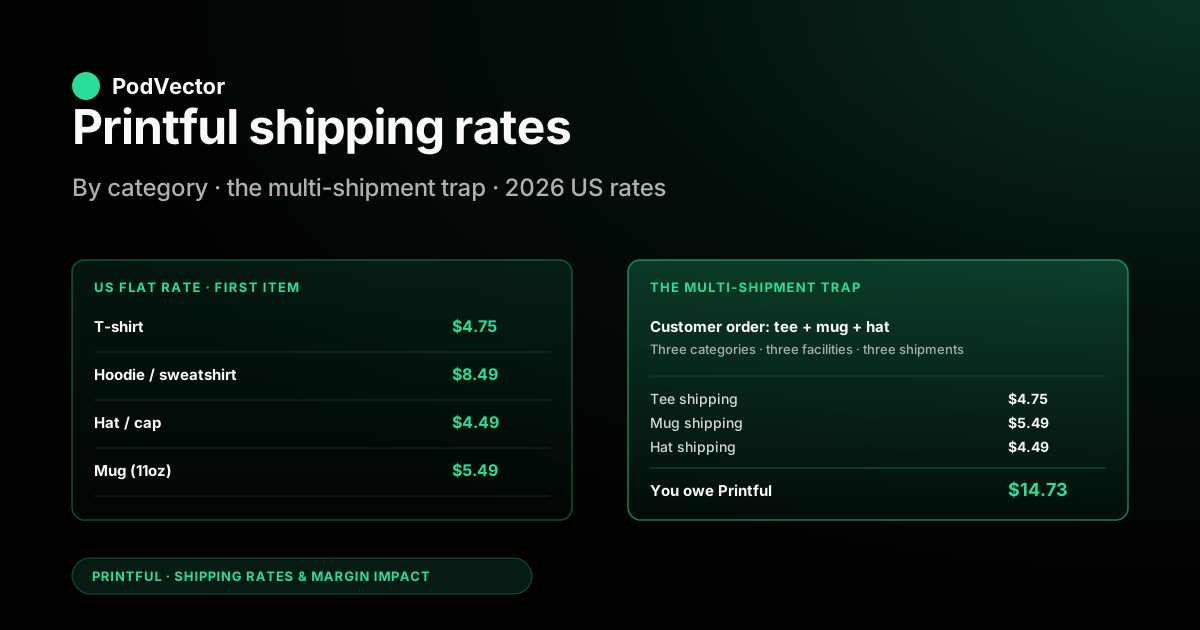
Quick Answer: Printful charges flat shipping rates by product category. In 2026, a single US t-shirt ships for $4.75 ($2.20 per additional tee), a hoodie for $8.49, a hat for $4.49, and a mug for ~$5.49. Rates climb 1.5–3x for international destinations.
The catch: Printful bills you, not your customer. You pick what to charge at checkout, and the gap between Printful's invoice and your storefront rate either funds your margin or erases it.
This guide lists the 2026 rates by category, explains the multiple-shipment trap that quietly doubles your shipping bill, and shows how to set storefront rates that recoup Printful's costs without scaring buyers off.
Printful shipping rates by product (US, 2026)
Printful groups its catalog into shipping categories. Every item in a category ships at the same rate, regardless of brand or color.
Here's what Printful is charging for US delivery in 2026, pulled from the live product pages:
| Product category | First item (US) | Each additional item |
|---|---|---|
| T-shirts | $4.75 | +$2.20 |
| Hoodies & sweatshirts | $8.49 | +$2.50 |
| All-over-print apparel | $5.49 | +$2.75 |
| Hats & caps | $4.49 | +$2.00 |
| Tote bags | $4.49 | +$2.00 |
| Backpacks | $10.49 | +$4.50 |
| Mugs (11oz) | $5.49 | +$2.85 |
| Posters (rolled) | $5.99 | +$2.95 |
| Canvas prints | $8.95 | +$4.25 |
| Stickers | $3.99 | +$1.25 |
| Phone cases | $4.49 | +$2.00 |
Two things to notice. First, the "additional item" rate is roughly 40–50% of the first-item rate, so multi-item orders bring your average per-unit shipping down hard. Second, mugs and canvas are weirdly expensive relative to apparel because they ship in protective packaging from a different facility.
Rates can shift quarterly. Printful adjusted its US tee rate from $3.99 to $4.75 over the last 18 months as carrier rates climbed.
How Printful actually charges shipping
Printful charges you for shipping when an order is fulfilled. Whatever you charge the customer at checkout is yours to decide — Printful's rate is just a cost on the invoice.
The flow looks like this:
- Customer places an order on your Shopify, Etsy, or other storefront.
- Customer pays you (product + your storefront shipping rate).
- Order syncs to Printful, which fulfills it and bills you for the product cost plus Printful's shipping rate.
- You keep the difference — or eat it, if your storefront rate was lower than Printful's.
The default shipping calculation is a flat rate per category, by region. Add multiple items in the same category and you pay the first-item rate plus an "each additional" rate per extra unit.
If a customer buys two t-shirts and a hoodie, you'd pay roughly $4.75 (first tee) + $2.20 (second tee) + $8.49 (hoodie ships separately category) = $15.44, not three line-item shipping fees.
International shipping rates
International rates are higher and vary by zone. Here's what a single t-shirt costs to ship to common Printful destinations:
| Destination | T-shirt (single) | Hoodie (single) | Mug (single) |
|---|---|---|---|
| United States | $4.75 | $8.49 | $5.49 |
| Canada | $5.99 | $9.49 | $7.49 |
| Europe (EU) | $4.99 | $8.49 | $6.99 |
| United Kingdom | $4.99 | $8.49 | $6.99 |
| Australia / NZ | $7.49 | $11.99 | $8.99 |
| Japan | $8.99 | $13.99 | $10.99 |
| Worldwide (other) | $10.99 | $15.99 | $12.99 |
Printful fulfills from facilities in the US, Canada, Mexico, Latvia, Spain, Brazil, Japan, and Australia. The system routes each order to the closest in-stock facility automatically.
That routing matters: a UK customer ordering a tee usually ships from Latvia or Spain at the EU rate, not from the US at the international rate. You don't need to do anything special to enable it — Printful handles the routing on its end.
The multiple-shipment trap
This is the line item that surprises new POD sellers: certain product categories always ship separately, even if the customer ordered them together.
The categories that ship separately as of 2026:
- Hats and caps
- Backpacks and tote bags (sometimes)
- Mugs and drinkware
- Posters, canvas, and framed prints
- Stickers
- Phone cases
- Pillows and home decor
- Notebooks and journals
- Water bottles
If a customer buys a t-shirt + a mug + a hat in one order, that's three separate shipments from three facilities. You pay three first-item shipping rates, not one + two additional fees.
Worked example: tee ($4.75) + mug ($5.49) + hat ($4.49) = $14.73 in shipping for a three-item order. Compared to three tees in one box at $9.15, that's an extra $5.58 you'll either eat or pass to the customer.
Most storefronts don't communicate this. Customers see one cart and expect one shipping fee, then get three tracking emails over the following week. Returns and complaint emails follow.
Flat rates vs. live shipping rates
Flat rates (the default) are predictable and simple. Live shipping rates are calculated by the carrier at checkout based on the customer's address and the package weight.
When live rates make sense:
- You sell heavy items where flat rates underprice (large canvas, framed prints, multi-item bundles)
- You ship internationally to a wide range of countries
- You want the customer to pay the actual carrier cost, not a Printful-set flat rate
When flat rates make sense:
- You sell mostly apparel, single-item orders
- You want predictable shipping math for margin planning
- You're running discounted shipping promos that won't survive live-rate shocks
Live rates require enabling Printful's shipping rate API on your storefront. Shopify, WooCommerce, and BigCommerce all support it natively. Etsy does not — Etsy sellers are stuck with flat rates or storefront-set custom rates.
How shipping fees hit your POD margin
Shipping is the second-biggest variable cost on a Printful order, right after product base. On a $24.99 retail tee with a $12.95 base cost and $4.75 shipping, here's where the money goes:
| Line | Amount | % of retail |
|---|---|---|
| Retail price | $24.99 | 100% |
| Storefront shipping charged | $5.00 | — |
| Total customer payment | $29.99 | — |
| Printful product cost | −$12.95 | 52% |
| Printful shipping | −$4.75 | 19% |
| Payment processing (Shopify ~3%) | −$0.90 | 3% |
| Net margin | $11.39 | 38% of product, 5% of total |
Shipping eats almost a full $5 from a $25 tee. If you offered free shipping at checkout, that $5 comes straight off the margin column.
Two SKUs that look identical at the catalog level can have very different shipping economics:
- A single tee at $24.99 retail with $4.75 shipping → ~$11 net margin
- A two-mug order at $39.98 retail with $11.18 shipping (mugs ship separately) → ~$3 net margin
The second order looks bigger. It's actually less profitable per minute of fulfillment work.
Setting storefront shipping rates
You have three viable options. Each has a different conversion impact.
Option 1: Pass Printful's rate through. Charge the customer exactly what Printful charges you. Margin-neutral, but checkout shipping looks high to buyers used to free-shipping defaults.
Option 2: Free shipping, baked into the product price. Raise your retail by $4–6 per item and offer free shipping. Highest conversion, but you'll lose money on multi-shipment orders unless you've modeled them.
Option 3: Hybrid threshold. Charge a flat $3.99–4.99 below an order threshold ($35–50), free above it. Moves average order value up while protecting margin on small orders.
For most POD apparel stores, option 3 wins on net profit. Set the threshold at roughly 2x your average single-item price so multi-item orders trigger the free upgrade.
Whatever you pick, model it against your last 90 days of orders before flipping the switch. A 5% checkout abandonment increase from raising shipping wipes out the $1.50/order you'd save by passing rates through.
How to find shipping rates for any product
Printful gives you three ways to check shipping costs before you list a product.
1. The product page on Printful's catalog. Open any product, scroll to the "Shipping" tab below the product image. You'll see rates for all major destinations and the additional-item add-on.
2. Printful's shipping rate calculator. Inside your dashboard, navigate to Shipping → Rate calculator. Enter the product, quantity, and destination — it returns the exact charge.
3. The Printful API. If you're building anything custom (calculator widget, margin dashboard, ad-bid logic), the /shipping/rates endpoint returns rates for any cart composition and destination.
Always pull rates fresh before any large product launch or ad campaign. Printful adjusts rates 2–4 times per year, usually quietly, and stale numbers in your bid math wreck campaign ROAS without obvious cause.
Tracking shipping cost across your store
Printful's invoices show shipping per order. What they don't show is the cumulative drift across your catalog: which SKUs have shipping eating the most margin, which countries have gone unprofitable as carrier rates climbed, which multi-shipment combos are silently bleeding cash.
The standard answer is to dump invoices into a spreadsheet monthly and look at margin by SKU and region. That works at low volume. At 50+ orders a day, it stops scaling — there's too much data and the lag means you find problems weeks after they started.
This is where a live data layer earns its keep. Pipe Shopify orders, Printful invoices (product + shipping), and ad spend into a unified warehouse and you can answer "which SKUs went negative this week after shipping" without touching a spreadsheet.
That's what Victor does for POD sellers — itemized cost tracking across product, shipping, fulfillment, and ad spend, with an agent that proposes price or shipping-rate changes when margins compress and executes them on Shopify after you approve. The shipping-margin question becomes a real-time alert, not a quarterly cleanup.
For more on the full Printful cost stack, see our Printful pricing plan breakdown, the comparison of all Printful pricing plans, and the subscription cost breakdown. The full costs and charges cluster covers every fee Printful adds to your invoice, and the Printful topic hub indexes the rest.
If you're also weighing whether Printful is the right partner for the long haul, our Printful reputation review and 2025 company review dig into reliability, customer service, and how shipping performance has held up over time.
FAQs
Does Printful offer free shipping?
Not as a default. Printful's Growth and Business plans include some discounted shipping (up to 30% off domestic rates on certain categories), but standard accounts pay full flat rates per shipment. If you offer free shipping to your customer, you absorb Printful's cost yourself.
How long does Printful shipping take?
US standard delivery: 3–4 business days after the 2–5 day fulfillment window. International standard: 5–20 business days. Express options are available on most products at higher rates if you need 1–3 day delivery.
Do customers see Printful's shipping rate?
No. Customers see whatever shipping rate you set in your storefront. Printful's rate appears only on your Printful invoice. The gap (positive or negative) is your responsibility to track.
Why does my customer get multiple packages?
Certain Printful product categories — hats, mugs, posters, canvas, stickers, phone cases — always ship separately because they're fulfilled at different facilities or require special packaging. A mixed-cart order can trigger 2–4 separate shipments. Communicate this on your product pages to head off complaints.
Can I get live shipping rates instead of flat rates?
Yes, on Shopify, WooCommerce, and BigCommerce. Enable Printful's live shipping rate API in your store settings. Etsy doesn't support live rates — you're limited to Etsy's flat-rate or calculated-shipping options.
How do I lower my Printful shipping costs?
Three levers: (1) upgrade to Growth or Business plan for the shipping discount if your volume justifies it, (2) push customers toward single-category orders so the additional-item rate kicks in, and (3) raise your free-shipping threshold so multi-item orders subsidize the shipping cost.
Where can I see exact rates for a specific product?
Open the product on the Printful shipping page or in your dashboard's product catalog. Scroll to the Shipping tab to see rates by region.
Does Printful charge customs or duties?
For most international shipments, customs and duties are the customer's responsibility on delivery. Printful offers DDP (Delivered Duty Paid) on Standard shipments to Canada and the UK, where customs is prepaid and rolled into the shipping charge.
Stop losing margin to shipping you didn't see coming
Printful's shipping rate is one line. Your real shipping cost is across every order, every category, every region — and it changes every quarter.
Victor pipes your Shopify and Printful data into a live warehouse, watches your shipping margin in real time, and proposes specific rate changes when SKUs go negative. He executes the changes on Shopify after you approve.
Connect your store in five minutes.
Try Victor free