
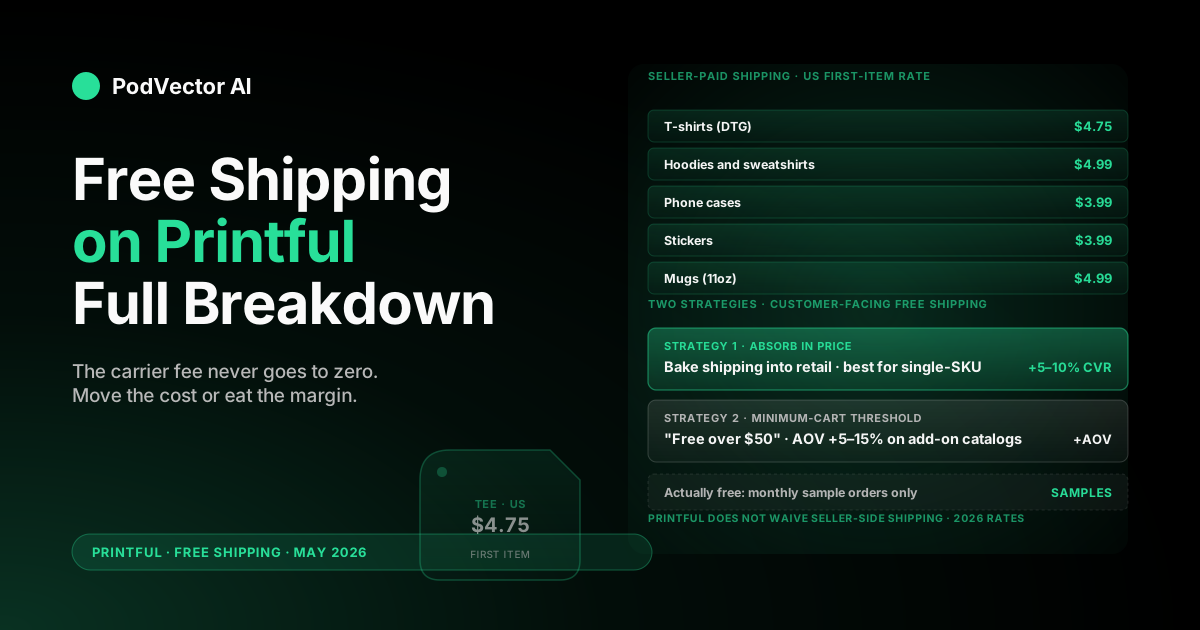
Quick Answer: Printful does not offer free shipping to sellers. You always pay the carrier fee — $4.75 for a US t-shirt, $6.99 for a EU hoodie, more for international. "Free shipping" is something you offer your customer by burying the fee inside your retail price.
The two real options: absorb the shipping cost into every product price (the simplest), or set a minimum cart threshold like "$50 ships free" (the AOV-booster). Both move the cost — neither removes it.
The only literally-free Printful shipping is on sample orders for new accounts (one free-shipping sample per month, up to two items). Everything else is a margin decision you make on purpose.
Is Printful Free Shipping Actually Free?
No. Printful charges sellers shipping on every customer order. There is no Printful-side free shipping tier, no membership that waives it, no volume discount that drops it to zero.
What people mean by "free shipping Printful" is the offer your store shows to your customer — the line at checkout that says "Shipping: Free." Behind that line, you are still paying Printful $4–$15 per order in carrier fees. You just decided not to show it to the buyer.
This distinction matters because POD operators search "free shipping" hoping for a way to cut costs. There isn't one. The question is which pricing structure lets you eat the fee without killing margin.
| Who you ask | What "free shipping" means | Cost |
|---|---|---|
| Your customer | "Shipping: $0" at checkout | $0 (visible) |
| You (the seller) | Carrier fee absorbed in product price or threshold logic | $4–$15 per order |
| Printful | You pay carrier rate per item, every time | Full rate, no exceptions |
The rest of this article works the seller's perspective: what shipping actually costs, when offering free shipping makes sense, and how to set it up without bleeding margin.
The Two Ways to Offer Free Shipping
There are only two structures that get a customer to checkout with a $0 shipping line. Pick the one that fits your catalog and price point.
Strategy 1 — Absorb in product price. Raise every item's retail price by the shipping cost. A $20 tee becomes a $25 tee that "ships free." Simplest to set up. Hurts you on high-priced SKUs where the absorbed cost feels small and helps on low-priced SKUs where shipping is a bigger share of price.
Strategy 2 — Minimum-cart threshold. "Free shipping over $50." Customers pay shipping below the threshold and the store eats it above. This is the AOV play — it pushes single-item carts to two-item carts. Works when your catalog has natural add-ons (sticker, hat, second tee).
| Strategy | Best for | What it does to AOV | What it does to conversion |
|---|---|---|---|
| Absorb in price | Single-SKU brands, gift items, low ASPs | Neutral | Lifts cart completion (no shipping shock at checkout) |
| Minimum threshold | Multi-SKU catalogs with add-ons | Lifts ~5–15% | Neutral or slight dip on small carts |
| Hybrid (threshold + flat low rate) | Mid-size catalogs that want both | Lifts ~3–8% | Mild lift |
Most POD operators end up with the threshold model once they have more than 4–5 SKUs. The absorb model is the right pick for a single-product brand or a launch SKU you want to keep visually cheap.
What Printful Shipping Actually Costs You
To price either strategy correctly, you need the raw shipping rates. Printful bills a "first-item" rate plus a discounted "each additional" rate. Both vary by product category and destination region.
| Product | US first | US additional | EU first | UK first | Worldwide first |
|---|---|---|---|---|---|
| T-shirts (DTG) | $4.75 | $2.20 | $5.49 | $5.49 | $8.49 |
| Hoodies and sweatshirts | $4.99 | $1.95 | $6.99 | $6.99 | $11.49 |
| All-over-print apparel | $5.75 | $2.50 | $7.99 | $7.99 | $11.49 |
| Phone cases | $3.99 | $1.50 | $4.69 | $4.69 | $5.49 |
| Mugs (11oz) | $4.99 | $2.50 | $5.99 | $5.99 | $10.99 |
| Stickers | $3.99 | $0.99 | $2.49 | $2.49 | $3.49 |
| Posters (12"×18") | $5.99 | $1.50 | $6.99 | $6.99 | $10.99 |
| Embroidered hats | $3.99 | $1.50 | $4.99 | $4.99 | $9.99 |
| Backpacks and bags | $5.99 | $2.50 | $8.49 | $8.49 | $36.19 |
Three things to notice. International shipping on bulky items (backpacks, hoodies) is brutal — $36 to Australia on a single backpack. Phone cases and stickers ship cheap everywhere. And the additional-item discount can be huge: a US tee bundle of two ships for $6.95 instead of $9.50.
Rates change quarterly. The Printful shipping rates page is the live source — bookmark it and recheck every time you reprice. Most rate increases land in late Q1 and early Q4.
Margin Math: When Free Shipping Works
Whether free shipping makes sense depends on three numbers — base product cost, average order size, and current shipping rate. Run this for every SKU before you flip the switch.
Take a Bella+Canvas 3001 tee. Base cost $11.50, US shipping $4.75, no print upcharges. Loaded cost: $16.25. If you sell at $24.99 with shipping not free, your customer pays $24.99 + $4.75 = $29.74, and your margin is $8.74 (35%).
Flip to absorbed-shipping pricing. You raise the tee to $29.99 with free shipping. Customer pays the same $29.99, your margin stays at $8.74 (29% on the higher number, same dollar margin). Conversion typically lifts 5–10% because the buyer never sees the shipping line.
| SKU | Base + Ship | Retail (paid ship) | Retail (free ship) | Same margin? |
|---|---|---|---|---|
| Tee (US) | $16.25 | $24.99 + $4.75 | $29.99 free | Yes ($8.74) |
| Hoodie (US) | $33.49 | $44.99 + $4.99 | $49.99 free | Yes ($11.50) |
| Phone case (US) | $17.94 | $26.99 + $3.99 | $30.99 free | Yes ($9.05) |
| Sticker (US) | $5.48 | $5.00 + $3.99 | $8.99 free | Yes ($3.51) |
The sticker line shows where absorb-pricing falls apart. A $5 sticker at $8.99 looks expensive next to competitors charging $3.50 + $0.99 shipping. On low-ASP items, the threshold strategy beats the absorb strategy every time.
The hoodie line shows the opposite. At $49.99 free shipping, the buyer doesn't blink. The same hoodie at $44.99 + $4.99 ship feels like a tacked-on fee and lifts cart abandonment.
Strategy 1: Absorb in Product Price
Absorbed shipping is the right pick for stores with average order value above $25 and a customer base that hates surprise fees. The setup is trivial.
Build your retail price on this formula: (base × markup) + shipping. If the tee base is $16.25 loaded and you want a 50% margin, retail is roughly $32.50 — round to $29.99 or $34.99 depending on price point.
Where it wins. Single-product brands, gift items, premium positioning, and any product where the unit price already feels round. A $50 hoodie that ships free reads cleaner than a $45 hoodie + $5 shipping.
Where it loses. Low-ticket items (under $10), price-sensitive categories like stickers and basic mugs, and any market where your competitors are showing the shipping line transparently.
This is the strategy Printful's product creator automates for new stores — when you toggle "Enable free shipping" during product push, Printful adds the shipping cost to the retail price you set. You don't have to do the math yourself, but you should sanity-check the resulting retail number against what your audience will actually pay.
Strategy 2: Minimum-Cart Threshold
Threshold-based free shipping is the AOV play. Set a minimum like "Free shipping over $50" and the cart logic absorbs the carrier fee only on qualifying orders.
The right threshold is your current AOV plus roughly 30–50%. If average orders run $35, set the threshold at $50. If they run $50, set it at $75. The goal is to push the single-item cart into a two-item cart, not to make every order qualify.
| Current AOV | Suggested threshold | What it nudges |
|---|---|---|
| $20 | $35 | Adding a sticker, hat, or second small item |
| $35 | $50 | Upsell to a second tee or a hat |
| $50 | $75 | Upsell to a hoodie or a 2-tee bundle |
| $75 | $100 | Bundle of 2-3 mid-tier items |
Pair the threshold with a progress bar in cart ("Add $12 more for free shipping") and a recommended-products row of low-priced add-ons. This is where most of the AOV lift comes from — the bar is the conversion mechanism, not the threshold itself.
For deeper threshold-tuning logic and Printful's official AOV-lift case studies, see the Printful blog's free shipping AOV guide.
The Only Truly Free Shipping: Sample Orders
One Printful program offers actually-free shipping: the sample order benefit for verified store owners.
If you have a connected store, you get up to 3 sample orders per month with a 20% product discount and free shipping (capped at 2 items per order, up to $40 in shipping savings per order). New accounts without a connected store get one such order per month, up to 2 items.
This is for ordering your own products to photograph, QC, or wear. It is not a customer-facing shipping benefit. But it's worth knowing because most POD operators discover sample orders only after they've already paid full shipping on 20 self-orders during launch.
How to use it. Connect a store (Shopify, Etsy, Woo, eBay — any qualifies). Use the sample-order flow inside your dashboard, not a regular checkout. The discount and free shipping apply automatically.
What doesn't qualify. Bulk orders, gift orders to non-business addresses, and any product flagged as "non-sampleable" (typically warehoused custom items or print-area-locked SKUs).
Setting It Up on Shopify, Etsy, and Woo
The exact toggle differs per platform. Below is the shortest path on each.
Shopify. Use Shopify's native shipping profiles instead of Printful's product-level free shipping. Set a profile with "Free shipping" for all Printful-fulfilled products, then upcharge the retail price by the shipping cost. Don't enable Printful's free-shipping toggle and Shopify's — you'll double-count the cost. The Printful Shopify setup guide walks through the profile config.
Etsy. Etsy rewards free-shipping listings in search ranking, so the absorb strategy is almost always correct here. Enable Etsy's "Free shipping guarantee" at the shop level and set Printful product retail prices to include shipping. Don't use Printful's per-listing toggle — Etsy's shop-level setting overrides it inconsistently.
WooCommerce. Use Woo's native "Free shipping" zone with a minimum order amount. Set it to your threshold (e.g., $50). Printful syncs product-level shipping rates by default, so you don't need to disable anything — Woo's zone logic takes priority for the customer-facing checkout, and Printful still charges you the carrier fee in the background.
eBay. eBay's "Free shipping" badge boosts search visibility. Use the absorb strategy and set listings to free domestic shipping; international can stay paid.
Free Shipping on Printful vs Printify
Printify has no native free-shipping toggle the way Printful does — you set retail prices and the customer-facing shipping logic on your store, and Printify just bills you the carrier rate per order. Functionally the seller-side cost math is identical: there is no provider-funded free shipping on either platform.
Where they diverge is base shipping rate. Printify is usually $0.50–$1.50 cheaper on US apparel because their fulfillment network includes more domestic providers (Monster Digital, Swiftpod, OPT). Printful runs a higher rate but offers more consistent print quality on the same Bella+Canvas blanks.
| Provider | US tee shipping (first) | US tee shipping (additional) | Free shipping toggle? |
|---|---|---|---|
| Printful | $4.75 | $2.20 | Yes (auto-adjusts retail) |
| Printify | $4.18 | $2.10 | No native toggle |
For a deeper provider-vs-provider breakdown including print quality, fulfillment time, and per-SKU margin comparison, see our guide on which is better, Printful or Printify. The shipping-cost differential alone usually isn't enough to switch providers — print quality and turn-around time matter more.
Modeling Free Shipping in Your Margin Stack
The hardest part of free shipping isn't setup. It's tracking what it actually costs you over a quarter. Printful bills shipping per order on your invoice, but the loaded per-SKU view — what shipping costs as a percent of retail on each variant, across regions, across time — is buried.
Most POD operators model this once in a spreadsheet, then never re-check when rates change. Then a Q4 rate bump quietly eats 2-3 points of margin and nobody notices until invoice review in January.
This is the workflow PodVector AI's Victor automates. Victor reads your Printful order data live alongside your store data and answers "what's my real margin per SKU after shipping?" or "which products went underwater after the October shipping rate change?" without you rebuilding the model. That's the value-add over a static cost-tracker spreadsheet — the numbers update themselves.
For the broader cost stack beyond shipping — base price, print upcharges, taxes, subscription discounts — see the Printful costs and charges hub or the deep guides on Printful membership cost and membership cost benefits. The Growth membership benefits guide is the one to read if you're deciding whether a paid plan changes your shipping economics (short answer: it discounts product base, not shipping).
Where Free Shipping Sits in a Full Printful Review
Free shipping isn't a feature in isolation — it interacts with print quality, fulfillment speed, and product category. Buyers who feel the shipping cost was tacked on rate the experience lower regardless of print quality. Stores running absorbed-shipping with a clean retail number rate higher even when print quality is identical.
For the broader print-on-demand business view, see the Printful print-on-demand business review. For category-specific reads (home and living catalog tends to have the highest shipping-to-base ratio), the Printful home and living products review covers what that means for retail pricing.
Printful Pricing Resources
Free shipping is one line in the Printful cost stack. The Printful topic hub indexes every cost and charge guide on the site, and the Costs and Charges cluster drills into specific fees — print upcharges, shipping rates, membership discounts, sample costs.
FAQs
Does Printful offer free shipping to sellers?
No. Printful charges sellers the carrier rate on every order. There is no membership tier, volume discount, or promotion that removes the shipping fee from your invoice. The only literally-free shipping is on monthly sample orders for connected stores.
Can I offer free shipping to my customers without losing money?
Yes — by raising your retail price to include the shipping cost (absorb strategy) or by requiring a cart minimum (threshold strategy). Both keep your dollar margin constant while changing what the customer sees at checkout. Absorbed shipping typically lifts conversion 5–10% on apparel.
What's the best free shipping threshold for a POD store?
Set your threshold roughly 30–50% above your current AOV. If average orders run $35, set the threshold at $50. The goal is to push single-item carts to two-item carts, not to make every order qualify. Pair with a "X more for free shipping" progress bar in cart.
Does Printful have a free shipping coupon code?
No. Printful does not run free-shipping promo codes for sellers. Third-party coupon sites sometimes claim to have one, but the codes don't apply to fulfillment shipping — they apply to retail orders Printful itself sells through Printful Studio, which is a different program.
Can new Printful sellers get free shipping on samples?
Yes. New accounts get one free-shipping sample order per month with a 20% discount, up to two items. Connected-store accounts get up to three such orders per month. The discount and free shipping apply automatically when you use the sample-order flow in your dashboard.
Does Printful free shipping work on international orders?
If you use the absorb strategy, yes — you can offer free shipping internationally as long as your retail price covers the international rate. International rates run $8–$36 per item depending on category, so absorbed-shipping retail prices on a worldwide-shipping store are noticeably higher than US-only.
Will offering free shipping make my Printful products rank higher on Etsy or eBay?
Yes on both. Etsy's "Free shipping guarantee" boosts listing rank in search. eBay's "Free shipping" badge lifts visibility on category pages. The absorb strategy is almost always correct on both platforms because their algorithms reward visible-free-shipping listings.
How do I know if free shipping is actually profitable for my store?
Track per-SKU margin after the absorbed shipping cost across a full month. If margin holds at your target (usually 30–50% for POD apparel), free shipping is profitable. If it drops below 25%, your retail price is too low for the shipping cost or your SKU mix is shipping-heavy. Re-price the offending SKUs or move to a threshold model.
Track Your Real Printful Margin After Shipping — Live
Printful's invoice shows shipping costs. Your store's report shows revenue. Neither shows you per-SKU loaded margin after carrier fees, by region, over time.
Victor connects to your Printful and store data and answers "which SKUs went underwater after the last shipping rate bump?" or "what's my real margin on US versus EU tees this month?" — the questions a static spreadsheet can't answer because the numbers change every week.
and stop guessing on shipping math.
Try Victor free