
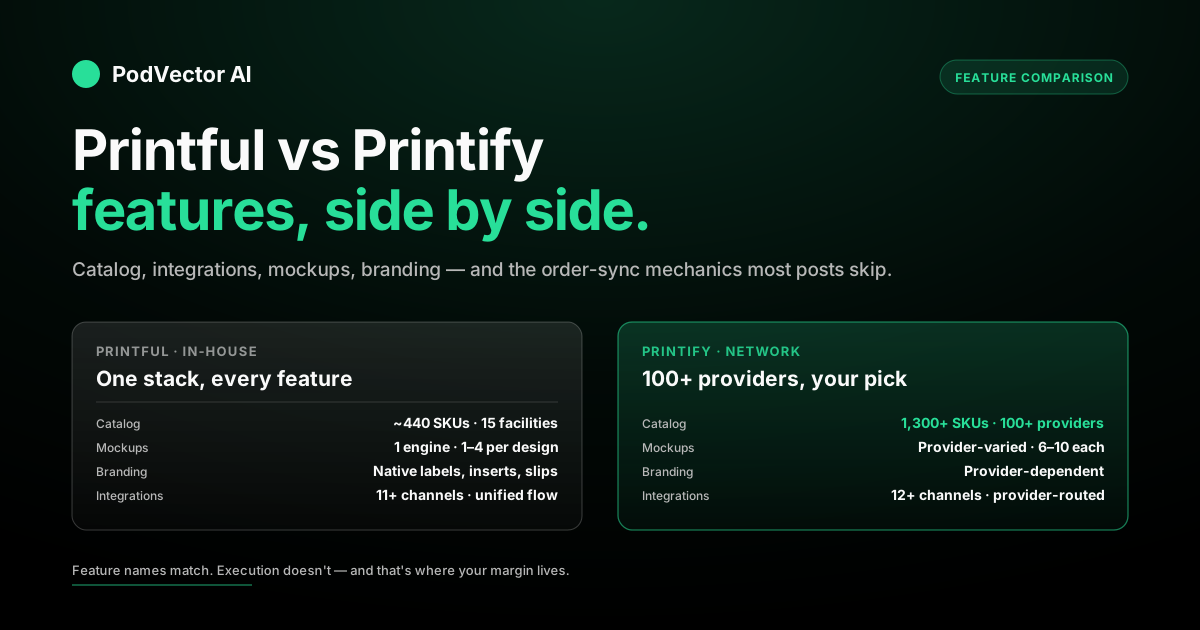
Quick Answer: Printful has the better feature experience if you want consistent behavior across SKUs; Printify is better if you want more provider choice and lower-cost catalog flexibility. Feature-for-feature, Printful and Printify cover the same surface area — Shopify/Etsy/Amazon/eBay/TikTok integrations, mockup generators, branded inserts, embroidery, and bulk discounts via paid plans. The differences sit in how each feature actually wires into your store.
Printful runs every feature off one in-house production stack, so behavior is consistent: one mockup generator, one order webhook, one shipping label flow. Printify exposes the same features but routes them through 100+ independent providers, so the same "feature" can behave differently SKU to SKU.
Below: the feature-by-feature breakdown, the integration mechanics behind each one, and the per-SKU profitability lens that beats either-or platform picks.
Feature snapshot
Both platforms tick almost the same checklist on paper. The execution differs — and that's what determines which one fits your operation.
| Feature | Printful | Printify |
|---|---|---|
| Product catalog | ~440 SKUs | 1,300+ SKUs |
| Production model | In-house, 15 facilities | Network of 100+ providers |
| Native integrations | Shopify, Etsy, WooCommerce, Amazon, Walmart, eBay, Wix, Squarespace, BigCommerce, TikTok, Webflow, Ecwid | Shopify, Etsy, WooCommerce, Amazon, eBay, Wix, Squarespace, BigCommerce, TikTok, Salla, PrestaShop |
| Mockup generator | 1 native generator, 1–4 mockups per design | Provider-dependent, 6–10 mockups per design |
| Branded inserts | Native: $2.49/item label, $0.50 packing slip, $1.99–$4.99 inserts | Provider-dependent; not all support inserts |
| Embroidery | Yes, in-house | Yes, via specific providers (Monster Digital, MyLocker, etc.) |
| All-Over Print (AOP) | Yes, in-house | Yes, provider-dependent |
| Order webhook | 1 unified endpoint, 4 main event types | 1 endpoint, but downstream behavior varies by provider |
| Free plan | Yes | Yes (up to 5 stores) |
| Paid plan price | $24.99/mo Growth, $49.99/mo Business | $29/mo Premium, $99/mo Enterprise |
| Customer support | 24/7 live chat, unified | Routed: app support vs provider support |
| Public API | REST + GraphQL, fulfillment-focused | REST, fulfillment + catalog |
The feature names match. The behavior behind them doesn't. Walking through each below.
Production model: the feature underneath every other feature
Almost every behavioral difference between Printful and Printify traces back to one architectural fact: Printful owns its production; Printify orchestrates a network.
Printful operates 15 fulfillment centers globally — US (multiple), Mexico, Latvia, Spain, Australia, Japan, and Canada. Every Printful product is printed and shipped by Printful staff in a Printful building. That means uniform print methods, uniform QC, and one customer service team accountable for the result.
Printify connects you to 100+ independent print providers — Monster Digital, MyLocker, Drive Fulfillment, SwiftPOD, Dimona, Stoked on Printing, and many more. You pick the provider per SKU. Printify handles billing and the integration layer; the provider handles the actual printing.
This shapes how every other "feature" behaves:
- Mockups: Printful's generator outputs from one library. Printify's outputs depend on which provider you select.
- Print quality: Printful's variance is narrow. Printify's can swing widely SKU to SKU depending on the provider you picked.
- Fulfillment SLAs: Printful publishes one production-time target. Printify shows you a target per provider — but it's the provider's commitment, not Printify's.
- Branding: Printful offers native inside-collar labels, packing slips, and inserts. Printify's branding options depend on which provider supports them.
- Support: Printful handles every issue. Printify handles app issues; provider handles production issues.
If you remember nothing else from this article: Printful is a product, Printify is a marketplace. The features look the same because both companies want sellers; the mechanics behind them are different categories.
Product catalog features
Printify's catalog is roughly 3x the size — 1,300+ products vs ~440. The size gap is real, but how you use the catalog matters more than the headline number.
Catalog breadth and depth
Printify has more SKUs in almost every category: t-shirts, hoodies, mugs, phone cases, wall art, jewelry, pet products, swimwear, home goods. If you sell a niche product — embroidered patches, can coolers, mouse pads with stitched edges — Printify likely has multiple providers stocking it.
Printful's catalog is narrower but every product is in-house, so adding a new SKU to your store means one mockup workflow, one production timeline, and one shipping zone. No provider research.
Per-SKU provider choice (Printify only)
This is the Printify feature with the biggest operational impact. For most popular products, Printify lists 3–10 providers, each with different prices, print methods, and locations.
Example: A Bella+Canvas 3001 unisex tee on Printify shows you Monster Digital (US, $7.99 base, 2–5 day production), Drive Fulfillment (US, $8.50, 1–3 days), MyLocker (US, $9.25, 2–4 days), Dimona (US/Argentina/Brazil, $7.50, 3–7 days), and others. You pick. Printful would just price the same tee at $13.95 and route to whichever facility is closest to the buyer.
That choice is power and overhead at the same time. Power because you can route US orders to the cheapest fast-shipper and EU orders to a Riga or Madrid provider. Overhead because someone has to make that decision per SKU and revisit it when providers underperform.
Product feature parity
Both platforms cover the standard POD categories: apparel, accessories, home and living, kids, pets, drinkware, wall art, stationery. Both support DTG (direct-to-garment), DTF (direct-to-film transfer), sublimation, embroidery, and AOP. The difference is which providers offer which method on Printify versus Printful's single in-house decision.
Mockup and design tool features
Mockup generators are how you turn a flat design into the lifestyle image your store displays. Both platforms include one — and both went through significant upgrades in 2024–2025.
Printful's mockup generator
Printful's mockup studio is one workflow for the whole catalog. Upload your design, drop it on a product, see 1–4 default mockups (a flat-lay, a model shot, a folded shot, sometimes a hanging shot). Premium and Pro tiers unlock unlimited mockup generation and faster export.
The 2025 update added AI-powered background editing, lifestyle scene swapping, and bulk mockup generation across multiple products in one session. The result is consistent because every mockup comes off the same template engine.
Printify's mockup generator
Printify's mockup output depends on the provider. Some providers ship with 8–10 stock mockups per product (lifestyle, flat, folded, multiple model shots in different settings). Others have 2–3. The Printify-side studio works across providers, but the raw assets per product come from the provider.
Printify added an AI mockup generator in 2024 that lets you generate custom lifestyle scenes (a coffee shop, a beach, a bedroom) and drop product images into them. That's a Printify-platform feature, not a provider feature, so it's available across the catalog.
Design tools
Both platforms include in-platform design tools — text overlays, clipart libraries, image upload, AI image generation. Printful's is the deeper asset library (700+ fonts and 25,000+ clipart graphics as of 2026); Printify's is lighter (roughly 350 fonts and a few hundred free graphics) but adds a pattern creator and AI image tools inside its Product Creator. For sellers coming from Canva-style flows, Printful's is cleaner; for quick trend mockups, Printify's is fast enough.
For serious sellers, both are scratch pads. The real design work happens in Photoshop, Illustrator, Figma, or Procreate, and the POD platform just hosts the final print file.
Integration mechanics: how features actually wire to your store
This is where the feature lists oversimplify. Both platforms support Shopify, Etsy, WooCommerce, Amazon, eBay, Wix, TikTok Shop, BigCommerce, Squarespace — but how the integration actually behaves matters more than which channels are on the list.
Order flow mechanics
When a customer buys from your Shopify store, the same general sequence happens on both:
- Shopify fires an
order/createwebhook. - The POD app receives it, matches the line items to its connected products.
- The POD platform creates an internal production order.
- Production starts (Printful in-house, Printify routes to the provider).
- Tracking number gets pushed back to Shopify as a fulfillment.
The difference is what happens between steps 3 and 4. On Printful, the production order goes directly to a Printful facility. On Printify, the order goes to the provider's queue — which may use its own internal MIS, batch differently, and have a different SLA for picking up new orders.
For 95% of orders the result is indistinguishable. For the edge cases (stockouts, provider going offline, a misprint reshipment) the difference shows up: Printful has one internal system to query; Printify has to route the question to the provider.
Sync features
Both platforms support these sync behaviors. Worth checking which are on by default:
- Product sync. Push a new design from the POD platform to Shopify as a product with variants. Both do this. Printify's flow is slightly faster for bulk SKU creation.
- Inventory sync. Mark a Shopify product as out of stock when the upstream POD provider runs out. Both platforms track stockouts; Printful's is more reliable because it's one inventory system.
- Order webhook. Both push fulfillment events (created, in production, shipped, delivered) back to Shopify or Etsy. Same event types, different reliability tails.
- Pricing sync. If you change retail prices in Shopify, do they flow back to the POD platform? On both, no — that's intentional. Retail price stays in Shopify; base cost stays in the POD app.
Channel-specific features
A few channels have integration nuances worth knowing:
Etsy. Both platforms handle Etsy's listing requirements well. Printify added native Etsy SEO suggestions in 2024 (auto-generated tags and titles) inside the listing flow. Printful's Etsy integration is more bare-bones but stable.
Amazon. Both support Amazon, but Amazon's POD program (Merch on Demand) is a separate channel. Printful's Amazon integration is for Amazon Seller Central (your own listings); Printify's same. Neither replaces Merch on Demand.
TikTok Shop. Both added native TikTok Shop integration in 2023. Printify's is slightly ahead on order volume handling because of its provider distribution.
Walmart Marketplace. Printful has a native Walmart integration; Printify's Walmart support is thinner and provider-dependent. If Walmart is a channel you sell on, Printful is the cleaner path today.
Shopify. Native app on both. Printful's app has slightly more polish on the design embed (its "Embedded Product Editor" lets your buyers customize products on your store at checkout — a personalization feature Printify covers less completely). Printify's Shopify app is more flexible for managing many SKUs at once.
What the integration list doesn't tell you
Both apps can connect to the same store. Plenty of sellers run a hybrid: Printful for branded core SKUs (consistent quality), Printify for catalog breadth (niche products, lower-cost variants). The integrations are designed to coexist — orders route based on which app owns each SKU.
That's the integration feature most sellers don't know about: you don't have to pick one platform per store. You pick one platform per product.
Branding features
Branding features are what let your POD-fulfilled order feel like it came from your warehouse, not a generic dropshipper. This is where Printful's in-house model shows up most clearly.
Printful branding features
- Inside-collar labels. $2.49/item. Printed on the inside neck of t-shirts and hoodies. Available across the apparel catalog.
- Outside labels. Replace the manufacturer's brand label with yours. $2.49/item.
- Custom packing slips. Free on Growth/Business plans; $0.50/item otherwise. Logo, custom text, return address.
- Packaging inserts. $1.99–$4.99/item depending on insert type (postcard, sticker, thank-you card). You ship a batch to Printful; they include one per order.
- Custom labels and tags. Hang tags, woven labels — available on select products.
Every branding feature is native, priced transparently, and available across the relevant catalog because Printful runs the production.
Printify branding features
Printify's branding feature set depends on the provider. Some highlights:
- Custom neck labels. Available on a subset of providers (Monster Digital, MyLocker, a few others). Pricing varies — typically $1.50–$3.50.
- Branded packing slips. Native Printify feature; available across most providers.
- Inserts. Limited. Some providers support them; many don't.
- Custom packaging. Mostly not available. Standard provider packaging is the default.
If branding consistency is core to your store, Printful has the structural advantage. If your customers care less about packaging than about price, Printify's tradeoff is fine.
Fulfillment and shipping features
Production speed and shipping options are where customer experience lives or dies. Both platforms publish targets; both miss them sometimes.
Production time features
Printful's published target: 2–5 business days for most products, 1–3 days for AOP, 5–7 days for embroidery. Their internal data has held this for years.
Printify's published target: 2–7 business days depending on provider, with the top-tier providers (Monster Digital, MyLocker, SwiftPOD) hitting 2–4 days consistently. Budget providers can stretch to 7–10 days.
The reshipment rate tells the rest of the story. Printful publishes ~0.19% reshipment rate (industry-leading). Printify's varies — premium providers run 0.5–1%, budget providers can hit 3–5%.
Shipping rate features
Both platforms calculate shipping at checkout via API integration with Shopify, Etsy, or your platform of choice. Both use carrier-direct rates with markup.
Printful's shipping is unified — one rate card, one routing logic, predictable behavior. Printify's shipping varies by provider, so the same product can have different shipping rates depending on which provider you selected.
International fulfillment features
Printful auto-routes to its closest facility based on the customer's address. A UK customer gets fulfilled from Riga or Madrid; an Australian customer from Brisbane. The seller doesn't configure anything.
Printify requires you to manually set up multi-region routing. Most sellers pick one US provider and one EU provider per SKU, with a fallback for international. It works, but it's a configuration step you own.
Customer support features
Support is one of the cleanest differences between the two platforms.
Printful: 24/7 live chat, unified support team, one point of contact for every issue. Email tickets typically responded to within 4–8 hours. Premium plans get priority queue.
Printify: App-level support handles billing, integration issues, and platform questions. Production issues route to the provider. Response times vary by provider — top-tier providers respond in hours; budget providers can take 24–72 hours.
For a small seller running 10–30 orders a day, neither model is a real problem. For larger volume operations, Printful's unified support is meaningfully less operational overhead.
API and automation features
If you're scaling past the manual-design workflow, the API features matter.
Printful API
Printful exposes REST and GraphQL APIs covering: catalog read (products, variants, pricing), order creation, fulfillment status, file upload (design files), mockup generation, and shipping rate calculation. Documentation is solid; rate limits are reasonable for most use cases.
What this enables: bulk product creation, automated reorder flows, custom dashboards pulling Printful order data, and integration with whatever middleware you run.
Printify API
Printify's REST API covers: catalog (with provider-level filtering), product creation, order management, fulfillment events, and shipping calculation. It's slightly newer than Printful's and has had a few iterations.
The Printify API exposes the provider-level data — which provider is fulfilling which order, what their queue depth is, what alternatives exist. That's useful if you're building automated provider-switching logic.
Automation features
Both platforms support: scheduled product publishing, bulk order import (CSV), automated reorder for personalized products, and webhook subscriptions for order events. The differences are minor — both work for most automation use cases.
The Fyul merger context
In November 2024, Printful and Printify announced a merger as equal partners under a new parent company, Fyul. Both brands continue to operate independently with separate apps, separate provider networks, separate websites, separate pricing.
So far the merger hasn't merged features. Printful is still Printful, Printify is still Printify, and there's no shared catalog or unified backend. The strategic logic is consolidation against rising competitors (Gelato, Gooten, regional providers), not platform unification.
For sellers, the practical impact is: nothing changes today. Both brands still operate the way they did in 2023. Worth watching whether 2026–2027 brings deeper integration — until then, decide as if they're separate platforms, because they functionally are.
When to choose each
Once you've walked the feature grid, the decision becomes operational, not feature-driven.
Choose Printful when:
- Branding consistency is core to your store (inside labels, custom inserts, premium packaging).
- You want one shipping logic, one support team, one production SLA — and you'll pay $3–6 per unit for that.
- You sell internationally and want auto-routing without managing per-region providers.
- You sell embroidered apparel — Printful's in-house embroidery is consistent.
- You're a B2B or premium DTC brand where reshipment rate and brand perception matter.
Choose Printify when:
- You want catalog breadth — niche products Printful doesn't carry.
- Margin per SKU matters more than brand consistency.
- You're comfortable picking providers per product and managing the routing yourself.
- You sell trend-driven products where catalog speed matters more than long-term consistency.
- You're scaling US-only and want the lowest cost-per-unit on Bella+Canvas, Gildan, Hanes apparel.
The hybrid approach
The most profitable POD operations we see don't pick one. Branded apparel and signature products go through Printful for consistency. Catalog expansion, niche tests, and price-sensitive SKUs go through Printify. Both apps coexist in the same Shopify store; orders route by which app owns each SKU.
The feature checklist won't tell you which is more profitable for your catalog
The frustrating thing about feature comparisons is they're decision-shaped but not decision-useful. Both platforms have inside-collar labels. Both have Shopify integration. Both have AOP. The feature grid is mostly green checkmarks on both sides.
The question that actually matters: given my real catalog, my real customer mix, my real margin requirements — which platform nets me more?
That answer lives in your store data, not in either company's marketing site. Specifically:
- What's the per-SKU base cost on Printful vs Printify (provider by provider) for your top 20 designs?
- What's the shipping cost per order to your actual customer geography?
- What's your reshipment rate when you A/B test the same design on both platforms?
- How much of your support cost gets eaten by Printify's provider routing on misprints?
- What's the LTV impact of Printful's branded packaging vs Printify's generic?
None of that lives in a comparison article. It lives in your Shopify, Etsy, Printful, and Printify accounts — and most sellers never pull it together because the data is split across four dashboards.
This is the gap Victor — PodVector AI's AI employee agent — is built to close. He ingests your Shopify, Printful, and Printify data into one live data warehouse and lets you ask the actual questions in plain English: "Which supplier nets more on my top 10 SKUs after shipping and reshipments?", "What's my US-only margin if I move all hoodies to Printify?", "Which Printify provider has the lowest reshipment rate on my catalog?"
Victor also proposes specific operator actions — price changes, discount creation, Shopify collection setup — and executes them on your approval with a full audit trail. The combo is the moat: a POD business playbook in the agent, a live link to your store data, and the ability to act on it. Strip any leg and you're back to a dashboard, a consultant, or a generic AI chatbot.
You can try Victor free to see what your actual Printful-vs-Printify decision looks like on your own catalog. The feature grid stops being the bottleneck once you have the data.
FAQs
Are Printful and Printify the same company now?
They merged in November 2024 under a new parent company called Fyul, as equal partners. Both brands continue to operate separately with their own apps, providers, and pricing. There's no shared catalog or unified backend as of 2026.
Can I use both Printful and Printify on the same Shopify store?
Yes. Both apps are designed to coexist. You assign each product to one POD app, and orders route automatically based on which app owns the SKU. The hybrid setup is common for sellers who want Printful's branding on signature SKUs and Printify's catalog breadth on test products.
Which has more features overall?
On the surface, similar. Both cover the same channel integrations, mockup generators, branding options, and fulfillment categories. Printify wins on catalog size (1,300+ vs ~440 SKUs) and provider choice. Printful wins on feature execution — uniform mockups, in-house branding, unified support.
Which mockup generator is better?
Printful's is more consistent because it's one engine. Printify's is more varied because output depends on the provider, but the AI scene generator added in 2024 gives Printify an edge for lifestyle imagery. For pure productivity, Printful's bulk mockup generation in the 2025 update is faster.
Which has better Shopify integration?
Both have native Shopify apps that handle product sync, inventory tracking, order webhooks, and fulfillment updates. Printful's embedded product editor (letting buyers personalize on your storefront) is slightly more polished. Printify's is more flexible for managing many SKUs at once.
Which has more branding options?
Printful, by a meaningful margin. Inside-collar labels, outside labels, custom packing slips, packaging inserts, and hang tags are all native and available across the apparel catalog. Printify's branding features depend on which provider you select per SKU.
What's the catch with Printify's lower prices?
The price gap reflects the operational model: Printify's network has higher variance in print quality, fulfillment speed, and reshipment rate. Pick a top-tier Printify provider (Monster Digital, MyLocker, SwiftPOD) and the gap closes; pick a budget provider and the savings can get eaten by higher reshipment cost and worse customer experience.
Which is better for international sellers?
Printful, for ease. Its auto-routing handles US/EU/UK/AU customers with no configuration on your end. Printify can match the geography (it has providers in most regions) but requires you to set up per-region routing per SKU.
Which API is more developer-friendly?
Printful has REST and GraphQL with mature documentation and predictable behavior. Printify is REST-only and exposes provider-level data, which is more useful for sellers building automated provider-switching logic but slightly less polished overall.
Stop comparing features. Compare what they earn you.
Printful and Printify both check the same boxes on every comparison article. The question your business actually needs answered is: given my catalog, my customers, and my actual margins — which one nets more?
Victor — PodVector AI's AI employee agent for POD sellers — connects to your Shopify, Printful, and Printify accounts and answers that question in plain English. He proposes specific actions (price changes, discount creation, collection setup on Shopify) and executes them on your approval, with a full audit trail.
The feature grid is one Google search. Knowing what your data says — and acting on it — is the real edge.
Try Victor freeRelated reads: Printful alternatives: the complete comparison · Gelato vs Printful vs Printify · Gelato vs Printful vs Printify in 2025/2026 · Is Printful Premium worth it? · Printful Premium Plus and Pro membership guide · All Printful comparisons · Printful hub · External: PrintOnDemandBusiness 2026 comparison.