
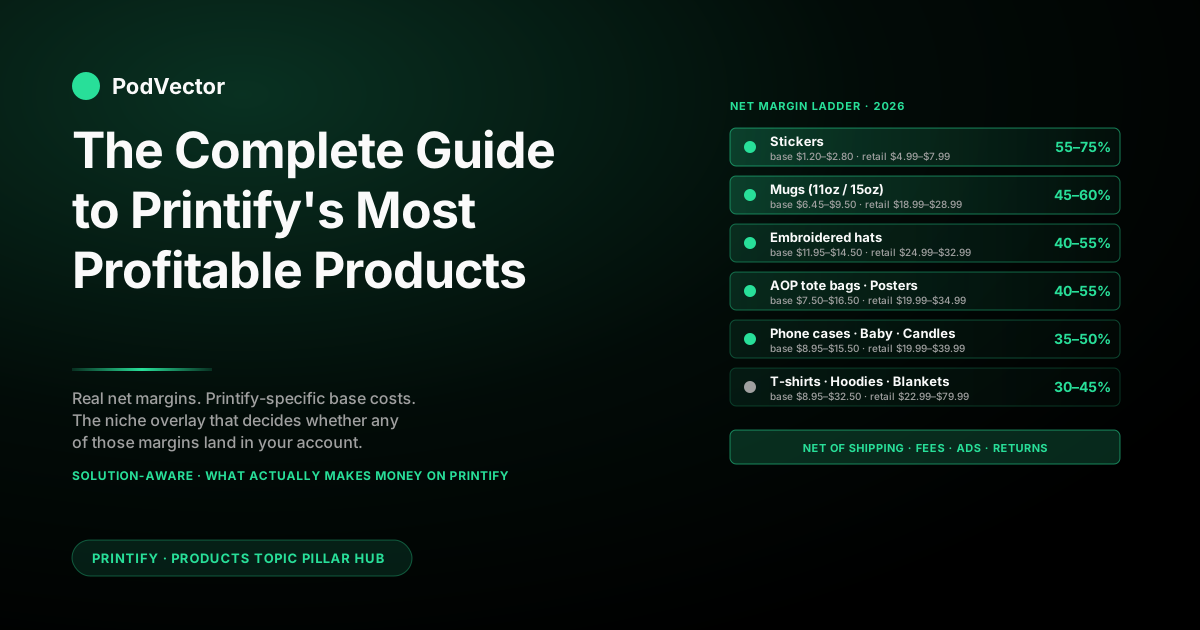
Quick Answer: The most profitable Printify products in 2026 — measured as landed-cost margin after provider base cost, shipping, platform fees, and realistic ad spend — are custom stickers (55–75%), mugs (45–60%), embroidered hats (40–55%), AOP tote bags (40–55%), and posters under 18×24 in (40–55%). The headline winners in most "most profitable POD product" listicles — t-shirts and hoodies — actually run 25–40% margins for most sellers because base costs, shipping, and ad spend compress what looks like a fat gross margin on a quote page.
The honest framing is: "most profitable" depends more on your niche and your traffic economics than on the product SKU. A gift-niche 11oz mug at $22 retail outperforms a generic t-shirt at $28 every day of the week, but a t-shirt in a well-targeted niche (pet, profession, hobby) outperforms that mug. This guide gives you the actual unit economics per product category on Printify specifically — not POD-generic averages — plus the niche overlay that decides whether any of those numbers show up in your bank account.
Why "most profitable" is the wrong question
Every "most profitable Printify products" roundup you'll find online has the same structural problem: it lists a product, quotes a "40–60% profit margin," and moves on. Those numbers are gross margin at suggested retail, calculated as (retail − base cost) / retail.
They ignore shipping (which the customer usually pays but which compresses your retail pricing ceiling), platform fees, payment processing, ad spend, and the long tail of returns and replacement orders. After you subtract all that, the 45% gross margin on the quote page becomes a 12–22% net margin in your bank account — and that's if you're running clean targeting.
The second problem is that "profit margin" is a per-unit number, but what you actually care about is profit per dollar of working capital and attention. A product with a 60% gross margin that you sell 12 of per month is worse than a product with a 35% gross margin that you sell 400 of per month. "Most profitable" without a denominator of volume is an aesthetic exercise, not a business one.
So this guide is structured differently. Each product gets three numbers that together tell you what actually happens:
- Printify-specific base cost on the Free and Premium plans — real numbers from current provider catalogs, not POD-generic averages.
- Realistic retail range based on what competitor stores actually charge on Etsy and Shopify in April 2026.
- Net margin expectation — what typically lands in your account after shipping, fees, ad spend, and returns.
Then at the end: the niche overlay that decides whether any of those margins are real for your specific store. If you want the broader Printify operational picture before going deep on products, the complete guide to Printify for POD sellers is the hub; for the pricing mechanics that power every margin calculation below, see the complete guide to Printify costs, fees, and discounts.
The five drivers of per-SKU profit on Printify
Before the product list, the five levers that actually move your bottom line on Printify. Products that rank well on all five are candidates for "most profitable"; products that fail on even one of them are hard to make money with even if the gross margin looks good.
| Driver | What it means | Why it matters on Printify |
|---|---|---|
| Base cost ceiling | How low the cheapest provider goes versus the average provider. | Printify is a marketplace; 10–30% provider spread per SKU is normal. Active sourcing = margin. |
| Shipping multiplier | How shipping scales with additional units. | Some products (mugs, posters) have brutal per-unit shipping; others (stickers, hats) are cheap to ship. |
| Return and reprint rate | % of orders that need a free replacement. | Apparel with size variance runs 6–12%; printed-flat products (posters, mugs) run 1–3%. |
| Customer acquisition cost | Ad spend or organic effort to make one sale. | Gift-niche products convert cheap; generic apparel burns ad budget before it converts. |
| Retail ceiling | What the market will actually pay. | A personalized pet mug can clear $28; a generic unisex tee plateaus at $22–$26 for most sellers. |
Premium is the biggest single lever under your control. The Premium discount (up to 20% off base) compresses every entry in the base-cost column below by roughly 15–20%. Whether that discount pays for its $39/month ($24.99/month annual) fee depends on your volume; break-even math lives in is Printify Premium worth it for POD sellers.
The overview: 12 products, real margins
The table below is the TL;DR. Every row is expanded in its own section afterward, with the provider detail and retail context you need to actually price your store. All base costs are current Printify provider catalog prices for the most common variant, Free plan; Premium knocks 15–20% off each base.
| Product | Base cost (Free) | Shipping (1st US) | Realistic retail | Net margin |
|---|---|---|---|---|
| Custom stickers (3×3 in) | $1.20–$2.80 | $3.99 | $4.99–$7.99 | 55–75% |
| Mugs (11oz ceramic) | $6.45–$8.25 | $4.55 | $18.99–$24.99 | 45–60% |
| Embroidered hats | $11.95–$14.50 | $4.75 | $24.99–$32.99 | 40–55% |
| AOP tote bags | $12.95–$16.50 | $4.99 | $26.99–$34.99 | 40–55% |
| Posters (12×18 in) | $7.50–$10.25 | $5.50 | $19.99–$28.99 | 40–55% |
| T-shirts (Bella+Canvas 3001) | $8.95–$10.75 | $4.45 | $22.99–$29.99 | 30–45% |
| Hoodies (Gildan 18500) | $20.95–$24.50 | $5.35 | $39.99–$54.99 | 30–45% |
| Phone cases (iPhone) | $11.95–$15.25 | $4.29 | $24.99–$32.99 | 35–50% |
| Baby onesies | $8.95–$10.75 | $4.25 | $19.99–$26.99 | 35–50% |
| Fleece/sherpa blankets (50×60 in) | $22.95–$32.50 | $7.99 | $54.99–$79.99 | 30–45% |
| Scented candles | $12.95–$15.50 | $5.99 | $28.99–$39.99 | 35–50% |
| Notebooks/journals | $7.95–$10.25 | $4.49 | $19.99–$26.99 | 40–55% |
Net margin ranges assume 10–15% ad spend, 3% platform+payment fees, and a 4% return/reprint reserve — defensible defaults for a mature Etsy or Shopify store in 2026. A seller running paid social at 25% cost-of-acquisition should shift every row down 8–12 points; an organic-traffic Etsy store with a compliance moat should shift up 5–8 points. The ranking between products stays roughly stable regardless.
1. Custom stickers
Base cost (Free plan): $1.20 (kiss-cut 3×3 in, domestic providers) to $2.80 (die-cut 4×4 in, specialty providers). Shipping: $3.99 first item, $0.50 additional. Realistic retail: $4.99–$7.99 single / $10.99–$16.99 for 3-packs. Net margin: 55–75%.
Stickers are the quiet dominant winner of the Printify profitability question. The base cost is low in absolute terms ($1.20–$2.80), the shipping is flat and cheap, the reprint rate is under 2% because stickers don't have a size dimension, and the retail ceiling is anchored by Etsy's thriving sticker market — where $5 single-stickers and $15 3-packs are standard. A $5.99 single sticker with a $1.50 base cost and a $3.99 shipping charge the customer covers is a 68% net margin product.
The strategic flaw is volume per order. Stickers rarely clear $8 in cart value per customer, so your AOV (average order value) on a sticker-only store is low — which means ad spend has to be proportionally lower.
Most profitable sticker operations bundle: 3-packs, 5-packs, or sticker-as-upsell on an apparel store. Stickers are also the best "testing SKU" on Printify: cheap enough to sample multiple designs before committing to apparel production.
For Etsy sellers specifically: stickers are the highest-margin product that still clears Etsy's search algorithm — low price, fast shipping, high review velocity. Many six-figure Etsy stores are stickers-first with apparel as the AOV booster.
2. Mugs (11oz and 15oz ceramic)
Base cost (Free plan): 11oz white: $6.45–$8.25. 15oz: $7.95–$9.50. Shipping: $4.55 first US item. Realistic retail: $18.99–$24.99 (11oz) / $22.99–$28.99 (15oz). Net margin: 45–60%.
Mugs are the archetypal "gift niche" product, and that's exactly why they're profitable — gift buyers anchor on experience, not comparison shopping. A personalized "World's Best Dad" mug at $22.99 faces no price comparison with a generic Amazon mug because the personalization is the product. Provider pricing on Printify for 11oz ceramic mugs has been stable around $6.45–$8.25 through 2026, with Printify's Sensaria, Monster Digital, and SwiftPOD providers clustering at the low end.
The reprint rate is low (2–3%), mostly driven by shipping damage rather than quality. Heavier than apparel, so shipping margin compression is real — especially on international orders where mug shipping can double the base cost. Sellers targeting EU customers should fulfill from Printify's EU providers rather than US, or the math inverts.
The 15oz mug is worth a separate note: base cost is only ~$1.50 more than 11oz, but retail clears $4–$6 more because "larger" maps directly to perceived value. If your design works equally well on both, list both and let the 15oz be your premium upsell — it's one of the highest per-unit-profit moves on Printify.
3. Embroidered hats
Base cost (Free plan): $11.95 (Richardson 112 structured trucker) to $14.50 (distressed dad hats). Shipping: $4.75 first US item. Realistic retail: $24.99–$32.99. Net margin: 40–55%.
Embroidered hats have been the quiet margin expander of the last two years on Printify. Unlike printed apparel, embroidery production costs barely scale with design complexity up to a threshold (typically 10–15,000 stitches), so a two-color logo on a cap costs the same to produce as a plain text cap. The retail ceiling is high because embroidered headwear is perceived as premium — the $28–$32 retail range on Etsy converts at rates comparable to $24 t-shirts.
The flaw is design constraint: embroidery favors flat, bold, high-contrast marks. Detailed photorealistic designs are not available on hats, which filters out most of the generic POD-design library that fills apparel stores. This is actually a competitive moat — hat stores skew toward brand-ready, niche-aware designs, which perform better long-term.
Return rate on hats is under 3%, almost entirely from fit (one-size-fits-most vs. fitted). Stick to adjustable trucker and dad-hat styles to keep the return rate down. Hats also travel well internationally — one of the cheapest POD categories to ship trans-Atlantic, because they're light and dimensionally efficient.
4. AOP (all-over-print) tote bags
Base cost (Free plan): $12.95–$16.50 depending on size and handle style. Shipping: $4.99 first US item. Realistic retail: $26.99–$34.99. Net margin: 40–55%.
AOP tote bags sit in the "perceived premium, actually affordable to produce" zone that Printify's marketplace model is good at. Base cost on a standard cotton 15×16 AOP tote is $12.95–$14.50 across Printify's AOP-capable providers (MWW On Demand, Subliminator, Dimona Tee); oversized canvas versions run $15.50–$16.50. Retail ceiling on personalized AOP totes runs to $34.99 on Etsy without price-comparison friction because the print covers the whole surface — there's no "plain tote with printed logo" equivalent to compare against.
Reprint rate is low (2–4%) and usually print-position-related rather than quality. The constraint is design effort: AOP totes need designs that tile or span the bag without an awkward seam placement, which takes more design time than a front-logo print. Sellers who master the AOP template on one product category can replicate the design across AOP tees, blankets, and pillows — compounding design ROI.
5. Posters and canvas prints
Base cost (Free plan): Posters 12×18 in: $7.50–$10.25. Canvas 16×20 in: $18.95–$24.50. Shipping: $5.50 first US item, tubes for rolled posters. Realistic retail: Posters $19.99–$28.99 / Canvas $42.99–$59.99. Net margin: Posters 40–55% / Canvas 35–50%.
Wall art is the highest-retail-ceiling flat-printed product on Printify. The reason: wall art is sold on aesthetic and room-fit, not on price-per-unit, so customers don't anchor against Amazon's $12 generic prints the same way they anchor against Amazon's $15 t-shirts. A personalized family-tree poster or a custom pet portrait canvas clears $45–$60 retail without retail comparison pressure.
Reprint rates on flat-printed paper and canvas are low (under 2%) because there's no size variable. The operational friction is shipping — posters ship in tubes (dimensionally inefficient), canvases ship in protective boxes (heavy).
International shipping on framed canvases is cost-prohibitive; stick to rolled canvas or paper posters for non-US customers and frame locally through partnerships. Printify's EU-based poster providers keep this tenable for European stores.
The strategic note: wall art is the product category where the design IP matters most. A good wall art design is re-sellable for years across multiple sizes and framing options, compounding the ROI on the initial design hour. Most other POD categories (apparel, mugs) are hit-driven; wall art is catalog-driven.
6. T-shirts (Bella+Canvas 3001, Gildan 5000, Next Level 3600)
Base cost (Free plan): Bella+Canvas 3001: $8.95–$10.75. Gildan 5000: $7.95–$9.25. Next Level 3600: $9.50–$11.25. Shipping: $4.45 first US item. Realistic retail: $22.99–$29.99. Net margin: 30–45%.
T-shirts are the most-sold POD product on Printify and also the most-competed, which is why their net margin sits below every product above in this list. The gross margin on a $27 Bella+Canvas 3001 with a $9.50 base cost looks fat — 65% gross. The net margin, after $4.45 shipping compresses your retail pricing, 12% ad spend, 3% fees, and 7% return/reprint reserve (sizing issues), lands at 30–45%.
T-shirts are still worth selling — they're the highest-volume product in the catalog, and volume matters. But the honest framing is: t-shirts are a volume game, not a margin game.
Sellers who treat them as a margin game get squeezed; sellers who treat them as a conversion-machine for niche-targeted designs with strong backend email capture do well. Full per-shirt breakdown including provider comparison lives at how much does Printify charge per shirt.
Provider choice matters most here. The spread between Printify's cheapest and most expensive t-shirt providers is $1.50–$2.50 per unit on a $9 base — which is a 15–25% margin swing.
Premium sellers who also actively source by provider capture both discounts simultaneously; Free-plan sellers on default routing leave most of that on the table. The unit-economics picture across a full order lives at Printify cost per sale: what sellers should expect.
7. Hoodies and sweatshirts
Base cost (Free plan): Hoodies (Gildan 18500): $20.95–$24.50. Crewneck sweatshirts (Gildan 18000): $18.95–$22.50. Shipping: $5.35 first US item. Realistic retail: Hoodies $39.99–$54.99 / Crewnecks $36.99–$46.99. Net margin: 30–45%.
Hoodies have the highest AOV boost of any POD apparel — a single hoodie sale is worth 1.6–2.2x a single t-shirt sale at retail. The tradeoff is base cost: Gildan 18500 runs $20.95 on the Free plan, and premium hoodies (Lane Seven, Champion S1051) can clear $28 base. Net margin bands are similar to t-shirts (30–45%), but the absolute dollars are meaningfully higher, which is why hoodie stores tend to look more profitable even at similar margin percentages.
Seasonality is the dominant variable. Hoodie sales compress 50–70% from May through August in US markets and pop 200–300% from October through January.
Any profitability analysis that doesn't weight-average across 12 months overstates hoodie attractiveness. The corollary: sellers who add hoodies to a t-shirt-dominated store capture the Q4 AOV boost without the summer downside, because the t-shirt catalog carries the store through summer.
Size variance returns are the highest on hoodies — 8–12% of orders — because hoodies fit differently across brands and body types. Detailed, brand-specific size charts in your listing reduce this by roughly half. Factor a 6% return reserve into your margin math.
8. Phone cases
Base cost (Free plan): Standard (iPhone 16/17 snap case): $11.95–$15.25. Tough cases: $14.95–$19.50. Shipping: $4.29 first US item. Realistic retail: Standard $24.99–$32.99 / Tough $29.99–$39.99. Net margin: 35–50%.
Phone cases are a SKU-proliferation play. A single design has to be listed across 20–40 phone model variants — iPhone 13 through 17, Samsung Galaxy S22 through S25, Pixel 7 through 9, etc. This looks like a ton of work, but it's the exact situation where a POD platform compounds value: one design upload populates every variant automatically. The margin is solid (35–50%), the return rate is low (2–4%), and shipping is cheap per unit.
The risk is model-cycle obsolescence. A seasonal phone case design targeted at iPhone 14 Plus was printable for three years; the new iPhone 17 variants replace that SKU spread every year. Designs that sell need to be re-listed on new models annually, and old-model inventory (which isn't real inventory — it's listings) needs to be pruned to keep the catalog sensible.
Printify's tough-case providers have closed most of the quality gap with direct-from-manufacturer custom cases, which was the category's biggest historical weakness. Net margin on tough cases is actually slightly higher than on standard snap cases because the retail ceiling rises faster than the base cost.
9. Baby and kids' apparel
Base cost (Free plan): Onesies: $8.95–$10.75. Toddler tees: $9.25–$11.50. Shipping: $4.25 first US item. Realistic retail: $19.99–$26.99. Net margin: 35–50%.
Baby apparel is the highest repeat-purchase category on Printify. A parent who bought a newborn onesie buys a 3-month, a 6-month, a 12-month — sometimes four to six re-purchases from a single email list subscription.
This dramatically compresses effective customer acquisition cost. A store with 30% gross margin and 4x repeat purchases per customer outperforms a store with 45% gross margin and 1x repeat purchases every time.
Retail ceiling is lower than adult apparel in absolute dollars ($19.99–$26.99 vs. $24.99–$29.99 for adult tees), but the repeat-purchase multiplier more than compensates. Gift-niche targeting (grandparent-as-buyer, baby-shower-as-occasion) is the highest-converting segment here — the buyer isn't the wearer, so personalization ("Grandma's Little One") commands premium pricing.
The operational note: baby apparel must pass CPSIA (US consumer product safety) labeling requirements, and Printify's baby-certified providers handle this at the base-cost level. Don't try to source baby apparel from a non-baby-certified provider to save a dollar — the legal risk is not worth it. Stick to Printify's tagged-as-baby providers.
10. Velveteen and sherpa blankets
Base cost (Free plan): Velveteen plush 50×60 in: $22.95–$28.50. Sherpa fleece 50×60 in: $27.95–$32.50. Shipping: $7.99 first US item (heavy). Realistic retail: $54.99–$79.99. Net margin: 30–45%.
Blankets are a gift-heavy, seasonal category with high absolute-dollar margins per unit ($16–$28 net per blanket) offset by heavy shipping and heavier returns if the print doesn't look exactly like the preview. Base cost on a 50×60 velveteen blanket has dropped 8–12% over the past year as Printify's blanket providers have competed for share; current low-end base on the Free plan is around $22.95, down from $25.50 in early 2025.
Seasonality is extreme — 60–70% of annual blanket sales happen October through January. Pet-memorial blankets, family photo blankets, and pet-portrait blankets lead the category; generic printed blankets underperform. This is a category where personalization drives retail ceiling hard: a "Family est. 2019" blanket with four names clears $70 retail; an identical-quality abstract-printed blanket struggles to clear $50.
International shipping on blankets is cost-prohibitive from US providers (often $25+ shipping). Sellers targeting non-US markets should use Printify's EU-based blanket providers or consider blankets as a US-only SKU.
11. Scented candles
Base cost (Free plan): 9oz soy candle: $12.95–$15.50. Shipping: $5.99 first US item (fragile). Realistic retail: $28.99–$39.99. Net margin: 35–50%.
Scented candles are Printify's highest-growth product category by listing count over the last 18 months. The attraction: premium retail ceiling ($28–$40), compact packaging, and clean margin bands.
The friction: scent is a personal preference, and "wrong scent" returns are higher than any flat-printed product (4–7% return rate). Sellers with narrow scent selections (3–5 curated scents rather than a 20-scent catalog) see lower return rates and better inventory of customer preference data.
Candles are a gift and home-decor crossover product, which means they play well in both Etsy-style gift-occasion targeting and Shopify-style home-niche traffic. Retail ceiling is sensitive to packaging aesthetics — a plain-label soy candle clears $28; the same candle with a thoughtful custom label clears $35. Design investment in the label ROI'd the highest of any Printify category in 2026 per dollar spent.
International shipping of candles is regulated in some corridors (flammable-goods classification), and Printify's candle-specialist providers handle this. Don't attempt to cross-border candles without confirming the provider's shipping scope explicitly.
12. Personalized notebooks and journals
Base cost (Free plan): Hardcover A5 journal: $7.95–$10.25. Softcover A5: $5.95–$7.25. Shipping: $4.49 first US item. Realistic retail: $19.99–$26.99. Net margin: 40–55%.
Personalized notebooks are the highest-margin paper-goods category on Printify. Base cost is low, shipping is cheap and flat, return rate is under 2%, and retail ceiling is anchored to the personalization rather than the paper. A "This Journal Belongs To [Name]" hardcover journal clears $24.99 retail in a gift-niche store without friction.
The SKU constraint is design repeatability: a single journal design rarely has the breadth of a t-shirt design catalog. Most profitable journal operations sell 6–12 SKUs rather than 100+, and the whole store is built around a tight design aesthetic (wedding, spiritual, productivity, pet-themed). This is a different operating model from high-SKU apparel stores — less design production, higher retained IP value per design.
Journals pair exceptionally well with mugs and stickers as a bundle. A $24 journal + $19 mug + $12 sticker 3-pack is a $55 gift bundle with stacked margins and roughly flat shipping cost — one of the highest AOV plays in the Printify catalog.
How to pick your profitable product
The unit economics above are necessary but not sufficient. The product list ranks on average across niches; your actual profitability depends on four niche-specific factors that override the averages:
- Buyer intent match. A sticker store targeting "stationery planner community" converts at 4–6x the rate of a generic "cute stickers" store, because the buyer is pre-qualified. Match your product to a community that already buys similar products, not to a demographic that "might like" your product.
- Design-ownable niche. Products in niches where you can own a specific design voice (pet breeds, rare hobbies, specific professions) outperform products in generic aesthetic niches (cute, motivational, floral) by a factor of 2–3x on long-tail sales. "Dachshund-owner-specific mug" beats "cute dog mug" for the same design effort.
- Channel-product fit. Etsy rewards personalized, gift-occasion products (mugs, ornaments, journals); Shopify rewards brand-build apparel (hoodies, tees, hats); TikTok Shop rewards visually striking lower-price products (stickers, AOP totes, phone cases); Amazon rewards high-volume flat-priced products (standard apparel, mugs). A mug store on Shopify without established brand traffic underperforms the same mug store on Etsy by 3–5x.
- Price anchor of your niche. Wedding-niche buyers tolerate $50 mugs; college-student niche buyers resist $25 tees. Every niche has its own retail ceiling, and products priced above that ceiling don't sell regardless of margin. Study competitor pricing in your exact niche before setting retail; don't generalize from category averages.
The most common mistake is picking a product from the "highest margin" column, slapping it in a generic niche, and being surprised that the margin doesn't materialize. The 55–75% sticker net margin on the table above is real — but only for sellers whose store has targeted traffic.
For a seller pushing generic designs with untargeted ads, the net margin collapses to 10–20% regardless of the unit economics, because CAC eats everything. Strategies for getting to the targeted version are walked through in how to make money with Printify: strategies for POD success and 5 proven ways to boost Printify profits.
The margin visibility problem
Everything above assumes you know what your margin actually is. Most Printify sellers don't — not because they're careless, but because the data lives in four places and nobody has time to stitch them together weekly.
Printify shows you base cost and shipping per order. Shopify or Etsy shows you transaction fees and refunds.
Meta/TikTok ad platforms show you spend and ROAS. Your bank balance shows the residual. None of those four systems shows you the picture that actually matters: what's the net margin of this specific SKU, in this specific niche, after all the bleed.
So sellers end up making product decisions on averages — on the 40–55% gross margin printed on a catalog page, or on a general sense that "stickers are high margin" — rather than on what's actually happening in their store. The predictable result is SKU-level opacity: a store that's overall profitable but contains 30% of SKUs that are actively losing money, and another 20% that are marginal, and nobody knows which is which.
Fixing this is the specific problem PodVector AI's AI employee Victor was built to solve. Victor keeps an eye on your Printify costs, your Shopify store, and your ad spend together, so you can just ask him in plain English: "what's my real net margin on the XYZ mug?"; "which SKU has the worst return rate this quarter?"; "if I raised prices 10% on sticker 3-packs, what would happen to volume?".
The reconciled picture that used to take three hours of spreadsheet work per week becomes a conversation. The full mechanics are walked through in Printify + Shopify profit tracking: automating your analytics.
The trajectory matters too: Victor answers margin questions; Victor tomorrow will take actions on margin problems — pruning loss-leader SKUs, nudging underpriced listings, flagging provider-swap opportunities before they become margin drains. The pricing and feature breakdown is at PodVector AI pricing, features, and profit tracking for Shopify + Printify sellers.
What's shifting in 2026
Three trend lines that change this product-profitability table's shape over the next 12 months:
- Sticker and paper-goods compression. Printify's sticker providers have dropped base costs 12–18% over the past 18 months as printing technology has commoditized. The net margin on stickers has stayed roughly stable because retail pricing has also compressed. Expect continued squeeze — stickers will stay profitable, but the "easiest money in POD" framing is less true in 2026 than in 2022.
- Embroidered headwear premium. Embroidery-capable Printify providers have expanded their catalogs (more hat styles, more fleece patches, more patch-on-jacket options) faster than demand, which is pushing base costs down. Embroidered hats are the category where net margins will expand most in 2026 — worth moving into now rather than waiting.
- Provider consolidation's margin effect. Printify's quiet reduction of its provider network (from 105+ providers in early 2024 to ~90 in early 2026) has tightened quality bands and narrowed base-cost spreads. Active-sourcing edge has gotten smaller. Premium's flat 15–20% discount is now proportionally more of the total margin lever — Free-plan sellers are losing ground faster than before. The Premium math is at the complete guide to Printify Premium for POD sellers.
None of these shift the ranking of products above substantially. Stickers are still the highest-margin Printify category; hoodies and t-shirts are still volume-game categories. But the spread between "profitable on Printify" and "not profitable on Printify" is tightening, which means product selection matters more, not less, than it did two years ago.
For external context: Printify's own 2026 most-profitable products breakdown approaches this question from the platform's own angle, and is worth reading alongside this guide for a comparison of perspectives.
FAQs
What's the single most profitable product on Printify?
Custom stickers, by net margin. 55–75% net margin is the highest in the catalog, driven by a low base cost ($1.20–$2.80), cheap flat shipping, and a sub-2% return rate. The caveat is order value — stickers rarely clear $8 AOV alone, so most profitable sticker operations bundle or upsell into other products.
Are t-shirts still worth selling on Printify in 2026?
Yes, but as a volume game rather than a margin game. Net margin on t-shirts sits at 30–45% after shipping, fees, ad spend, and return reserves — below stickers, mugs, hats, totes, posters, and journals. The reason to sell t-shirts is catalog volume: they're the highest-sellthrough category, and the largest single contributor to most profitable Printify stores' total revenue even at lower margins.
Do I need Printify Premium to make money?
No, but Premium is worth it above 25+ orders/month. Premium's 15–20% base-cost discount typically pays for itself ($39/month or $24.99/month annual) at roughly 25 monthly orders; break-even math is in is Printify Premium worth it for POD sellers. Free plan is genuinely usable — it just leaves margin on the table at volume.
What's the highest-retail-ceiling Printify product?
Canvas wall art (16×20 in or larger) and sherpa blankets. Both clear $55–$80 retail for personalized designs without price-comparison friction from competitors' generic products. They're not the highest-margin by percentage, but they're the highest-dollar-profit-per-unit, which matters for low-volume, high-ticket stores.
Which products should I avoid on Printify?
Generic unisex t-shirts without niche targeting. The economics work only with focused buyer intent; un-targeted generic apparel has a real net margin closer to 5–15% after ad spend, which isn't a business. Also avoid heavy international-friction products (blankets, candles) if your customer base is outside the US and you're sourcing from US providers — the shipping math inverts.
How do I actually know my margin per product?
By reconciling Printify's base-cost and shipping data against your sales channel's retail and fees data, against your ad platform's spend data. Manually it's 2–4 hours of weekly spreadsheet work.
Automated reconciliation — the way a dedicated profit-tracking tool handles it — takes seconds per query. Victor is built for exactly this reconciliation problem for POD sellers; walkthrough at Printify + Shopify profit tracking: automating your analytics.
Is Printify profitable overall compared to Printful or Gelato?
For US-heavy stores that actively source by provider, yes — Printify typically has a 10–20% landed-cost advantage over Printful and a comparable position to Gelato. For EU or APAC-heavy stores, Gelato's regional production network wins.
For stores that want a single-supplier experience without provider sourcing, Printful's 10–20% price premium is a fair trade for operational simplicity. Head-to-head in Printify alternatives: the complete comparison for POD sellers.
For a full-category Printify profitability breakdown beyond products, see is Printify profitable? The complete analysis for POD sellers.
Do Printify product margins get better at higher volumes?
Yes, in two ways. First, Premium's 15–20% base-cost discount expands in absolute dollars as volume grows, so high-volume stores capture more of that lever than low-volume stores.
Second, ad costs-per-sale typically decrease with scale on both Etsy (organic review compounding) and paid channels (better data-driven targeting), which expands net margin even at unchanged gross margin. A 10-order/month store and a 500-order/month store can have the same products and very different margin bands.
Should I sell one product well or a wide catalog?
One or two products in a well-defined niche, deeply, beats a wide catalog spread thin. The most profitable small Printify stores sell 5–15 SKUs in a specific niche (e.g., "dachshund gifts," "nurse humor apparel," "wedding personalized glassware").
Wide-catalog generic stores compete against Amazon pricing and lose. Depth of niche targeting is the variable that most separates profitable from unprofitable POD stores.
What's the best Printify product for a new seller?
Mugs or stickers. Both have low base costs ($1.20–$8.25), clean return rates (under 3%), and enough retail ceiling for real margin.
Mugs lean toward gift-niche personalization; stickers lean toward community/identity expression. Starting with one category, learning the design + niche + ad feedback loop, then expanding to apparel is a proven trajectory. Trying to launch with t-shirts as SKU #1 is a harder path — more competition, thinner margins.
How fast can I know if a product is profitable?
Three to four weeks of sustained traffic is the minimum for statistically meaningful margin data, assuming 50+ orders in that window. Anything less is noise — individual returns, one-off reprints, and ad campaign variance dominate the signal. Most sellers make premature "this product isn't profitable" calls based on week-one data; by week four the margin picture usually inverts. Live-data tooling (real-time margin dashboards) shortens the emotional lag but not the underlying sample-size requirement.
Know your real margin on every Printify product — not just the ones you guess about
Picking a profitable product is the first step. Knowing whether it's still profitable next month — after shipping costs drift, ad CAC creeps, return rates shift, and provider prices change — is the harder one. If your POD business runs on Shopify, PodVector AI's AI employee Victor keeps your Printify costs, your Shopify sales, and your ad spend together in one place, so he can answer the margin question for you on the spot, per SKU, in plain English. No more guessing which products are actually making you money.
Try Victor free