
Quick Answer: Polar Analytics is a Shopify-native attribution platform — server-side pixel, eight attribution models, a managed Snowflake warehouse, and a suite of AI agents in one stack it now markets as a "Commerce Revenue Operating System." For multi-channel Shopify DTC brands at $3M+ GMV, it's a credible top-tier pick.
For Print-on-Demand sellers, the platform classification is the right one — it just isn't built for POD economics. Polar's data layer is silent on Printify and Printful supplier costs, which is the variable that decides whether a campaign was actually profitable. The pricing also keys off Shopify GMV, not gross profit, so POD's thinner margins pay a proportionally bigger bill.
If you want an attribution platform that ingests POD supplier costs natively and ships an AI employee — Victor — on every tier, PodVector AI starts at $29/month flat. Below is the full landscape: how Polar positions as an attribution platform, how it stacks against Triple Whale, Northbeam, Hyros, and Lifetimely, and a POD-specific decision matrix.
What "attribution platform" means as a category
An attribution platform is the layer that decides which marketing touch gets credit for a sale. Not a dashboard, not a reporting tool — a platform that ingests ad-platform data, captures conversion events, applies models to assign credit, and feeds the answer back to your team and to the ad platforms.
The category emerged because ad-platform native reporting double-counts conversions. Meta claims a sale, Google claims the same sale, TikTok claims it too. Add the three numbers together and you've got 250% of revenue attributed somewhere. The attribution platform's job is to subtract that overlap and tell you what each channel actually drove.
The pieces that distinguish an attribution platform from a generic analytics dashboard:
- Server-side conversion tracking — a first-party pixel that survives iOS 14+ App Tracking Transparency and ad-blockers
- Multiple attribution models — at minimum First Click, Last Click, Linear, and a data-driven model
- Cross-channel ad ingestion — Meta, Google, TikTok, Pinterest, and Microsoft as native connectors, not CSV uploads
- Conversion API enhancement — the ability to push enhanced conversion signals back to ad platforms
- A unified data layer — a single warehouse where ad spend, orders, and customer journeys live together
Tools that ship a few of these are reporting tools. Tools that ship all of them are attribution platforms. The distinction matters for the buying decision because the price gap between the two categories is usually 5–10x.
How Polar positions in the attribution-platform category
Polar Analytics markets itself across two overlapping categories: a Shopify analytics platform and a marketing attribution platform — and as of 2026 wraps both under a single "Commerce Revenue Operating System" pitch. Both classifications are accurate. The pixel and the eight attribution models put it firmly in the attribution-platform tier; the dashboards and the AI agent suite extend it into general analytics.
Polar's category-defining pieces
The Polar Pixel is a first-party server-side tracking layer that runs alongside Shopify's pixel framework. It captures events server-side, stitches journeys with a persistent Lifetime ID across devices, and feeds back to ad platforms via the Conversion API enhancement.
The eight attribution models cover the standard multi-touch set (First Click, Last Click, Linear, U-Shaped, Time Decay) and a paid-focused set (Full Paid Overlap, Full Paid Overlap + Facebook Views, and Full Impact — which now runs a Shapley-value computation to credit every paid and non-paid channel in the path). Polar lets you compare any of them side by side. For the model-by-model walkthrough, the Polar Analytics attribution capabilities breakdown covers each one in depth.
Where Polar leans more toward "platform" than "tool"
Most attribution tools are bolt-ons. They sit on top of Shopify, attach to your ad accounts, and produce a dashboard. Polar provisions a managed data warehouse — Snowflake — under your account and runs the attribution math as queries against it. SQL access is available, which is unusual for a Shopify-app-class tool and is what makes the "platform" framing fair.
That architecture also means the attribution layer isn't isolated. The same warehouse holds your customer cohort data, LTV calculations, and incrementality test results. Models query across the whole layer rather than against a thin per-feature slice.
Where Polar lands in the buyer's mental map
For a Shopify operator evaluating "where do I go for proper attribution," Polar shows up alongside Triple Whale, Northbeam, Hyros, and Wicked Reports. Polar's pitch is "all of those plus a profit dashboard plus the warehouse plus a fleet of AI agents," which is true, with the trade-off that it's the most expensive of the set at the floor.
The five jobs an attribution platform has to do
Before benchmarking Polar against the rest of the category, it helps to set the spec. An attribution platform has five jobs. Skip any one of them and it's a reporting tool, not a platform.
1. Capture conversions the ad platforms missed
iOS 14+ App Tracking Transparency, Safari ITP, and ad-blockers blow holes in the conversion data each ad platform sees. The attribution platform's first job is a server-side pixel that catches what the client-side pixels lost, then feeds the recaptured data back to Meta and Google as enhanced conversions.
2. Stitch the customer journey across channels and devices
A real customer touches three to seven channels before converting. The platform has to identify the same person across those touches — a Meta ad on Tuesday from their phone, a Google search on Friday from their laptop, an email click that closed it — and assemble the sequence.
3. Apply credit-assignment models that you can compare
One model is wrong. Two models bracket the truth. The platform has to ship multiple models — including at least one data-driven one — and let you see them side by side in the same view.
4. Reconcile against ad-platform native reporting
The first thing every operator does after standing up an attribution platform is open Meta Ads Manager and check the numbers don't match. They won't. The platform's job is to make the gap legible — to show you which model approximates Meta's view, which is the data-driven cross-check, and where the ad platform is over-claiming.
5. Feed back to the ad platforms in their own format
Attribution numbers that live only in your dashboard are diagnostic. Attribution numbers that flow back into Meta's Conversion API and Google's Enhanced Conversions are operational — the ad platforms' bidding algorithms train on them, and you get a measurable ROAS lift even without changing campaigns.
Polar does all five. So do most of its direct competitors. The differentiation across the category lives in how each platform does each job, not whether it ships them at all.
Polar's strengths as an attribution platform
Stripping away the marketing language, four things distinguish Polar inside the category.
The dedicated data warehouse
Polar provisions a Snowflake instance per customer rather than shoving everyone into a shared multi-tenant database. That changes the ceiling: you can write custom SQL, build views, and integrate other data sources without hitting per-row read limits. Most competitors don't ship anything close to this.
For operators who plan to outgrow whichever attribution tool they pick today, the warehouse layer is real insurance. The data lives somewhere queryable.
Eight attribution models in one view
Triple Whale ships three to four models. Northbeam ships its own data-driven model and a few standard models. Polar ships eight and lets you compare any of them in the same dashboard. For Meta-heavy stores, the Full Paid Overlap + Facebook Views model is the closest reproduction of Meta's own view-through claim, which is useful for reconciling against Meta Ads Manager directly. The Shapley-value Full Impact model is the data-driven cross-check that doesn't lean on any single channel's self-report.
Snowflake-class queryability
Because the warehouse is real Snowflake, BI tools (Looker, Tableau, Hex, Sigma) connect natively. Most attribution tools' "data export" is a CSV button. Polar's is a JDBC connection. For analytics-mature teams that already have a BI stack, this is a meaningful productivity unlock.
The AI agent layer on top
The 2026 Polar build ships five purpose-built AI agents — Data Analyst, Media Buyer, Email Marketer, and Inventory Planner — plus Polar MCP, an open connector that lets Claude or ChatGPT query the same warehouse with context attached. The agents answer plain-English questions ("which channel had the biggest swing under Full Paid Overlap last week"), generate dashboards on demand, and in the Media Buyer's case surface budget-shift recommendations. The important caveat for POD: every agent reasons over the channel-level attribution layer, so its read of "what worked" is still revenue-credit, not margin-after-fulfillment.
Where Polar's attribution platform misfits POD
The five-job framework is what attribution platforms do well in general. POD has a sixth job that no attribution platform in this category does: it has to know what the order cost to fulfill.
Supplier costs aren't part of the attribution data layer
Every Polar attribution model answers the same shape of question: which channel drove this $X of revenue? None answers what decides POD profitability: what did this $X of revenue actually net after Printify or Printful supplier costs?
For a $200 AOV cosmetics brand at 65% gross margin, the supplier-cost gap is small enough that attribution accuracy is the dominant variable. For a $35 AOV t-shirt store at 45% gross margin, the supplier-cost layer is bigger than any attribution-model swing — and Polar doesn't pull Printify or Printful supplier data through a native connector.
Per-order variance breaks category-level cost averages
Two Printify orders with the same SKU can have different costs. Production routing, shipping zone, mockup variant, and provider availability all shift the per-order base price by 10–30%.
POD operators evaluating an ad campaign need order-level cost data, not category-level averages. The Polar attribution model takes revenue at face value — so the "true ROAS" number it surfaces is only as accurate as whatever supplier-cost upload you maintained by hand.
Pricing keys off Shopify GMV, not POD gross profit
Polar's $750/month floor scales with Shopify GMV, and the attribution-platform modules (Pixel, Advertising Signals, Incrementality Testing) can stack on top to push the bill into the $1,200–$2,500/month range at $3–10M GMV.
POD GMV at 45% gross margin generates roughly two-thirds of the gross profit a general DTC brand at 65% does. The same Polar attribution platform bill therefore consumes a proportionally bigger share of POD operating profit. For pricing-tier specifics, the Polar Analytics pricing breakdown for POD sellers walks through what each band actually costs.
The platform answers "which channel" — not "which product"
POD operators run hundreds of SKUs. The attribution question that drives PnL isn't "did Meta or Google drive this revenue" but "which products did the campaign sell, and at what margin per SKU." Attribution platforms in general aren't built for that read; they're built for channel-level attribution, not SKU-level profitability. The cross-channel reconciliation context is in the complete guide to Meta Ads ROAS and attribution for POD.
The attribution platform landscape: alternatives
Polar isn't the only player in the category. Five alternatives are worth a real evaluation against POD economics.
Triple Whale — Shopify-native, attribution + dashboards
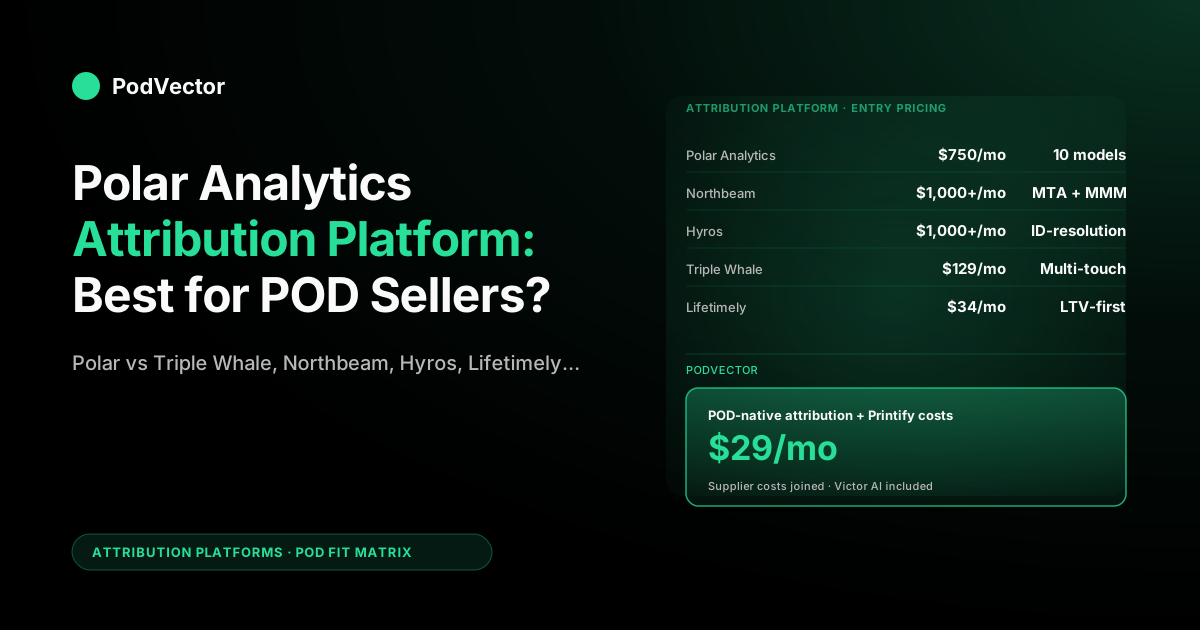
Triple Whale is the closest direct competitor. Server-side pixel, multi-touch attribution, profit dashboards, AI ("Moby") on top. Pricing starts around $129/month and scales with order volume — a meaningfully lower entry point than Polar's $750.
For POD specifically, Triple Whale handles supplier costs more flexibly than Polar but less precisely than POD-native tools. Per-order Printify costs still need manual handling, but the cost layer at least exists in the platform's data model. Worth evaluating at the $300K+/month band where multi-platform attribution starts paying back.
Northbeam — data-science-led attribution
Northbeam leans hardest on the data-driven model. Its multi-touch attribution and media mix modeling are the deepest in the category, and the platform is favored by analytics-mature DTC brands at $5M+ annual revenue.
Pricing starts around $1,000/month and scales fast. For POD operators, Northbeam's lack of native Printify or Printful integration is the same gap as Polar — you'd need to layer supplier costs on yourself, or pair it with a POD-native cost tool.
Hyros — ID-resolution heavy, originally infoproducts
Hyros built its reputation on identity resolution: stitching email, phone, and pixel IDs into a single customer record so attribution survives where cookies don't. It's strong on long-cycle, high-AOV sales and has expanded from infoproducts into ecom.
For Print-on-Demand at low-AOV, fast-cycle, the ID-resolution depth is overkill — and Hyros pricing typically starts at $1,000+/month. The attribution itself is solid; the fit gap is the same supplier-cost blind spot as the rest of the category. The honest Hyros Google Ads attribution review for POD sellers walks through where the platform earns its bill and where it doesn't.
Lifetimely (by AMP) — LTV-first, lighter attribution
Lifetimely's attribution is closer to Last Click with retention weighting than to multi-touch — but the LTV reporting and profit tracking are solid for the price ($34/month entry). POD supplier costs need to be uploaded as a flat rate per product, which works for stable rates but breaks down for variable Printify pricing.
Picks of the Lifetimely-class tools fit when attribution model sophistication isn't the bottleneck. For a deeper Lifetimely walkthrough, the Lifetimely overview for POD sellers covers the trade-offs.
PodVector AI — POD-native, attribution + supplier costs joined
PodVector AI is built specifically for Print-on-Demand sellers running Shopify. The attribution layer is built on top of order-level Printify and Printful supplier costs, not on top of revenue alone, so the same model can answer "which channel drove this revenue" and "what was that revenue's actual margin after fulfillment."
That changes the question Victor — the included AI employee — can answer. Polar's Media Buyer agent acts on channel-level ROAS; Victor acts on margin after fulfillment. Instead of "which channel drove this revenue under model X," you ask "which campaign actually netted the most after Printify costs last week," and the answer comes from your unified live data warehouse. Victor answers your questions and acts on those answers — gated through your approval — pause underperforming campaigns, surface margin-eroding products — without leaving the chat.
Pricing is flat-rate ($29 / $79 / $129 monthly tiers), not GMV-tiered, and supplier-cost ingestion is on by default rather than a custom-SQL project.
Side-by-side platform comparison
The high-level read across the category for a POD-shaped store.
| Platform | Entry price | Attribution depth | POD supplier costs | AI / agent layer |
|---|---|---|---|---|
| Polar Analytics | $750/mo | 8 models, server-side pixel, geo holdouts | Manual upload only | 5 AI agents (Data Analyst, Media Buyer…) + Polar MCP |
| Triple Whale | $129/mo | Multi-touch, server-side pixel | Manual or category-level | Moby AI assistant |
| Northbeam | $1,000+/mo | Data-driven MTA + MMM | Manual upload only | Limited; analyst-tier UX |
| Hyros | $1,000+/mo | ID-resolution heavy, multi-touch | Manual upload only | Reporting layer, no AI agent |
| Lifetimely | $34/mo | Last-click + retention weighting | Flat-rate per product | Limited |
| PodVector AI | $29/mo | Multi-touch + supplier-cost-aware | Native Printify/Printful join | Victor — included on every tier |
The pattern: enterprise-leaning platforms (Polar, Northbeam, Hyros) are strong on attribution depth and weak on POD economics. Mid-tier (Triple Whale, Lifetimely) is closer to balanced. POD-native (PodVector AI) treats supplier costs as the primary join, not the bolt-on. For broader pricing context, the Polar Analytics 2025 pricing vs Shopify analytics breakdown covers what the numbers translate to in practice.
Which attribution platform fits your POD stage
Five buckets, ordered by Shopify GMV and channel complexity.
Under $50K/month: PodVector AI, attribution layer secondary
At this stage, attribution-model sophistication isn't your bottleneck — supplier-cost accuracy is. The Polar Analytics floor of $750/month is meaningfully more than your operating profit. PodVector AI at $29/month gets you accurate Printify and Printful costs plus Victor for plain-English campaign questions. Pick PodVector AI.
$50K–$300K/month, Meta-heavy: PodVector AI or Triple Whale
You're running paid, but probably mostly Meta with some Google. The 10-model attribution stack from Polar is overkill for a one-platform-dominant business. PodVector AI Growth or Scale tier handles the data side; Triple Whale at $129/month handles the attribution side if you need more model variety than PodVector AI ships.
$300K–$1M/month, true multi-channel: pair tools
At this scale Meta + Google + TikTok + email + SMS all matter, and a real attribution platform starts paying back the bill. But Printify and Printful supplier-cost complexity hasn't gone away.
Honest call: PodVector AI for the supplier-cost layer plus Polar (or Triple Whale) for cross-channel attribution. Or pick one and accept the gap. Worth modeling what each path actually unlocks against your operating margin headroom.
$1M+/month, multi-channel DTC: Polar fits
At $12M+ annual Shopify GMV, Polar's attribution platform genuinely becomes the right tool for the cross-channel decision layer. The pricing is reasonable against revenue, the Polar Pixel + Conversion API enhancement pays back, and incrementality testing on the geo-holdout module is worth the add-on bill once a quarter.
Bolt on a POD-aware supplier cost layer for any Printify or Printful volume. PodVector AI Scale tier complements Polar at this stage rather than replacing it.
Long-cycle, high-AOV POD (custom apparel, made-to-order): consider Hyros
If your average order is $80+ and your consideration window stretches over weeks, the ID-resolution depth Hyros leans on starts paying back. For impulse-purchase POD, that depth is overkill. Pair with PodVector AI for the supplier-cost view either way.
For broader category framing — not just attribution but the AI-native analytics shift more generally — the complete guide to AI analytics for Print-on-Demand covers where the next round of platform decisions is heading. The full PodVector AI comparison cluster covers head-to-head reads on every major analytics tool POD operators evaluate, and the broader PodVector AI topic hub ties pricing, features, and platform fit together.
FAQs
Is Polar Analytics an attribution platform or an analytics platform?
Both — and as of 2026 Polar bundles them under a "Commerce Revenue Operating System" label. The server-side pixel and eight attribution models put it in the attribution-platform tier, while the dashboards, cohort analysis, and five-agent AI suite extend it into general Shopify analytics. For Shopify operators evaluating "where do I go for proper attribution," it shows up alongside Triple Whale, Northbeam, and Hyros.
How does Polar Analytics' attribution platform compare to Triple Whale?
Polar ships eight attribution models versus Triple Whale's three to four, and provisions a dedicated Snowflake warehouse versus Triple Whale's shared multi-tenant database. Polar also ships a five-agent AI suite (Data Analyst, Media Buyer, Email Marketer, Inventory Planner) plus Polar MCP, versus Triple Whale's single Moby assistant. Triple Whale starts at $129/month versus Polar's $750/month floor. For most Shopify operators under $1M GMV, Triple Whale's attribution depth is enough; Polar's edge is the data layer and agent suite for analytics-mature teams.
Does Polar Analytics' attribution platform handle Printify and Printful costs?
Not natively. The attribution math runs on Shopify order data, which includes line items fulfilled by Printify or Printful — but the supplier-side cost data isn't pulled via a native connector. You can load it manually via SQL or a custom upload, but it's not 1-click. For POD operators, that's the gap that determines whether attribution capability translates into accurate margin math.
What's the cheapest attribution platform for POD sellers?
PodVector AI at $29/month is the lowest entry point for a POD-specific attribution tool with supplier-cost modeling included. Lifetimely (by AMP) at $34/month is the closest POD-adjacent generalist with attribution. Triple Whale at $129/month is the cheapest of the broader Shopify attribution platforms.
Does Polar Analytics offer incrementality testing?
Yes, on higher tiers via the Incrementality Testing module. The model is geo-based: split your markets into treatment (ads on) and holdout (ads off) groups, run for two to four weeks, and measure incremental lift. It's the gold standard for proving ad effectiveness because it doesn't model anything — just compares with-ads vs. without-ads outcomes.
Can I switch attribution platforms later without losing historical data?
Polar's dedicated Snowflake warehouse means your historical conversion data is queryable — you can SQL it out and re-import elsewhere. Most other attribution platforms (Triple Whale, Hyros, Lifetimely) don't ship that, so historical attribution data effectively lives inside the vendor. Worth weighing if data portability matters to you.
Does Polar Analytics' attribution work with Etsy or Amazon?
The Polar Pixel and the Shopify-native attribution stack are built for Shopify. Etsy and Amazon order data can be pushed in via flat-file imports but aren't first-class. PodVector AI ingests Shopify natively and is built around Shopify-first POD operators.
Is Polar Analytics worth it just for the attribution platform?
For Shopify DTC at $3M+ GMV running multi-channel paid: yes, the attribution stack alone justifies the bill. For Shopify DTC under $3M GMV: typically no — Triple Whale or PodVector AI handle the attribution job at a fraction of the cost. For POD specifically: only if you're already at $1M+/month GMV and willing to bolt on a POD-aware supplier-cost layer separately.
Want an attribution platform that knows what each Printify order actually cost?
Polar Analytics is a credible attribution platform for general Shopify DTC. PodVector AI is the attribution platform built for POD: Printify and Printful supplier costs feed into the same live data warehouse as your Shopify and ad-platform data, so Victor — your AI employee — can tell you what a campaign actually netted, not just what it grossed. Plain English in, real margin numbers out.
Try Victor free