
Quick Answer: Polar Analytics' reporting capabilities cover six outcomes: automate the Monday-morning Excel pull, build custom metrics without SQL, ask plain-English questions, alert on KPI drift, consolidate multiple Shopify stores, and share dashboards with unlimited users.
Each capability is well-engineered. None of them fix the data underneath — flat COGS, no per-variant Printify or Printful supplier modeling, $750/month entry. For Shopify POD sellers, the reports run on time and the margin numbers run wrong.
If you want the same six capabilities sized and priced for POD economics, PodVector AI with Victor delivers each one starting at $29/month. Below: every Polar reporting capability, the alternatives that compete on each, and how to pick by store stage.
Polar's six reporting capabilities, mapped to outcomes
Polar's marketing site lists dozens of reporting features. Strip the marketing layer and the reporting work falls into six concrete capability outcomes — things your team can do with the platform that they couldn't do as cleanly without it.
These are the capabilities a POD operator should grade against, not the long feature inventory.
1. Automate recurring reports. Replace the Monday-morning Excel pull with a scheduled email or Slack snapshot. Pick metrics, cadence, recipients — Polar pushes the report on schedule. Every analytics platform claims this; the quality is in formatting, filtering, and how reliably the snapshot reflects yesterday's actual orders.
2. Build custom metrics without SQL. Open a no-code formula builder, define "Net Profit" or "Profit on Ad Spend" against the existing semantic layer, and the metric flows everywhere — dashboards, alerts, scheduled reports. The capability matters because operating decisions usually need a metric your platform doesn't ship by default.
3. Ask plain-English questions of your data. Ask Polar (the AI data analyst) handles natural-language queries like "which products had the highest return rate last month?" and returns an answer plus a chart. Polar has since expanded this into an Agent Suite — Email Marketer, Media Buyer, and Inventory Planner agents — plus Polar MCP, which exposes the data layer to outside AI tools with context. The capability is real; the accuracy depends on whether the underlying data model knows the answer.
4. Alert on KPI drift. Set thresholds or anomaly detection on metrics that matter — CAC, conversion rate, ROAS, AOV. Polar fires email or Slack alerts when something breaks the band. For POD operators, the useful question is whether the alert library covers POD-specific signals (supplier-cost drift, design-level margin collapse) by default.
5. Consolidate multiple stores into one view. If you run three Shopify stores under one brand, or eight stores as an agency, Polar can roll them into one master dashboard. The capability is hard to replicate without warehouse engineering — this is where Polar's price tag earns its keep at the high end.
6. Share dashboards with unlimited stakeholders. Investors, contractors, agency clients, internal team — give them read access to specific dashboards without licensing every seat. Useful for agencies; less critical for solo POD operators.
Polar prices this six-capability bundle at $750/month for the Core tier. The capabilities are real and well-engineered. The question for POD sellers is whether the data underneath those capabilities knows what a Printify variant actually costs. Mostly, it doesn't.
The roundup: 6 platforms scored on capability delivery
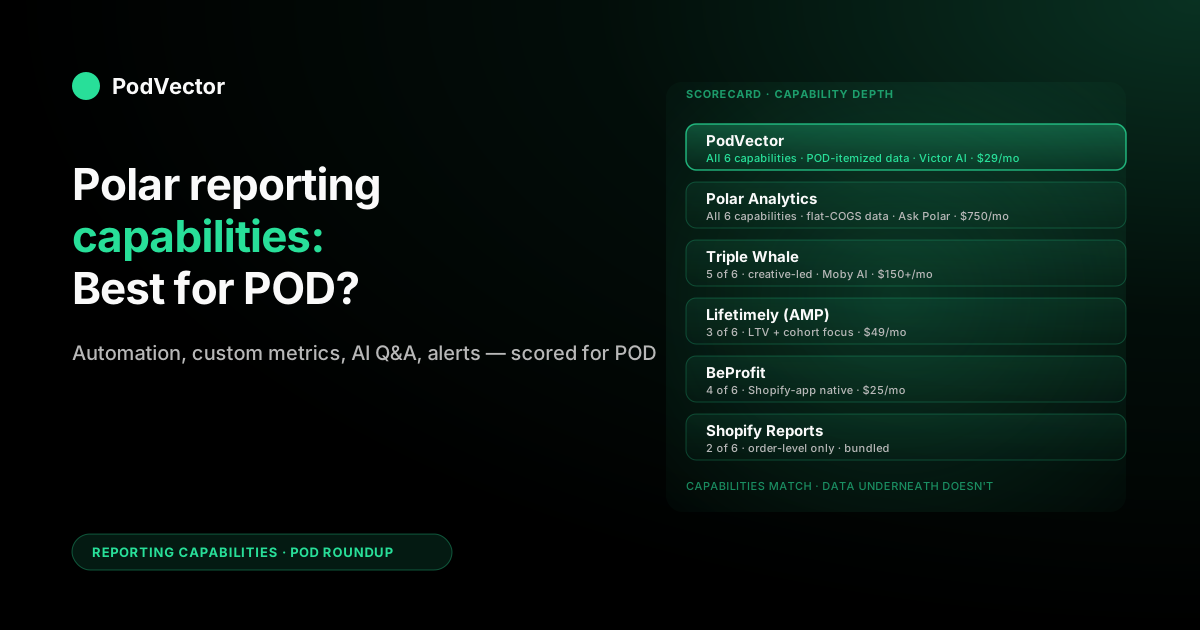
Six platforms compete on the same reporting capabilities at different price points. The scorecard below grades each one on the four capabilities that move daily POD decisions: automation, custom metrics, AI question-answering, and POD-margin accuracy underneath the reports.
| Platform | Automate reports | Custom metrics | AI Q&A | POD margin truth | Entry price |
|---|---|---|---|---|---|
| PodVector AI | Email + Slack | Victor + builder | Victor — POD-trained | Itemized per variant + region | $29/mo |
| Polar Analytics | Email + Slack | No-code builder | Ask Polar | Flat / category-level | $750/mo |
| Triple Whale | Email + Slack | Limited builder | Moby | Flat per product | $150/mo |
| Lifetimely | Email only | Pre-set only | No | Flat per product | $49/mo |
| BeProfit | Email only | Basic builder | No | Flat per product | $25/mo |
| Shopify Reports | Manual export | Advanced plan only | Sidekick (limited) | None — order-level | Bundled |
The capability parity is closer than the price gap suggests. Five of six platforms automate reports, run custom metrics, and answer questions. The differentiation lives in two places: the AI employee's domain depth, and the data model the capabilities run against.
1. PodVector AI — capabilities sized for POD
PodVector AI is the only platform on this list built specifically for Shopify POD sellers using Printify and Printful. The six reporting capabilities Polar charges $750/month for show up at $29 — and each one runs against a data model that itemizes supplier base cost, shipping band, region surcharge, and variant deltas natively.
Automate recurring reports. Email and Slack snapshots on daily, weekly, or monthly cadences. Format defaults to POD-specific summary lines — "5 designs lost contribution profit on TikTok this week" — instead of generic ROAS bands you have to interpret manually.
Build custom metrics. Visual builder plus Victor's natural-language metric definition. Ask Victor to "create a metric for break-even ROAS by Printify provider" and the metric saves to your library. New metrics propagate to dashboards, alerts, and scheduled exports the same way Polar handles propagation.
Ask plain-English questions. Victor is trained on POD economics. Ask "did the Bella+Canvas price hike hurt my Q3 margin?" and Victor knows what Bella+Canvas is, which Printify provider supplies it, and how the change flows through your variant-level COGS. Ask Polar can answer the same question only as accurately as your manually-loaded COGS table allows.
Alert on KPI drift. POD-specific alert library out of the box: contribution-margin collapse, supplier-cost drift, design-level performance breaks, ad spend efficiency. Most alerts on Polar or Triple Whale need custom configuration to be useful for POD; PodVector AI ships them as defaults.
Multi-store consolidation. Single dashboard view across Shopify stores plus Printify and Printful accounts. The unification logic understands when the same design SKU lives across multiple supplier accounts, which Polar's generic SKU-matching doesn't.
Share dashboards. Read-only links for accountants, agency clients, partners. No per-seat licensing.
Pricing: $29 (Starter) / $79 (Growth) / $129 (Pro) per month. Custom metrics and Victor are on every tier; ad-spend integration unlocks at Growth. For the broader Polar comparison, see Polar Analytics: Which Is Best for POD Sellers? or the more granular Polar Analytics Reporting Features deep-dive.
2. Polar Analytics — full DTC capability suite
Polar's capability suite is the most mature on this list. The six core capabilities, plus enterprise-tier additions like incrementality testing and Personas modeling, plus a deep semantic layer that lets data engineers extend the reports without breaking the AI layer on top.
What works:
- Data centralization is broad. Polar pulls 45+ data sources — Shopify, Google Analytics, Google Ads, Meta Ads, Klaviyo, and the rest of the marketing stack — into one dashboard, backed by a dedicated Snowflake warehouse and a semantic layer with hundreds of pre-built metrics. Data refreshes hourly with unlimited historical access. For a multi-channel DTC brand, that single-pane consolidation is the headline reason to buy.
- Out-of-the-box dashboards land fast. Polar ships four pre-built dashboard categories — P&L (profit and loss), acquisition (blended CAC, ROAS, MER, top-performing ads), retention (LTV, cohorts), and merchandising (product performance, inventory) — so a new account sees its core operating views without building anything. The templates are the fastest path to a working dashboard; the same flat-COGS caveat applies to the P&L and merchandising views for POD catalogs.
- Automation is reliable. Snapshots fire on schedule, formatting holds up across dashboards and email clients, recipient management is granular. Replaces the manual Monday Excel job cleanly.
- Custom-metric builder is best-in-class. Drag-and-drop with full access to the semantic layer. Agency analysts and data ops teams hit the ceiling slowly.
- The AI layer is growing. Ask Polar answers ad-hoc questions and surfaces trends, and Polar now wraps it in an Agent Suite — Email Marketer, Media Buyer, and Inventory Planner agents — with Polar MCP exposing the warehouse to outside AI tools. It's responsive and accurate on questions Polar's data model fully supports; most general-purpose DTC queries land cleanly. The catch for POD is unchanged: every agent reads from the same flat-COGS layer underneath.
- Attribution is deep. Ten attribution models plus a server-side pixel give cross-channel ad reporting that holds up against Triple Whale's. For ad-heavy DTC, this is a real strength.
- Multi-store consolidation is genuinely good. Brands running 3+ Shopify stores get a unified P&L view that's hard to replicate elsewhere without engineering work.
What doesn't work for POD-first stores:
- Flat COGS underneath. Each product gets one cost number. Printify and Printful charge per variant, per region, per supplier, per shipping band. The capabilities run cleanly; the margin numbers under them run wrong.
- $750/month entry. At sub-$50K monthly GMV, that's 10–25% of operating profit going to reporting. The capabilities aren't 25% of operating-decision value at that scale.
- Setup tax. Templates populate quickly, but custom dashboards that match your operating cadence take 2–6 weeks to dial in. Polar's onboarding teams help; the time cost is still real.
For deeper price analysis, see Polar Analytics Pricing: Which Is Best for POD Sellers?.
3. Triple Whale — creative-led capabilities
Triple Whale's capabilities are built around DTC creative and ad performance. Automation works. Custom metrics work, with a thinner builder than Polar's. Moby (the AI operator) handles natural-language queries decently and is fast on ad-creative questions specifically.
Strengths: creative analytics depth, Lighthouse AI for anomaly detection, strong attribution layer (Triple Whale Pixel + Sonar). Weakness: same flat-COGS problem as Polar, and the capability defaults assume stocked-inventory DTC, not POD's per-design economics.
Pricing starts around $150/month and scales to $700+ for the AI tier. Cheaper than Polar at the entry, more expensive than POD-native tools. The capabilities work — they just don't surface POD-specific wins or losses without manual configuration on top.
4. Lifetimely by AMP — narrow LTV capabilities
Lifetimely's capability surface is deliberately narrow. The platform owns LTV, cohort retention, repeat-purchase analysis, and product-level customer journey reports. Automation is email-only, custom metrics are limited to pre-set dimensions, and there's no AI question-answering layer.
For POD sellers, Lifetimely is a complement, not a replacement. The cohort and LTV capabilities are sharp — sharper than what Polar or Triple Whale produce on the same data. But you'll still need a primary reporting tool (PodVector AI, Polar, or Shopify Reports) for daily P&L, ad spend, and operating decisions.
Pricing: $49 (Starter) up to $349 (Premium) per month. For the full POD evaluation, see Lifetimely: Which Is Best for POD Sellers?.
5. BeProfit — Shopify-app capabilities
BeProfit handles automation, custom metrics, and KPI alerts inside a Shopify-native app. Capabilities are simpler than Polar's but functional. No AI Q&A layer, no Slack integration, no advanced semantic layer.
For POD sellers, BeProfit's capabilities work at the topline — you'll see revenue, ad spend, and total profit accurately. Per-design and per-variant capabilities require the same custom COGS work that Polar does. The app's strength is being cheap and Shopify-native; the weakness is depth.
Pricing: $25–$150/month. For the full evaluation, see BeProfit: Which Is Best for POD Sellers?.
6. Shopify built-in reports — the free baseline
Shopify's reporting capabilities scale with your plan. Basic plan: limited reports, manual export only. Shopify plan: standard reports. Advanced and Plus: custom reports, including SQL-style filtering. Sidekick (Shopify's AI assistant) handles some natural-language queries on the data Shopify already has.
What's missing for POD sellers: ad spend integration (Shopify doesn't pull Meta or Google ad data), supplier-cost modeling (Shopify treats COGS as a flat manual entry), and any cross-store consolidation. The capabilities are accurate as far as they go — they just don't go far enough for a POD operator making daily ad-spend and design-promotion decisions.
Cost: bundled with your existing Shopify plan, $39–$2,300+/month depending on tier. If your store does $300K+/month and you're already on Advanced or Plus, you're paying for these capabilities whether you use them or not.
The capability gap for POD operators
Every reporting platform on this list — Polar included — assumes the same data model underneath. One product, one cost. That assumption breaks immediately for POD.
A single t-shirt design on a POD store can have 60+ SKUs (size × color × style), and each one has a different supplier base price. Printify charges per variant; Printful charges per variant; both add region-specific shipping bands; both run periodic supplier price changes that don't sync to your COGS field automatically.
What that means for the six capabilities above:
Automated snapshots inherit the error. The Monday-morning email lands on schedule, but the contribution margin line shows you made money on a design that actually lost money once supplier costs are accurate.
Custom metrics inherit the error. However clever your formula, it pulls from the same flat-COGS table. The capability flexibility doesn't fix the data model's blind spot.
AI question-answering inherits the error. Ask Polar can only be as accurate as the data underneath. Ask "which Printify designs lost margin last week?" and the answer reflects flat COGS, not the variant truth.
Alerts misfire. A "margin collapse" alert tied to flat COGS triggers on the wrong designs and stays silent on the right ones. Operating teams stop trusting the alerts inside two months.
Polar's recommended fix is custom warehouse modeling on the higher tier — load supplier price tables into the data layer and maintain them. The work is real ($5K–$15K agency engagement plus ongoing maintenance), and it's a separate line item on top of the $750/month subscription. For a wider category view of where AI analytics is heading, see the complete guide to AI agents for ecommerce analytics.
PodVector AI's approach is different. The Printify and Printful supplier APIs are first-class data sources, not custom integrations. Variant-level cost modeling is the default, not the upgrade. Every capability — automation, custom metrics, AI Q&A, alerts, multi-store, sharing — runs against that POD-correct data model out of the box.
How to decide: a stage-based recommendation
Under $50K/month, POD-first: PodVector AI ($29) or BeProfit ($25)
At this stage, the capabilities you need are: daily P&L automation, ad spend ROI, per-design contribution margin. PodVector AI covers all three with itemized POD COGS. BeProfit covers the first two on flat COGS.
Polar's $750/month is structurally wrong here. You'd be paying for incrementality testing, multi-store consolidation, and Personas — none of which move decisions on a $30K/month store with concentrated single-channel spend.
$50K–$300K/month, POD-first: PodVector AI Growth ($79)
Higher PodVector AI tier unlocks Meta and Google ad-spend integration. Victor's question-answering capability becomes valuable here — natural-language queries on per-variant contribution profit start surfacing decisions the automated dashboards alone miss.
The DTC-class platforms (Polar, Triple Whale) overshoot at this scale. Capability depth you don't need; capability accuracy you actually need is missing.
$300K–$1M/month, multi-channel: stack evaluation
Here the math gets interesting. A practical stack: PodVector AI at $129 for POD margin truth + Triple Whale at $250 for cross-channel attribution. Two tools at $379/month combined often beats one Polar Core seat at $750.
If your supplier mix is mostly stocked inventory with POD as a secondary line, Polar plus a manual reconciliation can work — but the operational tax grows with catalog size.
$1M+/month, multi-channel, multi-brand: Polar earns its price
At this scale, Polar's capability suite is hard to replicate piecemeal. Custom semantic layer, multi-store consolidation, agency-grade reporting, and the no-code metric builder become economically rational. Custom warehouse models for POD supplier costs become economically rational too.
Even at this stage, many POD-focused brands keep PodVector AI running alongside Polar specifically for the daily POD margin view. Building and maintaining variant-level POD modeling on top of Polar's data layer isn't free, and Victor's POD-native answers stay faster than custom dashboards for ad-hoc questions.
For the cluster index of every alternative in this category, browse the PodVector AI comparison hub, or see the full PodVector AI topic hub for the broader product roadmap.
FAQs
What reporting capabilities does Polar Analytics include?
Six core capabilities: automate recurring reports via email and Slack, build custom metrics through a no-code formula builder, ask plain-English questions through the Ask Polar AI employee, alert on KPI drift through threshold or anomaly detection, consolidate multiple Shopify stores into one master view, and share dashboards with unlimited stakeholders. Enterprise-tier capabilities add incrementality testing and Personas modeling on top.
How many data sources can Polar Analytics report on?
Polar centralizes 45+ data sources into one dashboard — Shopify, Google Analytics, Google Ads, Meta Ads, Klaviyo, and most major marketing apps — backed by a dedicated Snowflake warehouse that refreshes hourly. On top of the raw reporting, it layers predictive trend forecasting and an AI Agent Suite (Ask Polar, plus Email Marketer, Media Buyer, and Inventory Planner agents) that summarizes movements and acts on the data. The breadth is real and it's the platform's strongest argument for multi-channel DTC brands. For a POD operator, the constraint isn't how many sources connect — it's whether the supplier-cost data underneath the margin numbers is variant-accurate. None of the 45 sources, and none of the agents, fixes a flat-COGS model.
How accurate are Polar Analytics' reporting capabilities for Printify or Printful sellers?
The capabilities themselves work well; the margin numbers underneath don't. Polar pulls Shopify orders, ad spend, and customer data cleanly. The COGS layer treats each product as one flat cost, which doesn't match how Printify or Printful actually price by variant, region, and supplier band. Reported gross margin on the POD portion of the catalog typically runs 8–22% higher than the truth without custom warehouse modeling.
Can Polar Analytics' capabilities be customized for POD-specific workflows?
Yes, with engineering work. Polar's no-code metric builder handles standard fields well. POD-specific capabilities — per-variant contribution margin, supplier-cost drift, design-level break-even — require either custom warehouse modeling on Polar's enterprise tier ($5K–$15K agency engagement plus ongoing maintenance) or a separate POD-native tool layered on top.
Does Polar Analytics offer scheduled reporting capabilities?
Yes. Email and Slack snapshots can be scheduled daily, weekly, or monthly. You pick the metrics, recipients, and cadence. The format is configurable and supports both summary views and full report exports. This replaces manual Monday-morning Excel pulls cleanly for agency analysts.
How does Ask Polar's question-answering capability compare to Victor for POD?
Ask Polar is general-purpose across DTC ecommerce. Victor is trained on POD economics specifically. For questions like "which Printify designs lost contribution margin last week after the Bella+Canvas price hike?" — Victor has the variant-level supplier data the question needs. Ask Polar can answer the same question only as accurately as your manually-loaded COGS model allows. For most POD sellers, that's the deciding factor.
What's the cheapest reporting platform with full capability coverage for POD?
PodVector AI at $29/month is the only entry-tier tool that delivers automation, custom metrics, AI Q&A, alerts, multi-store consolidation, and dashboard sharing on a POD-correct data model. BeProfit at $25/month is cheaper but skips AI Q&A and uses flat COGS. Shopify's built-in reports are bundled but skip ad spend and supplier modeling entirely. For full capability coverage at the lowest price, PodVector AI is the only structurally correct answer.
Can I run Polar Analytics' capabilities alongside another reporting tool?
Yes, and many POD operators do. The common stack: Polar for cross-store consolidation, agency reports, and incrementality testing; PodVector AI for daily POD margin truth and Victor's natural-language queries. Total cost lands around $830/month, which is structurally cheaper than building a custom warehouse layer on top of Polar to match POD economics.
Does Polar Analytics replace Shopify's reporting capabilities?
For most operating decisions, yes. Polar covers everything Shopify Reports does and adds ad-spend integration, multi-store consolidation, scheduled snapshots, and the AI employee. The exception is order-level operational reports (fulfillment status, return reasons, payment reconciliation) — Shopify's native reports remain the right tool for those, regardless of which analytics platform you layer on top.
POD-native reporting capabilities — without the DTC platform tax
Polar built its capability suite for stocked-inventory DTC. Printify and Printful sellers face a different reality: variable supplier costs per variant, per region, per shipping band. PodVector AI delivers all six reporting capabilities — automation, custom metrics, AI Q&A, alerts, multi-store, sharing — on a POD-correct data model. Victor, the AI employee trained on POD economics, ships on every tier. Start at $29/month.
Try Victor free